Number Systems
Learning Objectives
In this chapter you will learn about:
• Non-positional number system
• Positional number system
• Decimal number system
• Binary number system
• Octal number system
• Hexadecimal number system
(Continued on next slide)
Learning Objectives
(Continued from previous slide..)
Convert a number’s base
• Another base to decimal base
• Decimal base to another base
• Some base to another base
Shortcut methods for converting
• Binary to octal number
• Octal to binary number
• Binary to hexadecimal number
• Hexadecimal to binary number
Fractional numbers in binary number
•
•
system•
Number Systems
Two types of number systems are:
Non-positional number systems•
Positional number systems•
Non-positional Number Systems
Characteristics
• Use symbols such as I for 1, II for 2, III for 3, IIII
for 4, IIIII for 5, etc
• Each symbol represents the same value regardless
of its position in the number
• The symbols are simply added to find out the value
of a particular number
•
Difficulty•
It is difficult to perform
number system
arithmetic with such a•
Positional Number Systems
Characteristics•
Use only a few symbols called digits•
These symbols represent different values depending•
on the position they occupy in the number
(Continued on next slide)
Positional Number Systems
(Continued from previous slide..)
The value of each digit is determined by:•
1.
2.
3.
The digit itself
The position of the digit in the number
The base of the number system
(base =
system)
total number of digits in the number
The maximum value of a single digit is
always equal to one less than the value of
the base
•
Decimal Number System
Characteristics
A positional number system
Has 10 symbols or digits (0, 1, 2, 3, 4, 5, 6, 7,
•
•
8, 9). Hence, its base = 10
The maximum value of a single digit is 9 (one
less than the value of the base)
•
Each position of a digit represents a specific•
power of the
We use this
life
base (10)
number system in our day-to-day•
(Continued on next slide)
Decimal Number System
(Continued from previous slide..)
Example
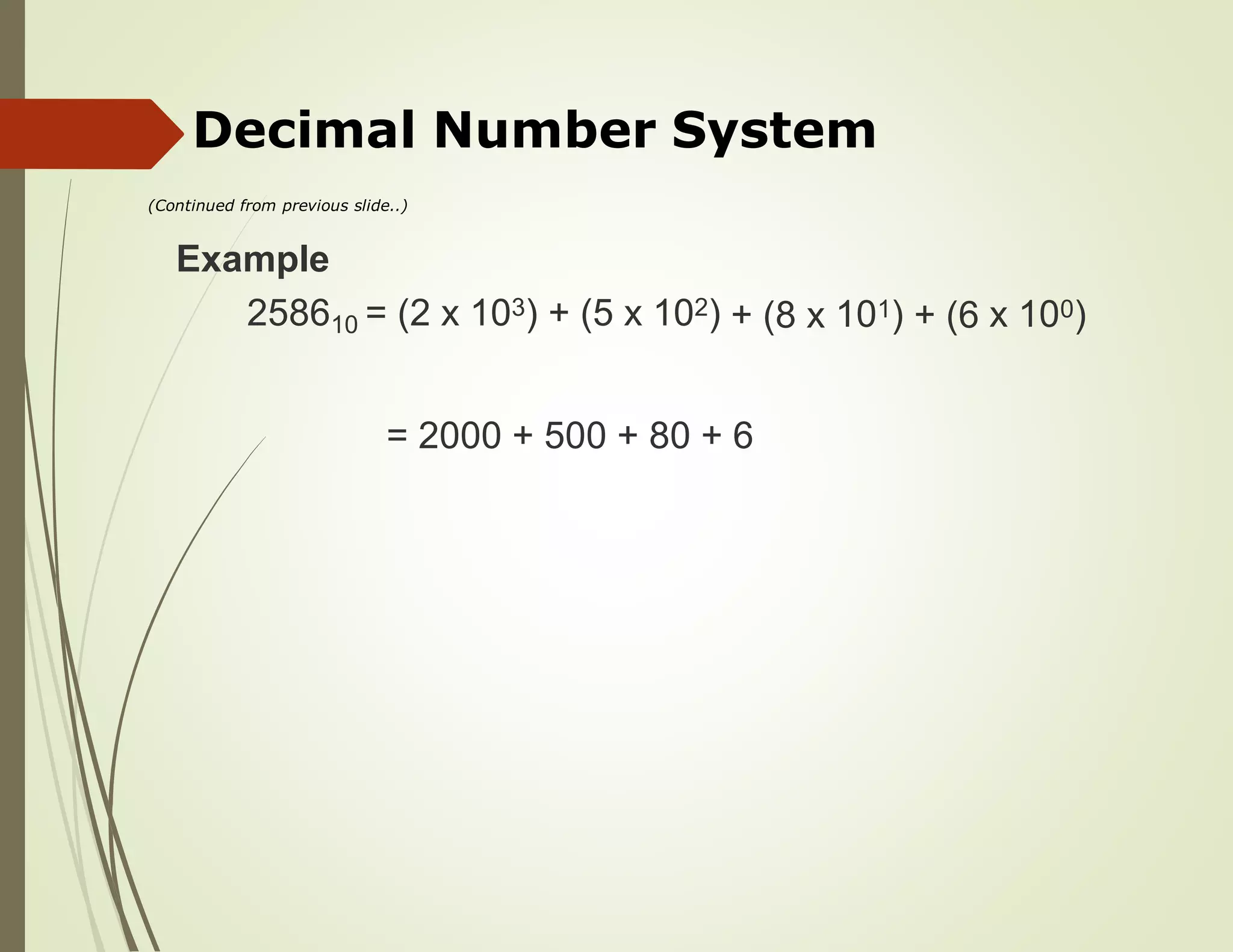
258610 = (2 x 10³) + (5 x 10²) 101) x 100)+ (8 x + (6
= 2000 + 500 + 80 + 6
Binary Number System
Characteristics
A positional number system
Has only 2 symbols or digits (0 and 1). Hence its
base = 2
The maximum value of a single digit is 1 (one less
than the value of the base)
Each position of a digit represents a specific power
of the base (2)
•
•
•
•
This number system is used in computers•
(Continued on next slide)
Binary Number System
(Continued from previous slide..)
Example
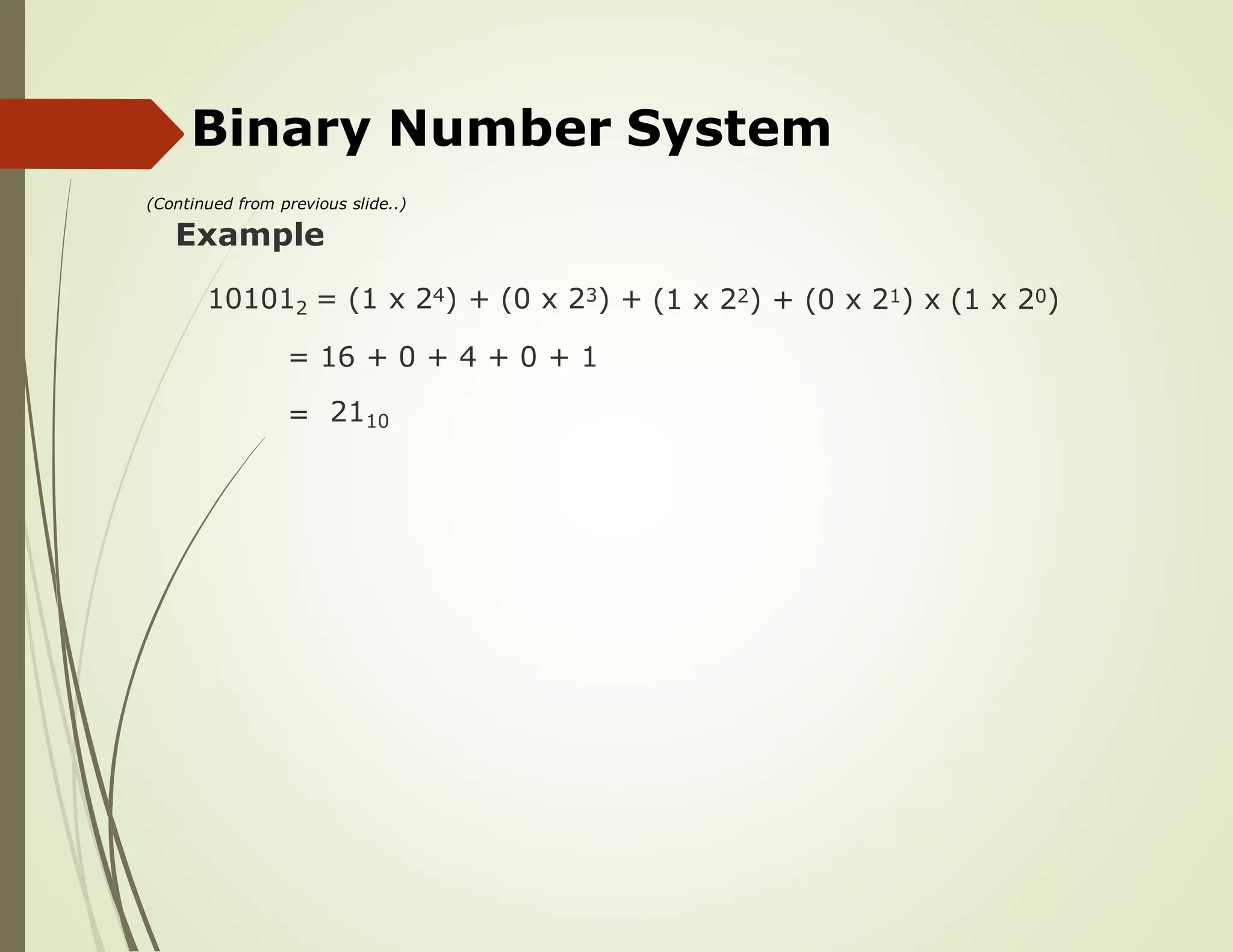
101012 = (1 x 24) + (0 x 23) + (1 x 22) + (0 x 21) x (1 x 20)
= 16 + 0 + 4 + 0 + 1
= 2110
Representing Numbers in Different Number
Systems
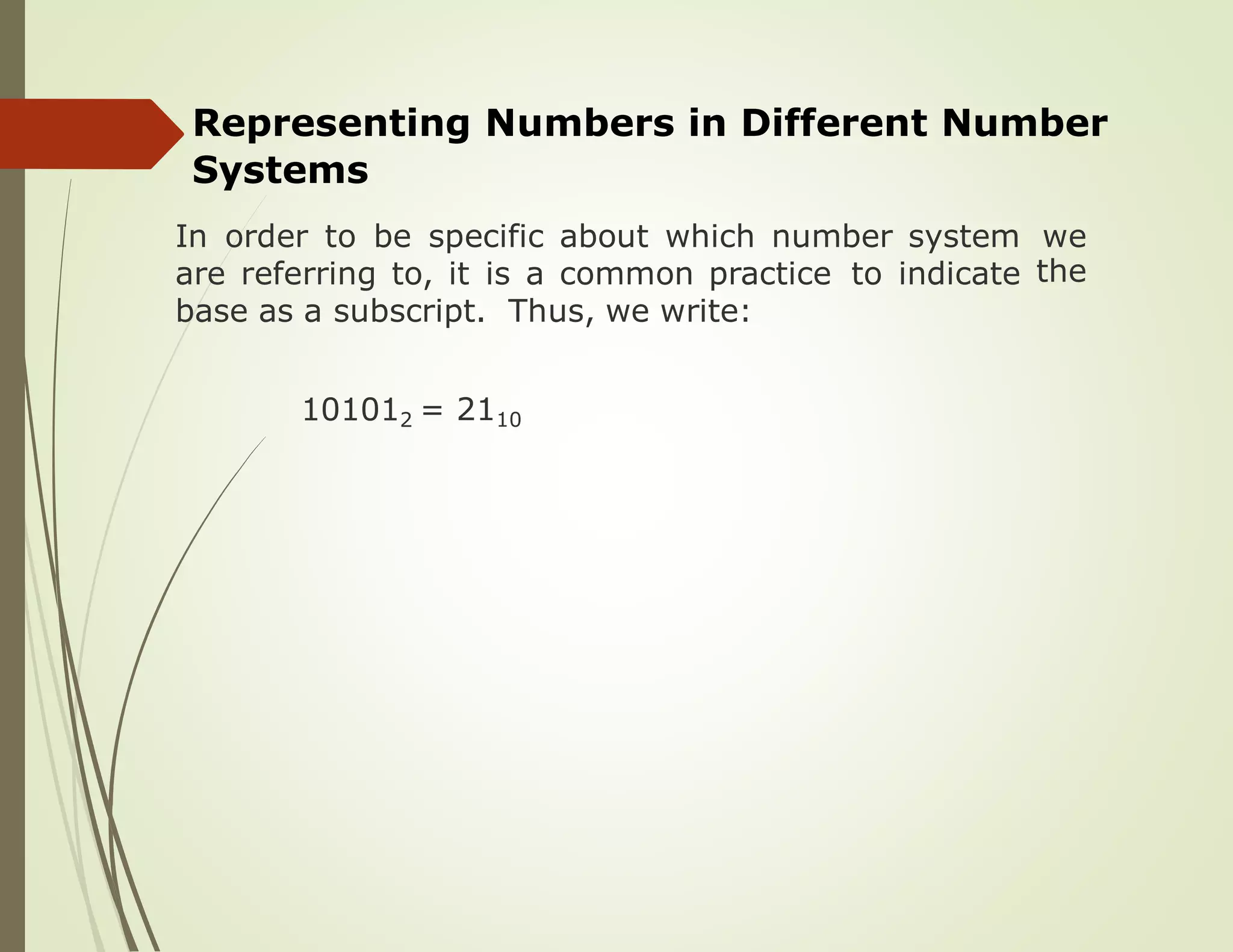
In order to be specific about which number system we
theare referring to, it is a common practice to indicate
base as a subscript. Thus, we write:
101012 = 2110
Bit
• Bit stands for binary digit
• A bit in computer terminology means either a 0 or a 1
• A binary
number
number consisting of n bits is called an n-bit
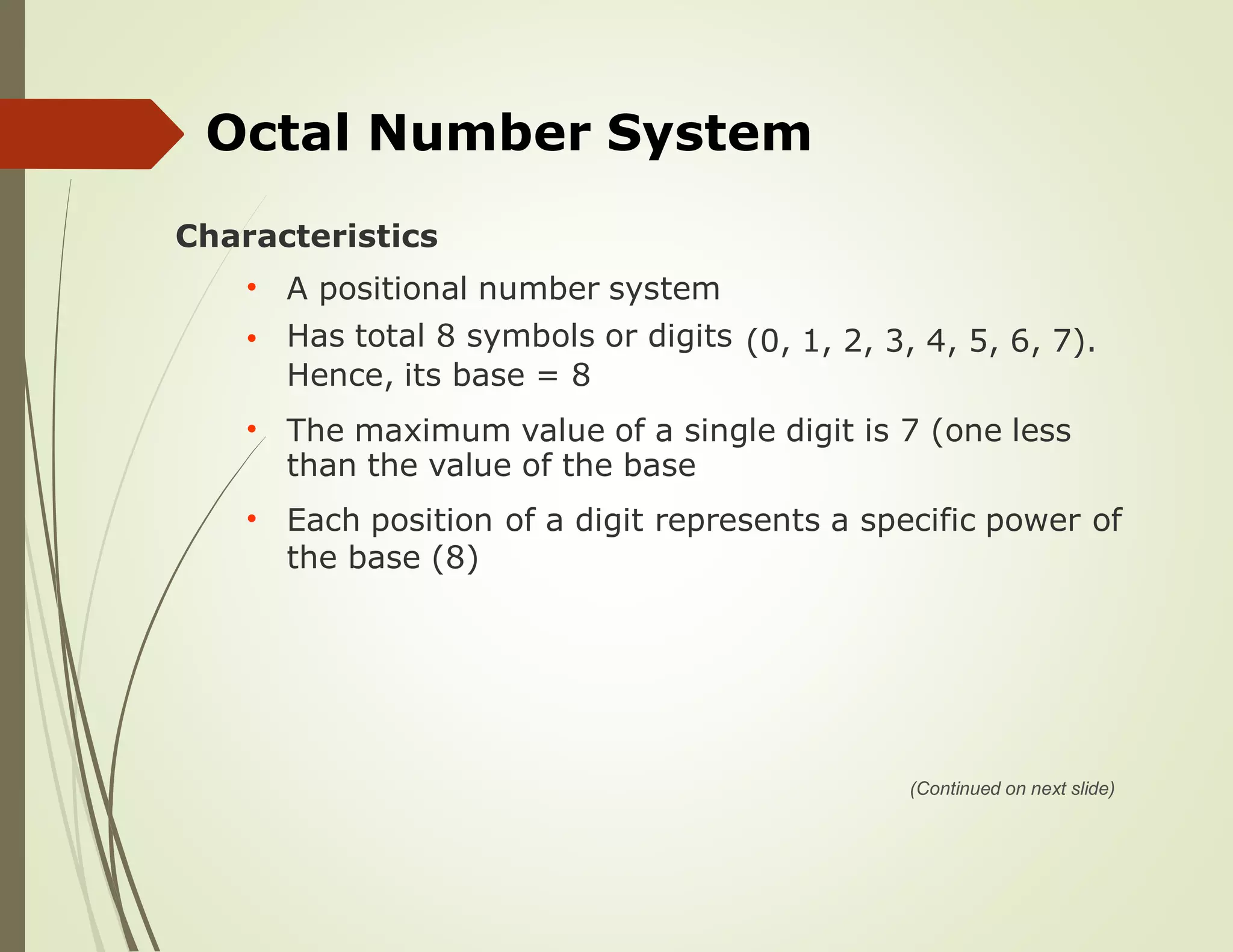
Octal Number System
Characteristics
A positional number system
Has total 8 symbols or digits
Hence, its base = 8
•
• (0, 1, 2, 3, 4, 5, 6, 7).
The maximum value of a single digit is 7 (one less
than the value of the base
•
Each position of a digit represents a specific power of•
the base (8)
(Continued on next slide)
Octal Number System
(Continued from previous slide..)
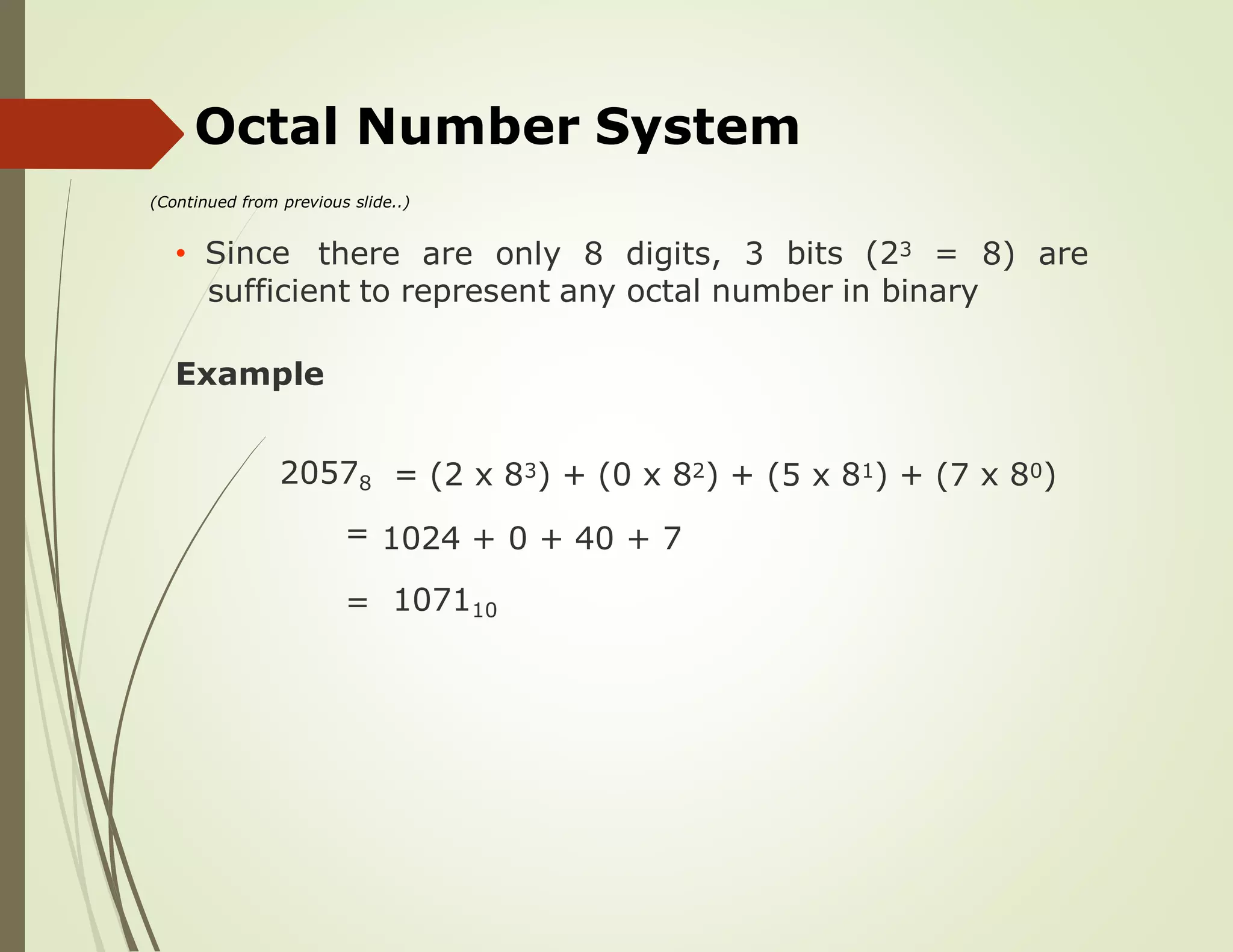
• Since there are only 8 digits, 3 bits (23 = 8) are
sufficient to represent any octal number in binary
Example
20578
=
= (2 x 83) + (0 x 82) + (5 x 81) + (7 x 80)
1024 + 0 + 40 + 7
= 107110
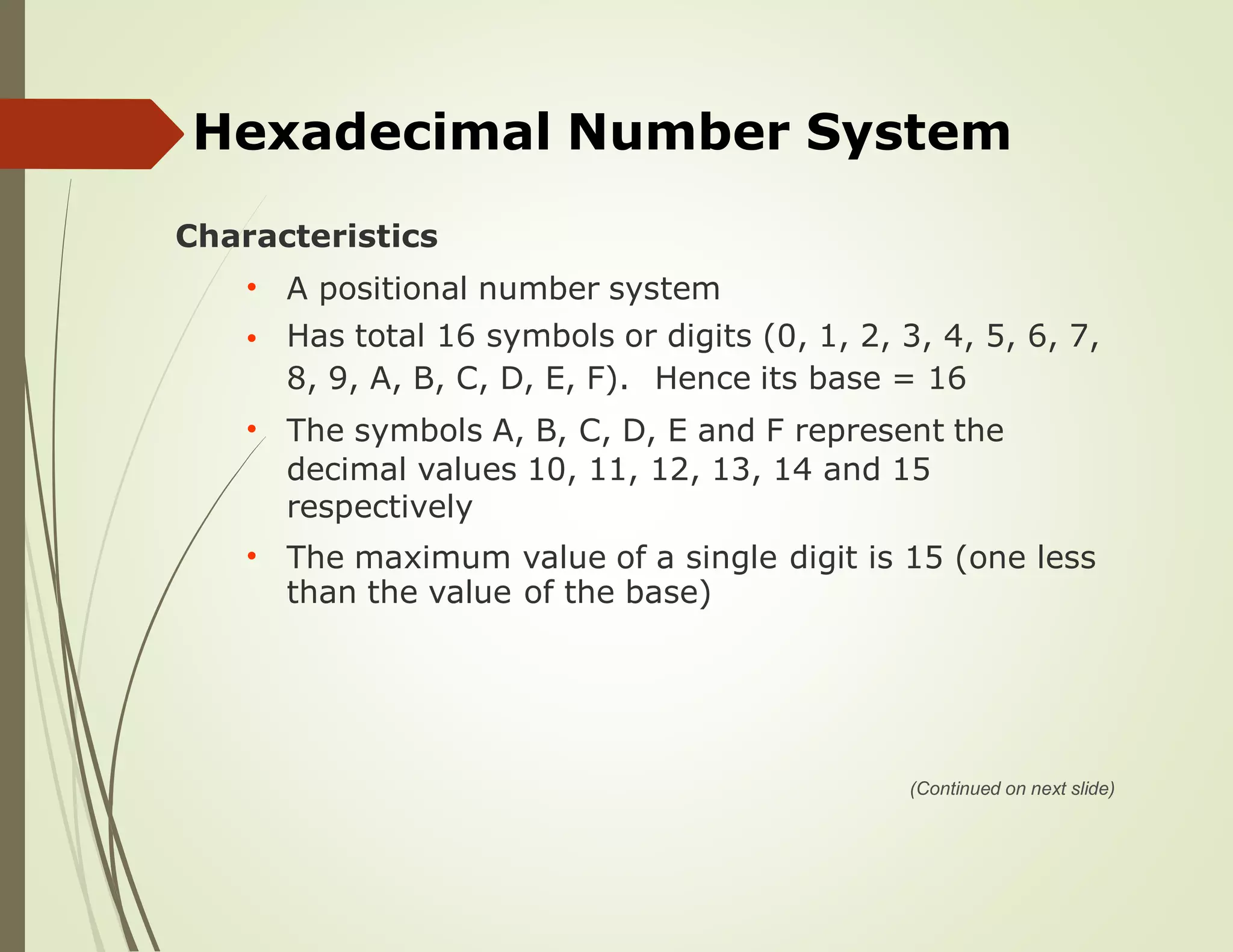
Hexadecimal Number System
Characteristics
A positional number system
Has total 16 symbols or digits (0, 1, 2, 3, 4, 5, 6, 7,
•
•
8, 9, A, B, C, D, E, F). Hence its base = 16
The symbols A, B, C, D, E and F represent the
decimal values 10, 11, 12, 13, 14 and 15
respectively
•
The maximum
than the value
value of a single
of the base)
digit is 15 (one less•
(Continued on next slide)
Hexadecimal Number System
(Continued from previous slide..)
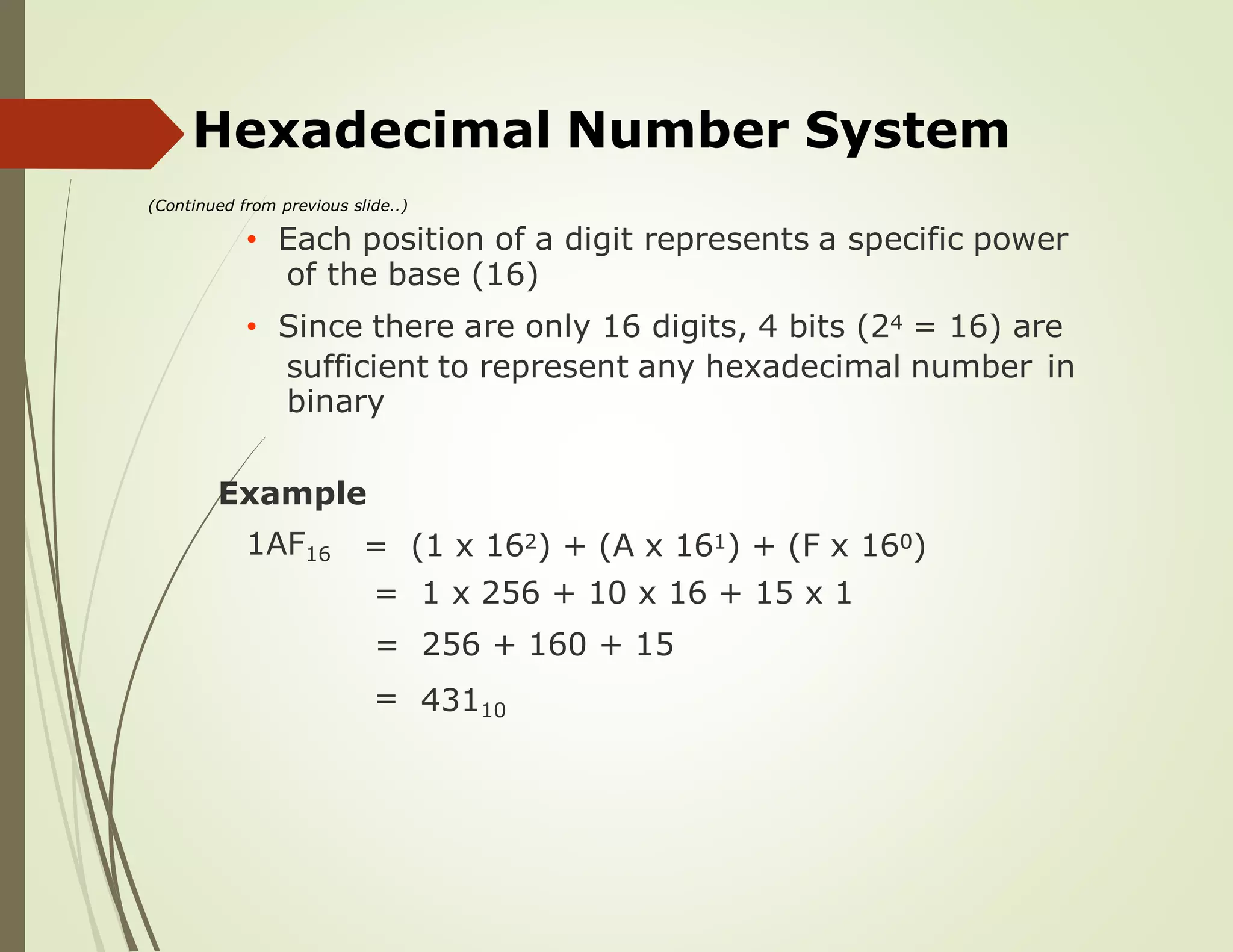
• Each position of a digit represents a specific power
of the base (16)
• Since there are only 16 digits, 4 bits (24 = 16) are
sufficient to represent any hexadecimal number
binary
in
Example
1AF16 =
=
=
=
(1 x 162) + (A x 161) + (F x 160)
1 x 256 + 10 x 16 + 15 x 1
256 + 160 + 15
43110
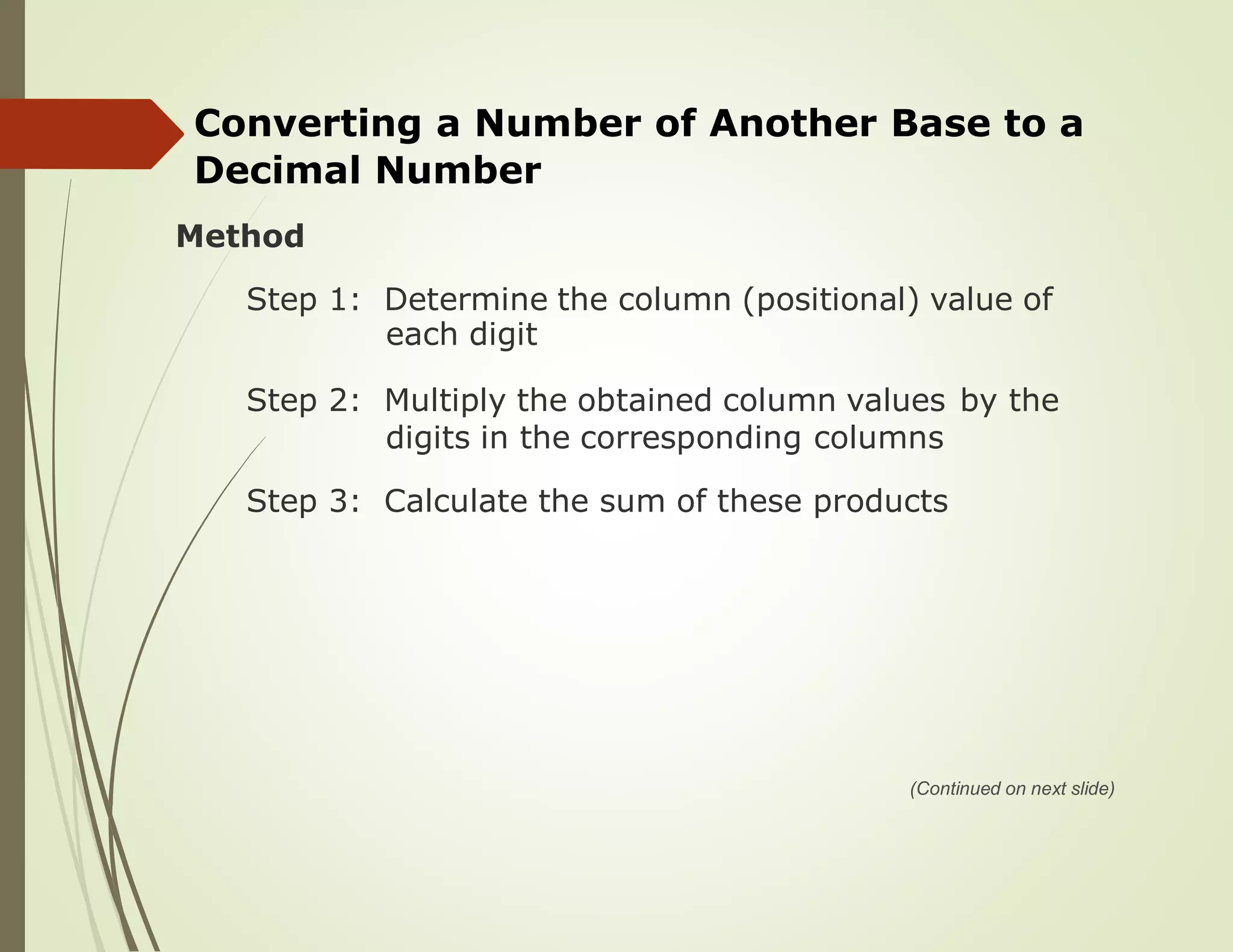
Converting a Number of Another Base to a
Decimal Number
Method
Step 1: Determine the column (positional) value of
each digit
Step 2: Multiply the obtained column values by the
digits in the corresponding columns
Step 3: Calculate the sum of these products
(Continued on next slide)
Converting a Number
Decimal Number
(Continued from previous slide..)
of Another Base to a
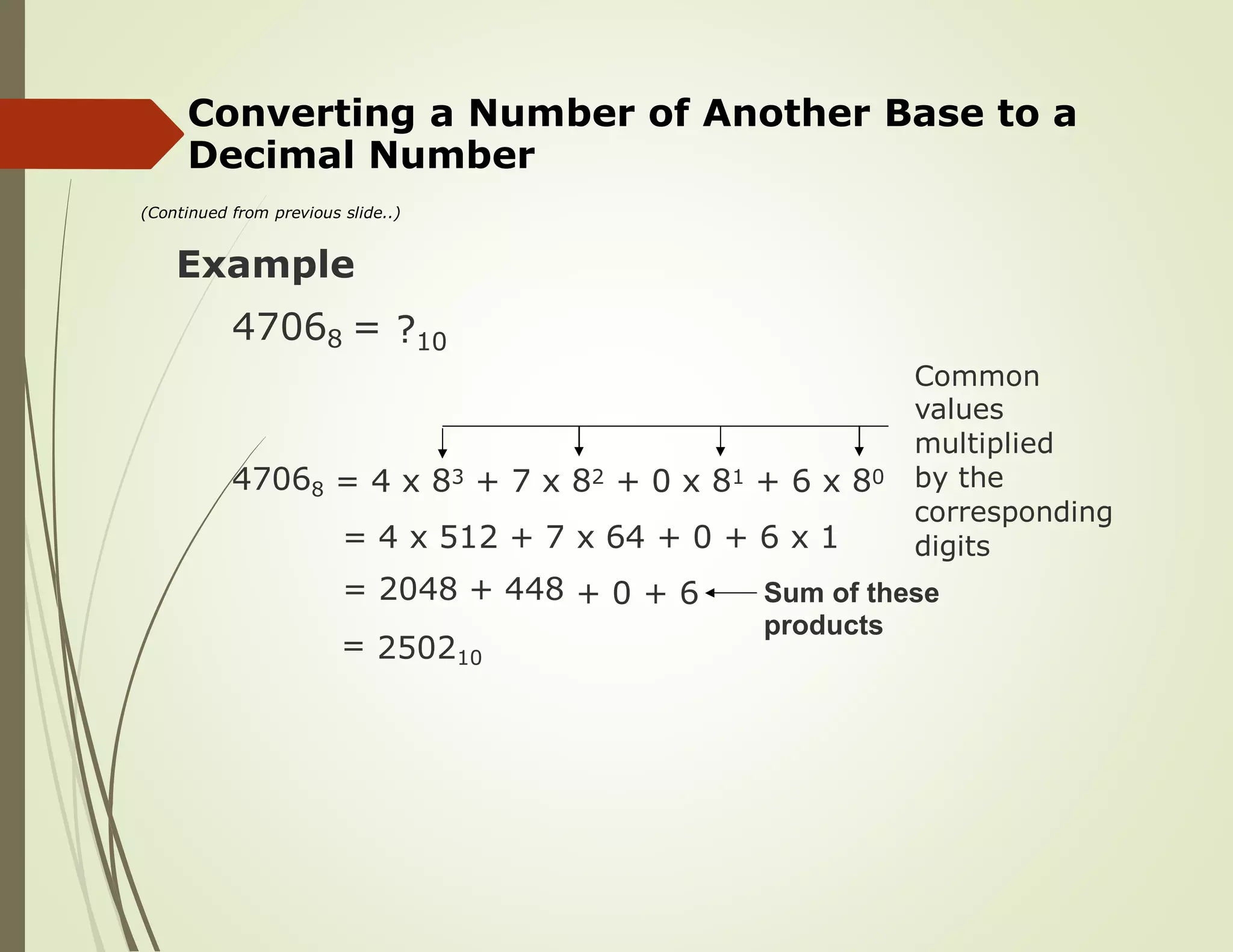
Example
47068 = ?10
Common
values
multiplied
by the
corresponding
digits
47068 = 4 x 83 + 7 x 82 + 0 x 81 + 6 x 80
=
=
=
4 x 512 + 7
2048 + 448
250210
x 64 + 0 + 6 x 1
+ 0 + 6 Sum of these
products
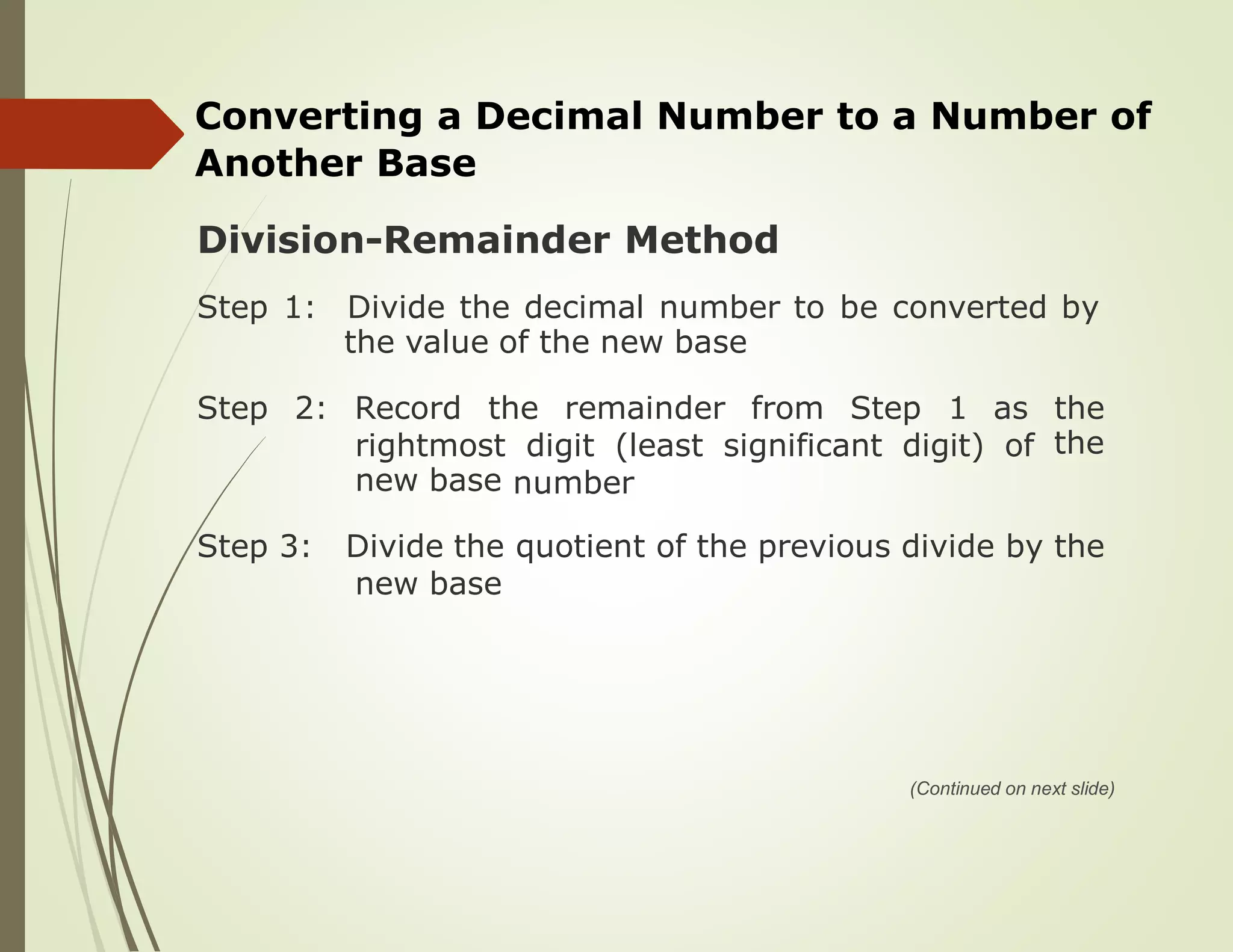
Converting a Decimal Number to a Number of
Another Base
Division-Remainder Method
Step 1: Divide the decimal number to be converted by
the value of the new base
Step 2: Record the remainder from Step 1 as the
therightmost
new base
digit (least significant digit) of
number
Step 3: Divide the quotient of the previous divide by the
new base
(Continued on next slide)
Converting a Decimal Number to a Number of
Another Base
(Continued from previous slide..)
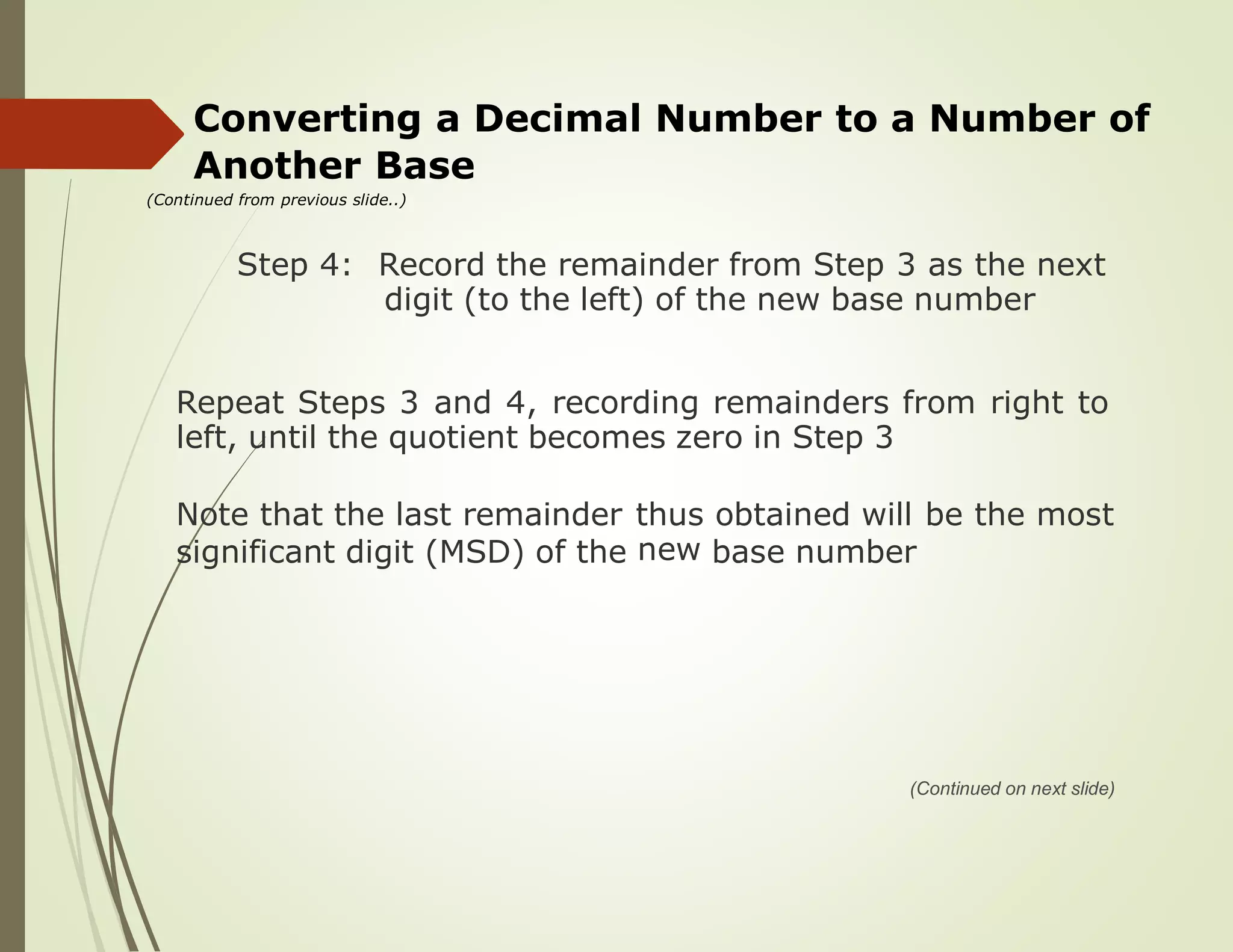
Step 4: Record the remainder from Step 3 as the next
digit (to the left) of the new base number
Repeat Steps 3 and 4, recording remainders from right to
left, until the quotient becomes zero in Step 3
Note that the last remainder thus
new
obtained will be the most
significant digit (MSD) of the base number
(Continued on next slide)
Converting a Decimal
Another Base
(Continued from previous slide..)
Number to a Number of
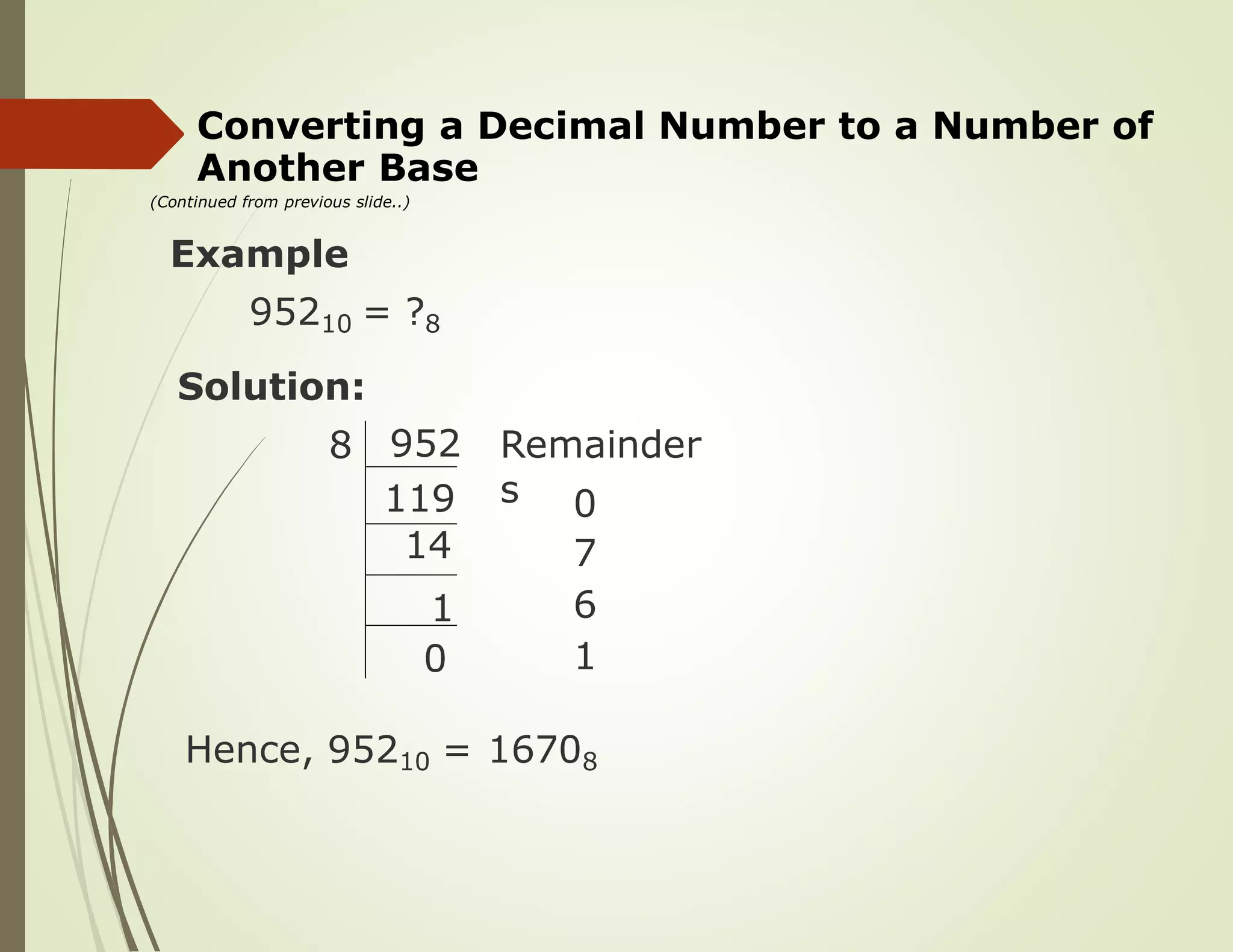
Example
95210 = ?8
Solution:
9528 Remainder
s 0
7
6
1
Hence, 95210 = 16708
119
14
1
0
Converting a Number of Some Base to a Number
of Another Base
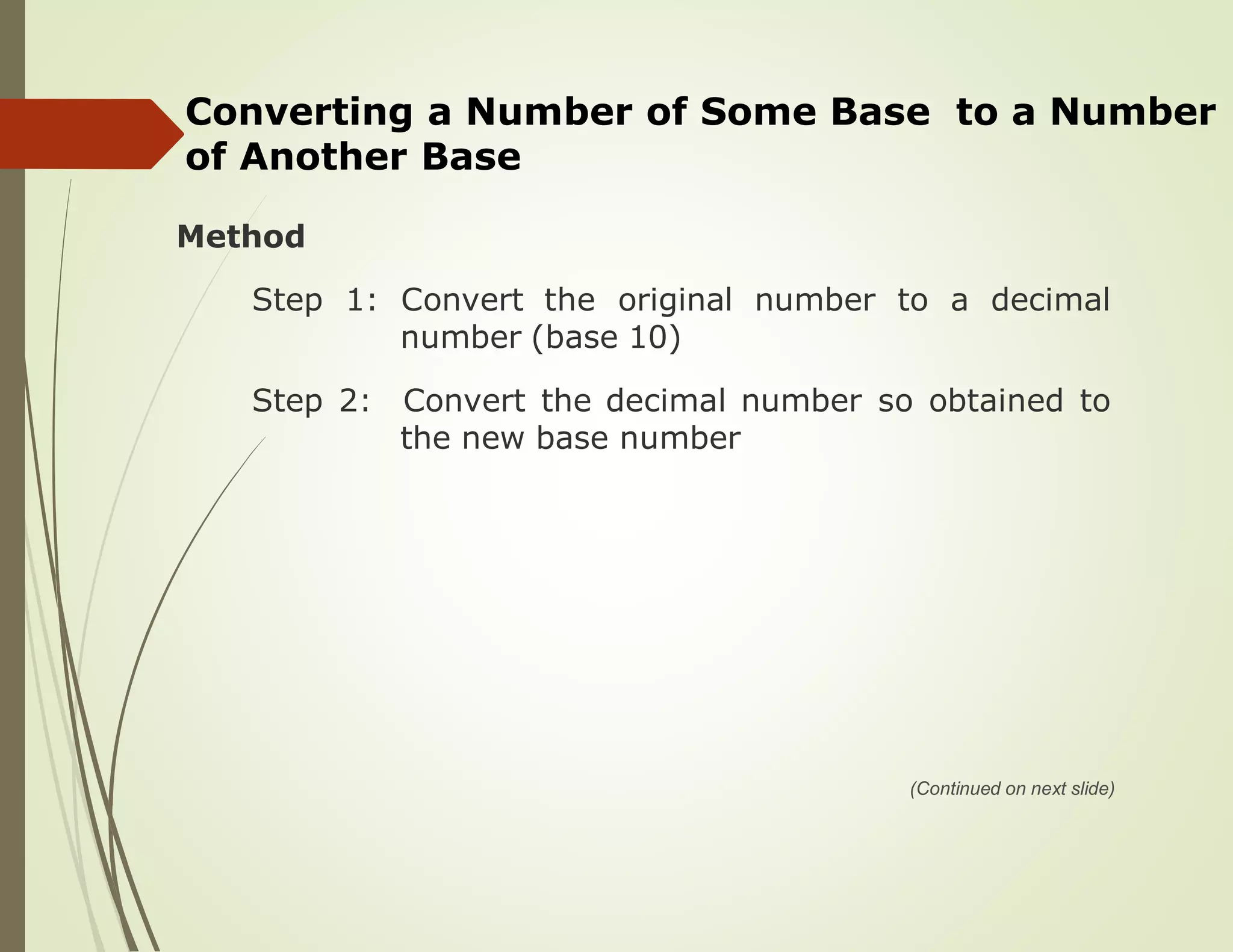
Method
Step 1: Convert the original number to a decimal
number (base 10)
Step 2: Convert the decimal number so obtained to
the new base number
(Continued on next slide)
Converting a Number
of Another Base
(Continued from previous slide..)
of Some Base to a Number
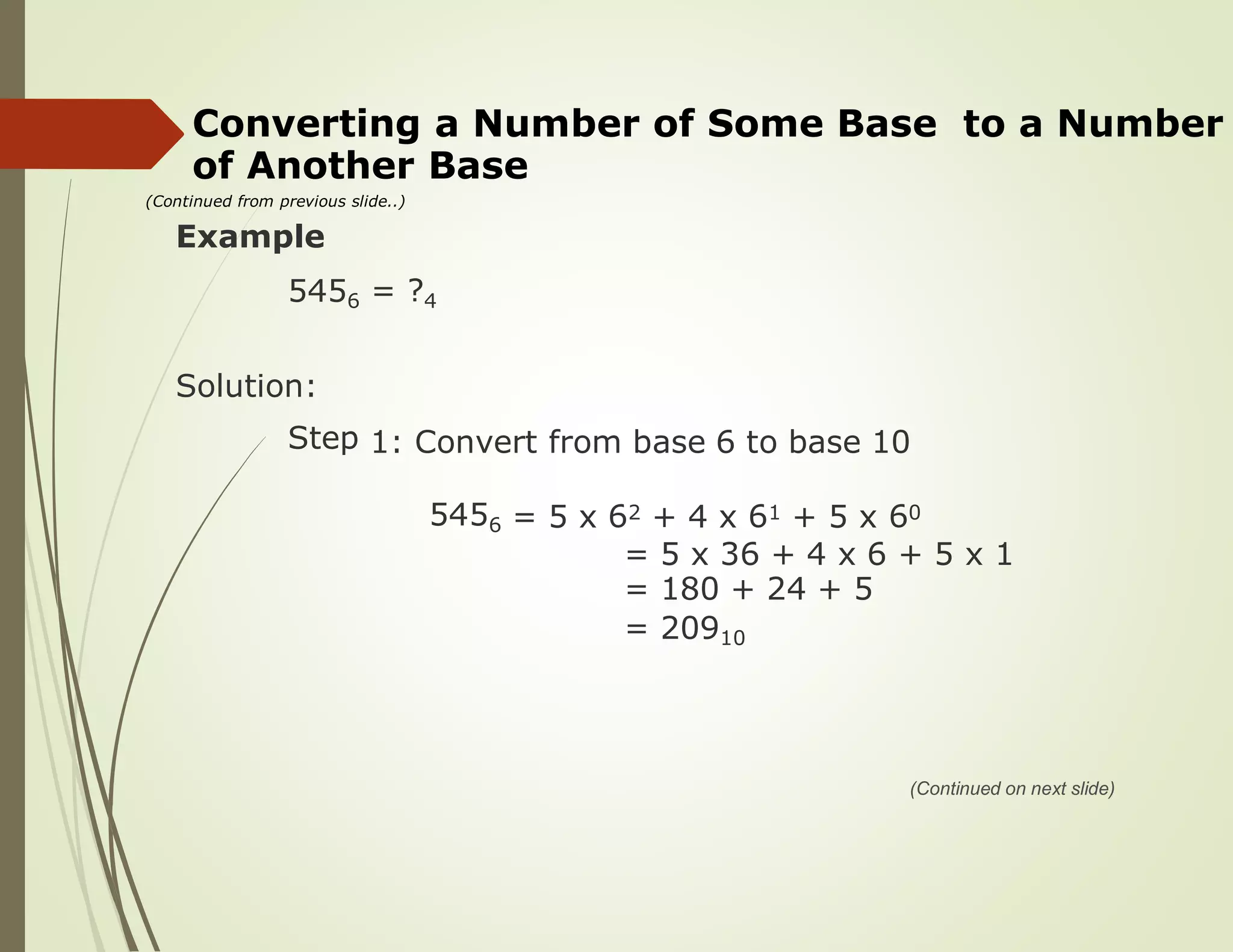
Example
5456 = ?4
Solution:
Step 1: Convert from base 6 to base 10
5456 = 5 x 62 + 4 x 61 + 5 x 60
= 5 x 36 + 4 x 6 + 5 x 1
= 180 + 24 + 5
= 20910
(Continued on next slide)
Converting a Number of Some
of Another Base
(Continued from previous slide..)
Base to a Number
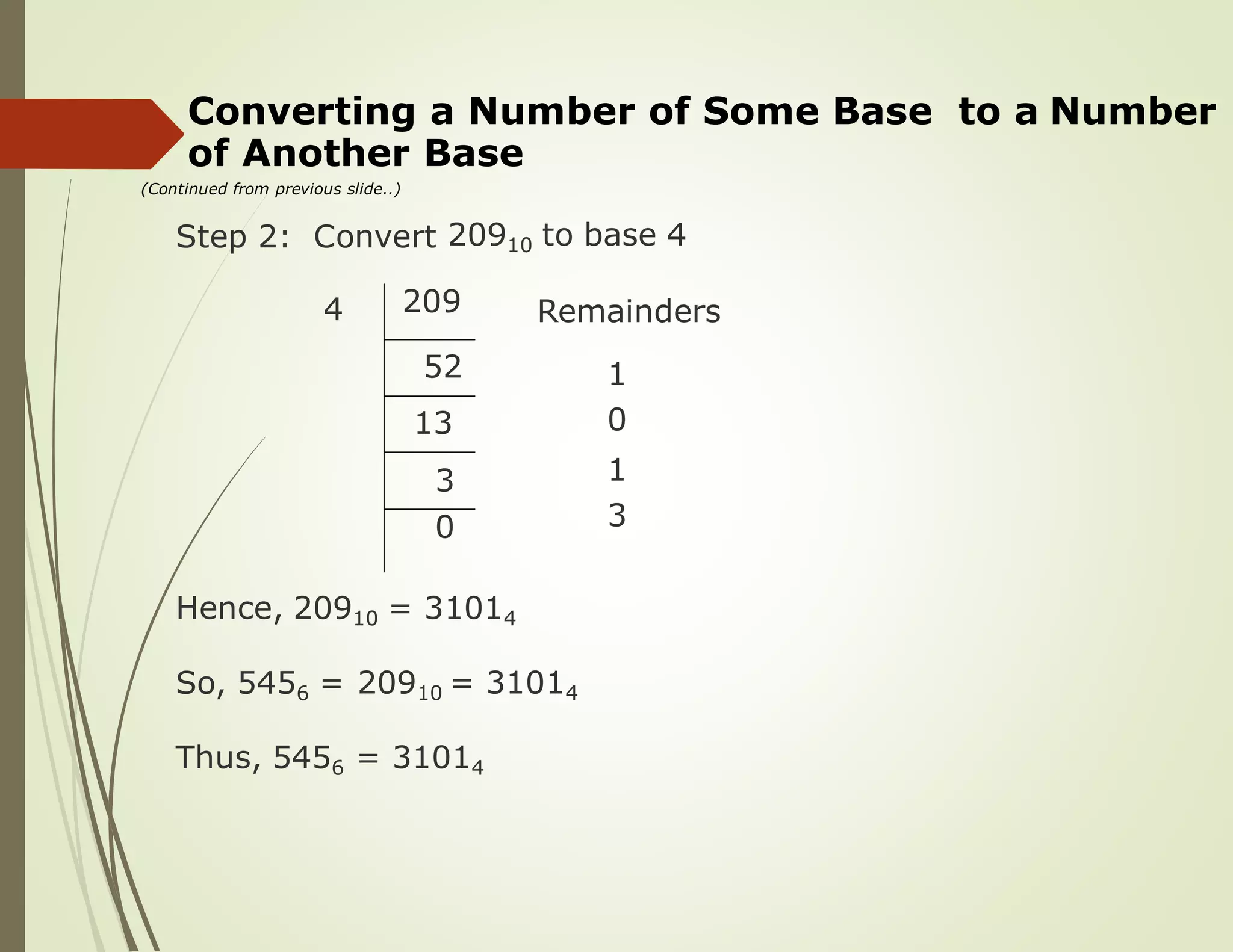
Step 2: Convert 20910 to base 4
4 Remainders
1
0
1
3
Hence, 20910 = 31014
So, 5456 = 20910 = 31014
Thus, 5456 = 31014
209
52
13
3
0
Shortcut Method for Converting a Binary Number
to its Equivalent Octal Number
Method
Step 1: Divide the digits into groups of three starting
from the right
Step 2: Convert each group of three binary digits to
toone octal digit using the method of binary
decimal conversion
(Continued on next slide)
Shortcut Method for Converting a Binary
to its Equivalent Octal Number
(Continued from previous slide..)
Number
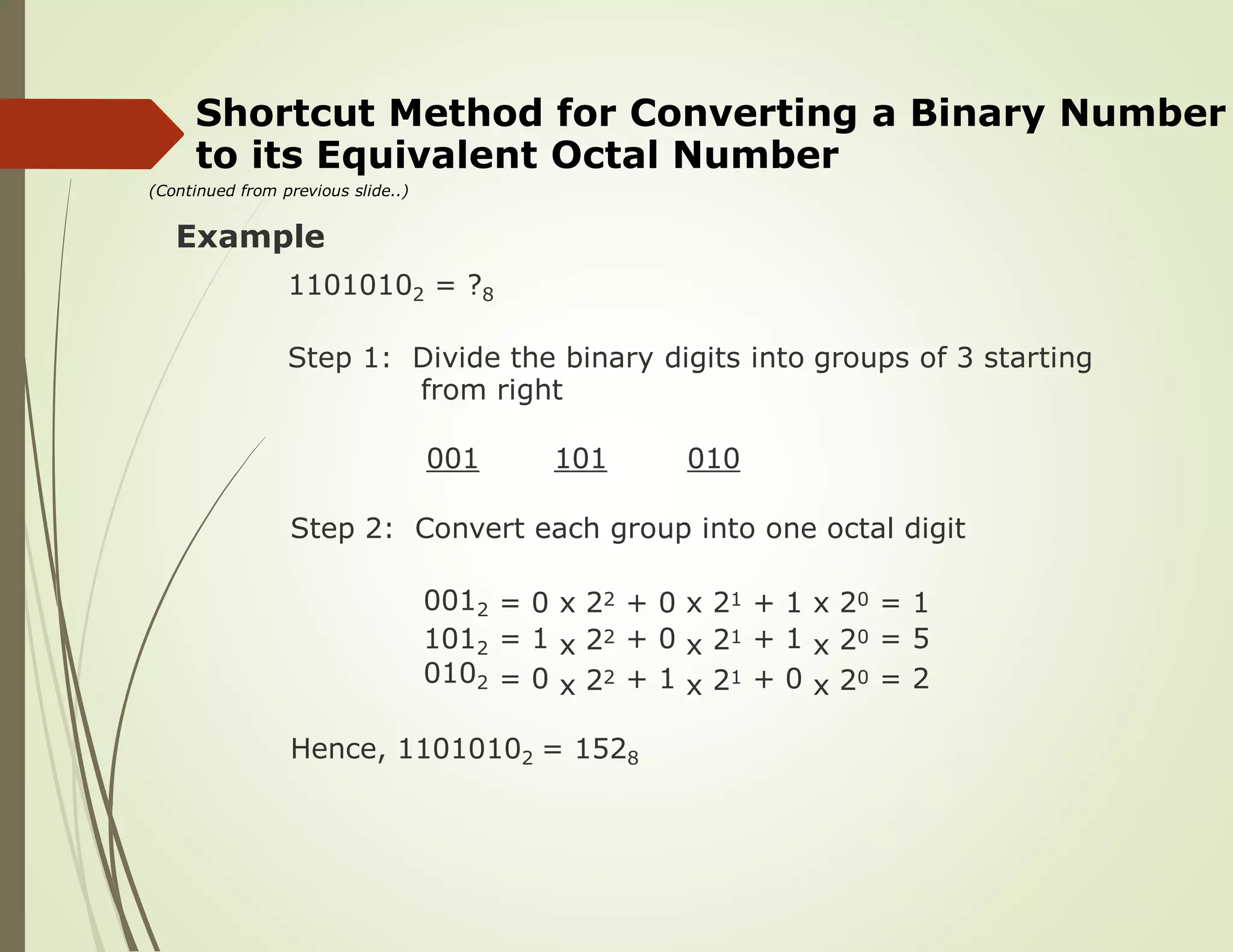
Example
11010102 = ?8
Step 1: Divide the binary digits into
from right
groups of 3 starting
001 101 010
Step 2: Convert each group into one octal digit
0012
1012
0102
=
=
=
0
1
0
x
x
x
22
22
22
+
+
+
0
0
1
x
x
x
21
21
21
+
+
+
1
1
0
x
x
x
20
20
20
=
=
=
1
5
2
Hence, 11010102 = 1528
Shortcut Method for Converting an Octal
Number to Its Equivalent Binary Number
Method
Step 1: Convert
number
decimal
each octal digit to a 3 digit binary
(the octal digits may be treated as
for this conversion)
Step 2: Combine all the resulting binary
single
groups
binary(of 3 digits each) into a
number
(Continued on next slide)
Shortcut Method for Converting an Octal
Number to Its Equivalent Binary Number
(Continued from previous slide..)
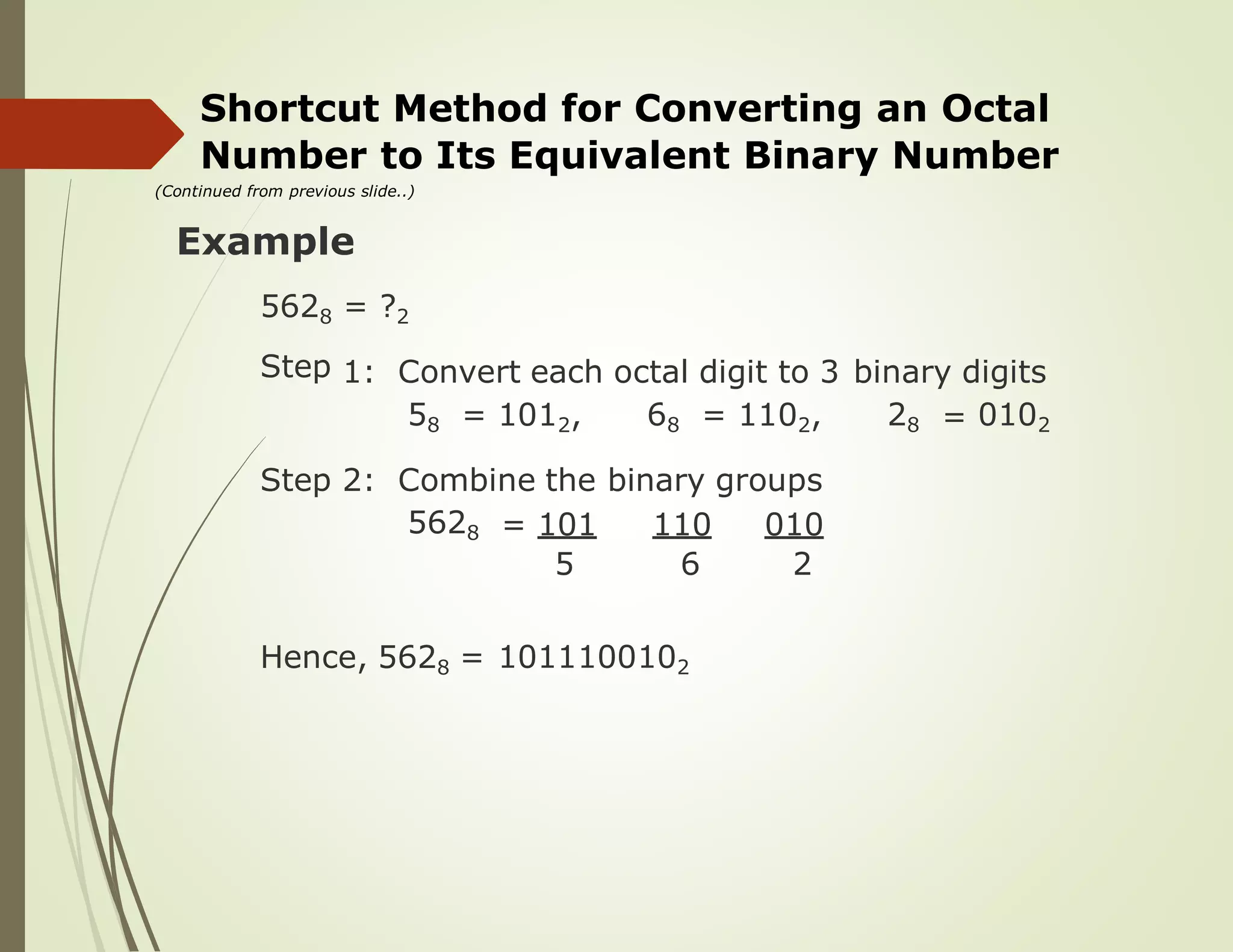
Example
5628
Step
= ?2
1: Convert each octal digit to 3 binary digits
58 = 1012, 68 = 1102, 28 = 0102
Step 2: Combine the binary groups
5628 = 101
5
110
6
010
2
Hence, 5628 = 1011100102
Shortcut Method for Converting a Binary
Number to its Equivalent Hexadecimal Number
Method
Step 1: Divide the binary digits into groups of four
starting from the right
Step 2: Combine each group of four binary digits to
one hexadecimal digit
(Continued on next slide)
Shortcut Method for Converting a Binary
Number to its Equivalent Hexadecimal Number
(Continued from previous slide..)
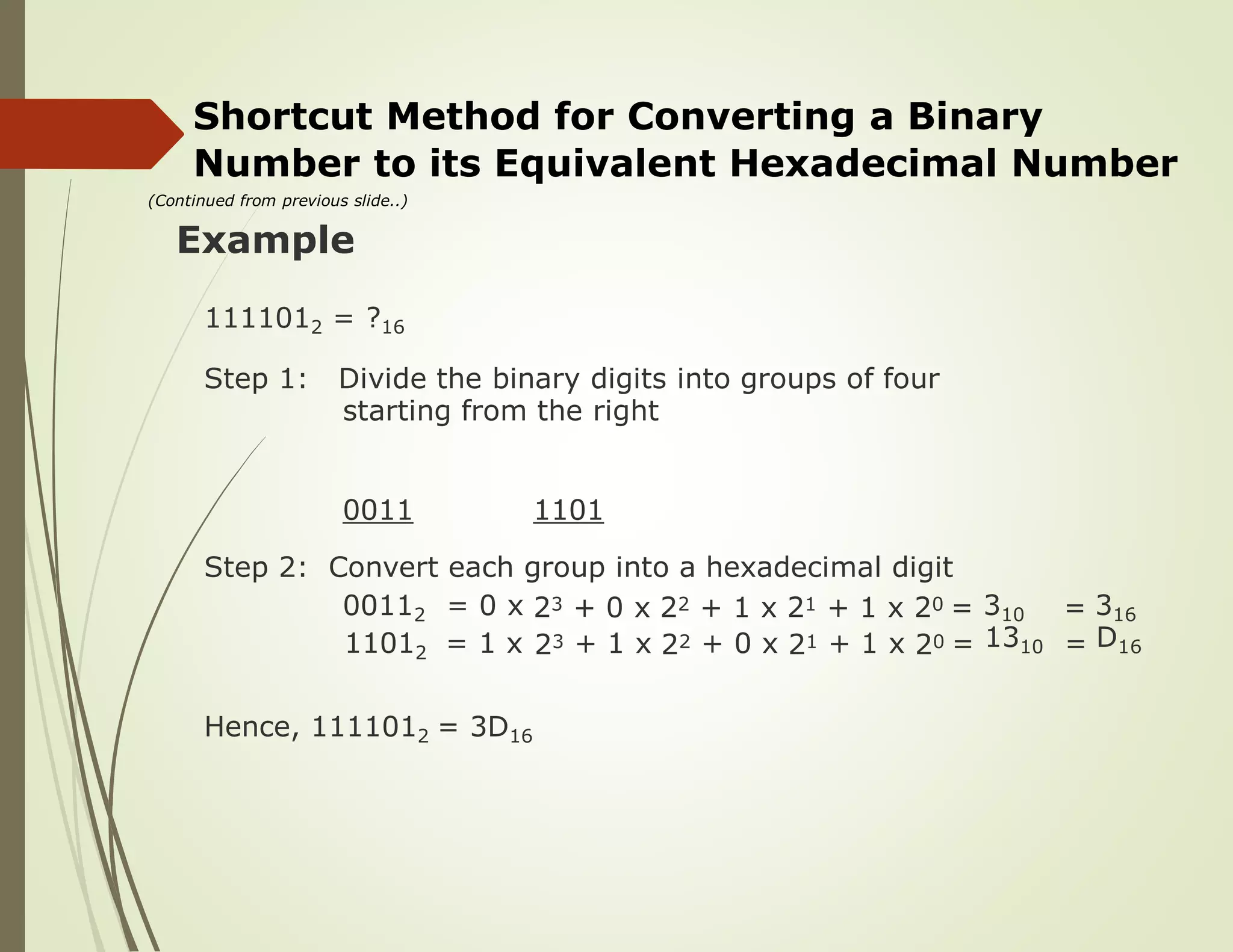
Example
1111012 = ?16
Step 1: Divide the binary digits into groups of four
starting from the right
0011 1101
Step 2: Convert each group into a hexadecimal digit
00112 = 0 x
11012 = 1 x
23
23
+ 0 x
+ 1 x
22
22
+ 1 x
+ 0 x
21
21
+
+
1
1
x
x
20
20
=
=
310
1310
=
=
316
D16
Hence, 1111012 = 3D16
Shortcut Method for Converting a Hexadecimal
Number to its Equivalent Binary Number
Method
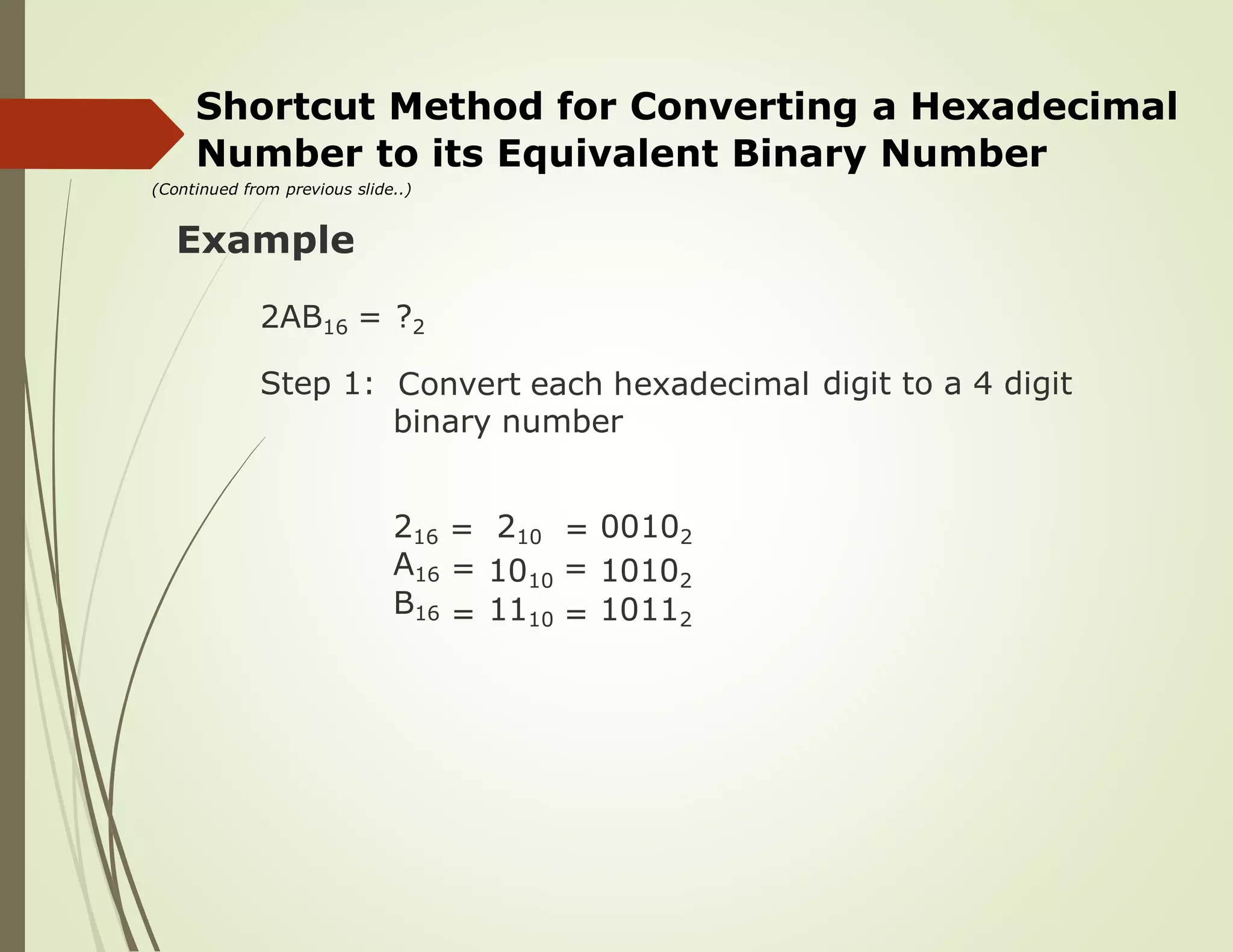
Step 1: Convert the decimal equivalent of each
hexadecimal digit to a 4 digit binary
number
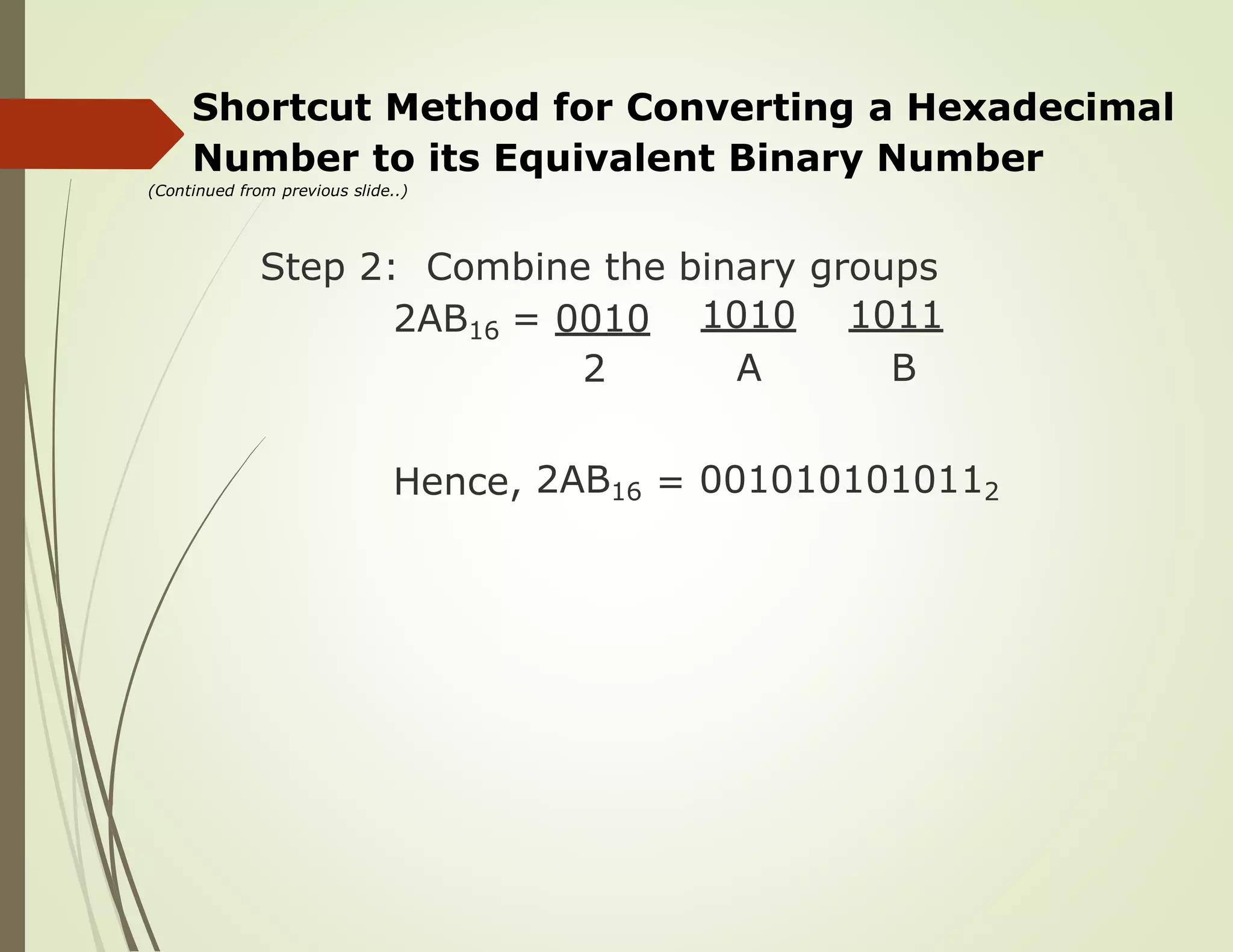
Step 2: Combine all the resulting binary groups
(of 4 digits each) in a single binary number
(Continued on next slide)
Shortcut Method for Converting a Hexadecimal
Number to its Equivalent Binary Number
(Continued from previous slide..)
Example
2AB16 = ?2
Convert each hexadecimal
binary number
Step 1: digit to a 4 digit
216
A16
B16
=
=
=
210
1010
1110
=
=
=
00102
10102
10112
Shortcut Method for Converting a Hexadecimal
Number to
(Continued from previous slide..)
its Equivalent Binary Number
Step 2: Combine the binary
1010
A
groups
1011
B
2AB16 = 0010
2
Hence, 2AB16 = 0010101010112
Key Words/Phrases
Base
Binary
Binary
Bit
•
•
•
•
•
•
•
•
Least Significant Digit (LSD)
Memory dump
Most Significant Digit (MSD)
Non-positional number
system
Number system
Octal number system
•
•
•
•
number
point
system
Decimal number system
Division-Remainder
Fractional numbers
technique •
•
•Hexadecimal number system Positional number system

Number Systems

  • 1.
  • 2.
    Learning Objectives In thischapter you will learn about: • Non-positional number system • Positional number system • Decimal number system • Binary number system • Octal number system • Hexadecimal number system (Continued on next slide)
  • 3.
    Learning Objectives (Continued fromprevious slide..) Convert a number’s base • Another base to decimal base • Decimal base to another base • Some base to another base Shortcut methods for converting • Binary to octal number • Octal to binary number • Binary to hexadecimal number • Hexadecimal to binary number Fractional numbers in binary number • • system•
  • 4.
    Number Systems Two typesof number systems are: Non-positional number systems• Positional number systems•
  • 5.
    Non-positional Number Systems Characteristics •Use symbols such as I for 1, II for 2, III for 3, IIII for 4, IIIII for 5, etc • Each symbol represents the same value regardless of its position in the number • The symbols are simply added to find out the value of a particular number • Difficulty• It is difficult to perform number system arithmetic with such a•
  • 6.
    Positional Number Systems Characteristics• Useonly a few symbols called digits• These symbols represent different values depending• on the position they occupy in the number (Continued on next slide)
  • 7.
    Positional Number Systems (Continuedfrom previous slide..) The value of each digit is determined by:• 1. 2. 3. The digit itself The position of the digit in the number The base of the number system (base = system) total number of digits in the number The maximum value of a single digit is always equal to one less than the value of the base •
  • 8.
    Decimal Number System Characteristics Apositional number system Has 10 symbols or digits (0, 1, 2, 3, 4, 5, 6, 7, • • 8, 9). Hence, its base = 10 The maximum value of a single digit is 9 (one less than the value of the base) • Each position of a digit represents a specific• power of the We use this life base (10) number system in our day-to-day• (Continued on next slide)
  • 9.
    Decimal Number System (Continuedfrom previous slide..) Example 258610 = (2 x 10³) + (5 x 10²) 101) x 100)+ (8 x + (6 = 2000 + 500 + 80 + 6
  • 10.
    Binary Number System Characteristics Apositional number system Has only 2 symbols or digits (0 and 1). Hence its base = 2 The maximum value of a single digit is 1 (one less than the value of the base) Each position of a digit represents a specific power of the base (2) • • • • This number system is used in computers• (Continued on next slide)
  • 11.
    Binary Number System (Continuedfrom previous slide..) Example 101012 = (1 x 24) + (0 x 23) + (1 x 22) + (0 x 21) x (1 x 20) = 16 + 0 + 4 + 0 + 1 = 2110
  • 12.
    Representing Numbers inDifferent Number Systems In order to be specific about which number system we theare referring to, it is a common practice to indicate base as a subscript. Thus, we write: 101012 = 2110
  • 13.
    Bit • Bit standsfor binary digit • A bit in computer terminology means either a 0 or a 1 • A binary number number consisting of n bits is called an n-bit
  • 14.
    Octal Number System Characteristics Apositional number system Has total 8 symbols or digits Hence, its base = 8 • • (0, 1, 2, 3, 4, 5, 6, 7). The maximum value of a single digit is 7 (one less than the value of the base • Each position of a digit represents a specific power of• the base (8) (Continued on next slide)
  • 15.
    Octal Number System (Continuedfrom previous slide..) • Since there are only 8 digits, 3 bits (23 = 8) are sufficient to represent any octal number in binary Example 20578 = = (2 x 83) + (0 x 82) + (5 x 81) + (7 x 80) 1024 + 0 + 40 + 7 = 107110
  • 16.
    Hexadecimal Number System Characteristics Apositional number system Has total 16 symbols or digits (0, 1, 2, 3, 4, 5, 6, 7, • • 8, 9, A, B, C, D, E, F). Hence its base = 16 The symbols A, B, C, D, E and F represent the decimal values 10, 11, 12, 13, 14 and 15 respectively • The maximum than the value value of a single of the base) digit is 15 (one less• (Continued on next slide)
  • 17.
    Hexadecimal Number System (Continuedfrom previous slide..) • Each position of a digit represents a specific power of the base (16) • Since there are only 16 digits, 4 bits (24 = 16) are sufficient to represent any hexadecimal number binary in Example 1AF16 = = = = (1 x 162) + (A x 161) + (F x 160) 1 x 256 + 10 x 16 + 15 x 1 256 + 160 + 15 43110
  • 18.
    Converting a Numberof Another Base to a Decimal Number Method Step 1: Determine the column (positional) value of each digit Step 2: Multiply the obtained column values by the digits in the corresponding columns Step 3: Calculate the sum of these products (Continued on next slide)
  • 19.
    Converting a Number DecimalNumber (Continued from previous slide..) of Another Base to a Example 47068 = ?10 Common values multiplied by the corresponding digits 47068 = 4 x 83 + 7 x 82 + 0 x 81 + 6 x 80 = = = 4 x 512 + 7 2048 + 448 250210 x 64 + 0 + 6 x 1 + 0 + 6 Sum of these products
  • 20.
    Converting a DecimalNumber to a Number of Another Base Division-Remainder Method Step 1: Divide the decimal number to be converted by the value of the new base Step 2: Record the remainder from Step 1 as the therightmost new base digit (least significant digit) of number Step 3: Divide the quotient of the previous divide by the new base (Continued on next slide)
  • 21.
    Converting a DecimalNumber to a Number of Another Base (Continued from previous slide..) Step 4: Record the remainder from Step 3 as the next digit (to the left) of the new base number Repeat Steps 3 and 4, recording remainders from right to left, until the quotient becomes zero in Step 3 Note that the last remainder thus new obtained will be the most significant digit (MSD) of the base number (Continued on next slide)
  • 22.
    Converting a Decimal AnotherBase (Continued from previous slide..) Number to a Number of Example 95210 = ?8 Solution: 9528 Remainder s 0 7 6 1 Hence, 95210 = 16708 119 14 1 0
  • 23.
    Converting a Numberof Some Base to a Number of Another Base Method Step 1: Convert the original number to a decimal number (base 10) Step 2: Convert the decimal number so obtained to the new base number (Continued on next slide)
  • 24.
    Converting a Number ofAnother Base (Continued from previous slide..) of Some Base to a Number Example 5456 = ?4 Solution: Step 1: Convert from base 6 to base 10 5456 = 5 x 62 + 4 x 61 + 5 x 60 = 5 x 36 + 4 x 6 + 5 x 1 = 180 + 24 + 5 = 20910 (Continued on next slide)
  • 25.
    Converting a Numberof Some of Another Base (Continued from previous slide..) Base to a Number Step 2: Convert 20910 to base 4 4 Remainders 1 0 1 3 Hence, 20910 = 31014 So, 5456 = 20910 = 31014 Thus, 5456 = 31014 209 52 13 3 0
  • 26.
    Shortcut Method forConverting a Binary Number to its Equivalent Octal Number Method Step 1: Divide the digits into groups of three starting from the right Step 2: Convert each group of three binary digits to toone octal digit using the method of binary decimal conversion (Continued on next slide)
  • 27.
    Shortcut Method forConverting a Binary to its Equivalent Octal Number (Continued from previous slide..) Number Example 11010102 = ?8 Step 1: Divide the binary digits into from right groups of 3 starting 001 101 010 Step 2: Convert each group into one octal digit 0012 1012 0102 = = = 0 1 0 x x x 22 22 22 + + + 0 0 1 x x x 21 21 21 + + + 1 1 0 x x x 20 20 20 = = = 1 5 2 Hence, 11010102 = 1528
  • 28.
    Shortcut Method forConverting an Octal Number to Its Equivalent Binary Number Method Step 1: Convert number decimal each octal digit to a 3 digit binary (the octal digits may be treated as for this conversion) Step 2: Combine all the resulting binary single groups binary(of 3 digits each) into a number (Continued on next slide)
  • 29.
    Shortcut Method forConverting an Octal Number to Its Equivalent Binary Number (Continued from previous slide..) Example 5628 Step = ?2 1: Convert each octal digit to 3 binary digits 58 = 1012, 68 = 1102, 28 = 0102 Step 2: Combine the binary groups 5628 = 101 5 110 6 010 2 Hence, 5628 = 1011100102
  • 30.
    Shortcut Method forConverting a Binary Number to its Equivalent Hexadecimal Number Method Step 1: Divide the binary digits into groups of four starting from the right Step 2: Combine each group of four binary digits to one hexadecimal digit (Continued on next slide)
  • 31.
    Shortcut Method forConverting a Binary Number to its Equivalent Hexadecimal Number (Continued from previous slide..) Example 1111012 = ?16 Step 1: Divide the binary digits into groups of four starting from the right 0011 1101 Step 2: Convert each group into a hexadecimal digit 00112 = 0 x 11012 = 1 x 23 23 + 0 x + 1 x 22 22 + 1 x + 0 x 21 21 + + 1 1 x x 20 20 = = 310 1310 = = 316 D16 Hence, 1111012 = 3D16
  • 32.
    Shortcut Method forConverting a Hexadecimal Number to its Equivalent Binary Number Method Step 1: Convert the decimal equivalent of each hexadecimal digit to a 4 digit binary number Step 2: Combine all the resulting binary groups (of 4 digits each) in a single binary number (Continued on next slide)
  • 33.
    Shortcut Method forConverting a Hexadecimal Number to its Equivalent Binary Number (Continued from previous slide..) Example 2AB16 = ?2 Convert each hexadecimal binary number Step 1: digit to a 4 digit 216 A16 B16 = = = 210 1010 1110 = = = 00102 10102 10112
  • 34.
    Shortcut Method forConverting a Hexadecimal Number to (Continued from previous slide..) its Equivalent Binary Number Step 2: Combine the binary 1010 A groups 1011 B 2AB16 = 0010 2 Hence, 2AB16 = 0010101010112
  • 35.
    Key Words/Phrases Base Binary Binary Bit • • • • • • • • Least SignificantDigit (LSD) Memory dump Most Significant Digit (MSD) Non-positional number system Number system Octal number system • • • • number point system Decimal number system Division-Remainder Fractional numbers technique • • •Hexadecimal number system Positional number system