Total Revenue Method
http://www.bized.ac.uk
Copyright 2005 – Biz/ed
2
The Total Revenue Method
• The total revenue
method is the
simplest way of
telling whether
demand is elastic,
inelastic.
http://www.bized.ac.uk
Copyright 2005 – Biz/ed
3
The Total Revenue Method
• The total revenue
that would be
received by
sellers at various
prices is found by
multiplying price
by quantity
demanded.
http://www.bized.ac.uk
Copyright 2005 – Biz/ed
4
The Total Revenue Method
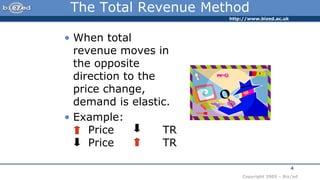
• When total
revenue moves in
the opposite
direction to the
price change,
demand is elastic.
• Example:
Price TR
Price TR
http://www.bized.ac.uk
Copyright 2005 – Biz/ed
5
The Total Revenue Method
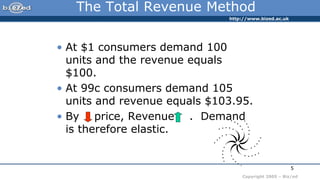
• At $1 consumers demand 100
units and the revenue equals
$100.
• At 99c consumers demand 105
units and revenue equals $103.95.
• By price, Revenue . Demand
is therefore elastic.
http://www.bized.ac.uk
Copyright 2005 – Biz/ed
6
The Total Revenue Method
• Total revenue remains the
same when prices change if
demand has unit elasticity.
• At $1 consumers demand 99
units and revenue equals
$99.
• At 99c consumers demand
100 units and revenue
equals $99
http://www.bized.ac.uk
Copyright 2005 – Biz/ed
7
The Total Revenue Method
• The price change
has not resulted
in any change in
revenue.
• Demand is
therefore unitary
elastic.
http://www.bized.ac.uk
Copyright 2005 – Biz/ed
Total Revenue Method
Price
Quantity Demanded (000s)
D
The importance of elasticity
is the information it
provides on the effect on
total revenue of changes in
price.
$5
100
Total revenue is price x
quantity sold. In this
example, TR = $5 x 100,000
= $500,000.
This value is represented by
the grey shaded rectangle.
Total Revenue
http://www.bized.ac.uk
Copyright 2005 – Biz/ed
Elasticity
Price
Quantity Demanded (000s)
D
If the firm decides to
decrease price to (say) $3,
the degree of price
elasticity of the demand
curve would determine the
extent of the increase in
demand and the change
therefore in total revenue.
$5
100
$3
140
Total Revenue
http://www.bized.ac.uk
Copyright 2005 – Biz/ed
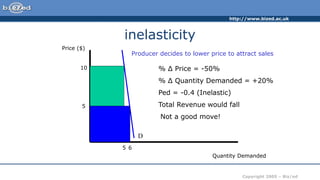
inelasticity
Price ($)
Quantity Demanded
10
D
5
5
6
% Δ Price = -50%
% Δ Quantity Demanded = +20%
Ped = -0.4 (Inelastic)
Total Revenue would fall
Producer decides to lower price to attract sales
Not a good move!
http://www.bized.ac.uk
Copyright 2005 – Biz/ed
Elasticity
Price ($)
Quantity Demanded
D
10
5 20
Producer decides to reduce price to increase sales
7
% Δ in Price = - 30%
% Δ in Demand = + 300%
Ped = - 10 (Elastic)
Total Revenue rises
Good Move!
http://www.bized.ac.uk
Copyright 2005 – Biz/ed
Total Revenue
Let's imagine we operate a small canteen in a school. I
might say to you ''increasing the price of a can of Brand
''X'' soft drink from $1.00 per can to $1.40 per can is not a
good idea. Our customers will buy Brand ''Y'' instead.'‘
http://www.bized.ac.uk
Copyright 2005 – Biz/ed
• ''At the moment, we are selling 200 cans per day of Brand ''X'',
at $1.00 per can.
• We are generating $1.00 per can x 200 cans = $200 per day in
revenue from sales of Brand ''X''.
• I believe that we will only sell 120 cans per day if we increase
the price of Brand ''X'' to $1.40 per can; resulting in a daily
revenue of ?
• $1.40 per can x 120 cans = $168.
http://www.bized.ac.uk
Copyright 2005 – Biz/ed
• Calculate the revenue gained
• The revenue we gain from increasing the price per can ($0.40 x
120 = $48)
• Calculate the revenue lost
• Will the revenue gained offset the revenue lost?
• It will not be enough to offset the revenue we will lose from the
decrease in the quantity of cans we sell ($1.00 x 80 = $80).''
• I show your reasoning, on a Supply and Demand diagram
• What is the reason for your conclusion? Why do you think this
might be the case?
• Implicit in my reasoning is my belief that Brand ''X'' has a close
substitute in Brand ''Y'', and that Brand ''X'' is price elastic.
http://www.bized.ac.uk
Copyright 2005 – Biz/ed
http://www.bized.ac.uk
Copyright 2005 – Biz/ed
• You, however, are more in touch with teenage trends and
fashion than I am.
• You reply ''Brand ''X'' is really popular at the moment. I
believe we can increase the price to $1.40 per can. We
will lose very few sales'‘.
• Using a Demand and Supply model show me your
analysis of the market for brand ''X”, based on the
belief that an increase in price to $1.40 per can will
only cause a loss of 10 cans in sales per day.
http://www.bized.ac.uk
Copyright 2005 – Biz/ed
The revenue gain from the increase in price ($0.40 x 190
cans = $76) will more than compensate for the revenue
loss caused the decrease in quantity sold ($1.00 x 10 =
$10)
You have correctly noticed that Brand ''X'' is price
inelastic, and that an increase in price will generate
more net revenue.
http://www.bized.ac.uk
Copyright 2005 – Biz/ed
Elasticity
• If demand is price
elastic:
• Increasing price would
reduce TR (%Δ Qd > %
Δ P)
• Reducing price would
increase TR
(%Δ Qd > % Δ P)
• If demand is price
inelastic:
• Increasing price would
increase TR
(%Δ Qd < % Δ P)
• Reducing price would
reduce TR (%Δ Qd < %
Δ P)
http://www.bized.ac.uk
Copyright 2005 – Biz/ed
Mid point method
• There is a more accurate method to calculating
elasticity
• This because a percent change in a given
problem could be different depending on
whether the price is increasing, or falling.
• Check out the example below for a price
change from $5 to $10:
•
• If the price increases to $10, then we have
($10-$5)/$5, which gives us $5/$5, or 100%
•
• However if the price decreases we have ($5-
$10)/$10, which gives us -$5/$10, or -50%.
• depending on whether it is a price increase or
decrease, then we will see different percentage
values.
• But if we use the midpoint formula, this won’t
be a problem.
• Let us look at our example above again.
http://www.bized.ac.uk
Copyright 2005 – Biz/ed
Mid point method
• Formula is as follows – first step find average
• Where Xaverage is the sum of the old and new values divided by 2. i.e.
• if price increased from 10 dollars to 12 dollars,
• (12 + 10)/2 = 11 Ave P
• If quantity demanded fell from 30 to 20 items
• (20 + 30)/2 = 25 Ave Q
•
midpoint
elasticity
=
Ave P
Δ Price
X
ΔQ
Ave Q
http://www.bized.ac.uk
Copyright 2005 – Biz/ed
The percentage change in price, calculated by the midpoint formula would be
2/11 = 18.2 percent
The percentage change in quantity, calculated bye the midpoint formula would
be
10/25 = -40 percent
And the coefficient of elasticity, calculated by the midpoint formula is
-40/18.2 = -2.2
The answer is negative because as the price goes up, we consume less of the
good (which follows the law of demand).
http://www.bized.ac.uk
Copyright 2005 – Biz/ed
• Have a go at the following
• Price increase from $8 to $9
• Quantity changes from 60,000 to 45,000
• Calculate using mid point method
http://www.bized.ac.uk
Copyright 2005 – Biz/ed
• Calculate averages first i.e (45,000 + 60,000) /2 =
•
midpoint
elasticity
=
8.5
1
X
15,000
52,500
= 2.43
http://www.bized.ac.uk
Copyright 2005 – Biz/ed
Factors affecting Elasticity of Demand
• Time period – the longer the time under consideration the
more elastic a good is likely to be.
• Short run demand relatively inelastic no time to adjust, long
run demand relatively elastic E.g. installing LPG in car, trading
car in on a hybrid
• Number and closeness of substitutes – the greater the
number of substitutes the more elastic. Brands of petrol
• Price elasticity of a brand is greater than the price elasticity of
a good
http://www.bized.ac.uk
Copyright 2005 – Biz/ed
Factors affecting Elasticity of Demand
• The proportion of income taken up by the
product – the smaller the proportion the more
inelastic
• Expensive goods are likely to be relatively price
elastic Why?
• Because they take up a larger proportion of
income
• Luxury or Necessity – necessity goods such as
food & drugs will be price inelastic
• Luxury items will be price elastic

Total Revenue Method.pptx

  • 1.
  • 2.
    http://www.bized.ac.uk Copyright 2005 –Biz/ed 2 The Total Revenue Method • The total revenue method is the simplest way of telling whether demand is elastic, inelastic.
  • 3.
    http://www.bized.ac.uk Copyright 2005 –Biz/ed 3 The Total Revenue Method • The total revenue that would be received by sellers at various prices is found by multiplying price by quantity demanded.
  • 4.
    http://www.bized.ac.uk Copyright 2005 –Biz/ed 4 The Total Revenue Method • When total revenue moves in the opposite direction to the price change, demand is elastic. • Example: Price TR Price TR
  • 5.
    http://www.bized.ac.uk Copyright 2005 –Biz/ed 5 The Total Revenue Method • At $1 consumers demand 100 units and the revenue equals $100. • At 99c consumers demand 105 units and revenue equals $103.95. • By price, Revenue . Demand is therefore elastic.
  • 6.
    http://www.bized.ac.uk Copyright 2005 –Biz/ed 6 The Total Revenue Method • Total revenue remains the same when prices change if demand has unit elasticity. • At $1 consumers demand 99 units and revenue equals $99. • At 99c consumers demand 100 units and revenue equals $99
  • 7.
    http://www.bized.ac.uk Copyright 2005 –Biz/ed 7 The Total Revenue Method • The price change has not resulted in any change in revenue. • Demand is therefore unitary elastic.
  • 8.
    http://www.bized.ac.uk Copyright 2005 –Biz/ed Total Revenue Method Price Quantity Demanded (000s) D The importance of elasticity is the information it provides on the effect on total revenue of changes in price. $5 100 Total revenue is price x quantity sold. In this example, TR = $5 x 100,000 = $500,000. This value is represented by the grey shaded rectangle. Total Revenue
  • 9.
    http://www.bized.ac.uk Copyright 2005 –Biz/ed Elasticity Price Quantity Demanded (000s) D If the firm decides to decrease price to (say) $3, the degree of price elasticity of the demand curve would determine the extent of the increase in demand and the change therefore in total revenue. $5 100 $3 140 Total Revenue
  • 10.
    http://www.bized.ac.uk Copyright 2005 –Biz/ed inelasticity Price ($) Quantity Demanded 10 D 5 5 6 % Δ Price = -50% % Δ Quantity Demanded = +20% Ped = -0.4 (Inelastic) Total Revenue would fall Producer decides to lower price to attract sales Not a good move!
  • 11.
    http://www.bized.ac.uk Copyright 2005 –Biz/ed Elasticity Price ($) Quantity Demanded D 10 5 20 Producer decides to reduce price to increase sales 7 % Δ in Price = - 30% % Δ in Demand = + 300% Ped = - 10 (Elastic) Total Revenue rises Good Move!
  • 12.
    http://www.bized.ac.uk Copyright 2005 –Biz/ed Total Revenue Let's imagine we operate a small canteen in a school. I might say to you ''increasing the price of a can of Brand ''X'' soft drink from $1.00 per can to $1.40 per can is not a good idea. Our customers will buy Brand ''Y'' instead.'‘
  • 13.
    http://www.bized.ac.uk Copyright 2005 –Biz/ed • ''At the moment, we are selling 200 cans per day of Brand ''X'', at $1.00 per can. • We are generating $1.00 per can x 200 cans = $200 per day in revenue from sales of Brand ''X''. • I believe that we will only sell 120 cans per day if we increase the price of Brand ''X'' to $1.40 per can; resulting in a daily revenue of ? • $1.40 per can x 120 cans = $168.
  • 14.
    http://www.bized.ac.uk Copyright 2005 –Biz/ed • Calculate the revenue gained • The revenue we gain from increasing the price per can ($0.40 x 120 = $48) • Calculate the revenue lost • Will the revenue gained offset the revenue lost? • It will not be enough to offset the revenue we will lose from the decrease in the quantity of cans we sell ($1.00 x 80 = $80).'' • I show your reasoning, on a Supply and Demand diagram • What is the reason for your conclusion? Why do you think this might be the case? • Implicit in my reasoning is my belief that Brand ''X'' has a close substitute in Brand ''Y'', and that Brand ''X'' is price elastic.
  • 15.
  • 16.
    http://www.bized.ac.uk Copyright 2005 –Biz/ed • You, however, are more in touch with teenage trends and fashion than I am. • You reply ''Brand ''X'' is really popular at the moment. I believe we can increase the price to $1.40 per can. We will lose very few sales'‘. • Using a Demand and Supply model show me your analysis of the market for brand ''X”, based on the belief that an increase in price to $1.40 per can will only cause a loss of 10 cans in sales per day.
  • 17.
    http://www.bized.ac.uk Copyright 2005 –Biz/ed The revenue gain from the increase in price ($0.40 x 190 cans = $76) will more than compensate for the revenue loss caused the decrease in quantity sold ($1.00 x 10 = $10) You have correctly noticed that Brand ''X'' is price inelastic, and that an increase in price will generate more net revenue.
  • 18.
    http://www.bized.ac.uk Copyright 2005 –Biz/ed Elasticity • If demand is price elastic: • Increasing price would reduce TR (%Δ Qd > % Δ P) • Reducing price would increase TR (%Δ Qd > % Δ P) • If demand is price inelastic: • Increasing price would increase TR (%Δ Qd < % Δ P) • Reducing price would reduce TR (%Δ Qd < % Δ P)
  • 19.
    http://www.bized.ac.uk Copyright 2005 –Biz/ed Mid point method • There is a more accurate method to calculating elasticity • This because a percent change in a given problem could be different depending on whether the price is increasing, or falling. • Check out the example below for a price change from $5 to $10: • • If the price increases to $10, then we have ($10-$5)/$5, which gives us $5/$5, or 100% • • However if the price decreases we have ($5- $10)/$10, which gives us -$5/$10, or -50%. • depending on whether it is a price increase or decrease, then we will see different percentage values. • But if we use the midpoint formula, this won’t be a problem. • Let us look at our example above again.
  • 20.
    http://www.bized.ac.uk Copyright 2005 –Biz/ed Mid point method • Formula is as follows – first step find average • Where Xaverage is the sum of the old and new values divided by 2. i.e. • if price increased from 10 dollars to 12 dollars, • (12 + 10)/2 = 11 Ave P • If quantity demanded fell from 30 to 20 items • (20 + 30)/2 = 25 Ave Q • midpoint elasticity = Ave P Δ Price X ΔQ Ave Q
  • 21.
    http://www.bized.ac.uk Copyright 2005 –Biz/ed The percentage change in price, calculated by the midpoint formula would be 2/11 = 18.2 percent The percentage change in quantity, calculated bye the midpoint formula would be 10/25 = -40 percent And the coefficient of elasticity, calculated by the midpoint formula is -40/18.2 = -2.2 The answer is negative because as the price goes up, we consume less of the good (which follows the law of demand).
  • 22.
    http://www.bized.ac.uk Copyright 2005 –Biz/ed • Have a go at the following • Price increase from $8 to $9 • Quantity changes from 60,000 to 45,000 • Calculate using mid point method
  • 23.
    http://www.bized.ac.uk Copyright 2005 –Biz/ed • Calculate averages first i.e (45,000 + 60,000) /2 = • midpoint elasticity = 8.5 1 X 15,000 52,500 = 2.43
  • 24.
    http://www.bized.ac.uk Copyright 2005 –Biz/ed Factors affecting Elasticity of Demand • Time period – the longer the time under consideration the more elastic a good is likely to be. • Short run demand relatively inelastic no time to adjust, long run demand relatively elastic E.g. installing LPG in car, trading car in on a hybrid • Number and closeness of substitutes – the greater the number of substitutes the more elastic. Brands of petrol • Price elasticity of a brand is greater than the price elasticity of a good
  • 25.
    http://www.bized.ac.uk Copyright 2005 –Biz/ed Factors affecting Elasticity of Demand • The proportion of income taken up by the product – the smaller the proportion the more inelastic • Expensive goods are likely to be relatively price elastic Why? • Because they take up a larger proportion of income • Luxury or Necessity – necessity goods such as food & drugs will be price inelastic • Luxury items will be price elastic