1
Effects of Inflation
 Inflation is a macroeconomic problem which
can have significant detrimental effects for an
economy.
 The rise in the general level of prices
(inflation) translates into a fall in the value of
money – an undesirable situation.
2
Effects of Inflation
 The effects of inflation are normally catergorised into
two areas:
(i) Output effects on income, output and employment
(ii) Redistribution effects of income and wealth in the
economy
3
Output effects: Confidence
 Uncertainty – Inflation increases uncertainty about future
outcomes.
 Businesses invest on the basis of expectations.
 Hence, inflation will tend to reduce productive investments and increase
speculative investments (e.g. purchase of property, antiques and
commodities-Gold ).
 Causes misallocation of resources away from productive job creating
investment
 It also reduces consumer confidence, increase savings, decrease spending
on durables and may reduce output and employment.
4
Output effects: International
competitiveness
 International competitiveness – If the rate of inflation is higher
than our trading partners and competitors, then imports become
relatively cheaper and exports become relatively more expensive
(international competitiveness reduced).
 This is likely to reduce national output and employment, as well
as increase the Current Account deficit.
5
Output effects: Government Policy
 Tighter monetary policy – Increases in inflation will force interest
rates upwards to maintain real interest rates.
 This may reduce investment and consumption, and have a negative
impact on output and employment.
 Tighter fiscal policy – Government expenditure may be reduced in a
period of inflation in an attempt to lower aggregate demand.
 This may also reduce output and employment.
6
Output effects: Labour Market
 Capital-for-labour substitution – increasing wage
rates cause uncertainty whereas the cost of
purchasing capital is certain.
 This effect occurs mainly in unskilled labour
markets.
7
Redistribution effects:
 Inflation affects the community on an uneven basis
and causes a redistribution and reallocation of
resources.
Much of the effect depends on whether the
inflation is anticipated.
8
Redistribution effects: Wealth &
Income
 Borrowers gain at the expense of lenders
 the real value of a loan falls in times of inflation.
 However, interest rates are normally adjusted to account for any
inflation.
 People on fixed incomes fall behind as the purchasing power of
their incomes is reduced in times of inflation, e.g. recipients of
welfare benefits.
9
Redistribution effects: Income
 Strongly unionised essential service workers benefit
by using industrial ‘muscle’ to gain wage increases
above the inflation rate.
 Monopolies in key industries can raise their prices
ahead of inflation to maintain or increase profits.
10
Redistribution effects: Income
 Government may benefit because as incomes rise, people
pay a higher rate of tax. This process is known as ‘bracket
creep’.
 The mining boom period of 2011-13 saw many people
forced into higher tax brackets particularly in the mining
resource sector, whilst those in the service sector missed out
(two-speed economy).
11
Positives of inflation
 Some demand-pull inflation encourages firms to increase
production in anticipation of receiving a higher price for
the output sold. This contributes to employment and
investment.
 Inflation encourages firms to seek more efficient methods
of production. This increases the production possibility
frontier for the economy.
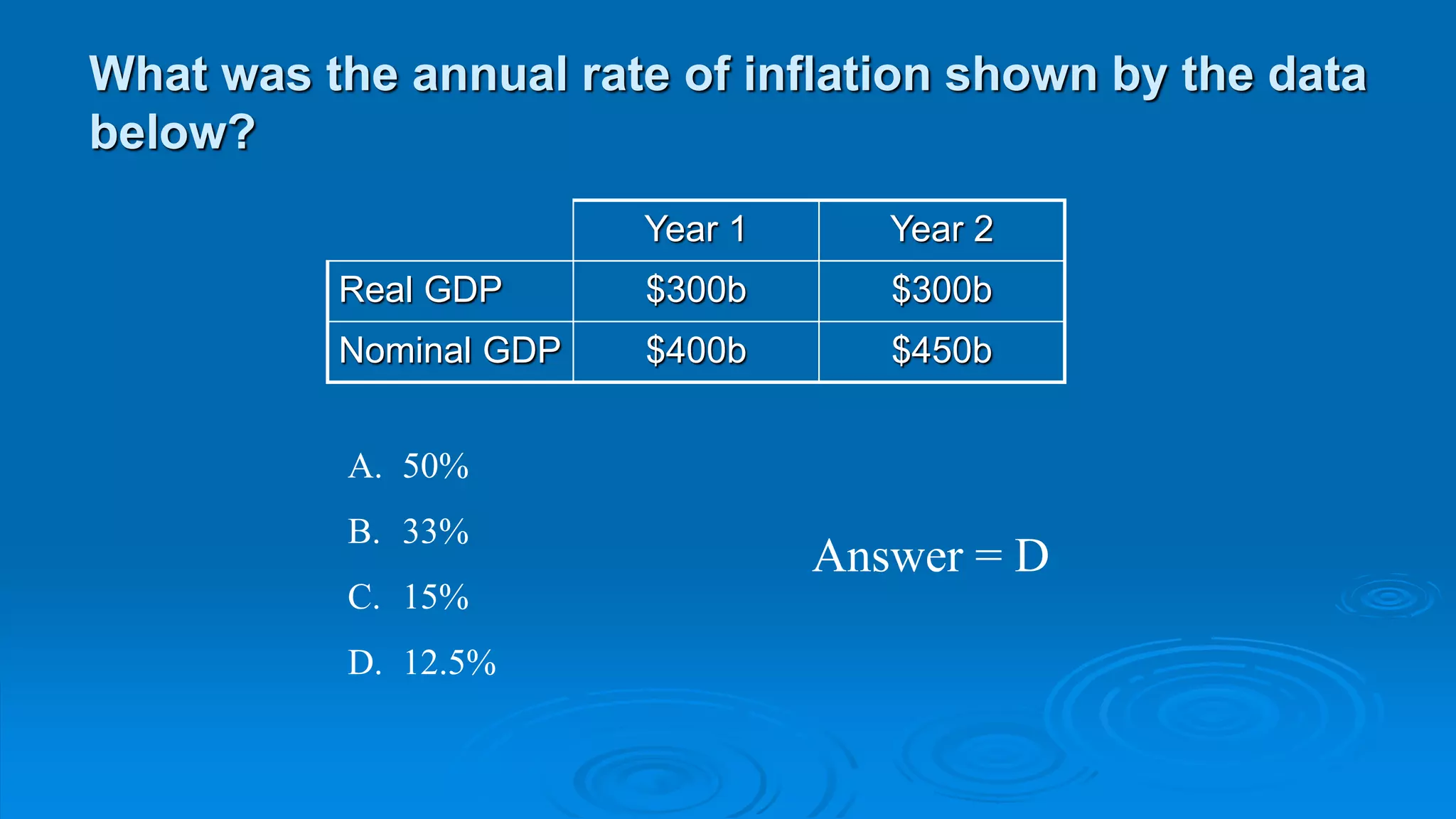
What was the annual rate of inflation shown by the data
below?
Year 1 Year 2
Real GDP $300b $300b
Nominal GDP $400b $450b
A. 50%
B. 33%
C. 15%
D. 12.5%
Answer = D
Section B style
CPI
March 1998 121.9
December 1998 121.8
March 1999 124.1
December 1999 125.2
Calculate the inflation rate for:
a) March quarter 1998 to December quarter 1998
b) March quarter 1999 to December quarter 1999
- 0.08%
0.89%
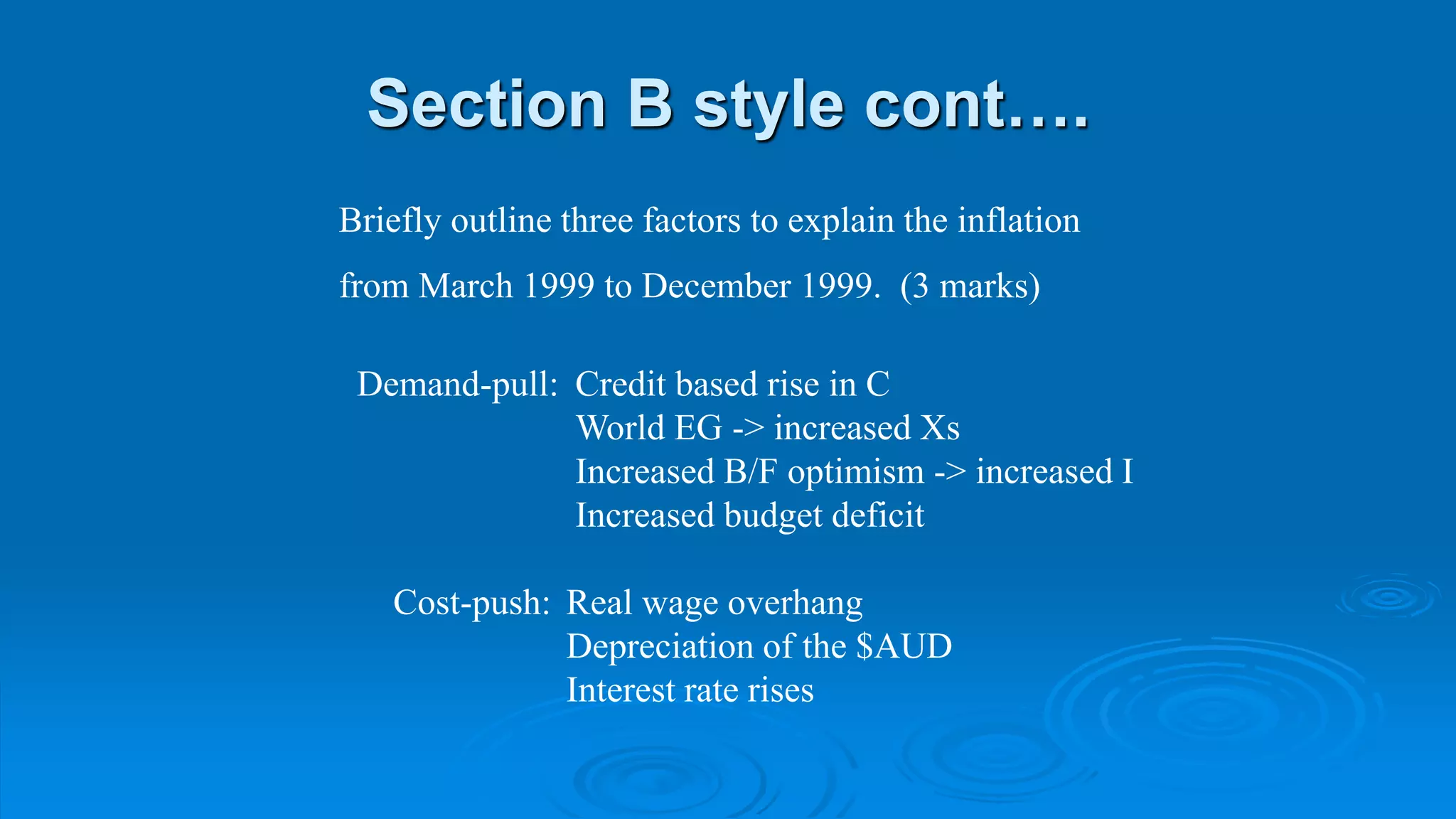
Section B style cont….
Briefly outline three factors to explain the inflation
from March 1999 to December 1999. (3 marks)
Demand-pull: Credit based rise in C
World EG -> increased Xs
Increased B/F optimism -> increased I
Increased budget deficit
Cost-push: Real wage overhang
Depreciation of the $AUD
Interest rate rises
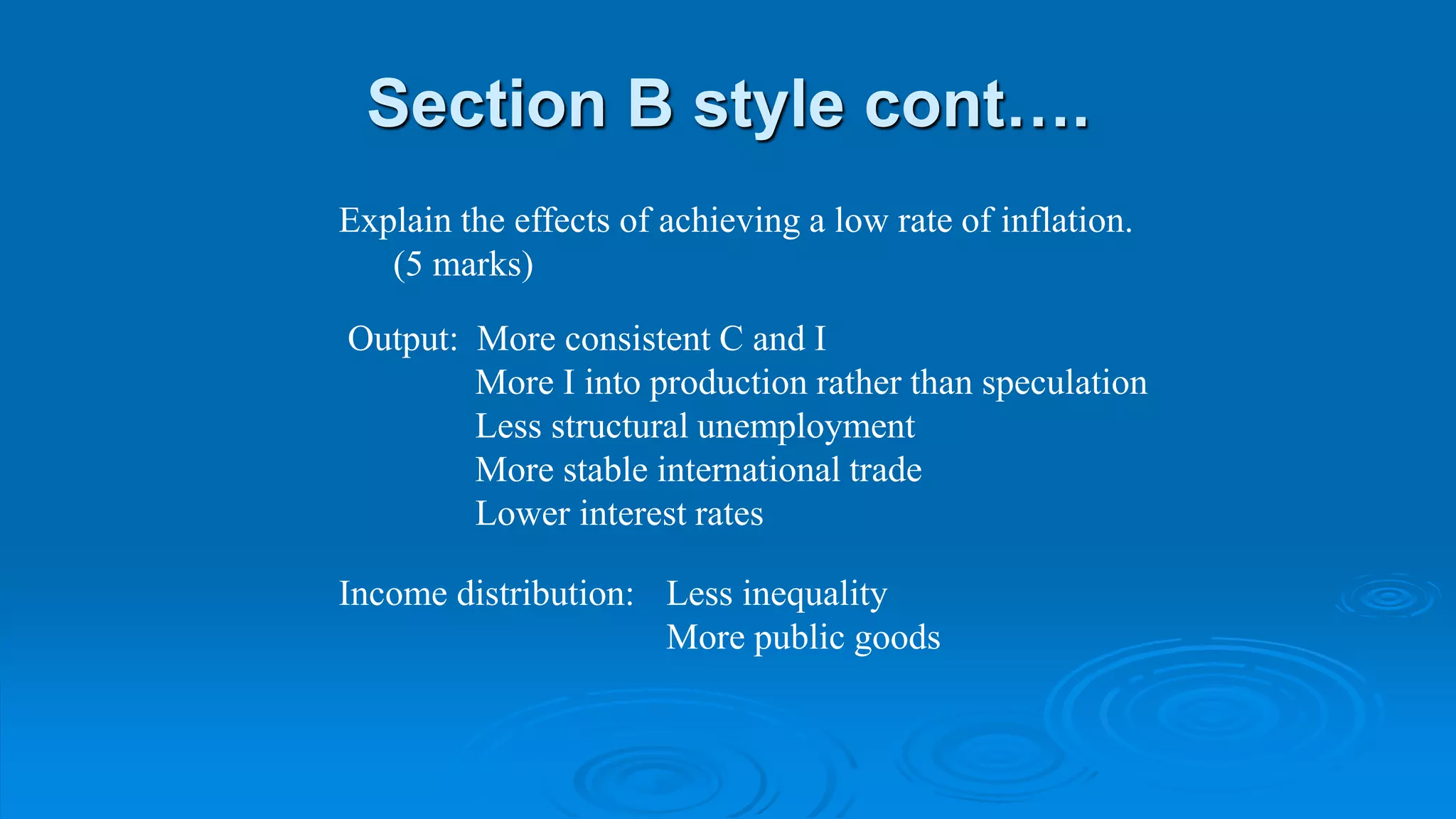
Section B style cont….
Explain the effects of achieving a low rate of inflation.
(5 marks)
Output: More consistent C and I
More I into production rather than speculation
Less structural unemployment
More stable international trade
Lower interest rates
Income distribution: Less inequality
More public goods
Section C style
a) Define inflation and how it is measured (8)
b) Outline the factors that have contributed to the
changing levels of inflation in Australia over recent
years. (12)
DOING words
KNOWLEDGE words
SKILLS - legibilty/literacy
- calculations
- graphics
PLAN!!!!!!!!!!!!
Define inflation
Show how it is measured
State factors affecting inflation
PLAN!!!!!!!!!!!!
Inf - rise gen level of ps
Dem-pull and cost-push
gen measure by CPI
[(CPI2 - CPI1) ÷ CPI1] x 100
Nos 140, 147 = 5%
a)
b)
RBA target 2%-3% per annum
Strong C (building and credit) = dem-pull
So must be reduced cost-push (use AD/AS graph)
- resource use prod/appreciation of $AUD
20

Effects of Inflation Teacher.ppt

  • 1.
  • 2.
    Effects of Inflation Inflation is a macroeconomic problem which can have significant detrimental effects for an economy.  The rise in the general level of prices (inflation) translates into a fall in the value of money – an undesirable situation. 2
  • 3.
    Effects of Inflation The effects of inflation are normally catergorised into two areas: (i) Output effects on income, output and employment (ii) Redistribution effects of income and wealth in the economy 3
  • 4.
    Output effects: Confidence Uncertainty – Inflation increases uncertainty about future outcomes.  Businesses invest on the basis of expectations.  Hence, inflation will tend to reduce productive investments and increase speculative investments (e.g. purchase of property, antiques and commodities-Gold ).  Causes misallocation of resources away from productive job creating investment  It also reduces consumer confidence, increase savings, decrease spending on durables and may reduce output and employment. 4
  • 5.
    Output effects: International competitiveness International competitiveness – If the rate of inflation is higher than our trading partners and competitors, then imports become relatively cheaper and exports become relatively more expensive (international competitiveness reduced).  This is likely to reduce national output and employment, as well as increase the Current Account deficit. 5
  • 6.
    Output effects: GovernmentPolicy  Tighter monetary policy – Increases in inflation will force interest rates upwards to maintain real interest rates.  This may reduce investment and consumption, and have a negative impact on output and employment.  Tighter fiscal policy – Government expenditure may be reduced in a period of inflation in an attempt to lower aggregate demand.  This may also reduce output and employment. 6
  • 7.
    Output effects: LabourMarket  Capital-for-labour substitution – increasing wage rates cause uncertainty whereas the cost of purchasing capital is certain.  This effect occurs mainly in unskilled labour markets. 7
  • 8.
    Redistribution effects:  Inflationaffects the community on an uneven basis and causes a redistribution and reallocation of resources. Much of the effect depends on whether the inflation is anticipated. 8
  • 9.
    Redistribution effects: Wealth& Income  Borrowers gain at the expense of lenders  the real value of a loan falls in times of inflation.  However, interest rates are normally adjusted to account for any inflation.  People on fixed incomes fall behind as the purchasing power of their incomes is reduced in times of inflation, e.g. recipients of welfare benefits. 9
  • 10.
    Redistribution effects: Income Strongly unionised essential service workers benefit by using industrial ‘muscle’ to gain wage increases above the inflation rate.  Monopolies in key industries can raise their prices ahead of inflation to maintain or increase profits. 10
  • 11.
    Redistribution effects: Income Government may benefit because as incomes rise, people pay a higher rate of tax. This process is known as ‘bracket creep’.  The mining boom period of 2011-13 saw many people forced into higher tax brackets particularly in the mining resource sector, whilst those in the service sector missed out (two-speed economy). 11
  • 12.
    Positives of inflation Some demand-pull inflation encourages firms to increase production in anticipation of receiving a higher price for the output sold. This contributes to employment and investment.  Inflation encourages firms to seek more efficient methods of production. This increases the production possibility frontier for the economy.
  • 13.
    What was theannual rate of inflation shown by the data below? Year 1 Year 2 Real GDP $300b $300b Nominal GDP $400b $450b A. 50% B. 33% C. 15% D. 12.5% Answer = D
  • 14.
    Section B style CPI March1998 121.9 December 1998 121.8 March 1999 124.1 December 1999 125.2 Calculate the inflation rate for: a) March quarter 1998 to December quarter 1998 b) March quarter 1999 to December quarter 1999 - 0.08% 0.89%
  • 15.
    Section B stylecont…. Briefly outline three factors to explain the inflation from March 1999 to December 1999. (3 marks) Demand-pull: Credit based rise in C World EG -> increased Xs Increased B/F optimism -> increased I Increased budget deficit Cost-push: Real wage overhang Depreciation of the $AUD Interest rate rises
  • 16.
    Section B stylecont…. Explain the effects of achieving a low rate of inflation. (5 marks) Output: More consistent C and I More I into production rather than speculation Less structural unemployment More stable international trade Lower interest rates Income distribution: Less inequality More public goods
  • 17.
    Section C style a)Define inflation and how it is measured (8) b) Outline the factors that have contributed to the changing levels of inflation in Australia over recent years. (12) DOING words KNOWLEDGE words SKILLS - legibilty/literacy - calculations - graphics
  • 18.
    PLAN!!!!!!!!!!!! Define inflation Show howit is measured State factors affecting inflation
  • 19.
    PLAN!!!!!!!!!!!! Inf - risegen level of ps Dem-pull and cost-push gen measure by CPI [(CPI2 - CPI1) ÷ CPI1] x 100 Nos 140, 147 = 5% a) b) RBA target 2%-3% per annum Strong C (building and credit) = dem-pull So must be reduced cost-push (use AD/AS graph) - resource use prod/appreciation of $AUD
  • 20.

Editor's Notes

  • #2 Effects of Inflation