Elasticity
Elasticity . . .
… allows us to analyze supply and
demand with greater precision.
… is a measure of how much buyers and
sellers respond to changes in market
conditions
THE ELASTICITY OF DEMAND
Price elasticity of demand is a measure of
how much the quantity demanded of a
good responds to a change in the price of
that good.
Price elasticity of demand is the
percentage change in quantity demanded
given a percent change in the price.
What determines price
elasticity?
To learn the determinants of price elasticity,
we look at a series of examples.
Each compares two common goods.
In each example:
– Suppose the prices of both goods rise by 20%.
– The good for which Qd falls the most (in percent) has
the highest price elasticity of demand.
Which good is it? Why?
– What lesson does the example teach us about the
determinants of the price elasticity of demand?
Determinants of Elasticity
Whether close substitutes are available
Broadly defined goods vs. narrowly
defined goods
Necessities vs. Luxuries
How much of the consumer’s budget is
spent on the good
Long run vs. Short run
EXAMPLE 1:
Rice Krispies vs. Sunscreen
The prices of both of these goods rise by 20%.
For which good does Qd drop the most? Why?
– Rice Krispies has lots of close substitutes
(e.g., Cap’n Crunch, Count Chocula),
so buyers can easily switch if the price rises.
– Sunscreen has no close substitutes,
so consumers would probably not
buy much less if its price rises.
Lesson: Price elasticity is higher when close
substitutes are available.
EXAMPLE 2:
“Blue Jeans” vs. “Clothing”
The prices of both goods rise by 20%.
For which good does Qd drop the most? Why?
– For a narrowly defined good such as
blue jeans, there are many substitutes
(khakis, shorts, Speedos).
– There are fewer substitutes available for broadly
defined goods.
(Can you think of a substitute for clothing,
other than living in a nudist colony?)
Lesson: Price elasticity is higher for narrowly
defined goods than broadly defined ones.
EXAMPLE 3:
Insulin vs. Caribbean Cruises
The prices of both of these goods rise by 20%.
For which good does Qd drop the most? Why?
– To millions of diabetics, insulin is a necessity.
A rise in its price would cause little or no decrease in
demand.
– A cruise is a luxury. If the price rises,
some people will forego it.
Lesson: Price elasticity is higher for luxuries than for
necessities.
EXAMPLE 4: Gasoline in the Short
Run vs. Gasoline in the Long Run
The price of gasoline rises 20%. Does Qd drop more in
the short run or the long run? Why?
– There’s not much people can do in the
short run, other than ride the bus or carpool.
– In the long run, people can buy smaller cars
or live closer to where they work.
Lesson: Price elasticity is higher in the
long run than the short run.
How much of the consumer’s
budget is spent on the good
When a good represents a large share of a
consumer’s budget, a price increase importantly
reduces the amount of the good that a consumer
is able to buy
– The amount demanded will decrease significantly.
When the good represents a smaller share of
the consumer’s budget, the consumer’s overall
income and purchasing power are less effected
by an increase in price.
– Therefore, demand is less price elastic in these
cases.
Percentage of Income
The higher the percentage of the
consumer's income that the product's price
represents, the higher the elasticity tends
to be, as people will pay more attention
when purchasing the good because of its
cost. (Income effect)
When the goods represent only a small
portion of the budget the income effect will
be insignificant and demand inelastic
The Price Elasticity of Demand and Its
Determinants
Demand tends to be more elastic :
– the larger the number of close substitutes.
– if the good is a luxury.
– the more narrowly defined the market.
– the longer the time period.
– Percentage of income
Computing the Price Elasticity of
Demand
The price elasticity of demand is computed
as the percentage change in the quantity
demanded divided by the percentage
change in price.
Price elasticity of demand =
Percentage change in quantity demanded
Percentage change in price
Example: If the price of an ice cream cone
increases from $2.00 to $2.20 and the
amount you buy falls from 10 to 8 cones,
then your elasticity of demand would be
calculated as:
Computing the Price Elasticity of
Demand
Price elasticity of demand =
Percentage change in quantity demanded
Percentage change in price
( )
( . . )
.
10 8
10
100
2 20 2 00
2 00
100
20%
10%
2




 
The Midpoint Method: A Better Way to
Calculate Percentage Changes and
Elasticities
The midpoint formula is preferable when
calculating the price elasticity of demand
because it gives the same answer
regardless of the direction of the change.
Price elasticity of demand =
( ) /[( ) / ]
( ) /[( ) / ]
Q Q Q Q
P P P P
2 1 2 1
2 1 2 1
2
2
 
 
The Midpoint Method: A Better Way to
Calculate Percentage Changes and
Elasticities
Example: If the price of an ice cream cone
increases from $2.00 to $2.20 and the
amount you buy falls from 10 to 8 cones,
then your elasticity of demand, using the
midpoint formula, would be calculated as:
( )
( ) /
( . . )
( . . ) /
.
.
10 8
10 8 2
2 20 2 00
2 00 2 20 2
22%
9 5%
2 32




 
The Variety of Demand Curves
Inelastic Demand
– Quantity demanded does not respond
strongly to price changes.
– Price elasticity of demand is less than one.
Elastic Demand
– Quantity demanded responds strongly to
changes in price.
– Price elasticity of demand is greater than one.
The Variety of Demand Curves
Perfectly Inelastic
– Quantity demanded does not respond to price
changes.
Perfectly Elastic
– Quantity demanded changes infinitely with
any change in price.
Unit Elastic
– Quantity demanded changes by the same
percentage as the price.
The Variety of Demand Curves
Because the price elasticity of demand
measures how much quantity demanded
responds to the price, it is closely related
to the slope of the demand curve.
Figure 1 The Price Elasticity of Demand
Copyright©2003 Southwestern/Thomson Learning
(a) Perfectly Inelastic Demand: Elasticity Equals 0
$5
4
Quantity
Demand
100
0
1. An
increase
in price . . .
2. . . . leaves the quantity demanded unchanged.
Price
Figure 1 The Price Elasticity of Demand
(b) Inelastic Demand: Elasticity Is Less Than 1
Quantity
0
$5
90
Demand
1. A 22%
increase
in price . . .
Price
2. . . . leads to an 11% decrease in quantity demanded.
4
100
ΔQ<ΔP
Figure 1 The Price Elasticity of Demand
Copyright©2003 Southwestern/Thomson Learning
2. . . . leads to a 22% decrease in quantity demanded.
(c) Unit Elastic Demand: Elasticity Equals 1
Quantity
4
100
0
Price
$5
80
1. A 22%
increase
in price . . .
Demand
Figure 1 The Price Elasticity of Demand
(d) Elastic Demand: Elasticity Is Greater Than 1
Demand
Quantity
4
100
0
Price
$5
50
1. A 22%
increase
in price . . .
2. . . . leads to a 67% decrease in quantity demanded.
ΔQ>ΔP
Figure 1 The Price Elasticity of Demand
(e) Perfectly Elastic Demand: Elasticity Equals Infinity
Quantity
0
Price
$4 Demand
2. At exactly $4,
consumers will
buy any quantity.
1. At any price
above $4, quantity
demanded is zero.
3. At a price below $4,
quantity demanded is infinite.
Total Revenue and the Price Elasticity
of Demand
Total revenue is the amount paid by
buyers and received by sellers of a good.
Computed as the price of the good times
the quantity sold.
TR = P x Q
Figure 2 Total Revenue
Copyright©2003 Southwestern/Thomson Learning
Demand
Quantity
Q
P
0
Price
P × Q = $400
(revenue)
$4
100
Elasticity and Total Revenue along a
Linear Demand Curve
With an inelastic demand curve, an
increase in price leads to a decrease in
quantity that is proportionately smaller.
Thus, total revenue increases.
Figure 3 How Total Revenue Changes When Price
Changes: Inelastic Demand
Copyright©2003 Southwestern/Thomson Learning
Demand
Quantity
0
Price
Revenue = $100
Quantity
0
Price
Revenue = $240
Demand
$1
100
$3
80
An Increase in price from $1
to $3 …
… leads to an Increase in
total revenue from $100 to
$240
Elasticity and Total Revenue along a
Linear Demand Curve
With an elastic demand curve, an increase
in the price leads to a decrease in quantity
demanded that is proportionately larger.
Thus, total revenue decreases.
Figure 4 How Total Revenue Changes When Price
Changes: Elastic Demand
Copyright©2003 Southwestern/Thomson Learning
Demand
Quantity
0
Price
Revenue = $200
$4
50
Demand
Quantity
0
Price
Revenue = $100
$5
20
An Increase in price from $4
to $5 …
… leads to an decrease in
total revenue from $200 to
$100
Elasticity & Total Revenue Test
Elastic > 1 if P decreases
=> TR increases; if P
increases TR decreases
Unit elastic = 1 if ΔP => no
ΔTR
Inelastic < 1 if P decreases
=> TR decreases; if P
increases TR increases
Figure 19-2 The Relationship Between Price Elasticity of
Demand and Total Revenues for Cellular Phone Service,
Panel (b)
Figure 19-2 The Relationship Between Price Elasticity of
Demand and Total Revenues for Cellular Phone Service,
Panel (c)
Relationship Between Price Elasticity of Demand
and Total Revenues
Income Elasticity of Demand
Income elasticity of demand measures
how much the quantity demanded of a
good responds to a change in consumers’
income.
It is computed as the percentage change
in the quantity demanded divided by the
percentage change in income.
Computing Income Elasticity
Income elasticity of demand =
Percentage change
in quantity demanded
Percentage change
in income
Income Elasticity
Types of Goods
– Normal Goods
– Inferior Goods
Higher income raises the quantity
demanded for normal goods but lowers
the quantity demanded for inferior goods.
Income Elasticity
Goods consumers regard as necessities
tend to be income inelastic
– Examples include food, fuel, clothing, utilities,
and medical services.
Goods consumers regard as luxuries tend
to be income elastic.
– Examples include sports cars, furs, and
expensive foods.
Cross-Price Elasticity of
Demand
A measure of how much the quantity demanded
of one good responds to a change in the price
of another good
Cross-price elasticity of demand = percentage
change in quantity demanded of good
1/percentage change in the price of good 2
Substitute goods – cross-price elasticity of
demand is positive
Complement goods – cross-price elasticity of
demand is negative
THE ELASTICITY OF SUPPLY
Price elasticity of supply is a measure of
how much the quantity supplied of a good
responds to a change in the price of that
good.
Price elasticity of supply is the percentage
change in quantity supplied resulting from
a percent change in price.
Figure 6 The Price Elasticity of Supply
Copyright©2003 Southwestern/Thomson Learning
(a) Perfectly Inelastic Supply: Elasticity Equals 0
$5
4
Supply
Quantity
100
0
1. An
increase
in price . . .
2. . . . leaves the quantity supplied unchanged.
Price
Figure 6 The Price Elasticity of Supply
Copyright©2003 Southwestern/Thomson Learning
(b) Inelastic Supply: Elasticity Is Less Than 1
110
$5
100
4
Quantity
0
1. A 22%
increase
in price . . .
Price
2. . . . leads to a 10% increase in quantity supplied.
Supply
Figure 6 The Price Elasticity of Supply
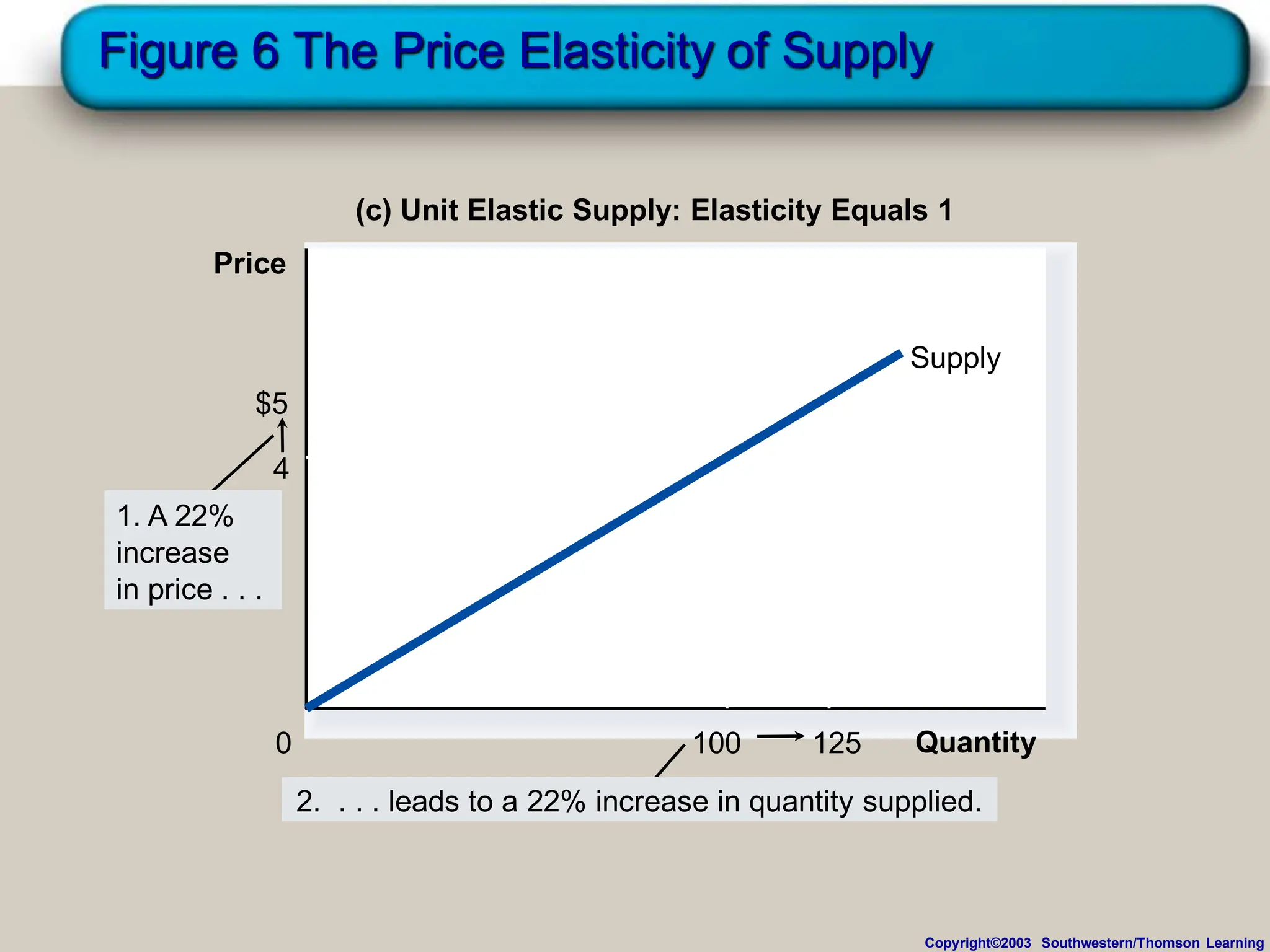
Copyright©2003 Southwestern/Thomson Learning
(c) Unit Elastic Supply: Elasticity Equals 1
125
$5
100
4
Quantity
0
Price
2. . . . leads to a 22% increase in quantity supplied.
1. A 22%
increase
in price . . .
Supply
Figure 6 The Price Elasticity of Supply
Copyright©2003 Southwestern/Thomson Learning
(d) Elastic Supply: Elasticity Is Greater Than 1
Quantity
0
Price
1. A 22%
increase
in price . . .
2. . . . leads to a 67% increase in quantity supplied.
4
100
$5
200
Supply
Figure 6 The Price Elasticity of Supply
Copyright©2003 Southwestern/Thomson Learning
(e) Perfectly Elastic Supply: Elasticity Equals Infinity
Quantity
0
Price
$4 Supply
3. At a price below $4,
quantity supplied is zero.
2. At exactly $4,
producers will
supply any quantity.
1. At any price
above $4, quantity
supplied is infinite.
Determinants of Elasticity of Supply
Ability of sellers to change the amount of
the good they produce.
– Beach-front land is inelastic.
– Books, cars, or manufactured goods are
elastic.
Time period. (Key determinant)
– The amount of time a seller has to change the
amount of the good they can produce
– Supply is more elastic in the long run.
Elasticity of Supply – Slope of
Curve
Immediately
– Inelastic supply
– Vertical or steep
Short Run
– More elastic due to the
firm’s intense use of
fixed resources
Elasticity of Supply – Slope of
Curve
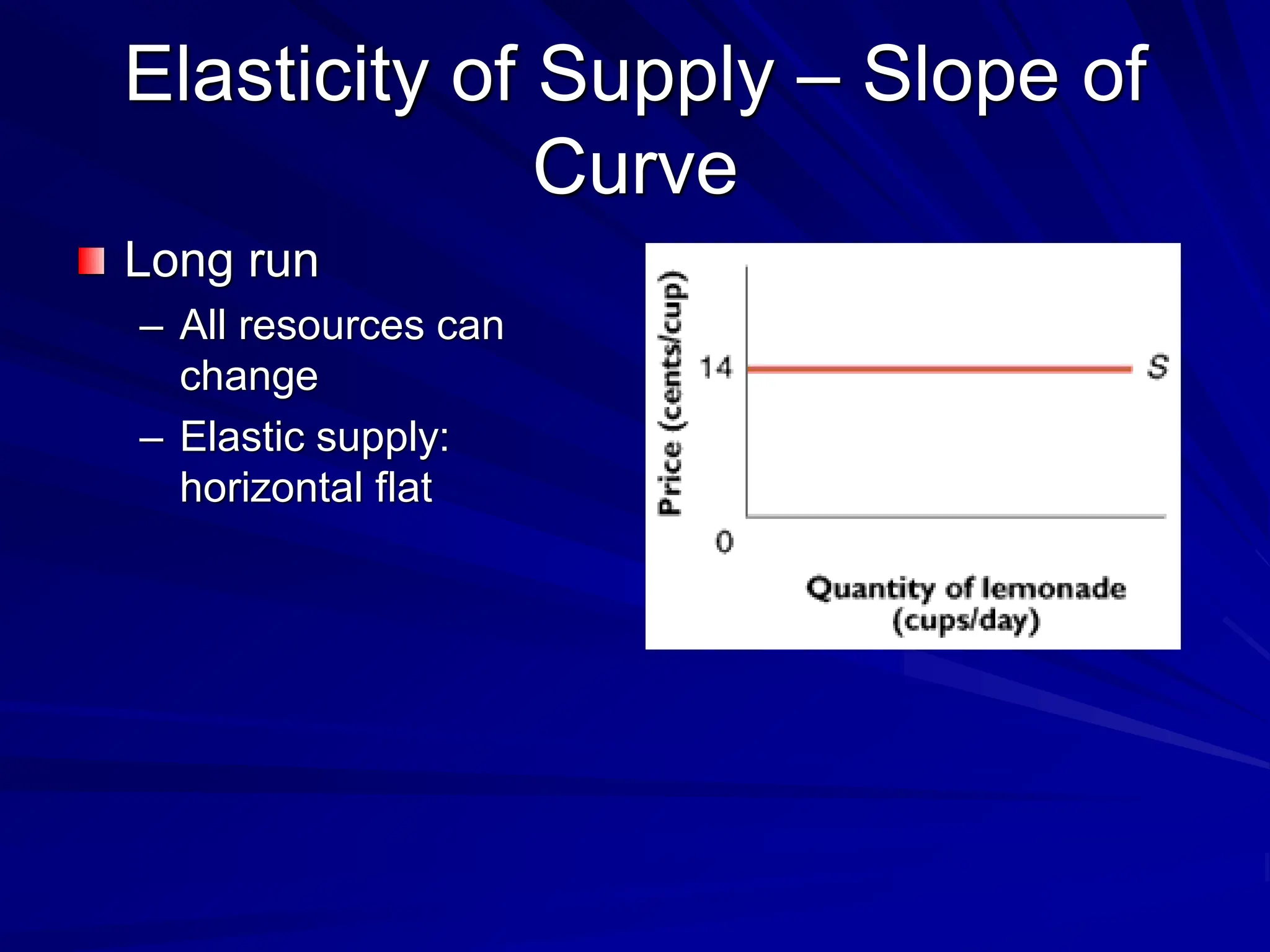
Long run
– All resources can
change
– Elastic supply:
horizontal flat
Computing the Price Elasticity of
Supply
The price elasticity of supply is computed
as the percentage change in the quantity
supplied divided by the percentage
change in price.
Price elasticity of supply =
Percentage change
in quantity supplied
Percentage change in price
APPLICATION of ELASTICITY
Can good news for farming be bad news
for farmers?
What happens to wheat farmers and the
market for wheat when university
agronomists discover a new wheat hybrid
that is more productive than existing
varieties?
THE APPLICATION OF SUPPLY,
DEMAND, AND ELASTICITY
Examine whether the supply or demand
curve shifts.
Determine the direction of the shift of the
curve.
Use the supply-and-demand diagram to
see how the market equilibrium changes.
Figure 8 An Increase in Supply in the Market for
Wheat
Copyright©2003 Southwestern/Thomson Learning
Quantity of
Wheat
0
Price of
Wheat
3. . . . and a proportionately smaller
increase in quantity sold. As a result,
revenue falls from $300 to $220.
Demand
S1
S2
2. . . . leads
to a large fall
in price . . .
1. When demand is inelastic,
an increase in supply . . .
2
110
$3
100
Compute the Price Elasticity of Supply
ED 






 
100 110
100 110 2
300 2 00
300 2 00 2
0095
04
0 24
( ) /
. .
( . . ) /
.
.
.
Supply is inelastic
Summary
Price elasticity of demand measures how
much the quantity demanded responds to
changes in the price.
Price elasticity of demand is calculated as the
percentage change in quantity demanded
divided by the percentage change in price.
If a demand curve is elastic, total revenue
falls when the price rises.
If it is inelastic, total revenue rises as the
price rises.
Summary
The income elasticity of demand measures how
much the quantity demanded responds to
changes in consumers’ income.
The cross-price elasticity of demand measures
how much the quantity demanded of one good
responds to the price of another good.
The price elasticity of supply measures how
much the quantity supplied responds to
changes in the price. .
Summary
In most markets, supply is more elastic in
the long run than in the short run.
The price elasticity of supply is calculated
as the percentage change in quantity
supplied divided by the percentage
change in price.
The tools of supply and demand can be
applied in many different types of markets.
Demand Elasticity
Demand elasticity – the extent to which a
change in price causes a change in the quantity
demanded.
A given change in price will cause a relatively
larger, a relatively smaller, or a proportional
change in quantity demanded.
A corporation must estimate if they change the
price either up or down will demand increase,
decrease or stay the same.
Elastic
Elastic – when the change in price causes a relatively
larger change in quantity demanded
During the summer price of vegetables decreases so the
amount purchased is increased.
But during the winter the price of vegetables increases
so the amount purchased decreases drastically. A big
change in the amount purchased over the seasons.
If a change in price causes a relatively large change
in the quantity demanded, demand is elastic.
Inelastic
Inelastic – means that a given change in the price
causes a relatively smaller change in quantity
demanded.
If table salt dropped in price by half going from $1 to $.50
then demand would not change because you can
consume only so much salt. And if salt goes from $1 to
$2 then demand would not change because it is still a
small percentage of your budget.
If change in price causes a relatively smaller change in
quantity demanded, demand is inelastic
Unit elastic
Unit elastic – a given change in price
causes a proportional change in quantity
demanded
So if there is a 5% change in price then
there will be a 5% change in quantity.
Price elasticity
Price elasticity = percentage change in quantity
percentage change in price
Perfectly inelastic: elasticity equals 0
Inelastic: elasticity is less than 1
Unit elastic: elasticity equals 1
Elastic: elasticity is greater than 1
Perfectly elastic: elasticity equals infinity
Q1
P1
D
“Perfectly inelastic demand” (one
extreme case)
P
Q
P2
P falls
by 10%
Q changes
by 0%
0%
10%
= 0
Price elasticity
of demand
=
% change in Q
% change in P
=
Consumers’
price sensitivity:
D
curve:
Elasticity:
vertical
0
0
D
“Inelastic demand”
P
Q
Q1
P1
Q2
P2
Q rises less
than 10%
< 10%
10%
< 1
Price elasticity
of demand
=
% change in Q
% change in P
=
P falls
by 10%
Consumers’
price sensitivity:
D
curve:
Elasticity:
relatively steep
relatively low
< 1
D
“Unit elastic demand”
P
Q
Q1
P1
Q2
P2
Q rises by 10%
10%
10%
= 1
Price elasticity
of demand
=
% change in Q
% change in P
=
P falls
by 10%
Consumers’
price sensitivity:
Elasticity:
intermediate
1
D curve:
intermediate slope
D
“Elastic demand”
P
Q
Q1
P1
Q2
P2
Q rises more
than 10%
> 10%
10%
> 1
Price elasticity
of demand
=
% change in Q
% change in P
=
P falls
by 10%
Consumers’
price sensitivity:
D curve:
Elasticity:
relatively flat
relatively high
> 1
D
“Perfectly elastic demand” (the
other extreme)
P
Q
P1
Q1
P changes
by 0%
Q changes
by any %
any %
0%
= infinity
Q2
P2 =
Consumers’
price sensitivity:
D curve:
Elasticity:
infinity
horizontal
extreme
Price elasticity
of demand
=
% change in Q
% change in P
=
Elasticity of a Linear Demand
Curve
The slope
of a linear
demand
curve is
constant,
but its
elasticity
is not.
P
Q
$30
20
10
$0
0 20 40 60
200%
40%
= 5.0
E =
67%
67%
= 1.0
E =
40%
200%
= 0.2
E =
Supply Elasticity
Supply Elasticity – describes how a change in quantity
supplied responds to a change in price
What is the difference between supply elasticity and
demand elasticity?
– If quantities are being purchased, the concept is demand
elasticity. If quantities are being brought to market for sale, the
concept is supply elasticity
If supply is elastic, a given change in price will cause a
more than proportional change in quantity supplied.
If supply is inelastic, a given change in price will cause a
less than proportional change in quantity supplied.
If supply is unit elastic, a given change in price will cause
a proportional change in quantity supplied.
Price Elasticity Problems
Are the following examples elastic,
inelastic, or unit elastic
1) change in price = 30%;
change in quantity demanded = 50%
2) change in price = 30%;
change in quantity supplied = 30%
3) change in price = 30%
change in quantity demanded = 15%
Price Elasticity Answers
1) 50/30 = 1.66… Elastic demand
2) 30/30 = 1 Unit Elastic supplied
3) 15/30 = 0.50 Inelastic demand
A C T I V E L E A R N I N G 2:
Elasticity and expenditure/revenue
A. Pharmacies raise the price of insulin by
10%. Does total expenditure on insulin
rise or fall?
B. As a result of a fare war, the price of a
luxury cruise falls 20%.
Does luxury cruise companies’ total
revenue rise or fall?
72
A C T I V E L E A R N I N G 2:
Answers
73
A. Pharmacies raise the price of insulin by
10%. Does total expenditure on insulin
rise or fall?
Expenditure = P x Q
Since demand is inelastic, Q will fall less
than 10%, so expenditure rises.
A C T I V E L E A R N I N G 2:
Answers
74
B. As a result of a fare war, the price of a luxury
cruise falls 20%.
Does luxury cruise companies’ total revenue
rise or fall?
Revenue = P x Q
The fall in P reduces revenue,
but Q increases, which increases revenue.
Which effect is bigger?
Since demand is elastic, Q will increase more
than 20%, so revenue rises.
Calculating Percentage Changes
P
Q
D
$250
8
B
$200
12
A
Demand for
your websites
Calculating Percentage
Changes
So, we instead use the midpoint
method:
end value – start value
midpoint
x 100%
The midpoint is the number halfway
between the start & end values, also
the average of those values.
It doesn’t matter which value you use
as the “start” and which as the “end” –
you get the same answer either way!
Calculating Percentage
Changes
Using the midpoint method, the % change
in P equals
$250 – $200
$225
x 100% = 22.2%
The % change in Q equals
12 – 8
10
x 100% = 40.0%
The price elasticity of demand equals
40/22.2 = 1.8
A C T I V E L E A R N I N G 1:
Calculate an elasticity
Use the following
information to
calculate the
price elasticity
of demand
for hotel rooms:
if P = $70, Qd =
5000
if P = $90, Qd =
3000 78
A C T I V E L E A R N I N G 1:
Answers
Use midpoint method to calculate
% change in Qd
(5000 – 3000)/4000 = 50%
% change in P
($90 – $70)/$80 = 25%
The price elasticity of demand equals
79
50%
25%
= 2.0
Chapter. 5 elasticity by Mankiw Economics .pdf

Chapter. 5 elasticity by Mankiw Economics .pdf

  • 1.
  • 2.
    Elasticity . .. … allows us to analyze supply and demand with greater precision. … is a measure of how much buyers and sellers respond to changes in market conditions
  • 3.
    THE ELASTICITY OFDEMAND Price elasticity of demand is a measure of how much the quantity demanded of a good responds to a change in the price of that good. Price elasticity of demand is the percentage change in quantity demanded given a percent change in the price.
  • 4.
    What determines price elasticity? Tolearn the determinants of price elasticity, we look at a series of examples. Each compares two common goods. In each example: – Suppose the prices of both goods rise by 20%. – The good for which Qd falls the most (in percent) has the highest price elasticity of demand. Which good is it? Why? – What lesson does the example teach us about the determinants of the price elasticity of demand?
  • 5.
    Determinants of Elasticity Whetherclose substitutes are available Broadly defined goods vs. narrowly defined goods Necessities vs. Luxuries How much of the consumer’s budget is spent on the good Long run vs. Short run
  • 6.
    EXAMPLE 1: Rice Krispiesvs. Sunscreen The prices of both of these goods rise by 20%. For which good does Qd drop the most? Why? – Rice Krispies has lots of close substitutes (e.g., Cap’n Crunch, Count Chocula), so buyers can easily switch if the price rises. – Sunscreen has no close substitutes, so consumers would probably not buy much less if its price rises. Lesson: Price elasticity is higher when close substitutes are available.
  • 7.
    EXAMPLE 2: “Blue Jeans”vs. “Clothing” The prices of both goods rise by 20%. For which good does Qd drop the most? Why? – For a narrowly defined good such as blue jeans, there are many substitutes (khakis, shorts, Speedos). – There are fewer substitutes available for broadly defined goods. (Can you think of a substitute for clothing, other than living in a nudist colony?) Lesson: Price elasticity is higher for narrowly defined goods than broadly defined ones.
  • 8.
    EXAMPLE 3: Insulin vs.Caribbean Cruises The prices of both of these goods rise by 20%. For which good does Qd drop the most? Why? – To millions of diabetics, insulin is a necessity. A rise in its price would cause little or no decrease in demand. – A cruise is a luxury. If the price rises, some people will forego it. Lesson: Price elasticity is higher for luxuries than for necessities.
  • 9.
    EXAMPLE 4: Gasolinein the Short Run vs. Gasoline in the Long Run The price of gasoline rises 20%. Does Qd drop more in the short run or the long run? Why? – There’s not much people can do in the short run, other than ride the bus or carpool. – In the long run, people can buy smaller cars or live closer to where they work. Lesson: Price elasticity is higher in the long run than the short run.
  • 10.
    How much ofthe consumer’s budget is spent on the good When a good represents a large share of a consumer’s budget, a price increase importantly reduces the amount of the good that a consumer is able to buy – The amount demanded will decrease significantly. When the good represents a smaller share of the consumer’s budget, the consumer’s overall income and purchasing power are less effected by an increase in price. – Therefore, demand is less price elastic in these cases.
  • 11.
    Percentage of Income Thehigher the percentage of the consumer's income that the product's price represents, the higher the elasticity tends to be, as people will pay more attention when purchasing the good because of its cost. (Income effect) When the goods represent only a small portion of the budget the income effect will be insignificant and demand inelastic
  • 12.
    The Price Elasticityof Demand and Its Determinants Demand tends to be more elastic : – the larger the number of close substitutes. – if the good is a luxury. – the more narrowly defined the market. – the longer the time period. – Percentage of income
  • 13.
    Computing the PriceElasticity of Demand The price elasticity of demand is computed as the percentage change in the quantity demanded divided by the percentage change in price. Price elasticity of demand = Percentage change in quantity demanded Percentage change in price
  • 14.
    Example: If theprice of an ice cream cone increases from $2.00 to $2.20 and the amount you buy falls from 10 to 8 cones, then your elasticity of demand would be calculated as: Computing the Price Elasticity of Demand Price elasticity of demand = Percentage change in quantity demanded Percentage change in price ( ) ( . . ) . 10 8 10 100 2 20 2 00 2 00 100 20% 10% 2      
  • 15.
    The Midpoint Method:A Better Way to Calculate Percentage Changes and Elasticities The midpoint formula is preferable when calculating the price elasticity of demand because it gives the same answer regardless of the direction of the change. Price elasticity of demand = ( ) /[( ) / ] ( ) /[( ) / ] Q Q Q Q P P P P 2 1 2 1 2 1 2 1 2 2    
  • 16.
    The Midpoint Method:A Better Way to Calculate Percentage Changes and Elasticities Example: If the price of an ice cream cone increases from $2.00 to $2.20 and the amount you buy falls from 10 to 8 cones, then your elasticity of demand, using the midpoint formula, would be calculated as: ( ) ( ) / ( . . ) ( . . ) / . . 10 8 10 8 2 2 20 2 00 2 00 2 20 2 22% 9 5% 2 32      
  • 17.
    The Variety ofDemand Curves Inelastic Demand – Quantity demanded does not respond strongly to price changes. – Price elasticity of demand is less than one. Elastic Demand – Quantity demanded responds strongly to changes in price. – Price elasticity of demand is greater than one.
  • 18.
    The Variety ofDemand Curves Perfectly Inelastic – Quantity demanded does not respond to price changes. Perfectly Elastic – Quantity demanded changes infinitely with any change in price. Unit Elastic – Quantity demanded changes by the same percentage as the price.
  • 19.
    The Variety ofDemand Curves Because the price elasticity of demand measures how much quantity demanded responds to the price, it is closely related to the slope of the demand curve.
  • 20.
    Figure 1 ThePrice Elasticity of Demand Copyright©2003 Southwestern/Thomson Learning (a) Perfectly Inelastic Demand: Elasticity Equals 0 $5 4 Quantity Demand 100 0 1. An increase in price . . . 2. . . . leaves the quantity demanded unchanged. Price
  • 21.
    Figure 1 ThePrice Elasticity of Demand (b) Inelastic Demand: Elasticity Is Less Than 1 Quantity 0 $5 90 Demand 1. A 22% increase in price . . . Price 2. . . . leads to an 11% decrease in quantity demanded. 4 100 ΔQ<ΔP
  • 22.
    Figure 1 ThePrice Elasticity of Demand Copyright©2003 Southwestern/Thomson Learning 2. . . . leads to a 22% decrease in quantity demanded. (c) Unit Elastic Demand: Elasticity Equals 1 Quantity 4 100 0 Price $5 80 1. A 22% increase in price . . . Demand
  • 23.
    Figure 1 ThePrice Elasticity of Demand (d) Elastic Demand: Elasticity Is Greater Than 1 Demand Quantity 4 100 0 Price $5 50 1. A 22% increase in price . . . 2. . . . leads to a 67% decrease in quantity demanded. ΔQ>ΔP
  • 24.
    Figure 1 ThePrice Elasticity of Demand (e) Perfectly Elastic Demand: Elasticity Equals Infinity Quantity 0 Price $4 Demand 2. At exactly $4, consumers will buy any quantity. 1. At any price above $4, quantity demanded is zero. 3. At a price below $4, quantity demanded is infinite.
  • 25.
    Total Revenue andthe Price Elasticity of Demand Total revenue is the amount paid by buyers and received by sellers of a good. Computed as the price of the good times the quantity sold. TR = P x Q
  • 26.
    Figure 2 TotalRevenue Copyright©2003 Southwestern/Thomson Learning Demand Quantity Q P 0 Price P × Q = $400 (revenue) $4 100
  • 27.
    Elasticity and TotalRevenue along a Linear Demand Curve With an inelastic demand curve, an increase in price leads to a decrease in quantity that is proportionately smaller. Thus, total revenue increases.
  • 28.
    Figure 3 HowTotal Revenue Changes When Price Changes: Inelastic Demand Copyright©2003 Southwestern/Thomson Learning Demand Quantity 0 Price Revenue = $100 Quantity 0 Price Revenue = $240 Demand $1 100 $3 80 An Increase in price from $1 to $3 … … leads to an Increase in total revenue from $100 to $240
  • 29.
    Elasticity and TotalRevenue along a Linear Demand Curve With an elastic demand curve, an increase in the price leads to a decrease in quantity demanded that is proportionately larger. Thus, total revenue decreases.
  • 30.
    Figure 4 HowTotal Revenue Changes When Price Changes: Elastic Demand Copyright©2003 Southwestern/Thomson Learning Demand Quantity 0 Price Revenue = $200 $4 50 Demand Quantity 0 Price Revenue = $100 $5 20 An Increase in price from $4 to $5 … … leads to an decrease in total revenue from $200 to $100
  • 31.
    Elasticity & TotalRevenue Test Elastic > 1 if P decreases => TR increases; if P increases TR decreases Unit elastic = 1 if ΔP => no ΔTR Inelastic < 1 if P decreases => TR decreases; if P increases TR increases
  • 32.
    Figure 19-2 TheRelationship Between Price Elasticity of Demand and Total Revenues for Cellular Phone Service, Panel (b)
  • 33.
    Figure 19-2 TheRelationship Between Price Elasticity of Demand and Total Revenues for Cellular Phone Service, Panel (c)
  • 34.
    Relationship Between PriceElasticity of Demand and Total Revenues
  • 35.
    Income Elasticity ofDemand Income elasticity of demand measures how much the quantity demanded of a good responds to a change in consumers’ income. It is computed as the percentage change in the quantity demanded divided by the percentage change in income.
  • 36.
    Computing Income Elasticity Incomeelasticity of demand = Percentage change in quantity demanded Percentage change in income
  • 37.
    Income Elasticity Types ofGoods – Normal Goods – Inferior Goods Higher income raises the quantity demanded for normal goods but lowers the quantity demanded for inferior goods.
  • 38.
    Income Elasticity Goods consumersregard as necessities tend to be income inelastic – Examples include food, fuel, clothing, utilities, and medical services. Goods consumers regard as luxuries tend to be income elastic. – Examples include sports cars, furs, and expensive foods.
  • 40.
    Cross-Price Elasticity of Demand Ameasure of how much the quantity demanded of one good responds to a change in the price of another good Cross-price elasticity of demand = percentage change in quantity demanded of good 1/percentage change in the price of good 2 Substitute goods – cross-price elasticity of demand is positive Complement goods – cross-price elasticity of demand is negative
  • 41.
    THE ELASTICITY OFSUPPLY Price elasticity of supply is a measure of how much the quantity supplied of a good responds to a change in the price of that good. Price elasticity of supply is the percentage change in quantity supplied resulting from a percent change in price.
  • 42.
    Figure 6 ThePrice Elasticity of Supply Copyright©2003 Southwestern/Thomson Learning (a) Perfectly Inelastic Supply: Elasticity Equals 0 $5 4 Supply Quantity 100 0 1. An increase in price . . . 2. . . . leaves the quantity supplied unchanged. Price
  • 43.
    Figure 6 ThePrice Elasticity of Supply Copyright©2003 Southwestern/Thomson Learning (b) Inelastic Supply: Elasticity Is Less Than 1 110 $5 100 4 Quantity 0 1. A 22% increase in price . . . Price 2. . . . leads to a 10% increase in quantity supplied. Supply
  • 44.
    Figure 6 ThePrice Elasticity of Supply Copyright©2003 Southwestern/Thomson Learning (c) Unit Elastic Supply: Elasticity Equals 1 125 $5 100 4 Quantity 0 Price 2. . . . leads to a 22% increase in quantity supplied. 1. A 22% increase in price . . . Supply
  • 45.
    Figure 6 ThePrice Elasticity of Supply Copyright©2003 Southwestern/Thomson Learning (d) Elastic Supply: Elasticity Is Greater Than 1 Quantity 0 Price 1. A 22% increase in price . . . 2. . . . leads to a 67% increase in quantity supplied. 4 100 $5 200 Supply
  • 46.
    Figure 6 ThePrice Elasticity of Supply Copyright©2003 Southwestern/Thomson Learning (e) Perfectly Elastic Supply: Elasticity Equals Infinity Quantity 0 Price $4 Supply 3. At a price below $4, quantity supplied is zero. 2. At exactly $4, producers will supply any quantity. 1. At any price above $4, quantity supplied is infinite.
  • 47.
    Determinants of Elasticityof Supply Ability of sellers to change the amount of the good they produce. – Beach-front land is inelastic. – Books, cars, or manufactured goods are elastic. Time period. (Key determinant) – The amount of time a seller has to change the amount of the good they can produce – Supply is more elastic in the long run.
  • 48.
    Elasticity of Supply– Slope of Curve Immediately – Inelastic supply – Vertical or steep Short Run – More elastic due to the firm’s intense use of fixed resources
  • 49.
    Elasticity of Supply– Slope of Curve Long run – All resources can change – Elastic supply: horizontal flat
  • 50.
    Computing the PriceElasticity of Supply The price elasticity of supply is computed as the percentage change in the quantity supplied divided by the percentage change in price. Price elasticity of supply = Percentage change in quantity supplied Percentage change in price
  • 51.
    APPLICATION of ELASTICITY Cangood news for farming be bad news for farmers? What happens to wheat farmers and the market for wheat when university agronomists discover a new wheat hybrid that is more productive than existing varieties?
  • 52.
    THE APPLICATION OFSUPPLY, DEMAND, AND ELASTICITY Examine whether the supply or demand curve shifts. Determine the direction of the shift of the curve. Use the supply-and-demand diagram to see how the market equilibrium changes.
  • 53.
    Figure 8 AnIncrease in Supply in the Market for Wheat Copyright©2003 Southwestern/Thomson Learning Quantity of Wheat 0 Price of Wheat 3. . . . and a proportionately smaller increase in quantity sold. As a result, revenue falls from $300 to $220. Demand S1 S2 2. . . . leads to a large fall in price . . . 1. When demand is inelastic, an increase in supply . . . 2 110 $3 100
  • 54.
    Compute the PriceElasticity of Supply ED          100 110 100 110 2 300 2 00 300 2 00 2 0095 04 0 24 ( ) / . . ( . . ) / . . . Supply is inelastic
  • 55.
    Summary Price elasticity ofdemand measures how much the quantity demanded responds to changes in the price. Price elasticity of demand is calculated as the percentage change in quantity demanded divided by the percentage change in price. If a demand curve is elastic, total revenue falls when the price rises. If it is inelastic, total revenue rises as the price rises.
  • 56.
    Summary The income elasticityof demand measures how much the quantity demanded responds to changes in consumers’ income. The cross-price elasticity of demand measures how much the quantity demanded of one good responds to the price of another good. The price elasticity of supply measures how much the quantity supplied responds to changes in the price. .
  • 57.
    Summary In most markets,supply is more elastic in the long run than in the short run. The price elasticity of supply is calculated as the percentage change in quantity supplied divided by the percentage change in price. The tools of supply and demand can be applied in many different types of markets.
  • 58.
    Demand Elasticity Demand elasticity– the extent to which a change in price causes a change in the quantity demanded. A given change in price will cause a relatively larger, a relatively smaller, or a proportional change in quantity demanded. A corporation must estimate if they change the price either up or down will demand increase, decrease or stay the same.
  • 59.
    Elastic Elastic – whenthe change in price causes a relatively larger change in quantity demanded During the summer price of vegetables decreases so the amount purchased is increased. But during the winter the price of vegetables increases so the amount purchased decreases drastically. A big change in the amount purchased over the seasons. If a change in price causes a relatively large change in the quantity demanded, demand is elastic.
  • 60.
    Inelastic Inelastic – meansthat a given change in the price causes a relatively smaller change in quantity demanded. If table salt dropped in price by half going from $1 to $.50 then demand would not change because you can consume only so much salt. And if salt goes from $1 to $2 then demand would not change because it is still a small percentage of your budget. If change in price causes a relatively smaller change in quantity demanded, demand is inelastic
  • 61.
    Unit elastic Unit elastic– a given change in price causes a proportional change in quantity demanded So if there is a 5% change in price then there will be a 5% change in quantity.
  • 62.
    Price elasticity Price elasticity= percentage change in quantity percentage change in price Perfectly inelastic: elasticity equals 0 Inelastic: elasticity is less than 1 Unit elastic: elasticity equals 1 Elastic: elasticity is greater than 1 Perfectly elastic: elasticity equals infinity
  • 63.
    Q1 P1 D “Perfectly inelastic demand”(one extreme case) P Q P2 P falls by 10% Q changes by 0% 0% 10% = 0 Price elasticity of demand = % change in Q % change in P = Consumers’ price sensitivity: D curve: Elasticity: vertical 0 0
  • 64.
    D “Inelastic demand” P Q Q1 P1 Q2 P2 Q risesless than 10% < 10% 10% < 1 Price elasticity of demand = % change in Q % change in P = P falls by 10% Consumers’ price sensitivity: D curve: Elasticity: relatively steep relatively low < 1
  • 65.
    D “Unit elastic demand” P Q Q1 P1 Q2 P2 Qrises by 10% 10% 10% = 1 Price elasticity of demand = % change in Q % change in P = P falls by 10% Consumers’ price sensitivity: Elasticity: intermediate 1 D curve: intermediate slope
  • 66.
    D “Elastic demand” P Q Q1 P1 Q2 P2 Q risesmore than 10% > 10% 10% > 1 Price elasticity of demand = % change in Q % change in P = P falls by 10% Consumers’ price sensitivity: D curve: Elasticity: relatively flat relatively high > 1
  • 67.
    D “Perfectly elastic demand”(the other extreme) P Q P1 Q1 P changes by 0% Q changes by any % any % 0% = infinity Q2 P2 = Consumers’ price sensitivity: D curve: Elasticity: infinity horizontal extreme Price elasticity of demand = % change in Q % change in P =
  • 68.
    Elasticity of aLinear Demand Curve The slope of a linear demand curve is constant, but its elasticity is not. P Q $30 20 10 $0 0 20 40 60 200% 40% = 5.0 E = 67% 67% = 1.0 E = 40% 200% = 0.2 E =
  • 69.
    Supply Elasticity Supply Elasticity– describes how a change in quantity supplied responds to a change in price What is the difference between supply elasticity and demand elasticity? – If quantities are being purchased, the concept is demand elasticity. If quantities are being brought to market for sale, the concept is supply elasticity If supply is elastic, a given change in price will cause a more than proportional change in quantity supplied. If supply is inelastic, a given change in price will cause a less than proportional change in quantity supplied. If supply is unit elastic, a given change in price will cause a proportional change in quantity supplied.
  • 70.
    Price Elasticity Problems Arethe following examples elastic, inelastic, or unit elastic 1) change in price = 30%; change in quantity demanded = 50% 2) change in price = 30%; change in quantity supplied = 30% 3) change in price = 30% change in quantity demanded = 15%
  • 71.
    Price Elasticity Answers 1)50/30 = 1.66… Elastic demand 2) 30/30 = 1 Unit Elastic supplied 3) 15/30 = 0.50 Inelastic demand
  • 72.
    A C TI V E L E A R N I N G 2: Elasticity and expenditure/revenue A. Pharmacies raise the price of insulin by 10%. Does total expenditure on insulin rise or fall? B. As a result of a fare war, the price of a luxury cruise falls 20%. Does luxury cruise companies’ total revenue rise or fall? 72
  • 73.
    A C TI V E L E A R N I N G 2: Answers 73 A. Pharmacies raise the price of insulin by 10%. Does total expenditure on insulin rise or fall? Expenditure = P x Q Since demand is inelastic, Q will fall less than 10%, so expenditure rises.
  • 74.
    A C TI V E L E A R N I N G 2: Answers 74 B. As a result of a fare war, the price of a luxury cruise falls 20%. Does luxury cruise companies’ total revenue rise or fall? Revenue = P x Q The fall in P reduces revenue, but Q increases, which increases revenue. Which effect is bigger? Since demand is elastic, Q will increase more than 20%, so revenue rises.
  • 75.
  • 76.
    Calculating Percentage Changes So, weinstead use the midpoint method: end value – start value midpoint x 100% The midpoint is the number halfway between the start & end values, also the average of those values. It doesn’t matter which value you use as the “start” and which as the “end” – you get the same answer either way!
  • 77.
    Calculating Percentage Changes Using themidpoint method, the % change in P equals $250 – $200 $225 x 100% = 22.2% The % change in Q equals 12 – 8 10 x 100% = 40.0% The price elasticity of demand equals 40/22.2 = 1.8
  • 78.
    A C TI V E L E A R N I N G 1: Calculate an elasticity Use the following information to calculate the price elasticity of demand for hotel rooms: if P = $70, Qd = 5000 if P = $90, Qd = 3000 78
  • 79.
    A C TI V E L E A R N I N G 1: Answers Use midpoint method to calculate % change in Qd (5000 – 3000)/4000 = 50% % change in P ($90 – $70)/$80 = 25% The price elasticity of demand equals 79 50% 25% = 2.0