Understanding and Preventing
Lameness
Jeffrey Bewley, PhD, PAS
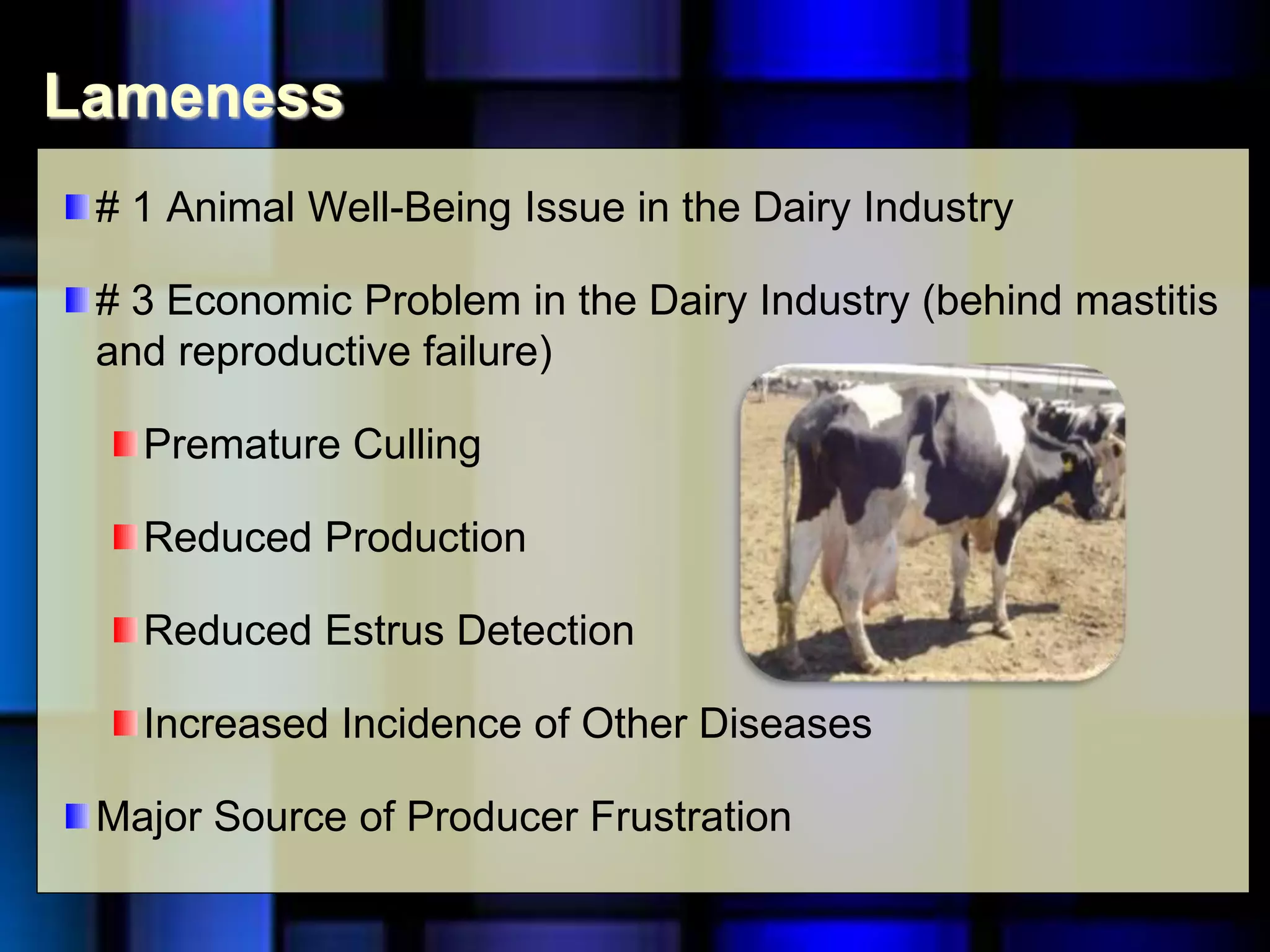
Lameness
# 1 Animal Well-Being Issue in the Dairy Industry
# 3 Economic Problem in the Dairy Industry (behind mastitis
and reproductive failure)
Premature Culling
Reduced Production
Reduced Estrus Detection
Increased Incidence of Other Diseases
Major Source of Producer Frustration
% of Culls by Culling Reason
0%
5%
10%
15%
20%
25%
30%
NAHMS, 2007
Infectious Hoof Disorders
Most common types
Digital Dermatitis
Heel Erosion
Interdigital
Dermatitis
Foot Rot
Risk Factors
Wet conditions
Poor foot hygiene
Presence of
infected animals in
the herd
Poor footbath
management
Heel Erosion
Zones Affected: 6
Common Signs:
Severe erosion of heel in
irregular pit-like
depressions or “v” shaped
grooves causing
lameness
Instability of the claw due
to lost or damaged horn
resulting in uneven weight
bearing
Heel becomes sore as
erosion progresses
Interdigital Dermatitis
Also called: Stable Rot,
Scald
Zones Affected: 0, 10
Common Signs:
Discharge and destruction
of skin between the claws
Bulb horn clefts leading to
contusion of the corium
and ulceration
Foot Rot or Foul
Also called: Interdigital
Phlegmon, Interdigital
Necrobacillosis
Zones Affected: 9
Common Signs:
Swelling of the entire foot
(equally) including the
dew claws
Separation of digits,
infection produces a
noticeable foul odor
Animals will likely have a
fever
Digital Dermatitis
Also called: Hairy Heel
Warts, Mortellaro Disease
Zones Affected: 9,10
Common Signs:
Raw, bright-red or black
circular growth above the
heel bulbs, with edges
forming a white opaque
ring or hard, thin, hairy,
wart-like growths or sores
Affected cattle are
reluctant to walk or lame
Late,
chronic
lesions
Early
stages
Hairy Heel Warts
First reported in Italy in 1972 and in US in 1980
Epidemic proportions since 1994
Highly contagious
Extremely painful
May have an odor
85 to 90% of warts are on rear feet
Herd prevalence > 50% of cows
Only 50 to 60% of cows with warts exhibit lameness
Changes in locomotion patterns create other hoof problems
% of Lameness Caused by Hairy Heel Warts
0%
10%
20%
30%
40%
50%
60%
70%
1996 2002 2007
NAHMS. 2007
Cost Per Digital Dermatitis Case=$132.96
$61.25
$56.18
$33.00
Milk Loss Decreased Fertility Treatment Cost
Cha et al., 2010
What Causes Hairy Heel Warts?
Likely bacterial
Spirochete bacteria (Treponema phagedenis, Treponema
vincentii and Treponema denticola, Treponema medium)
At least two strains
Other bacteria isolated (Fusobacterium spp.,
Campylobacter spp., Prevotella, spp.)
Not a virus (it responds to antibiotics)
Causative organism not present in manure within the cow
Digital dermatitis not created by these organisms in the lab
Needs constant moisture and low oxygen to occur
Conditions for Digital Dermatitis Spread
Excessive standing in manure/wet conditions
Infrequent scraping
Overstocking
Narrow alleys (manure buildup)
Excessive standing times
Inadequate bedding
Automatic scrapers or flush systems
Not cleaning hoof equipment between cows
Which Cows are More Susceptible?
Dirty cows
Early lactation
Younger cows
High production cows
Summer
Cows housed indoors rather than pasture
Purchased cows
Cows with shallow heels
Treatment
Important to prevent spread
Make sure hoof is cleaned
Copper pastes or disinfectants
Antibiotics (be careful with withdrawal)
Local and systemic (Tetracycline and
oxytetracycline)
Footbaths (with veterinary permission)
Spray in parlor
Clean and wrap (remove bandages 3 days)
Amputation
Vaccination
Effectiveness may be limited
Difficult because there may be multiple
causes
Immune aspects questioned
Same cows get infections year after
year
But, other cows seem to never get
infections
Limited trial work shows a little promise
Management Prevention
Scrape alleys and groom stalls at least twice daily
Use enough bedding on stalls to keep them dry
Allow some bedding to enter alley to reduce alley moisture
Eliminate poorly drained areas where water pools
Ventilate barns to minimize humidity/moisture
Maximize lying times (good cow comfort)
Minimize overstocking particularly for early lactation cows
Treat clinical cases promptly
Be cautious with cattle and equipment movement
Footbath Expectation Management
Only help with hairy heel warts, foot rot,
interdigital growths
Useful for prevention NOT treatment
Footbath/teat dip comparison
Prevent spread of new infections
Need other tools to treat
Environment cleanliness, footbath
frequency more important than chemical
used
Effects are not immediate
Challenges/Difficulties
Getting cows to walk through the bath
The first few days are hard, but they tend to
learn
Changing solutions frequently enough
Inconvenient
Too diluted-won’t work
Too concentrated-may burn skin, weaken
hooves, or make hooves brittle
Cold weather
Cost
Percentage of Operations by Use of Footbath
NAHMS. 2007
Footbath Options
Plastic bath
Concrete bath
Twin bath-may
reduce
chemical use
Sponge rubber
mats (timeliness
of chemical
release?)
Automated
options
Footbath of the Future (Nigel Cook)
10-12 feet long, 10 in. deep, 24 in wide, angled sidewalls(one
removable)
Wisconsin Design Logic
Probability of rear feet receiving at least 2 immersions
6 foot bath 53%
8 foot bath 84%
10 foot bath 96%
• No data to demonstrate advantages to more immersions
• Needed to change bath width and step-in height to make
sure that chemical use didn’t increase
• Cows coped well with increased depth, less waste
• Narrower bath width required side-walls
• Results in same amount of solution as old baths
Footbath Management
Work best when feet are cleaned off in parlor
Placed in exit lanes at least 2/3 down to prevent
bottlenecking
All four feet should be exposed to footbath solution
Enter a clean, dry area after foot bath
At least 5” deep, deeper the better
Non-slip floor (but high ridges uncomfortable)
Preferably not on a slope
Footbath Management
Using it “every once in a while” may lead to outbreaks
Options for “off days”
Soap solution
Remove the bath
Don’t let them walk through manure
Change solution every 150 to 200 cows
No manure baths
Really needs to be footbath for close-up cows
Use at least
3 successive
days once
per month
Wash Baths No Longer Recommended
Do not keep treatment bath cleaner
One immersion in water won’t have much cleaning effect
Doesn’t stimulate more defecation in wash bath
Wisconsin research showed more cows defecated in
treatment bath (8.5%) than the wash bath (5.8%)
May actually dilute treatment bath
May loosen manure so it comes off in treatment bath
More water in manure handling system
100 cow dairy with 50 gallon bath 5 days per week
changing bath every 200 cows
= 6,500 gallons of waste water per week
Winter Footbaths
Formaldehyde does not work below 45°
Drain bath completely between batches
Add salt or glycerin to reduce freezing
point
Heated floors
Bath in heated areas during winter
Spray
Dairy Herd Management, 2010
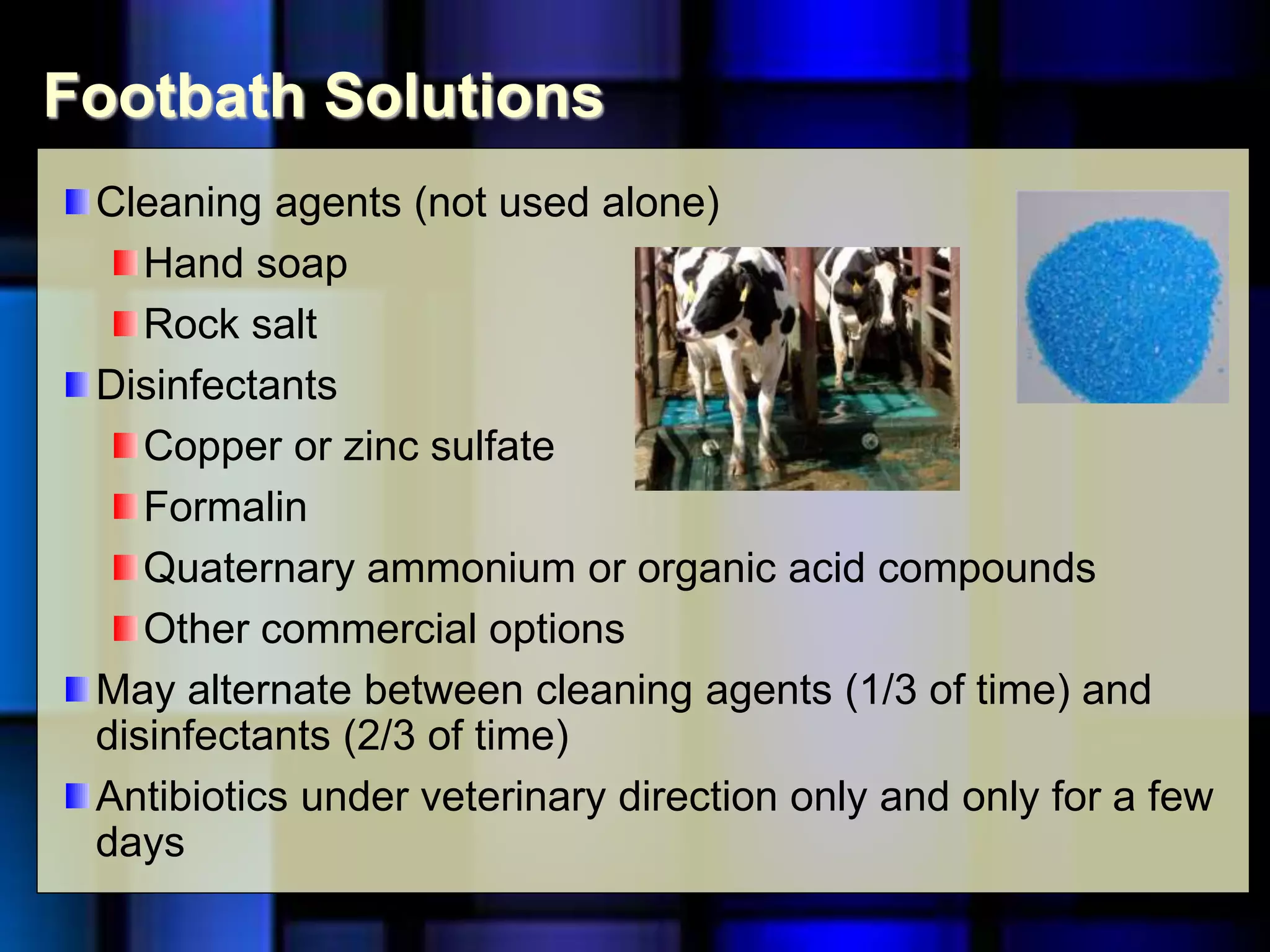
Footbath Solutions
Cleaning agents (not used alone)
Hand soap
Rock salt
Disinfectants
Copper or zinc sulfate
Formalin
Quaternary ammonium or organic acid compounds
Other commercial options
May alternate between cleaning agents (1/3 of time) and
disinfectants (2/3 of time)
Antibiotics under veterinary direction only and only for a few
days
Pros and Cons
Formalin
Cheap, environmentally friendly
Carcinogen, irritant to cows and people
Can burn heels, make them too brittle
Easily overwhelmed by manure
Copper Sulfate
Effective
Expensive, copper accumulations in soil
Commercial options
Some are very effective
Research is often limited, can be expensive
Hoof Trimming
Produce a balanced claw
Removal of horny tissue from sole
Re-establish proper shape of hoof
Trimming stimulates growth of new,
healthy tissue
Extends longevity
one full lactation on average
Non-Infectious Lesion Risk Factors
Lack of claw trimming, infrequent claw
trimming or improper claw trimming
More than three hours per day spent
standing in the holding area, stall area and/or
excessive time locked in headlocks
Poorly designed stalls creating discomfort
Insufficient lying time
Non-Infectious Lesion Risk Factors
Limited access to feed due to overstocking or
insufficient feed bunk space
Flooring conducive to excess horn wear
Nutritional factors:
Feeding excessive amounts of fermentable
carbohydrates
Lack of effective fiber
TMR sorting
Inconsistent feeding times
Inadequate trace mineral status
Non-Infectious Lesion Risk Factors
Post-calving metabolic disorders such as
milk fever and ketosis
Heat stress, resulting in lower rumen pH and
cows spending more time standing
Abrupt transition (nutrition and environment)
from dry to lactation period
White Line Lesion
Also called White Line
Separation, White Line
Disease
Zones Affected: 1, 2, 3
Common Signs:
In mild cases, a void
occurs in the junction
between the sole and the
wall
In severe cases,
abscesses form, generally
at the heel-sole-wall
juncture (Zone 3)
Sole Ulcer
Also Pododermatitis,
Circumscripta, Rusterholz
Disease
Zones Affected: 4
Common Signs:
Raw sore (horn erosive
defect) occurring at sole-
heel junction on inner side
of outside hind claw
Often occurs in both
outside hide claws (when
present)
Sole Hemorrhage
Also Called Sole Bruising
Zones Affected: 4, 5, 6
Common Signs:
Slight to significant red (or
blue) coloration of the
sole
Not to be confused with
natural black pigmentation
of claw horn
Toe Ulcer
Also called: Toe Necrosis,
Apicalis Necrotica
Zones Affected: 1
Common Signs:
Black mark, blood stain
and/or rupture in white line
or sole at the toe
Caused by rotation of pedal
bone within the claw
pressing down on the sole or
thin soles
Thin Sole
Zones Affected: 4,5
Common Signs:
Sole is thin and flexible
when pressure is applied
Caused by insufficient
length of toe, excessive
wear or over trimming
Minimum claw length of 3
inches (7.5 cm) does not
apply to heifers or animals
that weigh less than 900
lb (400 kg)
Laminitis and Subacute Laminitis
Can be the underlying cause of other diseases
Ulcers
White line disease
Heel erosion
The complex network of blood vessels between the claw
and the claw horn are seriously damaged, which
compromises the function of the horn-producing cells
Laminitis can be subclinical, acute, or chronic, depending
on the severity of the several causative variables
Vertical Fissure
Also Called Sandcrack,
Fissura Unglulae
Longitudinalis
Zones Affected: 7,8
Common Signs:
Vertical split in front or
side of claw
Occurs primarily on
outside front claws
Often the most painful
cause of lameness
Axial Fissure
Also Called Axial Wall
Fissure
Zones Affected: 11, 12
Common Signs:
Deep groove on interior
surface of claw wall
parallel to front claw
surface
Bleeding may indicate
lesion presence
Mild to severe lameness
Interdigital Hyperplasia
Also called: Corn, Interdigital
Fibroma, Interdigital Growth
Zones Affected: 0
Common Signs:
Rapid growth of skin
and/or tissue between the
digits, forming a firm mass
Secondary infection likely
with severe (large) lesion
Corkscrew Claw
Zones Affected: 7
Common Signs:
Rapid irregular growth of
the claw with rotation
Sole displaced inward and
rear
Causes difficulty walking
Horizontal Fissure or Hardship Groove
Also called: Horizontal Wall
Fissure, Fissura Ungulae
Transversalis
Zones Affected: 7,8
Common Signs:
Claw wall parallel to the
hairline cracks and
eventually breaks off
Caused by nutritional or
metabolic stress
Questions
Jeffrey Bewley, PhD, PAS
jbewley@bovisync.com
jbewley@cowfocused.com

Understanding and Preventing Dairy Cattle Lameness

  • 1.
  • 2.
    Lameness # 1 AnimalWell-Being Issue in the Dairy Industry # 3 Economic Problem in the Dairy Industry (behind mastitis and reproductive failure) Premature Culling Reduced Production Reduced Estrus Detection Increased Incidence of Other Diseases Major Source of Producer Frustration
  • 3.
    % of Cullsby Culling Reason 0% 5% 10% 15% 20% 25% 30% NAHMS, 2007
  • 5.
    Infectious Hoof Disorders Mostcommon types Digital Dermatitis Heel Erosion Interdigital Dermatitis Foot Rot Risk Factors Wet conditions Poor foot hygiene Presence of infected animals in the herd Poor footbath management
  • 6.
    Heel Erosion Zones Affected:6 Common Signs: Severe erosion of heel in irregular pit-like depressions or “v” shaped grooves causing lameness Instability of the claw due to lost or damaged horn resulting in uneven weight bearing Heel becomes sore as erosion progresses
  • 7.
    Interdigital Dermatitis Also called:Stable Rot, Scald Zones Affected: 0, 10 Common Signs: Discharge and destruction of skin between the claws Bulb horn clefts leading to contusion of the corium and ulceration
  • 8.
    Foot Rot orFoul Also called: Interdigital Phlegmon, Interdigital Necrobacillosis Zones Affected: 9 Common Signs: Swelling of the entire foot (equally) including the dew claws Separation of digits, infection produces a noticeable foul odor Animals will likely have a fever
  • 9.
    Digital Dermatitis Also called:Hairy Heel Warts, Mortellaro Disease Zones Affected: 9,10 Common Signs: Raw, bright-red or black circular growth above the heel bulbs, with edges forming a white opaque ring or hard, thin, hairy, wart-like growths or sores Affected cattle are reluctant to walk or lame
  • 11.
  • 12.
    Hairy Heel Warts Firstreported in Italy in 1972 and in US in 1980 Epidemic proportions since 1994 Highly contagious Extremely painful May have an odor 85 to 90% of warts are on rear feet Herd prevalence > 50% of cows Only 50 to 60% of cows with warts exhibit lameness Changes in locomotion patterns create other hoof problems
  • 13.
    % of LamenessCaused by Hairy Heel Warts 0% 10% 20% 30% 40% 50% 60% 70% 1996 2002 2007 NAHMS. 2007
  • 14.
    Cost Per DigitalDermatitis Case=$132.96 $61.25 $56.18 $33.00 Milk Loss Decreased Fertility Treatment Cost Cha et al., 2010
  • 15.
    What Causes HairyHeel Warts? Likely bacterial Spirochete bacteria (Treponema phagedenis, Treponema vincentii and Treponema denticola, Treponema medium) At least two strains Other bacteria isolated (Fusobacterium spp., Campylobacter spp., Prevotella, spp.) Not a virus (it responds to antibiotics) Causative organism not present in manure within the cow Digital dermatitis not created by these organisms in the lab Needs constant moisture and low oxygen to occur
  • 16.
    Conditions for DigitalDermatitis Spread Excessive standing in manure/wet conditions Infrequent scraping Overstocking Narrow alleys (manure buildup) Excessive standing times Inadequate bedding Automatic scrapers or flush systems Not cleaning hoof equipment between cows
  • 17.
    Which Cows areMore Susceptible? Dirty cows Early lactation Younger cows High production cows Summer Cows housed indoors rather than pasture Purchased cows Cows with shallow heels
  • 18.
    Treatment Important to preventspread Make sure hoof is cleaned Copper pastes or disinfectants Antibiotics (be careful with withdrawal) Local and systemic (Tetracycline and oxytetracycline) Footbaths (with veterinary permission) Spray in parlor Clean and wrap (remove bandages 3 days) Amputation
  • 19.
    Vaccination Effectiveness may belimited Difficult because there may be multiple causes Immune aspects questioned Same cows get infections year after year But, other cows seem to never get infections Limited trial work shows a little promise
  • 20.
    Management Prevention Scrape alleysand groom stalls at least twice daily Use enough bedding on stalls to keep them dry Allow some bedding to enter alley to reduce alley moisture Eliminate poorly drained areas where water pools Ventilate barns to minimize humidity/moisture Maximize lying times (good cow comfort) Minimize overstocking particularly for early lactation cows Treat clinical cases promptly Be cautious with cattle and equipment movement
  • 21.
    Footbath Expectation Management Onlyhelp with hairy heel warts, foot rot, interdigital growths Useful for prevention NOT treatment Footbath/teat dip comparison Prevent spread of new infections Need other tools to treat Environment cleanliness, footbath frequency more important than chemical used Effects are not immediate
  • 22.
    Challenges/Difficulties Getting cows towalk through the bath The first few days are hard, but they tend to learn Changing solutions frequently enough Inconvenient Too diluted-won’t work Too concentrated-may burn skin, weaken hooves, or make hooves brittle Cold weather Cost
  • 23.
    Percentage of Operationsby Use of Footbath NAHMS. 2007
  • 24.
    Footbath Options Plastic bath Concretebath Twin bath-may reduce chemical use Sponge rubber mats (timeliness of chemical release?) Automated options
  • 25.
    Footbath of theFuture (Nigel Cook) 10-12 feet long, 10 in. deep, 24 in wide, angled sidewalls(one removable)
  • 26.
    Wisconsin Design Logic Probabilityof rear feet receiving at least 2 immersions 6 foot bath 53% 8 foot bath 84% 10 foot bath 96% • No data to demonstrate advantages to more immersions • Needed to change bath width and step-in height to make sure that chemical use didn’t increase • Cows coped well with increased depth, less waste • Narrower bath width required side-walls • Results in same amount of solution as old baths
  • 27.
    Footbath Management Work bestwhen feet are cleaned off in parlor Placed in exit lanes at least 2/3 down to prevent bottlenecking All four feet should be exposed to footbath solution Enter a clean, dry area after foot bath At least 5” deep, deeper the better Non-slip floor (but high ridges uncomfortable) Preferably not on a slope
  • 28.
    Footbath Management Using it“every once in a while” may lead to outbreaks Options for “off days” Soap solution Remove the bath Don’t let them walk through manure Change solution every 150 to 200 cows No manure baths Really needs to be footbath for close-up cows
  • 29.
    Use at least 3successive days once per month
  • 30.
    Wash Baths NoLonger Recommended Do not keep treatment bath cleaner One immersion in water won’t have much cleaning effect Doesn’t stimulate more defecation in wash bath Wisconsin research showed more cows defecated in treatment bath (8.5%) than the wash bath (5.8%) May actually dilute treatment bath May loosen manure so it comes off in treatment bath More water in manure handling system 100 cow dairy with 50 gallon bath 5 days per week changing bath every 200 cows = 6,500 gallons of waste water per week
  • 31.
    Winter Footbaths Formaldehyde doesnot work below 45° Drain bath completely between batches Add salt or glycerin to reduce freezing point Heated floors Bath in heated areas during winter Spray Dairy Herd Management, 2010
  • 32.
    Footbath Solutions Cleaning agents(not used alone) Hand soap Rock salt Disinfectants Copper or zinc sulfate Formalin Quaternary ammonium or organic acid compounds Other commercial options May alternate between cleaning agents (1/3 of time) and disinfectants (2/3 of time) Antibiotics under veterinary direction only and only for a few days
  • 33.
    Pros and Cons Formalin Cheap,environmentally friendly Carcinogen, irritant to cows and people Can burn heels, make them too brittle Easily overwhelmed by manure Copper Sulfate Effective Expensive, copper accumulations in soil Commercial options Some are very effective Research is often limited, can be expensive
  • 35.
    Hoof Trimming Produce abalanced claw Removal of horny tissue from sole Re-establish proper shape of hoof Trimming stimulates growth of new, healthy tissue Extends longevity one full lactation on average
  • 37.
    Non-Infectious Lesion RiskFactors Lack of claw trimming, infrequent claw trimming or improper claw trimming More than three hours per day spent standing in the holding area, stall area and/or excessive time locked in headlocks Poorly designed stalls creating discomfort Insufficient lying time
  • 38.
    Non-Infectious Lesion RiskFactors Limited access to feed due to overstocking or insufficient feed bunk space Flooring conducive to excess horn wear Nutritional factors: Feeding excessive amounts of fermentable carbohydrates Lack of effective fiber TMR sorting Inconsistent feeding times Inadequate trace mineral status
  • 39.
    Non-Infectious Lesion RiskFactors Post-calving metabolic disorders such as milk fever and ketosis Heat stress, resulting in lower rumen pH and cows spending more time standing Abrupt transition (nutrition and environment) from dry to lactation period
  • 40.
    White Line Lesion Alsocalled White Line Separation, White Line Disease Zones Affected: 1, 2, 3 Common Signs: In mild cases, a void occurs in the junction between the sole and the wall In severe cases, abscesses form, generally at the heel-sole-wall juncture (Zone 3)
  • 41.
    Sole Ulcer Also Pododermatitis, Circumscripta,Rusterholz Disease Zones Affected: 4 Common Signs: Raw sore (horn erosive defect) occurring at sole- heel junction on inner side of outside hind claw Often occurs in both outside hide claws (when present)
  • 42.
    Sole Hemorrhage Also CalledSole Bruising Zones Affected: 4, 5, 6 Common Signs: Slight to significant red (or blue) coloration of the sole Not to be confused with natural black pigmentation of claw horn
  • 43.
    Toe Ulcer Also called:Toe Necrosis, Apicalis Necrotica Zones Affected: 1 Common Signs: Black mark, blood stain and/or rupture in white line or sole at the toe Caused by rotation of pedal bone within the claw pressing down on the sole or thin soles
  • 44.
    Thin Sole Zones Affected:4,5 Common Signs: Sole is thin and flexible when pressure is applied Caused by insufficient length of toe, excessive wear or over trimming Minimum claw length of 3 inches (7.5 cm) does not apply to heifers or animals that weigh less than 900 lb (400 kg)
  • 45.
    Laminitis and SubacuteLaminitis Can be the underlying cause of other diseases Ulcers White line disease Heel erosion The complex network of blood vessels between the claw and the claw horn are seriously damaged, which compromises the function of the horn-producing cells Laminitis can be subclinical, acute, or chronic, depending on the severity of the several causative variables
  • 46.
    Vertical Fissure Also CalledSandcrack, Fissura Unglulae Longitudinalis Zones Affected: 7,8 Common Signs: Vertical split in front or side of claw Occurs primarily on outside front claws Often the most painful cause of lameness
  • 47.
    Axial Fissure Also CalledAxial Wall Fissure Zones Affected: 11, 12 Common Signs: Deep groove on interior surface of claw wall parallel to front claw surface Bleeding may indicate lesion presence Mild to severe lameness
  • 48.
    Interdigital Hyperplasia Also called:Corn, Interdigital Fibroma, Interdigital Growth Zones Affected: 0 Common Signs: Rapid growth of skin and/or tissue between the digits, forming a firm mass Secondary infection likely with severe (large) lesion
  • 49.
    Corkscrew Claw Zones Affected:7 Common Signs: Rapid irregular growth of the claw with rotation Sole displaced inward and rear Causes difficulty walking
  • 50.
    Horizontal Fissure orHardship Groove Also called: Horizontal Wall Fissure, Fissura Ungulae Transversalis Zones Affected: 7,8 Common Signs: Claw wall parallel to the hairline cracks and eventually breaks off Caused by nutritional or metabolic stress
  • 51.
    Questions Jeffrey Bewley, PhD,PAS jbewley@bovisync.com jbewley@cowfocused.com