Questionnaire Design Dr. J Kishore,   MBBS, MD, PCHFWM, PGDEE, MSc, MNAMS, FIPHA Professor Community Medicine, Maulana Azad Medical College,  New Delhi
Aim of Questionnaire   It is to extract useful and accurate information. Any defect in the questionnaire could have impact in data collection.
Use of Questionnaire Scientific Research Screening Diagnostic Tool Audit Administration Demography  Public relations J Kishore. Ind J O & EM 2000
Basic Requirements for a questionnaire design Clear Objectives Sampling methods Sample Size Respondent: Literacy, physical and mental capabilities J Kishore. Ind J O & EM 2000
Qualities of Questionnaire Without ambiguity Unbiased Appropriateness: studying heat exposure in Cold unit workers Intellegibility: it should be understood Validity, Reliability Logical order Capable to cope with all possible responses Coded Pretested, open to close/structured No double barreled questions Ethical Language J Kishore. Ind J O & EM 2000
Approaches  Structured:   you set a line of questionnaire in your survey and all respondents are led through it. This approach guarantee that all respondents consider the same issues or topics so their results can be compared with each other and easily summerized. Unstructured:  Allow the person being interview to take the lead and talk about whatever aspects of the survey topic he or she chooses. It is best suited for qualitative data in which once opinion or attitude needs to be assessed.
Mode of Inquiry Based on qualitative or quantitative or both type of data collection a) Face to Face Interview b) Telephone Interview c) Self-reported/completed questionnaire
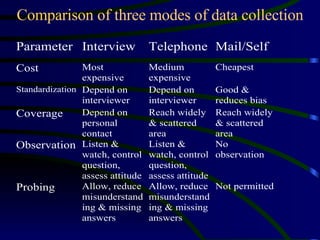
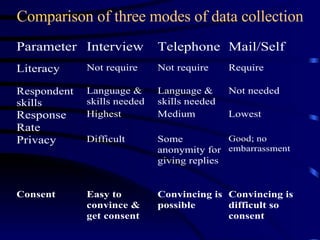
Comparison of three modes of data collection
Designing of questionnaire: Stages -1 A. Basic components (Parts) I. Guidelines on the introduction to, and the ending of interview/questionnaire II. A section on identification of the study unit and its location III. Consent IV. The main body of the questionnaire: subdivision is allowed V. Interviewer guidelines dispersed throughout the questionnaire VI. Filters (Jump) instructions
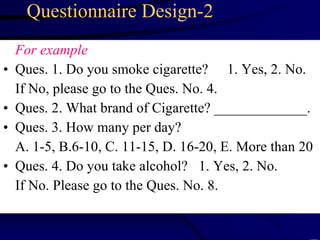
Questionnaire Design-2 For example Ques. 1. Do you smoke cigarette?  1. Yes, 2. No. If No, please go to the Ques. No. 4. Ques. 2. What brand of Cigarette? _____________. Ques. 3. How many per day? A. 1-5, B.6-10, C. 11-15, D. 16-20, E. More than 20 Ques. 4. Do you take alcohol?   1. Yes, 2. No. If No. Please go to the Ques. No. 8.
Designing of questionnaire: Stages-3 B. Practical Steps 1. Write out, as breifly as you can. 2. Make a list of the information 3. Decide the main section (Components) a) A section on identification/address b) Separate section for each aspect of study 4. Within each section and for each item of information required, write out the questions  5. Check each of the questions against the aims 6. Check whether the list of questions will obtain and record all the information necessary.
Designing of questionnaire: Stages-4 7. Examine each and every questions following: I) Is it Necessary? II) It is Clear and Unambiguous? III) Is it Simple and Short? IV) Is it A reasonable question to ask? V) Is it Non-offensive? VI) Should it be an “open” or “close” question? Closed Question  offers a list of possible options (Answers) from which the respondent must select one or two answer Open Question  offers the respondent to answer in her/his own words.
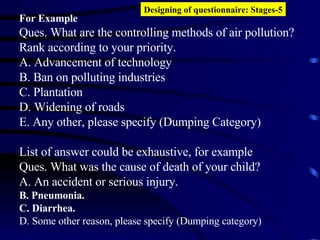
For Example Ques. What are the controlling methods of air pollution? Rank according to your priority. A. Advancement of technology B. Ban on polluting industries C. Plantation D. Widening of roads E. Any other, please specify (Dumping Category) List of answer could be exhaustive, for example Ques. What was the cause of death of your child? A. An accident or serious injury. B. Pneumonia. C. Diarrhea. D. Some other reason, please specify (Dumping category) Designing of questionnaire: Stages-5
Designing of questionnaire: Stages-6 8. Check that the interview does not take too long 9. Think of Layout and presentation 10. Write a draft 11. Pilot and evalution * Validity * Test-Retest Reliability * Acceptability 12. Enhancing the reliability of interviewers by conducting training 13. Conducting survey
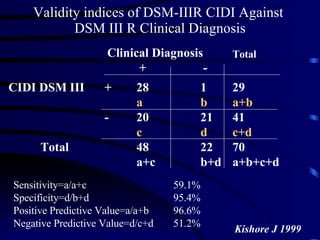
Validity indices of DSM-IIIR CIDI Against  DSM III R Clinical Diagnosis Clinical Diagnosis + - Total CIDI DSM III  + 28  1  29 a b a+b - 20 21 41 c d c+d Total 48 22 70 a+c b+d a+b+c+d Sensitivity=a/a+c 59.1% Specificity=d/b+d 95.4% Positive Predictive Value=a/a+b 96.6% Negative Predictive Value=d/c+d 51.2%  Kishore J 1999
Check Respondent’s Consistency For example Ques. How many children would you like to have? Ques. What do you consider the ideal (best) number of children for you?
Codes Numeric and alphabetic codes transfor answers into variables that can be tabulated and analyzed statically. For nominal variable, the code can be labels without meaning, For example: “1” for Hindu, “2” for Muslim, “3” Christian, etc. For ordinal variable the numeric value has inherent meaning that reflects the rank order, for example, “0” for non-smoker, “1” smoking less than 1 pack per day, “2” 1-2 packs per day, etc.
Scores Answer to the questions are given in a score as a way of measuring an abstract characteristics: Measuring attitude,  e.g., “1” Not important, “4” very important  Importance A. Annual health check 1 2 3 4 B. Health & Safety training 1 2 3 4 C. Nutrition 1 2 3 4 How important of these items for maintaining the health of workers?
Scales Summative Scales:   Likert scales  is used to quantify attitude and behavior e.g., Please read the statement below and answer these questions using one of the five options  (Tick) Strongly  Agree Neutral Disagree  Strongly Agree   Disagree 1. Smoking should be banned - - - - - 2. Compulsory testing for HIV  - - - - - 3. Compulsory Sex education in  - - - - - Secondary schools
Scales Cummulative (Guttman) Scales:  A series of statements that express increasing intensity of a characteristics.  Ques. Circle the letter of every statement that you agree with: A. Asbestos can cause lung cancer B. Asbestos is an important cause of cancer C. Asbestos is a very important cause of lung cancer and death. D. Asbestos is the most important cause of lung cancer and death in India Ques. What is the highest level of education you have completed? A. Primary School certificate  B. High School Certificate C. Undergraduate Degree D. Postgraduate Degree E. Doctoral or higher Degree
Scales Multiple Choice Questions:  where respondent must choose just one answer from many choices; use in competitive exam or screening the disease e.g.,  Ques. Which one of the following is the most common methods of transmission of HIV? A. Sharing meals B. Sharing needles C. Sharing towel e.g.,  For TB Screening   Ques Which symptoms do you experienced for last one month? A. Cough B. Fever C. Weight loss D. Loss of appetite
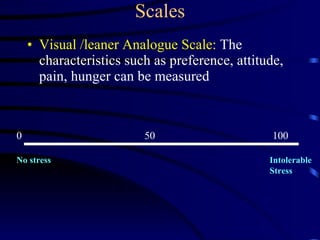
Scales Visual /leaner Analogue Scale:  The characteristics such as preference, attitude, pain, hunger can be measured 0 50 100 No stress   Intolerable   Stress
Scale Sentence Completion Test This is very useful scale to measure internal conflict, stress, personality, etc. Commonly used in psychiatric assessment

Questionnaire Designing

  • 1.
    Questionnaire Design Dr.J Kishore, MBBS, MD, PCHFWM, PGDEE, MSc, MNAMS, FIPHA Professor Community Medicine, Maulana Azad Medical College, New Delhi
  • 2.
    Aim of Questionnaire It is to extract useful and accurate information. Any defect in the questionnaire could have impact in data collection.
  • 3.
    Use of QuestionnaireScientific Research Screening Diagnostic Tool Audit Administration Demography Public relations J Kishore. Ind J O & EM 2000
  • 4.
    Basic Requirements fora questionnaire design Clear Objectives Sampling methods Sample Size Respondent: Literacy, physical and mental capabilities J Kishore. Ind J O & EM 2000
  • 5.
    Qualities of QuestionnaireWithout ambiguity Unbiased Appropriateness: studying heat exposure in Cold unit workers Intellegibility: it should be understood Validity, Reliability Logical order Capable to cope with all possible responses Coded Pretested, open to close/structured No double barreled questions Ethical Language J Kishore. Ind J O & EM 2000
  • 6.
    Approaches Structured: you set a line of questionnaire in your survey and all respondents are led through it. This approach guarantee that all respondents consider the same issues or topics so their results can be compared with each other and easily summerized. Unstructured: Allow the person being interview to take the lead and talk about whatever aspects of the survey topic he or she chooses. It is best suited for qualitative data in which once opinion or attitude needs to be assessed.
  • 7.
    Mode of InquiryBased on qualitative or quantitative or both type of data collection a) Face to Face Interview b) Telephone Interview c) Self-reported/completed questionnaire
  • 8.
    Comparison of threemodes of data collection
  • 9.
    Comparison of threemodes of data collection
  • 10.
    Designing of questionnaire:Stages -1 A. Basic components (Parts) I. Guidelines on the introduction to, and the ending of interview/questionnaire II. A section on identification of the study unit and its location III. Consent IV. The main body of the questionnaire: subdivision is allowed V. Interviewer guidelines dispersed throughout the questionnaire VI. Filters (Jump) instructions
  • 11.
    Questionnaire Design-2 Forexample Ques. 1. Do you smoke cigarette? 1. Yes, 2. No. If No, please go to the Ques. No. 4. Ques. 2. What brand of Cigarette? _____________. Ques. 3. How many per day? A. 1-5, B.6-10, C. 11-15, D. 16-20, E. More than 20 Ques. 4. Do you take alcohol? 1. Yes, 2. No. If No. Please go to the Ques. No. 8.
  • 12.
    Designing of questionnaire:Stages-3 B. Practical Steps 1. Write out, as breifly as you can. 2. Make a list of the information 3. Decide the main section (Components) a) A section on identification/address b) Separate section for each aspect of study 4. Within each section and for each item of information required, write out the questions 5. Check each of the questions against the aims 6. Check whether the list of questions will obtain and record all the information necessary.
  • 13.
    Designing of questionnaire:Stages-4 7. Examine each and every questions following: I) Is it Necessary? II) It is Clear and Unambiguous? III) Is it Simple and Short? IV) Is it A reasonable question to ask? V) Is it Non-offensive? VI) Should it be an “open” or “close” question? Closed Question offers a list of possible options (Answers) from which the respondent must select one or two answer Open Question offers the respondent to answer in her/his own words.
  • 14.
    For Example Ques.What are the controlling methods of air pollution? Rank according to your priority. A. Advancement of technology B. Ban on polluting industries C. Plantation D. Widening of roads E. Any other, please specify (Dumping Category) List of answer could be exhaustive, for example Ques. What was the cause of death of your child? A. An accident or serious injury. B. Pneumonia. C. Diarrhea. D. Some other reason, please specify (Dumping category) Designing of questionnaire: Stages-5
  • 15.
    Designing of questionnaire:Stages-6 8. Check that the interview does not take too long 9. Think of Layout and presentation 10. Write a draft 11. Pilot and evalution * Validity * Test-Retest Reliability * Acceptability 12. Enhancing the reliability of interviewers by conducting training 13. Conducting survey
  • 16.
    Validity indices ofDSM-IIIR CIDI Against DSM III R Clinical Diagnosis Clinical Diagnosis + - Total CIDI DSM III + 28 1 29 a b a+b - 20 21 41 c d c+d Total 48 22 70 a+c b+d a+b+c+d Sensitivity=a/a+c 59.1% Specificity=d/b+d 95.4% Positive Predictive Value=a/a+b 96.6% Negative Predictive Value=d/c+d 51.2% Kishore J 1999
  • 17.
    Check Respondent’s ConsistencyFor example Ques. How many children would you like to have? Ques. What do you consider the ideal (best) number of children for you?
  • 18.
    Codes Numeric andalphabetic codes transfor answers into variables that can be tabulated and analyzed statically. For nominal variable, the code can be labels without meaning, For example: “1” for Hindu, “2” for Muslim, “3” Christian, etc. For ordinal variable the numeric value has inherent meaning that reflects the rank order, for example, “0” for non-smoker, “1” smoking less than 1 pack per day, “2” 1-2 packs per day, etc.
  • 19.
    Scores Answer tothe questions are given in a score as a way of measuring an abstract characteristics: Measuring attitude, e.g., “1” Not important, “4” very important Importance A. Annual health check 1 2 3 4 B. Health & Safety training 1 2 3 4 C. Nutrition 1 2 3 4 How important of these items for maintaining the health of workers?
  • 20.
    Scales Summative Scales: Likert scales is used to quantify attitude and behavior e.g., Please read the statement below and answer these questions using one of the five options (Tick) Strongly Agree Neutral Disagree Strongly Agree Disagree 1. Smoking should be banned - - - - - 2. Compulsory testing for HIV - - - - - 3. Compulsory Sex education in - - - - - Secondary schools
  • 21.
    Scales Cummulative (Guttman)Scales: A series of statements that express increasing intensity of a characteristics. Ques. Circle the letter of every statement that you agree with: A. Asbestos can cause lung cancer B. Asbestos is an important cause of cancer C. Asbestos is a very important cause of lung cancer and death. D. Asbestos is the most important cause of lung cancer and death in India Ques. What is the highest level of education you have completed? A. Primary School certificate B. High School Certificate C. Undergraduate Degree D. Postgraduate Degree E. Doctoral or higher Degree
  • 22.
    Scales Multiple ChoiceQuestions: where respondent must choose just one answer from many choices; use in competitive exam or screening the disease e.g., Ques. Which one of the following is the most common methods of transmission of HIV? A. Sharing meals B. Sharing needles C. Sharing towel e.g., For TB Screening Ques Which symptoms do you experienced for last one month? A. Cough B. Fever C. Weight loss D. Loss of appetite
  • 23.
    Scales Visual /leanerAnalogue Scale: The characteristics such as preference, attitude, pain, hunger can be measured 0 50 100 No stress Intolerable Stress
  • 24.
    Scale Sentence CompletionTest This is very useful scale to measure internal conflict, stress, personality, etc. Commonly used in psychiatric assessment