CLASSIFICATION
Classification
– meaningful grouping of persons,
things, animals, etc. in a systematic way
-- also means grouping things or
objects that have the property or
characteristics in common into a class.
-- involves establishing
relationships among classes and
making distinctions within classes to
arrive at subclasses and finer divisions.
Library Classification
– the systematic arrangement by
subject of books and other materials
on shelves or of catalog and index
entries in the manner which is most
useful to those who read or who
seek a definite piece of information
 Class – a group of objects exhibiting one
or more common characteristics,
identified by specific notation
 Class number – notation that
designates the class to which a given
item belongs
 Book number – part of call number that
distinguishes a specific item from
other items within the same class
number
Call Number
– a set of letters, numerals, or
other symbols (in combination or
alone) used by a library to identify a
specific copy of a book. It may
consists of a class number, book
number, date , volume number, copy
number, etc.
 Work mark
– that part of a book number that
consists of a letter appended to the
author designation to show the first
letter of the title (or first letter of the
surname of the biographer).
 Mnemonic devices – devices
intended to aid or assist the
memory
Purpose of a Classification
 Order the field of knowledge in a
systematic way.
 Bring related items together in a
helpful sequence
 Provide orderly access to the shelves
either by browsing or via the catalog
 Provide exact location of an item on
the shelves.
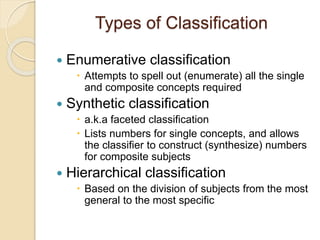
Types of Classification
 Enumerative classification
 Attempts to spell out (enumerate) all the single
and composite concepts required
 Synthetic classification
 a.k.a faceted classification
 Lists numbers for single concepts, and allows
the classifier to construct (synthesize) numbers
for composite subjects
 Hierarchical classification
 Based on the division of subjects from the most
general to the most specific
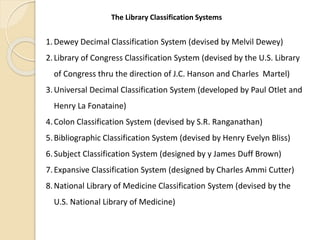
The Library Classification Systems
1.Dewey Decimal Classification System (devised by Melvil Dewey)
2.Library of Congress Classification System (devised by the U.S. Library
of Congress thru the direction of J.C. Hanson and Charles Martel)
3.Universal Decimal Classification System (developed by Paul Otlet and
Henry La Fonataine)
4.Colon Classification System (devised by S.R. Ranganathan)
5.Bibliographic Classification System (devised by Henry Evelyn Bliss)
6.Subject Classification System (designed by y James Duff Brown)
7.Expansive Classification System (designed by Charles Ammi Cutter)
8.National Library of Medicine Classification System (devised by the
U.S. National Library of Medicine)
Library of Congress
Classification System
(LCCS)
Historical Backgorund
 Developed by James Hanson for the
US Library of Congress in 1897
 Outline & notation of the main class
are similar to C.A. Cutter’s Expansive
Classification
 Based on LC’s initial book collection
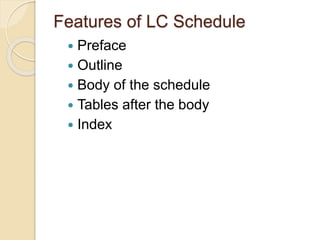
Features of LC Schedule
 Preface
 Outline
 Body of the schedule
 Tables after the body
 Index
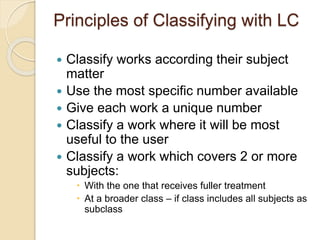
Principles of Classifying with LC
 Classify works according their subject
matter
 Use the most specific number available
 Give each work a unique number
 Classify a work where it will be most
useful to the user
 Classify a work which covers 2 or more
subjects:
 With the one that receives fuller treatment
 At a broader class – if class includes all subjects as
subclass
MAIN CLASS
A General works
B Philosophy. Psychology. Religion
C Auxiliary sciences of history
D History: General and Old World
E-F General History and Local History of America and United States
G Geography. Anthropology. Recreation
H Social Sciences
J Political Science
K Law
L Education
M Music
N Fine Arts
P Language and Literature
Q Science
R Medicine
S Agriculture. Landscape Architecture
T Technology
U Military Science
V Naval Science
Z Bibliography. Publishing. Library Science
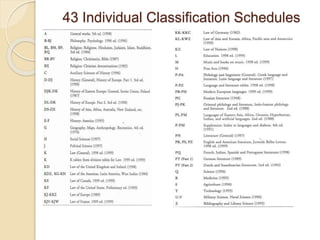
43 Individual Classification Schedules
Letters I, O, W, X, Y
- Unassigned
- Reserve for further expansion
SUBCLASS
H Social Sciences (General)
HA Statistics
HB Economic Theory. Demography
HC Economic History and Conditions
HD Industries. Land Use. Labor
HE Transportation and Communications
HF Commerce
HG Finance
HJ Public Finance
HM Sociology
HN Social History and Conditions. Social Problem. Social Reform
HQ The Family. Marriage. Woman.
HS Societies: Secret, Benevolent, etc.
HT Communities. Classes. Races.
HV Social Pathology. Social and Public Welfare. Criminology
HX Socialism. Communism. Anarchism
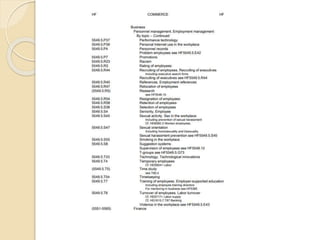
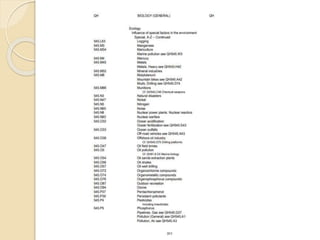
Outline (provides a detailed summary of topics & subtopics)
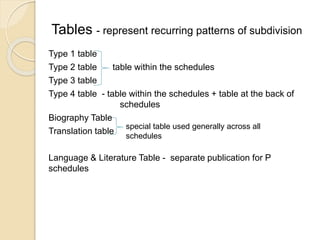
Tables - represent recurring patterns of subdivision
Type 1 table
Type 2 table table within the schedules
Type 3 table
Type 4 table - table within the schedules + table at the back of
schedules
Biography Table
Translation table
Language & Literature Table - separate publication for P
schedules
special table used generally across all
schedules
Notes
 Scope notes - explain the type of works to be classified at that
subject
 Including notes – list topics which are included within a
subject
 See notes – refer the classifier to a number elsewhere in the
schedules, often as a result to reclassification decision.
 Confer notes – indicate that related topics are
classified elsewhere in the schedules.
 Apply table at notes - refer the classifier to a table with
subdivision instructions
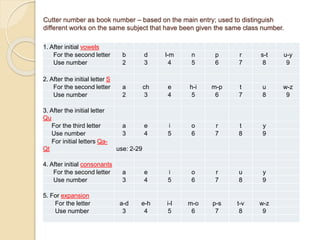
Cutter number as book number – based on the main entry; used to distinguish
different works on the same subject that have been given the same class number.
1. After initial vowels
For the second letter b d l-m n p r s-t u-y
Use number 2 3 4 5 6 7 8 9
2. After the initial letter S
For the second letter a ch e h-i m-p t u w-z
Use number 2 3 4 5 6 7 8 9
3. After the initial letter
Qu
For the third letter a e i o r t y
Use number 3 4 5 6 7 8 9
For initial letters Qa-
Qt use: 2-29
4. After initial consonants
For the second letter a e i o r u y
Use number 3 4 5 6 7 8 9
5. For expansion
For the letter a-d e-h i-l m-o p-s t-v w-z
Use number 3 4 5 6 7 8 9
DDC vs LC
DDC DISCIPLINE LC
000 General Works A, QA 76, Z
100 Philosophy, Psychology B-BJ
200 Religion BL-BX
300 Social Sciences H (x HF)J, K, L, U, V
400 Language & languages P-PM
500 Pure sciences Q (x QA 76)
600 Applied sciences HF, R, S. T
700 Arts GV, M, N
800 Literature PN-PZ
900 History, Geography, C, D, E-F, G-GT
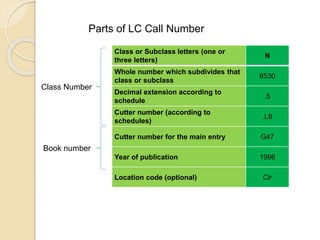
Class or Subclass letters (one or
three letters)
N
Whole number which subdivides that
class or subclass
6530
Decimal extension according to
schedule
.5
Cutter number (according to
schedules)
.L8
Cutter number for the main entry G47
Year of publication 1996
Location code (optional) Cir
Parts of LC Call Number
Class Number
Book number
Book: Introduction to computer languages by Sawyer,
published in 2017
QA Mathematics
76 Electronic computers
.7 Programming languages (decimal extension
breaks down subjects to a mor
specific patterns)
.S29 Cutter for the author (Sawyer)
2017 Year of publication
Call Number with Single Cutter Number
…A work by Walters (2015) on
dance poster would be classified
at :
NC Drawing. Design.
Illustration
1849 special topics
.D35 topical cutter for dance
.W35 main entry cutter for
author
2015 Date of publication
NC DRAWING. DESIGN.
ILLUSTRATIONS
Double Cutter
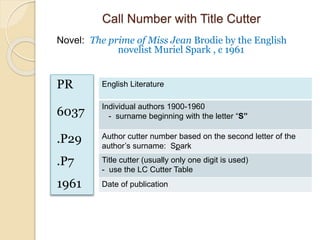
Call Number with Title Cutter
Novel: The prime of Miss Jean Brodie by the English
novelist Muriel Spark , c 1961
PR
6037
.P29
.P7
1961
English Literature
Individual authors 1900-1960
- surname beginning with the letter “S”
Author cutter number based on the second letter of the
author’s surname: Spark
Title cutter (usually only one digit is used)
- use the LC Cutter Table
Date of publication
Type 1 table
HE Transportation and Communications
Urban transportation
By region or country
311 Other regions or countries, A-Z
Under each country:
.x General works
.x2A-Z Local A-Z
Book :
Canada’s urban
transportation
development strategy
the cutter for Canada is .C2
the .x is now replaced by .C2
HE
311
.C2
main entry cutter
date of publication
Biography table
.x Cutter for the bigraphee
.xA2 Collected works. By date
.xA25 Selected works. Selections. By date
Including quotations
.xA3 Autobiography, diaries, etc. By date
.xA4 Letters. By date
.xA5 Speeches, essays, lectures. By date
Including interviews
.xA6-Z Individual biography, interviews, and criticism
By main entry
Including criticism of selected works, autobiography, quotations
letters, speeches, interviews, etc.
Collective Biography:
The lives of ten well-known
Germans of the 19th century
(Kessler, 1995)
DD Germany
205 Biography & memiors-19th cent.
.A2 Collective
.K47 main entry cutter
1995 Date of publication
DD Germany
205 Biography & memiors-19th cent.
.H67 Individual cutter w/in range .A6-Z
.F74 main entry cutter
1998 Date of publication
Individual Biography:
A biography of Hecker (Freitag,
1998)
Translation table
.x Original works
.x12 Polyglot
.x13 English translation
.x14 French translation
.x15 German translation
.x16 Italian translation
.x17 Russian translation
.x18 Spanish translation
Original work:
A brief history of time by Stephen
Hawking (1988)
QB Astronomy
981 Gen. works, treatises, etc.
.H39 cutter for author, Hawking
1988 Date of publication
QB Astronomy
981 Gen. works, treatises, etc.
.H3914 cutter for Hawking + French translation
1995 Date of publication
French translation of his work
by Leroux, (1995)
Language & Literature tables
American Literature
Individual authors
1961- (XXXIX or XL, unless otherwise specified
Fiction:
The Tommyknockers (King, 1988)
PS American literature, Individual authors, 1961-
3561 Authors starting with K
.I483 cutter based on second letter of surname, King
.T66 cutter from Table XL for separate works
1988 Date of publication
SHELVING
To shelve a book by its Library of Congress call number,
begin with the first letter(s)
A AC AG AP B
After finding the proper alphabetical section, read the
numbers that follow the letters in numerical order
AP AP AP AP AP
1 2 5 10 50
 If there is a decimal point in the first row, a number to
the right of decimal point is treated as a decimal
number
DS comes before DS
668.29 668.3
 Books on similar subject have call numbers that begin with the
same set of letters and numbers. Each book is then identified by
the remaining letter/number set in the call number. Read the letter
that begins the next line of the call number in alphabetical order.
AP AP AP AP AP
2 2 2 2 2
.A .B .D .G .S
 Now read the final number group in the call number as a decimal
number
AP AP AP AP AP
2 2 2 2 2
.N2 .N31 .N3545 .N4 .N43
 When a date appears as the last line of the call number,
the call numbers with the additional line follow those
without the date.
DS DS
668 comes before 668
.B39 .B39
1954
 Dates are shelved in chronological order.
JV JV
9185 comes before 9185
.I8 .I8
.C72 .C72
1990 1996
 Example of sequence
B BA BA BA BA BA
1649 164 1631 1631 1631 1631
.R94 .D63 .A48 .A5 .A5 .A5
.M3 .N71 .S55 .P3 .P36 .P36
1964 1991 1985 1979 1976 1980
Credits
 Dittman, Helena. Learn Library of Congress classification.
Canberra : DocMatrix Pty Ltd., c2000
 https://www.loc.gov/aba/publications/Archived-
LCC02/freelcc.html
Thank you…
Bernardita F. Federico, RL
PRC No. 1767
Technical Services
Fr. James J. O’Brien, S.J. Library
Ateneo de Naga University

Classification

  • 1.
  • 2.
    Classification – meaningful groupingof persons, things, animals, etc. in a systematic way -- also means grouping things or objects that have the property or characteristics in common into a class. -- involves establishing relationships among classes and making distinctions within classes to arrive at subclasses and finer divisions.
  • 3.
    Library Classification – thesystematic arrangement by subject of books and other materials on shelves or of catalog and index entries in the manner which is most useful to those who read or who seek a definite piece of information
  • 4.
     Class –a group of objects exhibiting one or more common characteristics, identified by specific notation  Class number – notation that designates the class to which a given item belongs  Book number – part of call number that distinguishes a specific item from other items within the same class number
  • 5.
    Call Number – aset of letters, numerals, or other symbols (in combination or alone) used by a library to identify a specific copy of a book. It may consists of a class number, book number, date , volume number, copy number, etc.
  • 6.
     Work mark –that part of a book number that consists of a letter appended to the author designation to show the first letter of the title (or first letter of the surname of the biographer).  Mnemonic devices – devices intended to aid or assist the memory
  • 7.
    Purpose of aClassification  Order the field of knowledge in a systematic way.  Bring related items together in a helpful sequence  Provide orderly access to the shelves either by browsing or via the catalog  Provide exact location of an item on the shelves.
  • 8.
    Types of Classification Enumerative classification  Attempts to spell out (enumerate) all the single and composite concepts required  Synthetic classification  a.k.a faceted classification  Lists numbers for single concepts, and allows the classifier to construct (synthesize) numbers for composite subjects  Hierarchical classification  Based on the division of subjects from the most general to the most specific
  • 9.
    The Library ClassificationSystems 1.Dewey Decimal Classification System (devised by Melvil Dewey) 2.Library of Congress Classification System (devised by the U.S. Library of Congress thru the direction of J.C. Hanson and Charles Martel) 3.Universal Decimal Classification System (developed by Paul Otlet and Henry La Fonataine) 4.Colon Classification System (devised by S.R. Ranganathan) 5.Bibliographic Classification System (devised by Henry Evelyn Bliss) 6.Subject Classification System (designed by y James Duff Brown) 7.Expansive Classification System (designed by Charles Ammi Cutter) 8.National Library of Medicine Classification System (devised by the U.S. National Library of Medicine)
  • 10.
  • 11.
    Historical Backgorund  Developedby James Hanson for the US Library of Congress in 1897  Outline & notation of the main class are similar to C.A. Cutter’s Expansive Classification  Based on LC’s initial book collection
  • 12.
    Features of LCSchedule  Preface  Outline  Body of the schedule  Tables after the body  Index
  • 13.
    Principles of Classifyingwith LC  Classify works according their subject matter  Use the most specific number available  Give each work a unique number  Classify a work where it will be most useful to the user  Classify a work which covers 2 or more subjects:  With the one that receives fuller treatment  At a broader class – if class includes all subjects as subclass
  • 14.
    MAIN CLASS A Generalworks B Philosophy. Psychology. Religion C Auxiliary sciences of history D History: General and Old World E-F General History and Local History of America and United States G Geography. Anthropology. Recreation H Social Sciences J Political Science K Law L Education M Music N Fine Arts P Language and Literature Q Science R Medicine S Agriculture. Landscape Architecture T Technology U Military Science V Naval Science Z Bibliography. Publishing. Library Science
  • 15.
  • 16.
    Letters I, O,W, X, Y - Unassigned - Reserve for further expansion
  • 17.
    SUBCLASS H Social Sciences(General) HA Statistics HB Economic Theory. Demography HC Economic History and Conditions HD Industries. Land Use. Labor HE Transportation and Communications HF Commerce HG Finance HJ Public Finance HM Sociology HN Social History and Conditions. Social Problem. Social Reform HQ The Family. Marriage. Woman. HS Societies: Secret, Benevolent, etc. HT Communities. Classes. Races. HV Social Pathology. Social and Public Welfare. Criminology HX Socialism. Communism. Anarchism
  • 18.
    Outline (provides adetailed summary of topics & subtopics)
  • 22.
    Tables - representrecurring patterns of subdivision Type 1 table Type 2 table table within the schedules Type 3 table Type 4 table - table within the schedules + table at the back of schedules Biography Table Translation table Language & Literature Table - separate publication for P schedules special table used generally across all schedules
  • 23.
    Notes  Scope notes- explain the type of works to be classified at that subject  Including notes – list topics which are included within a subject  See notes – refer the classifier to a number elsewhere in the schedules, often as a result to reclassification decision.  Confer notes – indicate that related topics are classified elsewhere in the schedules.  Apply table at notes - refer the classifier to a table with subdivision instructions
  • 24.
    Cutter number asbook number – based on the main entry; used to distinguish different works on the same subject that have been given the same class number. 1. After initial vowels For the second letter b d l-m n p r s-t u-y Use number 2 3 4 5 6 7 8 9 2. After the initial letter S For the second letter a ch e h-i m-p t u w-z Use number 2 3 4 5 6 7 8 9 3. After the initial letter Qu For the third letter a e i o r t y Use number 3 4 5 6 7 8 9 For initial letters Qa- Qt use: 2-29 4. After initial consonants For the second letter a e i o r u y Use number 3 4 5 6 7 8 9 5. For expansion For the letter a-d e-h i-l m-o p-s t-v w-z Use number 3 4 5 6 7 8 9
  • 25.
    DDC vs LC DDCDISCIPLINE LC 000 General Works A, QA 76, Z 100 Philosophy, Psychology B-BJ 200 Religion BL-BX 300 Social Sciences H (x HF)J, K, L, U, V 400 Language & languages P-PM 500 Pure sciences Q (x QA 76) 600 Applied sciences HF, R, S. T 700 Arts GV, M, N 800 Literature PN-PZ 900 History, Geography, C, D, E-F, G-GT
  • 26.
    Class or Subclassletters (one or three letters) N Whole number which subdivides that class or subclass 6530 Decimal extension according to schedule .5 Cutter number (according to schedules) .L8 Cutter number for the main entry G47 Year of publication 1996 Location code (optional) Cir Parts of LC Call Number Class Number Book number
  • 27.
    Book: Introduction tocomputer languages by Sawyer, published in 2017 QA Mathematics 76 Electronic computers .7 Programming languages (decimal extension breaks down subjects to a mor specific patterns) .S29 Cutter for the author (Sawyer) 2017 Year of publication Call Number with Single Cutter Number
  • 28.
    …A work byWalters (2015) on dance poster would be classified at : NC Drawing. Design. Illustration 1849 special topics .D35 topical cutter for dance .W35 main entry cutter for author 2015 Date of publication NC DRAWING. DESIGN. ILLUSTRATIONS Double Cutter
  • 29.
    Call Number withTitle Cutter Novel: The prime of Miss Jean Brodie by the English novelist Muriel Spark , c 1961 PR 6037 .P29 .P7 1961 English Literature Individual authors 1900-1960 - surname beginning with the letter “S” Author cutter number based on the second letter of the author’s surname: Spark Title cutter (usually only one digit is used) - use the LC Cutter Table Date of publication
  • 30.
    Type 1 table HETransportation and Communications Urban transportation By region or country 311 Other regions or countries, A-Z Under each country: .x General works .x2A-Z Local A-Z Book : Canada’s urban transportation development strategy the cutter for Canada is .C2 the .x is now replaced by .C2 HE 311 .C2 main entry cutter date of publication
  • 31.
    Biography table .x Cutterfor the bigraphee .xA2 Collected works. By date .xA25 Selected works. Selections. By date Including quotations .xA3 Autobiography, diaries, etc. By date .xA4 Letters. By date .xA5 Speeches, essays, lectures. By date Including interviews .xA6-Z Individual biography, interviews, and criticism By main entry Including criticism of selected works, autobiography, quotations letters, speeches, interviews, etc. Collective Biography: The lives of ten well-known Germans of the 19th century (Kessler, 1995) DD Germany 205 Biography & memiors-19th cent. .A2 Collective .K47 main entry cutter 1995 Date of publication DD Germany 205 Biography & memiors-19th cent. .H67 Individual cutter w/in range .A6-Z .F74 main entry cutter 1998 Date of publication Individual Biography: A biography of Hecker (Freitag, 1998)
  • 32.
    Translation table .x Originalworks .x12 Polyglot .x13 English translation .x14 French translation .x15 German translation .x16 Italian translation .x17 Russian translation .x18 Spanish translation Original work: A brief history of time by Stephen Hawking (1988) QB Astronomy 981 Gen. works, treatises, etc. .H39 cutter for author, Hawking 1988 Date of publication QB Astronomy 981 Gen. works, treatises, etc. .H3914 cutter for Hawking + French translation 1995 Date of publication French translation of his work by Leroux, (1995)
  • 33.
    Language & Literaturetables American Literature Individual authors 1961- (XXXIX or XL, unless otherwise specified Fiction: The Tommyknockers (King, 1988) PS American literature, Individual authors, 1961- 3561 Authors starting with K .I483 cutter based on second letter of surname, King .T66 cutter from Table XL for separate works 1988 Date of publication
  • 34.
    SHELVING To shelve abook by its Library of Congress call number, begin with the first letter(s) A AC AG AP B After finding the proper alphabetical section, read the numbers that follow the letters in numerical order AP AP AP AP AP 1 2 5 10 50  If there is a decimal point in the first row, a number to the right of decimal point is treated as a decimal number DS comes before DS 668.29 668.3
  • 35.
     Books onsimilar subject have call numbers that begin with the same set of letters and numbers. Each book is then identified by the remaining letter/number set in the call number. Read the letter that begins the next line of the call number in alphabetical order. AP AP AP AP AP 2 2 2 2 2 .A .B .D .G .S  Now read the final number group in the call number as a decimal number AP AP AP AP AP 2 2 2 2 2 .N2 .N31 .N3545 .N4 .N43
  • 36.
     When adate appears as the last line of the call number, the call numbers with the additional line follow those without the date. DS DS 668 comes before 668 .B39 .B39 1954  Dates are shelved in chronological order. JV JV 9185 comes before 9185 .I8 .I8 .C72 .C72 1990 1996
  • 37.
     Example ofsequence B BA BA BA BA BA 1649 164 1631 1631 1631 1631 .R94 .D63 .A48 .A5 .A5 .A5 .M3 .N71 .S55 .P3 .P36 .P36 1964 1991 1985 1979 1976 1980
  • 38.
    Credits  Dittman, Helena.Learn Library of Congress classification. Canberra : DocMatrix Pty Ltd., c2000  https://www.loc.gov/aba/publications/Archived- LCC02/freelcc.html
  • 39.
    Thank you… Bernardita F.Federico, RL PRC No. 1767 Technical Services Fr. James J. O’Brien, S.J. Library Ateneo de Naga University