How much water exists on, in, and above
our planet?
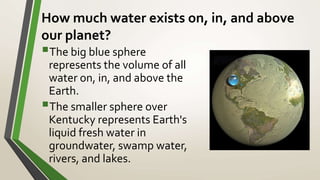
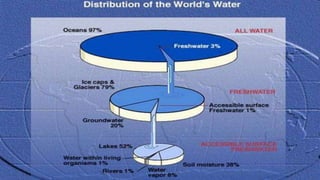
The big blue sphere
represents the volume of all
water on, in, and above the
Earth.
The smaller sphere over
Kentucky represents Earth's
liquid fresh water in
groundwater, swamp water,
rivers, and lakes.
Water Distribution
Water is a finite source.
The Earth is a closed system.
The water that was here billions of
years ago is still here now.
The Earth cleans and replenishes
the water supply through the
hydrologic cycle.
Not that much actually…
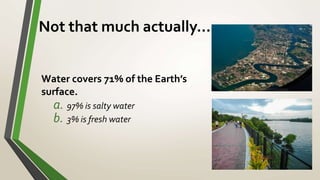
Water covers 71% of the Earth’s
surface.
a. 97% is salty water
b. 3% is fresh water
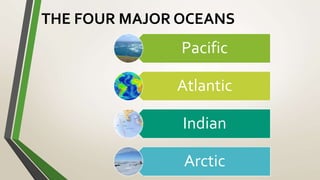
THE FOUR MAJOR OCEANS
Pacific
Atlantic
Indian
Arctic
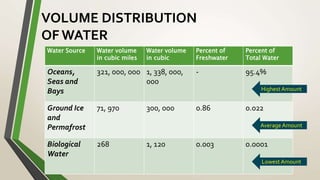
VOLUME DISTRIBUTION
OF WATER
Water Source Water volume
in cubic miles
Water volume
in cubic
Percent of
Freshwater
Percent of
Total Water
Oceans,
Seas and
Bays
321, 000, 000 1, 338, 000,
000
- 95.4%
Ground Ice
and
Permafrost
71, 970 300, 000 0.86 0.022
Biological
Water
268 1, 120 0.003 0.0001
HighestAmount
Average Amount
Lowest Amount
In Detail
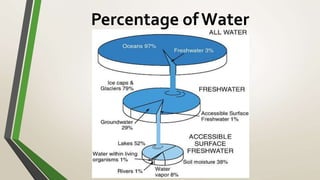
1) Ocean water 97.2 percent
2) Glaciers and other ice 2.15 percent
3) Groundwater 0.61 percent
4) Fresh water lakes 0.009 percent
5) Inland seas 0.008 percent
6) Soil Moisture 0.005 percent
7) Atmosphere 0.001 percent
8) Rivers 0.0001 percent.
(Source: Nace, USGS, 1967 and The Hydrologic Cycle (Pamphlet), USGS, 1984)
Percentage of Water
Classification of water resources:
SURFACE WATER
-Water that is on the surface of the Earth
GLACIERS AND ICE CAPS
-Storehouse of Freshwater
GROUNDWATER
-as water that is found beneath the surface of the
THE STATE OF WATER
The Natural
Water
Physical and
Chemical
attributes
Biological
attributes
Organisms’
Adaptation
Salty
Fresh
Water
Pollution
Alteration of
water
features
Hazardous
for users
WATER QUALITY
•The degree of pollution from the point of
view of organisms living in or using the
water.

Water Distribution on Earth

  • 2.
    How much waterexists on, in, and above our planet? The big blue sphere represents the volume of all water on, in, and above the Earth. The smaller sphere over Kentucky represents Earth's liquid fresh water in groundwater, swamp water, rivers, and lakes.
  • 3.
    Water Distribution Water isa finite source. The Earth is a closed system. The water that was here billions of years ago is still here now. The Earth cleans and replenishes the water supply through the hydrologic cycle.
  • 4.
    Not that muchactually… Water covers 71% of the Earth’s surface. a. 97% is salty water b. 3% is fresh water
  • 6.
    THE FOUR MAJOROCEANS Pacific Atlantic Indian Arctic
  • 7.
    VOLUME DISTRIBUTION OF WATER WaterSource Water volume in cubic miles Water volume in cubic Percent of Freshwater Percent of Total Water Oceans, Seas and Bays 321, 000, 000 1, 338, 000, 000 - 95.4% Ground Ice and Permafrost 71, 970 300, 000 0.86 0.022 Biological Water 268 1, 120 0.003 0.0001 HighestAmount Average Amount Lowest Amount
  • 8.
    In Detail 1) Oceanwater 97.2 percent 2) Glaciers and other ice 2.15 percent 3) Groundwater 0.61 percent 4) Fresh water lakes 0.009 percent 5) Inland seas 0.008 percent 6) Soil Moisture 0.005 percent 7) Atmosphere 0.001 percent 8) Rivers 0.0001 percent. (Source: Nace, USGS, 1967 and The Hydrologic Cycle (Pamphlet), USGS, 1984)
  • 9.
  • 10.
    Classification of waterresources: SURFACE WATER -Water that is on the surface of the Earth GLACIERS AND ICE CAPS -Storehouse of Freshwater GROUNDWATER -as water that is found beneath the surface of the
  • 12.
    THE STATE OFWATER The Natural Water Physical and Chemical attributes Biological attributes Organisms’ Adaptation Salty Fresh Water Pollution Alteration of water features Hazardous for users
  • 13.
    WATER QUALITY •The degreeof pollution from the point of view of organisms living in or using the water.

Editor's Notes

  • #2 Earth is known as the "Blue Planet" because 71 percent of the Earth's surface is covered with water.
  • #3 Earth is a watery planet. 321, 000, 000 cubic miles
  • #4 Water does not sit still. The bottled water that is consumed today might possibly be the same water that once trickled down the back of a wooly mammoth. Very little matter, including water, ever leaves or enters the atmosphere.
  • #5 The earth has an abundance of water, but unfortunately, only a small percentage (about 0.3 percent), is even usable by humans. The other 99.7 percent is in the oceans, soils, icecaps, and floating in the atmosphere
  • #8 Major distributions only
  • #11 This includes the oceans, rivers and streams, lakes, and reservoirs. Surface waters make up the majority of the water used for public supply and irrigation. They cover 10 percent of the world's land mass. Glaciers have had a tremendous effect on the formation of the Earth's surface and are still influencing the topography everyday. Acquifers