Some Essentials of
Thermo Compression
Bonding
A Machine Vendor’s View
Hugo Pristauz
Dec-2016
(presented on the 3D-ASIP 2016 conference in San Francisco)
Introduction
TCB Core Capabilities
Accuracy
Co-planarity
Bond Control
Conclusions
Dec-2016
Adoption of 2.5D/3D Integration
33D-ASIP 2016
Source: Yole
TCB is still seen as the key assembly technology
for 2.5/3DI C2S, C2C or C2W (might change in the future)
Dec-2016
Challenges Which are Mastered with TCB
43D-ASIP 2016
warping
substrate
thin warping die
Warpage
non-wets
solder bridging
Ultra Fine
Pitchsmall
solder volume
dielectric
cracks
Thermal
Stressextra
low-k
solder climbing squish
non-wet
Dec-2016
3 Kinds of TCB Processes
53D-ASIP 2016
TC-NCF Process
(WL applied nonconductive
film or wafer level underfill)
T
F future
killer process
enables
collective
bonding !!!
simple
bond
control
TC-NCP Process
(pre-applied nonconductive
paste)
T
F TCB pioneer!
not good for
thin (memory)
die
simple
bond
control
TC-CUF Process
(capillary underfill, or
TC-MUF: molded underfill)
T
F still major
volume
(material
readiness)
z
hybrid bond
control
Dec-2016
Video Clips from 8800 TCadvanced
63D-ASIP 2016
Face-up TCB Robot handling for C2W
TC-NCF @ C2W TC-CUF @ C2S
Dec-2016
3D TSV Stacks - Done in 2014
73D-ASIP 2016
60 ... 80 µ pitch
Dec-2016
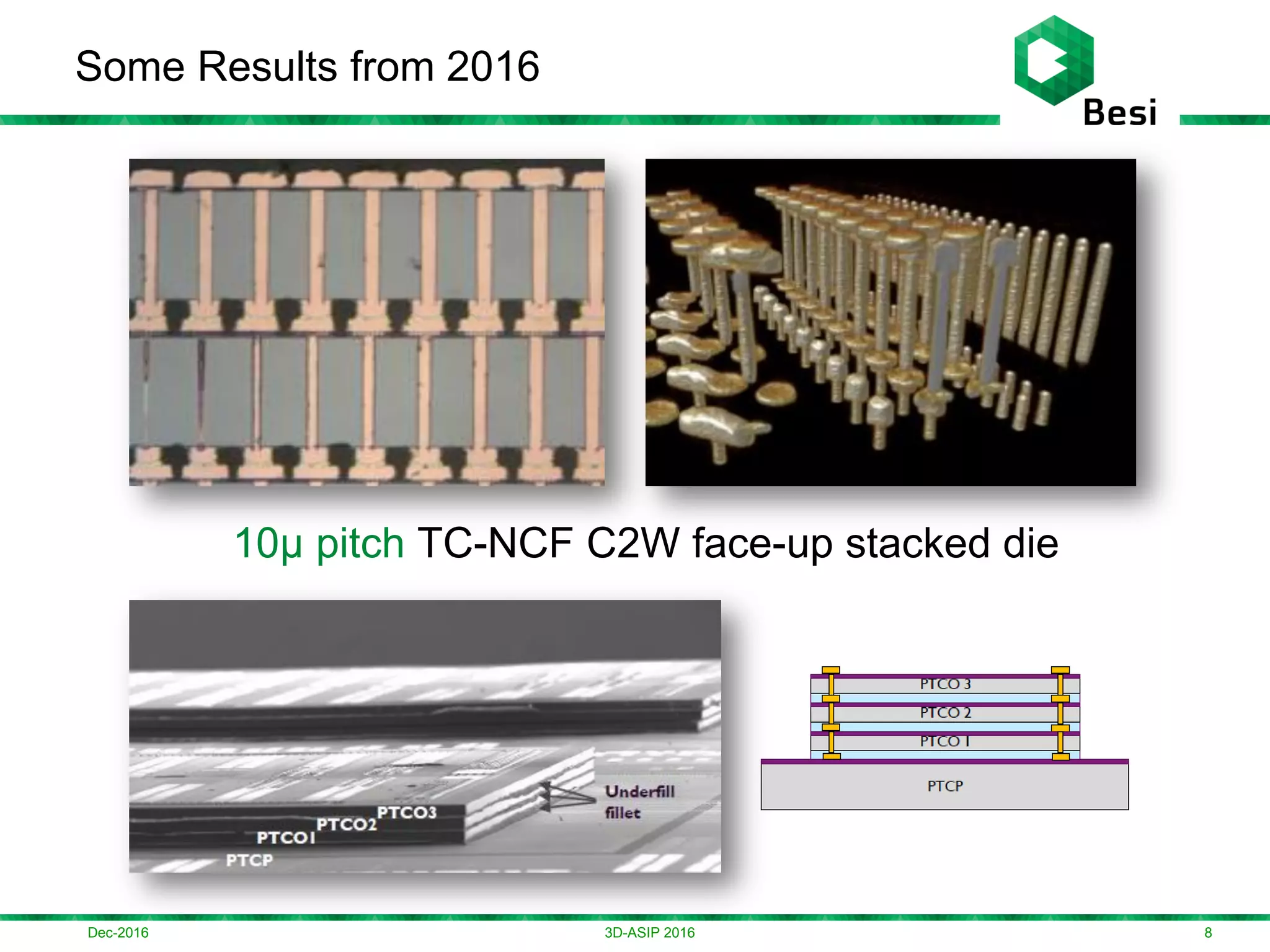
10µ pitch TC-NCF C2W face-up stacked die
Some Results from 2016
83D-ASIP 2016
Dec-2016
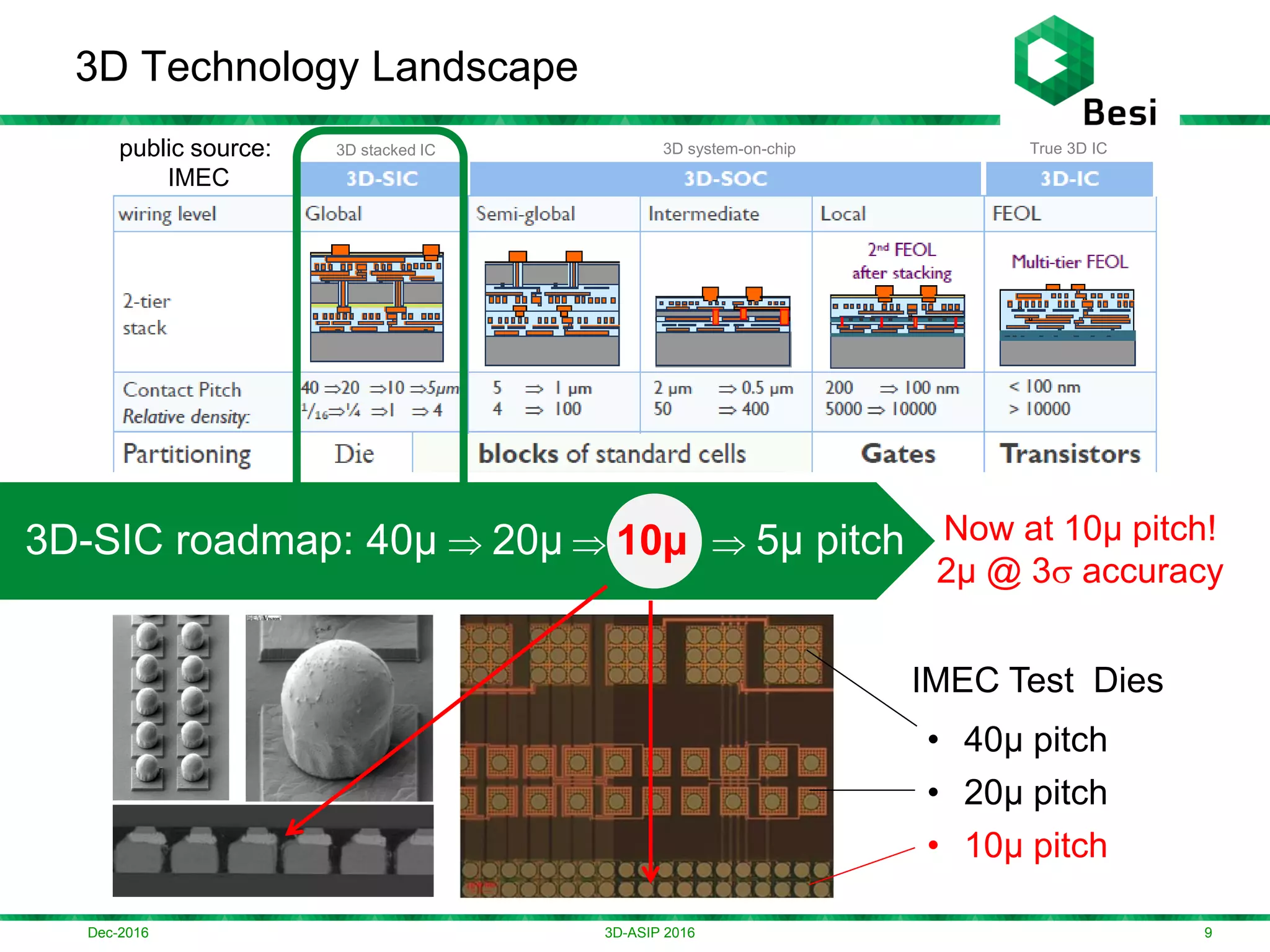
3D Technology Landscape
93D-ASIP 2016
IMEC Test Dies
• 40µ pitch
• 20µ pitch
• 10µ pitch
Now at 10µ pitch!
2µ @ 3 accuracy
3D stacked IC 3D system-on-chip True 3D ICpublic source:
IMEC
3D-SIC roadmap: 40µ  20µ  10µ  5µ pitch10µ
3D stacked IC 3D system-on-chip
Dec-2016
Get Back to 3D Technology Landscape
103D-ASIP 2016
source: IMEC (public)
Next step to focus:
• 1µ @ 3 pitch, needs 200 nm @ 3 placement accuracy!
3D-SOC roadmap: 5µ  pitch1µ
Introduction
TCB Core Capabilities
Accuracy
Co-planarity
Bond Control
Conclusions
Dec-2016
TCB Core Capabilities – Yield
123D-ASIP 2016
3 Core Capabilities
Accuracy Co-planarity Bond Control
Essential - Yield
3 core capabilities are major
responsible for making yield
Current HVM requirement:
99.8% yield per die
Introduction
TCB Core Capabilities
Accuracy
Co-planarity
Bond Control
Conclusions
Dec-2016
Breaking Up the Accuracy Chain
143D-ASIP 2016
2µ@3
hot
matrix
high force
real die
2µ@3 2µ @ 3
Dec-2016
Breaking Up the Accuracy Chain
153D-ASIP 2016
2µ@3
hot process
matrix position
high force
GoG real die
2µ@3 2µ @ 32µ @ 4
Dec-2016
Breaking Up the Accuracy Chain
163D-ASIP 2016
2µ@3
hot process
matrix position
high forcelow force
glass-on-glass (GoG) real die
2µ@3 2µ @ 32µ @ 42µ @ 5
Dec-2016
Breaking Up the Accuracy Chain
173D-ASIP 2016
2µ@3
cold proc. hot process
matrix position
low force high force
glass-on-glass aplication (GoG) real die
2µ@3 2µ @ 32µ @ 42µ @ 52µ @ 6
Dec-2016
Breaking Up the Accuracy Chain
183D-ASIP 2016
2µ@3
cold process hot process
matrix positionsingle pos.
low force high force (250N)
glass-on-glass aplication (GoG) real die
2µ@3 2µ @ 32µ @ 42µ @ 52µ @ 62µ @ 7
0 100 200 300 400 500 600 700 800 900
-2.5
-2
-1.5
-1
-0.5
0
0.5
1
1.5
2
2.5
x[µ],y[µ]
@4305.77.Speck Challenge (17:04:43) [stream]: mean = 0.17/0.02, sigma = 0.16/0.12 @ x/y [µ/µ]
Cpk = 3.88/5.57, Cp = 4.24/5.62 @ x/y [2µ/2µ]
Dec-2016
A Closer Look at the Data
193D-ASIP 2016
2µ @ 7
required
Single position GoG application
cold (20°C), low force (30N)
2µ @ 11 sigma
achieved!
(+/- 0.55µ)

Matrix GoG application
hot (380°C), high force (250N)
0 200 400 600 800 1000 1200
-2.5
-2
-1.5
-1
-0.5
0
0.5
1
1.5
2
2.5
x[µ],y[µ]
Matrix GoG, T: 100->380°C, 30N [stream]: mean = 0.17/-0, sigma = 0.4/0.4 @ x/y [µ/µ]
Cpk = 1.53/1.68, Cp = 1.67/1.68 @ x/y [2µ/2µ]
2µ @ 4
required

2µ @ 5 sigma
achieved!
(+/- 1.2µ)
Temperature
Ramp
>300°C/s
Heat Up
Accuracy – Essential !
203D-ASIP 2016
Essential - Accuracy
Maintain position accuracy while
ramping from cold to hot state
Dec-2016
Accuracy – Essential !
213D-ASIP 2016
Essential - Accuracy
Maintain position accuracy while
ramping from cold to hot state
Dec-2016
single position GoG application
hot (380°C), low force (30N)
2µ @ 5
required weird
behavior !!!
1000 1500 2000 2500 3000 3500 4000 4500
-10
-8
-6
-4
-2
0
2
4
6
8
10
@4305.84.BMC_Test_left_heated_tool_hot (13:51:51)
time
x[µ],y[µ]
Potential Issue
Or: bring accuracy
from bond head down to die
80°C
80°C
80°C->380°C
Dec-2016
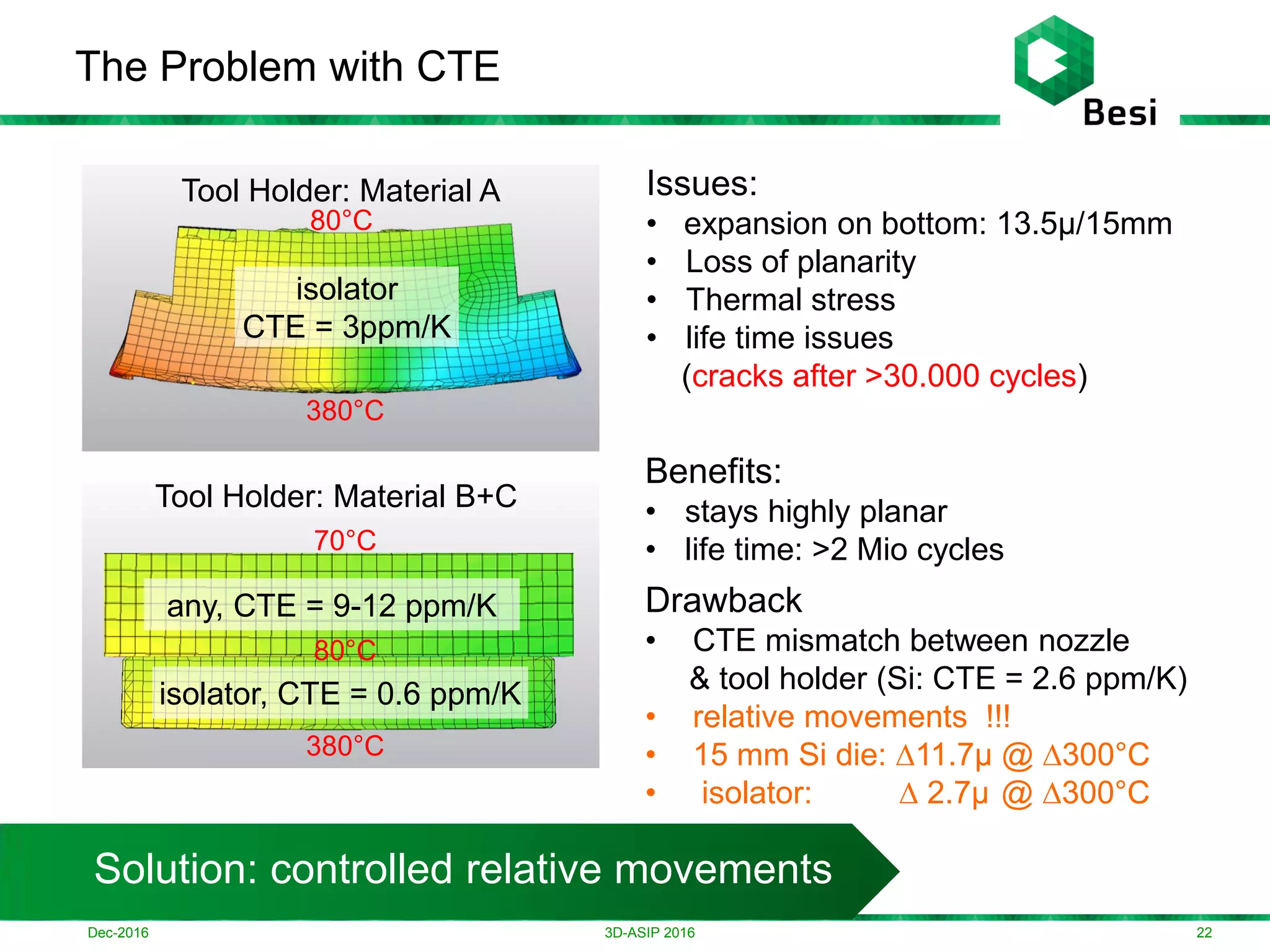
The Problem with CTE
223D-ASIP 2016
Tool Holder: Material A
isolator
CTE = 3ppm/K
Issues:
• expansion on bottom: 13.5µ/15mm
• Loss of planarity
• Thermal stress
• life time issues
(cracks after >30.000 cycles)
Solution: controlled relative movements
80°C
380°C
Benefits:
• stays highly planar
• life time: >2 Mio cycles
Drawback
• CTE mismatch between nozzle
& tool holder (Si: CTE = 2.6 ppm/K)
• relative movements !!!
• 15 mm Si die: 11.7µ @ 300°C
• isolator:  2.7µ @ 300°C
Tool Holder: Material B+C
isolator, CTE = 0.6 ppm/K
any, CTE = 9-12 ppm/K
380°C
70°C
80°C
Introduction
TCB Core Capabilities
Accuracy
Co-planarity
Bond Control
Conclusions
Dec-2016
Co-Planarity
243D-ASIP 2016
US Patent 6 651 866 B1US Patent 2014/0030052A1
Besi: Two approaches to
achieve co-planarity
better than +/-1µ@10mm
Why? - a picture says
more than 1000 words!
Challenge: small solder volume of micro bumps is not forgiving!
Dec-2016
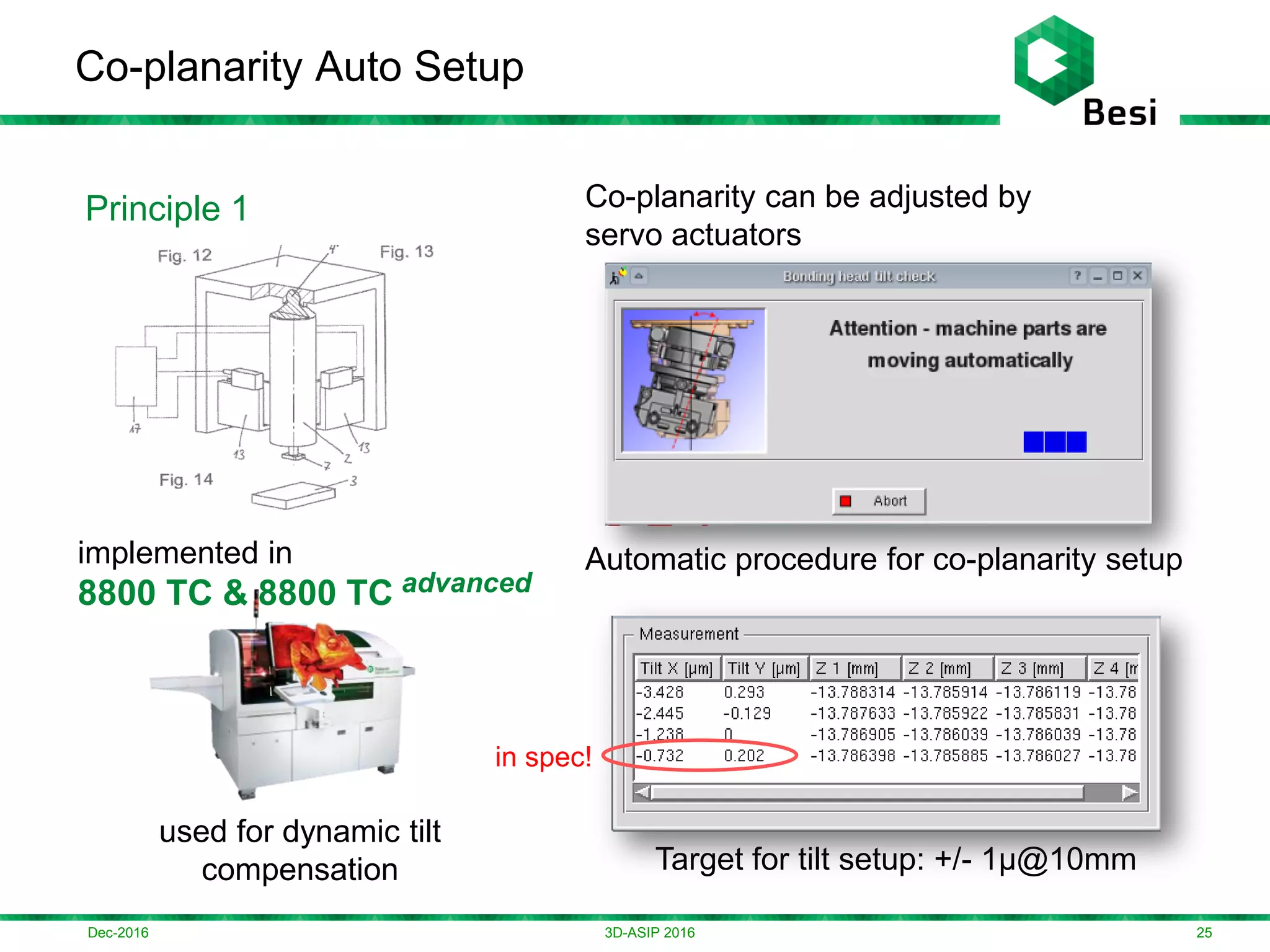
Co-planarity Auto Setup
253D-ASIP 2016
Automatic procedure for co-planarity setup
Target for tilt setup: +/- 1µ@10mm
Principle 1
implemented in
8800 TC & 8800 TC advanced
used for dynamic tilt
compensation
Co-planarity can be adjusted by
servo actuators
in spec!
Dec-2016
Co-planarity Auto Setup
263D-ASIP 2016
Target for tilt setup: +/- 0.5µ @ 10mm
Principle 2
More simple principle!
if dynamic tilt compensation
is not reqired!
Automatic procedure
a) spherical air bearing in bond head can be
switched from fixed to friction-less state
b) co-planarity is established while pressing
bond head to stage in friction-less state
c) after establishing co-planarity spherical
bearing is fixed
max 0.45µ
Dec-2016
Co-planarity – Essential !
273D-ASIP 2016
0 1 2 3 4 5 6 7 8
10
15
20
25
30
#2.56 Tilt 119G-05 (2015-01-29)
F[N](force-blue),T/10[°C](temp.-red),w[µ](pos.-green)
(C) Time t [s] - (selection by: tasks: All Tasks, types: * gantry: L layer: 0)
100
150
200
250
300
Test:
Run 40 repeatable
temperature ramps
from 80°C to 300°C
0 1 2 3 4 5 6 7 8
-4
-2
0
2
4
6
Residues: kinematic: std = NaNµ (Cpk = NaN), thermal: std = 0.69µ (Cpk = 0.48)
#2.56 Tilt 119G-05 (2015-01-29)
-40
-20
0
20
40
60
Improper Co-planarity Integrity
Position traces of
4 die corners
Residual analysis out of spec
0 1 2 3 4 5 6 7 8
-4
-2
0
2
4
6
Residues: kinematic: std = 0.03µ (Cpk = 12.29), thermal: std = 0.09µ (Cpk = 3.8)
#2.56 Tilt 119G-05 (2015-01-29)
-40
-20
0
20
40
60
Proper Co-planarity Integrity
Position traces of
4 die corners
Residual analysis in spec +/-1µ
Essential:
Coplanarity Integrity
„Maintain co-planarity during
temperature ramp!“
Introduction
TCB Core Capabilities
Accuracy
Co-planarity
Bond Control
Conclusions
Dec-2016
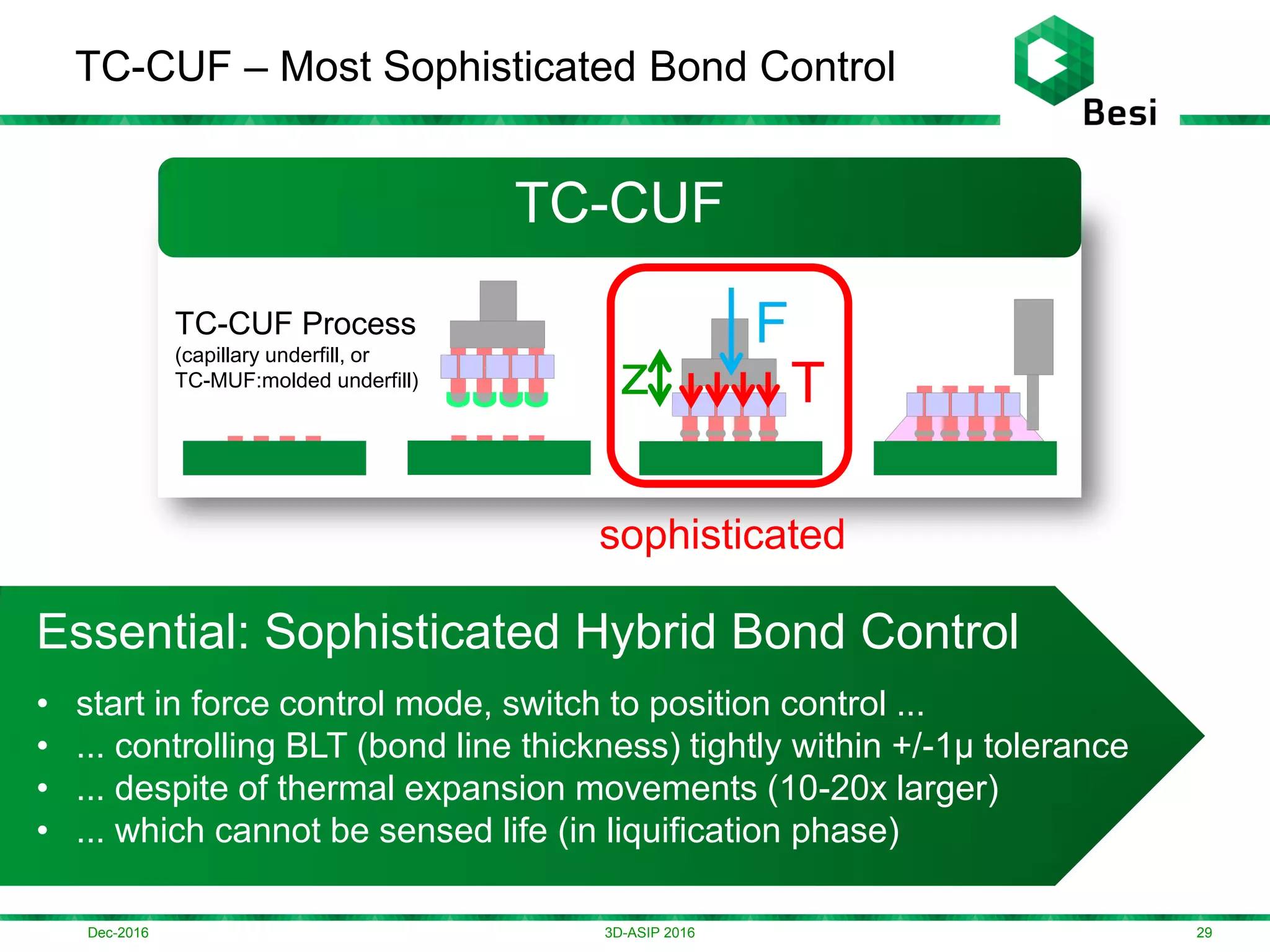
TC-CUF – Most Sophisticated Bond Control
293D-ASIP 2016
Essential: Sophisticated Hybrid Bond Control
TC-CUF Process
(capillary underfill, or
TC-MUF:molded underfill)
T
F
TC-CUF
sophisticated
z
• start in force control mode, switch to position control ...
• ... controlling BLT (bond line thickness) tightly within +/-1µ tolerance
• ... despite of thermal expansion movements (10-20x larger)
• ... which cannot be sensed life (in liquification phase)
Dec-2016
Bond Control for TC-CUF Process
303D-ASIP 2016
z (position)
T (temperature)
F (force)
0 0.5 1 1.5 2 2.5 3 3.5 4 4.5 5 5.5
-20
-10
0
10
20
30
40
50
-200
-100
0
100
200
300
400
500
Temperature[°C]
Bond Control for CUF Process
Force[N],Position[µm]
time [s]
high temperature
ramping rate
200°C/s
dynamic
z-control
during collapse
thermal
compensation
rapid cooling
-100°C/s
• Challenge 1: How do you teach the position control?
• Challenge 2: How do you move from one tool to another?
T (temperature)
F (force)
z (position)
position control.
force
control
Dec-2016
Enhanced Bond Control for TC-CUF Process
313D-ASIP 2016
0 0.5 1 1.5 2 2.5 3 3.5 4 4.5 5 5.5
-20
-10
0
10
20
30
40
50
-200
-100
0
100
200
300
400
500
Temperature[°C]
Enhanced Bond Control for CUF Process
Force[N],Position[µm]
time [s]
• By distributing bond control over two position axes the
complexity of the bond control is reduced
w (position)
T (temperature)
F (force)
z (position)
thermal
compensation
@ z-position-axis
w-position axis
used for
BLT control
-7µ@2s
responsibility of
process engineer
kinematic
compensation position control.
force
control
Dec-2016
1) Start with Force Ramp
323D-ASIP 2016
0 0.5 1 1.5 2 2.5 3 3.5 4 4.5 5 5.5
-20
-10
0
10
20
30
40
50
-200
-100
0
100
200
300
400
500
Temperature[°C]
Enhanced Bond Control for CUF Process
Force[N],Position[µm]
time [s]
w (position)
T (temperature)
z (position)
start with
force ramping
-7µ@2s
responsibility of
process engineer
bond head position (w)
reacts with elastic movement)
F (force)
0 0.5 1 1.5 2 2.5 3 3.5 4 4.5 5 5.5
-20
-10
0
10
20
30
40
50
-200
-100
0
100
200
300
400
500
Temperature[°C]
Enhanced Bond Control for CUF Process
Force[N],Position[µm]
time [s]
Dec-2016
2) Start Temperature Ramping
333D-ASIP 2016
w (position)
T (temperature)
z (position)
-7µ@2s
responsibility of
process engineer
start
temperature
ramping
bond head position (z)
will start moving due to
thermal expansion
Shortly before liquification:
switch from force to position
control (to be prepared for the
soon following force collapse)
hold force
start your compensation for
the thermal expansion
0 0.5 1 1.5 2 2.5 3 3.5 4 4.5 5 5.5
-20
-10
0
10
20
30
40
50
-200
-100
0
100
200
300
400
500
Temperature[°C]
Enhanced Bond Control for CUF Process
Force[N],Position[µm]
time [s]
Dec-2016
3) Liquification Phase: Hurry up!
343D-ASIP 2016
w (position)
T (temperature)
z (position)
-7µ@2s
responsibility of
process engineer
temperature
exceeds
liquification
threshold
Liquification:
the bump gets
liquid and the
force breaks
down
Luckily you are already in
position mode and you can
control bond head position
for whatever you want!
Hurry up and raise the bond
head position, since by collapse
of the force your compressed
elasticities relax at sudden
don‘t forget: your materials
are thermally expanding!
Compensate with porper
bond head raise movement!
solder climbing
squish
otherwise you get these
nasty results
0 0.5 1 1.5 2 2.5 3 3.5 4 4.5 5 5.5
-20
-10
0
10
20
30
40
50
-200
-100
0
100
200
300
400
500
Temperature[°C]
Enhanced Bond Control for CUF Process
Force[N],Position[µm]
time [s]
Dec-2016
4) Relax – Solder Joint Formation
353D-ASIP 2016
w (position)
T (temperature)
z (position)
-7µ@2s
Relax!
Adjust bond head position to
form final solder joint height
and never forget:
your materials are still
thermally expanding!
Compensate with porper
bond head raise movement!
responsibility of
process engineer
temperature
is still in a
transient
phase
0 0.5 1 1.5 2 2.5 3 3.5 4 4.5 5 5.5
-20
-10
0
10
20
30
40
50
-200
-100
0
100
200
300
400
500
Temperature[°C]
Enhanced Bond Control for CUF Process
Force[N],Position[µm]
time [s]
Dec-2016
5) Bring to the End
363D-ASIP 2016
w (position)
T (temperature)
z (position)
-7µ@2s
Hold your solder joint thickness!
Especially during solidification
phase, otherwise you will
impact your solder joint strength
And never forget:
your materials are still
thermally expanding, later
on shrinking!
Compensate with porper
bond head movement!
run the rest of
your thermal profile.
solder joints are still
liquid until
solidification
Dec-2016
Further Essential
373D-ASIP 2016
Essential:
The control of each process variable
must be highly repeatable !
Keep in mind!
• There is no sensor which helps you how to do the
• thermal compensation (this is the current standard)
• The thermal compensation movement has to be identified
automatically and to be recalled from memory during bond
control
Introduction
TCB Core Capabilities
Accuracy
Co-planarity
Bond Control
Conclusions
Dec-2016
• For 2.5D/3DI C2S, C2C and C2W TCB is fully established in HVM
packaging
• Essential for TCB yield are 3 core capabilities: accuracy, co-planarity
and bond control.
• Essential for TCB is to maintain high accuracy from a cold die position
to a hot die position during rapid temperature ramps (rapid means:
>300°C/s)
• Essential for TCB is to maintain high co-planarity during whole rapid
temperature transients (heating & cooling)
• Essential for TCB is a highly repeatable bond control, especially for
TC-CUF where BLT control of +/-1µ needs to be achieved
Conclusions
393D-ASIP 2016
Thank You
Questions ?

Some Essentials of TCB

  • 1.
    Some Essentials of ThermoCompression Bonding A Machine Vendor’s View Hugo Pristauz Dec-2016 (presented on the 3D-ASIP 2016 conference in San Francisco)
  • 2.
  • 3.
    Dec-2016 Adoption of 2.5D/3DIntegration 33D-ASIP 2016 Source: Yole TCB is still seen as the key assembly technology for 2.5/3DI C2S, C2C or C2W (might change in the future)
  • 4.
    Dec-2016 Challenges Which areMastered with TCB 43D-ASIP 2016 warping substrate thin warping die Warpage non-wets solder bridging Ultra Fine Pitchsmall solder volume dielectric cracks Thermal Stressextra low-k solder climbing squish non-wet
  • 5.
    Dec-2016 3 Kinds ofTCB Processes 53D-ASIP 2016 TC-NCF Process (WL applied nonconductive film or wafer level underfill) T F future killer process enables collective bonding !!! simple bond control TC-NCP Process (pre-applied nonconductive paste) T F TCB pioneer! not good for thin (memory) die simple bond control TC-CUF Process (capillary underfill, or TC-MUF: molded underfill) T F still major volume (material readiness) z hybrid bond control
  • 6.
    Dec-2016 Video Clips from8800 TCadvanced 63D-ASIP 2016 Face-up TCB Robot handling for C2W TC-NCF @ C2W TC-CUF @ C2S
  • 7.
    Dec-2016 3D TSV Stacks- Done in 2014 73D-ASIP 2016 60 ... 80 µ pitch
  • 8.
    Dec-2016 10µ pitch TC-NCFC2W face-up stacked die Some Results from 2016 83D-ASIP 2016
  • 9.
    Dec-2016 3D Technology Landscape 93D-ASIP2016 IMEC Test Dies • 40µ pitch • 20µ pitch • 10µ pitch Now at 10µ pitch! 2µ @ 3 accuracy 3D stacked IC 3D system-on-chip True 3D ICpublic source: IMEC 3D-SIC roadmap: 40µ  20µ  10µ  5µ pitch10µ
  • 10.
    3D stacked IC3D system-on-chip Dec-2016 Get Back to 3D Technology Landscape 103D-ASIP 2016 source: IMEC (public) Next step to focus: • 1µ @ 3 pitch, needs 200 nm @ 3 placement accuracy! 3D-SOC roadmap: 5µ  pitch1µ
  • 11.
  • 12.
    Dec-2016 TCB Core Capabilities– Yield 123D-ASIP 2016 3 Core Capabilities Accuracy Co-planarity Bond Control Essential - Yield 3 core capabilities are major responsible for making yield Current HVM requirement: 99.8% yield per die
  • 13.
  • 14.
    Dec-2016 Breaking Up theAccuracy Chain 143D-ASIP 2016 2µ@3 hot matrix high force real die 2µ@3 2µ @ 3
  • 15.
    Dec-2016 Breaking Up theAccuracy Chain 153D-ASIP 2016 2µ@3 hot process matrix position high force GoG real die 2µ@3 2µ @ 32µ @ 4
  • 16.
    Dec-2016 Breaking Up theAccuracy Chain 163D-ASIP 2016 2µ@3 hot process matrix position high forcelow force glass-on-glass (GoG) real die 2µ@3 2µ @ 32µ @ 42µ @ 5
  • 17.
    Dec-2016 Breaking Up theAccuracy Chain 173D-ASIP 2016 2µ@3 cold proc. hot process matrix position low force high force glass-on-glass aplication (GoG) real die 2µ@3 2µ @ 32µ @ 42µ @ 52µ @ 6
  • 18.
    Dec-2016 Breaking Up theAccuracy Chain 183D-ASIP 2016 2µ@3 cold process hot process matrix positionsingle pos. low force high force (250N) glass-on-glass aplication (GoG) real die 2µ@3 2µ @ 32µ @ 42µ @ 52µ @ 62µ @ 7
  • 19.
    0 100 200300 400 500 600 700 800 900 -2.5 -2 -1.5 -1 -0.5 0 0.5 1 1.5 2 2.5 x[µ],y[µ] @4305.77.Speck Challenge (17:04:43) [stream]: mean = 0.17/0.02, sigma = 0.16/0.12 @ x/y [µ/µ] Cpk = 3.88/5.57, Cp = 4.24/5.62 @ x/y [2µ/2µ] Dec-2016 A Closer Look at the Data 193D-ASIP 2016 2µ @ 7 required Single position GoG application cold (20°C), low force (30N) 2µ @ 11 sigma achieved! (+/- 0.55µ)  Matrix GoG application hot (380°C), high force (250N) 0 200 400 600 800 1000 1200 -2.5 -2 -1.5 -1 -0.5 0 0.5 1 1.5 2 2.5 x[µ],y[µ] Matrix GoG, T: 100->380°C, 30N [stream]: mean = 0.17/-0, sigma = 0.4/0.4 @ x/y [µ/µ] Cpk = 1.53/1.68, Cp = 1.67/1.68 @ x/y [2µ/2µ] 2µ @ 4 required  2µ @ 5 sigma achieved! (+/- 1.2µ)
  • 20.
    Temperature Ramp >300°C/s Heat Up Accuracy –Essential ! 203D-ASIP 2016 Essential - Accuracy Maintain position accuracy while ramping from cold to hot state Dec-2016
  • 21.
    Accuracy – Essential! 213D-ASIP 2016 Essential - Accuracy Maintain position accuracy while ramping from cold to hot state Dec-2016 single position GoG application hot (380°C), low force (30N) 2µ @ 5 required weird behavior !!! 1000 1500 2000 2500 3000 3500 4000 4500 -10 -8 -6 -4 -2 0 2 4 6 8 10 @4305.84.BMC_Test_left_heated_tool_hot (13:51:51) time x[µ],y[µ] Potential Issue Or: bring accuracy from bond head down to die 80°C 80°C 80°C->380°C
  • 22.
    Dec-2016 The Problem withCTE 223D-ASIP 2016 Tool Holder: Material A isolator CTE = 3ppm/K Issues: • expansion on bottom: 13.5µ/15mm • Loss of planarity • Thermal stress • life time issues (cracks after >30.000 cycles) Solution: controlled relative movements 80°C 380°C Benefits: • stays highly planar • life time: >2 Mio cycles Drawback • CTE mismatch between nozzle & tool holder (Si: CTE = 2.6 ppm/K) • relative movements !!! • 15 mm Si die: 11.7µ @ 300°C • isolator:  2.7µ @ 300°C Tool Holder: Material B+C isolator, CTE = 0.6 ppm/K any, CTE = 9-12 ppm/K 380°C 70°C 80°C
  • 23.
  • 24.
    Dec-2016 Co-Planarity 243D-ASIP 2016 US Patent6 651 866 B1US Patent 2014/0030052A1 Besi: Two approaches to achieve co-planarity better than +/-1µ@10mm Why? - a picture says more than 1000 words! Challenge: small solder volume of micro bumps is not forgiving!
  • 25.
    Dec-2016 Co-planarity Auto Setup 253D-ASIP2016 Automatic procedure for co-planarity setup Target for tilt setup: +/- 1µ@10mm Principle 1 implemented in 8800 TC & 8800 TC advanced used for dynamic tilt compensation Co-planarity can be adjusted by servo actuators in spec!
  • 26.
    Dec-2016 Co-planarity Auto Setup 263D-ASIP2016 Target for tilt setup: +/- 0.5µ @ 10mm Principle 2 More simple principle! if dynamic tilt compensation is not reqired! Automatic procedure a) spherical air bearing in bond head can be switched from fixed to friction-less state b) co-planarity is established while pressing bond head to stage in friction-less state c) after establishing co-planarity spherical bearing is fixed max 0.45µ
  • 27.
    Dec-2016 Co-planarity – Essential! 273D-ASIP 2016 0 1 2 3 4 5 6 7 8 10 15 20 25 30 #2.56 Tilt 119G-05 (2015-01-29) F[N](force-blue),T/10[°C](temp.-red),w[µ](pos.-green) (C) Time t [s] - (selection by: tasks: All Tasks, types: * gantry: L layer: 0) 100 150 200 250 300 Test: Run 40 repeatable temperature ramps from 80°C to 300°C 0 1 2 3 4 5 6 7 8 -4 -2 0 2 4 6 Residues: kinematic: std = NaNµ (Cpk = NaN), thermal: std = 0.69µ (Cpk = 0.48) #2.56 Tilt 119G-05 (2015-01-29) -40 -20 0 20 40 60 Improper Co-planarity Integrity Position traces of 4 die corners Residual analysis out of spec 0 1 2 3 4 5 6 7 8 -4 -2 0 2 4 6 Residues: kinematic: std = 0.03µ (Cpk = 12.29), thermal: std = 0.09µ (Cpk = 3.8) #2.56 Tilt 119G-05 (2015-01-29) -40 -20 0 20 40 60 Proper Co-planarity Integrity Position traces of 4 die corners Residual analysis in spec +/-1µ Essential: Coplanarity Integrity „Maintain co-planarity during temperature ramp!“
  • 28.
  • 29.
    Dec-2016 TC-CUF – MostSophisticated Bond Control 293D-ASIP 2016 Essential: Sophisticated Hybrid Bond Control TC-CUF Process (capillary underfill, or TC-MUF:molded underfill) T F TC-CUF sophisticated z • start in force control mode, switch to position control ... • ... controlling BLT (bond line thickness) tightly within +/-1µ tolerance • ... despite of thermal expansion movements (10-20x larger) • ... which cannot be sensed life (in liquification phase)
  • 30.
    Dec-2016 Bond Control forTC-CUF Process 303D-ASIP 2016 z (position) T (temperature) F (force) 0 0.5 1 1.5 2 2.5 3 3.5 4 4.5 5 5.5 -20 -10 0 10 20 30 40 50 -200 -100 0 100 200 300 400 500 Temperature[°C] Bond Control for CUF Process Force[N],Position[µm] time [s] high temperature ramping rate 200°C/s dynamic z-control during collapse thermal compensation rapid cooling -100°C/s • Challenge 1: How do you teach the position control? • Challenge 2: How do you move from one tool to another? T (temperature) F (force) z (position) position control. force control
  • 31.
    Dec-2016 Enhanced Bond Controlfor TC-CUF Process 313D-ASIP 2016 0 0.5 1 1.5 2 2.5 3 3.5 4 4.5 5 5.5 -20 -10 0 10 20 30 40 50 -200 -100 0 100 200 300 400 500 Temperature[°C] Enhanced Bond Control for CUF Process Force[N],Position[µm] time [s] • By distributing bond control over two position axes the complexity of the bond control is reduced w (position) T (temperature) F (force) z (position) thermal compensation @ z-position-axis w-position axis used for BLT control -7µ@2s responsibility of process engineer kinematic compensation position control. force control
  • 32.
    Dec-2016 1) Start withForce Ramp 323D-ASIP 2016 0 0.5 1 1.5 2 2.5 3 3.5 4 4.5 5 5.5 -20 -10 0 10 20 30 40 50 -200 -100 0 100 200 300 400 500 Temperature[°C] Enhanced Bond Control for CUF Process Force[N],Position[µm] time [s] w (position) T (temperature) z (position) start with force ramping -7µ@2s responsibility of process engineer bond head position (w) reacts with elastic movement) F (force)
  • 33.
    0 0.5 11.5 2 2.5 3 3.5 4 4.5 5 5.5 -20 -10 0 10 20 30 40 50 -200 -100 0 100 200 300 400 500 Temperature[°C] Enhanced Bond Control for CUF Process Force[N],Position[µm] time [s] Dec-2016 2) Start Temperature Ramping 333D-ASIP 2016 w (position) T (temperature) z (position) -7µ@2s responsibility of process engineer start temperature ramping bond head position (z) will start moving due to thermal expansion Shortly before liquification: switch from force to position control (to be prepared for the soon following force collapse) hold force start your compensation for the thermal expansion
  • 34.
    0 0.5 11.5 2 2.5 3 3.5 4 4.5 5 5.5 -20 -10 0 10 20 30 40 50 -200 -100 0 100 200 300 400 500 Temperature[°C] Enhanced Bond Control for CUF Process Force[N],Position[µm] time [s] Dec-2016 3) Liquification Phase: Hurry up! 343D-ASIP 2016 w (position) T (temperature) z (position) -7µ@2s responsibility of process engineer temperature exceeds liquification threshold Liquification: the bump gets liquid and the force breaks down Luckily you are already in position mode and you can control bond head position for whatever you want! Hurry up and raise the bond head position, since by collapse of the force your compressed elasticities relax at sudden don‘t forget: your materials are thermally expanding! Compensate with porper bond head raise movement! solder climbing squish otherwise you get these nasty results
  • 35.
    0 0.5 11.5 2 2.5 3 3.5 4 4.5 5 5.5 -20 -10 0 10 20 30 40 50 -200 -100 0 100 200 300 400 500 Temperature[°C] Enhanced Bond Control for CUF Process Force[N],Position[µm] time [s] Dec-2016 4) Relax – Solder Joint Formation 353D-ASIP 2016 w (position) T (temperature) z (position) -7µ@2s Relax! Adjust bond head position to form final solder joint height and never forget: your materials are still thermally expanding! Compensate with porper bond head raise movement! responsibility of process engineer temperature is still in a transient phase
  • 36.
    0 0.5 11.5 2 2.5 3 3.5 4 4.5 5 5.5 -20 -10 0 10 20 30 40 50 -200 -100 0 100 200 300 400 500 Temperature[°C] Enhanced Bond Control for CUF Process Force[N],Position[µm] time [s] Dec-2016 5) Bring to the End 363D-ASIP 2016 w (position) T (temperature) z (position) -7µ@2s Hold your solder joint thickness! Especially during solidification phase, otherwise you will impact your solder joint strength And never forget: your materials are still thermally expanding, later on shrinking! Compensate with porper bond head movement! run the rest of your thermal profile. solder joints are still liquid until solidification
  • 37.
    Dec-2016 Further Essential 373D-ASIP 2016 Essential: Thecontrol of each process variable must be highly repeatable ! Keep in mind! • There is no sensor which helps you how to do the • thermal compensation (this is the current standard) • The thermal compensation movement has to be identified automatically and to be recalled from memory during bond control
  • 38.
  • 39.
    Dec-2016 • For 2.5D/3DIC2S, C2C and C2W TCB is fully established in HVM packaging • Essential for TCB yield are 3 core capabilities: accuracy, co-planarity and bond control. • Essential for TCB is to maintain high accuracy from a cold die position to a hot die position during rapid temperature ramps (rapid means: >300°C/s) • Essential for TCB is to maintain high co-planarity during whole rapid temperature transients (heating & cooling) • Essential for TCB is a highly repeatable bond control, especially for TC-CUF where BLT control of +/-1µ needs to be achieved Conclusions 393D-ASIP 2016
  • 40.