Brick masonry
Brick masonry
• Construction of brick units bonded together with mortar is known
as brick masonary
• Strength of brick masonry depends on
– Quality of brick ,
– Quality of mortar
– Method of bonding
– Workmanship
– Mortar used may be – cement mortar , lime mortar , composite mortar ,
mud mortar
– Types of brick :
– 1.standard modular brick
– 2.traditional brick
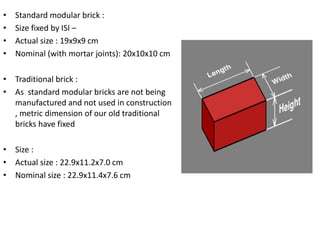
• Standard modular brick :
• Size fixed by ISI –
• Actual size : 19x9x9 cm
• Nominal (with mortar joints): 20x10x10 cm
• Traditional brick :
• As standard modular bricks are not being
manufactured and not used in construction
, metric dimension of our old traditional
bricks have fixed
• Size :
• Actual size : 22.9x11.2x7.0 cm
• Nominal size : 22.9x11.4x7.6 cm
Brick
Terms in masonary
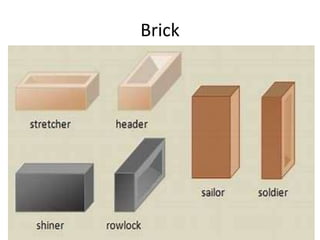
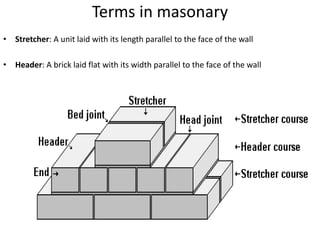
• Stretcher: A unit laid with its length parallel to the face of the wall
• Header: A brick laid flat with its width parallel to the face of the wall
Terms in masonary
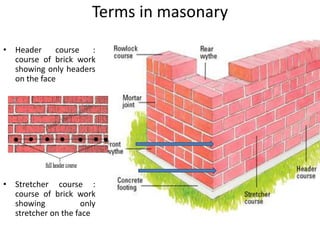
• Header course :
course of brick work
showing only headers
on the face
• Stretcher course :
course of brick work
showing only
stretcher on the face
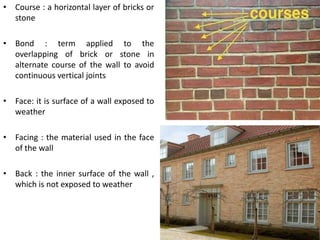
• Course : a horizontal layer of bricks or
stone
• Bond : term applied to the
overlapping of brick or stone in
alternate course of the wall to avoid
continuous vertical joints
• Face: it is surface of a wall exposed to
weather
• Facing : the material used in the face
of the wall
• Back : the inner surface of the wall ,
which is not exposed to weather
• Backing : material used in forming the
back of wall
• Hearting : the inner portion of wall
between facing and backing
• Joint : junction of nearby brick or stone
• It may be – cement mortar or lime
mortar
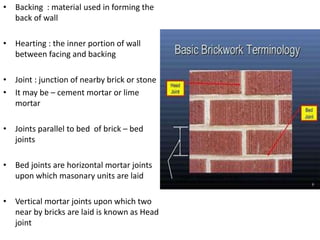
• Joints parallel to bed of brick – bed
joints
• Bed joints are horizontal mortar joints
upon which masonary units are laid
• Vertical mortar joints upon which two
near by bricks are laid is known as Head
joint
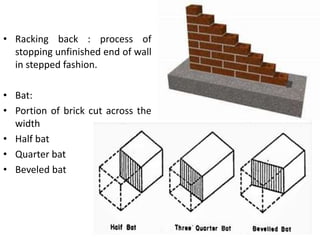
• Racking back : process of
stopping unfinished end of wall
in stepped fashion.
• Bat:
• Portion of brick cut across the
width
• Half bat
• Quarter bat
• Beveled bat
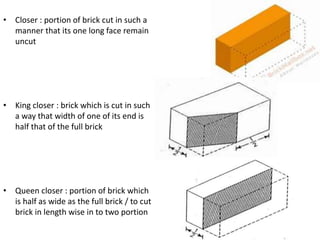
• Closer : portion of brick cut in such a
manner that its one long face remain
uncut
• King closer : brick which is cut in such
a way that width of one of its end is
half that of the full brick
• Queen closer : portion of brick which
is half as wide as the full brick / to cut
brick in length wise in to two portion
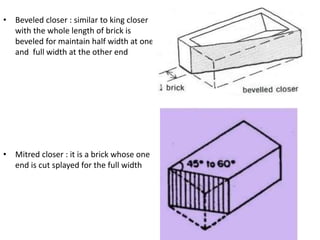
• Beveled closer : similar to king closer
with the whole length of brick is
beveled for maintain half width at one
and full width at the other end
• Mitred closer : it is a brick whose one
end is cut splayed for the full width
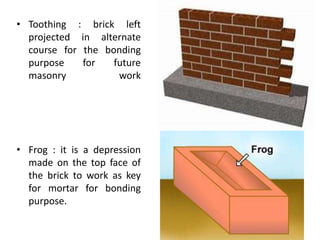
• Toothing : brick left
projected in alternate
course for the bonding
purpose for future
masonry work
• Frog : it is a depression
made on the top face of
the brick to work as key
for mortar for bonding
purpose.
BONDS IN BRICK MASONARY
Types of bond
1. Stretcher bond
2. Header bond
3. Facing bond
4. English bond
5. Flemish bond
6. Dutch bond
7. English cross bond
8. Raking bond
9. Zigzag bond
10. Garden wall bond
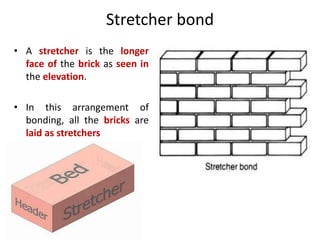
Stretcher bond
• A stretcher is the longer
face of the brick as seen in
the elevation.
• In this arrangement of
bonding, all the bricks are
laid as stretchers
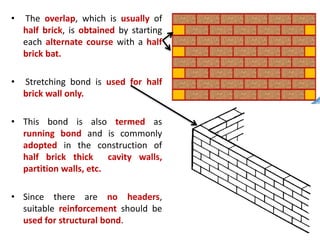
• The overlap, which is usually of
half brick, is obtained by starting
each alternate course with a half
brick bat.
• Stretching bond is used for half
brick wall only.
• This bond is also termed as
running bond and is commonly
adopted in the construction of
half brick thick cavity walls,
partition walls, etc.
• Since there are no headers,
suitable reinforcement should be
used for structural bond.
Header bond
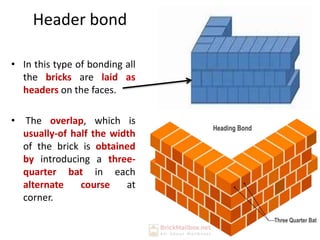
• In this type of bonding all
the bricks are laid as
headers on the faces.
• The overlap, which is
usually-of half the width
of the brick is obtained
by introducing a three-
quarter bat in each
alternate course at
corner.
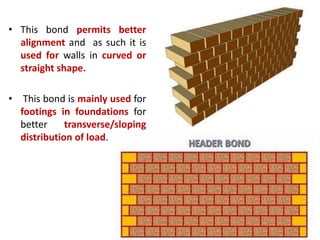
• This bond permits better
alignment and as such it is
used for walls in curved or
straight shape.
• This bond is mainly used for
footings in foundations for
better transverse/sloping
distribution of load.
Facing bond
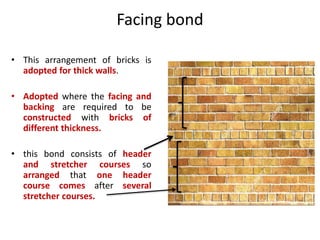
• This arrangement of bricks is
adopted for thick walls.
• Adopted where the facing and
backing are required to be
constructed with bricks of
different thickness.
• this bond consists of header
and stretcher courses so
arranged that one header
course comes after several
stretcher courses.
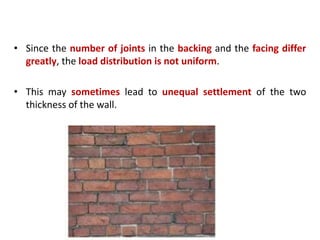
• Since the number of joints in the backing and the facing differ
greatly, the load distribution is not uniform.
• This may sometimes lead to unequal settlement of the two
thickness of the wall.
English bond
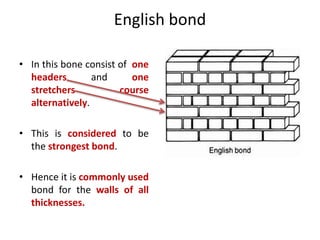
• In this bone consist of one
headers and one
stretchers course
alternatively.
• This is considered to be
the strongest bond.
• Hence it is commonly used
bond for the walls of all
thicknesses.
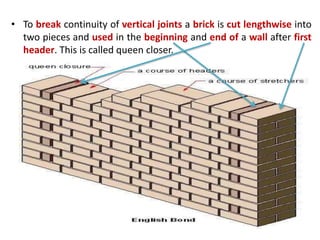
• To break continuity of vertical joints a brick is cut lengthwise into
two pieces and used in the beginning and end of a wall after first
header. This is called queen closer.
Flemish bond
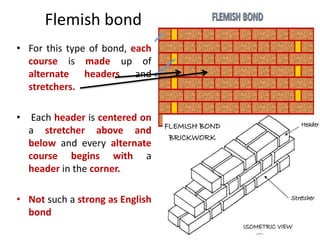
• For this type of bond, each
course is made up of
alternate headers and
stretchers.
• Each header is centered on
a stretcher above and
below and every alternate
course begins with a
header in the corner.
• Not such a strong as English
bond
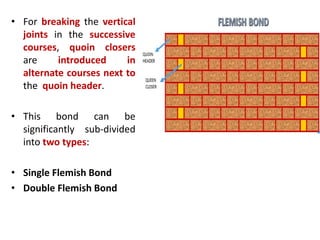
• For breaking the vertical
joints in the successive
courses, quoin closers
are introduced in
alternate courses next to
the quoin header.
• This bond can be
significantly sub-divided
into two types:
• Single Flemish Bond
• Double Flemish Bond
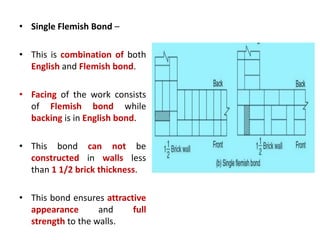
• Single Flemish Bond –
• This is combination of both
English and Flemish bond.
• Facing of the work consists
of Flemish bond while
backing is in English bond.
• This bond can not be
constructed in walls less
than 1 1/2 brick thickness.
• This bond ensures attractive
appearance and full
strength to the walls.
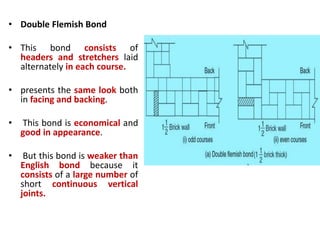
• Double Flemish Bond
• This bond consists of
headers and stretchers laid
alternately in each course.
• presents the same look both
in facing and backing.
• This bond is economical and
good in appearance.
• But this bond is weaker than
English bond because it
consists of a large number of
short continuous vertical
joints.
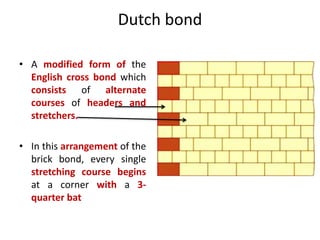
Dutch bond
• A modified form of the
English cross bond which
consists of alternate
courses of headers and
stretchers.
• In this arrangement of the
brick bond, every single
stretching course begins
at a corner with a 3-
quarter bat
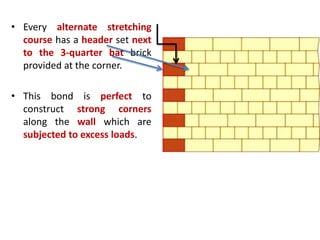
• Every alternate stretching
course has a header set next
to the 3-quarter bat brick
provided at the corner.
• This bond is perfect to
construct strong corners
along the wall which are
subjected to excess loads.
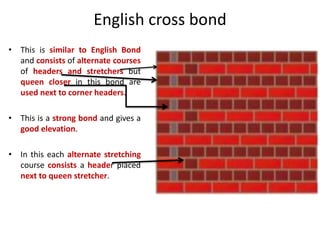
English cross bond
• This is similar to English Bond
and consists of alternate courses
of headers and stretchers but
queen closer in this bond are
used next to corner headers.
• This is a strong bond and gives a
good elevation.
• In this each alternate stretching
course consists a header placed
next to queen stretcher.
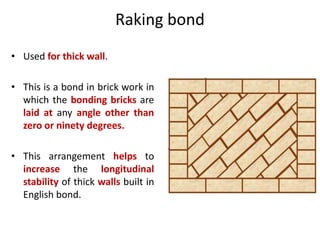
Raking bond
• Used for thick wall.
• This is a bond in brick work in
which the bonding bricks are
laid at any angle other than
zero or ninety degrees.
• This arrangement helps to
increase the longitudinal
stability of thick walls built in
English bond.
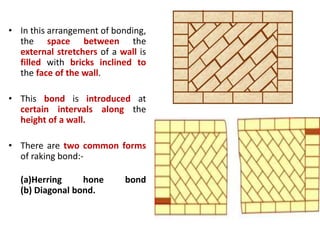
• In this arrangement of bonding,
the space between the
external stretchers of a wall is
filled with bricks inclined to
the face of the wall.
• This bond is introduced at
certain intervals along the
height of a wall.
• There are two common forms
of raking bond:-
(a)Herring hone bond
(b) Diagonal bond.
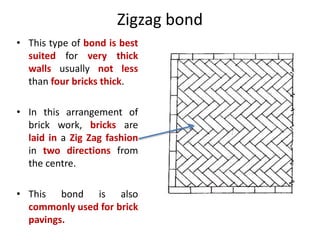
Zigzag bond
• This type of bond is best
suited for very thick
walls usually not less
than four bricks thick.
• In this arrangement of
brick work, bricks are
laid in a Zig Zag fashion
in two directions from
the centre.
• This bond is also
commonly used for brick
pavings.
Garden wall bond
• This bond is suitably adopted
for one brick thick wall which
may act as Garden Wall or
Boundary wall.
• This is not so strong as English
bond.
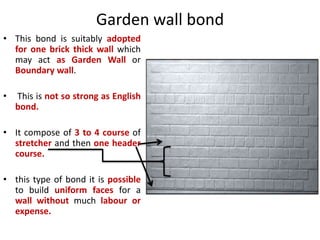
• It compose of 3 to 4 course of
stretcher and then one header
course.
• this type of bond it is possible
to build uniform faces for a
wall without much labour or
expense.
• On account of its good
appearance, this bond
is sometime used for
the construction of
outer face of cavity
walls.
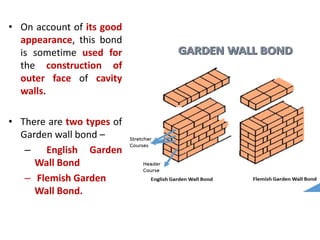
• There are two types of
Garden wall bond –
– English Garden
Wall Bond
– Flemish Garden
Wall Bond.

brick masonary.pptx

  • 1.
  • 2.
    Brick masonry • Constructionof brick units bonded together with mortar is known as brick masonary • Strength of brick masonry depends on – Quality of brick , – Quality of mortar – Method of bonding – Workmanship – Mortar used may be – cement mortar , lime mortar , composite mortar , mud mortar – Types of brick : – 1.standard modular brick – 2.traditional brick
  • 3.
    • Standard modularbrick : • Size fixed by ISI – • Actual size : 19x9x9 cm • Nominal (with mortar joints): 20x10x10 cm • Traditional brick : • As standard modular bricks are not being manufactured and not used in construction , metric dimension of our old traditional bricks have fixed • Size : • Actual size : 22.9x11.2x7.0 cm • Nominal size : 22.9x11.4x7.6 cm
  • 4.
  • 5.
    Terms in masonary •Stretcher: A unit laid with its length parallel to the face of the wall • Header: A brick laid flat with its width parallel to the face of the wall
  • 6.
    Terms in masonary •Header course : course of brick work showing only headers on the face • Stretcher course : course of brick work showing only stretcher on the face
  • 7.
    • Course :a horizontal layer of bricks or stone • Bond : term applied to the overlapping of brick or stone in alternate course of the wall to avoid continuous vertical joints • Face: it is surface of a wall exposed to weather • Facing : the material used in the face of the wall • Back : the inner surface of the wall , which is not exposed to weather
  • 8.
    • Backing :material used in forming the back of wall • Hearting : the inner portion of wall between facing and backing • Joint : junction of nearby brick or stone • It may be – cement mortar or lime mortar • Joints parallel to bed of brick – bed joints • Bed joints are horizontal mortar joints upon which masonary units are laid • Vertical mortar joints upon which two near by bricks are laid is known as Head joint
  • 9.
    • Racking back: process of stopping unfinished end of wall in stepped fashion. • Bat: • Portion of brick cut across the width • Half bat • Quarter bat • Beveled bat
  • 10.
    • Closer :portion of brick cut in such a manner that its one long face remain uncut • King closer : brick which is cut in such a way that width of one of its end is half that of the full brick • Queen closer : portion of brick which is half as wide as the full brick / to cut brick in length wise in to two portion
  • 11.
    • Beveled closer: similar to king closer with the whole length of brick is beveled for maintain half width at one and full width at the other end • Mitred closer : it is a brick whose one end is cut splayed for the full width
  • 12.
    • Toothing :brick left projected in alternate course for the bonding purpose for future masonry work • Frog : it is a depression made on the top face of the brick to work as key for mortar for bonding purpose.
  • 13.
  • 14.
    Types of bond 1.Stretcher bond 2. Header bond 3. Facing bond 4. English bond 5. Flemish bond 6. Dutch bond 7. English cross bond 8. Raking bond 9. Zigzag bond 10. Garden wall bond
  • 15.
    Stretcher bond • Astretcher is the longer face of the brick as seen in the elevation. • In this arrangement of bonding, all the bricks are laid as stretchers
  • 16.
    • The overlap,which is usually of half brick, is obtained by starting each alternate course with a half brick bat. • Stretching bond is used for half brick wall only. • This bond is also termed as running bond and is commonly adopted in the construction of half brick thick cavity walls, partition walls, etc. • Since there are no headers, suitable reinforcement should be used for structural bond.
  • 17.
    Header bond • Inthis type of bonding all the bricks are laid as headers on the faces. • The overlap, which is usually-of half the width of the brick is obtained by introducing a three- quarter bat in each alternate course at corner.
  • 18.
    • This bondpermits better alignment and as such it is used for walls in curved or straight shape. • This bond is mainly used for footings in foundations for better transverse/sloping distribution of load.
  • 19.
    Facing bond • Thisarrangement of bricks is adopted for thick walls. • Adopted where the facing and backing are required to be constructed with bricks of different thickness. • this bond consists of header and stretcher courses so arranged that one header course comes after several stretcher courses.
  • 20.
    • Since thenumber of joints in the backing and the facing differ greatly, the load distribution is not uniform. • This may sometimes lead to unequal settlement of the two thickness of the wall.
  • 21.
    English bond • Inthis bone consist of one headers and one stretchers course alternatively. • This is considered to be the strongest bond. • Hence it is commonly used bond for the walls of all thicknesses.
  • 22.
    • To breakcontinuity of vertical joints a brick is cut lengthwise into two pieces and used in the beginning and end of a wall after first header. This is called queen closer.
  • 23.
    Flemish bond • Forthis type of bond, each course is made up of alternate headers and stretchers. • Each header is centered on a stretcher above and below and every alternate course begins with a header in the corner. • Not such a strong as English bond
  • 24.
    • For breakingthe vertical joints in the successive courses, quoin closers are introduced in alternate courses next to the quoin header. • This bond can be significantly sub-divided into two types: • Single Flemish Bond • Double Flemish Bond
  • 25.
    • Single FlemishBond – • This is combination of both English and Flemish bond. • Facing of the work consists of Flemish bond while backing is in English bond. • This bond can not be constructed in walls less than 1 1/2 brick thickness. • This bond ensures attractive appearance and full strength to the walls.
  • 26.
    • Double FlemishBond • This bond consists of headers and stretchers laid alternately in each course. • presents the same look both in facing and backing. • This bond is economical and good in appearance. • But this bond is weaker than English bond because it consists of a large number of short continuous vertical joints.
  • 27.
    Dutch bond • Amodified form of the English cross bond which consists of alternate courses of headers and stretchers. • In this arrangement of the brick bond, every single stretching course begins at a corner with a 3- quarter bat
  • 28.
    • Every alternatestretching course has a header set next to the 3-quarter bat brick provided at the corner. • This bond is perfect to construct strong corners along the wall which are subjected to excess loads.
  • 29.
    English cross bond •This is similar to English Bond and consists of alternate courses of headers and stretchers but queen closer in this bond are used next to corner headers. • This is a strong bond and gives a good elevation. • In this each alternate stretching course consists a header placed next to queen stretcher.
  • 30.
    Raking bond • Usedfor thick wall. • This is a bond in brick work in which the bonding bricks are laid at any angle other than zero or ninety degrees. • This arrangement helps to increase the longitudinal stability of thick walls built in English bond.
  • 31.
    • In thisarrangement of bonding, the space between the external stretchers of a wall is filled with bricks inclined to the face of the wall. • This bond is introduced at certain intervals along the height of a wall. • There are two common forms of raking bond:- (a)Herring hone bond (b) Diagonal bond.
  • 32.
    Zigzag bond • Thistype of bond is best suited for very thick walls usually not less than four bricks thick. • In this arrangement of brick work, bricks are laid in a Zig Zag fashion in two directions from the centre. • This bond is also commonly used for brick pavings.
  • 33.
    Garden wall bond •This bond is suitably adopted for one brick thick wall which may act as Garden Wall or Boundary wall. • This is not so strong as English bond. • It compose of 3 to 4 course of stretcher and then one header course. • this type of bond it is possible to build uniform faces for a wall without much labour or expense.
  • 34.
    • On accountof its good appearance, this bond is sometime used for the construction of outer face of cavity walls. • There are two types of Garden wall bond – – English Garden Wall Bond – Flemish Garden Wall Bond.