Viral infections
Human Herpesviruses
Human Herpesviruses
(Herpesviridae)
• The family name is derived from the
Greek word herpein ("to creep or
crawl"), referring to the spreading
nature of the skin lesions.
• The herpes viruses are all large
dsDNA viruses (8 members) with
icosahedral capsid & lipid envelope.
• The virus is unable to survive for long in the
environment and does not penetrate intact keratinized
skin. Transmission is principally by intimate contact.
Structure of Herpesvirus
Human Herpesviruses
• Herpesviridae can cause latent or lytic infections.
• All share the ability to establish lifelong latency in
their host following primary infection by infecting
nerves & immune cells.
• Spread of infection is usually the result of contact with
bodily secretions containing the virus.
Human Herpesviruses
• Clinical presentations depend on:
1. The host’s age,
2. Anatomic location,
3. Immune status,
4. Ethnicity (e.g. EBV).
Human herpesviruses (HHV)
Dual nomenclature system
Type Synonym
HHV-1 HSV-1
HHV-2 HSV-2
HHV-3 VZV
HHV-4 EBV
HHV-5 CMV
HHV-6
(Roseolovirus, Herpes
lymphotropic virus)
HHV-7 --
HHV-8 KSHV
Type Primary Target Cell Latency
HSV-1 Epithelial Neuron
HSV-2 Epithelial Neuron
VZV Epithelial Neuron
EBV
B lymphocytes &
epithelial cells
B lymphocytes
CMV
Macrophages,
lymphocyte &
endothelial cells
Macrophages,
lymphocyte
HHV-6 T lymphocytes Lymphocytes
HHV-7 T lymphocytes T lymphocytes
HHV-8 Lymphocyte
Lymphocytes &
endothelial cells
3 Herpesviruses subfamilies
Herpes Simplex Viruses
Overview
1. Introduction
2. Epidemiology
3. Pathogenesis
4. C/P
5. Dx
6. DDx
7. Rx
8. Prevention
Herpes Simplex Viruses
Introduction
HSV-1 and HSV-2 are ubiquitous pathogens that produce primarily
orolabial and genital herpes infections.
Primarily involve the skin and mucous surfaces
Asymptomatic shedding of virus is common in saliva & tears.
Can be disseminated in neonates and immunocompromised
hosts.
Produces primary infection -enters a latent or dormant stage,
residing in the sensory ganglia- can be reactivated at any time.
Herpes Simplex Viruses
Epidemiology
Herpes simplex viruses have a worldwide distribution.
One-third of the world’s population has experienced a symptomatic
HSV infection.
Genital herpes is one of the most common sexually transmitted
infection worldwide.
In children less than 10 years of age, most herpetic infections are
caused by HSV-1 (>80–90%).
HSV-2 remains the cause of most genital herpes infections (70–
90% overall)
Herpes Simplex Viruses
Pathogenesis
MOT:
• HSV-1 is spread
primarily through direct
contact with
contaminated saliva
or other infected
secretions, while HSV-
2 is spread primarily by
sexual contact.
• Transmission can occur during both symptomatic and
asymptomatic periods of viral shedding.
Site of latency
Virus replicates at the
mucocutaneous site of
infection and then
travels by retrograde
axonal flow to the
dorsal root ganglia,
where it establishes
latency until
reactivation.
HSV-SPECIFIC
MEMORY CD8+ T
CELLS, selectively
activated & retained in
latently infected
sensory ganglia, have
important roles in
controlling the
infection & preventing
symptomatic
recurrences
Herpes Simplex Viruses
Pathogenesis
Typically, reactivation will produce vesicular lesions localized to the
skin. However, viremia followed by widespread internal organ
involvement can occur in immunocompromised hosts.
Herpes Simplex Viruses
Pathogenesis: HSV’S MECHANISMS
OF IMMUNE EVASION
HSV’s mechanisms to evade the immune system include
down-regulation of various immunologic cells and
cytokines.
Immune system evasions by downregulation of MHC I
and MHC II.
TLRs are critical to the first line of innate immune defense
against HSV. HSV inhibits signaling through TLRs.
The HSV-1 glycoprotein C blocks complement
activation, and glycoprotein E functions as an IgG Fc
receptor that can block antibody-dependent cellular
cytotoxicity.
Herpes Simplex Viruses
Pathogenesis
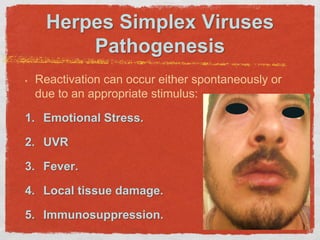
• Reactivation can occur either spontaneously or
due to an appropriate stimulus:
1. Emotional Stress.
2. UVR
3. Fever.
4. Local tissue damage.
5. Immunosuppression.
Herpes Simplex Viruses
Clinical Presentations
HSV-1
>90% of 1ry INFECTIONS are subclinical
more common
mostly associated with orolabial disease
HSV-2
usually the genital pathogen
usual pathogen of neonatal herpes
But both can infect oral and genital areas and
cause acute and recurrent infections.
Clinical presentations of HSV infection
Clinical presentations of
HSV infection
1. Orolabial HSV
2. Genital HSV
3. Herpetic Whitlow
4. Eczema herpeticum (Kaposi’s varicelliform eruption)
5. Herpes Gladiatorum
6. Herpes simplex folliculitis
7. Chronic/severe HSV infections
8. Ocular HSV infection
9. Herpes encephalitis
10. Neonatal HSV infection (Congenital herpes)
 A wide range of clinical presentations exist,
with asymptomatic infection being the most
common.
PRIMARY INFECTIONS
• 3 to 7 days after exposure.
• Primary infections can range from subclinical to
severe, with prodrome of fever, headache,
malaise, anorexia, pain, lymphadenopathy and
edema. Secondary infections are usually milder.
• Present as gingivostomatitis in children or as
pharyngitis and a mononucleosis-like
syndrome in young adults.
Clinical Presentations
1. Orolabial HSV
Clinical Presentation
1. Orolabial HSV
PRIMARY GINGIVOSTOMATITIS
HSV-1/Kids/young adults
High fever, irritability, anorexia, mouth
pain, drooling halitosis in infants and
toddlers.
gingivae becomes intensely
erythematous, edematous, friable and
tends to bleed
Painful small yellow erosions with red
halos seen on buccal and labial
mucosa, tongue, gingivae, palate,
tonsils characteristic gray membrane
Clinical Presentation
1. Orolabial HSV
SKIN INFECTIONS
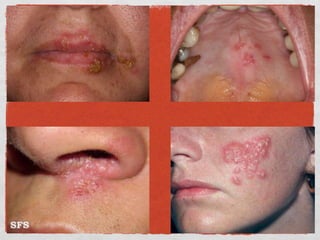
most common site are lips
lesions evolve over several
days - pustular,
coalesce scalloped
border, ulcerate, then crust
over.
Recurrent herpes simplex
• HSV-1 > HSV-2
• RECURRENT LESIONS APPEAR ON:
1. The vermilion border of the lip
(most common).
2. The perioral skin,
3. Nasal mucosa,
4. Oral mucosa overlying bone (e.g.
hard palate)
5. The cheek.
Clinical Presentation
1. Orolabial HSV
Recurrent facial herpes simplex or
Herpes labialis/Cold Sore
Clinical Presentations
2. Genital HSV
PRIMARY GENITAL HERPES
• Genital herpes is one of the most
common sexually transmitted infections worldwide.
• HSV-2 > HSV-1
• Asymptomatic infection is rule rather than exception
• 3-7 days post-exposure get tender, malaise, anorexia, fever, localized
pain, tenderness and burning; Vesicles pustules, resolves in 2-6
weeks
• Erosive balanitis, vulvitis or vaginitis. Lesions often also involve the
glans or shaft of the penis, cervix, buttocks and perineum and are
associated with inguinal adenopathy and dysuria.
• Travel by retrograde axonal flow to dorsal root ganglia and establish
latency until reactivation or subclinical viral shedding.
Clinical Presentations
2. Genital HSV
PRIMARY GENITAL HERPES
Systemic complaints and complications are more common in women.
1. Extragenital lesions, 20%
2. Urinary retention 10–15%
3. Aseptic meningitis 10%
(rare in men)
Clinical Presentations
2. Genital HSV
Recurrent Genital Herpes
• HSV-2 > HSV-1
• Reactivated by: stress, UV, fever, tissue
damage or immunosuppression
• Decrease in # of lesions, severity and
duration
• Frequency of recurrences correlates
directly with severity of primary infection
• Average of 4-7 outbreaks annually
Clinical Presentations
2. Genital HSV
Factors associated with acquisition of genital
herpes include:
1. An age of 15–30 years (period of greatest sexual
activity).
2. An increased number of sexual partners.
3. Lower levels of income and education.
4. Homosexuality.
5. HIV-positivity.
Clinical Presentations
3. Herpetic Whitlow
• HSV-1, HSV-2
• Herpes simplex infection of the digits
• Common in children,
• Secondary to digital–genital contact
(usually due to HSV-2)
• Historically medical personnel, dentists, and people who do IPL
bikini hair removal who did not use gloves.
• Digits presenting with pain, swelling and vesicular lesions
appearance of vesicles may be delayed.
• Recurrences in the same location can be a clue to the diagnosis.
• sometimes misdiagnosed as cellulitis or blistering dactylitis
paronychia.
Herpetic whitlow is an intensely painful
infection of the hand involving 1 or
more fingers that typically affects the
terminal phalanx. HSV-1 causes
approximately 60% of cases, whereas
HSV-2 accounts for the remaining 40%.
Clinical Presentations
4. Eczema herpeticum (Kaposi
varicelliform eruption)
Usually due to HSV-1. Onset of high
fever, malaise, lymphadenopathy,
irritability, and discomfort.
Lesions appear in crops in areas of
currently or recently affected skin (for
those with atopic eczema or chronic
dermatitis/skin barrier disruption.
Monomorphic, discrete, 2–3 mm punched-out erosions with
hemorrhagic crusts are evident more often than intact vesicles
Lesions begin as pustules, then rupture and crust over the course
of a couple of days
Clinical Presentations
4. Eczema herpeticum (Kaposi
varicelliform eruption)
Multiple crops can appear over 7-10 days (like varicella).
Can be mild or fulminant, depending (in part) on the
underlying dermatitis.
If area of involvement is large, can be lots of fluid loss and
potentially fatal.
Risk of secondary bacterial infections.
Can also occur in patients with an impaired skin barrier due
to other conditions such as
1. Burns,
2. Pemphigus (foliaceus, vulgaris),
3. Darier disease,
4. Hailey–Hailey disease,
5. MF- Sézary syndrome
6. Ichthyoses
Clinical Presentations
5. Herpes Gladiatorum
• HSV-1 infection
• Highly contagious occur in athletes
participating in contact sports such as
wrestling.
• Transmitted via direct skin-to-skin
contact Distribution of cutaneous
HSV infection (sometimes widespread),
reflecting sites of contact with another
athlete’s skin lesions.
Most common Sites
1. Arms
2. Head
3. Neck
Clinical Presentations
6. Herpes simplex folliculitis
• Shaving with a blade razor (e .g . herpetic sycosis in a
man’s beard area).
• Usually due to HSV-1.
• HIV-positive or otherwise
immunocompromised individuals
• Rapid development of follicular
vesicles and pustules
Clinical Presentations
7. Severe/chronic HSV infections
• Immunocompromised patients e.g. HIV
• Most common presentation is chronic, enlarging ulcerations
• Lesions at multiple sites and/or cutaneous dissemination.
• Skin findings are often atypical, e .g . verrucous, exophytic and
pustular lesions.
• Recurrences can involve oral
mucosa, including the tongue
& areas that dont overlie bone
• Involvement of the respiratory
tract, esophagus & remainder
of the GIT may also occur
Clinical Presentations
8. Ocular HSV infection
• HSV-2 Newborns HSV-1 children and adults
PRIMARY INFECTION:
• unilateral or bilateral periorbital, keratoconjunctivitis, eyelid edema,
tearing, photophobia, chemosis and preauricular LAD
• Branching dendritic lesions of the cornea is pathognomonic
RECURRENT EPISODES:
• (typically unilateral) are common
COMPLICATIONS:
1. Corneal ulceration
2. Scarring
3. Globe rupture
4. Blindness
Clinical Presentations
9. Herpes encephalitis
• Usually due to HSV-1
• Most common cause of fatal
sporadic viral encephalitis
• Fever, altered mental status,
bizarre behavior and localized
neurologic findings
• The temporal lobe is often
involved
• Mortality ≥70% without treatment;
residual neurologic defects in
most survivors
Clinical Presentations
10. Neonatal HSV infection
• Resulting from exposure to HSV during
a vaginal delivery
• Risk of transmission is highest (30–
50%) for women who acquire a genital
HSV infection (which is often
asymptomatic) near the time of delivery.
• Risk of transmission is low (<1–3%) with
recurrent genital herpes.
• Can be avoided by cesarean delivery
• Onset from birth to 2 weeks of age, but usually ≥5 days of age
• Localized (favoring the scalp and trunk) or disseminated cutaneous
lesions; involvement of the oral mucosa, eye, CNS & internal organs
• Vesicles may progress to bullae and erosions
• Encephalitis can present with lethargy, irritability, poor feeding,
temperature instability, seizures and a bulging fontanelle
Herpes Simplex Viruses
DDx
OROLABIAL HERPES: “6”
1. Aphthous stomatitis
2. Bullous Impetigo
3. Drug Eruption
4. EM/SJS
5. Viral Exanthem
6. Herpangina, pharyngitis (e.g.
due to EBV)
GENITAL HERPES: “6”
1. Genital aphthae
2. Trauma
3. Chancre
4. Chancroid
5. Granuloma inguinale
6. Lymphogranuloma venereum
Herpes Simplex Viruses
Dx “6”
Usually made clinically
1. Tzanck smear
2. Viral cultures
3. PCR
4. Serology
5. Direct fluorescent antibody assays (DFA)
6. Histologic examination
Herpes Simplex Viruses
Dx
1. TZANCK SMEAR: can scrap the base/edges of a freshly unroofed
vesicle) and a special stain – Giemsa stain, findings:
a) Ballooned epithelial cells.
b) Intranuclear inclusion bodies.
c) Multinucleated giant cells (Tzanck cells) are the key finding
generating a positive test and a diagnosis of herpes. Note that
the Tzanck test will not tell you if this is a herpes infection or a
zoster infection.
• HSV-1 cannot be differentiated from HSV-2.
Tzanck smear showing secondary acantholysis
in Herpes simplex. The yellow arrow points to a
single acantholytic cell; the red arrow indicates a
MNG. (Giemsa stain, 10× )
High power view of secondary
acantholysis in Herpes simplex. Few
MNGs are also seen. (Giemsa stain, 40× )
Herpes Simplex Viruses
Dx
2. VIRAL CULTURES: take 2-5 days
3. PCR: detect HSV DNA in specimens from the CSF, skin etc.
4. SEROLOGIC TESTING: available for HSV, but a positive test does
not necessarily indicate that the viral infection is the cause of the
current lesion. ELISAs detect antibodies against HSV-1 and HSV-2.
Western blot represents the gold standard for serologic assays; it is
99% sensitive and specific for HSV antibodies. limited value in acute
clinical diagnosis because of time delay for seroconversion following
initial infection.
5. DIRECT FLUORESCENT ANTIBODY
ASSAYS (DFA):
initial diagnostic test due to its greater sensitivity,
ability to distinguish between HSV and VZV, and
rapid turnaround time.
Herpes Simplex Viruses Dx
6. Histologic Examination
(A)
-steel-grey color
Herpes Simplex Viruses
Treatment
Herpes Simplex Viruses
Treatment
Herpes Simplex Viruses
Treatment
CHRONIC SUPPRESSIVE THERAPY
• Usually reserved for patients with six or more
outbreaks per year,
• Advantages:
1. Eliminating symptomatic outbreaks, or
2. the frequency of outbreaks
3. asymptomatic viral shedding by 95% and
can prevent transmission of genital herpes to a
susceptible partner.
4. the frequency Recurrent EM
Herpes Simplex Viruses
Prevention
Between 70% and 80% of HSV is transmitted during
periods of asymptomatic viral shedding.
Sexual abstinence is the only method for absolute
prevention of genital herpes, which can be transmitted
even with the use of condoms.
In addition to antiviral therapy, patient education
regarding prevention of genital herpes transmission is
essential.
There is currently no licensed vaccine available for
HSV.
References
• Bolognia 3rd ed.
• Bolognia Dermatology Essentials.
• http://www.dermnetnz.org
• http://en.wikipedia.org
• http://emedicine.medscape.com
• http://www.ijdvl.com
Thank U

Hsv1&2

  • 1.
  • 2.
    Human Herpesviruses (Herpesviridae) • Thefamily name is derived from the Greek word herpein ("to creep or crawl"), referring to the spreading nature of the skin lesions. • The herpes viruses are all large dsDNA viruses (8 members) with icosahedral capsid & lipid envelope. • The virus is unable to survive for long in the environment and does not penetrate intact keratinized skin. Transmission is principally by intimate contact.
  • 3.
  • 4.
    Human Herpesviruses • Herpesviridaecan cause latent or lytic infections. • All share the ability to establish lifelong latency in their host following primary infection by infecting nerves & immune cells. • Spread of infection is usually the result of contact with bodily secretions containing the virus.
  • 5.
    Human Herpesviruses • Clinicalpresentations depend on: 1. The host’s age, 2. Anatomic location, 3. Immune status, 4. Ethnicity (e.g. EBV).
  • 6.
    Human herpesviruses (HHV) Dualnomenclature system Type Synonym HHV-1 HSV-1 HHV-2 HSV-2 HHV-3 VZV HHV-4 EBV HHV-5 CMV HHV-6 (Roseolovirus, Herpes lymphotropic virus) HHV-7 -- HHV-8 KSHV
  • 7.
    Type Primary TargetCell Latency HSV-1 Epithelial Neuron HSV-2 Epithelial Neuron VZV Epithelial Neuron EBV B lymphocytes & epithelial cells B lymphocytes CMV Macrophages, lymphocyte & endothelial cells Macrophages, lymphocyte HHV-6 T lymphocytes Lymphocytes HHV-7 T lymphocytes T lymphocytes HHV-8 Lymphocyte Lymphocytes & endothelial cells
  • 8.
  • 9.
  • 10.
    Overview 1. Introduction 2. Epidemiology 3.Pathogenesis 4. C/P 5. Dx 6. DDx 7. Rx 8. Prevention
  • 11.
    Herpes Simplex Viruses Introduction HSV-1and HSV-2 are ubiquitous pathogens that produce primarily orolabial and genital herpes infections. Primarily involve the skin and mucous surfaces Asymptomatic shedding of virus is common in saliva & tears. Can be disseminated in neonates and immunocompromised hosts. Produces primary infection -enters a latent or dormant stage, residing in the sensory ganglia- can be reactivated at any time.
  • 12.
    Herpes Simplex Viruses Epidemiology Herpessimplex viruses have a worldwide distribution. One-third of the world’s population has experienced a symptomatic HSV infection. Genital herpes is one of the most common sexually transmitted infection worldwide. In children less than 10 years of age, most herpetic infections are caused by HSV-1 (>80–90%). HSV-2 remains the cause of most genital herpes infections (70– 90% overall)
  • 13.
    Herpes Simplex Viruses Pathogenesis MOT: •HSV-1 is spread primarily through direct contact with contaminated saliva or other infected secretions, while HSV- 2 is spread primarily by sexual contact. • Transmission can occur during both symptomatic and asymptomatic periods of viral shedding.
  • 14.
  • 15.
    Virus replicates atthe mucocutaneous site of infection and then travels by retrograde axonal flow to the dorsal root ganglia, where it establishes latency until reactivation. HSV-SPECIFIC MEMORY CD8+ T CELLS, selectively activated & retained in latently infected sensory ganglia, have important roles in controlling the infection & preventing symptomatic recurrences
  • 16.
    Herpes Simplex Viruses Pathogenesis Typically,reactivation will produce vesicular lesions localized to the skin. However, viremia followed by widespread internal organ involvement can occur in immunocompromised hosts.
  • 17.
    Herpes Simplex Viruses Pathogenesis:HSV’S MECHANISMS OF IMMUNE EVASION HSV’s mechanisms to evade the immune system include down-regulation of various immunologic cells and cytokines. Immune system evasions by downregulation of MHC I and MHC II. TLRs are critical to the first line of innate immune defense against HSV. HSV inhibits signaling through TLRs. The HSV-1 glycoprotein C blocks complement activation, and glycoprotein E functions as an IgG Fc receptor that can block antibody-dependent cellular cytotoxicity.
  • 18.
    Herpes Simplex Viruses Pathogenesis •Reactivation can occur either spontaneously or due to an appropriate stimulus: 1. Emotional Stress. 2. UVR 3. Fever. 4. Local tissue damage. 5. Immunosuppression.
  • 19.
    Herpes Simplex Viruses ClinicalPresentations HSV-1 >90% of 1ry INFECTIONS are subclinical more common mostly associated with orolabial disease HSV-2 usually the genital pathogen usual pathogen of neonatal herpes But both can infect oral and genital areas and cause acute and recurrent infections.
  • 20.
  • 21.
    Clinical presentations of HSVinfection 1. Orolabial HSV 2. Genital HSV 3. Herpetic Whitlow 4. Eczema herpeticum (Kaposi’s varicelliform eruption) 5. Herpes Gladiatorum 6. Herpes simplex folliculitis 7. Chronic/severe HSV infections 8. Ocular HSV infection 9. Herpes encephalitis 10. Neonatal HSV infection (Congenital herpes)
  • 22.
     A widerange of clinical presentations exist, with asymptomatic infection being the most common. PRIMARY INFECTIONS • 3 to 7 days after exposure. • Primary infections can range from subclinical to severe, with prodrome of fever, headache, malaise, anorexia, pain, lymphadenopathy and edema. Secondary infections are usually milder. • Present as gingivostomatitis in children or as pharyngitis and a mononucleosis-like syndrome in young adults. Clinical Presentations 1. Orolabial HSV
  • 24.
    Clinical Presentation 1. OrolabialHSV PRIMARY GINGIVOSTOMATITIS HSV-1/Kids/young adults High fever, irritability, anorexia, mouth pain, drooling halitosis in infants and toddlers. gingivae becomes intensely erythematous, edematous, friable and tends to bleed Painful small yellow erosions with red halos seen on buccal and labial mucosa, tongue, gingivae, palate, tonsils characteristic gray membrane
  • 25.
    Clinical Presentation 1. OrolabialHSV SKIN INFECTIONS most common site are lips lesions evolve over several days - pustular, coalesce scalloped border, ulcerate, then crust over.
  • 26.
  • 27.
    • HSV-1 >HSV-2 • RECURRENT LESIONS APPEAR ON: 1. The vermilion border of the lip (most common). 2. The perioral skin, 3. Nasal mucosa, 4. Oral mucosa overlying bone (e.g. hard palate) 5. The cheek. Clinical Presentation 1. Orolabial HSV Recurrent facial herpes simplex or Herpes labialis/Cold Sore
  • 29.
    Clinical Presentations 2. GenitalHSV PRIMARY GENITAL HERPES • Genital herpes is one of the most common sexually transmitted infections worldwide. • HSV-2 > HSV-1 • Asymptomatic infection is rule rather than exception • 3-7 days post-exposure get tender, malaise, anorexia, fever, localized pain, tenderness and burning; Vesicles pustules, resolves in 2-6 weeks • Erosive balanitis, vulvitis or vaginitis. Lesions often also involve the glans or shaft of the penis, cervix, buttocks and perineum and are associated with inguinal adenopathy and dysuria. • Travel by retrograde axonal flow to dorsal root ganglia and establish latency until reactivation or subclinical viral shedding.
  • 30.
    Clinical Presentations 2. GenitalHSV PRIMARY GENITAL HERPES Systemic complaints and complications are more common in women. 1. Extragenital lesions, 20% 2. Urinary retention 10–15% 3. Aseptic meningitis 10% (rare in men)
  • 31.
    Clinical Presentations 2. GenitalHSV Recurrent Genital Herpes • HSV-2 > HSV-1 • Reactivated by: stress, UV, fever, tissue damage or immunosuppression • Decrease in # of lesions, severity and duration • Frequency of recurrences correlates directly with severity of primary infection • Average of 4-7 outbreaks annually
  • 33.
    Clinical Presentations 2. GenitalHSV Factors associated with acquisition of genital herpes include: 1. An age of 15–30 years (period of greatest sexual activity). 2. An increased number of sexual partners. 3. Lower levels of income and education. 4. Homosexuality. 5. HIV-positivity.
  • 34.
    Clinical Presentations 3. HerpeticWhitlow • HSV-1, HSV-2 • Herpes simplex infection of the digits • Common in children, • Secondary to digital–genital contact (usually due to HSV-2) • Historically medical personnel, dentists, and people who do IPL bikini hair removal who did not use gloves. • Digits presenting with pain, swelling and vesicular lesions appearance of vesicles may be delayed. • Recurrences in the same location can be a clue to the diagnosis. • sometimes misdiagnosed as cellulitis or blistering dactylitis paronychia.
  • 35.
    Herpetic whitlow isan intensely painful infection of the hand involving 1 or more fingers that typically affects the terminal phalanx. HSV-1 causes approximately 60% of cases, whereas HSV-2 accounts for the remaining 40%.
  • 37.
    Clinical Presentations 4. Eczemaherpeticum (Kaposi varicelliform eruption) Usually due to HSV-1. Onset of high fever, malaise, lymphadenopathy, irritability, and discomfort. Lesions appear in crops in areas of currently or recently affected skin (for those with atopic eczema or chronic dermatitis/skin barrier disruption. Monomorphic, discrete, 2–3 mm punched-out erosions with hemorrhagic crusts are evident more often than intact vesicles Lesions begin as pustules, then rupture and crust over the course of a couple of days
  • 38.
    Clinical Presentations 4. Eczemaherpeticum (Kaposi varicelliform eruption) Multiple crops can appear over 7-10 days (like varicella). Can be mild or fulminant, depending (in part) on the underlying dermatitis. If area of involvement is large, can be lots of fluid loss and potentially fatal. Risk of secondary bacterial infections. Can also occur in patients with an impaired skin barrier due to other conditions such as 1. Burns, 2. Pemphigus (foliaceus, vulgaris), 3. Darier disease, 4. Hailey–Hailey disease, 5. MF- Sézary syndrome 6. Ichthyoses
  • 40.
    Clinical Presentations 5. HerpesGladiatorum • HSV-1 infection • Highly contagious occur in athletes participating in contact sports such as wrestling. • Transmitted via direct skin-to-skin contact Distribution of cutaneous HSV infection (sometimes widespread), reflecting sites of contact with another athlete’s skin lesions. Most common Sites 1. Arms 2. Head 3. Neck
  • 41.
    Clinical Presentations 6. Herpessimplex folliculitis • Shaving with a blade razor (e .g . herpetic sycosis in a man’s beard area). • Usually due to HSV-1. • HIV-positive or otherwise immunocompromised individuals • Rapid development of follicular vesicles and pustules
  • 43.
    Clinical Presentations 7. Severe/chronicHSV infections • Immunocompromised patients e.g. HIV • Most common presentation is chronic, enlarging ulcerations • Lesions at multiple sites and/or cutaneous dissemination. • Skin findings are often atypical, e .g . verrucous, exophytic and pustular lesions. • Recurrences can involve oral mucosa, including the tongue & areas that dont overlie bone • Involvement of the respiratory tract, esophagus & remainder of the GIT may also occur
  • 44.
    Clinical Presentations 8. OcularHSV infection • HSV-2 Newborns HSV-1 children and adults PRIMARY INFECTION: • unilateral or bilateral periorbital, keratoconjunctivitis, eyelid edema, tearing, photophobia, chemosis and preauricular LAD • Branching dendritic lesions of the cornea is pathognomonic RECURRENT EPISODES: • (typically unilateral) are common COMPLICATIONS: 1. Corneal ulceration 2. Scarring 3. Globe rupture 4. Blindness
  • 46.
    Clinical Presentations 9. Herpesencephalitis • Usually due to HSV-1 • Most common cause of fatal sporadic viral encephalitis • Fever, altered mental status, bizarre behavior and localized neurologic findings • The temporal lobe is often involved • Mortality ≥70% without treatment; residual neurologic defects in most survivors
  • 47.
    Clinical Presentations 10. NeonatalHSV infection • Resulting from exposure to HSV during a vaginal delivery • Risk of transmission is highest (30– 50%) for women who acquire a genital HSV infection (which is often asymptomatic) near the time of delivery. • Risk of transmission is low (<1–3%) with recurrent genital herpes. • Can be avoided by cesarean delivery • Onset from birth to 2 weeks of age, but usually ≥5 days of age • Localized (favoring the scalp and trunk) or disseminated cutaneous lesions; involvement of the oral mucosa, eye, CNS & internal organs • Vesicles may progress to bullae and erosions • Encephalitis can present with lethargy, irritability, poor feeding, temperature instability, seizures and a bulging fontanelle
  • 49.
    Herpes Simplex Viruses DDx OROLABIALHERPES: “6” 1. Aphthous stomatitis 2. Bullous Impetigo 3. Drug Eruption 4. EM/SJS 5. Viral Exanthem 6. Herpangina, pharyngitis (e.g. due to EBV) GENITAL HERPES: “6” 1. Genital aphthae 2. Trauma 3. Chancre 4. Chancroid 5. Granuloma inguinale 6. Lymphogranuloma venereum
  • 52.
    Herpes Simplex Viruses Dx“6” Usually made clinically 1. Tzanck smear 2. Viral cultures 3. PCR 4. Serology 5. Direct fluorescent antibody assays (DFA) 6. Histologic examination
  • 53.
    Herpes Simplex Viruses Dx 1.TZANCK SMEAR: can scrap the base/edges of a freshly unroofed vesicle) and a special stain – Giemsa stain, findings: a) Ballooned epithelial cells. b) Intranuclear inclusion bodies. c) Multinucleated giant cells (Tzanck cells) are the key finding generating a positive test and a diagnosis of herpes. Note that the Tzanck test will not tell you if this is a herpes infection or a zoster infection. • HSV-1 cannot be differentiated from HSV-2.
  • 54.
    Tzanck smear showingsecondary acantholysis in Herpes simplex. The yellow arrow points to a single acantholytic cell; the red arrow indicates a MNG. (Giemsa stain, 10× )
  • 55.
    High power viewof secondary acantholysis in Herpes simplex. Few MNGs are also seen. (Giemsa stain, 40× )
  • 57.
    Herpes Simplex Viruses Dx 2.VIRAL CULTURES: take 2-5 days 3. PCR: detect HSV DNA in specimens from the CSF, skin etc. 4. SEROLOGIC TESTING: available for HSV, but a positive test does not necessarily indicate that the viral infection is the cause of the current lesion. ELISAs detect antibodies against HSV-1 and HSV-2. Western blot represents the gold standard for serologic assays; it is 99% sensitive and specific for HSV antibodies. limited value in acute clinical diagnosis because of time delay for seroconversion following initial infection. 5. DIRECT FLUORESCENT ANTIBODY ASSAYS (DFA): initial diagnostic test due to its greater sensitivity, ability to distinguish between HSV and VZV, and rapid turnaround time.
  • 58.
    Herpes Simplex VirusesDx 6. Histologic Examination
  • 61.
  • 63.
  • 64.
  • 66.
    Herpes Simplex Viruses Treatment CHRONICSUPPRESSIVE THERAPY • Usually reserved for patients with six or more outbreaks per year, • Advantages: 1. Eliminating symptomatic outbreaks, or 2. the frequency of outbreaks 3. asymptomatic viral shedding by 95% and can prevent transmission of genital herpes to a susceptible partner. 4. the frequency Recurrent EM
  • 67.
    Herpes Simplex Viruses Prevention Between70% and 80% of HSV is transmitted during periods of asymptomatic viral shedding. Sexual abstinence is the only method for absolute prevention of genital herpes, which can be transmitted even with the use of condoms. In addition to antiviral therapy, patient education regarding prevention of genital herpes transmission is essential. There is currently no licensed vaccine available for HSV.
  • 68.
    References • Bolognia 3rded. • Bolognia Dermatology Essentials. • http://www.dermnetnz.org • http://en.wikipedia.org • http://emedicine.medscape.com • http://www.ijdvl.com
  • 69.