Dental Charting
CHAPTER 14
Dental Charts
Two areas:
Dental charting
Record treatment
Anatomical versus geometric
Computerized
Dental Charts
 Charting is a part of the patient’s legal record and must be
done correctly.
 The initial charting is normally done on the first exam.
 Anatomical charts show the crown of the tooth, the crown and
a portion of the tooth, or the crown and the complete root.
 Geometric charts show the teeth as circles.
 Computerized charting helps standardize.
 It’s more efficient, fewer mistakes are made, and it’s easier in many
ways.
 Light pens are used to highlight and color.
Numbering Systems
 The Universal/National system was developed in
1968 and is most commonly used in the United
States.
 FDI was developed to provide an international
system for coding teeth.
 Canada and European countries use this the most.
 In 1996, the ADA adopted this system and the universal
system for tooth numbering.
 The Palmer system is not very common, but it’s
still used in some offices.
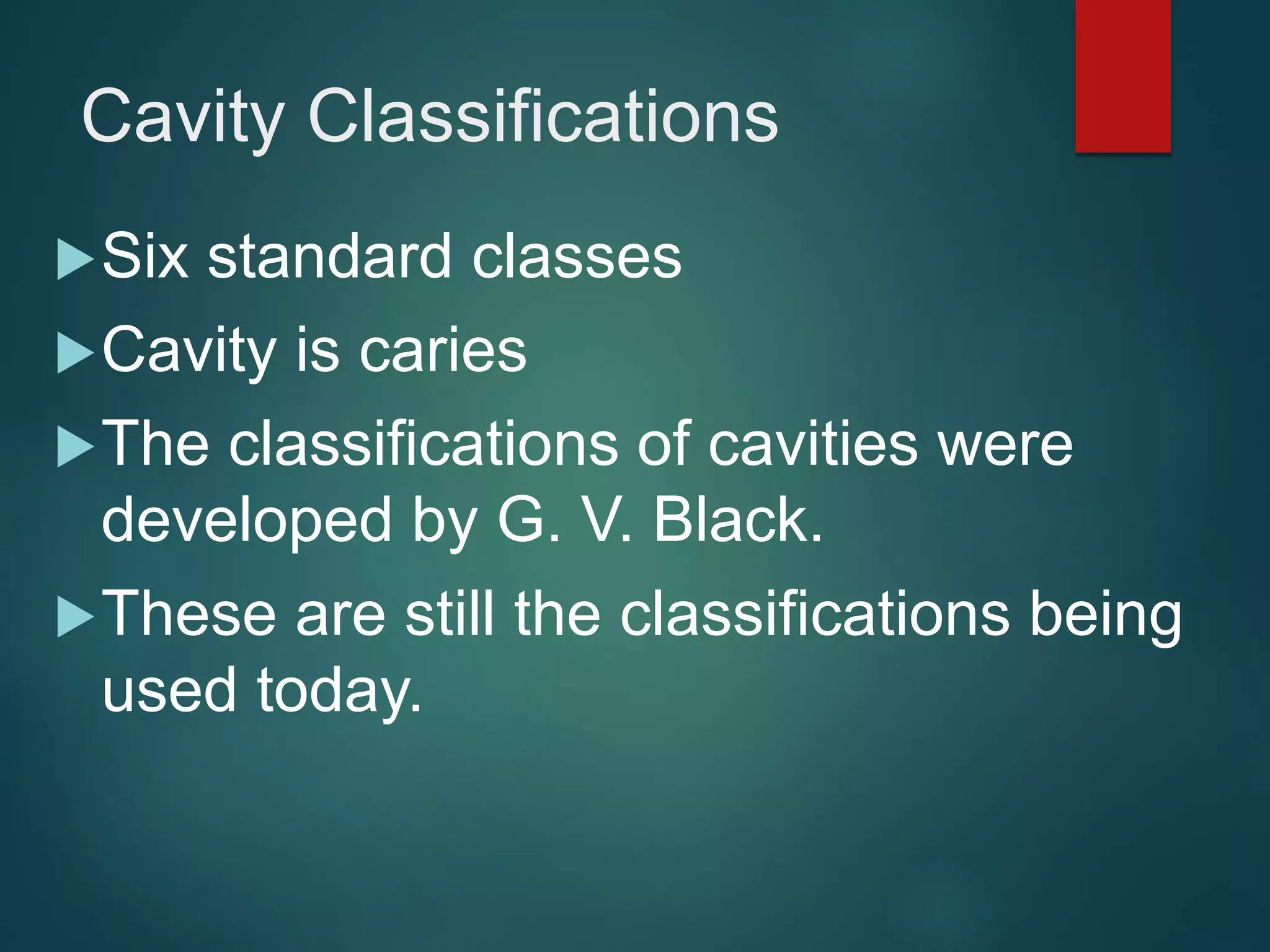
Cavity Classifications
Six standard classes
Cavity is caries
The classifications of cavities were
developed by G. V. Black.
These are still the classifications being
used today.
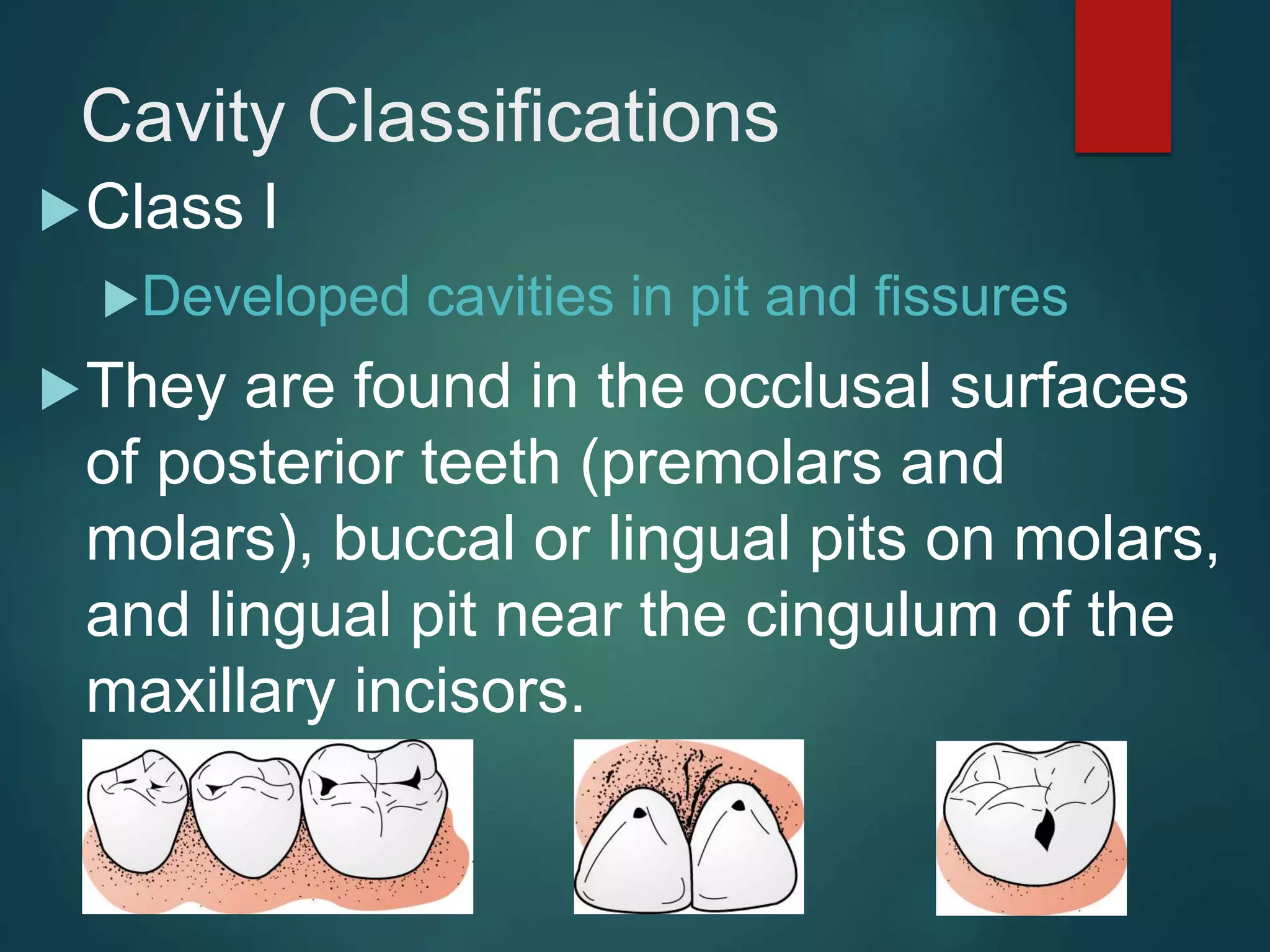
Cavity Classifications
Class I
Developed cavities in pit and fissures
They are found in the occlusal surfaces
of posterior teeth (premolars and
molars), buccal or lingual pits on molars,
and lingual pit near the cingulum of the
maxillary incisors.
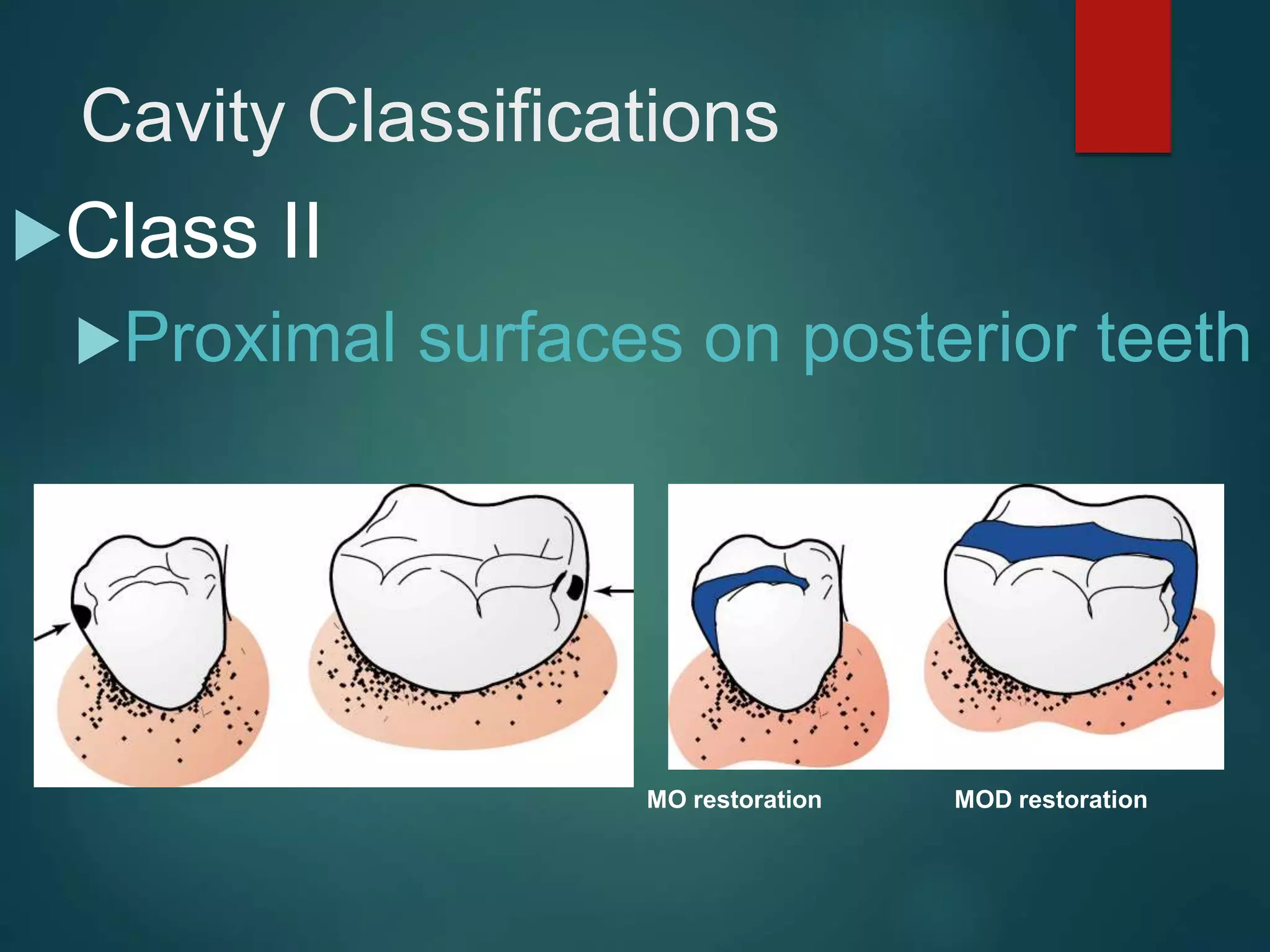
Cavity Classifications
Class II
Proximal surfaces on posterior teeth
MO restoration MOD restoration
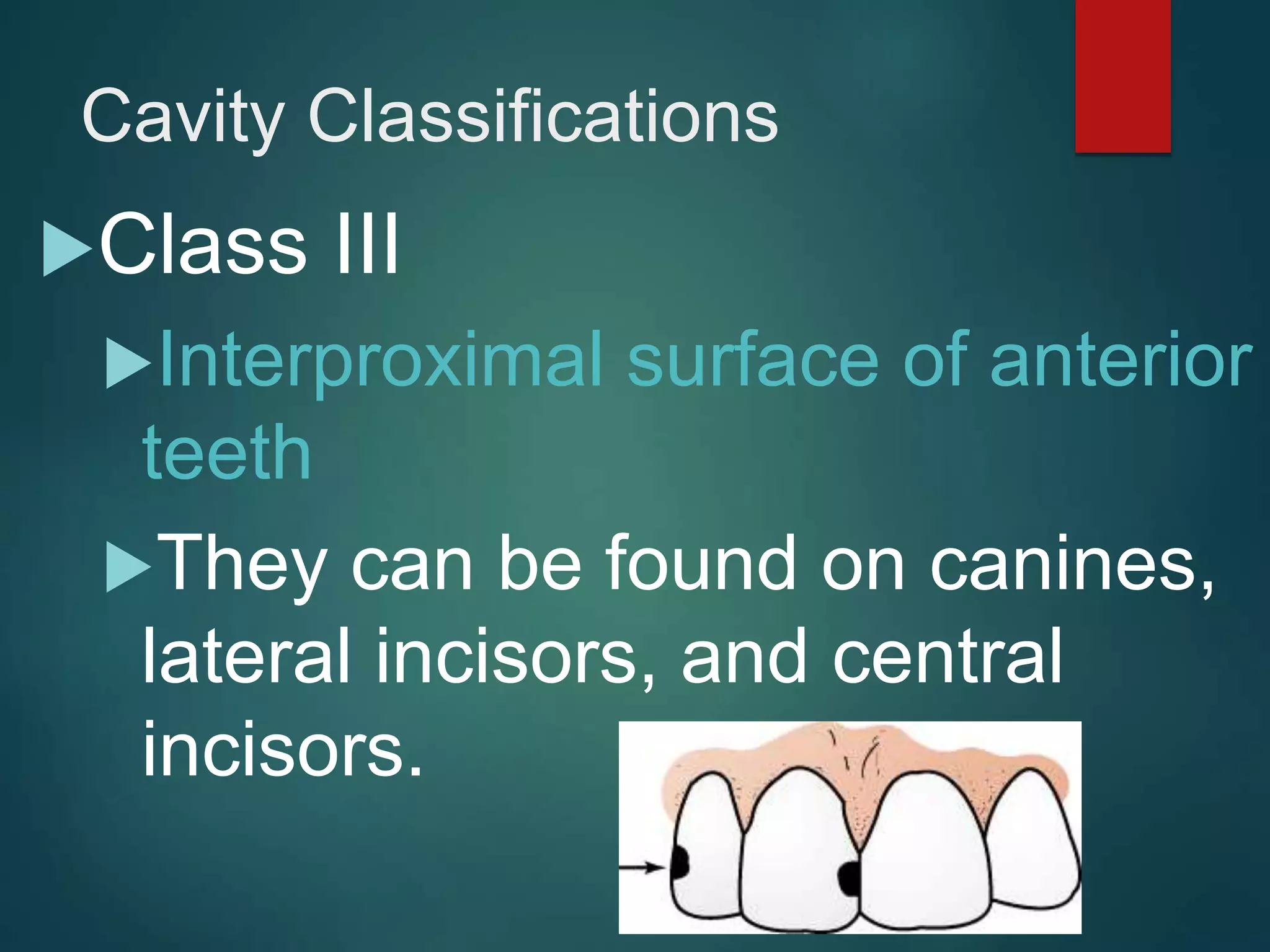
Cavity Classifications
Class III
Interproximal surface of anterior
teeth
They can be found on canines,
lateral incisors, and central
incisors.
Cavity Classifications
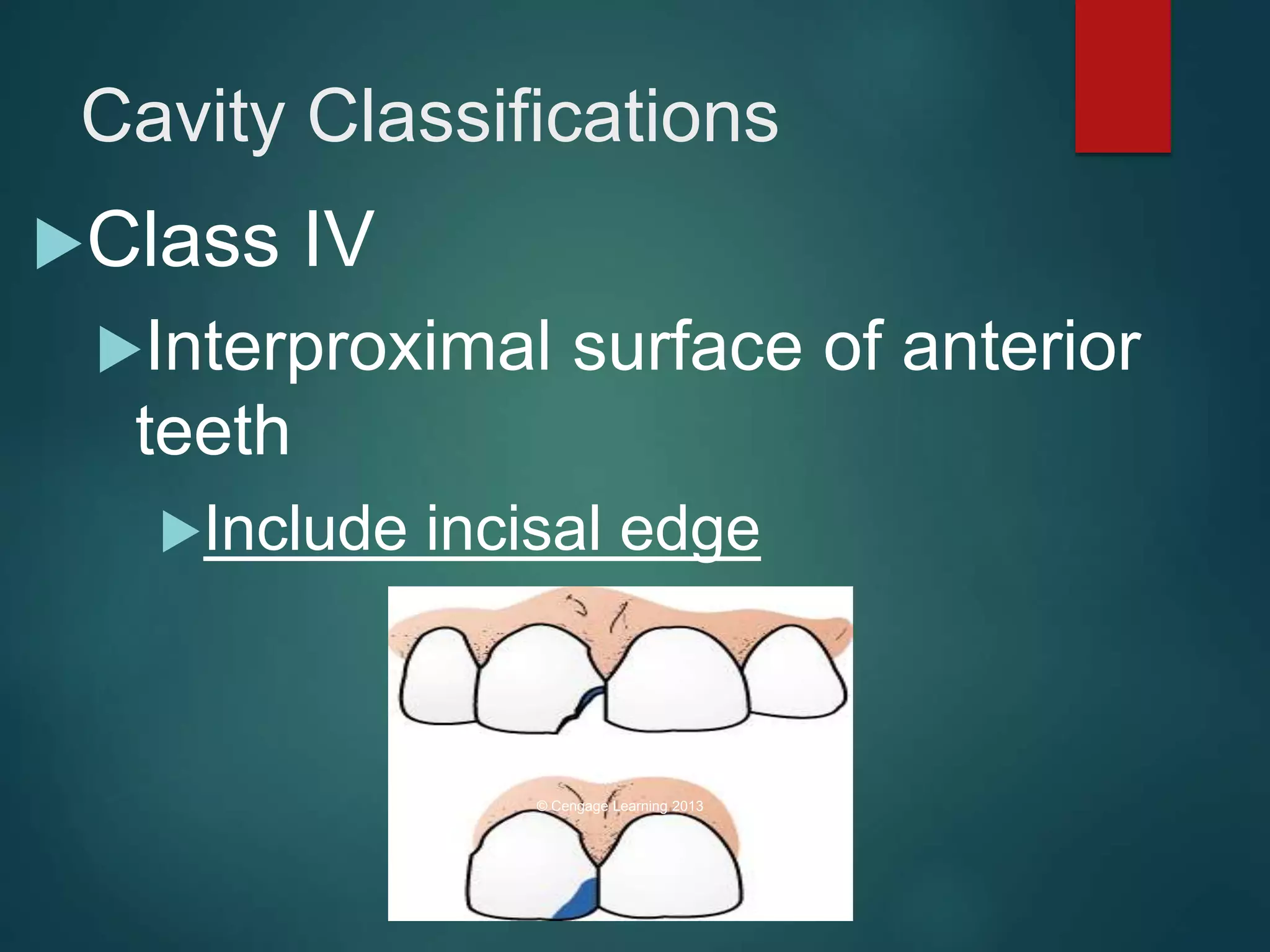
Class IV
Interproximal surface of anterior
teeth
Include incisal edge
© Cengage Learning 2013
Cavity Classifications
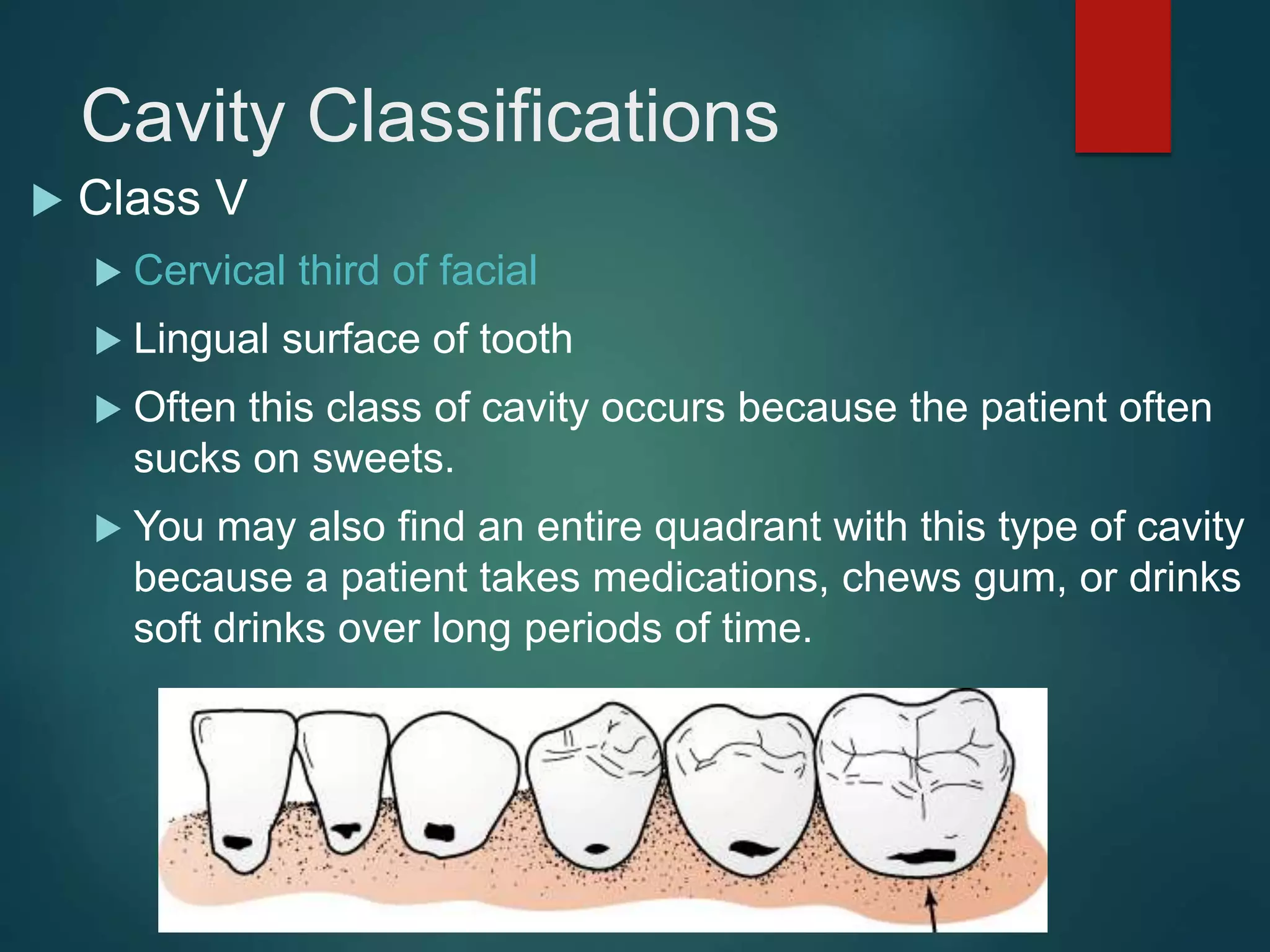
 Class V
 Cervical third of facial
 Lingual surface of tooth
 Often this class of cavity occurs because the patient often
sucks on sweets.
 You may also find an entire quadrant with this type of cavity
because a patient takes medications, chews gum, or drinks
soft drinks over long periods of time.
Cavity Classifications
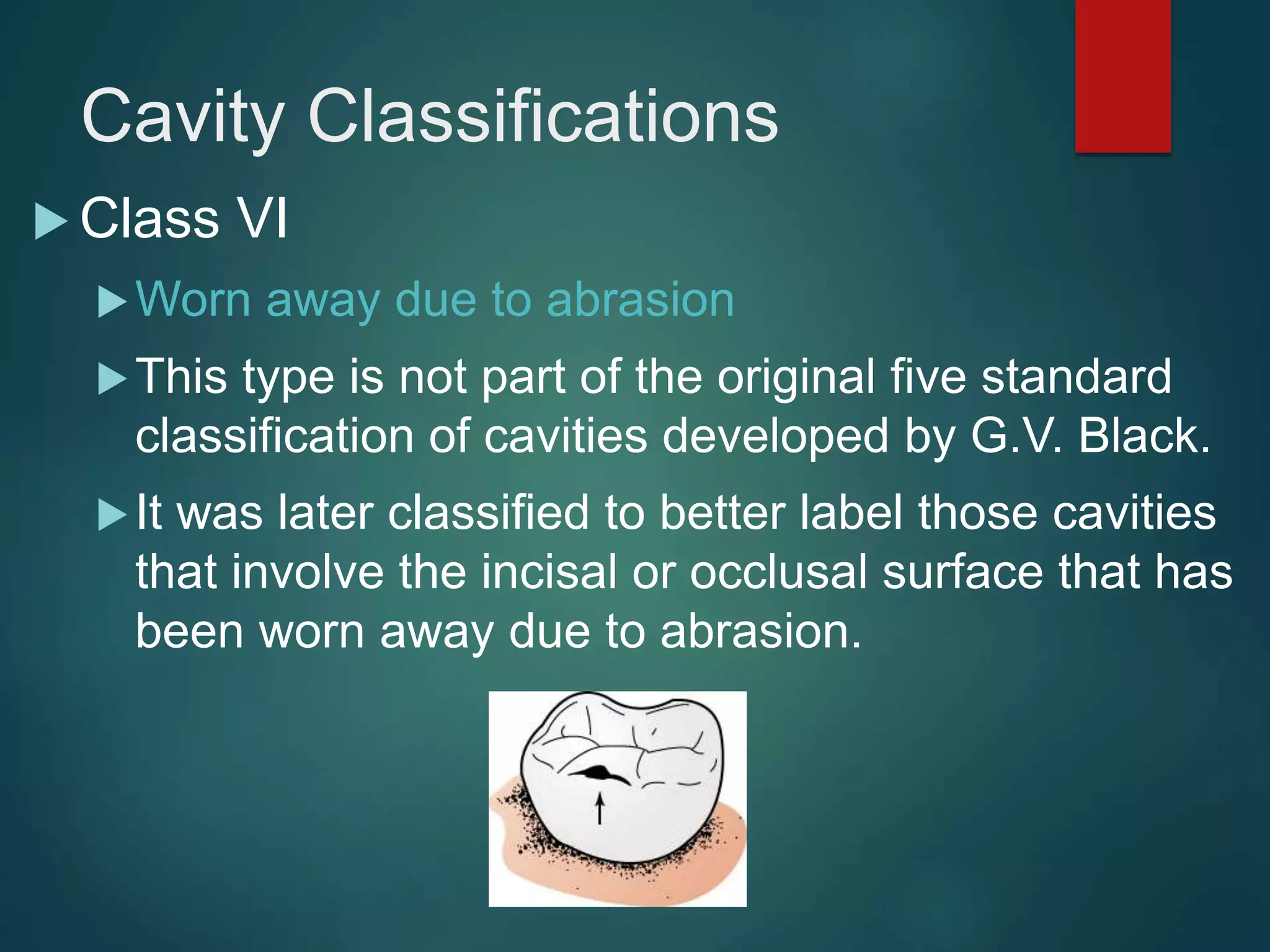
 Class VI
Worn away due to abrasion
This type is not part of the original five standard
classification of cavities developed by G.V. Black.
It was later classified to better label those cavities
that involve the incisal or occlusal surface that has
been worn away due to abrasion.
©2013 Delmar, Cengage Learning. All Rights Reserved. May not be scanned,
copied, duplicated, or posted to a publicly accessible website, in whole or in part.
Dental Check
• Which type of caries commonly occur in a
patient that regularly sucks on sweets?
– Class V
Charting
When a dental assistant is documenting
the chart to record the surfaces of the
teeth that need restoration,
abbreviations for single-surface
restorations are used.
Each surface is abbreviated using the
first letter of the surface, capitalized.
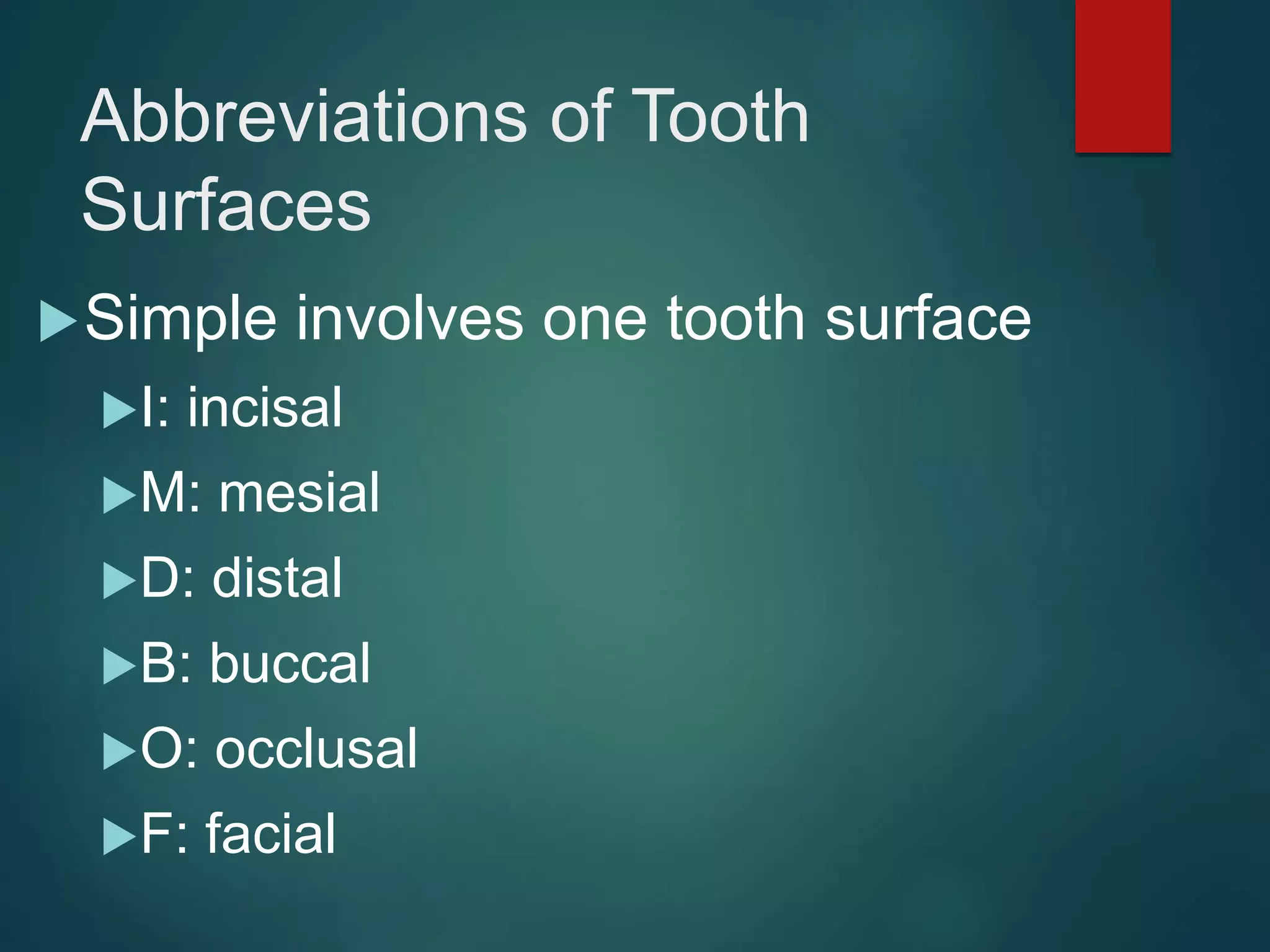
Abbreviations of Tooth
Surfaces
Simple involves one tooth surface
I: incisal
M: mesial
D: distal
B: buccal
O: occlusal
F: facial
Charting
If two or more surfaces are
restored, then a combined
abbreviation is used.
For example, to identify the
restoration on the distal and
occlusal surfaces, the term is disto-
occlusal restoration or DO
restoration.
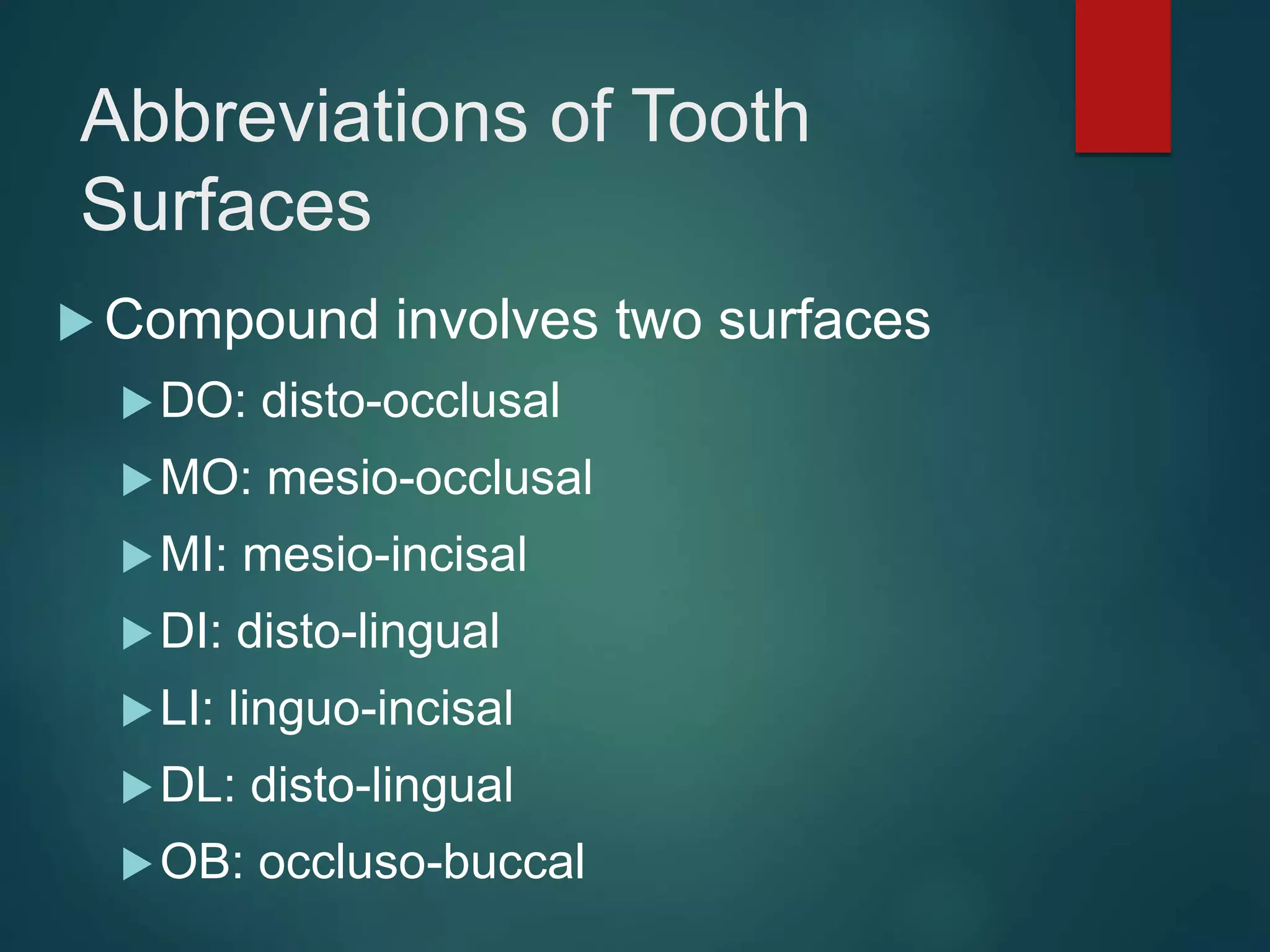
Abbreviations of Tooth
Surfaces
 Compound involves two surfaces
DO: disto-occlusal
MO: mesio-occlusal
MI: mesio-incisal
DI: disto-lingual
LI: linguo-incisal
DL: disto-lingual
OB: occluso-buccal
Charting
If three surfaces are combined, the same
principle is applied to the second word,
as well (e.g., mesial-occlusor-distal or
MOD restoration).
If a mesial surface of the tooth is
restored with another surface, it is always
used first.
Occlusal and lingual normally fall in the
last position.
Abbreviations of Tooth
Surfaces
Complex involves more than two
surfaces
MOD: mesio-occluso-distal
MODBL: mesio-occluso-disto-
bucco-lingual
Basic Charting Terms
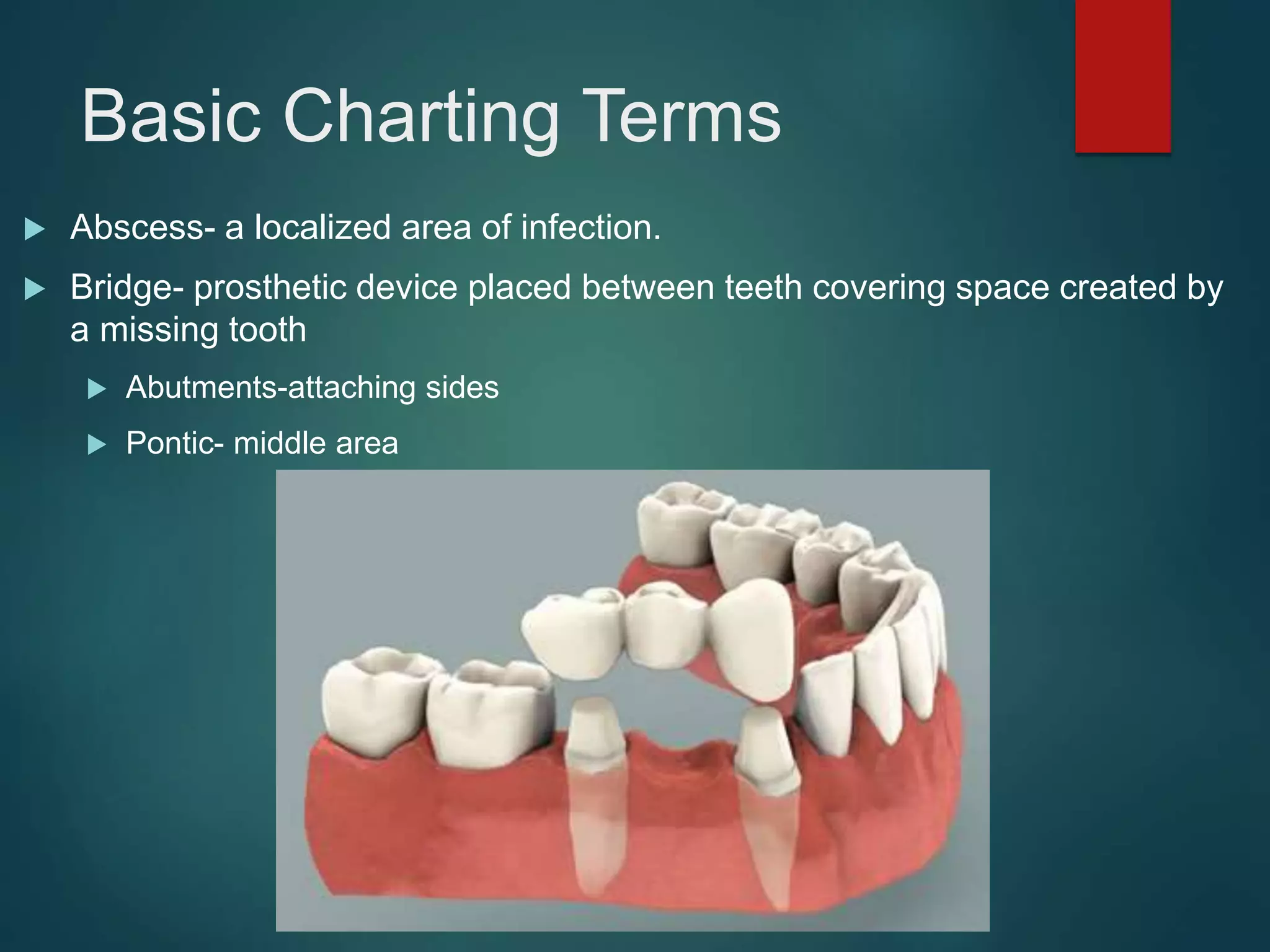
 Abscess- a localized area of infection.
 Bridge- prosthetic device placed between teeth covering space created by
a missing tooth
 Abutments-attaching sides
 Pontic- middle area
Basic Charting Terms
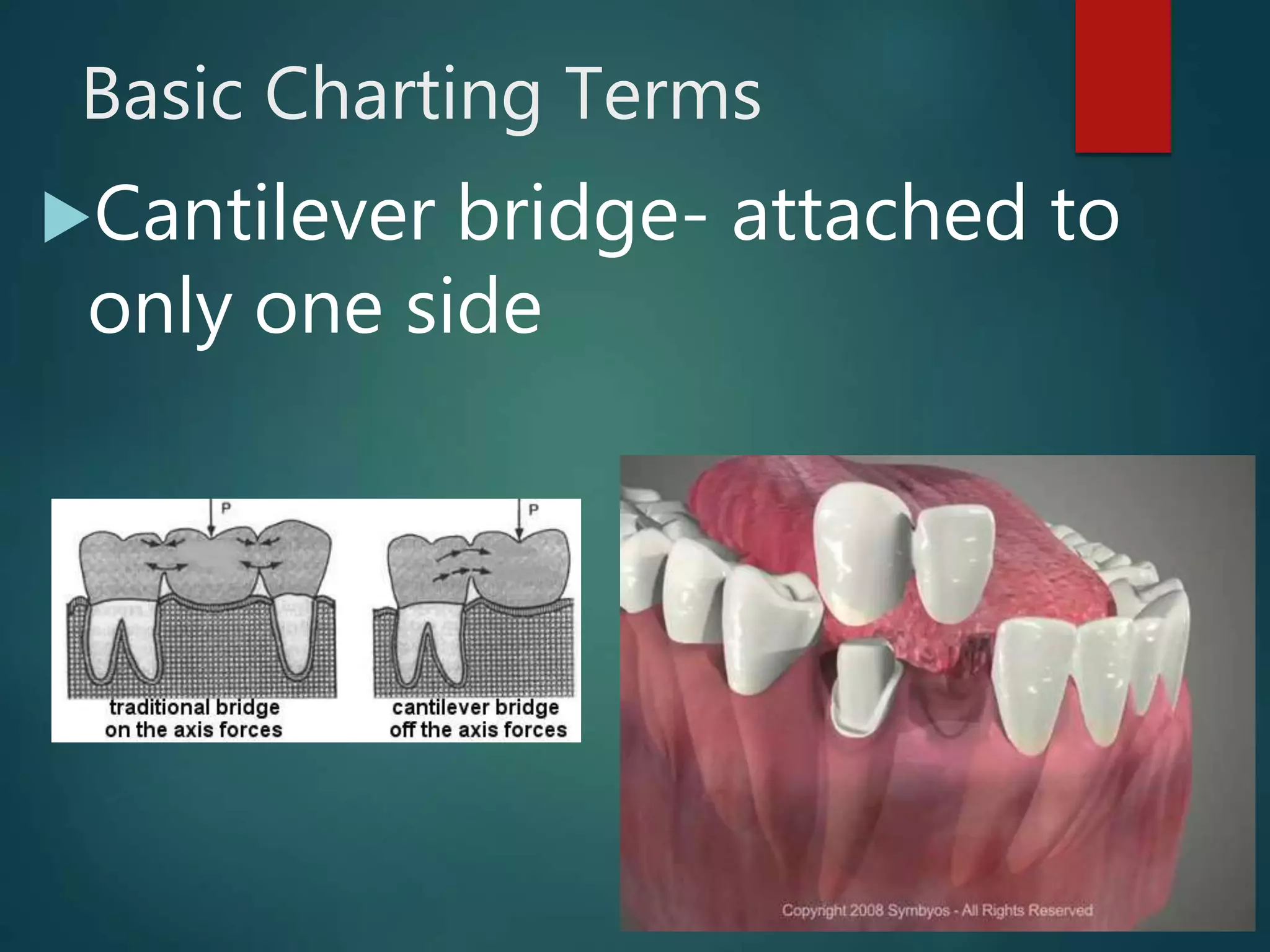
Cantilever bridge- attached to
only one side
Basic Charting Terms
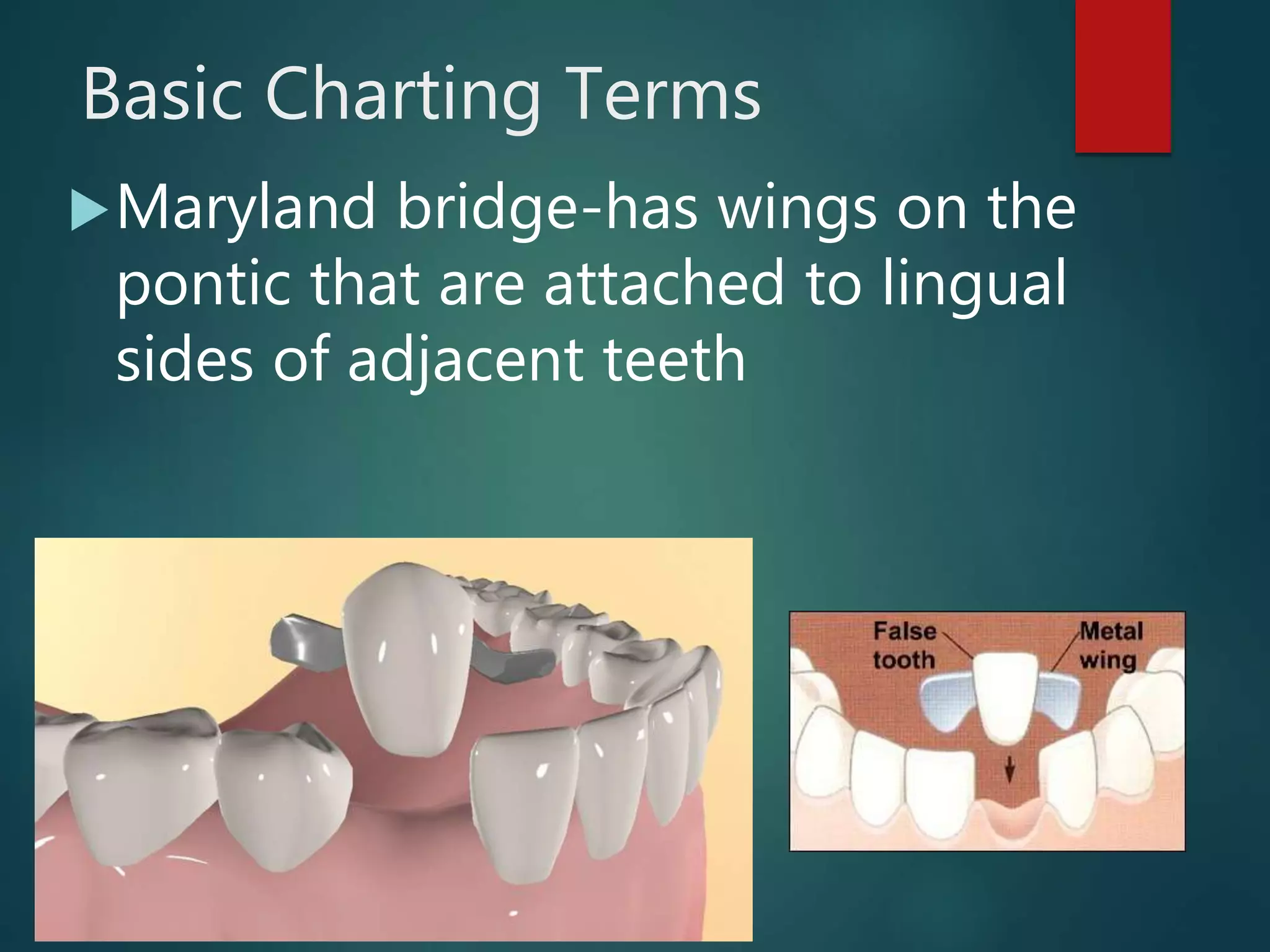
Maryland bridge-has wings on the
pontic that are attached to lingual
sides of adjacent teeth
Basic Charting Terms
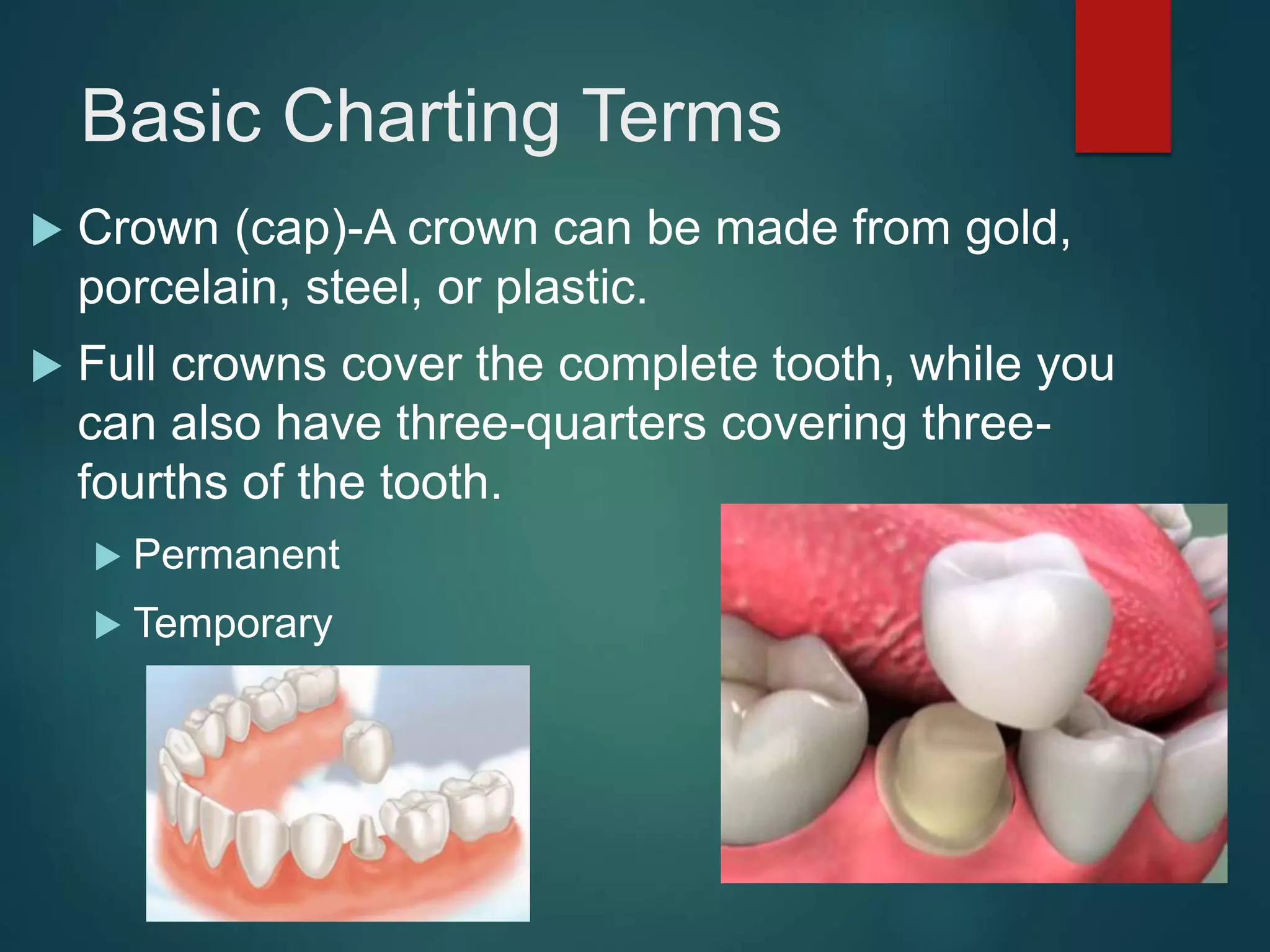
 Crown (cap)-A crown can be made from gold,
porcelain, steel, or plastic.
 Full crowns cover the complete tooth, while you
can also have three-quarters covering three-
fourths of the tooth.
 Permanent
 Temporary
Basic Charting Terms
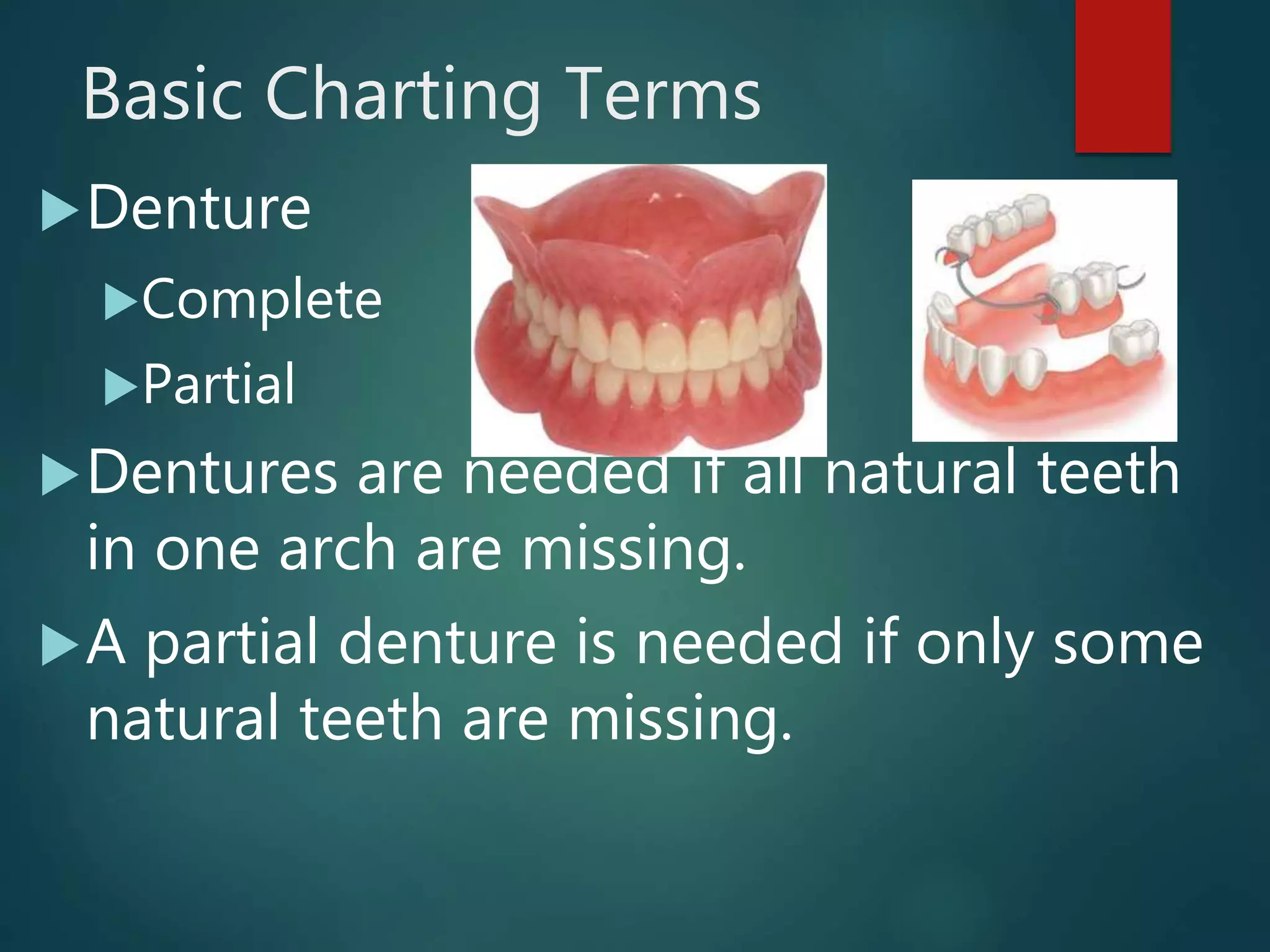
Denture
Complete
Partial
Dentures are needed if all natural teeth
in one arch are missing.
A partial denture is needed if only some
natural teeth are missing.
Basic Charting Terms
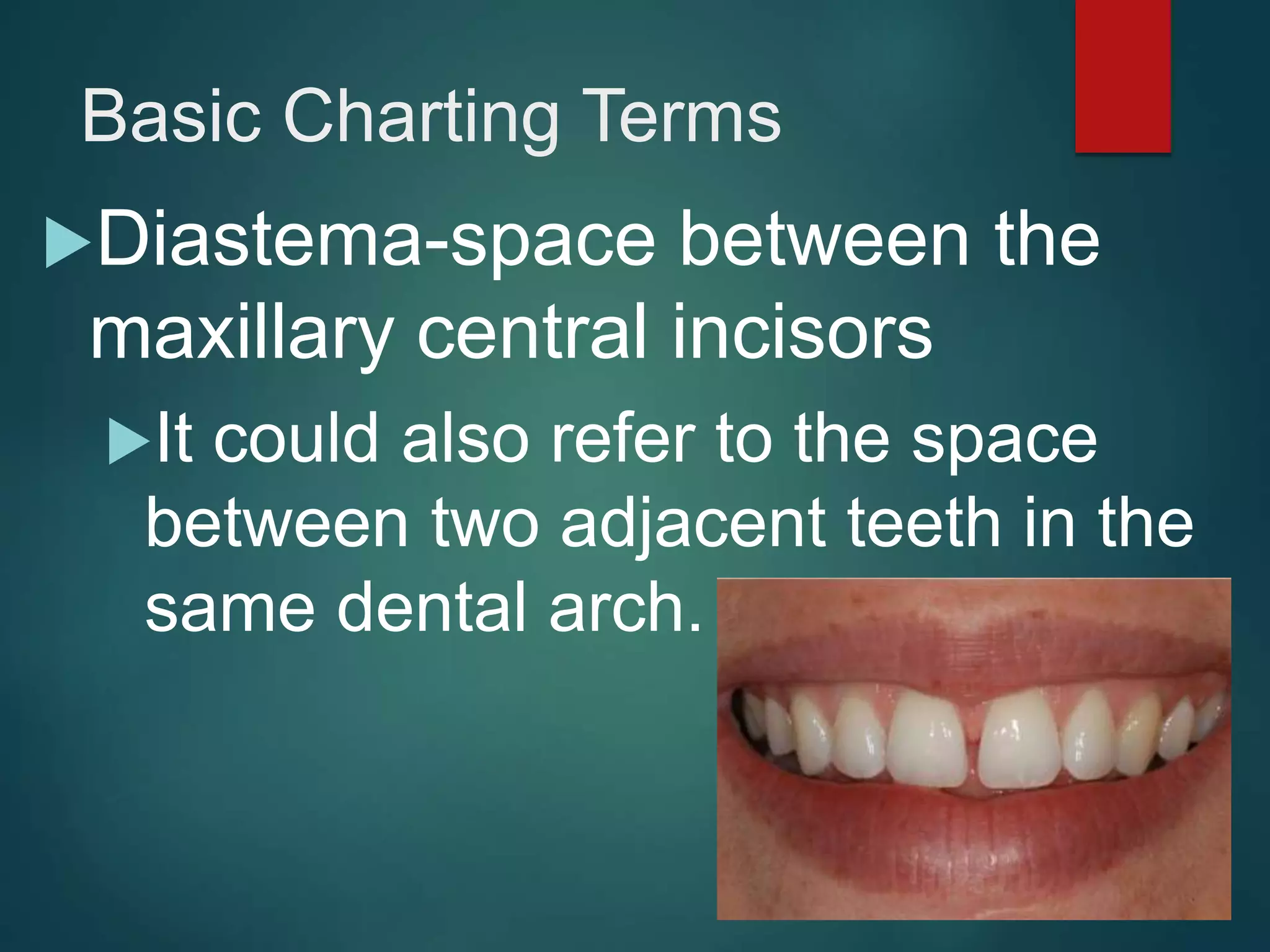
Diastema-space between the
maxillary central incisors
It could also refer to the space
between two adjacent teeth in the
same dental arch.
Basic Charting Terms
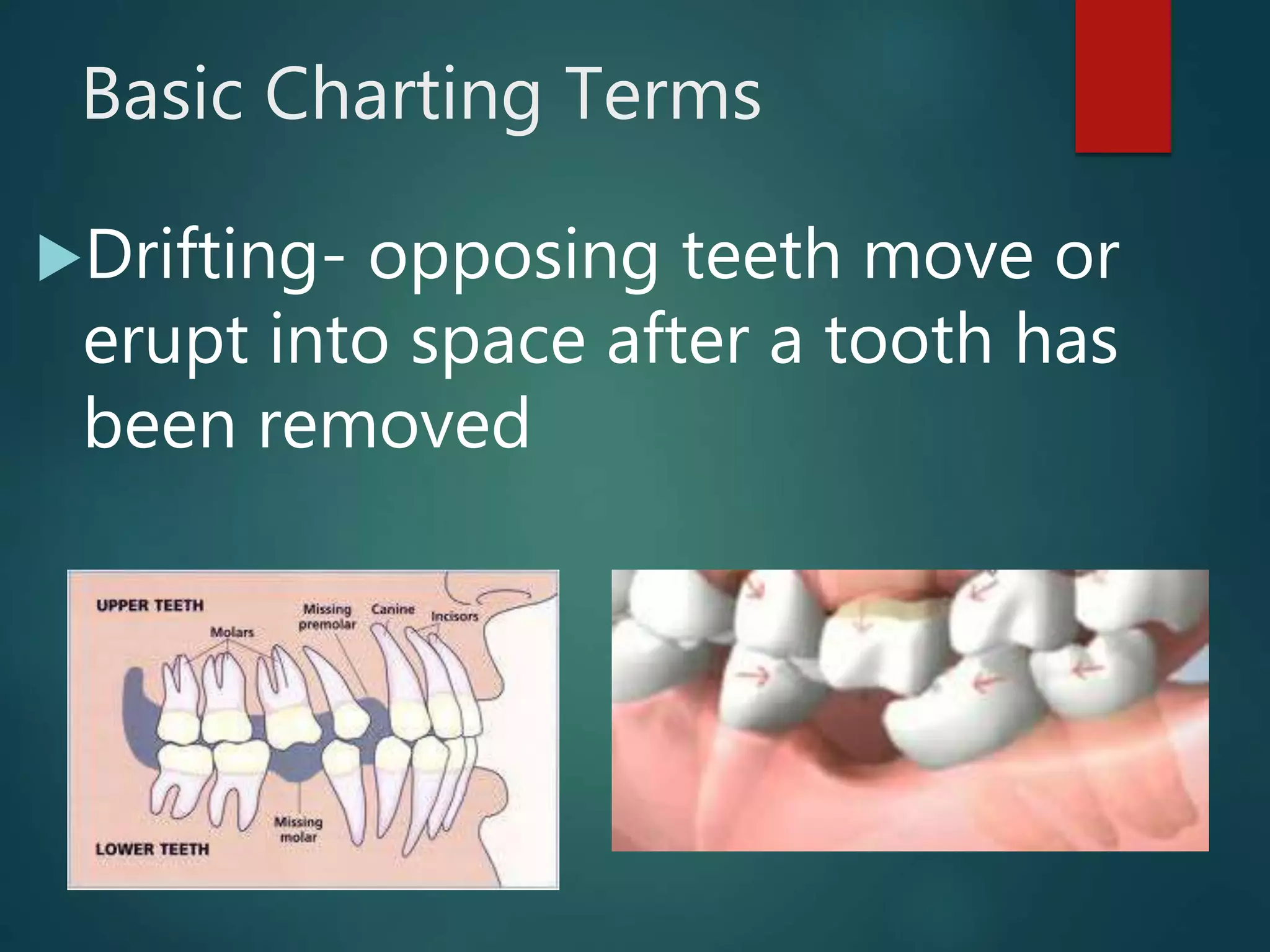
Drifting- opposing teeth move or
erupt into space after a tooth has
been removed
Basic Charting Terms
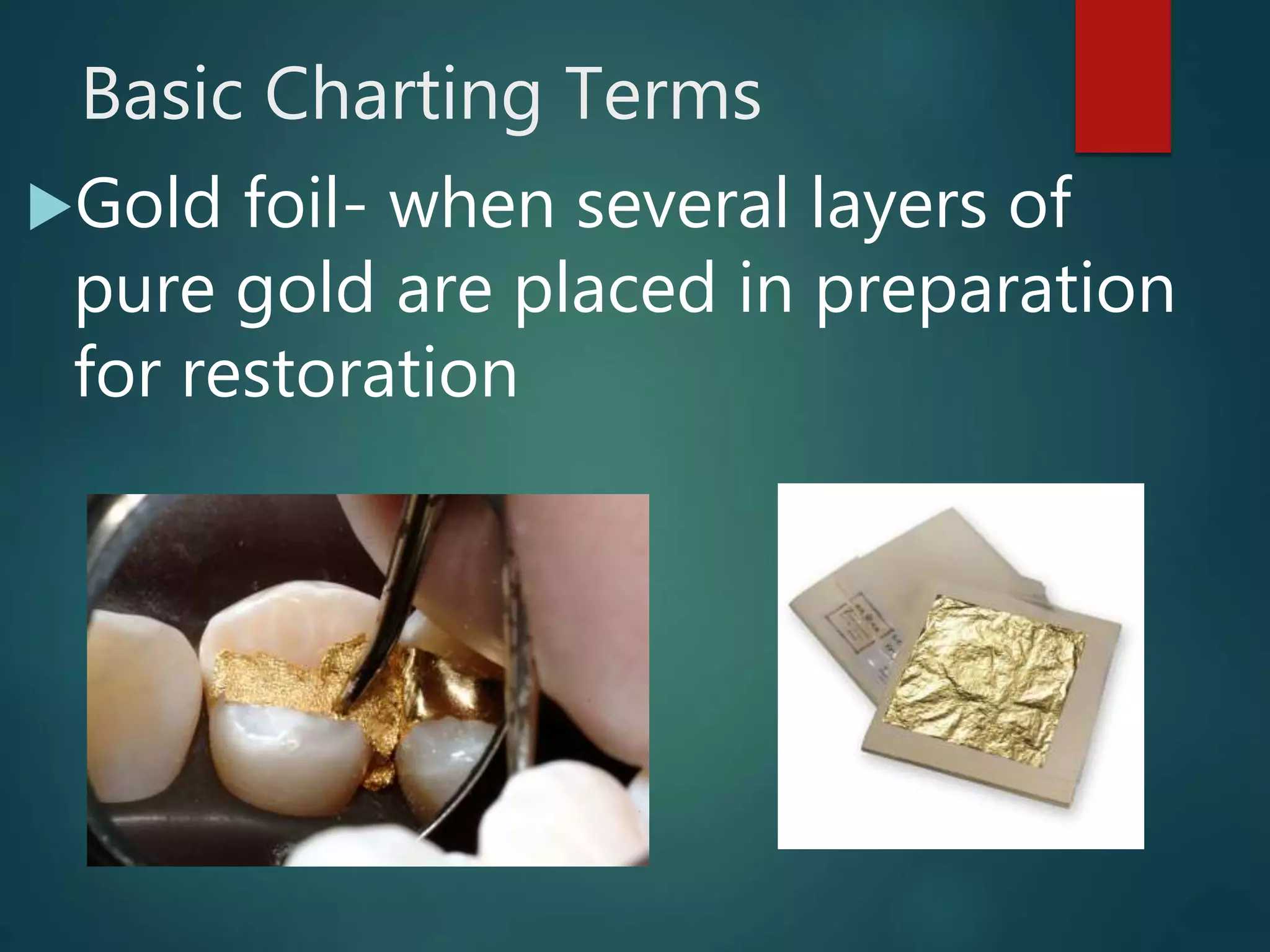
Gold foil- when several layers of
pure gold are placed in preparation
for restoration
Basic Charting Terms
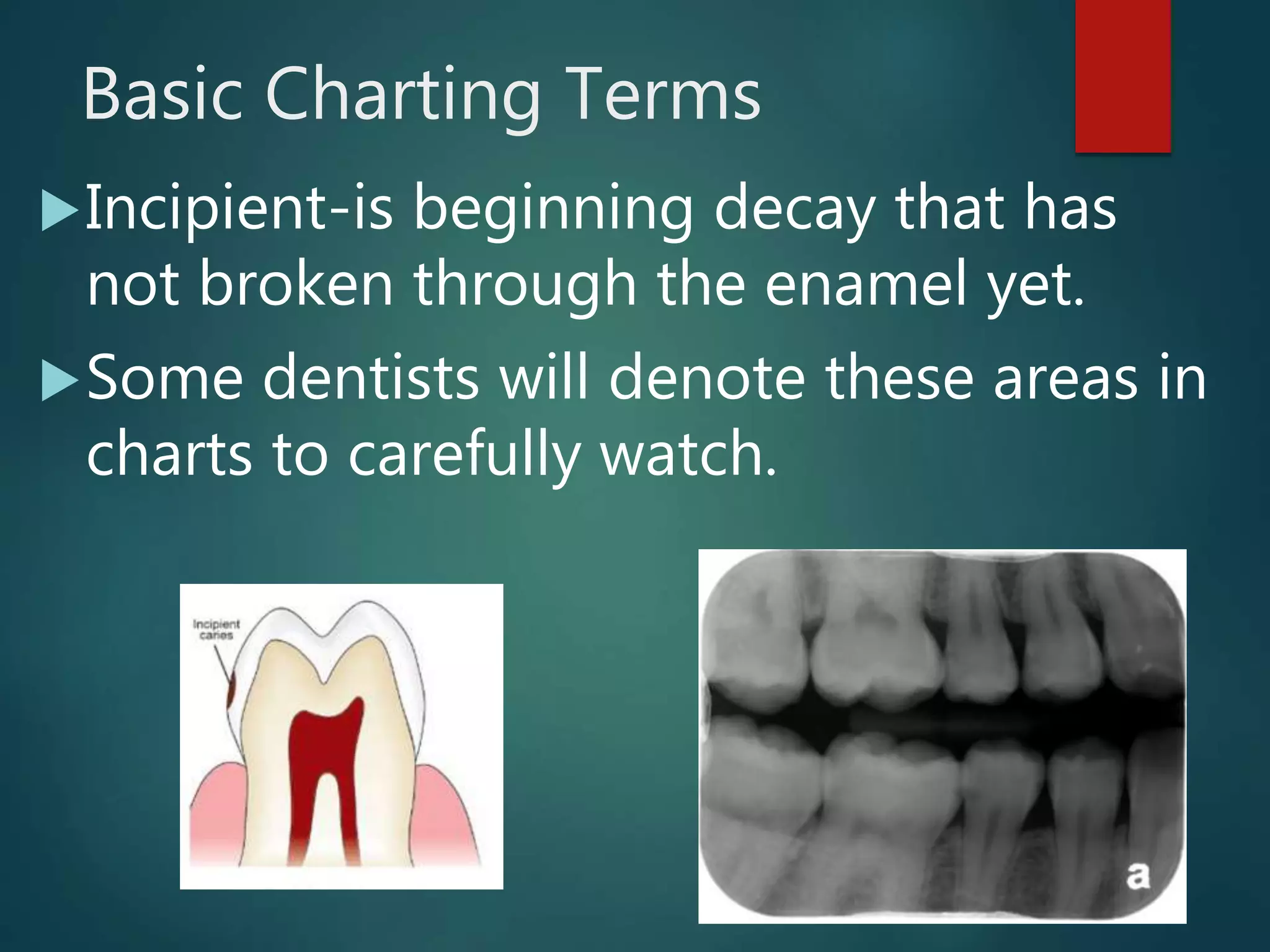
Incipient-is beginning decay that has
not broken through the enamel yet.
Some dentists will denote these areas in
charts to carefully watch.
Basic Charting Terms
Mobility
when a tooth moves in the socket
due to periodontal disease or
trauma.
A numbering system is used to
record how many millimeters the
tooth moves
Basic Charting Terms
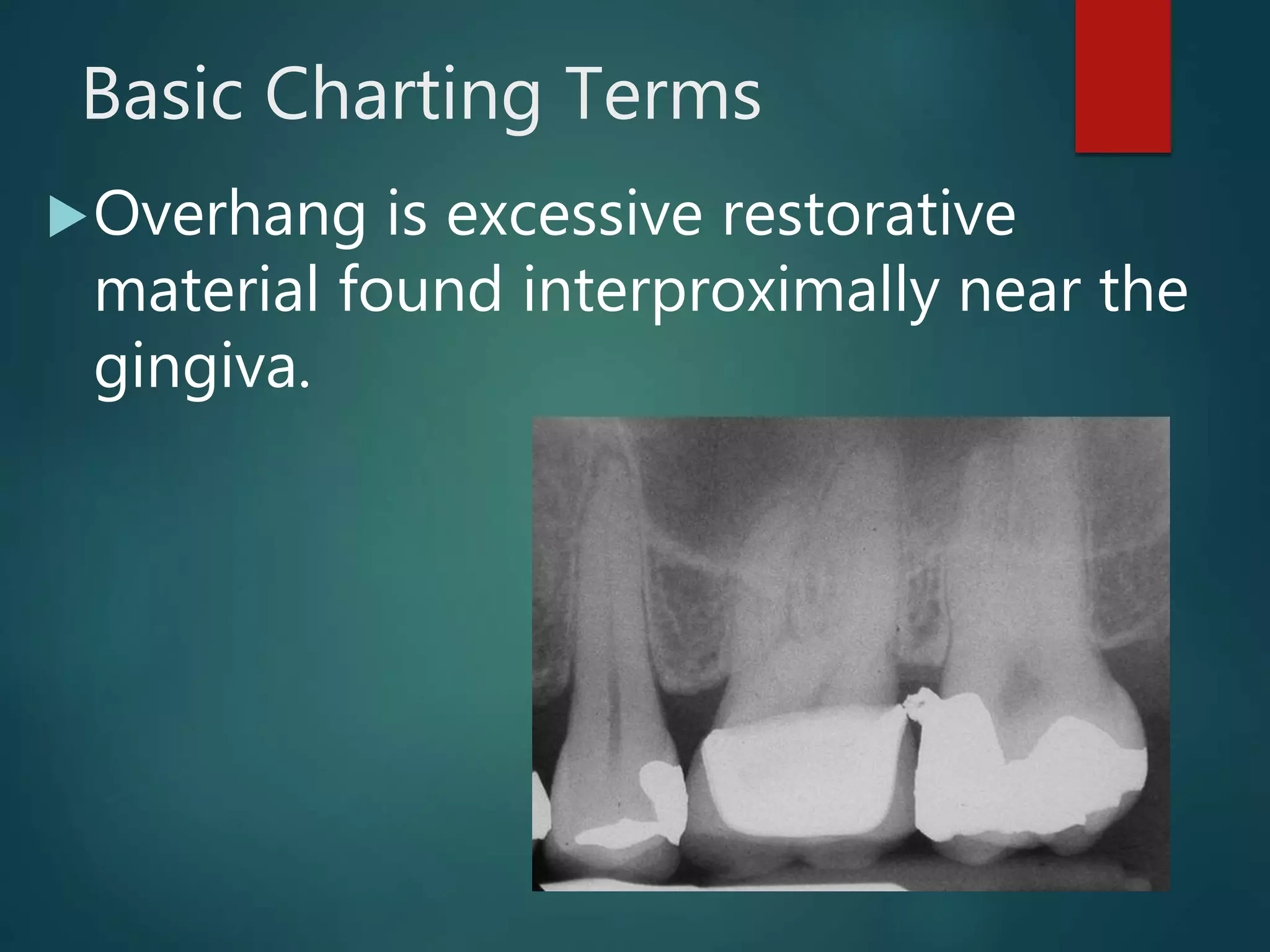
Overhang is excessive restorative
material found interproximally near the
gingiva.
Basic Charting Terms
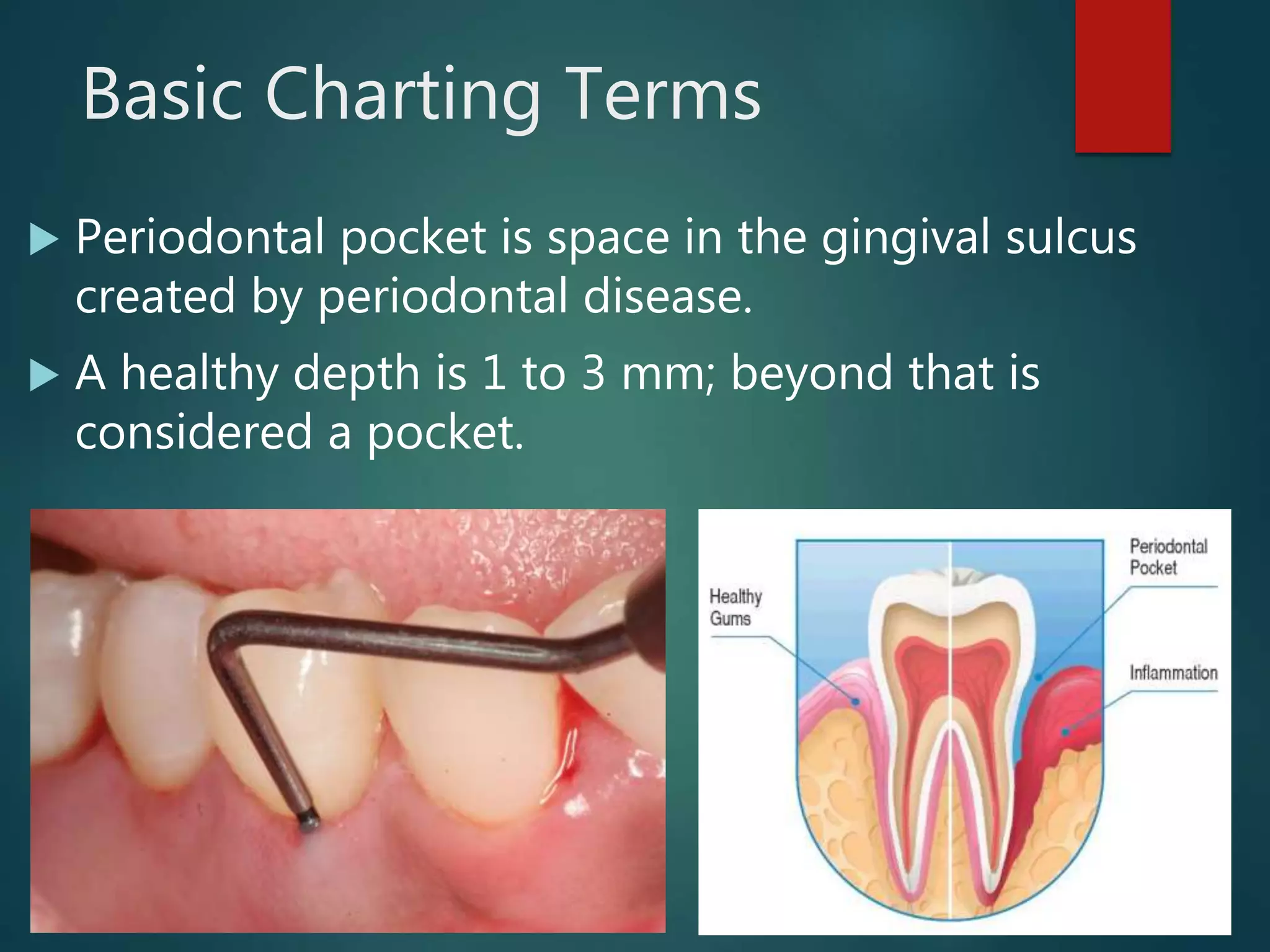
 Periodontal pocket is space in the gingival sulcus
created by periodontal disease.
 A healthy depth is 1 to 3 mm; beyond that is
considered a pocket.
Basic Charting Terms
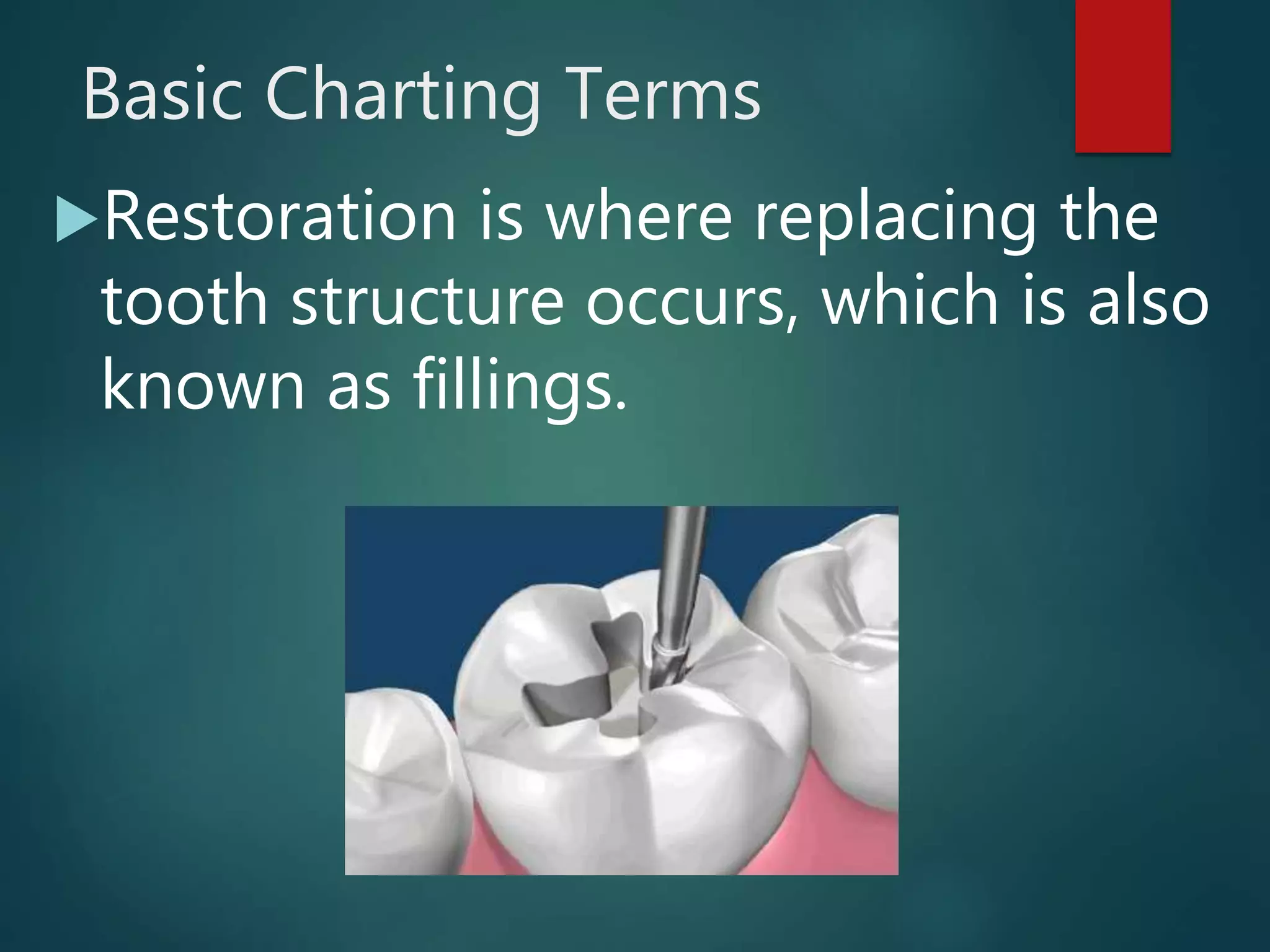
Restoration is where replacing the
tooth structure occurs, which is also
known as fillings.
Basic Charting Terms
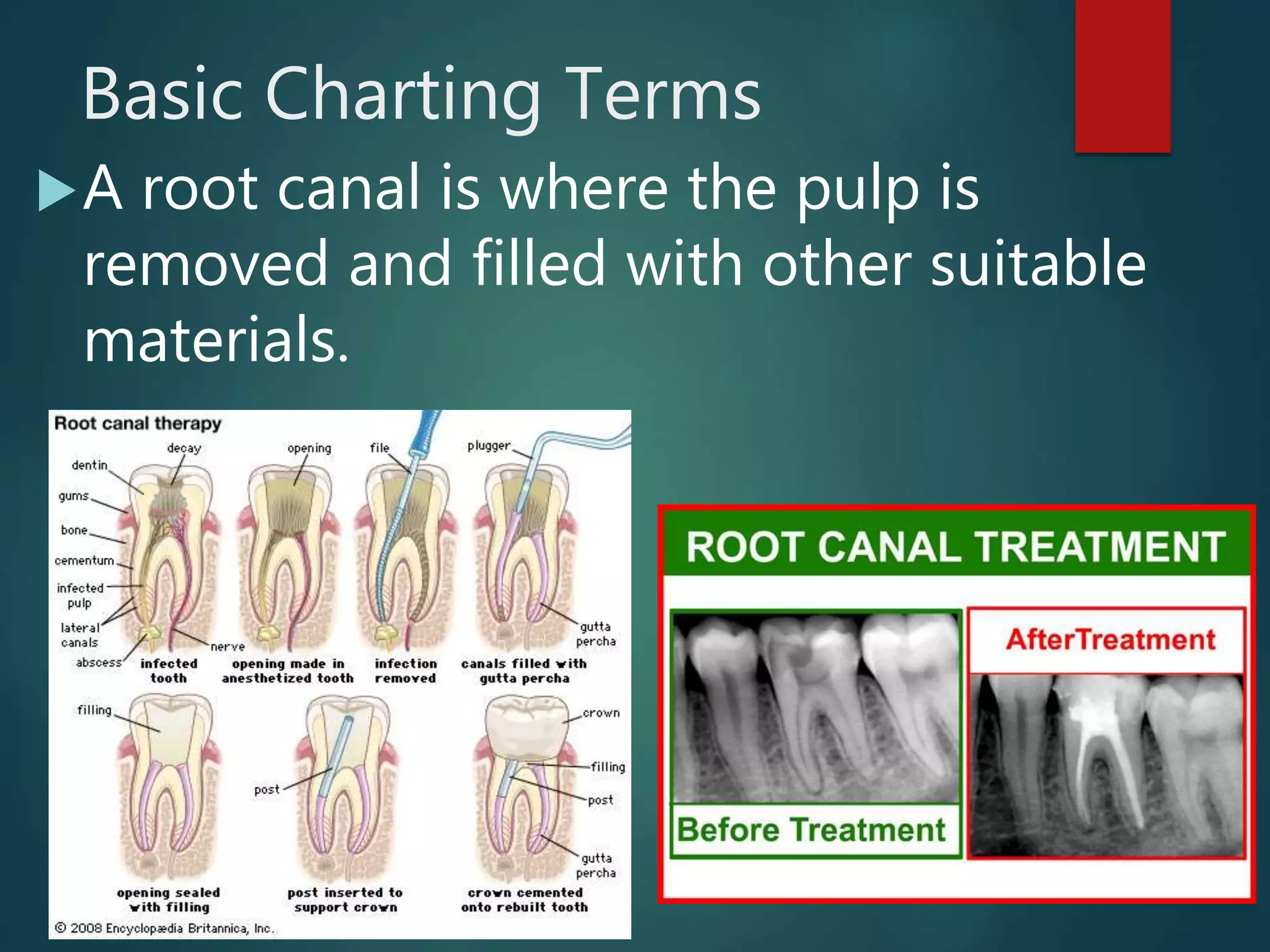
A root canal is where the pulp is
removed and filled with other suitable
materials.
Basic Charting Terms
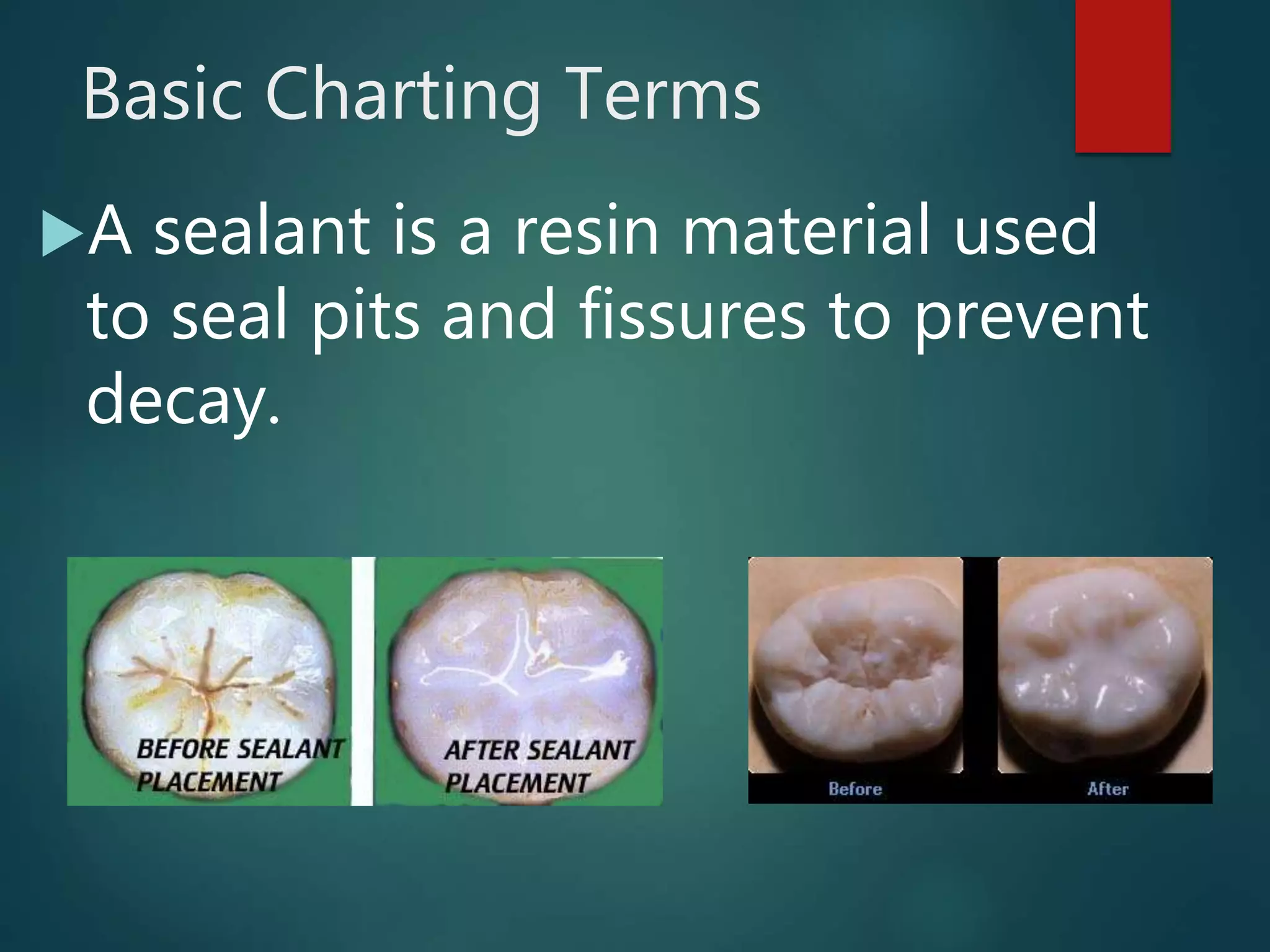
A sealant is a resin material used
to seal pits and fissures to prevent
decay.

Dental charting, Cavity Classification, Basic Charting Terms

  • 1.
  • 2.
    Dental Charts Two areas: Dentalcharting Record treatment Anatomical versus geometric Computerized
  • 3.
    Dental Charts  Chartingis a part of the patient’s legal record and must be done correctly.  The initial charting is normally done on the first exam.  Anatomical charts show the crown of the tooth, the crown and a portion of the tooth, or the crown and the complete root.  Geometric charts show the teeth as circles.  Computerized charting helps standardize.  It’s more efficient, fewer mistakes are made, and it’s easier in many ways.  Light pens are used to highlight and color.
  • 4.
    Numbering Systems  TheUniversal/National system was developed in 1968 and is most commonly used in the United States.  FDI was developed to provide an international system for coding teeth.  Canada and European countries use this the most.  In 1996, the ADA adopted this system and the universal system for tooth numbering.  The Palmer system is not very common, but it’s still used in some offices.
  • 5.
    Cavity Classifications Six standardclasses Cavity is caries The classifications of cavities were developed by G. V. Black. These are still the classifications being used today.
  • 6.
    Cavity Classifications Class I Developedcavities in pit and fissures They are found in the occlusal surfaces of posterior teeth (premolars and molars), buccal or lingual pits on molars, and lingual pit near the cingulum of the maxillary incisors.
  • 7.
    Cavity Classifications Class II Proximalsurfaces on posterior teeth MO restoration MOD restoration
  • 8.
    Cavity Classifications Class III Interproximalsurface of anterior teeth They can be found on canines, lateral incisors, and central incisors.
  • 9.
    Cavity Classifications Class IV Interproximalsurface of anterior teeth Include incisal edge © Cengage Learning 2013
  • 10.
    Cavity Classifications  ClassV  Cervical third of facial  Lingual surface of tooth  Often this class of cavity occurs because the patient often sucks on sweets.  You may also find an entire quadrant with this type of cavity because a patient takes medications, chews gum, or drinks soft drinks over long periods of time.
  • 11.
    Cavity Classifications  ClassVI Worn away due to abrasion This type is not part of the original five standard classification of cavities developed by G.V. Black. It was later classified to better label those cavities that involve the incisal or occlusal surface that has been worn away due to abrasion.
  • 12.
    ©2013 Delmar, CengageLearning. All Rights Reserved. May not be scanned, copied, duplicated, or posted to a publicly accessible website, in whole or in part. Dental Check • Which type of caries commonly occur in a patient that regularly sucks on sweets? – Class V
  • 13.
    Charting When a dentalassistant is documenting the chart to record the surfaces of the teeth that need restoration, abbreviations for single-surface restorations are used. Each surface is abbreviated using the first letter of the surface, capitalized.
  • 14.
    Abbreviations of Tooth Surfaces Simpleinvolves one tooth surface I: incisal M: mesial D: distal B: buccal O: occlusal F: facial
  • 15.
    Charting If two ormore surfaces are restored, then a combined abbreviation is used. For example, to identify the restoration on the distal and occlusal surfaces, the term is disto- occlusal restoration or DO restoration.
  • 16.
    Abbreviations of Tooth Surfaces Compound involves two surfaces DO: disto-occlusal MO: mesio-occlusal MI: mesio-incisal DI: disto-lingual LI: linguo-incisal DL: disto-lingual OB: occluso-buccal
  • 17.
    Charting If three surfacesare combined, the same principle is applied to the second word, as well (e.g., mesial-occlusor-distal or MOD restoration). If a mesial surface of the tooth is restored with another surface, it is always used first. Occlusal and lingual normally fall in the last position.
  • 18.
    Abbreviations of Tooth Surfaces Complexinvolves more than two surfaces MOD: mesio-occluso-distal MODBL: mesio-occluso-disto- bucco-lingual
  • 19.
    Basic Charting Terms Abscess- a localized area of infection.  Bridge- prosthetic device placed between teeth covering space created by a missing tooth  Abutments-attaching sides  Pontic- middle area
  • 20.
    Basic Charting Terms Cantileverbridge- attached to only one side
  • 21.
    Basic Charting Terms Marylandbridge-has wings on the pontic that are attached to lingual sides of adjacent teeth
  • 22.
    Basic Charting Terms Crown (cap)-A crown can be made from gold, porcelain, steel, or plastic.  Full crowns cover the complete tooth, while you can also have three-quarters covering three- fourths of the tooth.  Permanent  Temporary
  • 23.
    Basic Charting Terms Denture Complete Partial Denturesare needed if all natural teeth in one arch are missing. A partial denture is needed if only some natural teeth are missing.
  • 24.
    Basic Charting Terms Diastema-spacebetween the maxillary central incisors It could also refer to the space between two adjacent teeth in the same dental arch.
  • 25.
    Basic Charting Terms Drifting-opposing teeth move or erupt into space after a tooth has been removed
  • 26.
    Basic Charting Terms Goldfoil- when several layers of pure gold are placed in preparation for restoration
  • 27.
    Basic Charting Terms Incipient-isbeginning decay that has not broken through the enamel yet. Some dentists will denote these areas in charts to carefully watch.
  • 28.
    Basic Charting Terms Mobility whena tooth moves in the socket due to periodontal disease or trauma. A numbering system is used to record how many millimeters the tooth moves
  • 29.
    Basic Charting Terms Overhangis excessive restorative material found interproximally near the gingiva.
  • 30.
    Basic Charting Terms Periodontal pocket is space in the gingival sulcus created by periodontal disease.  A healthy depth is 1 to 3 mm; beyond that is considered a pocket.
  • 31.
    Basic Charting Terms Restorationis where replacing the tooth structure occurs, which is also known as fillings.
  • 33.
    Basic Charting Terms Aroot canal is where the pulp is removed and filled with other suitable materials.
  • 34.
    Basic Charting Terms Asealant is a resin material used to seal pits and fissures to prevent decay.