Mixed methods research
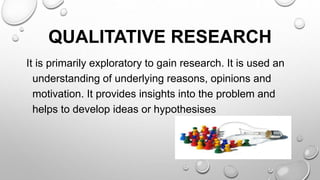
QUANTITATIVE RESEARCH
• It is way of collecting numerical research or data which
then can be converted into useable statistics
• It uses measurable data to formulate facts and uncover
patterns in research.
QUALITATIVE RESEARCH
It is primarily exploratory to gain research. It is used an
understanding of underlying reasons, opinions and
motivation. It provides insights into the problem and
helps to develop ideas or hypothesises
MIXED METHODS RESEARCH
According to Creswell and Plano Clark,
“ Mixed methods research is procedure for collecting,
analyzing and mixing both quantitative and qualitative
methods in single study or a series of studies to
understand a research problem.”
WHEN IS MIXED METHODS
RESEARCH CONDUCTED
When we have both quantitative and qualitative data
When one type of research is not enough to explain or to
answer the questions
When we want qualitative research to help to explain
quantitative findings.
When we want to generalize findings to a large population.
When we want to provide alternative perspective in a study
ROLE OF MIXED METHODS
RESEARCHER
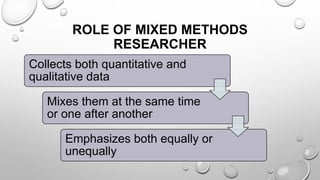
• Collect both quantitative and qualitative data
• Mixes them
Collects both quantitative and
qualitative data
Mixes them at the same time
or one after another
Emphasizes both equally or
unequally
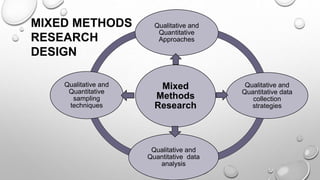
Mixed
Methods
Research
Qualitative and
Quantitative
Approaches
Qualitative and
Quantitative data
collection
strategies
Qualitative and
Quantitative data
analysis
Qualitative and
Quantitative
sampling
techniques
MIXED METHODS
RESEARCH
DESIGN
TYPES OF MIXED METHODS
RESEARCH DESIGN
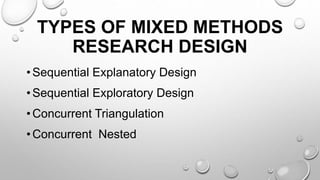
•Sequential Explanatory Design
•Sequential Exploratory Design
•Concurrent Triangulation
•Concurrent Nested
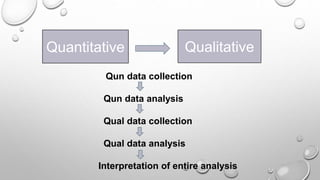
SEQUENTIAL EXPLANATORY DESIGN
This design involves the collection and analysis of
Quantitative data followed by the collection and
analysis of Qualitative data. The priority is given is
given to to the Qualitative data and the finding are
integrated during the interpretation stage
Quantitative Qualitative
Qun data collection
Qun data analysis
Qual data collection
Qual data analysis
Interpretation of entire analysis
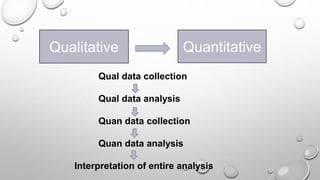
SEQUENTIAL EXPLORATORY DESIGN
In this design, of Qualitative data collection and
analysis is followed by Quantitative data collection
and analysis . The priority is given to the Qualitative
aspect of study and the finding are integrated during
the interpretation phase of study
Qualitative Quantitative
Qual data collection
Qual data analysis
Quan data collection
Quan data analysis
Interpretation of entire analysis
CONCURRENT TRIANGULATION DESIGN
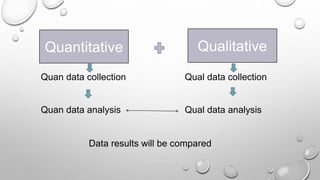
In this design, only one data collection phase is used, during
which quantitative and qualitative data collection and analysis
are conducted separately yet concurrently. The findings are
integrated during interpretation stage. Usually equal priority is
given to both types of research.
Quantitative Qualitative
Quan data collection Qual data collection
Quan data analysis Qual data analysis
Data results will be compared
CONCURRENT NESTED DESIGN
In this design only one data collection phase is used during
which predominant method ( quantitative or qualitative) nests or
embeds the other less priority method (quantitative or
qualitative) . This nesting means that embedded method
addresses different question the dominant method or seeks
information from different levels. The data collected from two
methods are mixed during analysis phase of the project.
QUANTITATIVE
(qual)
interpretation based on
Quantitative (qual)
QUALITATIVE
(quan)
interpretation based on
Qualitative (quan)
ADVANTAGES OF MIXED METHOD
RESEARCH
Clarify and explain the relationships that exist between
varibles
Can be very useful as unexpected result has arisen from
the prior study
Can help to generalize the qualitative data
Helpful in designing and validating the instrument
DISADVANTAGES OF MIXED METHOD
RESEARCH
Extremely time and expensive to carry out
Many researchers are only experienced in one type of
research
Discrepancies may arise between different type of data
Can be difficult to decide when to proceed sequential
designs
CONCLUSION
Mixed Methods Research has its own strengths and
weaknesses, yet it is becoming popular and common in
educational research. It overcome the weaknesses of
single design. It provide more valid results by offsetting the
weaknesses of single method. It helps to to look at a
research question from different angles and clarify
potential contradictions.
Mixed Method Research

Mixed Method Research

  • 2.
  • 3.
    QUANTITATIVE RESEARCH • Itis way of collecting numerical research or data which then can be converted into useable statistics • It uses measurable data to formulate facts and uncover patterns in research.
  • 4.
    QUALITATIVE RESEARCH It isprimarily exploratory to gain research. It is used an understanding of underlying reasons, opinions and motivation. It provides insights into the problem and helps to develop ideas or hypothesises
  • 5.
    MIXED METHODS RESEARCH Accordingto Creswell and Plano Clark, “ Mixed methods research is procedure for collecting, analyzing and mixing both quantitative and qualitative methods in single study or a series of studies to understand a research problem.”
  • 6.
    WHEN IS MIXEDMETHODS RESEARCH CONDUCTED When we have both quantitative and qualitative data When one type of research is not enough to explain or to answer the questions When we want qualitative research to help to explain quantitative findings. When we want to generalize findings to a large population. When we want to provide alternative perspective in a study
  • 7.
    ROLE OF MIXEDMETHODS RESEARCHER • Collect both quantitative and qualitative data • Mixes them Collects both quantitative and qualitative data Mixes them at the same time or one after another Emphasizes both equally or unequally
  • 8.
    Mixed Methods Research Qualitative and Quantitative Approaches Qualitative and Quantitativedata collection strategies Qualitative and Quantitative data analysis Qualitative and Quantitative sampling techniques MIXED METHODS RESEARCH DESIGN
  • 9.
    TYPES OF MIXEDMETHODS RESEARCH DESIGN •Sequential Explanatory Design •Sequential Exploratory Design •Concurrent Triangulation •Concurrent Nested
  • 10.
    SEQUENTIAL EXPLANATORY DESIGN Thisdesign involves the collection and analysis of Quantitative data followed by the collection and analysis of Qualitative data. The priority is given is given to to the Qualitative data and the finding are integrated during the interpretation stage
  • 11.
    Quantitative Qualitative Qun datacollection Qun data analysis Qual data collection Qual data analysis Interpretation of entire analysis
  • 12.
    SEQUENTIAL EXPLORATORY DESIGN Inthis design, of Qualitative data collection and analysis is followed by Quantitative data collection and analysis . The priority is given to the Qualitative aspect of study and the finding are integrated during the interpretation phase of study
  • 13.
    Qualitative Quantitative Qual datacollection Qual data analysis Quan data collection Quan data analysis Interpretation of entire analysis
  • 14.
    CONCURRENT TRIANGULATION DESIGN Inthis design, only one data collection phase is used, during which quantitative and qualitative data collection and analysis are conducted separately yet concurrently. The findings are integrated during interpretation stage. Usually equal priority is given to both types of research.
  • 15.
    Quantitative Qualitative Quan datacollection Qual data collection Quan data analysis Qual data analysis Data results will be compared
  • 16.
    CONCURRENT NESTED DESIGN Inthis design only one data collection phase is used during which predominant method ( quantitative or qualitative) nests or embeds the other less priority method (quantitative or qualitative) . This nesting means that embedded method addresses different question the dominant method or seeks information from different levels. The data collected from two methods are mixed during analysis phase of the project.
  • 17.
    QUANTITATIVE (qual) interpretation based on Quantitative(qual) QUALITATIVE (quan) interpretation based on Qualitative (quan)
  • 18.
    ADVANTAGES OF MIXEDMETHOD RESEARCH Clarify and explain the relationships that exist between varibles Can be very useful as unexpected result has arisen from the prior study Can help to generalize the qualitative data Helpful in designing and validating the instrument
  • 19.
    DISADVANTAGES OF MIXEDMETHOD RESEARCH Extremely time and expensive to carry out Many researchers are only experienced in one type of research Discrepancies may arise between different type of data Can be difficult to decide when to proceed sequential designs
  • 20.
    CONCLUSION Mixed Methods Researchhas its own strengths and weaknesses, yet it is becoming popular and common in educational research. It overcome the weaknesses of single design. It provide more valid results by offsetting the weaknesses of single method. It helps to to look at a research question from different angles and clarify potential contradictions.