Language Acquisition
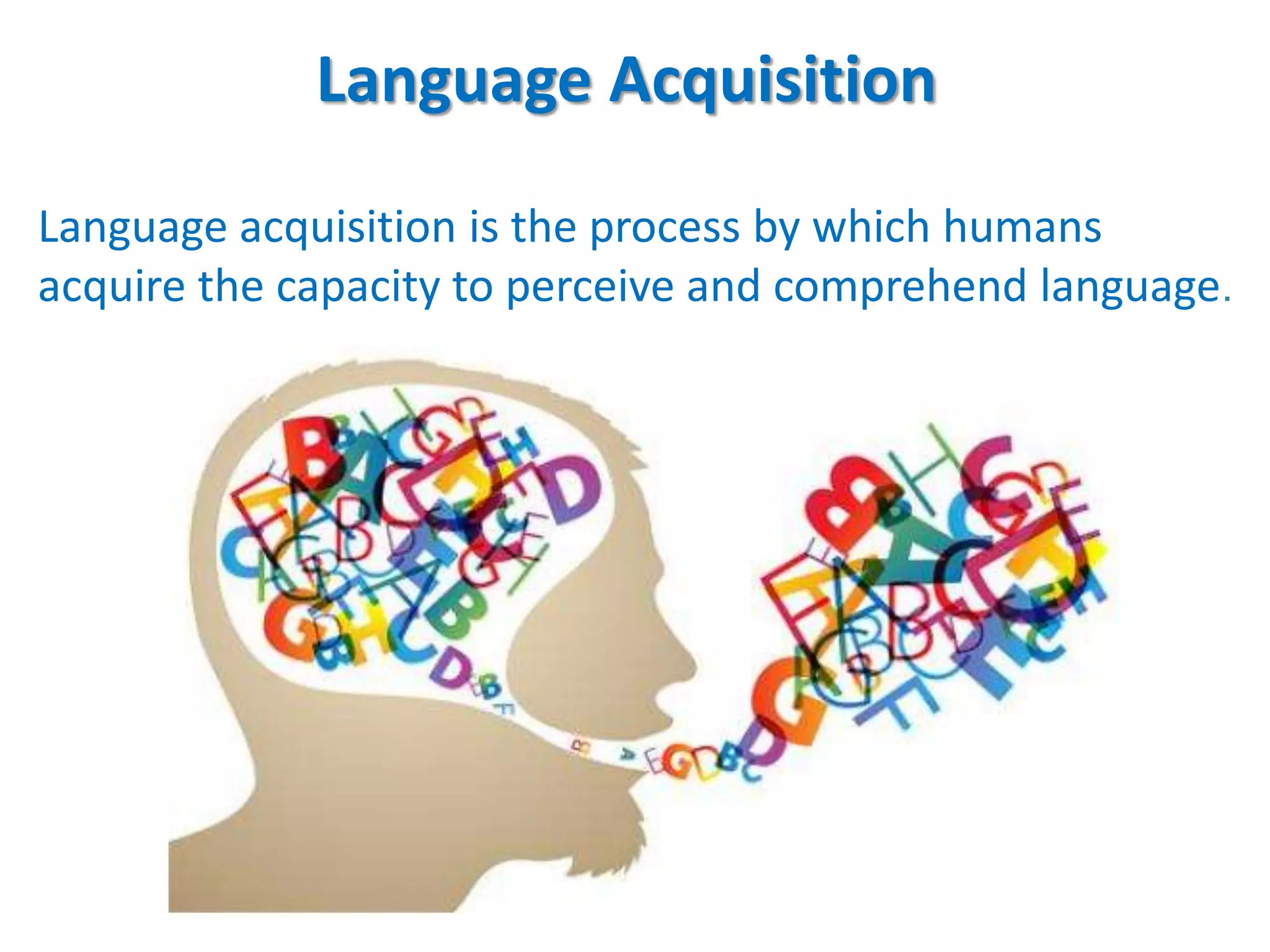
Language acquisition is the process by which humans
acquire the capacity to perceive and comprehend language.
L1 and L2 Acquisition
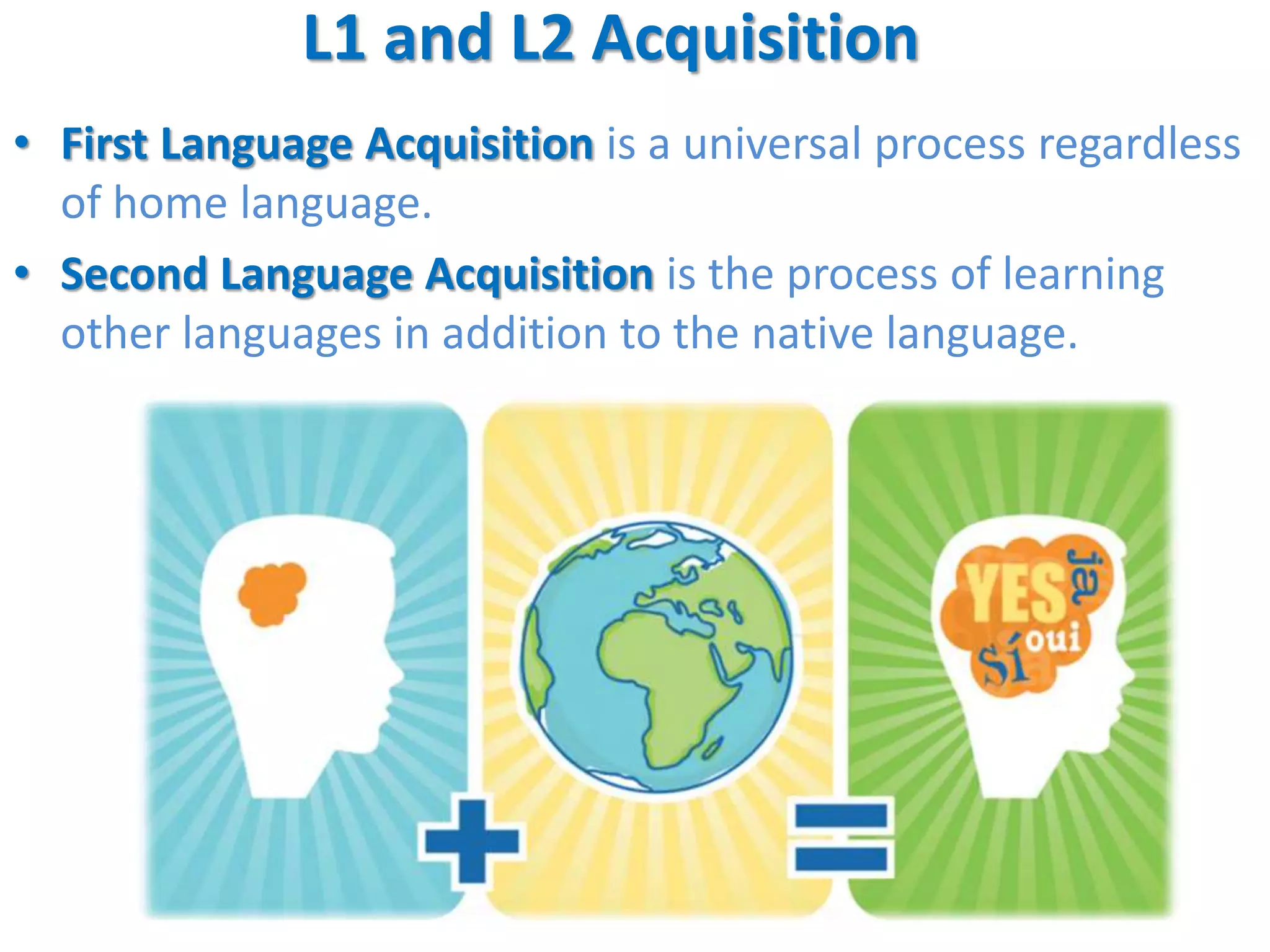
• First Language Acquisition is a universal process regardless
of home language.
• Second Language Acquisition is the process of learning
other languages in addition to the native language.
Stephen Krashen divides the process of second-language
acquisition into five stages:
1. preproduction
2. early production
3. speech emergence
4. intermediate fluency
5. advanced fluency
Five Stages of Second Language Acquisition
Stage I: Pre-Production
This stage lasts for about six weeks or longer. At this stage
learners do not speak they just listen to second language.
Stage I: Pre-Production
Student Characteristics
• Hesitant and unsure
• May use one word responses
• Develop listening skills
• Need time to be comfortable
with classroom environment
procedures and activities
• Respond non-verbally by:
Pointing
Nodding
Gesturing
Drawing
Teachers Strategies
• Encourage listening; don't
force speaking
• Slow speech, emphasize key
words
• Use gestures and body
language
• Use multimedia aids to
illustrate concepts
Stage II: Early Production
This stage may last up to six months and students will develop a
receptive and active vocabulary of about 1000 words. During this stage,
students can usually speak in one- or two-word phrases.
Stage II: Early Production
Student Characteristics
• Begin to grasp main ideas of message
• Begin to focus on contextual clues
• Use routine expressions
independently
• Demonstrate improved
comprehension
• May not tell you if they do not
understand
• Mispronounce words
Teachers Strategies
• Speak only in target language, using the
native language only for clarification of
difficult words
• Ask Yes/No and directed choice questions
• Ask Who? What? Where? Questions
• Ask listing type questions
• Use Think-Pair-Share technique when
asking questions of the class
• Work intensively on their articulation by
putting their sentences together
• Allow students to illustrate knowledge
Stage III: Speech Emergence
Learners' vocabularies increase to around 3000 words during this
stage, and they can communicate using simple questions and phrases.
Stage III: Speech Emergence
• Demonstrate expanded
vocabulary
• May ask for clarification or
meaning
• Participate in small group
discussions
• May rely on native language to
communicate complex ideas
• Start to acquire basic
communication
Student Characteristics
• Encourage efforts to participate
small group discussions
• Ask How and Why questions
• Emphasize content area
vocabulary
• Provide opportunities for
participation in reading and
writing activities
• Modify work according to
individual need
Teachers Strategies
Stage IV: Intermediate Fluency
At this stage, learners have a vocabulary of around 6000
words, and can use more complicated sentence structures.
Stage IV: Intermediate Fluency
• Describe with details a place or an
event they have attended
• Retell stories with good command of
verb tenses
• Begin to think in the new language
instead of translating from native
language
• Interact with native speakers with
some support
• Understand the main idea of movies,
songs, reports, articles in the target
language
Student Characteristics Teachers Strategies
• Explore the richness of adjectives,
language constructions, phrasal
verbs and idioms.
• Engage the student in retelling
stories in order to expose students
to the language
• Explore different ways to express
the same things
• Promote ways of self-assessment
and learner empowerment
Stage V: Advanced Fluency
The final stage is advanced fluency, which is typically reached
somewhere between five and ten years of learning the language.
Learners at this stage can function at a level close to native speakers.
Student Characteristics
• Can interact extensively with native
speakers
• Have high levels of comprehension but
may not understand all of the academic
language
• Read and write for a variety of purposes
• Continue to need extensive vocabulary
development in content
Teachers strategies
• Encourage reading newspapers
and magazines in target language
• Encourage watching different TV
channels in the target language
• Encourage using Internet to read
different topics and to listen to
podcasts and videos in target
language
Stage IV: Advanced Fluency
 Stages of Second Language Acquisition

Stages of Second Language Acquisition

  • 2.
    Language Acquisition Language acquisitionis the process by which humans acquire the capacity to perceive and comprehend language.
  • 3.
    L1 and L2Acquisition • First Language Acquisition is a universal process regardless of home language. • Second Language Acquisition is the process of learning other languages in addition to the native language.
  • 4.
    Stephen Krashen dividesthe process of second-language acquisition into five stages: 1. preproduction 2. early production 3. speech emergence 4. intermediate fluency 5. advanced fluency Five Stages of Second Language Acquisition
  • 5.
    Stage I: Pre-Production Thisstage lasts for about six weeks or longer. At this stage learners do not speak they just listen to second language.
  • 6.
    Stage I: Pre-Production StudentCharacteristics • Hesitant and unsure • May use one word responses • Develop listening skills • Need time to be comfortable with classroom environment procedures and activities • Respond non-verbally by: Pointing Nodding Gesturing Drawing Teachers Strategies • Encourage listening; don't force speaking • Slow speech, emphasize key words • Use gestures and body language • Use multimedia aids to illustrate concepts
  • 7.
    Stage II: EarlyProduction This stage may last up to six months and students will develop a receptive and active vocabulary of about 1000 words. During this stage, students can usually speak in one- or two-word phrases.
  • 8.
    Stage II: EarlyProduction Student Characteristics • Begin to grasp main ideas of message • Begin to focus on contextual clues • Use routine expressions independently • Demonstrate improved comprehension • May not tell you if they do not understand • Mispronounce words Teachers Strategies • Speak only in target language, using the native language only for clarification of difficult words • Ask Yes/No and directed choice questions • Ask Who? What? Where? Questions • Ask listing type questions • Use Think-Pair-Share technique when asking questions of the class • Work intensively on their articulation by putting their sentences together • Allow students to illustrate knowledge
  • 9.
    Stage III: SpeechEmergence Learners' vocabularies increase to around 3000 words during this stage, and they can communicate using simple questions and phrases.
  • 10.
    Stage III: SpeechEmergence • Demonstrate expanded vocabulary • May ask for clarification or meaning • Participate in small group discussions • May rely on native language to communicate complex ideas • Start to acquire basic communication Student Characteristics • Encourage efforts to participate small group discussions • Ask How and Why questions • Emphasize content area vocabulary • Provide opportunities for participation in reading and writing activities • Modify work according to individual need Teachers Strategies
  • 11.
    Stage IV: IntermediateFluency At this stage, learners have a vocabulary of around 6000 words, and can use more complicated sentence structures.
  • 12.
    Stage IV: IntermediateFluency • Describe with details a place or an event they have attended • Retell stories with good command of verb tenses • Begin to think in the new language instead of translating from native language • Interact with native speakers with some support • Understand the main idea of movies, songs, reports, articles in the target language Student Characteristics Teachers Strategies • Explore the richness of adjectives, language constructions, phrasal verbs and idioms. • Engage the student in retelling stories in order to expose students to the language • Explore different ways to express the same things • Promote ways of self-assessment and learner empowerment
  • 13.
    Stage V: AdvancedFluency The final stage is advanced fluency, which is typically reached somewhere between five and ten years of learning the language. Learners at this stage can function at a level close to native speakers.
  • 14.
    Student Characteristics • Caninteract extensively with native speakers • Have high levels of comprehension but may not understand all of the academic language • Read and write for a variety of purposes • Continue to need extensive vocabulary development in content Teachers strategies • Encourage reading newspapers and magazines in target language • Encourage watching different TV channels in the target language • Encourage using Internet to read different topics and to listen to podcasts and videos in target language Stage IV: Advanced Fluency