

T e a m M e m b e r s :
F . Z a c h o p o u l o s
S . K y r i a k i d i s
E . M i c h a i l i d i
A . M i t s i s
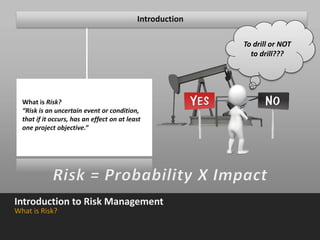
What is Risk?
“Risk is an uncertain event or condition,
that if it occurs, has an effect on at least
one project objective.”
Introduction
Introduction to Risk Management
What is Risk?
To drill or NOT
to drill???
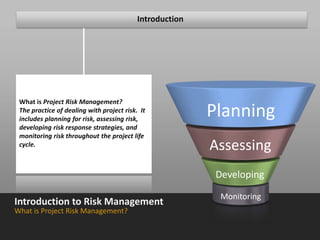
What is Project Risk Management?
The practice of dealing with project risk. It
includes planning for risk, assessing risk,
developing risk response strategies, and
monitoring risk throughout the project life
cycle.
Introduction
Introduction to Risk Management
What is Project Risk Management?
Monitoring
Developing
Assessing
Planning
The role of Risk Management
Essential to successful project
management because of high level of
uncertainties.
Addresses uncertainty in project
estimates and assumptions.
Integral part of project management
processes
Introduction
Introduction
Introduction to Risk Management
Knowledge Area Mapping
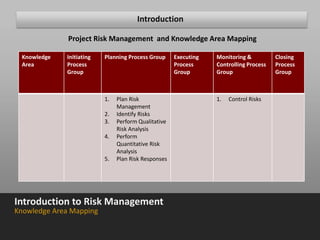
Knowledge
Area
Initiating
Process
Group
Planning Process Group Executing
Process
Group
Monitoring &
Controlling Process
Group
Closing
Process
Group
1. Plan Risk
Management
2. Identify Risks
3. Perform Qualitative
Risk Analysis
4. Perform
Quantitative Risk
Analysis
5. Plan Risk Responses
1. Control Risks
Project Risk Management and Knowledge Area Mapping
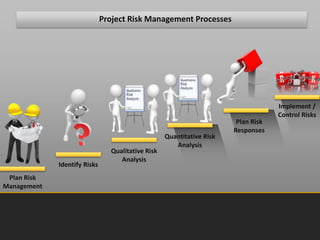
Project Risk Management Processes
Plan Risk
Management
Identify Risks
Qualitative Risk
Analysis
Quantitative Risk
Analysis
Plan Risk
Responses
Implement /
Control Risks
Plan Identify Qualitative Quantitative Response Control
…how to
conduct
activities?
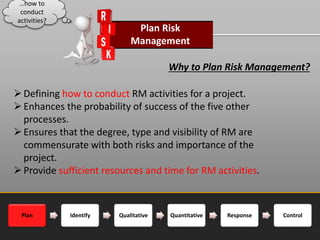
Why to Plan Risk Management?
Defining how to conduct RM activities for a project.
Enhances the probability of success of the five other
processes.
Ensures that the degree, type and visibility of RM are
commensurate with both risks and importance of the
project.
Provide sufficient resources and time for RM activities.
Plan Risk
Management
Plan Identify Qualitative Quantitative Response Control
…how to
conduct
activities?
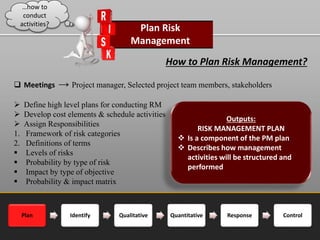
How to Plan Risk Management?
 Meetings → Project manager, Selected project team members, stakeholders
 Define high level plans for conducting RM
 Develop cost elements & schedule activities
 Assign Responsibilities
1. Framework of risk categories
2. Definitions of terms
 Levels of risks
 Probability by type of risk
 Impact by type of objective
 Probability & impact matrix
Outputs:
RISK MANAGEMENT PLAN
 Is a component of the PM plan
 Describes how management
activities will be structured and
performed
Plan Risk
Management
Plan Identify Qualitative Quantitative Response Control
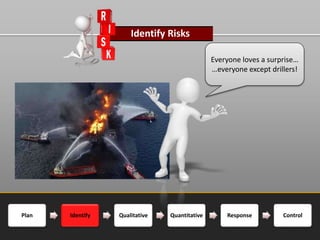
Everyone loves a surprise…
…everyone except drillers!
Identify Risks
Identify Risks
Plan Identify Qualitative Quantitative Response Control
…which risks
affect the
project?
Why to Identify Risks?
To determine which risks may affect the project and
document their characteristics in order to create the risk
register.
Identify Risks
Plan Identify Qualitative Quantitative Response Control
…which risks
affect the
project?
How to Identify Risks?
By gathering inputs
such as:
 Risk Management
Plan
 Cost Management
Plan
 Stakeholders Register
 Project Documents
Examining them
with tools, such
as:
 Documentation
 Diagramming
techniques
 SWOT Analysis
 Expert Judgment
Output:
RISK REGISTER
 Risk analysis
and response,
planning and
recording
 It contains the
outcomes of
RM processes
Qualitative Risk
Analysis
Plan Identify Qualitative Quantitative Response Control
…how to
prioritize
risks?
Why to perform Qualitative Risk Analysis?
 Qualitative Risk Analysis aims to prioritize risks for
further analysis or action.
Qualitative Risk
Analysis
Plan Identify Qualitative Quantitative Response Control
…how to
prioritize
risks?
How to perform Qualitative Risk Analysis?
 Using probability of occurrence the
corresponding impact on project
objectives, the time frame for
response and organizations’ risk
tolerance.
Output:
RISK REGISTER UPDATES
ASSUMPTION LOG UPDATES
Quantitative Risk
Analysis
Plan Identify Qualitative Quantitative Response Control
…how to
analyze the
effect of risks?
Why to perform Quantitative Risk Analysis?
Numerically analyzing the effect of identified risks on overall
project objectives and analyze their effect.
Quantitative approach to making decisions in the presence of
uncertainty.
Quantitative Risk
Analysis
Plan Identify Qualitative Quantitative Response Control
…how to
analyze the
effect of risks?
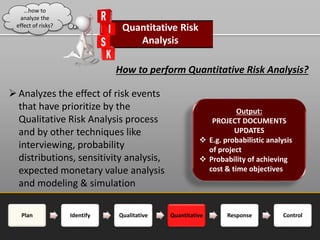
How to perform Quantitative Risk Analysis?
Analyzes the effect of risk events
that have prioritize by the
Qualitative Risk Analysis process
and by other techniques like
interviewing, probability
distributions, sensitivity analysis,
expected monetary value analysis
and modeling & simulation
Output:
PROJECT DOCUMENTS
UPDATES
 E.g. probabilistic analysis
of project
 Probability of achieving
cost & time objectives
Plan Risk Responses
Plan Identify Qualitative Quantitative Response Control
…which
actions?
Why to perform Plan Risk Response?
To develop options and actions to enhance opportunities and to
reduce threats to project objectives.
Plan Risk Responses
Plan Identify Qualitative Quantitative Response Control
…which
actions?
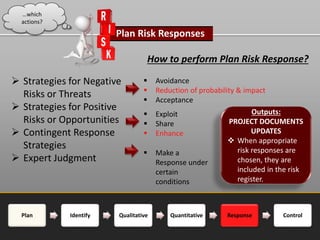
How to perform Plan Risk Response?
 Strategies for Negative
Risks or Threats
 Strategies for Positive
Risks or Opportunities
 Contingent Response
Strategies
 Expert Judgment
 Avoidance
 Reduction of probability & impact
 Acceptance
 Exploit
 Share
 Enhance
 Make a
Response under
certain
conditions
Outputs:
PROJECT DOCUMENTS
UPDATES
 When appropriate
risk responses are
chosen, they are
included in the risk
register.
Control Risks
Plan Identify Qualitative Quantitative Response Control
…evaluate?
Control?
Monitor?
Why we need to control risk?
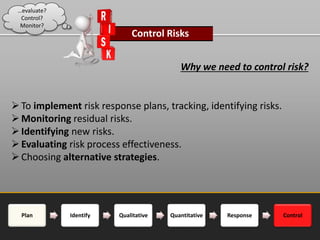
To implement risk response plans, tracking, identifying risks.
Monitoring residual risks.
Identifying new risks.
Evaluating risk process effectiveness.
Choosing alternative strategies.
Control Risks
Plan Identify Qualitative Quantitative Response Control
…evaluate?
Control?
Monitor?
How we control risk?
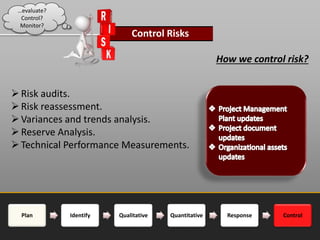
Risk audits.
Risk reassessment.
Variances and trends analysis.
Reserve Analysis.
Technical Performance Measurements.
CONCLUSION
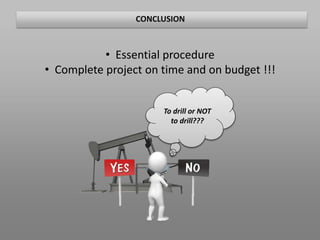
• Essential procedure
• Complete project on time and on budget !!!
To drill or NOT
to drill???
Thank you for your attention!

Risk Management Assignment

  • 1.
    T e am M e m b e r s : F . Z a c h o p o u l o s S . K y r i a k i d i s E . M i c h a i l i d i A . M i t s i s
  • 3.
    What is Risk? “Riskis an uncertain event or condition, that if it occurs, has an effect on at least one project objective.” Introduction Introduction to Risk Management What is Risk? To drill or NOT to drill???
  • 4.
    What is ProjectRisk Management? The practice of dealing with project risk. It includes planning for risk, assessing risk, developing risk response strategies, and monitoring risk throughout the project life cycle. Introduction Introduction to Risk Management What is Project Risk Management? Monitoring Developing Assessing Planning
  • 5.
    The role ofRisk Management Essential to successful project management because of high level of uncertainties. Addresses uncertainty in project estimates and assumptions. Integral part of project management processes Introduction
  • 6.
    Introduction Introduction to RiskManagement Knowledge Area Mapping Knowledge Area Initiating Process Group Planning Process Group Executing Process Group Monitoring & Controlling Process Group Closing Process Group 1. Plan Risk Management 2. Identify Risks 3. Perform Qualitative Risk Analysis 4. Perform Quantitative Risk Analysis 5. Plan Risk Responses 1. Control Risks Project Risk Management and Knowledge Area Mapping
  • 7.
    Project Risk ManagementProcesses Plan Risk Management Identify Risks Qualitative Risk Analysis Quantitative Risk Analysis Plan Risk Responses Implement / Control Risks
  • 8.
    Plan Identify QualitativeQuantitative Response Control …how to conduct activities? Why to Plan Risk Management? Defining how to conduct RM activities for a project. Enhances the probability of success of the five other processes. Ensures that the degree, type and visibility of RM are commensurate with both risks and importance of the project. Provide sufficient resources and time for RM activities. Plan Risk Management
  • 9.
    Plan Identify QualitativeQuantitative Response Control …how to conduct activities? How to Plan Risk Management?  Meetings → Project manager, Selected project team members, stakeholders  Define high level plans for conducting RM  Develop cost elements & schedule activities  Assign Responsibilities 1. Framework of risk categories 2. Definitions of terms  Levels of risks  Probability by type of risk  Impact by type of objective  Probability & impact matrix Outputs: RISK MANAGEMENT PLAN  Is a component of the PM plan  Describes how management activities will be structured and performed Plan Risk Management
  • 10.
    Plan Identify QualitativeQuantitative Response Control Everyone loves a surprise… …everyone except drillers! Identify Risks
  • 11.
    Identify Risks Plan IdentifyQualitative Quantitative Response Control …which risks affect the project? Why to Identify Risks? To determine which risks may affect the project and document their characteristics in order to create the risk register.
  • 12.
    Identify Risks Plan IdentifyQualitative Quantitative Response Control …which risks affect the project? How to Identify Risks? By gathering inputs such as:  Risk Management Plan  Cost Management Plan  Stakeholders Register  Project Documents Examining them with tools, such as:  Documentation  Diagramming techniques  SWOT Analysis  Expert Judgment Output: RISK REGISTER  Risk analysis and response, planning and recording  It contains the outcomes of RM processes
  • 13.
    Qualitative Risk Analysis Plan IdentifyQualitative Quantitative Response Control …how to prioritize risks? Why to perform Qualitative Risk Analysis?  Qualitative Risk Analysis aims to prioritize risks for further analysis or action.
  • 14.
    Qualitative Risk Analysis Plan IdentifyQualitative Quantitative Response Control …how to prioritize risks? How to perform Qualitative Risk Analysis?  Using probability of occurrence the corresponding impact on project objectives, the time frame for response and organizations’ risk tolerance. Output: RISK REGISTER UPDATES ASSUMPTION LOG UPDATES
  • 15.
    Quantitative Risk Analysis Plan IdentifyQualitative Quantitative Response Control …how to analyze the effect of risks? Why to perform Quantitative Risk Analysis? Numerically analyzing the effect of identified risks on overall project objectives and analyze their effect. Quantitative approach to making decisions in the presence of uncertainty.
  • 16.
    Quantitative Risk Analysis Plan IdentifyQualitative Quantitative Response Control …how to analyze the effect of risks? How to perform Quantitative Risk Analysis? Analyzes the effect of risk events that have prioritize by the Qualitative Risk Analysis process and by other techniques like interviewing, probability distributions, sensitivity analysis, expected monetary value analysis and modeling & simulation Output: PROJECT DOCUMENTS UPDATES  E.g. probabilistic analysis of project  Probability of achieving cost & time objectives
  • 17.
    Plan Risk Responses PlanIdentify Qualitative Quantitative Response Control …which actions? Why to perform Plan Risk Response? To develop options and actions to enhance opportunities and to reduce threats to project objectives.
  • 18.
    Plan Risk Responses PlanIdentify Qualitative Quantitative Response Control …which actions? How to perform Plan Risk Response?  Strategies for Negative Risks or Threats  Strategies for Positive Risks or Opportunities  Contingent Response Strategies  Expert Judgment  Avoidance  Reduction of probability & impact  Acceptance  Exploit  Share  Enhance  Make a Response under certain conditions Outputs: PROJECT DOCUMENTS UPDATES  When appropriate risk responses are chosen, they are included in the risk register.
  • 19.
    Control Risks Plan IdentifyQualitative Quantitative Response Control …evaluate? Control? Monitor? Why we need to control risk? To implement risk response plans, tracking, identifying risks. Monitoring residual risks. Identifying new risks. Evaluating risk process effectiveness. Choosing alternative strategies.
  • 20.
    Control Risks Plan IdentifyQualitative Quantitative Response Control …evaluate? Control? Monitor? How we control risk? Risk audits. Risk reassessment. Variances and trends analysis. Reserve Analysis. Technical Performance Measurements.
  • 21.
    CONCLUSION • Essential procedure •Complete project on time and on budget !!! To drill or NOT to drill???
  • 22.
    Thank you foryour attention!