RISK
MANAGEMENT
CONTENTS
• Risk Management
• Importance
• What does it includes
• How is it done in project
• Pane risk management
• Identify risk
• Qualitative Risk analysis
• Plan risk response
• Risk register
• Monitor and control risk
• Benifits
WHAT IS RISK MANAGEMENT?
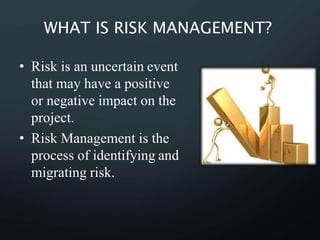
• Risk is an uncertain event
that may have a positive
or negative impact on the
project.
• Risk Management is the
process of identifying and
migrating risk.
WHY IS IT
IMPORTANT?
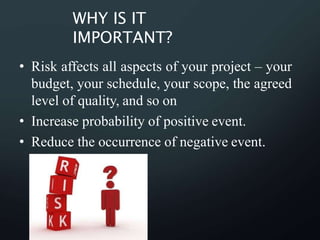
• Risk affects all aspects of your project – your
budget, your schedule, your scope, the agreed
level of quality, and so on
• Increase probability of positive event.
• Reduce the occurrence of negative event.
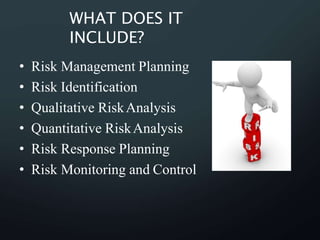
WHAT DOES IT
INCLUDE?
• Risk Management Planning
• Risk Identification
• Qualitative RiskAnalysis
• Quantitative RiskAnalysis
• Risk Response Planning
• Risk Monitoring and Control
HOW IS IT DONE IN
PROJECT?
• Make Risk Management Part of YourProject
• Identify Risks Early in Your Project
• Communicate About Risks
• Consider Both Threats and Opportunities
• Clarify Ownership Issues
HOW IS IT DONE IN
PROJECT?
• Prioritise Risks
• Analyse Risks
• Plan and Implement Risk Responses
• Register Project Risks
• Track Risks and AssociatedTasks
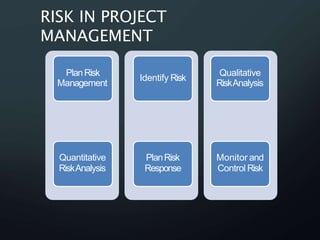
RISK IN PROJECT
MANAGEMENT
PlanRisk
Management
Quantitative
RiskAnalysis
Identify Risk
PlanRisk
Response
Qualitative
RiskAnalysis
Monitor and
Control Risk
PLAN RISK MANAGEMENT
• Analysis and decision making
to implement risk
management.
• Appropriate to size and
complexity of the project.
• Stakeholders will be involved
in planning risk management.
RISK MANAGEMENT PLAN
• Schedule Risk
• Cost Risk
• Quality Risk
• Scope Risk
• Resource Risk
• Customer Satisfaction Risk
IDENTIFY RISK
• Which risk has more probability of affecting
the project?
• SWOTAnalysis
• Information gathering
• Check-listAnalysis
• AssumptionAnalysis
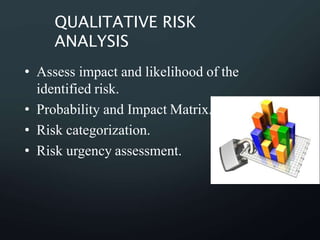
QUALITATIVE RISK
ANALYSIS
• Assess impact and likelihood of the
identified risk.
• Probability and Impact Matrix.
• Risk categorization.
• Risk urgency assessment.
QUANTITATIVE RISK
ANALYSIS
• Data gathering
– Direct
– Diagrammatic
– Delphi
• Probability distribution
• Modeling Techniques
– Decision treeAnalysis
– SensitivityAnalysis
– Expert Judgment
PLAN RISK RESPONSE
• Eliminate threats before they happen.
• Decrease impact of threat.
• Contingency plan ( Do something if risk
happens)
• Fallback plan ( Do something if contingency
plans are not effective)
PLAN RISK RESPONSE
• Negative risk or threat
– Avoid
– Transfer
– Mitigate
– Accept
• Positive risk or opportunity
– Exploit
– Share
– Enhance
WHAT IS A RISK REGISTER?
• The Risk Register records details of all the
risks identified at the beginning and during
the life of the project.
• It usually includes:
• a unique identifier for each risk
• a description of each risk and how it will affect
the project
• an assessment of the likelihood it will occur
and the possible seriousness/impact if it does
occur (low, medium, high)
MONITOR AND CONTROL
RISK
• Risk Reassessment (Scheduled regularly to
identify new risk)
• Risk Audit (Examine the effectivenessof
planned risk response)
• Trend analysis (Monitor overall project
performance)
WHAT ARE THE BENEFITS?
• Effective use of resources
• Promoting continuous improvement
• Fewer shocks and failures
• Strategic business planning
• Raised awareness of significant risks.
WHAT ARE THE BENEFITS?
• Quick grasp of new opportunities
• Enhancing communication
• Reassuring stakeholders
• Focus on internal audit programme
• Recognition of responsibility and
accountability.
THANK
YOU

Risk management

  • 1.
  • 2.
    CONTENTS • Risk Management •Importance • What does it includes • How is it done in project • Pane risk management • Identify risk • Qualitative Risk analysis • Plan risk response • Risk register • Monitor and control risk • Benifits
  • 3.
    WHAT IS RISKMANAGEMENT? • Risk is an uncertain event that may have a positive or negative impact on the project. • Risk Management is the process of identifying and migrating risk.
  • 4.
    WHY IS IT IMPORTANT? •Risk affects all aspects of your project – your budget, your schedule, your scope, the agreed level of quality, and so on • Increase probability of positive event. • Reduce the occurrence of negative event.
  • 5.
    WHAT DOES IT INCLUDE? •Risk Management Planning • Risk Identification • Qualitative RiskAnalysis • Quantitative RiskAnalysis • Risk Response Planning • Risk Monitoring and Control
  • 6.
    HOW IS ITDONE IN PROJECT? • Make Risk Management Part of YourProject • Identify Risks Early in Your Project • Communicate About Risks • Consider Both Threats and Opportunities • Clarify Ownership Issues
  • 7.
    HOW IS ITDONE IN PROJECT? • Prioritise Risks • Analyse Risks • Plan and Implement Risk Responses • Register Project Risks • Track Risks and AssociatedTasks
  • 8.
    RISK IN PROJECT MANAGEMENT PlanRisk Management Quantitative RiskAnalysis IdentifyRisk PlanRisk Response Qualitative RiskAnalysis Monitor and Control Risk
  • 9.
    PLAN RISK MANAGEMENT •Analysis and decision making to implement risk management. • Appropriate to size and complexity of the project. • Stakeholders will be involved in planning risk management.
  • 10.
    RISK MANAGEMENT PLAN •Schedule Risk • Cost Risk • Quality Risk • Scope Risk • Resource Risk • Customer Satisfaction Risk
  • 11.
    IDENTIFY RISK • Whichrisk has more probability of affecting the project? • SWOTAnalysis • Information gathering • Check-listAnalysis • AssumptionAnalysis
  • 12.
    QUALITATIVE RISK ANALYSIS • Assessimpact and likelihood of the identified risk. • Probability and Impact Matrix. • Risk categorization. • Risk urgency assessment.
  • 13.
    QUANTITATIVE RISK ANALYSIS • Datagathering – Direct – Diagrammatic – Delphi • Probability distribution • Modeling Techniques – Decision treeAnalysis – SensitivityAnalysis – Expert Judgment
  • 14.
    PLAN RISK RESPONSE •Eliminate threats before they happen. • Decrease impact of threat. • Contingency plan ( Do something if risk happens) • Fallback plan ( Do something if contingency plans are not effective)
  • 15.
    PLAN RISK RESPONSE •Negative risk or threat – Avoid – Transfer – Mitigate – Accept • Positive risk or opportunity – Exploit – Share – Enhance
  • 16.
    WHAT IS ARISK REGISTER? • The Risk Register records details of all the risks identified at the beginning and during the life of the project.
  • 17.
    • It usuallyincludes: • a unique identifier for each risk • a description of each risk and how it will affect the project • an assessment of the likelihood it will occur and the possible seriousness/impact if it does occur (low, medium, high)
  • 18.
    MONITOR AND CONTROL RISK •Risk Reassessment (Scheduled regularly to identify new risk) • Risk Audit (Examine the effectivenessof planned risk response) • Trend analysis (Monitor overall project performance)
  • 19.
    WHAT ARE THEBENEFITS? • Effective use of resources • Promoting continuous improvement • Fewer shocks and failures • Strategic business planning • Raised awareness of significant risks.
  • 20.
    WHAT ARE THEBENEFITS? • Quick grasp of new opportunities • Enhancing communication • Reassuring stakeholders • Focus on internal audit programme • Recognition of responsibility and accountability.
  • 21.