SoiLEX: Towards the
strengthening of soil
governance
Natalia Rodríguez Eugenio
Strengthen soil governance
• Recommendation 1: Politicians, policy advisors,
decision makers and associated agencies should
be informed to better appreciate the true
societal value of soil […] in order to encourage
the development of enabling frameworks for soil
protection or sustainable management in line
with the goals of the World Soil Charter
• Recommendation 2: Policy development
should be supported by regular and
harmonised assessments of the state of soil,
associated pressures, their impacts and trends to
prioritise and target interventions.
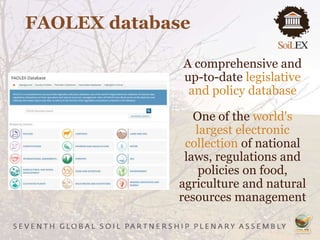
FAOLEX database
A comprehensive and
up-to-date legislative
and policy database
One of the world's
largest electronic
collection of national
laws, regulations and
policies on food,
agriculture and natural
resources management
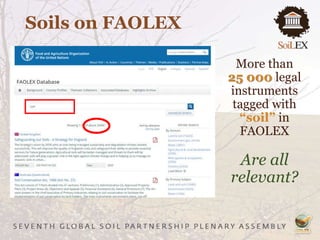
Soils on FAOLEX
More than
25 000 legal
instruments
tagged with
“soil” in
FAOLEX
Are all
relevant?
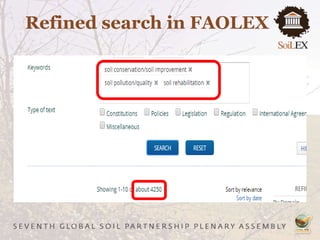
Refined search in FAOLEX
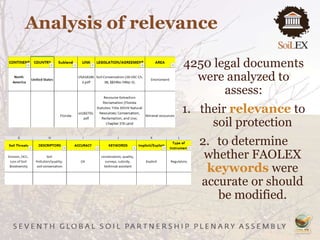
Analysis of relevance
4250 legal documents
were analyzed to
assess:
1. their relevance to
soil protection
2. to determine
whether FAOLEX
keywords were
accurate or should
be modified.
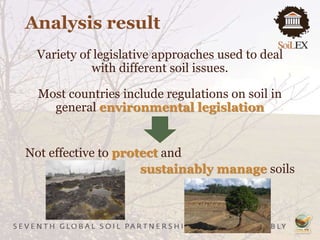
Analysis result
Variety of legislative approaches used to deal
with different soil issues.
Most countries include regulations on soil in
general environmental legislation
Not effective to protect and
sustainably manage soils
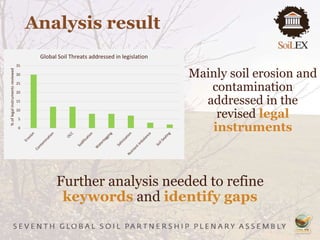
Analysis result
Mainly soil erosion and
contamination
addressed in the
revised legal
instruments0
5
10
15
20
25
30
35
%oflegalinstrumentsreviewed
Global Soil Threats addressed in legislation
Further analysis needed to refine
keywords and identify gaps
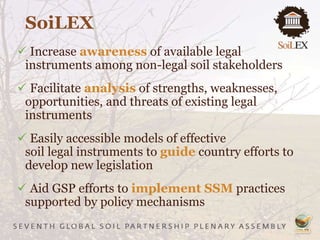
 Increase awareness of available legal
instruments among non-legal soil stakeholders
 Facilitate analysis of strengths, weaknesses,
opportunities, and threats of existing legal
instruments
 Easily accessible models of effective
soil legal instruments to guide country efforts to
develop new legislation
 Aid GSP efforts to implement SSM practices
supported by policy mechanisms
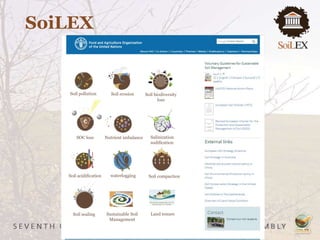
SoiLEX
SoiLEX
Soil pollution Soil erosion
Salinization
sodification
Nutrient imbalanceSOC loss
Soil acidification waterlogging Soil compaction
Soil sealing
Soil biodiversity
loss
Sustainable Soil
Management
Land tenure
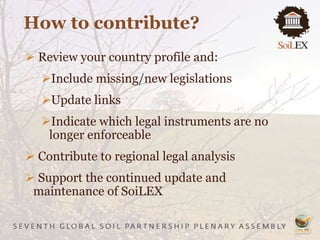
 Review your country profile and:
Include missing/new legislations
Update links
Indicate which legal instruments are no
longer enforceable
 Contribute to regional legal analysis
 Support the continued update and
maintenance of SoiLEX
How to contribute?
The main legislative challenge
today is the need to strengthen
existing laws, increasing their
ambition, making them more
effective, and filling the gaps.
Thank you for your
attention!

SoilLEX

  • 1.
    SoiLEX: Towards the strengtheningof soil governance Natalia Rodríguez Eugenio
  • 2.
    Strengthen soil governance •Recommendation 1: Politicians, policy advisors, decision makers and associated agencies should be informed to better appreciate the true societal value of soil […] in order to encourage the development of enabling frameworks for soil protection or sustainable management in line with the goals of the World Soil Charter • Recommendation 2: Policy development should be supported by regular and harmonised assessments of the state of soil, associated pressures, their impacts and trends to prioritise and target interventions.
  • 3.
    FAOLEX database A comprehensiveand up-to-date legislative and policy database One of the world's largest electronic collection of national laws, regulations and policies on food, agriculture and natural resources management
  • 4.
    Soils on FAOLEX Morethan 25 000 legal instruments tagged with “soil” in FAOLEX Are all relevant?
  • 5.
  • 6.
    Analysis of relevance 4250legal documents were analyzed to assess: 1. their relevance to soil protection 2. to determine whether FAOLEX keywords were accurate or should be modified.
  • 7.
    Analysis result Variety oflegislative approaches used to deal with different soil issues. Most countries include regulations on soil in general environmental legislation Not effective to protect and sustainably manage soils
  • 8.
    Analysis result Mainly soilerosion and contamination addressed in the revised legal instruments0 5 10 15 20 25 30 35 %oflegalinstrumentsreviewed Global Soil Threats addressed in legislation Further analysis needed to refine keywords and identify gaps
  • 9.
     Increase awarenessof available legal instruments among non-legal soil stakeholders  Facilitate analysis of strengths, weaknesses, opportunities, and threats of existing legal instruments  Easily accessible models of effective soil legal instruments to guide country efforts to develop new legislation  Aid GSP efforts to implement SSM practices supported by policy mechanisms SoiLEX
  • 10.
    SoiLEX Soil pollution Soilerosion Salinization sodification Nutrient imbalanceSOC loss Soil acidification waterlogging Soil compaction Soil sealing Soil biodiversity loss Sustainable Soil Management Land tenure
  • 11.
     Review yourcountry profile and: Include missing/new legislations Update links Indicate which legal instruments are no longer enforceable  Contribute to regional legal analysis  Support the continued update and maintenance of SoiLEX How to contribute?
  • 12.
    The main legislativechallenge today is the need to strengthen existing laws, increasing their ambition, making them more effective, and filling the gaps. Thank you for your attention!