Report on GSP Activities
Ronald Vargas – GSP Secretary
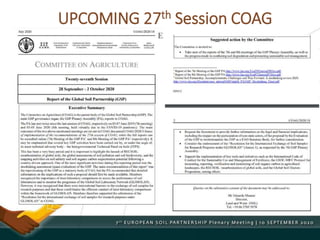
UPCOMING 27th Session COAG
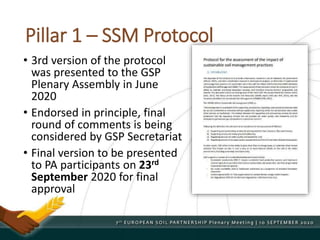
Pillar 1 – SSM Protocol
• 3rd version of the protocol
was presented to the GSP
Plenary Assembly in June
2020
• Endorsed in principle, final
round of comments is being
considered by GSP Secretariat
• Final version to be presented
to PA participants on 23rd
September 2020 for final
approval
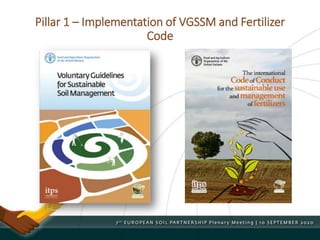
Pillar 1 – Implementation of VGSSM and Fertilizer
Code
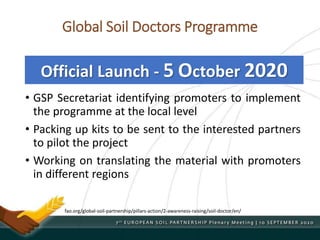
Global Soil Doctors Programme
• GSP Secretariat identifying promoters to implement
the programme at the local level
• Packing up kits to be sent to the interested partners
to pilot the project
• Working on translating the material with promoters
in different regions
Official Launch - 5 October 2020
fao.org/global-soil-partnership/pillars-action/2-awareness-raising/soil-doctor/en/
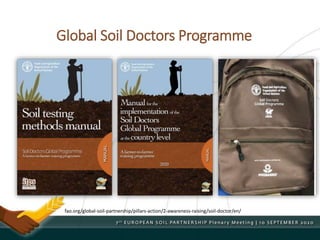
Global Soil Doctors Programme
fao.org/global-soil-partnership/pillars-action/2-awareness-raising/soil-doctor/en/
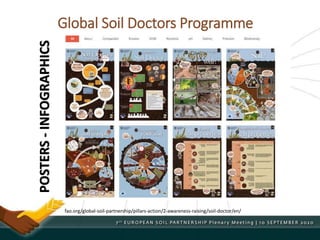
Global Soil Doctors Programme
POSTERS-INFOGRAPHICS
fao.org/global-soil-partnership/pillars-action/2-awareness-raising/soil-doctor/en/
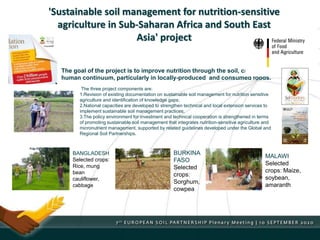
'Sustainable soil management for nutrition-sensitive
agriculture in Sub-Saharan Africa and South East
Asia' project
The three project components are:
1.Revision of existing documentation on sustainable soil management for nutrition sensitive
agriculture and identification of knowledge gaps;
2.National capacities are developed to strengthen technical and local extension services to
implement sustainable soil management practices;
3.The policy environment for investment and technical cooperation is strengthened in terms
of promoting sustainable soil management that integrates nutrition-sensitive agriculture and
micronutrient management, supported by related guidelines developed under the Global and
Regional Soil Partnerships.
The goal of the project is to improve nutrition through the soil, crop, and
human continuum, particularly in locally-produced and consumed foods.
BANGLADESH
Selected crops:
Rice, mung
bean
cauliflower,
cabbage
BURKINA
FASO
Selected
crops:
Sorghum,
cowpea
MALAWI
Selected
crops: Maize,
soybean,
amaranth
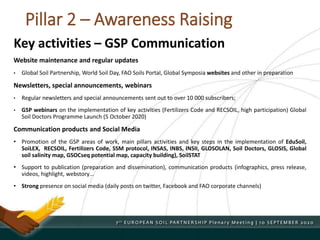
Pillar 2 – Awareness Raising
Key activities – GSP Communication
Website maintenance and regular updates
• Global Soil Partnership, World Soil Day, FAO Soils Portal, Global Symposia websites and other in preparation
Newsletters, special announcements, webinars
• Regular newsletters and special announcements sent out to over 10 000 subscribers;
• GSP webinars on the implementation of key activities (Fertilizers Code and RECSOIL, high participation) Global
Soil Doctors Programme Launch (5 October 2020)
Communication products and Social Media
• Promotion of the GSP areas of work, main pillars activities and key steps in the implementation of EduSoil,
SoiLEX, RECSOIL, Fertilizers Code, SSM protocol, INSAS, INBS, INSII, GLOSOLAN, Soil Doctors, GLOSIS, Global
soil salinity map, GSOCseq potential map, capacity building), SoilSTAT
• Support to publication (preparation and dissemination), communication products (infographics, press release,
videos, highlight, webstory…
• Strong presence on social media (daily posts on twitter, Facebook and FAO corporate channels)
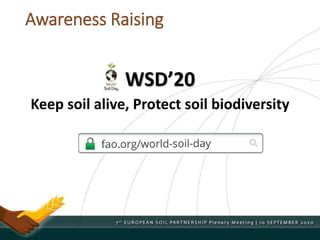
Awareness Raising
WSD’20
Keep soil alive, Protect soil biodiversity
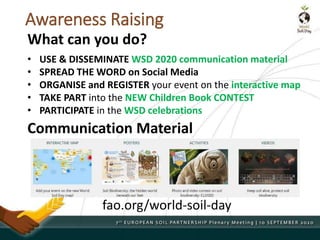
Awareness Raising
• USE & DISSEMINATE WSD 2020 communication material
• SPREAD THE WORD on Social Media
• ORGANISE and REGISTER your event on the interactive map
• TAKE PART into the NEW Children Book CONTEST
• PARTICIPATE in the WSD celebrations
What can you do?
Communication Material
fao.org/world-soil-day
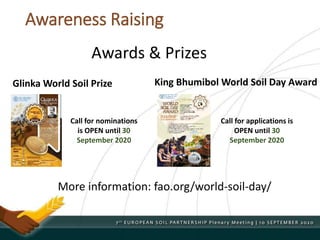
Awareness Raising
Awards & Prizes
Glinka World Soil Prize
Call for nominations
is OPEN until 30
September 2020
King Bhumibol World Soil Day Award
Call for applications is
OPEN until 30
September 2020
More information: fao.org/world-soil-day/
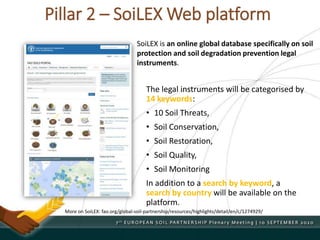
Pillar 2 – SoiLEX Web platform
The legal instruments will be categorised by
14 keywords:
• 10 Soil Threats,
• Soil Conservation,
• Soil Restoration,
• Soil Quality,
• Soil Monitoring
In addition to a search by keyword, a
search by country will be available on the
platform.
More on SoiLEX: fao.org/global-soil-partnership/resources/highlights/detail/en/c/1274929/
SoiLEX is an online global database specifically on soil
protection and soil degradation prevention legal
instruments.
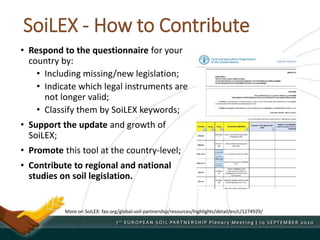
SoiLEX - How to Contribute
• Respond to the questionnaire for your
country by:
• Including missing/new legislation;
• Indicate which legal instruments are
not longer valid;
• Classify them by SoiLEX keywords;
• Support the update and growth of
SoiLEX;
• Promote this tool at the country-level;
• Contribute to regional and national
studies on soil legislation.
More on SoiLEX: fao.org/global-soil-partnership/resources/highlights/detail/en/c/1274929/
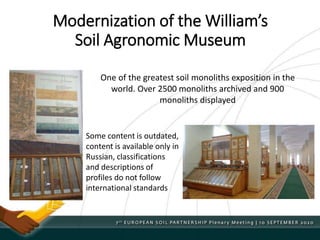
Modernization of the William’s
Soil Agronomic Museum
One of the greatest soil monoliths exposition in the
world. Over 2500 monoliths archived and 900
monoliths displayed
Some content is outdated,
content is available only in
Russian, classifications
and descriptions of
profiles do not follow
international standards
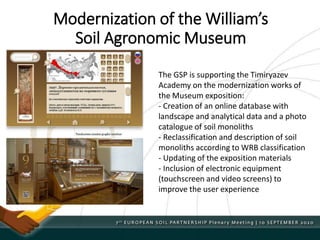
The GSP is supporting the Timiryazev
Academy on the modernization works of
the Museum exposition:
- Creation of an online database with
landscape and analytical data and a photo
catalogue of soil monoliths
- Reclassification and description of soil
monoliths according to WRB classification
- Updating of the exposition materials
- Inclusion of electronic equipment
(touchscreen and video screens) to
improve the user experience
Modernization of the William’s
Soil Agronomic Museum
Pillar 3
ReSOIL: Online Database of Soil Science R&D
• Identify all existing soil research partners,
facilities and infrastructure, soil teaching and
research programmes, and soil related research
gaps
• Knowledge exchange and facilitation platform
for the development of joint projects
• Identify pools of external experts on different
soil-related topics
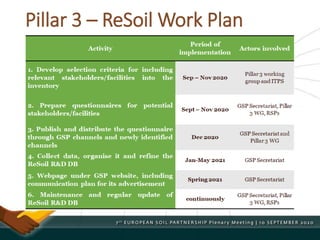
Pillar 3 – ReSoil Work Plan
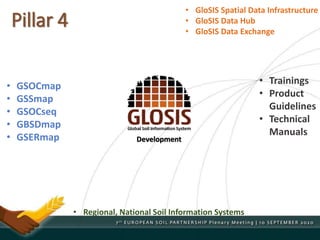
• GloSIS Spatial Data Infrastructure
• GloSIS Data Hub
• GloSIS Data Exchange
• GSOCmap
• GSSmap
• GSOCseq
• GBSDmap
• GSERmap
• Trainings
• Product
Guidelines
• Technical
Manuals
• Regional, National Soil Information Systems
Development
Pillar 4
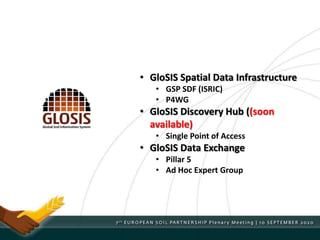
• GloSIS Spatial Data Infrastructure
• GSP SDF (ISRIC)
• P4WG
• GloSIS Discovery Hub ((soon
available)
• Single Point of Access
• GloSIS Data Exchange
• Pillar 5
• Ad Hoc Expert Group
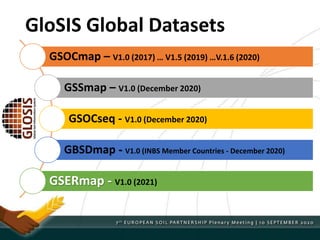
GloSIS Global Datasets
GSOCmap – V1.0 (2017) … V1.5 (2019) …V.1.6 (2020)
GSSmap – V1.0 (December 2020)
GSOCseq - V1.0 (December 2020)
GBSDmap - V1.0 (INBS Member Countries - December 2020)
GSERmap - V1.0 (2021)
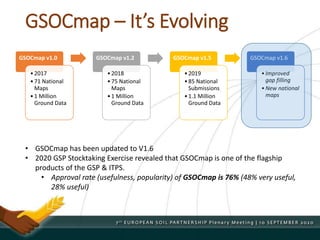
GSOCmap – It’s Evolving
GSOCmap v1.0
•2017
•71 National
Maps
•1 Million
Ground Data
GSOCmap v1.2
•2018
•75 National
Maps
•1 Million
Ground Data
GSOCmap v1.5
•2019
•85 National
Submissions
•1.1 Million
Ground Data
GSOCmap v1.6
•Improved
gap filling
•New national
maps
• GSOCmap has been updated to V1.6
• 2020 GSP Stocktaking Exercise revealed that GSOCmap is one of the flagship
products of the GSP & ITPS.
• Approval rate (usefulness, popularity) of GSOCmap is 76% (48% very useful,
28% useful)
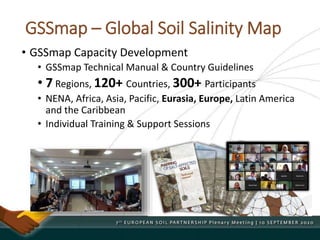
GSSmap – Global Soil Salinity Map
• GSSmap Capacity Development
• GSSmap Technical Manual & Country Guidelines
• 7 Regions, 120+ Countries, 300+ Participants
• NENA, Africa, Asia, Pacific, Eurasia, Europe, Latin America
and the Caribbean
• Individual Training & Support Sessions
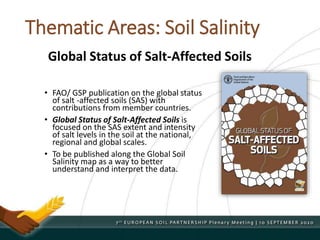
Thematic Areas: Soil Salinity
• FAO/ GSP publication on the global status
of salt -affected soils (SAS) with
contributions from member countries.
• Global Status of Salt-Affected Soils is
focused on the SAS extent and intensity
of salt levels in the soil at the national,
regional and global scales.
• To be published along the Global Soil
Salinity map as a way to better
understand and interpret the data.
Global Status of Salt-Affected Soils
GSSmap – Global Soil Salinity Map
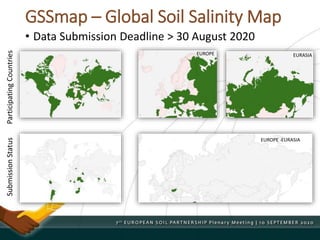
• Data Submission Deadline > 30 August 2020
ParticipatingCountries
EURASIAEUROPE
SubmissionStatus
EUROPE -EURASIA
GSOCseq
Global Soil Organic Carbon Sequestration Potential Map
• Set attainable and evidence based national targets for carbon sequestration;
• Achieve their commitments to the LDN Target Setting Programme implemented by
the UNCCD;
• Simulate national soil organic carbon stocks under Business as Usual (BAU) and
different sustainable soil management scenarios;
• Identify which regions which have greater risks & greater potential;
• Support policy making in adoption of SSM practices that foster SOC sequestration at
national scale;
• Improve technical capacities on sustainable soil management, soil data
management, digital soil mapping and modelling.
• Improve soil health as an integral step towards achieving the Sustainable
Development Goals (SDGs),
• Support the provision of incentives to farmers implementing SOC-centred SSM
practices under the RECSOIL umbrella programme.
GSOCseq
Global Soil Organic Carbon Sequestration Potential Map
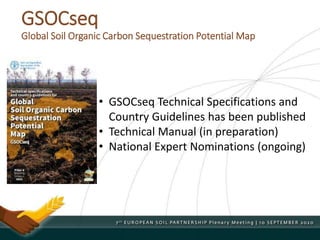
• GSOCseq Technical Specifications and
Country Guidelines has been published
• Technical Manual (in preparation)
• National Expert Nominations (ongoing)
GSOCseq
Global Soil Organic Carbon Sequestration Potential Map
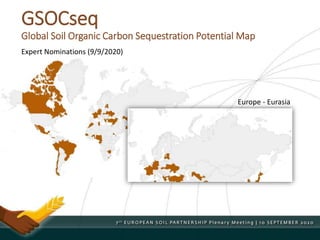
Expert Nominations (9/9/2020)
Europe - Eurasia
GBSDmap
Global Black Soil Distribution Map
• Definition of Black Soil was approved by the ITPS
(2019).
• GBSD Guidelines (INBS & GSP Secretariat) –
ongoing.
• GBSDmap will be developed by INBS members.
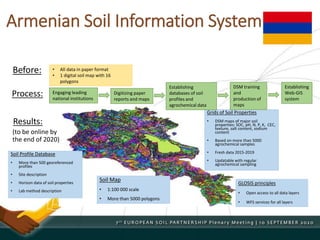
Armenian Soil Information System
Before:
Soil Profile Database
• More than 500 georeferenced
profiles
• Site description
• Horizon data of soil properties
• Lab method description
Soil Map
• 1:100 000 scale
• More than 5000 polygons
Grids of Soil Properties
• DSM maps of major soil
properties: SOC, pH, N, P, K, CEC,
texture, salt content, sodium
content
• Based on more than 5000
agrochemical samples
• Fresh data 2015-2019
• Updatable with regular
agrochemical sampling
• All data in paper format
• 1 digital soil map with 16
polygons
GLOSIS principles
• Open access to all data layers
• WFS services for all layers
(to be online by
the end of 2020)
Process:
Results:
Digitizing paper
reports and maps
DSM training
and
production of
maps
Establishing
Web-GIS
system
Establishing
databases of soil
profiles and
agrochemical data
Engaging leading
national institutions
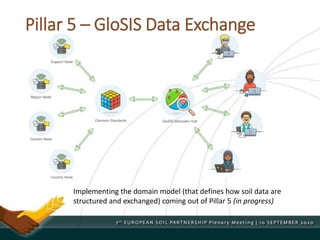
Pillar 5 – GloSIS Data Exchange
Implementing the domain model (that defines how soil data are
structured and exchanged) coming out of Pillar 5 (in progress)
Pillar 5 – GLOSOLAN
• Downscaling the activities
• Empowerment of Regional Soil Laboratory Networks
(RESONAL)
• Implementation of National Soil Laboratory Networks,
under the guidance of the National Reference Laboratories
• Standard Operating Procedures (SOPs)
• Harmonization of new SOPs
• Demonstration videos
• Translation of the material in other languages
• Quality Assurance and Quality Control (QA/QC)
• Encourage laboratories to organize national
Proficiency Tests (PTs)
• Identify PT sample providers
More on GLOSOLAN: fao.org/global-soil-partnership/glosolan/
Pillar 5 – GLOSOLAN Work Plan
• Laboratory equipment procurement/donation
• Donors
• Barter system
• GLOSOLAN programme on Spectroscopy
as alternative for wet chemistry
• INFA - International Network on
Fertilizers Quality Assessment
• First ever-global customs control procedure
database SIMPLE - Soil IMPort Legislation
More on GLOSOLAN: fao.org/global-soil-partnership/glosolan/
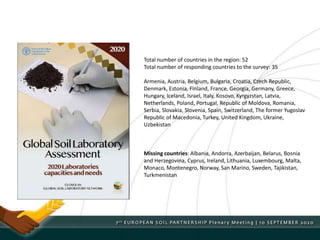
Total number of countries in the region: 52
Total number of responding countries to the survey: 35
Armenia, Austria, Belgium, Bulgaria, Croatia, Czech Republic,
Denmark, Estonia, Finland, France, Georgia, Germany, Greece,
Hungary, Iceland, Israel, Italy, Kosovo, Kyrgyzstan, Latvia,
Netherlands, Poland, Portugal, Republic of Moldova, Romania,
Serbia, Slovakia, Slovenia, Spain, Switzerland, The former Yugoslav
Republic of Macedonia, Turkey, United Kingdom, Ukraine,
Uzbekistan
Missing countries: Albania, Andorra, Azerbaijan, Belarus, Bosnia
and Herzegovina, Cyprus, Ireland, Lithuania, Luxembourg, Malta,
Monaco, Montenegro, Norway, San Marino, Sweden, Tajikistan,
Turkmenistan
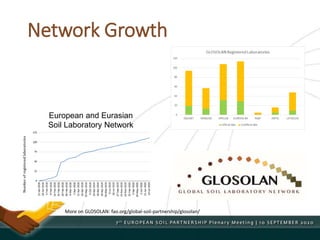
Network Growth
European and Eurasian
Soil Laboratory Network
More on GLOSOLAN: fao.org/global-soil-partnership/glosolan/
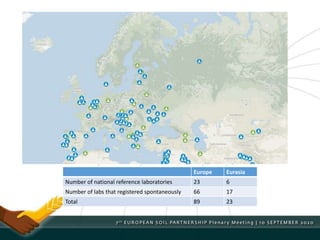
Europe Eurasia
Number of national reference laboratories 23 6
Number of labs that registered spontaneously 66 17
Total 89 23
Thematic Areas: Soil Pollution
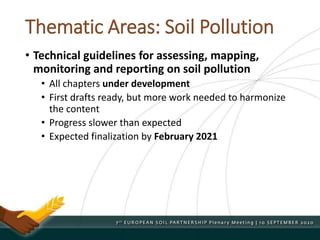
• Technical guidelines for assessing, mapping,
monitoring and reporting on soil pollution
• All chapters under development
• First drafts ready, but more work needed to harmonize
the content
• Progress slower than expected
• Expected finalization by February 2021
Thematic Areas: Soil Pollution
• Database of good practices on the management
and remediation of soil pollution
• Four chapters are still orphan
• Progress slower than the other document
• Complex to summarize relevant information and use
appropriate language (too scientific)
• It has a huge potential, nothing similar exist
• Some content has been used for the GASP report
Thematic Areas: Soil Pollution
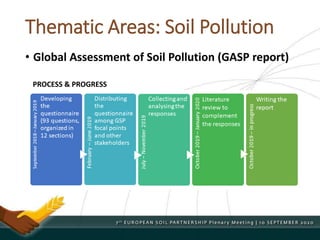
• Global Assessment of Soil Pollution (GASP report)
PROCESS & PROGRESS
Thematic Areas: Soil Pollution
Global Assessment of Soil Pollution
(GASP report- February 2021)
Questionnaire:
• developed and circulated by GSP, UNEP
and WHO.
• 110 responses from 70 countries.
• MoAs, research centres and MoEs main
respondents.
• very limited information on the number
and extent of polluted sites.
• virtually inexistent information on diffuse
pollution.
• contradictory information for some
countries with more than one
respondent.
Thematic Areas: Soil Pollution
• Global Assessment of Soil Pollution (GASP report)
Literature review:
• about 2,000 scientific papers, national reports, UN reports, book and
newspapers reviewed
• Complexity on drawing limits, soil pollution is a very broad issue and tackles
practically all land uses, great diversity of contaminants, health and
environmental impacts…
• 10 regional and international consultants to develop the content
• Support from regional networks, some stronger (Eurasia and Asia) than others
Thematic Areas: Soil Pollution
• Global Assessment of Soil Pollution (GASP report)
Need for a global plan of action to:
1. strengthen existing international mechanisms (chemical conventions);
2. build capacities on soil contaminants assessment;
3. promote the generation and collection of reliable and harmonized data; and
4. develop strategies to reduce and prevent the impact of soil pollution building
on the VGSSM.
Thematic Areas: Soil Erosion
• The development of two special issues to be
published in December 2020
• Policy activities linked to the development of the
SoiLEX database
• Global Soil Erosion Map (GSERmap): 2021
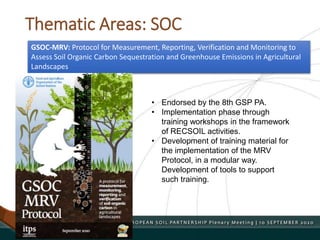
Thematic Areas: SOC
• Endorsed by the 8th GSP PA.
• Implementation phase through
training workshops in the framework
of RECSOIL activities.
• Development of training material for
the implementation of the MRV
Protocol, in a modular way.
Development of tools to support
such training.
GSOC-MRV: Protocol for Measurement, Reporting, Verification and Monitoring to
Assess Soil Organic Carbon Sequestration and Greenhouse Emissions in Agricultural
Landscapes
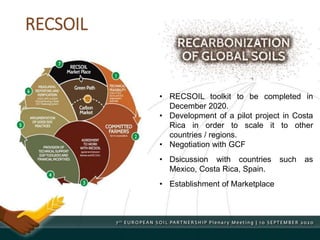
RECSOIL
• RECSOIL toolkit to be completed in
December 2020.
• Development of a pilot project in Costa
Rica in order to scale it to other
countries / regions.
• Negotiation with GCF
• Dsicussion with countries such as
Mexico, Costa Rica, Spain.
• Establishment of Marketplace
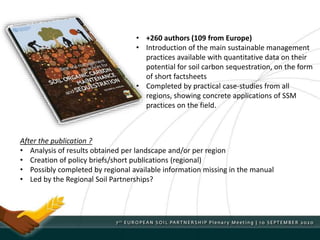
• +260 authors (109 from Europe)
• Introduction of the main sustainable management
practices available with quantitative data on their
potential for soil carbon sequestration, on the form
of short factsheets
• Completed by practical case-studies from all
regions, showing concrete applications of SSM
practices on the field.
After the publication ?
• Analysis of results obtained per landscape and/or per region
• Creation of policy briefs/short publications (regional)
• Possibly completed by regional available information missing in the manual
• Led by the Regional Soil Partnerships?
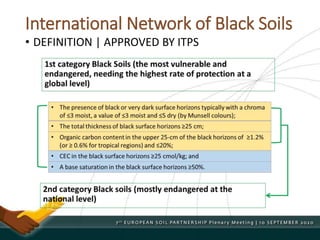
International Network of Black Soils
• DEFINITION | APPROVED BY ITPS
International Network of Black Soils
• Call for countries to join the network according to
the endorsed definition of INBS.
• Support the activities of INBS:
• the report of the Global Status on Black Soils;
• the Global Black Soil Distribution Map (GBSDmap)
• http://www.fao.org/global-soil-partnership/intergovernmental-
technical-panel-soils/gsoc17-
implementation/internationalnetworkblacksoils/more-on-
black-soils/international-black-soil-monitoring-network/en/
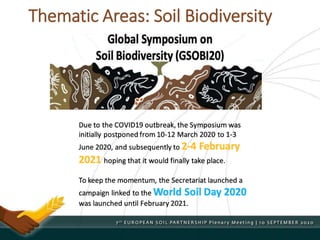
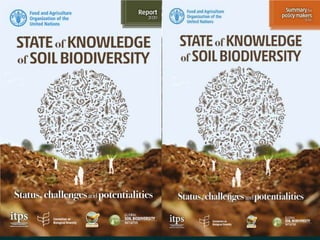
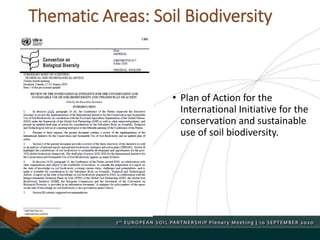
Thematic Areas: Soil Biodiversity
• Plan of Action for the
International Initiative for the
conservation and sustainable
use of soil biodiversity.
Thematic Areas: Soil Salinity
Objectives of the network:
• To provide a platform for countries with salt-affected soils to discuss
common issues related to the conservation and sustainable
management of salt-affected soils.
• To foster collaboration among these countries towards promoting the
sustainable use and management of salt-affected soils and identify
relevant research gaps.
• To serve as a platform for knowledge sharing and technical
cooperation on salt-affected soils management.
International Network of Salt-Affected Soils
Thematic Areas: Soil Salinity
Global Symposium on Salt-Affected Soils (GSSAS21)
Postponed to September 2021
ITEM 3 - Global Soil Partnership updates

ITEM 3 - Global Soil Partnership updates

  • 1.
    Report on GSPActivities Ronald Vargas – GSP Secretary
  • 2.
  • 3.
    Pillar 1 –SSM Protocol • 3rd version of the protocol was presented to the GSP Plenary Assembly in June 2020 • Endorsed in principle, final round of comments is being considered by GSP Secretariat • Final version to be presented to PA participants on 23rd September 2020 for final approval
  • 4.
    Pillar 1 –Implementation of VGSSM and Fertilizer Code
  • 5.
    Global Soil DoctorsProgramme • GSP Secretariat identifying promoters to implement the programme at the local level • Packing up kits to be sent to the interested partners to pilot the project • Working on translating the material with promoters in different regions Official Launch - 5 October 2020 fao.org/global-soil-partnership/pillars-action/2-awareness-raising/soil-doctor/en/
  • 6.
    Global Soil DoctorsProgramme fao.org/global-soil-partnership/pillars-action/2-awareness-raising/soil-doctor/en/
  • 7.
    Global Soil DoctorsProgramme POSTERS-INFOGRAPHICS fao.org/global-soil-partnership/pillars-action/2-awareness-raising/soil-doctor/en/
  • 8.
    'Sustainable soil managementfor nutrition-sensitive agriculture in Sub-Saharan Africa and South East Asia' project The three project components are: 1.Revision of existing documentation on sustainable soil management for nutrition sensitive agriculture and identification of knowledge gaps; 2.National capacities are developed to strengthen technical and local extension services to implement sustainable soil management practices; 3.The policy environment for investment and technical cooperation is strengthened in terms of promoting sustainable soil management that integrates nutrition-sensitive agriculture and micronutrient management, supported by related guidelines developed under the Global and Regional Soil Partnerships. The goal of the project is to improve nutrition through the soil, crop, and human continuum, particularly in locally-produced and consumed foods. BANGLADESH Selected crops: Rice, mung bean cauliflower, cabbage BURKINA FASO Selected crops: Sorghum, cowpea MALAWI Selected crops: Maize, soybean, amaranth
  • 9.
    Pillar 2 –Awareness Raising Key activities – GSP Communication Website maintenance and regular updates • Global Soil Partnership, World Soil Day, FAO Soils Portal, Global Symposia websites and other in preparation Newsletters, special announcements, webinars • Regular newsletters and special announcements sent out to over 10 000 subscribers; • GSP webinars on the implementation of key activities (Fertilizers Code and RECSOIL, high participation) Global Soil Doctors Programme Launch (5 October 2020) Communication products and Social Media • Promotion of the GSP areas of work, main pillars activities and key steps in the implementation of EduSoil, SoiLEX, RECSOIL, Fertilizers Code, SSM protocol, INSAS, INBS, INSII, GLOSOLAN, Soil Doctors, GLOSIS, Global soil salinity map, GSOCseq potential map, capacity building), SoilSTAT • Support to publication (preparation and dissemination), communication products (infographics, press release, videos, highlight, webstory… • Strong presence on social media (daily posts on twitter, Facebook and FAO corporate channels)
  • 10.
    Awareness Raising WSD’20 Keep soilalive, Protect soil biodiversity
  • 11.
    Awareness Raising • USE& DISSEMINATE WSD 2020 communication material • SPREAD THE WORD on Social Media • ORGANISE and REGISTER your event on the interactive map • TAKE PART into the NEW Children Book CONTEST • PARTICIPATE in the WSD celebrations What can you do? Communication Material fao.org/world-soil-day
  • 12.
    Awareness Raising Awards &Prizes Glinka World Soil Prize Call for nominations is OPEN until 30 September 2020 King Bhumibol World Soil Day Award Call for applications is OPEN until 30 September 2020 More information: fao.org/world-soil-day/
  • 13.
    Pillar 2 –SoiLEX Web platform The legal instruments will be categorised by 14 keywords: • 10 Soil Threats, • Soil Conservation, • Soil Restoration, • Soil Quality, • Soil Monitoring In addition to a search by keyword, a search by country will be available on the platform. More on SoiLEX: fao.org/global-soil-partnership/resources/highlights/detail/en/c/1274929/ SoiLEX is an online global database specifically on soil protection and soil degradation prevention legal instruments.
  • 14.
    SoiLEX - Howto Contribute • Respond to the questionnaire for your country by: • Including missing/new legislation; • Indicate which legal instruments are not longer valid; • Classify them by SoiLEX keywords; • Support the update and growth of SoiLEX; • Promote this tool at the country-level; • Contribute to regional and national studies on soil legislation. More on SoiLEX: fao.org/global-soil-partnership/resources/highlights/detail/en/c/1274929/
  • 15.
    Modernization of theWilliam’s Soil Agronomic Museum One of the greatest soil monoliths exposition in the world. Over 2500 monoliths archived and 900 monoliths displayed Some content is outdated, content is available only in Russian, classifications and descriptions of profiles do not follow international standards
  • 16.
    The GSP issupporting the Timiryazev Academy on the modernization works of the Museum exposition: - Creation of an online database with landscape and analytical data and a photo catalogue of soil monoliths - Reclassification and description of soil monoliths according to WRB classification - Updating of the exposition materials - Inclusion of electronic equipment (touchscreen and video screens) to improve the user experience Modernization of the William’s Soil Agronomic Museum
  • 17.
    Pillar 3 ReSOIL: OnlineDatabase of Soil Science R&D • Identify all existing soil research partners, facilities and infrastructure, soil teaching and research programmes, and soil related research gaps • Knowledge exchange and facilitation platform for the development of joint projects • Identify pools of external experts on different soil-related topics
  • 18.
    Pillar 3 –ReSoil Work Plan
  • 19.
    • GloSIS SpatialData Infrastructure • GloSIS Data Hub • GloSIS Data Exchange • GSOCmap • GSSmap • GSOCseq • GBSDmap • GSERmap • Trainings • Product Guidelines • Technical Manuals • Regional, National Soil Information Systems Development Pillar 4
  • 20.
    • GloSIS SpatialData Infrastructure • GSP SDF (ISRIC) • P4WG • GloSIS Discovery Hub ((soon available) • Single Point of Access • GloSIS Data Exchange • Pillar 5 • Ad Hoc Expert Group
  • 21.
    GloSIS Global Datasets GSOCmap– V1.0 (2017) … V1.5 (2019) …V.1.6 (2020) GSSmap – V1.0 (December 2020) GSOCseq - V1.0 (December 2020) GBSDmap - V1.0 (INBS Member Countries - December 2020) GSERmap - V1.0 (2021)
  • 22.
    GSOCmap – It’sEvolving GSOCmap v1.0 •2017 •71 National Maps •1 Million Ground Data GSOCmap v1.2 •2018 •75 National Maps •1 Million Ground Data GSOCmap v1.5 •2019 •85 National Submissions •1.1 Million Ground Data GSOCmap v1.6 •Improved gap filling •New national maps • GSOCmap has been updated to V1.6 • 2020 GSP Stocktaking Exercise revealed that GSOCmap is one of the flagship products of the GSP & ITPS. • Approval rate (usefulness, popularity) of GSOCmap is 76% (48% very useful, 28% useful)
  • 23.
    GSSmap – GlobalSoil Salinity Map • GSSmap Capacity Development • GSSmap Technical Manual & Country Guidelines • 7 Regions, 120+ Countries, 300+ Participants • NENA, Africa, Asia, Pacific, Eurasia, Europe, Latin America and the Caribbean • Individual Training & Support Sessions
  • 24.
    Thematic Areas: SoilSalinity • FAO/ GSP publication on the global status of salt -affected soils (SAS) with contributions from member countries. • Global Status of Salt-Affected Soils is focused on the SAS extent and intensity of salt levels in the soil at the national, regional and global scales. • To be published along the Global Soil Salinity map as a way to better understand and interpret the data. Global Status of Salt-Affected Soils
  • 25.
    GSSmap – GlobalSoil Salinity Map • Data Submission Deadline > 30 August 2020 ParticipatingCountries EURASIAEUROPE SubmissionStatus EUROPE -EURASIA
  • 26.
    GSOCseq Global Soil OrganicCarbon Sequestration Potential Map • Set attainable and evidence based national targets for carbon sequestration; • Achieve their commitments to the LDN Target Setting Programme implemented by the UNCCD; • Simulate national soil organic carbon stocks under Business as Usual (BAU) and different sustainable soil management scenarios; • Identify which regions which have greater risks & greater potential; • Support policy making in adoption of SSM practices that foster SOC sequestration at national scale; • Improve technical capacities on sustainable soil management, soil data management, digital soil mapping and modelling. • Improve soil health as an integral step towards achieving the Sustainable Development Goals (SDGs), • Support the provision of incentives to farmers implementing SOC-centred SSM practices under the RECSOIL umbrella programme.
  • 27.
    GSOCseq Global Soil OrganicCarbon Sequestration Potential Map • GSOCseq Technical Specifications and Country Guidelines has been published • Technical Manual (in preparation) • National Expert Nominations (ongoing)
  • 28.
    GSOCseq Global Soil OrganicCarbon Sequestration Potential Map Expert Nominations (9/9/2020) Europe - Eurasia
  • 29.
    GBSDmap Global Black SoilDistribution Map • Definition of Black Soil was approved by the ITPS (2019). • GBSD Guidelines (INBS & GSP Secretariat) – ongoing. • GBSDmap will be developed by INBS members.
  • 30.
    Armenian Soil InformationSystem Before: Soil Profile Database • More than 500 georeferenced profiles • Site description • Horizon data of soil properties • Lab method description Soil Map • 1:100 000 scale • More than 5000 polygons Grids of Soil Properties • DSM maps of major soil properties: SOC, pH, N, P, K, CEC, texture, salt content, sodium content • Based on more than 5000 agrochemical samples • Fresh data 2015-2019 • Updatable with regular agrochemical sampling • All data in paper format • 1 digital soil map with 16 polygons GLOSIS principles • Open access to all data layers • WFS services for all layers (to be online by the end of 2020) Process: Results: Digitizing paper reports and maps DSM training and production of maps Establishing Web-GIS system Establishing databases of soil profiles and agrochemical data Engaging leading national institutions
  • 31.
    Pillar 5 –GloSIS Data Exchange Implementing the domain model (that defines how soil data are structured and exchanged) coming out of Pillar 5 (in progress)
  • 32.
    Pillar 5 –GLOSOLAN • Downscaling the activities • Empowerment of Regional Soil Laboratory Networks (RESONAL) • Implementation of National Soil Laboratory Networks, under the guidance of the National Reference Laboratories • Standard Operating Procedures (SOPs) • Harmonization of new SOPs • Demonstration videos • Translation of the material in other languages • Quality Assurance and Quality Control (QA/QC) • Encourage laboratories to organize national Proficiency Tests (PTs) • Identify PT sample providers More on GLOSOLAN: fao.org/global-soil-partnership/glosolan/
  • 33.
    Pillar 5 –GLOSOLAN Work Plan • Laboratory equipment procurement/donation • Donors • Barter system • GLOSOLAN programme on Spectroscopy as alternative for wet chemistry • INFA - International Network on Fertilizers Quality Assessment • First ever-global customs control procedure database SIMPLE - Soil IMPort Legislation More on GLOSOLAN: fao.org/global-soil-partnership/glosolan/
  • 34.
    Total number ofcountries in the region: 52 Total number of responding countries to the survey: 35 Armenia, Austria, Belgium, Bulgaria, Croatia, Czech Republic, Denmark, Estonia, Finland, France, Georgia, Germany, Greece, Hungary, Iceland, Israel, Italy, Kosovo, Kyrgyzstan, Latvia, Netherlands, Poland, Portugal, Republic of Moldova, Romania, Serbia, Slovakia, Slovenia, Spain, Switzerland, The former Yugoslav Republic of Macedonia, Turkey, United Kingdom, Ukraine, Uzbekistan Missing countries: Albania, Andorra, Azerbaijan, Belarus, Bosnia and Herzegovina, Cyprus, Ireland, Lithuania, Luxembourg, Malta, Monaco, Montenegro, Norway, San Marino, Sweden, Tajikistan, Turkmenistan
  • 35.
    Network Growth European andEurasian Soil Laboratory Network More on GLOSOLAN: fao.org/global-soil-partnership/glosolan/
  • 36.
    Europe Eurasia Number ofnational reference laboratories 23 6 Number of labs that registered spontaneously 66 17 Total 89 23
  • 37.
    Thematic Areas: SoilPollution • Technical guidelines for assessing, mapping, monitoring and reporting on soil pollution • All chapters under development • First drafts ready, but more work needed to harmonize the content • Progress slower than expected • Expected finalization by February 2021
  • 38.
    Thematic Areas: SoilPollution • Database of good practices on the management and remediation of soil pollution • Four chapters are still orphan • Progress slower than the other document • Complex to summarize relevant information and use appropriate language (too scientific) • It has a huge potential, nothing similar exist • Some content has been used for the GASP report
  • 39.
    Thematic Areas: SoilPollution • Global Assessment of Soil Pollution (GASP report) PROCESS & PROGRESS
  • 40.
    Thematic Areas: SoilPollution Global Assessment of Soil Pollution (GASP report- February 2021) Questionnaire: • developed and circulated by GSP, UNEP and WHO. • 110 responses from 70 countries. • MoAs, research centres and MoEs main respondents. • very limited information on the number and extent of polluted sites. • virtually inexistent information on diffuse pollution. • contradictory information for some countries with more than one respondent.
  • 41.
    Thematic Areas: SoilPollution • Global Assessment of Soil Pollution (GASP report) Literature review: • about 2,000 scientific papers, national reports, UN reports, book and newspapers reviewed • Complexity on drawing limits, soil pollution is a very broad issue and tackles practically all land uses, great diversity of contaminants, health and environmental impacts… • 10 regional and international consultants to develop the content • Support from regional networks, some stronger (Eurasia and Asia) than others
  • 42.
    Thematic Areas: SoilPollution • Global Assessment of Soil Pollution (GASP report) Need for a global plan of action to: 1. strengthen existing international mechanisms (chemical conventions); 2. build capacities on soil contaminants assessment; 3. promote the generation and collection of reliable and harmonized data; and 4. develop strategies to reduce and prevent the impact of soil pollution building on the VGSSM.
  • 43.
    Thematic Areas: SoilErosion • The development of two special issues to be published in December 2020 • Policy activities linked to the development of the SoiLEX database • Global Soil Erosion Map (GSERmap): 2021
  • 44.
    Thematic Areas: SOC •Endorsed by the 8th GSP PA. • Implementation phase through training workshops in the framework of RECSOIL activities. • Development of training material for the implementation of the MRV Protocol, in a modular way. Development of tools to support such training. GSOC-MRV: Protocol for Measurement, Reporting, Verification and Monitoring to Assess Soil Organic Carbon Sequestration and Greenhouse Emissions in Agricultural Landscapes
  • 45.
    RECSOIL • RECSOIL toolkitto be completed in December 2020. • Development of a pilot project in Costa Rica in order to scale it to other countries / regions. • Negotiation with GCF • Dsicussion with countries such as Mexico, Costa Rica, Spain. • Establishment of Marketplace
  • 46.
    • +260 authors(109 from Europe) • Introduction of the main sustainable management practices available with quantitative data on their potential for soil carbon sequestration, on the form of short factsheets • Completed by practical case-studies from all regions, showing concrete applications of SSM practices on the field. After the publication ? • Analysis of results obtained per landscape and/or per region • Creation of policy briefs/short publications (regional) • Possibly completed by regional available information missing in the manual • Led by the Regional Soil Partnerships?
  • 47.
    International Network ofBlack Soils • DEFINITION | APPROVED BY ITPS
  • 48.
    International Network ofBlack Soils • Call for countries to join the network according to the endorsed definition of INBS. • Support the activities of INBS: • the report of the Global Status on Black Soils; • the Global Black Soil Distribution Map (GBSDmap) • http://www.fao.org/global-soil-partnership/intergovernmental- technical-panel-soils/gsoc17- implementation/internationalnetworkblacksoils/more-on- black-soils/international-black-soil-monitoring-network/en/
  • 49.
  • 51.
    Thematic Areas: SoilBiodiversity • Plan of Action for the International Initiative for the conservation and sustainable use of soil biodiversity.
  • 52.
    Thematic Areas: SoilSalinity Objectives of the network: • To provide a platform for countries with salt-affected soils to discuss common issues related to the conservation and sustainable management of salt-affected soils. • To foster collaboration among these countries towards promoting the sustainable use and management of salt-affected soils and identify relevant research gaps. • To serve as a platform for knowledge sharing and technical cooperation on salt-affected soils management. International Network of Salt-Affected Soils
  • 53.
    Thematic Areas: SoilSalinity Global Symposium on Salt-Affected Soils (GSSAS21) Postponed to September 2021