EU perspectives on
lessons from
implementation –
Mainstreaming Biodiversity in
Development Strategies, Policies,
Plans and Budgets
Arnold Jacques de Dixmude, European Commission
Development Cooperation Office – EuropeAid
Laure Ledoux, European Commission, D-G Environment
Joint Workshop DAC/ENVIRONET – EPOC/WPBWE on Biodiversity and Development
Paris, 18 February 2015
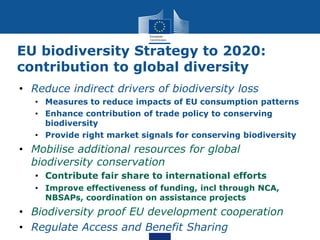
EU biodiversity Strategy to 2020:
contribution to global diversity
• Reduce indirect drivers of biodiversity loss
• Measures to reduce impacts of EU consumption patterns
• Enhance contribution of trade policy to conserving
biodiversity
• Provide right market signals for conserving biodiversity
• Mobilise additional resources for global
biodiversity conservation
• Contribute fair share to international efforts
• Improve effectiveness of funding, incl through NCA,
NBSAPs, coordination on assistance projects
• Biodiversity proof EU development cooperation
• Regulate Access and Benefit Sharing
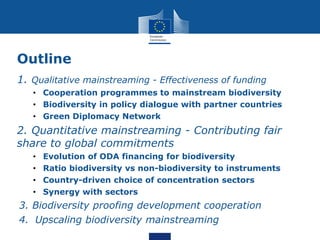
Outline
1. Qualitative mainstreaming - Effectiveness of funding
• Cooperation programmes to mainstream biodiversity
• Biodiversity in policy dialogue with partner countries
• Green Diplomacy Network
2. Quantitative mainstreaming - Contributing fair
share to global commitments
• Evolution of ODA financing for biodiversity
• Ratio biodiversity vs non-biodiversity to instruments
• Country-driven choice of concentration sectors
• Synergy with sectors
3. Biodiversity proofing development cooperation
4. Upscaling biodiversity mainstreaming
Cooperation programmes to
mainstream biodiversity - Aichi
Target 2
• Implementing Aichi Target 2 within the EU (MAES)
and supporting efforts outside the EU
• Valuing biodiversity - TEEB
• Integrating biodiversity values in accounting
systems – Natural Capital Accounting:
• WAVES
• Partnership Instrument – NCA in Emerging
economies
• Link with Resource Mobilisation Strategies – Biofin
• Poverty-Environment Initiative
Policy Dialogues with Partner
Countries
- Inclusion of biodiversity-related topics
(ecosystems; ecosystem services; sustainable
management of natural resources; nature-based
green economy):
- A selected number of strategic partner countries
have dialogues by sectors
- Often environment as a whole, not only
biodiversity
- Biodiversity in agenda rather in "COP years"
- When environment is covered, it often focuses
primarily on climate change
Green Diplomacy Network
• Mainstreaming environment/climate change
issues into the foreign affair agenda
• Mostly climate change; water; energy
• BD agenda item in 8 out of 9 last meetings since
Feb 2012 (COP and IWT)
• Recent strong entry point for biodiversity in
diplomacy and security: wildlife crisis (poaching,
trafficking)
• Regular updates on CBD outcomes, resource
mobilisation issues, link to post-2015
Quantitative mainstreaming
• New Multi-annual Financial Framework 2014-2020:
 New Thematic Instrument: Global Public Good and
Challenges – GPGC
• € 5.1 Bn over 7 years of which € 1.377 Bn for climate
change and environment (incl. biodiv. ~30% i.e. € 400
M).
 increase 71% wrt ENRTP
• Means 0.8% of total Dvpt Coop instruments (EDF + DCI)
• Ratio of Biodiversity funding with regard to
- "environment-minded" funding instrument (enrtp, gpgc) 
20-30%
- "non-environment" funding instrument (EDF, geograph
DCI, other thematic DCI, other instrument)  3-7%
Quantitative mainstreaming
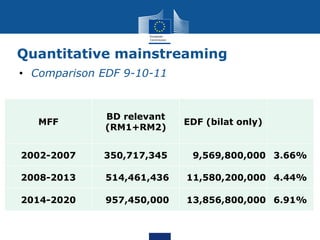
• Comparison EDF 9-10-11
MFF
BD relevant
(RM1+RM2)
EDF (bilat only)
2002-2007 350,717,345 9,569,800,000 3.66%
2008-2013 514,461,436 11,580,200,000 4.44%
2014-2020 957,450,000 13,856,800,000 6.91%
Quantitative mainstreaming
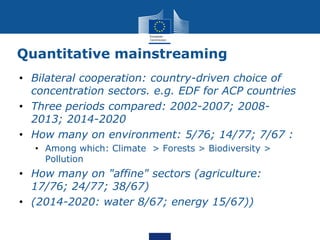
• Bilateral cooperation: country-driven choice of
concentration sectors. e.g. EDF for ACP countries
• Three periods compared: 2002-2007; 2008-
2013; 2014-2020
• How many on environment: 5/76; 14/77; 7/67 :
• Among which: Climate > Forests > Biodiversity >
Pollution
• How many on "affine" sectors (agriculture:
17/76; 24/77; 38/67)
• (2014-2020: water 8/67; energy 15/67))
'Biodiversity-proof' development cooperation
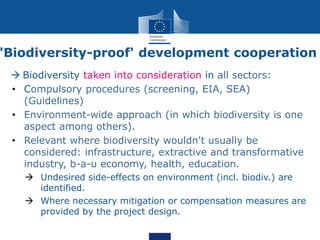
 Biodiversity taken into consideration in all sectors:
• Compulsory procedures (screening, EIA, SEA)
(Guidelines)
• Environment-wide approach (in which biodiversity is one
aspect among others).
• Relevant where biodiversity wouldn't usually be
considered: infrastructure, extractive and transformative
industry, b-a-u economy, health, education.
 Undesired side-effects on environment (incl. biodiv.) are
identified.
 Where necessary mitigation or compensation measures are
provided by the project design.
How to upscale biodiversity mainstreaming
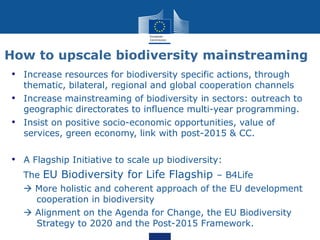
• Increase resources for biodiversity specific actions, through
thematic, bilateral, regional and global cooperation channels
• Increase mainstreaming of biodiversity in sectors: outreach to
geographic directorates to influence multi-year programming.
• Insist on positive socio-economic opportunities, value of
services, green economy, link with post-2015 & CC.
• A Flagship Initiative to scale up biodiversity:
The EU Biodiversity for Life Flagship – B4Life
 More holistic and coherent approach of the EU development
cooperation in biodiversity
 Alignment on the Agenda for Change, the EU Biodiversity
Strategy to 2020 and the Post-2015 Framework.
Through…
• Internal lobbying, training, awareness raising, guidance for
staff, technical assistance, quality support
• Helpdesk on Env/CC integration 2004-2009
• Internal staff resources 2010-2012
• TA on ENV/CC mainstreaming 2013-2015
• TA on tracking biodiversity-expenditure (ex ante & ex
post)
• B4Life Facility 2015-2018
How to upscale biodiversity mainstreaming

EU perspectives on lessons from implementation of biodiversity and development strategies, policies, plans and budgets

  • 1.
    EU perspectives on lessonsfrom implementation – Mainstreaming Biodiversity in Development Strategies, Policies, Plans and Budgets Arnold Jacques de Dixmude, European Commission Development Cooperation Office – EuropeAid Laure Ledoux, European Commission, D-G Environment Joint Workshop DAC/ENVIRONET – EPOC/WPBWE on Biodiversity and Development Paris, 18 February 2015
  • 2.
    EU biodiversity Strategyto 2020: contribution to global diversity • Reduce indirect drivers of biodiversity loss • Measures to reduce impacts of EU consumption patterns • Enhance contribution of trade policy to conserving biodiversity • Provide right market signals for conserving biodiversity • Mobilise additional resources for global biodiversity conservation • Contribute fair share to international efforts • Improve effectiveness of funding, incl through NCA, NBSAPs, coordination on assistance projects • Biodiversity proof EU development cooperation • Regulate Access and Benefit Sharing
  • 3.
    Outline 1. Qualitative mainstreaming- Effectiveness of funding • Cooperation programmes to mainstream biodiversity • Biodiversity in policy dialogue with partner countries • Green Diplomacy Network 2. Quantitative mainstreaming - Contributing fair share to global commitments • Evolution of ODA financing for biodiversity • Ratio biodiversity vs non-biodiversity to instruments • Country-driven choice of concentration sectors • Synergy with sectors 3. Biodiversity proofing development cooperation 4. Upscaling biodiversity mainstreaming
  • 4.
    Cooperation programmes to mainstreambiodiversity - Aichi Target 2 • Implementing Aichi Target 2 within the EU (MAES) and supporting efforts outside the EU • Valuing biodiversity - TEEB • Integrating biodiversity values in accounting systems – Natural Capital Accounting: • WAVES • Partnership Instrument – NCA in Emerging economies • Link with Resource Mobilisation Strategies – Biofin • Poverty-Environment Initiative
  • 5.
    Policy Dialogues withPartner Countries - Inclusion of biodiversity-related topics (ecosystems; ecosystem services; sustainable management of natural resources; nature-based green economy): - A selected number of strategic partner countries have dialogues by sectors - Often environment as a whole, not only biodiversity - Biodiversity in agenda rather in "COP years" - When environment is covered, it often focuses primarily on climate change
  • 6.
    Green Diplomacy Network •Mainstreaming environment/climate change issues into the foreign affair agenda • Mostly climate change; water; energy • BD agenda item in 8 out of 9 last meetings since Feb 2012 (COP and IWT) • Recent strong entry point for biodiversity in diplomacy and security: wildlife crisis (poaching, trafficking) • Regular updates on CBD outcomes, resource mobilisation issues, link to post-2015
  • 7.
    Quantitative mainstreaming • NewMulti-annual Financial Framework 2014-2020:  New Thematic Instrument: Global Public Good and Challenges – GPGC • € 5.1 Bn over 7 years of which € 1.377 Bn for climate change and environment (incl. biodiv. ~30% i.e. € 400 M).  increase 71% wrt ENRTP • Means 0.8% of total Dvpt Coop instruments (EDF + DCI) • Ratio of Biodiversity funding with regard to - "environment-minded" funding instrument (enrtp, gpgc)  20-30% - "non-environment" funding instrument (EDF, geograph DCI, other thematic DCI, other instrument)  3-7%
  • 8.
    Quantitative mainstreaming • ComparisonEDF 9-10-11 MFF BD relevant (RM1+RM2) EDF (bilat only) 2002-2007 350,717,345 9,569,800,000 3.66% 2008-2013 514,461,436 11,580,200,000 4.44% 2014-2020 957,450,000 13,856,800,000 6.91%
  • 9.
    Quantitative mainstreaming • Bilateralcooperation: country-driven choice of concentration sectors. e.g. EDF for ACP countries • Three periods compared: 2002-2007; 2008- 2013; 2014-2020 • How many on environment: 5/76; 14/77; 7/67 : • Among which: Climate > Forests > Biodiversity > Pollution • How many on "affine" sectors (agriculture: 17/76; 24/77; 38/67) • (2014-2020: water 8/67; energy 15/67))
  • 10.
    'Biodiversity-proof' development cooperation Biodiversity taken into consideration in all sectors: • Compulsory procedures (screening, EIA, SEA) (Guidelines) • Environment-wide approach (in which biodiversity is one aspect among others). • Relevant where biodiversity wouldn't usually be considered: infrastructure, extractive and transformative industry, b-a-u economy, health, education.  Undesired side-effects on environment (incl. biodiv.) are identified.  Where necessary mitigation or compensation measures are provided by the project design.
  • 11.
    How to upscalebiodiversity mainstreaming • Increase resources for biodiversity specific actions, through thematic, bilateral, regional and global cooperation channels • Increase mainstreaming of biodiversity in sectors: outreach to geographic directorates to influence multi-year programming. • Insist on positive socio-economic opportunities, value of services, green economy, link with post-2015 & CC. • A Flagship Initiative to scale up biodiversity: The EU Biodiversity for Life Flagship – B4Life  More holistic and coherent approach of the EU development cooperation in biodiversity  Alignment on the Agenda for Change, the EU Biodiversity Strategy to 2020 and the Post-2015 Framework.
  • 12.
    Through… • Internal lobbying,training, awareness raising, guidance for staff, technical assistance, quality support • Helpdesk on Env/CC integration 2004-2009 • Internal staff resources 2010-2012 • TA on ENV/CC mainstreaming 2013-2015 • TA on tracking biodiversity-expenditure (ex ante & ex post) • B4Life Facility 2015-2018 How to upscale biodiversity mainstreaming