Rainfall Erosivity in China
Yun Xie1*, Shuiqing Yin1, Baoyuan Liu1, Wenbo Zhang1, Tianyu Yue1
1Faculty of Geographical Science, Beijing Normal University, Beijing 100875, China,
baoyuan@bnu.edu.cn
Introduction
Rainfall erosivity, the product of the total
kinetic energy and maximum 30-min intensity
EI30, is one of two dimensional variables of the
USLE (Universal Soil Loss Equation). It
requires high resolution rainfall data, which
are often unavailable. Many average annual
erosivity estimation equations using easily
available were developed. To predict precise
soil loss, both annual erosivity and its seasonal
distributions using ratio of half-month or
month erosivity to annual values are needed.
The objective of this study was to develop a
series of erosivity estimation equations in four
scales of event, daily, monthly, and yearly by
using different time resolution rainfall data,
and to assess their estimated accuracy
comparing to the one-minute resolution
rainfall data.
Methodology
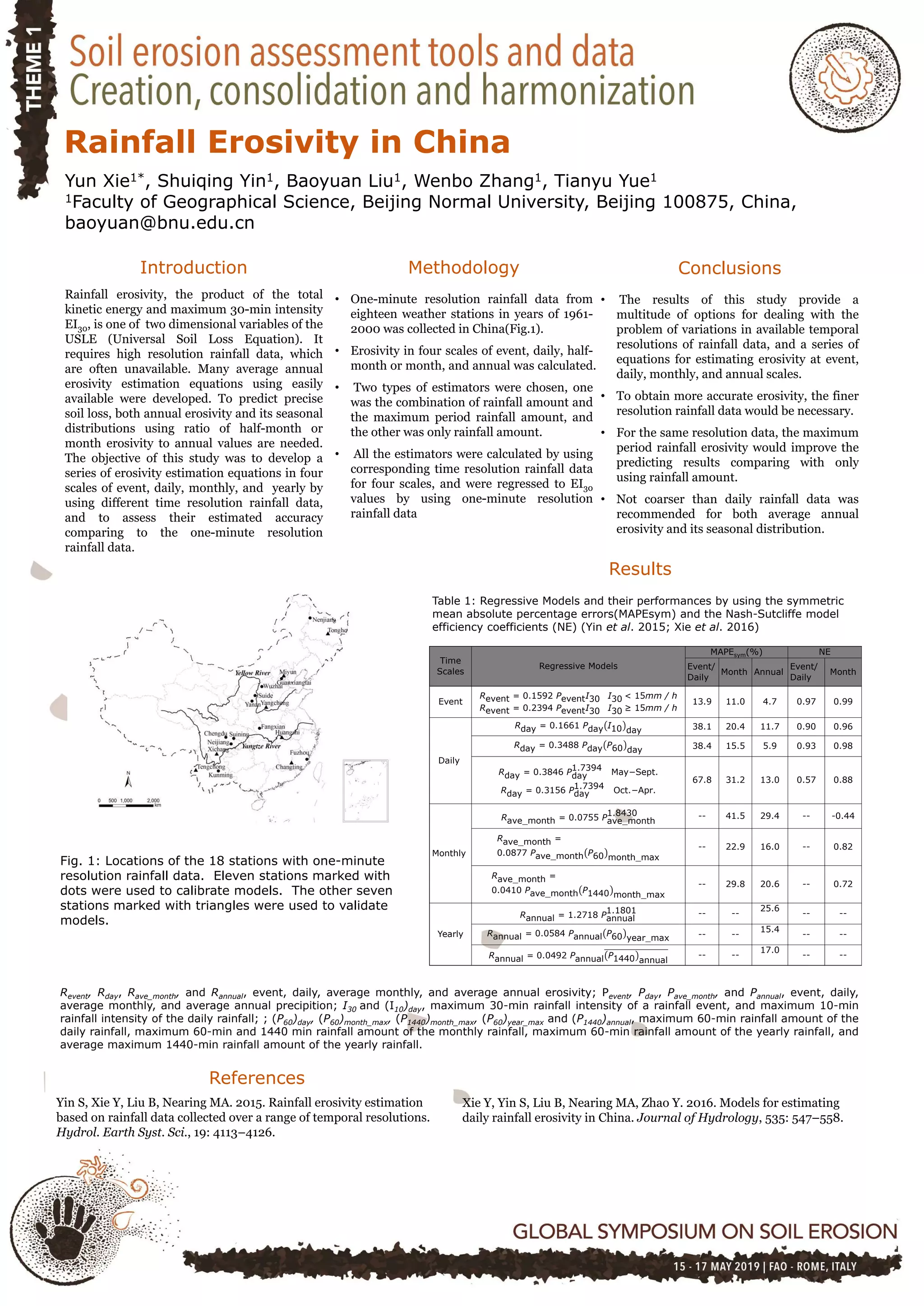
• One-minute resolution rainfall data from
eighteen weather stations in years of 1961-
2000 was collected in China(Fig.1).
• Erosivity in four scales of event, daily, half-
month or month, and annual was calculated.
• Two types of estimators were chosen, one
was the combination of rainfall amount and
the maximum period rainfall amount, and
the other was only rainfall amount.
• All the estimators were calculated by using
corresponding time resolution rainfall data
for four scales, and were regressed to EI30
values by using one-minute resolution
rainfall data
Conclusions
• The results of this study provide a
multitude of options for dealing with the
problem of variations in available temporal
resolutions of rainfall data, and a series of
equations for estimating erosivity at event,
daily, monthly, and annual scales.
• To obtain more accurate erosivity, the finer
resolution rainfall data would be necessary.
• For the same resolution data, the maximum
period rainfall erosivity would improve the
predicting results comparing with only
using rainfall amount.
• Not coarser than daily rainfall data was
recommended for both average annual
erosivity and its seasonal distribution.
Results
Table 1: Regressive Models and their performances by using the symmetric
mean absolute percentage errors(MAPEsym) and the Nash-Sutcliffe model
efficiency coefficients (NE) (Yin et al. 2015; Xie et al. 2016)
Xie Y, Yin S, Liu B, Nearing MA, Zhao Y. 2016. Models for estimating
daily rainfall erosivity in China. Journal of Hydrology, 535: 547–558.
Time
Scales
Regressive Models
MAPEsym(%) NE
Event/
Daily
Month Annual
Event/
Daily
Month
Event
Revent = 0.1592 PeventI30 I30 < 15mm / h
Revent = 0.2394 PeventI30 I30 ≥ 15mm / h
13.9 11.0 4.7 0.97 0.99
Daily
Rday = 0.1661 Pday I10 day 38.1 20.4 11.7 0.90 0.96
Rday = 0.3488 Pday P60 day 38.4 15.5 5.9 0.93 0.98
Rday = 0.3846 Pday
1.7394
May−Sept.
Rday = 0.3156 Pday
1.7394
Oct.−Apr.
67.8 31.2 13.0 0.57 0.88
Monthly
Rave_month = 0.0755 Pave_month
1.8430 -- 41.5 29.4 -- -0.44
Rave_month =
0.0877 Pave_month P60 month_max
-- 22.9 16.0 -- 0.82
Rave_month =
0.0410 Pave_month P1440 month_max
-- 29.8 20.6 -- 0.72
Yearly
Rannual = 1.2718 Pannual
1.1801 -- --
25.6
-- --
Rannual = 0.0584 Pannual P60 year_max -- --
15.4
-- --
Rannual = 0.0492 Pannual P1440 annual
-- --
17.0
-- --
Fig. 1: Locations of the 18 stations with one-minute
resolution rainfall data. Eleven stations marked with
dots were used to calibrate models. The other seven
stations marked with triangles were used to validate
models.
References
Yin S, Xie Y, Liu B, Nearing MA. 2015. Rainfall erosivity estimation
based on rainfall data collected over a range of temporal resolutions.
Hydrol. Earth Syst. Sci., 19: 4113–4126.
Revent, Rday, Rave_month, and Rannual, event, daily, average monthly, and average annual erosivity; Pevent, Pday, Pave_month, and Pannual, event, daily,
average monthly, and average annual precipition; I30 and (I10)day, maximum 30-min rainfall intensity of a rainfall event, and maximum 10-min
rainfall intensity of the daily rainfall; ; (P60)day, (P60)month_max, (P1440)month_max, (P60)year_max and (P1440)annual, maximum 60-min rainfall amount of the
daily rainfall, maximum 60-min and 1440 min rainfall amount of the monthly rainfall, maximum 60-min rainfall amount of the yearly rainfall, and
average maximum 1440-min rainfall amount of the yearly rainfall.

Rainfall Erosivity in China

  • 1.
    Rainfall Erosivity inChina Yun Xie1*, Shuiqing Yin1, Baoyuan Liu1, Wenbo Zhang1, Tianyu Yue1 1Faculty of Geographical Science, Beijing Normal University, Beijing 100875, China, baoyuan@bnu.edu.cn Introduction Rainfall erosivity, the product of the total kinetic energy and maximum 30-min intensity EI30, is one of two dimensional variables of the USLE (Universal Soil Loss Equation). It requires high resolution rainfall data, which are often unavailable. Many average annual erosivity estimation equations using easily available were developed. To predict precise soil loss, both annual erosivity and its seasonal distributions using ratio of half-month or month erosivity to annual values are needed. The objective of this study was to develop a series of erosivity estimation equations in four scales of event, daily, monthly, and yearly by using different time resolution rainfall data, and to assess their estimated accuracy comparing to the one-minute resolution rainfall data. Methodology • One-minute resolution rainfall data from eighteen weather stations in years of 1961- 2000 was collected in China(Fig.1). • Erosivity in four scales of event, daily, half- month or month, and annual was calculated. • Two types of estimators were chosen, one was the combination of rainfall amount and the maximum period rainfall amount, and the other was only rainfall amount. • All the estimators were calculated by using corresponding time resolution rainfall data for four scales, and were regressed to EI30 values by using one-minute resolution rainfall data Conclusions • The results of this study provide a multitude of options for dealing with the problem of variations in available temporal resolutions of rainfall data, and a series of equations for estimating erosivity at event, daily, monthly, and annual scales. • To obtain more accurate erosivity, the finer resolution rainfall data would be necessary. • For the same resolution data, the maximum period rainfall erosivity would improve the predicting results comparing with only using rainfall amount. • Not coarser than daily rainfall data was recommended for both average annual erosivity and its seasonal distribution. Results Table 1: Regressive Models and their performances by using the symmetric mean absolute percentage errors(MAPEsym) and the Nash-Sutcliffe model efficiency coefficients (NE) (Yin et al. 2015; Xie et al. 2016) Xie Y, Yin S, Liu B, Nearing MA, Zhao Y. 2016. Models for estimating daily rainfall erosivity in China. Journal of Hydrology, 535: 547–558. Time Scales Regressive Models MAPEsym(%) NE Event/ Daily Month Annual Event/ Daily Month Event Revent = 0.1592 PeventI30 I30 < 15mm / h Revent = 0.2394 PeventI30 I30 ≥ 15mm / h 13.9 11.0 4.7 0.97 0.99 Daily Rday = 0.1661 Pday I10 day 38.1 20.4 11.7 0.90 0.96 Rday = 0.3488 Pday P60 day 38.4 15.5 5.9 0.93 0.98 Rday = 0.3846 Pday 1.7394 May−Sept. Rday = 0.3156 Pday 1.7394 Oct.−Apr. 67.8 31.2 13.0 0.57 0.88 Monthly Rave_month = 0.0755 Pave_month 1.8430 -- 41.5 29.4 -- -0.44 Rave_month = 0.0877 Pave_month P60 month_max -- 22.9 16.0 -- 0.82 Rave_month = 0.0410 Pave_month P1440 month_max -- 29.8 20.6 -- 0.72 Yearly Rannual = 1.2718 Pannual 1.1801 -- -- 25.6 -- -- Rannual = 0.0584 Pannual P60 year_max -- -- 15.4 -- -- Rannual = 0.0492 Pannual P1440 annual -- -- 17.0 -- -- Fig. 1: Locations of the 18 stations with one-minute resolution rainfall data. Eleven stations marked with dots were used to calibrate models. The other seven stations marked with triangles were used to validate models. References Yin S, Xie Y, Liu B, Nearing MA. 2015. Rainfall erosivity estimation based on rainfall data collected over a range of temporal resolutions. Hydrol. Earth Syst. Sci., 19: 4113–4126. Revent, Rday, Rave_month, and Rannual, event, daily, average monthly, and average annual erosivity; Pevent, Pday, Pave_month, and Pannual, event, daily, average monthly, and average annual precipition; I30 and (I10)day, maximum 30-min rainfall intensity of a rainfall event, and maximum 10-min rainfall intensity of the daily rainfall; ; (P60)day, (P60)month_max, (P1440)month_max, (P60)year_max and (P1440)annual, maximum 60-min rainfall amount of the daily rainfall, maximum 60-min and 1440 min rainfall amount of the monthly rainfall, maximum 60-min rainfall amount of the yearly rainfall, and average maximum 1440-min rainfall amount of the yearly rainfall.