

WRF-PDM: Prototype for
discharge prediction in
ungauged basin
Prashant K. Srivastava
IESD, Banaras Hindu University,
Varanasi, India
Email: prashant.iesd@bhu.ac.in
Why WRF-PDM?
 Hydro-meteorological variables such as Precipitation
and Reference Evapotranspiration (ET) are the most
important variables for discharge prediction.
 The mesoscale model such as WRF (Weather
Research & Forecasting model) can be used for
prediction of hydro-meteorological variables.
 While, Probability Distributed Model (PDM)--a rainfall
runoff model can be used for discharge prediction and
forecasting.
 Therefore, an integration of WRF with PDM up to some
extent can solve the problem of discharge prediction in
data limited regions.
WRF-PDM framework
Rainfall
Meteorological variables
Sensitivity and Uncertainty analysis
 The sensitivity analysis (SA) and uncertainty
estimation (UE) are important for rigorous model
calibration and thus facilitate a good modelling
practice for hydrological predictions.
 There are many models available for SA and UE such
as GLUE, SUFI, Parasol etc.
 In WRF-PDM, for sake of simplicity GLUE model is
used in integration with PDM for SA and UE.
 The main advantage with the GLUE parameter
uncertainty is that it takes into account all sources of
uncertainty either explicitly or implicitly.
 In future other models will be also integrated in WRF-
PDM framework such as IHACRES, Top model etc
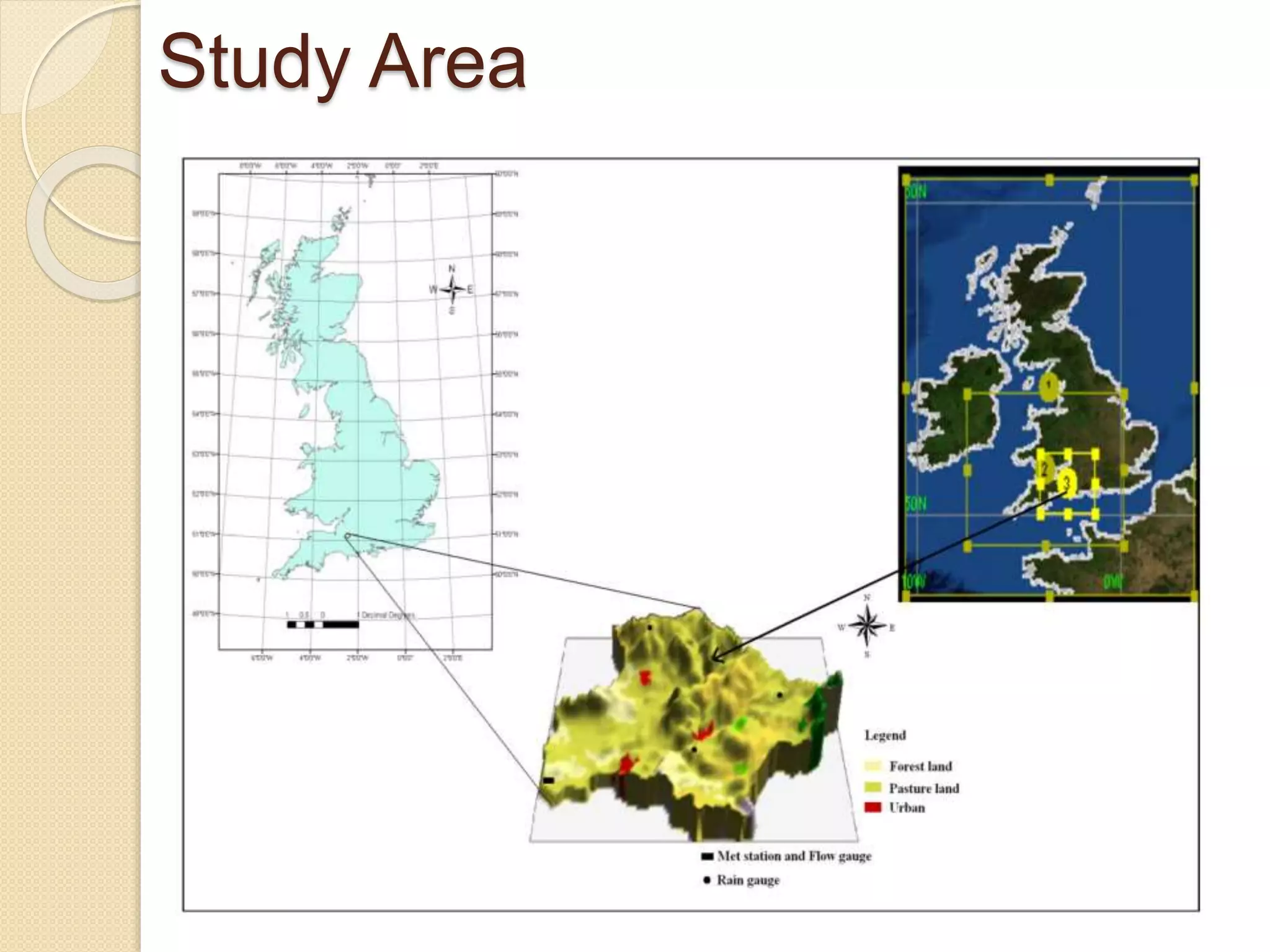
Study Area
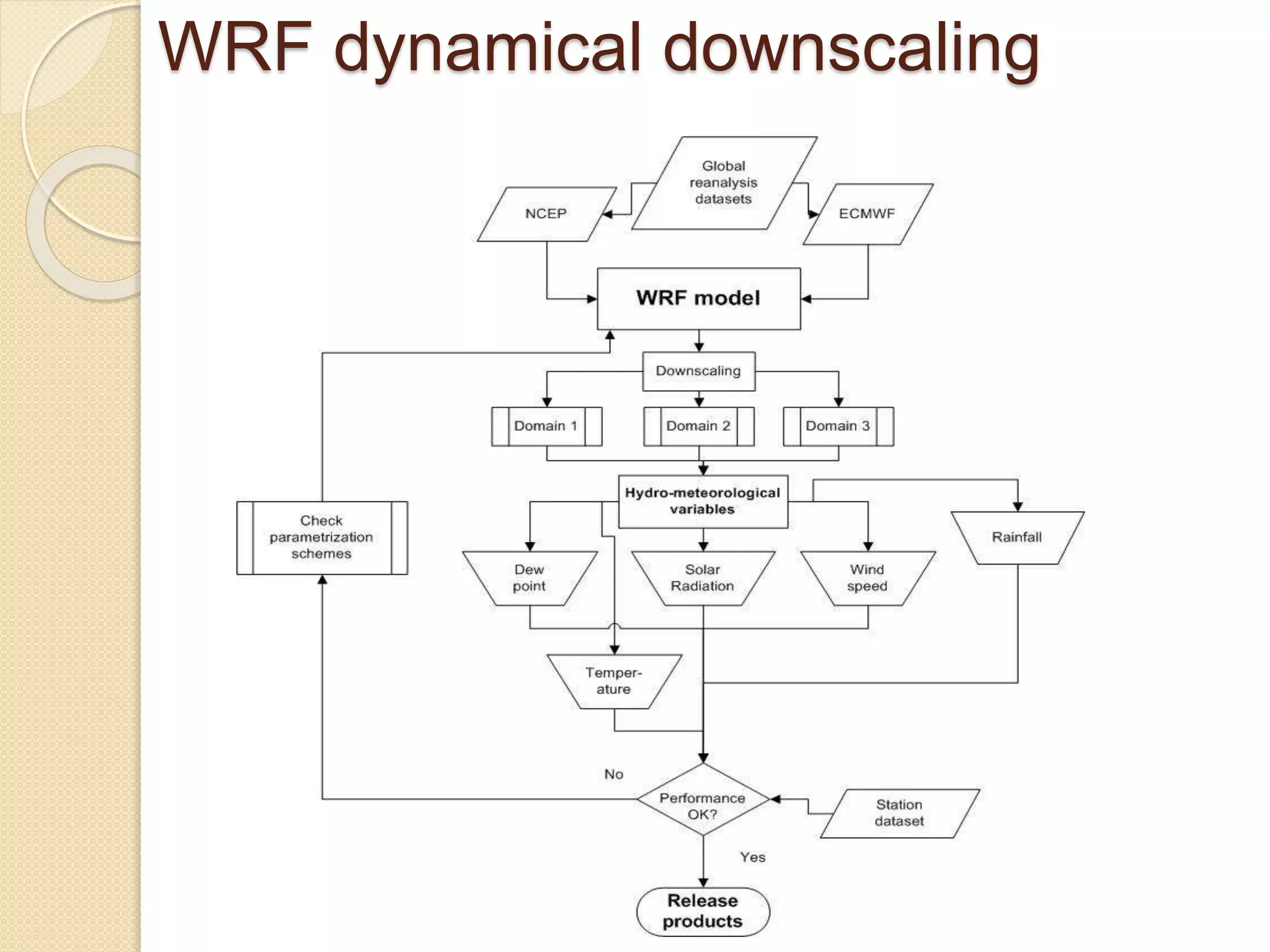
WRF dynamical downscaling
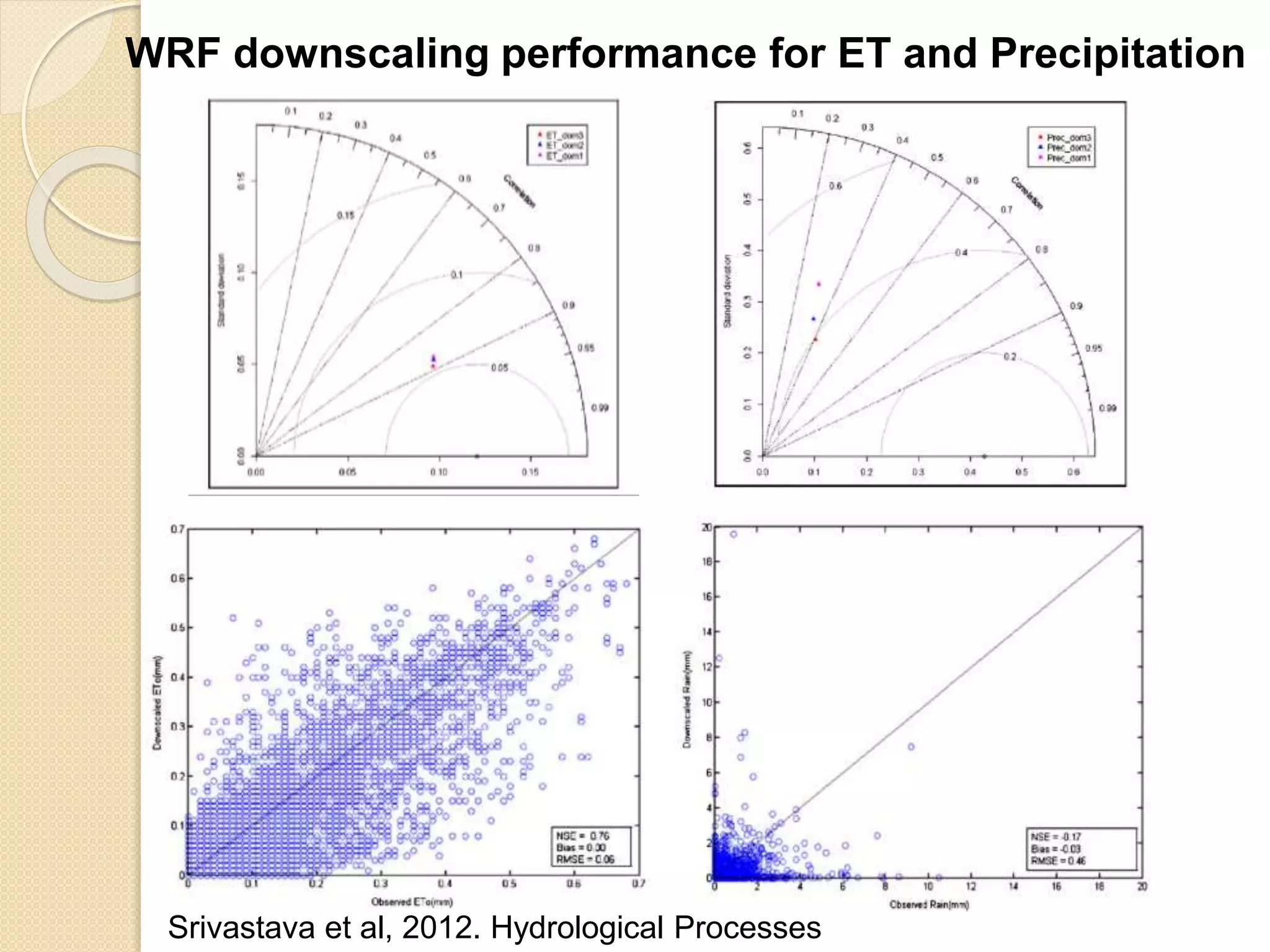
Srivastava et al, 2012. Hydrological Processes
WRF downscaling performance for ET and Precipitation
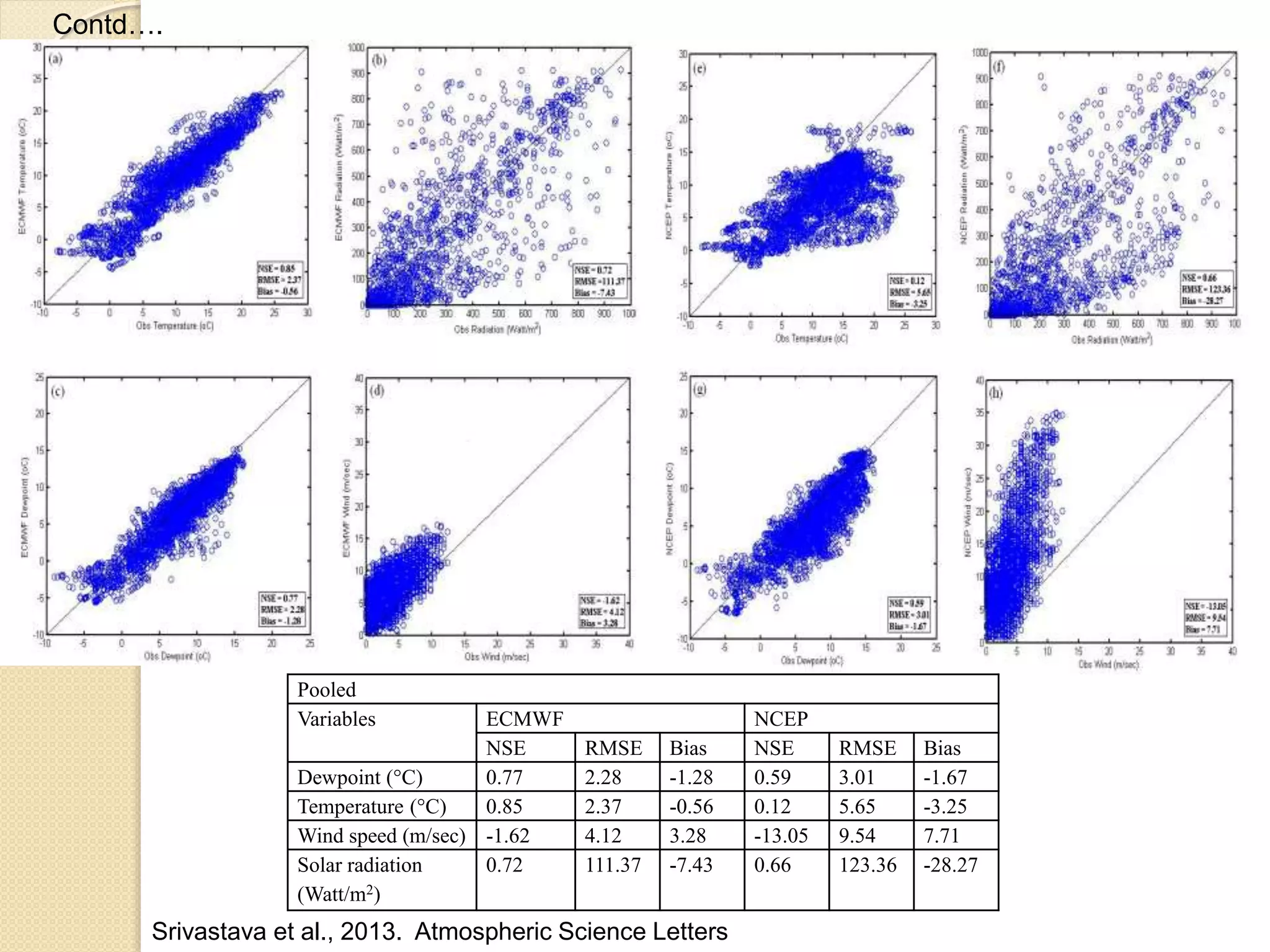
Pooled
Variables ECMWF NCEP
NSE RMSE Bias NSE RMSE Bias
Dewpoint (°C) 0.77 2.28 -1.28 0.59 3.01 -1.67
Temperature (°C) 0.85 2.37 -0.56 0.12 5.65 -3.25
Wind speed (m/sec) -1.62 4.12 3.28 -13.05 9.54 7.71
Solar radiation
(Watt/m2)
0.72 111.37 -7.43 0.66 123.36 -28.27
Srivastava et al., 2013. Atmospheric Science Letters
Contd….
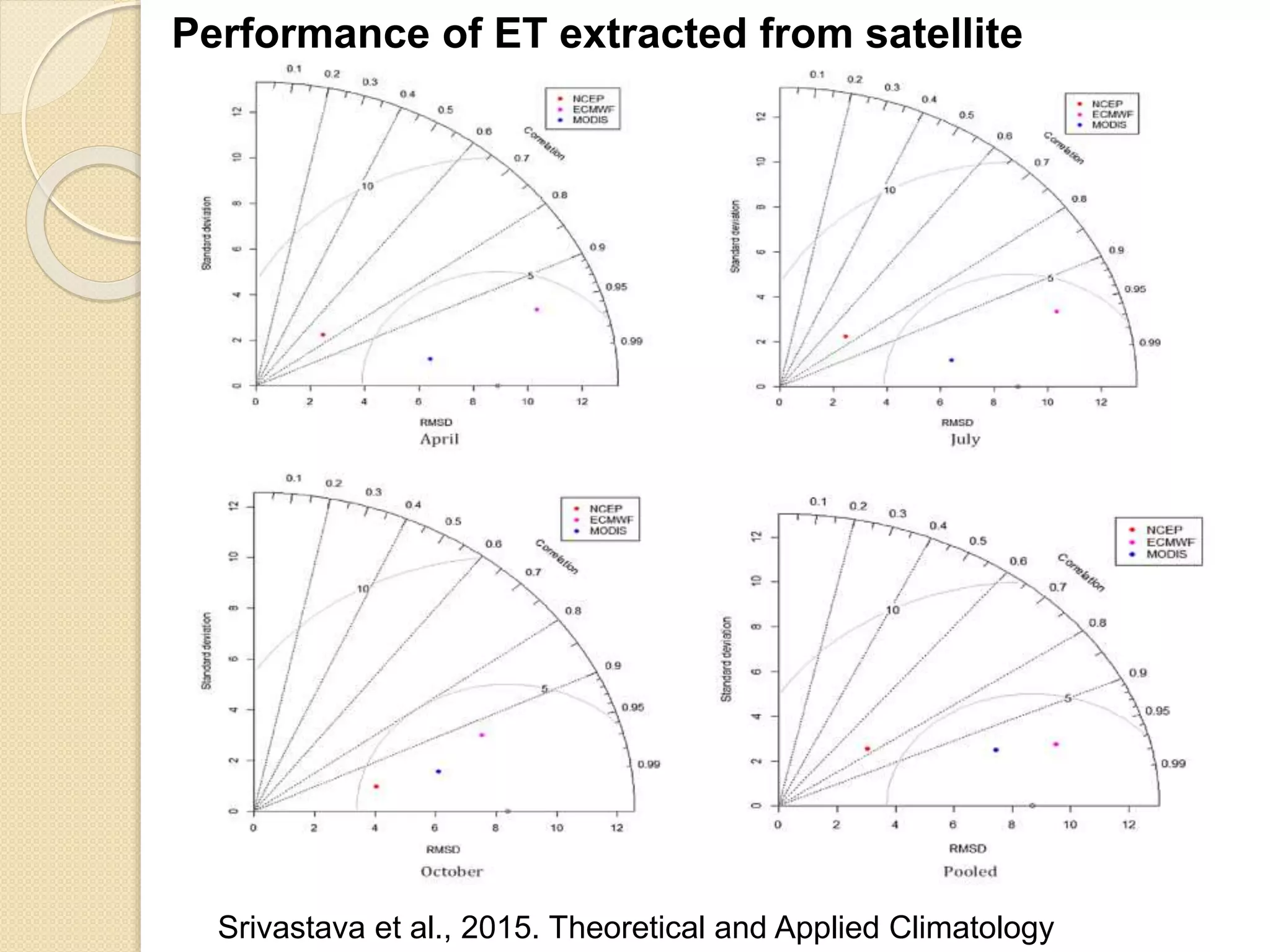
Srivastava et al., 2015. Theoretical and Applied Climatology
Performance of ET extracted from satellite
Discharge Prediction
 After acquiring input information required
for any rainfall runoff model i.e. rainfall and
ET, the discharge can be predicted.
 However, as mentioned before making any
prediction a rigorous calibration of those
models are needed.
 Further uncertainty should be taken into
account before using the forecast for
operational applications to minimize any
false alarm.
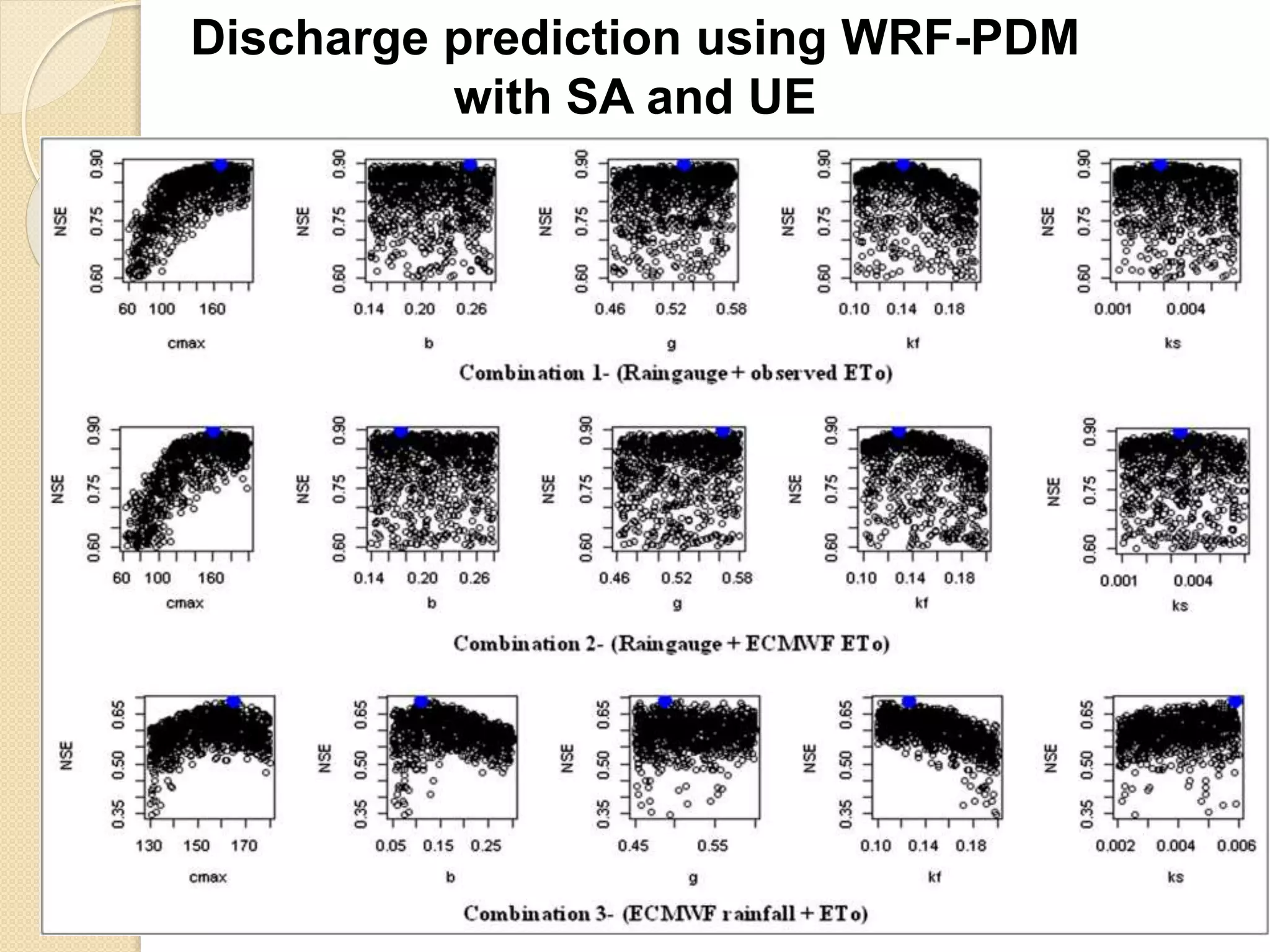
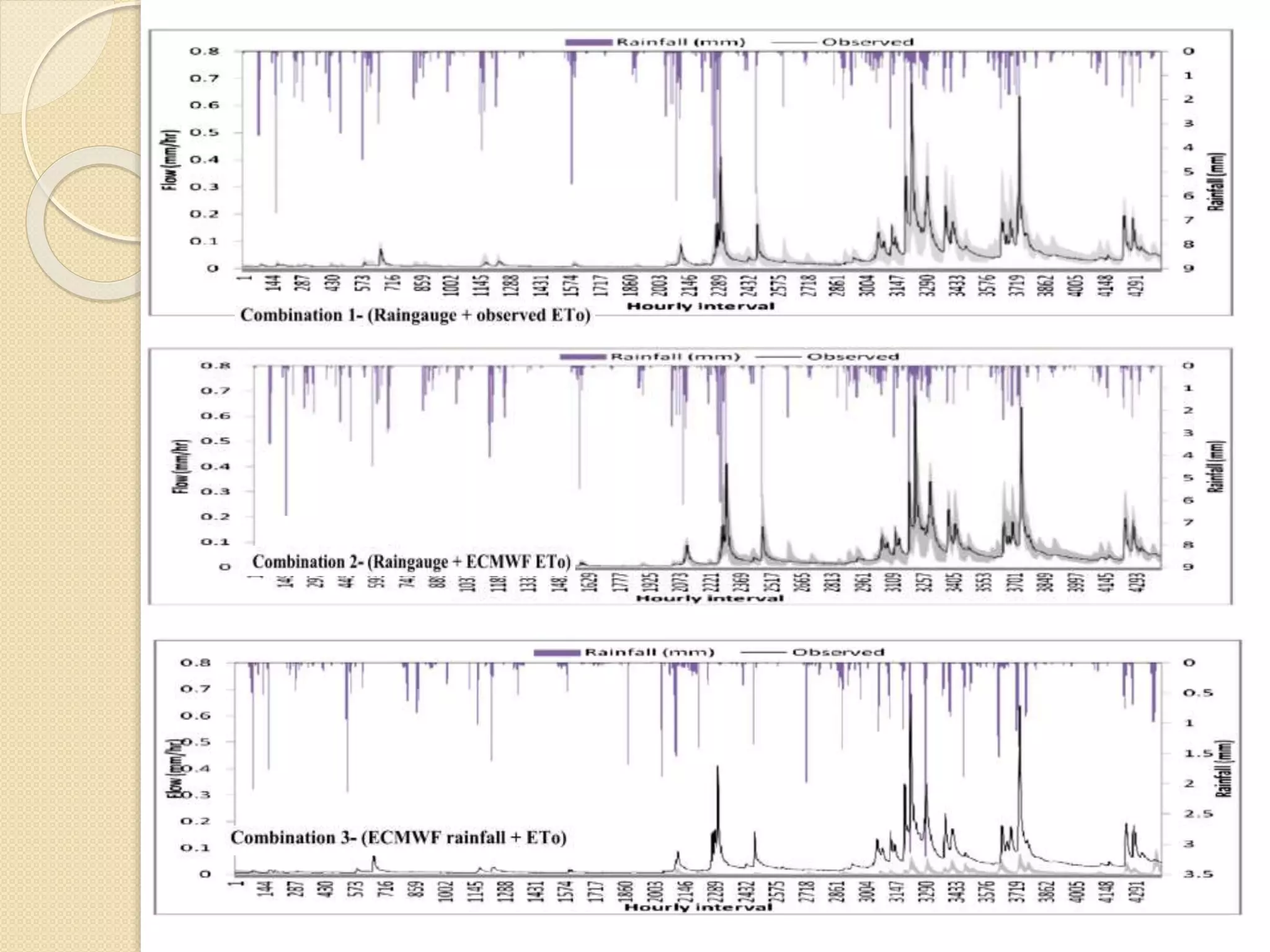
Discharge prediction using WRF-PDM
with SA and UE
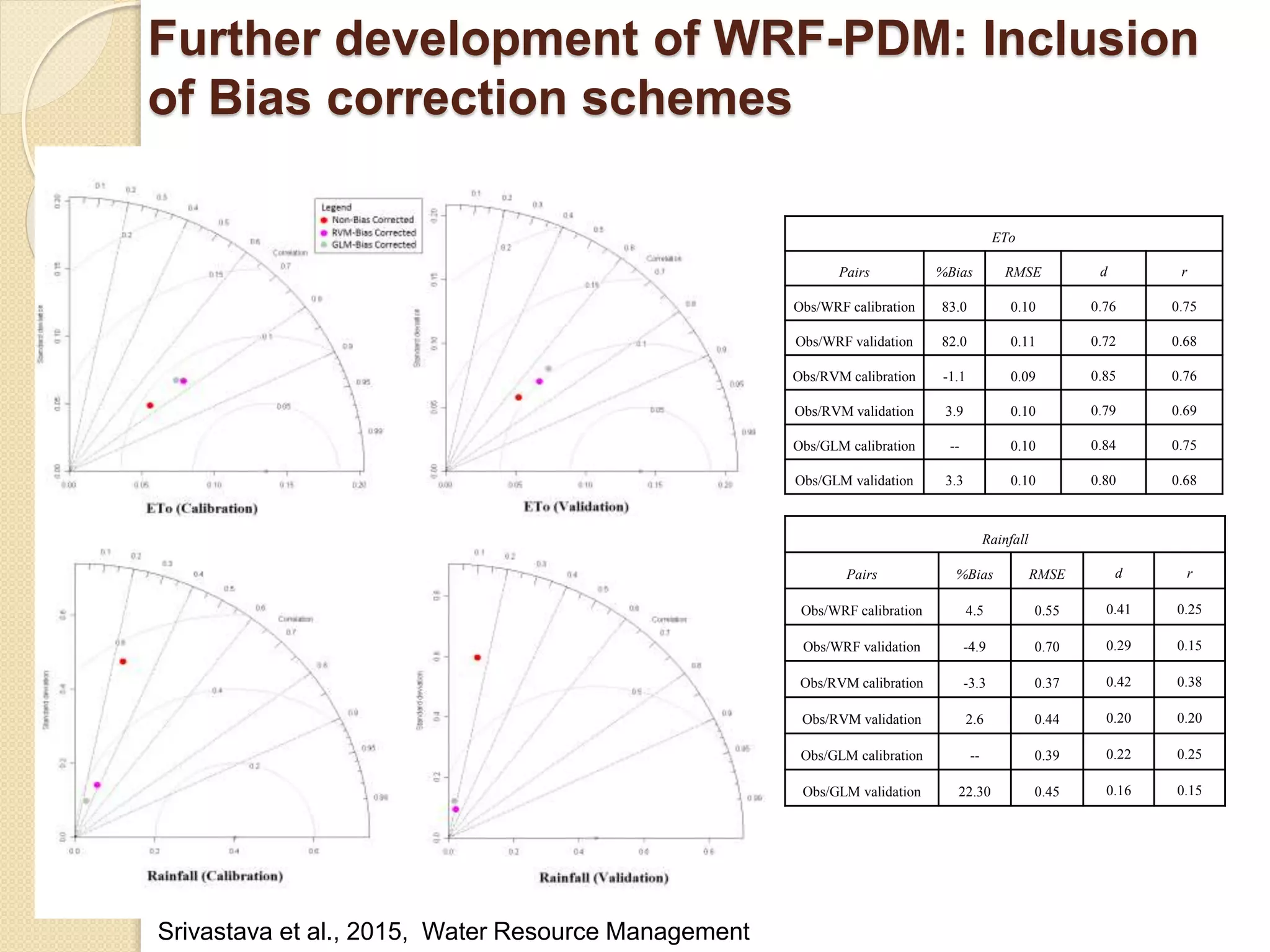
Further development of WRF-PDM: Inclusion
of Bias correction schemes
Srivastava et al., 2015, Water Resource Management
ETo
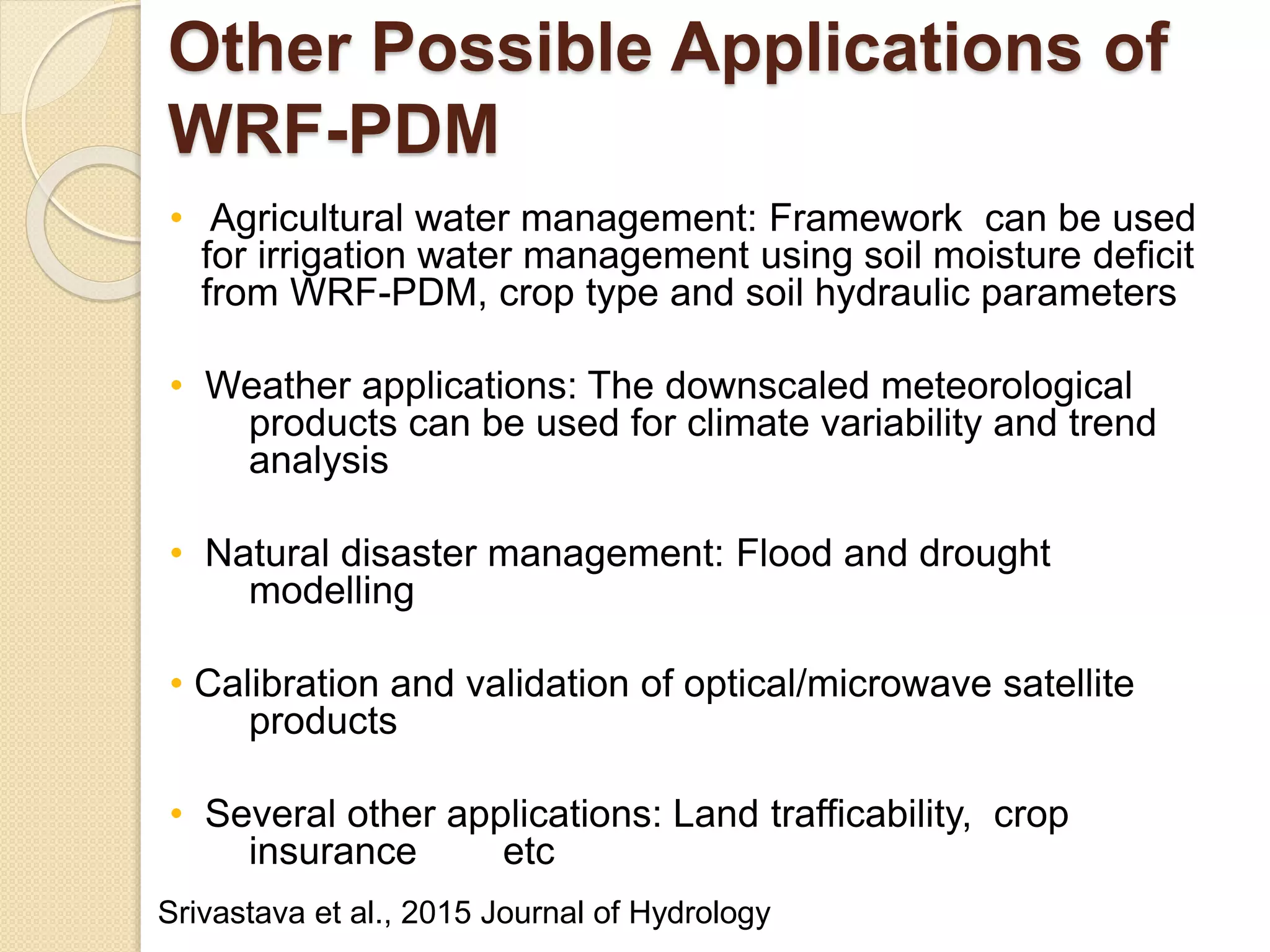
Pairs %Bias RMSE d r
Obs/WRF calibration 83.0 0.10 0.76 0.75
Obs/WRF validation 82.0 0.11 0.72 0.68
Obs/RVM calibration -1.1 0.09 0.85 0.76
Obs/RVM validation 3.9 0.10 0.79 0.69
Obs/GLM calibration -- 0.10 0.84 0.75
Obs/GLM validation 3.3 0.10 0.80 0.68
Rainfall
Pairs %Bias RMSE d r
Obs/WRF calibration 4.5 0.55 0.41 0.25
Obs/WRF validation -4.9 0.70 0.29 0.15
Obs/RVM calibration -3.3 0.37 0.42 0.38
Obs/RVM validation 2.6 0.44 0.20 0.20
Obs/GLM calibration -- 0.39 0.22 0.25
Obs/GLM validation 22.30 0.45 0.16 0.15
Other Possible Applications of
WRF-PDM
• Agricultural water management: Framework can be used
for irrigation water management using soil moisture deficit
from WRF-PDM, crop type and soil hydraulic parameters
• Weather applications: The downscaled meteorological
products can be used for climate variability and trend
analysis
• Natural disaster management: Flood and drought
modelling
• Calibration and validation of optical/microwave satellite
products
• Several other applications: Land trafficability, crop
insurance etc
Srivastava et al., 2015 Journal of Hydrology
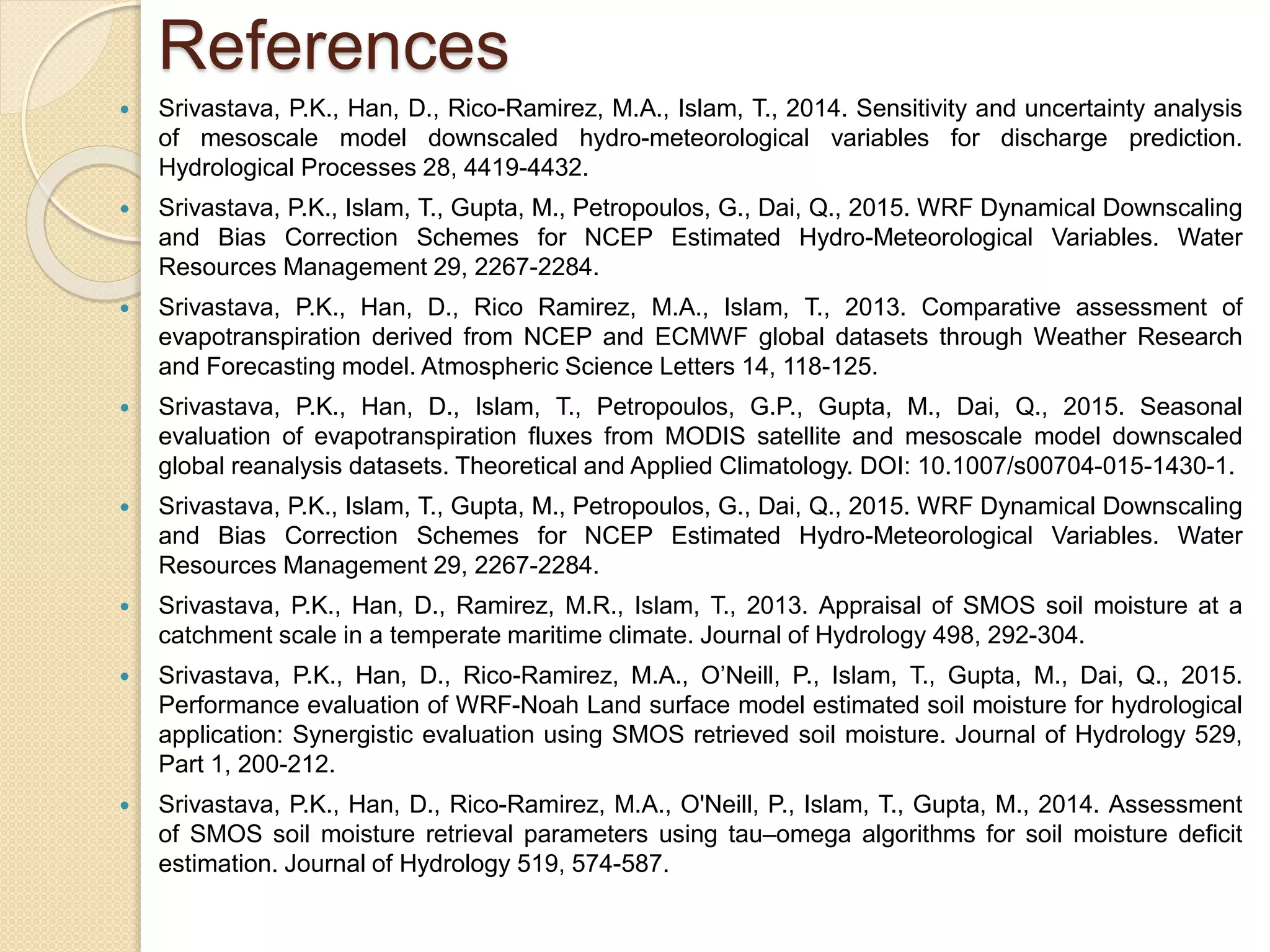
Conclusions
 The suitability of data for rainfall–runoff modelling suggests that ET from
WRF meteorological dataset is promising and has comparable
performance to the observed datasets.
 On the other hand, WRF downscaled precipitation and ET together give a
poor performance, indicating that there is a need of more work on
parameterization schemes to improve the precipitation estimates or
utilization of some other sources are needed such as radar for
precipitation input.
 Further more work is needed on the bias correction of the mesoscale or
satellite data to reduce the error in the prediction
 Integration of SA and UE in prediction modelling is needed. It will be
useful for planner and disaster management and important for quality
control in the estimation of underlying uncertainty and related
assumptions.
 There is need of exploration of other hydrological models (IHACRES,
Framework for Understanding Structural Errors (FUSE) etc) as well as SA
and UE techniques to improve the performances and prediction quality.
 Assimilation of satellite dataset such as soil moisture or precipitation in
WRF-PDM can improve the performance, so will be attempted in future.
Collaborators
References
 Srivastava, P.K., Han, D., Rico-Ramirez, M.A., Islam, T., 2014. Sensitivity and uncertainty analysis
of mesoscale model downscaled hydro-meteorological variables for discharge prediction.
Hydrological Processes 28, 4419-4432.
 Srivastava, P.K., Islam, T., Gupta, M., Petropoulos, G., Dai, Q., 2015. WRF Dynamical Downscaling
and Bias Correction Schemes for NCEP Estimated Hydro-Meteorological Variables. Water
Resources Management 29, 2267-2284.
 Srivastava, P.K., Han, D., Rico Ramirez, M.A., Islam, T., 2013. Comparative assessment of
evapotranspiration derived from NCEP and ECMWF global datasets through Weather Research
and Forecasting model. Atmospheric Science Letters 14, 118-125.
 Srivastava, P.K., Han, D., Islam, T., Petropoulos, G.P., Gupta, M., Dai, Q., 2015. Seasonal
evaluation of evapotranspiration fluxes from MODIS satellite and mesoscale model downscaled
global reanalysis datasets. Theoretical and Applied Climatology. DOI: 10.1007/s00704-015-1430-1.
 Srivastava, P.K., Islam, T., Gupta, M., Petropoulos, G., Dai, Q., 2015. WRF Dynamical Downscaling
and Bias Correction Schemes for NCEP Estimated Hydro-Meteorological Variables. Water
Resources Management 29, 2267-2284.
 Srivastava, P.K., Han, D., Ramirez, M.R., Islam, T., 2013. Appraisal of SMOS soil moisture at a
catchment scale in a temperate maritime climate. Journal of Hydrology 498, 292-304.
 Srivastava, P.K., Han, D., Rico-Ramirez, M.A., O’Neill, P., Islam, T., Gupta, M., Dai, Q., 2015.
Performance evaluation of WRF-Noah Land surface model estimated soil moisture for hydrological
application: Synergistic evaluation using SMOS retrieved soil moisture. Journal of Hydrology 529,
Part 1, 200-212.
 Srivastava, P.K., Han, D., Rico-Ramirez, M.A., O'Neill, P., Islam, T., Gupta, M., 2014. Assessment
of SMOS soil moisture retrieval parameters using tau–omega algorithms for soil moisture deficit
estimation. Journal of Hydrology 519, 574-587.
THANK YOU

IUKWC Workshop Nov16: Developing Hydro-climatic Services for Water Security – Session 6 – Item 3 P_Srivastava

  • 1.
    WRF-PDM: Prototype for dischargeprediction in ungauged basin Prashant K. Srivastava IESD, Banaras Hindu University, Varanasi, India Email: prashant.iesd@bhu.ac.in
  • 2.
    Why WRF-PDM?  Hydro-meteorologicalvariables such as Precipitation and Reference Evapotranspiration (ET) are the most important variables for discharge prediction.  The mesoscale model such as WRF (Weather Research & Forecasting model) can be used for prediction of hydro-meteorological variables.  While, Probability Distributed Model (PDM)--a rainfall runoff model can be used for discharge prediction and forecasting.  Therefore, an integration of WRF with PDM up to some extent can solve the problem of discharge prediction in data limited regions.
  • 3.
  • 4.
    Sensitivity and Uncertaintyanalysis  The sensitivity analysis (SA) and uncertainty estimation (UE) are important for rigorous model calibration and thus facilitate a good modelling practice for hydrological predictions.  There are many models available for SA and UE such as GLUE, SUFI, Parasol etc.  In WRF-PDM, for sake of simplicity GLUE model is used in integration with PDM for SA and UE.  The main advantage with the GLUE parameter uncertainty is that it takes into account all sources of uncertainty either explicitly or implicitly.  In future other models will be also integrated in WRF- PDM framework such as IHACRES, Top model etc
  • 5.
  • 6.
  • 7.
    Srivastava et al,2012. Hydrological Processes WRF downscaling performance for ET and Precipitation
  • 8.
    Pooled Variables ECMWF NCEP NSERMSE Bias NSE RMSE Bias Dewpoint (°C) 0.77 2.28 -1.28 0.59 3.01 -1.67 Temperature (°C) 0.85 2.37 -0.56 0.12 5.65 -3.25 Wind speed (m/sec) -1.62 4.12 3.28 -13.05 9.54 7.71 Solar radiation (Watt/m2) 0.72 111.37 -7.43 0.66 123.36 -28.27 Srivastava et al., 2013. Atmospheric Science Letters Contd….
  • 9.
    Srivastava et al.,2015. Theoretical and Applied Climatology Performance of ET extracted from satellite
  • 10.
    Discharge Prediction  Afteracquiring input information required for any rainfall runoff model i.e. rainfall and ET, the discharge can be predicted.  However, as mentioned before making any prediction a rigorous calibration of those models are needed.  Further uncertainty should be taken into account before using the forecast for operational applications to minimize any false alarm.
  • 11.
    Discharge prediction usingWRF-PDM with SA and UE
  • 13.
    Further development ofWRF-PDM: Inclusion of Bias correction schemes Srivastava et al., 2015, Water Resource Management ETo Pairs %Bias RMSE d r Obs/WRF calibration 83.0 0.10 0.76 0.75 Obs/WRF validation 82.0 0.11 0.72 0.68 Obs/RVM calibration -1.1 0.09 0.85 0.76 Obs/RVM validation 3.9 0.10 0.79 0.69 Obs/GLM calibration -- 0.10 0.84 0.75 Obs/GLM validation 3.3 0.10 0.80 0.68 Rainfall Pairs %Bias RMSE d r Obs/WRF calibration 4.5 0.55 0.41 0.25 Obs/WRF validation -4.9 0.70 0.29 0.15 Obs/RVM calibration -3.3 0.37 0.42 0.38 Obs/RVM validation 2.6 0.44 0.20 0.20 Obs/GLM calibration -- 0.39 0.22 0.25 Obs/GLM validation 22.30 0.45 0.16 0.15
  • 14.
    Other Possible Applicationsof WRF-PDM • Agricultural water management: Framework can be used for irrigation water management using soil moisture deficit from WRF-PDM, crop type and soil hydraulic parameters • Weather applications: The downscaled meteorological products can be used for climate variability and trend analysis • Natural disaster management: Flood and drought modelling • Calibration and validation of optical/microwave satellite products • Several other applications: Land trafficability, crop insurance etc Srivastava et al., 2015 Journal of Hydrology
  • 15.
    Conclusions  The suitabilityof data for rainfall–runoff modelling suggests that ET from WRF meteorological dataset is promising and has comparable performance to the observed datasets.  On the other hand, WRF downscaled precipitation and ET together give a poor performance, indicating that there is a need of more work on parameterization schemes to improve the precipitation estimates or utilization of some other sources are needed such as radar for precipitation input.  Further more work is needed on the bias correction of the mesoscale or satellite data to reduce the error in the prediction  Integration of SA and UE in prediction modelling is needed. It will be useful for planner and disaster management and important for quality control in the estimation of underlying uncertainty and related assumptions.  There is need of exploration of other hydrological models (IHACRES, Framework for Understanding Structural Errors (FUSE) etc) as well as SA and UE techniques to improve the performances and prediction quality.  Assimilation of satellite dataset such as soil moisture or precipitation in WRF-PDM can improve the performance, so will be attempted in future.
  • 16.
  • 17.
    References  Srivastava, P.K.,Han, D., Rico-Ramirez, M.A., Islam, T., 2014. Sensitivity and uncertainty analysis of mesoscale model downscaled hydro-meteorological variables for discharge prediction. Hydrological Processes 28, 4419-4432.  Srivastava, P.K., Islam, T., Gupta, M., Petropoulos, G., Dai, Q., 2015. WRF Dynamical Downscaling and Bias Correction Schemes for NCEP Estimated Hydro-Meteorological Variables. Water Resources Management 29, 2267-2284.  Srivastava, P.K., Han, D., Rico Ramirez, M.A., Islam, T., 2013. Comparative assessment of evapotranspiration derived from NCEP and ECMWF global datasets through Weather Research and Forecasting model. Atmospheric Science Letters 14, 118-125.  Srivastava, P.K., Han, D., Islam, T., Petropoulos, G.P., Gupta, M., Dai, Q., 2015. Seasonal evaluation of evapotranspiration fluxes from MODIS satellite and mesoscale model downscaled global reanalysis datasets. Theoretical and Applied Climatology. DOI: 10.1007/s00704-015-1430-1.  Srivastava, P.K., Islam, T., Gupta, M., Petropoulos, G., Dai, Q., 2015. WRF Dynamical Downscaling and Bias Correction Schemes for NCEP Estimated Hydro-Meteorological Variables. Water Resources Management 29, 2267-2284.  Srivastava, P.K., Han, D., Ramirez, M.R., Islam, T., 2013. Appraisal of SMOS soil moisture at a catchment scale in a temperate maritime climate. Journal of Hydrology 498, 292-304.  Srivastava, P.K., Han, D., Rico-Ramirez, M.A., O’Neill, P., Islam, T., Gupta, M., Dai, Q., 2015. Performance evaluation of WRF-Noah Land surface model estimated soil moisture for hydrological application: Synergistic evaluation using SMOS retrieved soil moisture. Journal of Hydrology 529, Part 1, 200-212.  Srivastava, P.K., Han, D., Rico-Ramirez, M.A., O'Neill, P., Islam, T., Gupta, M., 2014. Assessment of SMOS soil moisture retrieval parameters using tau–omega algorithms for soil moisture deficit estimation. Journal of Hydrology 519, 574-587.
  • 18.