Soil Erosion
Estimation using
USLE Model in
ArcGIS Pro
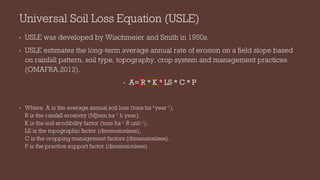
Universal Soil Loss Equation (USLE)
• USLE was developed by Wischmeier and Smith in 1950s.
• USLE estimates the long-term average annual rate of erosion on a field slope based
on rainfall pattern, soil type, topography, crop system and management practices
(OMAFRA,2012).
• A= R * K * LS * C * P
• Where, A is the average annual soil loss (tons ha-1year-1),
R is the rainfall erosivity (MJmm ha-1 h-1 year-1),
K is the soil erodibility factor (tons ha-1 R unit-1),
LS is the topographic factor (dimensionless),
C is the cropping management factors (dimensionless),
P is the practice support factor (dimensionless)
Rainfall Erosivity (R)
• Rainfall erosivity is the kinetic energy of raindrop’s impact and the rate of associated
runoff.
• Data source: Global Rainfall Erosivity (https://esdac.jrc.ec.europa.eu/content/global-
rainfall-erosivity)
• Spatial coverage: World
• Pixel size: 30 arc-seconds (~ 1 km at the equator)
• Limitation: It can overestimate the soil erosion.
Soil Erodibility (K)
• Soil erodibility represents the effect of soil properties and soil profile characteristics
on soil loss.
• Data source: Harmonized World Soil Database v 1.2
(https://webarchive.iiasa.ac.at/Research/LUC/External-World-soil-database/HTML/)
• Spatial coverage: World
• Pixel size: 30 arc-seconds (~ 1 km at the equator)
• Limitation: It can overestimate the soil erosion.
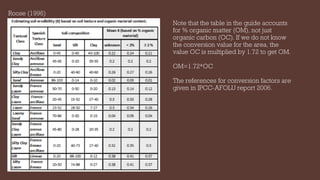
Roose (1996)
Note that the table in the guide accounts
for % organic matter (OM), not just
organic carbon (OC). If we do not know
the conversion value for the area, the
value OC is multiplied by 1.72 to get OM.
OM=1.72*OC
The references for conversion factors are
given in IPCC-AFOLU report 2006.
Universal Soil Loss Equation (USLE)
• USLE was developed by Wischmeier and Smith in 1950s.
• USLE estimates the long-term average annual rate of erosion on a field slope based
on rainfall pattern, soil type, topography, crop system and management practices
(OMAFRA,2012).
• A= R * K * LS * C * P
• Where, A is the average annual soil loss (tons ha-1year-1),
R is the rainfall erosivity (MJmm ha-1 h year),
K is the soil erodibility factor (tons ha-1 R unit-1),
LS is the topographic factor (dimensionless),
C is the cropping management factors (dimensionless),
P is the practice support factor (dimensionless)
Topographic factor (LS)
• Topographic factors LS consist of slope length L and slope steepness S.
• Increase in the slope length L causes increase in erosion due to a progressive
accumulation of runoff in the direction of downslope.
• Increase in slope steepness factor S increase the soil erosion as a result of increasing
velocity.
L = [(FA * cell size)/22.13]m (Moore and Wilson, 1992)
• where, FA is flow accumulation, cell size is the size of DEM and m ranges from 0.2-0.6.
• S = [(sinβ * 0.01745)/0.09]n
• where, β is slope angle in percentage, n ranges from 1.0 -1.3.
• LS = (L * S)/100
• DEM data source: SRTM (30 m) (https://dwtkns.com/srtm30m/)
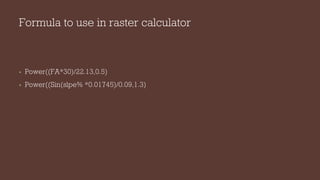
Formula to use in raster calculator
• Power((FA*30)/22.13,0.5)
• Power((Sin(slpe% *0.01745)/0.09,1.3)
Crop /vegetation and management factor (C)
• Used to determine the relative effectiveness of soil and crop management systems in
preventing soil loss.
• Value can be assigned for different landcover classes from look-up table in literatures.
• Landcover data source: Sentinel-2 Land Use/Land Cover (10 m)
(https://www.arcgis.com/apps/instant/media/index.html?appid=fc92d38533d440078f1
7678ebc20e8e2)
Support practice factor (P)
• It reflects the effects of practices that will reduce the amount and rate of the water
runoff and thus reduce the amount of erosion.
• Values are obtained from literatures based on the farmers practices.
• For easy interpretation, we can used 1 irrespective of landcover classes.
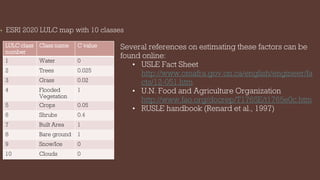
• ESRI 2020 LULC map with 10 classes
LULC class
number
Class name C value
1 Water 0
2 Trees 0.025
3 Grass 0.02
4 Flooded
Vegetation
1
5 Crops 0.05
6 Shrubs 0.4
7 Built Area 1
8 Bare ground 1
9 Snow/Ice 0
10 Clouds 0
Several references on estimating these factors can be
found online:
• USLE Fact Sheet
http://www.omafra.gov.on.ca/english/engineer/fa
cts/12-051.htm
• U.N. Food and Agriculture Organization
http://www.fao.org/docrep/T1765E/t1765e0c.htm
• RUSLE handbook (Renard et al., 1997)
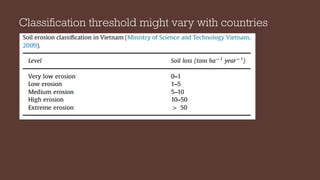
Classification threshold might vary with countries
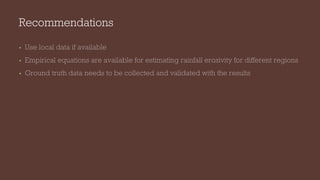
Recommendations
•
•
•
• Supporting links:
• https://www.researchgate.net/publication/322371635_Integrated_universal_soil_loss_
equation_USLE_and_Geographical_Information_System_GIS_for_soil_erosion_estim
ation_in_A_Sap_basin_Central_Vietnam
• https://www.researchgate.net/publication/325402279_Estimation_of_Slope_Length_fa
ctor_L_and_Slope_Steepness_Factor_S_of_RUSLE_equation_in_the_Euphrates_River
_Watershed_by_GIS

Soil Loss_GeoDev.pdf

  • 1.
  • 2.
    Universal Soil LossEquation (USLE) • USLE was developed by Wischmeier and Smith in 1950s. • USLE estimates the long-term average annual rate of erosion on a field slope based on rainfall pattern, soil type, topography, crop system and management practices (OMAFRA,2012). • A= R * K * LS * C * P • Where, A is the average annual soil loss (tons ha-1year-1), R is the rainfall erosivity (MJmm ha-1 h-1 year-1), K is the soil erodibility factor (tons ha-1 R unit-1), LS is the topographic factor (dimensionless), C is the cropping management factors (dimensionless), P is the practice support factor (dimensionless)
  • 3.
    Rainfall Erosivity (R) •Rainfall erosivity is the kinetic energy of raindrop’s impact and the rate of associated runoff. • Data source: Global Rainfall Erosivity (https://esdac.jrc.ec.europa.eu/content/global- rainfall-erosivity) • Spatial coverage: World • Pixel size: 30 arc-seconds (~ 1 km at the equator) • Limitation: It can overestimate the soil erosion.
  • 4.
    Soil Erodibility (K) •Soil erodibility represents the effect of soil properties and soil profile characteristics on soil loss. • Data source: Harmonized World Soil Database v 1.2 (https://webarchive.iiasa.ac.at/Research/LUC/External-World-soil-database/HTML/) • Spatial coverage: World • Pixel size: 30 arc-seconds (~ 1 km at the equator) • Limitation: It can overestimate the soil erosion.
  • 5.
    Roose (1996) Note thatthe table in the guide accounts for % organic matter (OM), not just organic carbon (OC). If we do not know the conversion value for the area, the value OC is multiplied by 1.72 to get OM. OM=1.72*OC The references for conversion factors are given in IPCC-AFOLU report 2006.
  • 6.
    Universal Soil LossEquation (USLE) • USLE was developed by Wischmeier and Smith in 1950s. • USLE estimates the long-term average annual rate of erosion on a field slope based on rainfall pattern, soil type, topography, crop system and management practices (OMAFRA,2012). • A= R * K * LS * C * P • Where, A is the average annual soil loss (tons ha-1year-1), R is the rainfall erosivity (MJmm ha-1 h year), K is the soil erodibility factor (tons ha-1 R unit-1), LS is the topographic factor (dimensionless), C is the cropping management factors (dimensionless), P is the practice support factor (dimensionless)
  • 7.
    Topographic factor (LS) •Topographic factors LS consist of slope length L and slope steepness S. • Increase in the slope length L causes increase in erosion due to a progressive accumulation of runoff in the direction of downslope. • Increase in slope steepness factor S increase the soil erosion as a result of increasing velocity. L = [(FA * cell size)/22.13]m (Moore and Wilson, 1992) • where, FA is flow accumulation, cell size is the size of DEM and m ranges from 0.2-0.6. • S = [(sinβ * 0.01745)/0.09]n • where, β is slope angle in percentage, n ranges from 1.0 -1.3. • LS = (L * S)/100 • DEM data source: SRTM (30 m) (https://dwtkns.com/srtm30m/)
  • 8.
    Formula to usein raster calculator • Power((FA*30)/22.13,0.5) • Power((Sin(slpe% *0.01745)/0.09,1.3)
  • 9.
    Crop /vegetation andmanagement factor (C) • Used to determine the relative effectiveness of soil and crop management systems in preventing soil loss. • Value can be assigned for different landcover classes from look-up table in literatures. • Landcover data source: Sentinel-2 Land Use/Land Cover (10 m) (https://www.arcgis.com/apps/instant/media/index.html?appid=fc92d38533d440078f1 7678ebc20e8e2) Support practice factor (P) • It reflects the effects of practices that will reduce the amount and rate of the water runoff and thus reduce the amount of erosion. • Values are obtained from literatures based on the farmers practices. • For easy interpretation, we can used 1 irrespective of landcover classes.
  • 10.
    • ESRI 2020LULC map with 10 classes LULC class number Class name C value 1 Water 0 2 Trees 0.025 3 Grass 0.02 4 Flooded Vegetation 1 5 Crops 0.05 6 Shrubs 0.4 7 Built Area 1 8 Bare ground 1 9 Snow/Ice 0 10 Clouds 0 Several references on estimating these factors can be found online: • USLE Fact Sheet http://www.omafra.gov.on.ca/english/engineer/fa cts/12-051.htm • U.N. Food and Agriculture Organization http://www.fao.org/docrep/T1765E/t1765e0c.htm • RUSLE handbook (Renard et al., 1997)
  • 11.
    Classification threshold mightvary with countries
  • 12.
  • 13.
    • Supporting links: •https://www.researchgate.net/publication/322371635_Integrated_universal_soil_loss_ equation_USLE_and_Geographical_Information_System_GIS_for_soil_erosion_estim ation_in_A_Sap_basin_Central_Vietnam • https://www.researchgate.net/publication/325402279_Estimation_of_Slope_Length_fa ctor_L_and_Slope_Steepness_Factor_S_of_RUSLE_equation_in_the_Euphrates_River _Watershed_by_GIS