GLOBALSYMPOSIUMONSOILPOLLUTION
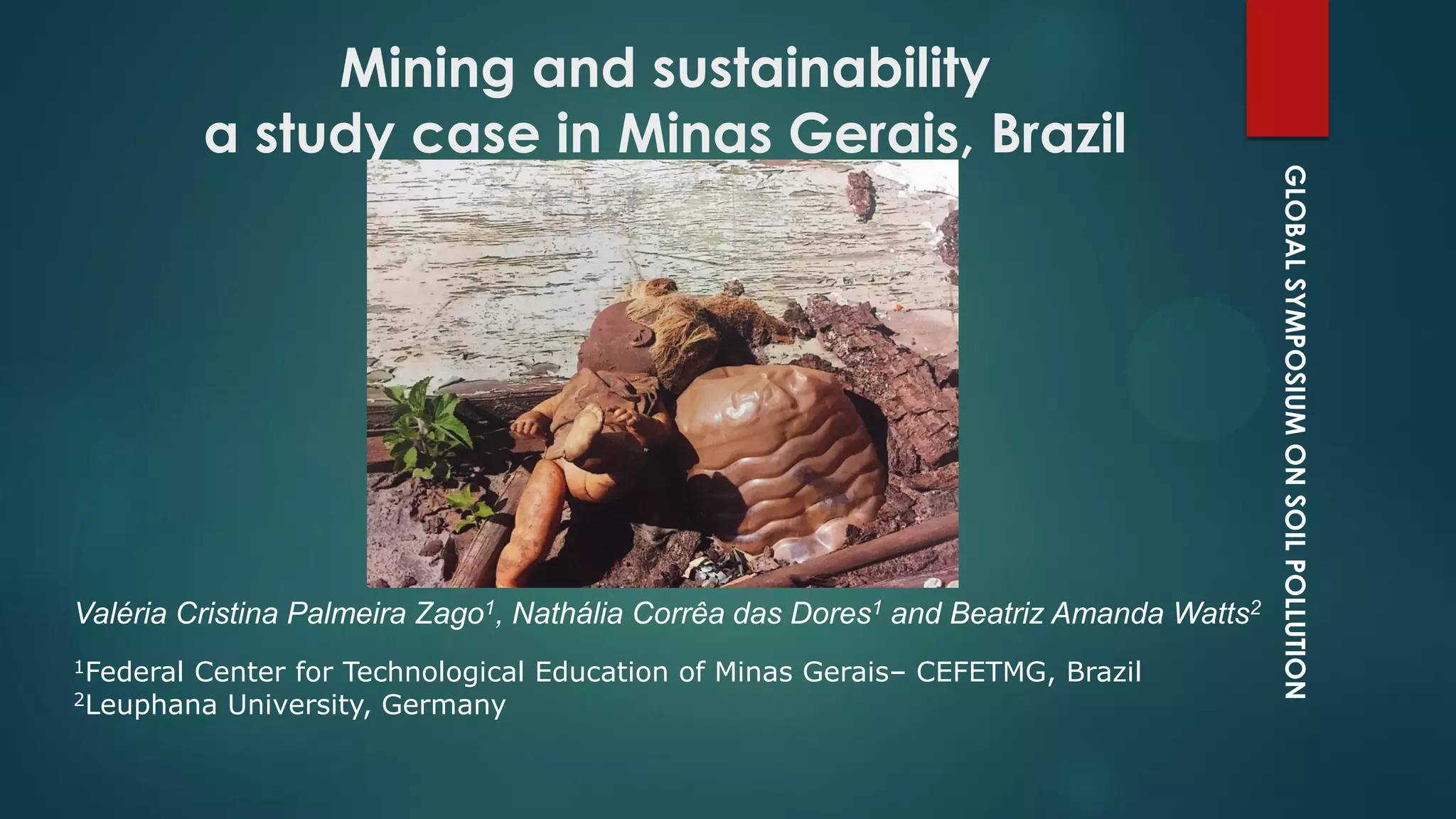
Mining and sustainability
a study case in Minas Gerais, Brazil
Valéria Cristina Palmeira Zago1, Nathália Corrêa das Dores1 and Beatriz Amanda Watts2
1Federal Center for Technological Education of Minas Gerais– CEFETMG, Brazil
2Leuphana University, Germany
GLOBALSYMPOSIUMONSOILPOLLUTION
Introduction
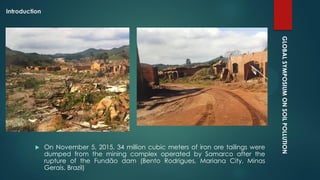
 On November 5, 2015, 34 million cubic meters of iron ore tailings were
dumped from the mining complex operated by Samarco after the
rupture of the Fundão dam (Bento Rodrigues, Mariana City, Minas
Gerais, Brazil)
GLOBALSYMPOSIUMONSOILPOLLUTION
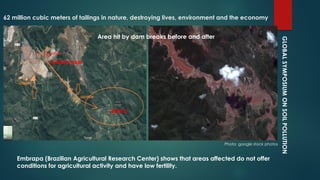
62 million cubic meters of tailings in nature, destroying lives, environment and the economy
Photo: google stock photos
FUNDÃO DAM
BENTO
Area hit by dam breaks before and after
Embrapa (Brazilian Agricultural Research Center) shows that areas affected do not offer
conditions for agricultural activity and have low fertility.
GLOBALSYMPOSIUMONSOILPOLLUTION
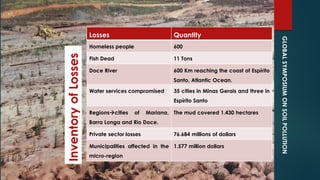
InventoryofLosses
Losses Quantity
Homeless people 600
Fish Dead 11 Tons
Doce River 600 Km reaching the coast of Espírito
Santo, Atlantic Ocean.
Water services compromised 35 cities in Minas Gerais and three in
Espírito Santo
Regionscities of Mariana,
Barra Longa and Rio Doce.
The mud covered 1.430 hectares
Private sector losses 76.684 millions of dollars
Municipalities affected in the
micro-region
1.577 million dollars
GLOBALSYMPOSIUMONSOILPOLLUTION
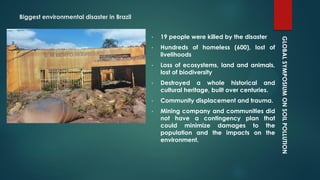
Biggest environmental disaster in Brazil
• 19 people were killed by the disaster
• Hundreds of homeless (600), lost of
livelihoods
• Loss of ecosystems, land and animals,
lost of biodiversity
• Destroyed a whole historical and
cultural heritage, built over centuries.
• Community displacement and trauma.
• Mining company and communities did
not have a contingency plan that
could minimize damages to the
population and the impacts on the
environment.
GLOBALSYMPOSIUMONSOILPOLLUTION
Aims
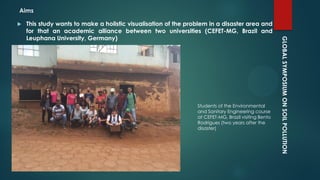
 This study wants to make a holistic visualisation of the problem in a disaster area and
for that an academic alliance between two universities (CEFET-MG, Brazil and
Leuphana University, Germany)
Students of the Environmental
and Sanitary Engineering course
at CEFET-MG, Brazil visiting Bento
Rodrigues (two years after the
disaster)
GLOBALSYMPOSIUMONSOILPOLLUTION
Photo: Leonardo Merçon
Aims
This study highlights the main points in which mining could improve their approach to
become more sustainable.
The sustainable development goals are attempted to cover here:
 Goal number 15 about land and diversity restoration
 Goal number 6 of improving water quality through reduction of pollution
 Goal number 12 about supporting sustainable consumption and production
patterns.
GLOBALSYMPOSIUMONSOILPOLLUTION
Methodology
 Awareness Campaing
 The legal aspects
 Webpage, stickers, petitions
 Relationship in the supply chain between the minerals extracted in Brazil and
the everyday consumer items were exposed.
 Literature review about best phytoremediation plants for the region was drawn.
 In Brazil, students made visits to the site of the disaster
 Covering the environmental and aspects Interviews with the affected residents
and authorities of the municipality of Mariana-MG
GLOBALSYMPOSIUMONSOILPOLLUTION
Methodology
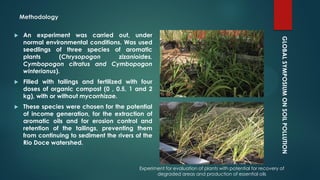
 An experiment was carried out, under
normal environmental conditions. Was used
seedlings of three species of aromatic
plants (Chrysopogon zizanioides,
Cymbopogon citratus and Cymbopogon
winterianus).
 Filled with tailings and fertilized with four
doses of organic compost (0 , 0.5, 1 and 2
kg), with or without mycorrhizae.
 These species were chosen for the potential
of income generation, for the extraction of
aromatic oils and for erosion control and
retention of the tailings, preventing them
from continuing to sediment the rivers of the
Rio Doce watershed.
Experiment for evaluation of plants with potential for recovery of
degraded areas and production of essential oils
GLOBALSYMPOSIUMONSOILPOLLUTION
Results
Awareness campaign: Leuphana Conference week and website.
GLOBALSYMPOSIUMONSOILPOLLUTION
Community
Lecturers
The lectures became
partners with the students
on the development of
the project
Trans disciplinary sustainability
education gives freedom to
propose solutions tailored to
receptor communities without
subordination to the own
agenda
Students teams
https://samarcodisaster.jimdo.com/
GLOBALSYMPOSIUMONSOILPOLLUTION
Long-term
Reclamation
Plan
GLOBALSYMPOSIUMONSOILPOLLUTION
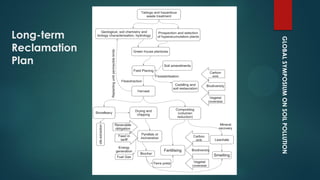
Long-term Reclamation Plan
 Long-term reclamation plan involves the characterisation of the
soil, prospection and selection of the best plants for
phytoremediation. The growing of the plans in a green house
and posterior field planting. Depending on the type of chosen
plant the technique would be phytostabilisation or
phytoextraction.
 With phytoextraction, the biomass is harvested and have various
possibilities. To extract the oils from the plans to be used in the
cosmetic industry. The biomass could also be dry and chipped
and undergo a pyrolysis process for energy generation leaving
the ash request with heavy metals that could go to the smelting
process and another part to be terra petra. Another possibility
could be for the biomass to be composted and leached the
heavy metals leaving another part of the biomass as a fertiliser.
GLOBALSYMPOSIUMONSOILPOLLUTION
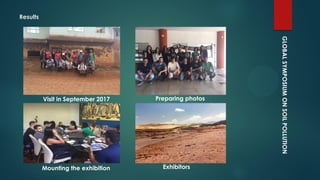
Results
Visit in September 2017 Preparing photos
Mounting the exhibition Exhibitors
GLOBALSYMPOSIUMONSOILPOLLUTION
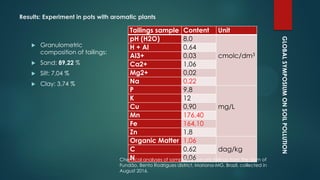
Results: Experiment in pots with aromatic plants
 Granulometric
composition of tailings:
 Sand: 89,22 %
 Silt: 7,04 %
 Clay: 3,74 %
Tailings sample Content Unit
pH (H2O) 8,0
cmolc/dm3
H + Al 0,64
Al3+ 0,03
Ca2+ 1,06
Mg2+ 0,02
Na 0,22
P 9,8
mg/L
K 12
Cu 0,90
Mn 176,40
Fe 164,10
Zn 1,8
Organic Matter 1,06
dag/kgC 0,62
N 0,06Chemical analyses of samples of iron ore tailings from the dam of
Fundão, Bento Rodrigues district, Mariana-MG, Brazil, collected in
August 2016.
GLOBALSYMPOSIUMONSOILPOLLUTION
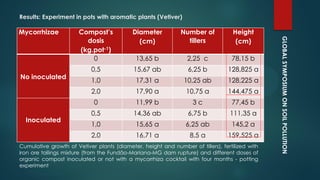
Mycorrhizae Compost’s
dosis
(kg.pot-1)
Diameter
(cm)
Number of
tillers
Height
(cm)
No inoculated
0 13,65 b 2,25 c 78,15 b
0,5 15,67 ab 6,25 b 128,825 a
1,0 17,31 a 10,25 ab 128,225 a
2,0 17,90 a 10,75 a 144,475 a
Inoculated
0 11,99 b 3 c 77,45 b
0,5 14,36 ab 6,75 b 111,35 a
1,0 15,65 a 6,25 ab 145,2 a
2,0 16,71 a 8,5 a 159,525 a
Results: Experiment in pots with aromatic plants (Vetiver)
Cumulative growth of Vetiver plants (diameter, height and number of tillers), fertilized with
iron ore tailings mixture (from the Fundão-Mariana-MG dam rupture) and different doses of
organic compost inoculated or not with a mycorrhiza cocktail with four months - potting
experiment
GLOBALSYMPOSIUMONSOILPOLLUTION
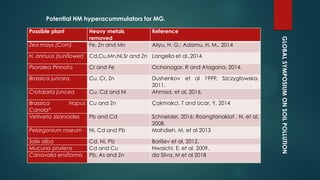
Potential HM hyperacummulators for MG.
Possible plant Heavy metals
removed
Reference
Zea mays (Corn) Fe, Zn and Mn Aliyu, H. G.; Adamu, H. M., 2014
H. annuus (sunflower) Cd,Cu,Mn,Ni,Sr and Zn Langella et al.,2014
Psoralea Pinnata Cr and Fe Ochonogor, R and Atagana, 2014.
Brassica juncea, Cu, Cr, Zn Dushenkov et al 1999; Szczygłowska,
2011.
Crotalaria juncea Cu, Cd and Ni Ahmad, et al, 2016.
Brassica Napus
Canola*
Cu and Zn Çakmakci, T and Ucar, Y, 2014
Vetiveria zizanoides Pb and Cd Schneider, 2016; Roongtanakiat , N. et al.
2008.
Pelargonium roseum Ni, Cd and Pb Mahdieh, M, et al 2013
Salix alba Cd, Ni, Pb Borišev et al, 2012.
Mucuna pruriens Cd and Cu Nwaichi, E. et al, 2009.
Canavalia ensiformis Pb, As and Zn da Silva, M et al 2018
GLOBALSYMPOSIUMONSOILPOLLUTION
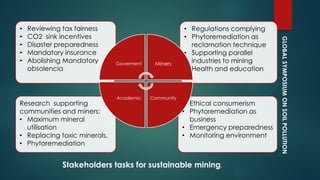
• Reviewing tax fairness
• CO2 sink incentives
• Disaster preparedness
• Mandatory insurance
• Abolishing Mandatory
obsolencia
Research supporting
communities and miners:
• Maximum mineral
utilisation
• Replacing toxic minerals.
• Phytoremediation
• Ethical consumerism
• Phytoremediation as
business
• Emergency preparedness
• Monitoring environment
• Regulations complying
• Phytoremediation as
reclamation technique
• Supporting parallel
industries to mining
• Health and education
Goverment Miners
CommunityAcademic
Stakeholders tasks for sustainable mining.
GLOBALSYMPOSIUMONSOILPOLLUTION
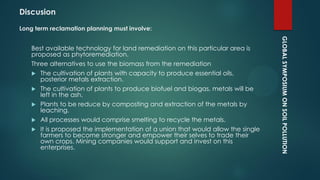
Long term reclamation planning must involve:
Best available technology for land remediation on this particular area is
proposed as phytoremediation.
Three alternatives to use the biomass from the remediation
 The cultivation of plants with capacity to produce essential oils,
posterior metals extraction.
 The cultivation of plants to produce biofuel and biogas, metals will be
left in the ash.
 Plants to be reduce by composting and extraction of the metals by
leaching.
 All processes would comprise smelting to recycle the metals.
 It is proposed the implementation of a union that would allow the single
farmers to become stronger and empower their selves to trade their
own crops. Mining companies would support and invest on this
enterprises.
Discusion
GLOBALSYMPOSIUMONSOILPOLLUTION
Discussion:
Sustainable mining practices need to have a heuristic approach to the prevention of disasters
but also in ecosystem remediation planning for the normal operation. It is necessary good
practices such as:
 Empowering the community to monitor the environmental limits and cooperating with them
on Emergency Drill's planning.
 Consumption reduction, replacing minerals with biomaterials, Making mandatory
obsolescence an illegal practice.
 Ethical consumption of minerals from free conflict areas and fair trade, Knowledge is the base
to chose as a consumer. Ethical consumerism gives a governance power to influence the
fairness of mineral extraction.
 Better utilization of mine waste as a resource and developing novel technologies to extract
maximum of metals.
 Supporting and promoting agricultural industries parallel to mining, Investing in community
education and health.
 Enforcement of legislative measures to plan the budget for an eventual accident or
purchasing a compulsory insurance for the mining companies to mitigate the damages.
 To give miners an incentive for CO2 sink in fitoremediation projects.
 Treating the hazardous waste, proper disposal of tailings.
 Remediation of the contaminated soil depending on the physicochemical characterization
of the soil, with processes that may involve physical removal, neutralizing hazardous material,
bio-sorption and finally managing the mines waste through bioremediation.
GLOBALSYMPOSIUMONSOILPOLLUTION
Discussion: Experiment in pots with aromatic plants
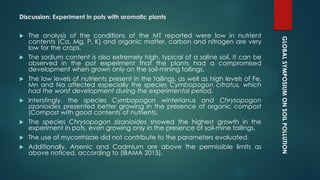
 The analysis of the conditions of the MT reported were low in nutrient
contents (Ca, Mg, P, K) and organic matter, carbon and nitrogen are very
low for the crops.
 The sodium content is also extremely high, typical of a saline soil. It can be
observed in the pot experiment that the plants had a compromised
development when grown only on the soil-mining tailings.
 The low levels of nutrients present in the tailings, as well as high levels of Fe,
Mn and Na affected especially the species Cymbopogon citratus, which
had the worst development during the experimental period.
 Interstingly, the species Cymbopogon winterianus and Chrysopogon
zizanioides presented better growing in the presence of organic compost
(Compost with good contents of nutrients.
 The species Chrysopogon zizanioides showed the highest growth in the
experiment in pots, even growing only in the presence of soil-mine tailings.
 The use of mycorrhizae did not contribute to the parameters evaluated.
 Additionally, Arsenic and Cadmium are above the permissible limits as
above noticed, according to (IBAMA 2015).
GLOBALSYMPOSIUMONSOILPOLLUTION
Discussion: Experiment in pots with aromatic plants
 Chrysopogon zizanioides is widely used in reclamation projects in
degraded areas. In order to evaluate the effect of the herbicide
treatment on the soil, it is important to note that there is a significant
difference in the soil fertility of the Vetiver and the Pb / Zn soil (Wu et
al. 2011).
 This species is considered as one of the most versatile crops of the
millennium based on its numerous qualities, such as a thick and
deep root system and tolerances to adverse conditions (high levels
of heavy metals, acid or very alkaline soils, large temperature
ranges, etc.) (Khan 2006; Saeb et al. 2015).
GLOBALSYMPOSIUMONSOILPOLLUTION
Conclusions and Recommendations
 Sustainable mining practices need to have a heuristic approach on
prevention of disasters but also on ecosystem remediation.
 Therefore good practices such as community preparedness, consumption
reduction, fair trade, supporting additional industries parallel to mining,
investing on community education and health are necessary as well as
managing the mining waste in environmental sound way, effective
contingency plan and a compulsory insurance for the mining companies
are necessary as a prevention measure so that in case of a disaster the
impact would be minimal.
 After a disaster it is necessary the characterisation of the soil and water and
phytoremediation of the contaminated water and soil.
 The use of less fertile plants, associated with the use of low cost fertilizers,
such as composting of urban or rural organic waste, can make a significant
contribution to the gradual recovery of the recovery potential of that area.
 The use of vetiver (Chrysopogon zizanioides) to field in local disaster
conditions is suggested, helping to control soil erosion and can generate
economic income for the affected residents.
GLOBALSYMPOSIUMONSOILPOLLUTION
Acknowledgements
 To the two groups of students from Leuphana University, during the
seminar “Mining and sustainability”.
 To students of the Environmental and Sanitary Engineering of the
Federal Center of Technological Education of Minas Gerais, during
the discipline "Recuperation of Degraded Areas”, between 2016-
2017.
 To CEFET-MG for transport assistance for technical visits
GLOBALSYMPOSIUMONSOILPOLLUTION
References
 Langella, Francesca; Grawunder, Anja; Stark, Romy; Weist, Aileen; Merten, Dirk; Haferburg,
Götz et al. (2014): Microbially assisted phytoremediation approaches for two multi-element
contaminated sites. In: Environmental science and pollution research international 21 (11),
S. 6845–6858. DOI: 10.1007/s11356-013-2165-0.
 Ochonogor, Richie O.; Atagana, Harrison I. (2014): Phytoremediation of Heavy Metal
Contaminated Soil by Psoralea Pinnata. In: IJESD 5 (5), 449-443. DOI:
10.7763/IJESD.2014.V5.524.
 Carmo, Flávio Fonseca do; Kamino, Luciana Hiromi Yoshino; Junior, Rogério Tobias;
Campos, Iara Christina de; Carmo, Felipe Fonseca do; Silvino, Guilherme et al. (2017):
Fundão tailings dam failures. The environment tragedy of the largest technological disaster
of Brazilian mining in global context. In: Perspectives in Ecology and Conservation 15 (3), S.
145–151. DOI: 10.1016/j.pecon.2017.06.002.
 Szczygłowska, M., Piekarska, A., Konieczka, P., & Namieśnik, J. (2011). Use of Brassica Plants
in the Phytoremediation and Biofumigation Processes. International Journal of Molecular
Sciences, 12(11), 7760–7771. http://doi.org/10.3390/ijms12117760
GLOBALSYMPOSIUMONSOILPOLLUTION
 Aliyu, H. G.; Adamu, H. M., 2014. “The Potential of Maize as Phytoremediation Tool of Heavy
Metals”, European Scientific Journal, vol.10
 Mahdieh, Majid; Yazdani, Mojtaba; Mahdieh, Shahla (2013): The high potential of Pelargonium
roseum plant for phytoremediation of heavy metals. In Environmental monitoring and assessment
185 (9), pp. 7877–7881. DOI: 10.1007/s10661-013-3141-3.
 Borišev, Milan; Pajević, Slobodanka; Nikolić, Nataša; Borivoj, K.; Župunski, Milan; Kebert, Marko et
al. (2012): Response of Salix alba L. to heavy metals and diesel fuel contamination. In Afr J
Biotechnol 11. DOI: 10.5897/AJB12.1004.
 Nwaichi, E., Wegwu, M., Onyeike, E., 2009. Phytoextracting cadmium and copper using Mucuna
pruriens Vol. 3 (12), pp. 277-282.
 da Silva, M; de Andrade, Sara Adrián López; De-Campos, Alfredo Borges (2018):
Phytoremediation Potential of Jack Bean Plant for Multi-Element Contaminated Soils From Ribeira
Valley, Brazil. In Clean - Soil, Air, Water 64, p. 1700321. DOI: 10.1002/clen.201700321
 Ahmad, Rafiq; Tehsin, Zara; Malik, Samina Tanvir; Asad, Saeed Ahmad; Shahzad, Muhammad;
Bilal, Muhammad et al. (2016): Phytoremediation Potential of Hemp (Cannabis sativa L.).
Identification and Characterization of Heavy Metals Responsive Genes. In Clean Soil Air Water 44
(2), pp. 195–201. DOI: 10.1002/clen.201500117.
GLOBALSYMPOSIUMONSOILPOLLUTION
Thanks!

Mining and sustainability -a study case in Minas Gerais, Brazil

  • 1.
    GLOBALSYMPOSIUMONSOILPOLLUTION Mining and sustainability astudy case in Minas Gerais, Brazil Valéria Cristina Palmeira Zago1, Nathália Corrêa das Dores1 and Beatriz Amanda Watts2 1Federal Center for Technological Education of Minas Gerais– CEFETMG, Brazil 2Leuphana University, Germany
  • 2.
    GLOBALSYMPOSIUMONSOILPOLLUTION Introduction  On November5, 2015, 34 million cubic meters of iron ore tailings were dumped from the mining complex operated by Samarco after the rupture of the Fundão dam (Bento Rodrigues, Mariana City, Minas Gerais, Brazil)
  • 3.
    GLOBALSYMPOSIUMONSOILPOLLUTION 62 million cubicmeters of tailings in nature, destroying lives, environment and the economy Photo: google stock photos FUNDÃO DAM BENTO Area hit by dam breaks before and after Embrapa (Brazilian Agricultural Research Center) shows that areas affected do not offer conditions for agricultural activity and have low fertility.
  • 4.
    GLOBALSYMPOSIUMONSOILPOLLUTION InventoryofLosses Losses Quantity Homeless people600 Fish Dead 11 Tons Doce River 600 Km reaching the coast of Espírito Santo, Atlantic Ocean. Water services compromised 35 cities in Minas Gerais and three in Espírito Santo Regionscities of Mariana, Barra Longa and Rio Doce. The mud covered 1.430 hectares Private sector losses 76.684 millions of dollars Municipalities affected in the micro-region 1.577 million dollars
  • 5.
    GLOBALSYMPOSIUMONSOILPOLLUTION Biggest environmental disasterin Brazil • 19 people were killed by the disaster • Hundreds of homeless (600), lost of livelihoods • Loss of ecosystems, land and animals, lost of biodiversity • Destroyed a whole historical and cultural heritage, built over centuries. • Community displacement and trauma. • Mining company and communities did not have a contingency plan that could minimize damages to the population and the impacts on the environment.
  • 6.
    GLOBALSYMPOSIUMONSOILPOLLUTION Aims  This studywants to make a holistic visualisation of the problem in a disaster area and for that an academic alliance between two universities (CEFET-MG, Brazil and Leuphana University, Germany) Students of the Environmental and Sanitary Engineering course at CEFET-MG, Brazil visiting Bento Rodrigues (two years after the disaster)
  • 7.
    GLOBALSYMPOSIUMONSOILPOLLUTION Photo: Leonardo Merçon Aims Thisstudy highlights the main points in which mining could improve their approach to become more sustainable. The sustainable development goals are attempted to cover here:  Goal number 15 about land and diversity restoration  Goal number 6 of improving water quality through reduction of pollution  Goal number 12 about supporting sustainable consumption and production patterns.
  • 8.
    GLOBALSYMPOSIUMONSOILPOLLUTION Methodology  Awareness Campaing The legal aspects  Webpage, stickers, petitions  Relationship in the supply chain between the minerals extracted in Brazil and the everyday consumer items were exposed.  Literature review about best phytoremediation plants for the region was drawn.  In Brazil, students made visits to the site of the disaster  Covering the environmental and aspects Interviews with the affected residents and authorities of the municipality of Mariana-MG
  • 9.
    GLOBALSYMPOSIUMONSOILPOLLUTION Methodology  An experimentwas carried out, under normal environmental conditions. Was used seedlings of three species of aromatic plants (Chrysopogon zizanioides, Cymbopogon citratus and Cymbopogon winterianus).  Filled with tailings and fertilized with four doses of organic compost (0 , 0.5, 1 and 2 kg), with or without mycorrhizae.  These species were chosen for the potential of income generation, for the extraction of aromatic oils and for erosion control and retention of the tailings, preventing them from continuing to sediment the rivers of the Rio Doce watershed. Experiment for evaluation of plants with potential for recovery of degraded areas and production of essential oils
  • 10.
  • 11.
    GLOBALSYMPOSIUMONSOILPOLLUTION Community Lecturers The lectures became partnerswith the students on the development of the project Trans disciplinary sustainability education gives freedom to propose solutions tailored to receptor communities without subordination to the own agenda Students teams https://samarcodisaster.jimdo.com/
  • 12.
  • 13.
    GLOBALSYMPOSIUMONSOILPOLLUTION Long-term Reclamation Plan Long-term reclamation plan involves the characterisation of the soil, prospection and selection of the best plants for phytoremediation. The growing of the plans in a green house and posterior field planting. Depending on the type of chosen plant the technique would be phytostabilisation or phytoextraction.  With phytoextraction, the biomass is harvested and have various possibilities. To extract the oils from the plans to be used in the cosmetic industry. The biomass could also be dry and chipped and undergo a pyrolysis process for energy generation leaving the ash request with heavy metals that could go to the smelting process and another part to be terra petra. Another possibility could be for the biomass to be composted and leached the heavy metals leaving another part of the biomass as a fertiliser.
  • 14.
    GLOBALSYMPOSIUMONSOILPOLLUTION Results Visit in September2017 Preparing photos Mounting the exhibition Exhibitors
  • 15.
    GLOBALSYMPOSIUMONSOILPOLLUTION Results: Experiment inpots with aromatic plants  Granulometric composition of tailings:  Sand: 89,22 %  Silt: 7,04 %  Clay: 3,74 % Tailings sample Content Unit pH (H2O) 8,0 cmolc/dm3 H + Al 0,64 Al3+ 0,03 Ca2+ 1,06 Mg2+ 0,02 Na 0,22 P 9,8 mg/L K 12 Cu 0,90 Mn 176,40 Fe 164,10 Zn 1,8 Organic Matter 1,06 dag/kgC 0,62 N 0,06Chemical analyses of samples of iron ore tailings from the dam of Fundão, Bento Rodrigues district, Mariana-MG, Brazil, collected in August 2016.
  • 16.
    GLOBALSYMPOSIUMONSOILPOLLUTION Mycorrhizae Compost’s dosis (kg.pot-1) Diameter (cm) Number of tillers Height (cm) Noinoculated 0 13,65 b 2,25 c 78,15 b 0,5 15,67 ab 6,25 b 128,825 a 1,0 17,31 a 10,25 ab 128,225 a 2,0 17,90 a 10,75 a 144,475 a Inoculated 0 11,99 b 3 c 77,45 b 0,5 14,36 ab 6,75 b 111,35 a 1,0 15,65 a 6,25 ab 145,2 a 2,0 16,71 a 8,5 a 159,525 a Results: Experiment in pots with aromatic plants (Vetiver) Cumulative growth of Vetiver plants (diameter, height and number of tillers), fertilized with iron ore tailings mixture (from the Fundão-Mariana-MG dam rupture) and different doses of organic compost inoculated or not with a mycorrhiza cocktail with four months - potting experiment
  • 17.
    GLOBALSYMPOSIUMONSOILPOLLUTION Potential HM hyperacummulatorsfor MG. Possible plant Heavy metals removed Reference Zea mays (Corn) Fe, Zn and Mn Aliyu, H. G.; Adamu, H. M., 2014 H. annuus (sunflower) Cd,Cu,Mn,Ni,Sr and Zn Langella et al.,2014 Psoralea Pinnata Cr and Fe Ochonogor, R and Atagana, 2014. Brassica juncea, Cu, Cr, Zn Dushenkov et al 1999; Szczygłowska, 2011. Crotalaria juncea Cu, Cd and Ni Ahmad, et al, 2016. Brassica Napus Canola* Cu and Zn Çakmakci, T and Ucar, Y, 2014 Vetiveria zizanoides Pb and Cd Schneider, 2016; Roongtanakiat , N. et al. 2008. Pelargonium roseum Ni, Cd and Pb Mahdieh, M, et al 2013 Salix alba Cd, Ni, Pb Borišev et al, 2012. Mucuna pruriens Cd and Cu Nwaichi, E. et al, 2009. Canavalia ensiformis Pb, As and Zn da Silva, M et al 2018
  • 18.
    GLOBALSYMPOSIUMONSOILPOLLUTION • Reviewing taxfairness • CO2 sink incentives • Disaster preparedness • Mandatory insurance • Abolishing Mandatory obsolencia Research supporting communities and miners: • Maximum mineral utilisation • Replacing toxic minerals. • Phytoremediation • Ethical consumerism • Phytoremediation as business • Emergency preparedness • Monitoring environment • Regulations complying • Phytoremediation as reclamation technique • Supporting parallel industries to mining • Health and education Goverment Miners CommunityAcademic Stakeholders tasks for sustainable mining.
  • 19.
    GLOBALSYMPOSIUMONSOILPOLLUTION Long term reclamationplanning must involve: Best available technology for land remediation on this particular area is proposed as phytoremediation. Three alternatives to use the biomass from the remediation  The cultivation of plants with capacity to produce essential oils, posterior metals extraction.  The cultivation of plants to produce biofuel and biogas, metals will be left in the ash.  Plants to be reduce by composting and extraction of the metals by leaching.  All processes would comprise smelting to recycle the metals.  It is proposed the implementation of a union that would allow the single farmers to become stronger and empower their selves to trade their own crops. Mining companies would support and invest on this enterprises. Discusion
  • 20.
    GLOBALSYMPOSIUMONSOILPOLLUTION Discussion: Sustainable mining practicesneed to have a heuristic approach to the prevention of disasters but also in ecosystem remediation planning for the normal operation. It is necessary good practices such as:  Empowering the community to monitor the environmental limits and cooperating with them on Emergency Drill's planning.  Consumption reduction, replacing minerals with biomaterials, Making mandatory obsolescence an illegal practice.  Ethical consumption of minerals from free conflict areas and fair trade, Knowledge is the base to chose as a consumer. Ethical consumerism gives a governance power to influence the fairness of mineral extraction.  Better utilization of mine waste as a resource and developing novel technologies to extract maximum of metals.  Supporting and promoting agricultural industries parallel to mining, Investing in community education and health.  Enforcement of legislative measures to plan the budget for an eventual accident or purchasing a compulsory insurance for the mining companies to mitigate the damages.  To give miners an incentive for CO2 sink in fitoremediation projects.  Treating the hazardous waste, proper disposal of tailings.  Remediation of the contaminated soil depending on the physicochemical characterization of the soil, with processes that may involve physical removal, neutralizing hazardous material, bio-sorption and finally managing the mines waste through bioremediation.
  • 21.
    GLOBALSYMPOSIUMONSOILPOLLUTION Discussion: Experiment inpots with aromatic plants  The analysis of the conditions of the MT reported were low in nutrient contents (Ca, Mg, P, K) and organic matter, carbon and nitrogen are very low for the crops.  The sodium content is also extremely high, typical of a saline soil. It can be observed in the pot experiment that the plants had a compromised development when grown only on the soil-mining tailings.  The low levels of nutrients present in the tailings, as well as high levels of Fe, Mn and Na affected especially the species Cymbopogon citratus, which had the worst development during the experimental period.  Interstingly, the species Cymbopogon winterianus and Chrysopogon zizanioides presented better growing in the presence of organic compost (Compost with good contents of nutrients.  The species Chrysopogon zizanioides showed the highest growth in the experiment in pots, even growing only in the presence of soil-mine tailings.  The use of mycorrhizae did not contribute to the parameters evaluated.  Additionally, Arsenic and Cadmium are above the permissible limits as above noticed, according to (IBAMA 2015).
  • 22.
    GLOBALSYMPOSIUMONSOILPOLLUTION Discussion: Experiment inpots with aromatic plants  Chrysopogon zizanioides is widely used in reclamation projects in degraded areas. In order to evaluate the effect of the herbicide treatment on the soil, it is important to note that there is a significant difference in the soil fertility of the Vetiver and the Pb / Zn soil (Wu et al. 2011).  This species is considered as one of the most versatile crops of the millennium based on its numerous qualities, such as a thick and deep root system and tolerances to adverse conditions (high levels of heavy metals, acid or very alkaline soils, large temperature ranges, etc.) (Khan 2006; Saeb et al. 2015).
  • 23.
    GLOBALSYMPOSIUMONSOILPOLLUTION Conclusions and Recommendations Sustainable mining practices need to have a heuristic approach on prevention of disasters but also on ecosystem remediation.  Therefore good practices such as community preparedness, consumption reduction, fair trade, supporting additional industries parallel to mining, investing on community education and health are necessary as well as managing the mining waste in environmental sound way, effective contingency plan and a compulsory insurance for the mining companies are necessary as a prevention measure so that in case of a disaster the impact would be minimal.  After a disaster it is necessary the characterisation of the soil and water and phytoremediation of the contaminated water and soil.  The use of less fertile plants, associated with the use of low cost fertilizers, such as composting of urban or rural organic waste, can make a significant contribution to the gradual recovery of the recovery potential of that area.  The use of vetiver (Chrysopogon zizanioides) to field in local disaster conditions is suggested, helping to control soil erosion and can generate economic income for the affected residents.
  • 24.
    GLOBALSYMPOSIUMONSOILPOLLUTION Acknowledgements  To thetwo groups of students from Leuphana University, during the seminar “Mining and sustainability”.  To students of the Environmental and Sanitary Engineering of the Federal Center of Technological Education of Minas Gerais, during the discipline "Recuperation of Degraded Areas”, between 2016- 2017.  To CEFET-MG for transport assistance for technical visits
  • 25.
    GLOBALSYMPOSIUMONSOILPOLLUTION References  Langella, Francesca;Grawunder, Anja; Stark, Romy; Weist, Aileen; Merten, Dirk; Haferburg, Götz et al. (2014): Microbially assisted phytoremediation approaches for two multi-element contaminated sites. In: Environmental science and pollution research international 21 (11), S. 6845–6858. DOI: 10.1007/s11356-013-2165-0.  Ochonogor, Richie O.; Atagana, Harrison I. (2014): Phytoremediation of Heavy Metal Contaminated Soil by Psoralea Pinnata. In: IJESD 5 (5), 449-443. DOI: 10.7763/IJESD.2014.V5.524.  Carmo, Flávio Fonseca do; Kamino, Luciana Hiromi Yoshino; Junior, Rogério Tobias; Campos, Iara Christina de; Carmo, Felipe Fonseca do; Silvino, Guilherme et al. (2017): Fundão tailings dam failures. The environment tragedy of the largest technological disaster of Brazilian mining in global context. In: Perspectives in Ecology and Conservation 15 (3), S. 145–151. DOI: 10.1016/j.pecon.2017.06.002.  Szczygłowska, M., Piekarska, A., Konieczka, P., & Namieśnik, J. (2011). Use of Brassica Plants in the Phytoremediation and Biofumigation Processes. International Journal of Molecular Sciences, 12(11), 7760–7771. http://doi.org/10.3390/ijms12117760
  • 26.
    GLOBALSYMPOSIUMONSOILPOLLUTION  Aliyu, H.G.; Adamu, H. M., 2014. “The Potential of Maize as Phytoremediation Tool of Heavy Metals”, European Scientific Journal, vol.10  Mahdieh, Majid; Yazdani, Mojtaba; Mahdieh, Shahla (2013): The high potential of Pelargonium roseum plant for phytoremediation of heavy metals. In Environmental monitoring and assessment 185 (9), pp. 7877–7881. DOI: 10.1007/s10661-013-3141-3.  Borišev, Milan; Pajević, Slobodanka; Nikolić, Nataša; Borivoj, K.; Župunski, Milan; Kebert, Marko et al. (2012): Response of Salix alba L. to heavy metals and diesel fuel contamination. In Afr J Biotechnol 11. DOI: 10.5897/AJB12.1004.  Nwaichi, E., Wegwu, M., Onyeike, E., 2009. Phytoextracting cadmium and copper using Mucuna pruriens Vol. 3 (12), pp. 277-282.  da Silva, M; de Andrade, Sara Adrián López; De-Campos, Alfredo Borges (2018): Phytoremediation Potential of Jack Bean Plant for Multi-Element Contaminated Soils From Ribeira Valley, Brazil. In Clean - Soil, Air, Water 64, p. 1700321. DOI: 10.1002/clen.201700321  Ahmad, Rafiq; Tehsin, Zara; Malik, Samina Tanvir; Asad, Saeed Ahmad; Shahzad, Muhammad; Bilal, Muhammad et al. (2016): Phytoremediation Potential of Hemp (Cannabis sativa L.). Identification and Characterization of Heavy Metals Responsive Genes. In Clean Soil Air Water 44 (2), pp. 195–201. DOI: 10.1002/clen.201500117.
  • 27.