TURP Technique
Eko Indra Pradono
INTRODUCTION
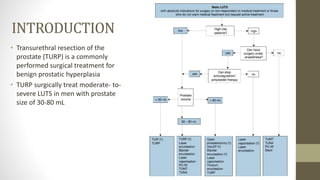
• Transurethral resection of the
prostate (TURP) is a commonly
performed surgical treatment for
benign prostatic hyperplasia
• TURP surgically treat moderate- to-
severe LUTS in men with prostate
size of 30-80 mL
INDICATION
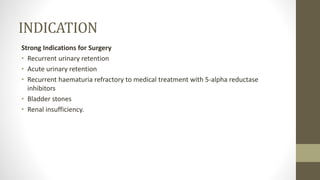
Strong Indications for Surgery
• Recurrent urinary retention
• Acute urinary retention
• Recurrent haematuria refractory to medical treatment with 5-alpha reductase
inhibitors
• Bladder stones
• Renal insufficiency.
INDICATION
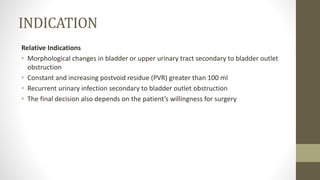
Relative Indications
• Morphological changes in bladder or upper urinary tract secondary to bladder outlet
obstruction
• Constant and increasing postvoid residue (PVR) greater than 100 ml
• Recurrent urinary infection secondary to bladder outlet obstruction
• The final decision also depends on the patient’s willingness for surgery
Contraindications
Absolute :
- Active urinary tract infection
- Uncorrected coagulopathy
Relative :
- Large bladder stone (two-stage procedure, cystolitholapaxy and TURP)
- Anaesthetic contraindications
- Acute renal insufficiency secondary to bladder outlet obstruction
Pre-operative
• Stop any ‘bleeders drugs’
• Informed consent
• No shaving necessary
• Antibiotics
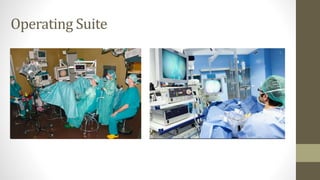
Operating Suite
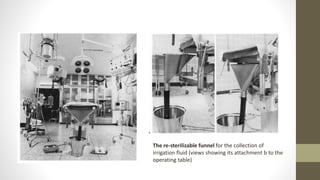
The re-sterilizable funnel for the collection of
irrigation fluid (views showing its attachment b to the
operating table)
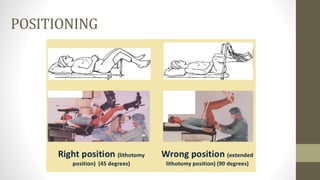
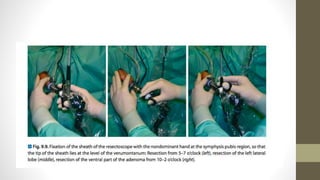
Positioning
POSITIONING
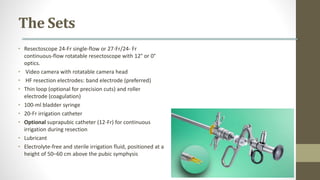
The Sets
• Resectoscope 24-Fr single-flow or 27-Fr/24- Fr
continuous-flow rotatable resectoscope with 12° or 0°
optics.
• Video camera with rotatable camera head
• HF resection electrodes: band electrode (preferred)
• Thin loop (optional for precision cuts) and roller
electrode (coagulation)
• 100-ml bladder syringe
• 20-Fr irrigation catheter
• Optional suprapubic catheter (12-Fr) for continuous
irrigation during resection
• Lubricant
• Electrolyte-free and sterile irrigation fluid, positioned at a
height of 50–60 cm above the pubic symphysis
TECHNIQUE
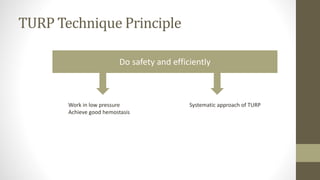
TURP Technique Principle
Do safety and efficiently
Work in low pressure
Achieve good hemostasis
Systematic approach of TURP
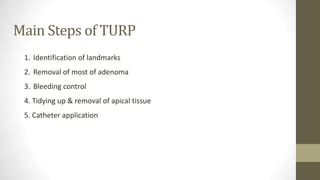
Main Steps of TURP
1. Identification of landmarks
2. Removal of most of adenoma
3. Bleeding control
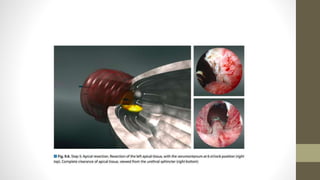
4. Tidying up & removal of apical tissue
5. Catheter application
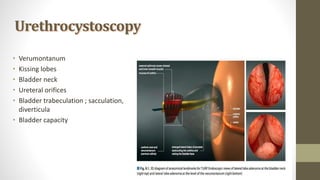
Urethrocystoscopy
• Verumontanum
• Kissing lobes
• Bladder neck
• Ureteral orifices
• Bladder trabeculation ; sacculation,
diverticula
• Bladder capacity
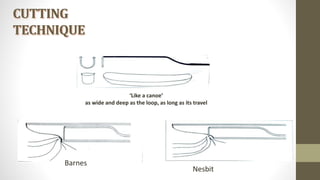
CUTTING
TECHNIQUE
Nesbit
Barnes
‘Like a canoe’
as wide and deep as the loop, as long as its travel
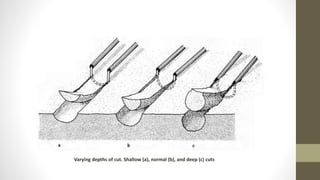
Varying depths of cut. Shallow (a), normal (b), and deep (c) cuts
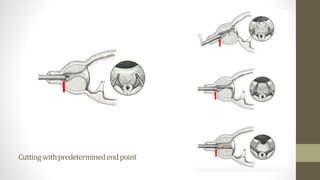
Cuttingwithpredeterminedendpoint
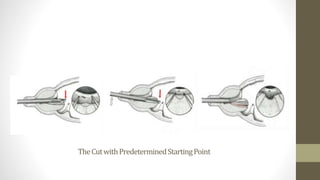
TheCutwithPredeterminedStartingPoint
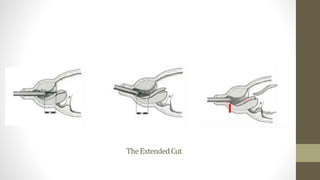
TheExtendedCut
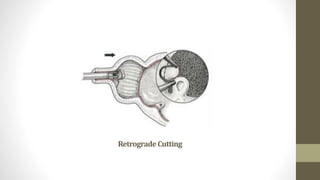
RetrogradeCutting
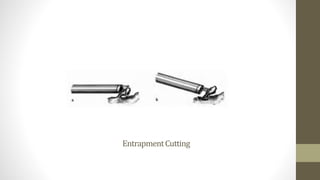
EntrapmentCutting
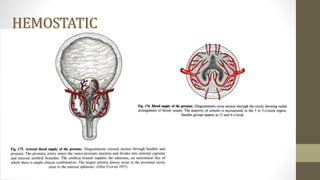
HEMOSTATIC
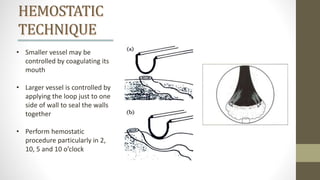
• Smaller vessel may be
controlled by coagulating its
mouth
• Larger vessel is controlled by
applying the loop just to one
side of wall to seal the walls
together
• Perform hemostatic
procedure particularly in 2,
10, 5 and 10 o’clock
HEMOSTATIC
TECHNIQUE
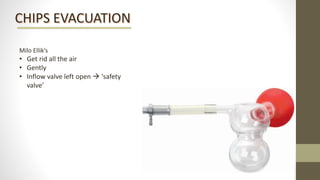
CHIPS EVACUATION
Milo Ellik’s
• Get rid all the air
• Gently
• Inflow valve left open  ‘safety
valve’
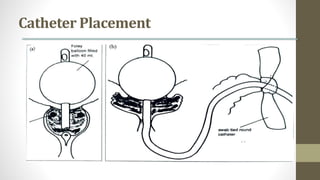
Catheter Placement
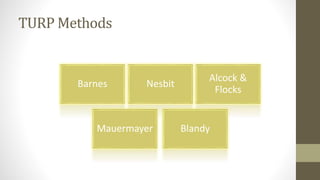
TURP Methods
NesbitBarnes
Alcock &
Flocks
Mauermayer Blandy
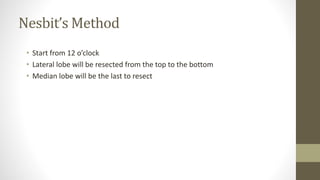
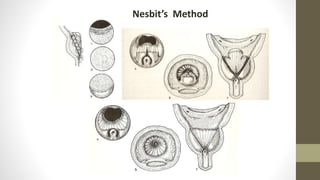
Nesbit’s Method
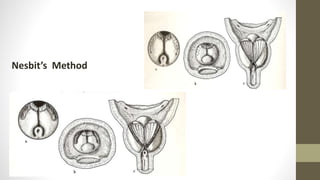
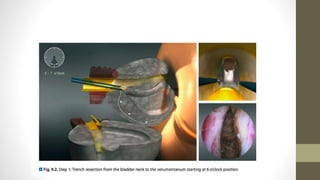
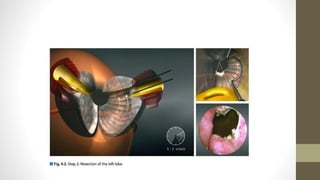
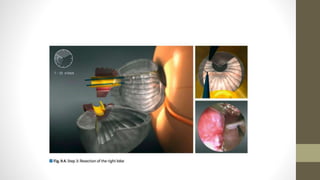
• Start from 12 o’clock
• Lateral lobe will be resected from the top to the bottom
• Median lobe will be the last to resect
Nesbit’s Method
Nesbit’s Method
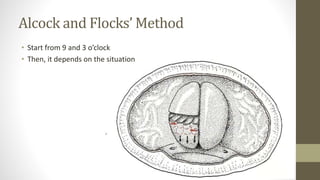
Alcock and Flocks’ Method
• Start from 9 and 3 o’clock
• Then, it depends on the situation
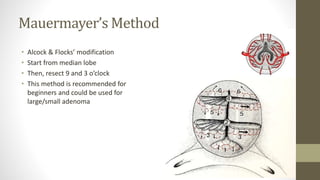
Mauermayer’s Method
• Alcock & Flocks’ modification
• Start from median lobe
• Then, resect 9 and 3 o’clock
• This method is recommended for
beginners and could be used for
large/small adenoma
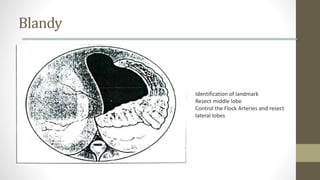
Blandy
Identification of landmark
Resect middle lobe
Control the Flock Arteries and resect
lateral lobes
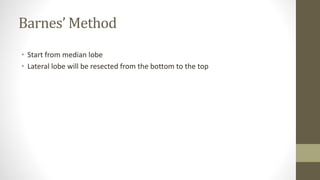
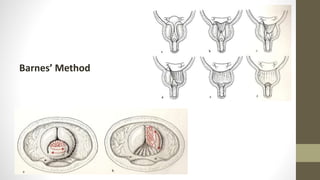
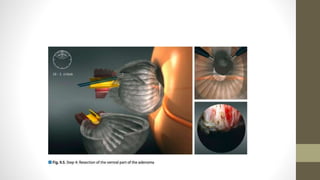
Barnes’ Method
• Start from median lobe
• Lateral lobe will be resected from the bottom to the top
Barnes’ Method
Post operative
• POD 0:
• Irrigation is running freely, is no darker than vin rose, and fully conscious
 send to wards
• POD 1 – 2: Early mobilization
• When the effluent is clear, little brownish blood  discontinue irrigation
• POD 3: Remove the catheter
Failure to void after removing the catheter:
• Uncomfortable
• Detrusor failure
• Insufficient tissue resection
Postoperative Care
• When the irrigation fluid becomes clear  catheter traction can be
released up to 4 h
• Continue irrigation of the bladder overnight
• If there is no complication  catheter can be removed 2 days POD
• Common complications: bleeding (macroscopic haematuria),
undermining the bladder neck, inadvertent peritoneal puncture,
capsular perforation
• Going Home POD 3
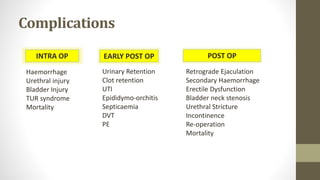
Complications
INTRA OP EARLY POST OP POST OP
Haemorrhage
Urethral injury
Bladder Injury
TUR syndrome
Mortality
Urinary Retention
Clot retention
UTI
Epididymo-orchitis
Septicaemia
DVT
PE
Retrograde Ejaculation
Secondary Haemorrhage
Erectile Dysfunction
Bladder neck stenosis
Urethral Stricture
Incontinence
Re-operation
Mortality
Reference
• Mauermayer, Wolfgang. Transurethral surgery. Springer Science & Business Media,
2012.
• John P. Blandy. Transurethral Resection. 2005
• Hohenfellner. Manual Endourology for Residents. 2005
• Marszalek M, et al. Transurethral Resection of the Prostate. EAU. 2019
• Hamid ARAH. TUR-P techniques. Presented on Simulative Training on Basic
Endourology ICTEC. 2018 Mar 8
THANK YOU

TURP TECHNIQUE

  • 1.
  • 2.
    INTRODUCTION • Transurethral resectionof the prostate (TURP) is a commonly performed surgical treatment for benign prostatic hyperplasia • TURP surgically treat moderate- to- severe LUTS in men with prostate size of 30-80 mL
  • 3.
    INDICATION Strong Indications forSurgery • Recurrent urinary retention • Acute urinary retention • Recurrent haematuria refractory to medical treatment with 5-alpha reductase inhibitors • Bladder stones • Renal insufficiency.
  • 4.
    INDICATION Relative Indications • Morphologicalchanges in bladder or upper urinary tract secondary to bladder outlet obstruction • Constant and increasing postvoid residue (PVR) greater than 100 ml • Recurrent urinary infection secondary to bladder outlet obstruction • The final decision also depends on the patient’s willingness for surgery
  • 5.
    Contraindications Absolute : - Activeurinary tract infection - Uncorrected coagulopathy Relative : - Large bladder stone (two-stage procedure, cystolitholapaxy and TURP) - Anaesthetic contraindications - Acute renal insufficiency secondary to bladder outlet obstruction
  • 6.
    Pre-operative • Stop any‘bleeders drugs’ • Informed consent • No shaving necessary • Antibiotics
  • 7.
  • 8.
    The re-sterilizable funnelfor the collection of irrigation fluid (views showing its attachment b to the operating table)
  • 9.
  • 10.
    The Sets • Resectoscope24-Fr single-flow or 27-Fr/24- Fr continuous-flow rotatable resectoscope with 12° or 0° optics. • Video camera with rotatable camera head • HF resection electrodes: band electrode (preferred) • Thin loop (optional for precision cuts) and roller electrode (coagulation) • 100-ml bladder syringe • 20-Fr irrigation catheter • Optional suprapubic catheter (12-Fr) for continuous irrigation during resection • Lubricant • Electrolyte-free and sterile irrigation fluid, positioned at a height of 50–60 cm above the pubic symphysis
  • 11.
  • 12.
    TURP Technique Principle Dosafety and efficiently Work in low pressure Achieve good hemostasis Systematic approach of TURP
  • 13.
    Main Steps ofTURP 1. Identification of landmarks 2. Removal of most of adenoma 3. Bleeding control 4. Tidying up & removal of apical tissue 5. Catheter application
  • 14.
    Urethrocystoscopy • Verumontanum • Kissinglobes • Bladder neck • Ureteral orifices • Bladder trabeculation ; sacculation, diverticula • Bladder capacity
  • 15.
    CUTTING TECHNIQUE Nesbit Barnes ‘Like a canoe’ aswide and deep as the loop, as long as its travel
  • 16.
    Varying depths ofcut. Shallow (a), normal (b), and deep (c) cuts
  • 18.
  • 19.
  • 20.
  • 21.
  • 22.
  • 23.
  • 24.
    • Smaller vesselmay be controlled by coagulating its mouth • Larger vessel is controlled by applying the loop just to one side of wall to seal the walls together • Perform hemostatic procedure particularly in 2, 10, 5 and 10 o’clock HEMOSTATIC TECHNIQUE
  • 25.
    CHIPS EVACUATION Milo Ellik’s •Get rid all the air • Gently • Inflow valve left open  ‘safety valve’
  • 26.
  • 27.
  • 28.
    Nesbit’s Method • Startfrom 12 o’clock • Lateral lobe will be resected from the top to the bottom • Median lobe will be the last to resect
  • 29.
  • 30.
  • 31.
    Alcock and Flocks’Method • Start from 9 and 3 o’clock • Then, it depends on the situation
  • 32.
    Mauermayer’s Method • Alcock& Flocks’ modification • Start from median lobe • Then, resect 9 and 3 o’clock • This method is recommended for beginners and could be used for large/small adenoma
  • 33.
    Blandy Identification of landmark Resectmiddle lobe Control the Flock Arteries and resect lateral lobes
  • 34.
    Barnes’ Method • Startfrom median lobe • Lateral lobe will be resected from the bottom to the top
  • 35.
  • 41.
    Post operative • POD0: • Irrigation is running freely, is no darker than vin rose, and fully conscious  send to wards • POD 1 – 2: Early mobilization • When the effluent is clear, little brownish blood  discontinue irrigation • POD 3: Remove the catheter Failure to void after removing the catheter: • Uncomfortable • Detrusor failure • Insufficient tissue resection
  • 42.
    Postoperative Care • Whenthe irrigation fluid becomes clear  catheter traction can be released up to 4 h • Continue irrigation of the bladder overnight • If there is no complication  catheter can be removed 2 days POD • Common complications: bleeding (macroscopic haematuria), undermining the bladder neck, inadvertent peritoneal puncture, capsular perforation • Going Home POD 3
  • 43.
    Complications INTRA OP EARLYPOST OP POST OP Haemorrhage Urethral injury Bladder Injury TUR syndrome Mortality Urinary Retention Clot retention UTI Epididymo-orchitis Septicaemia DVT PE Retrograde Ejaculation Secondary Haemorrhage Erectile Dysfunction Bladder neck stenosis Urethral Stricture Incontinence Re-operation Mortality
  • 44.
    Reference • Mauermayer, Wolfgang.Transurethral surgery. Springer Science & Business Media, 2012. • John P. Blandy. Transurethral Resection. 2005 • Hohenfellner. Manual Endourology for Residents. 2005 • Marszalek M, et al. Transurethral Resection of the Prostate. EAU. 2019 • Hamid ARAH. TUR-P techniques. Presented on Simulative Training on Basic Endourology ICTEC. 2018 Mar 8
  • 45.