Introduction to the
Philosophy
of the Human Person
June 6, 2018
The word philosophy came from
two Greek words:
1) philos (love)
2) sophia (wisdom)
philosophy = “love of wisdom”
People who engage in philosophy
are called philosophers or “lovers
of wisdom.”
Among the ancient Greeks, the
philosophers became the pioneers
in various fields of knowledge such
as history, biology, medicine,
mathematics, astronomy, and even
physics.
What does it mean to be a lover of
wisdom?
What characteristics should a
philosopher posses?
• What is real? Are we able to
perceive and understand reality
and everything in it?
• How do we know what we know?
Are the things that we know
true?
• What is the ultimate cause of all
things? What is our purpose in
this world?
• To what extent are our choices
and actions considered “free”?
What are some philosophical questions
have you asked yourself?
What led you to ponder those
questions?
Do you think that you will be able to
figure out the answers to these
philosophical questions?
Explain.
The most notable ancient Greek
philosophers:
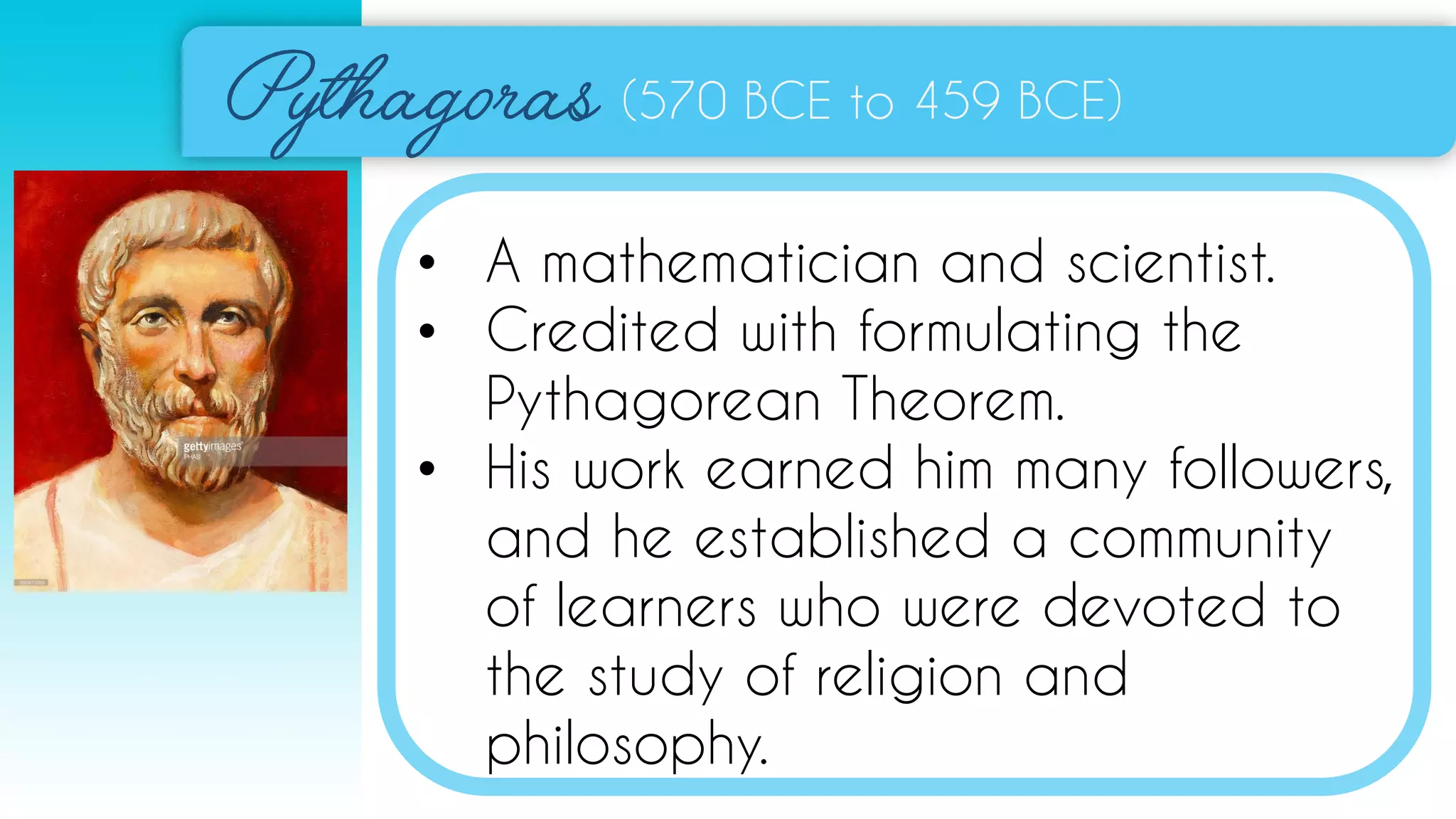
(570 BCE to 459 BCE)
• A mathematician and scientist.
• Credited with formulating the
Pythagorean Theorem.
• His work earned him many followers,
and he established a community
of learners who were devoted to
the study of religion and
philosophy.
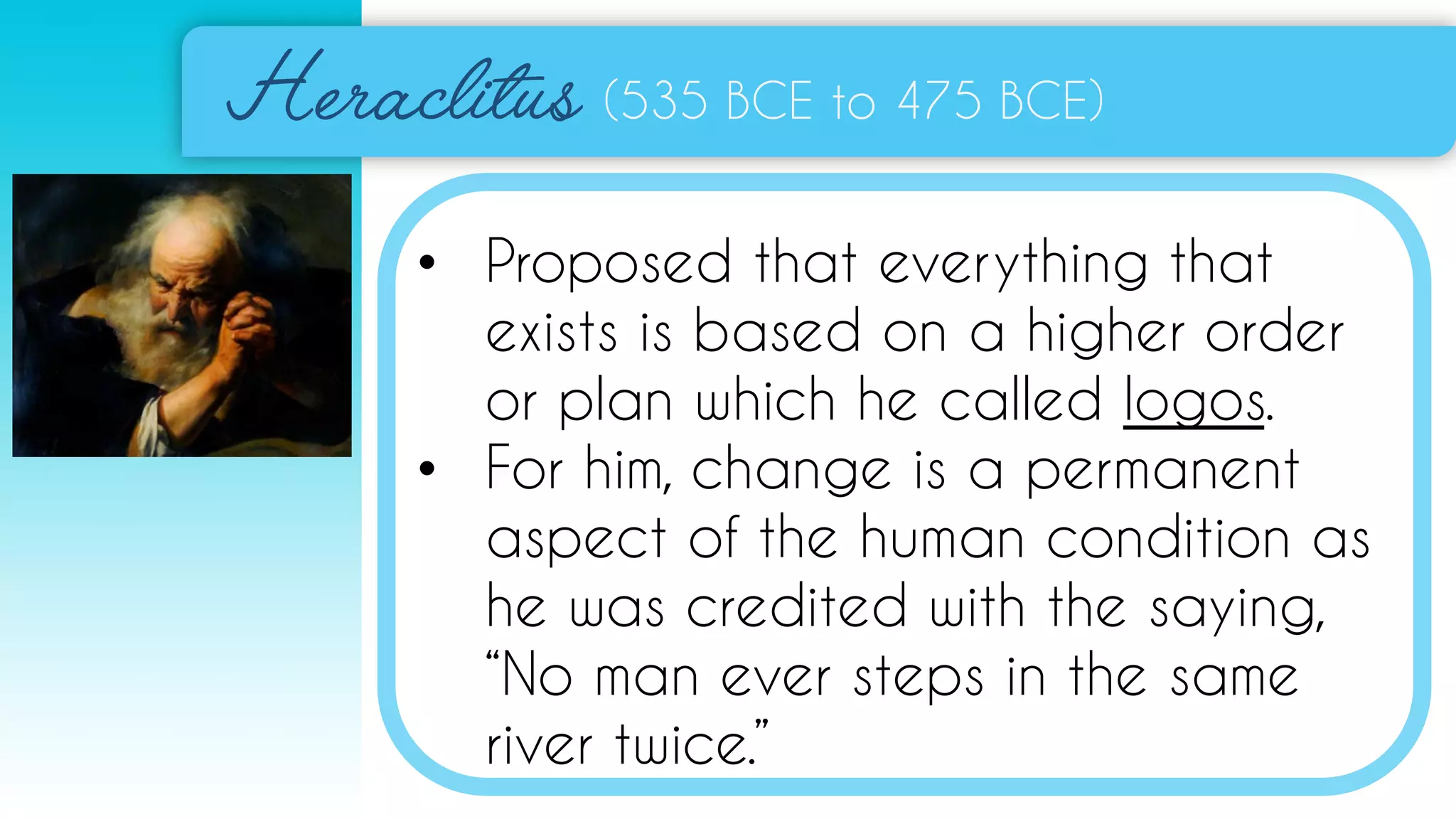
(535 BCE to 475 BCE)
• Proposed that everything that
exists is based on a higher order
or plan which he called logos.
• For him, change is a permanent
aspect of the human condition as
he was credited with the saying,
“No man ever steps in the same
river twice.”
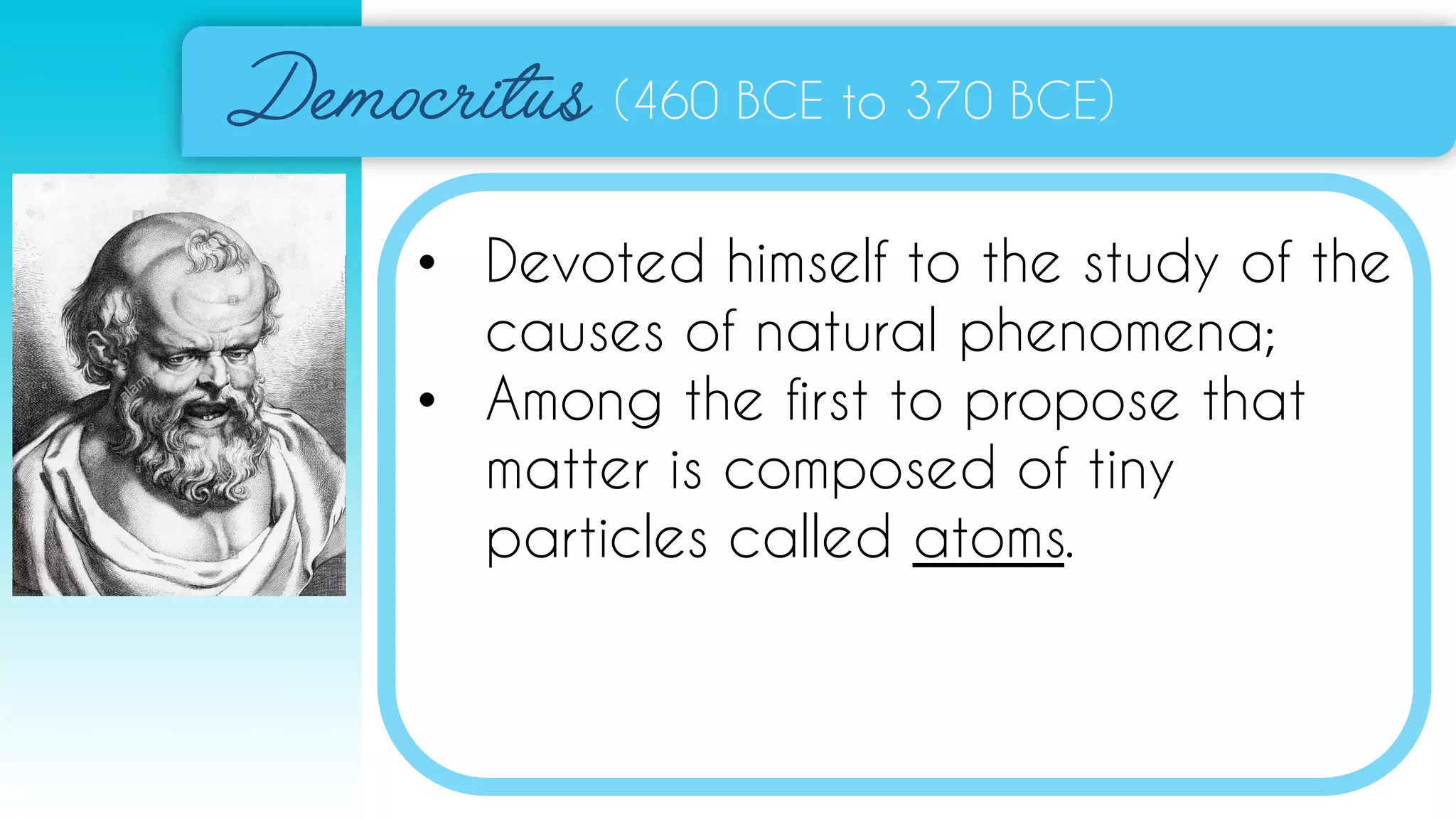
(460 BCE to 370 BCE)
• Devoted himself to the study of the
causes of natural phenomena;
• Among the first to propose that
matter is composed of tiny
particles called atoms.
(412 BCE to 323 BCE)
• A known advocate of living a
simple and virtuous life.
• For him, one should not talk of
virtue, but should show it in words
and actions.
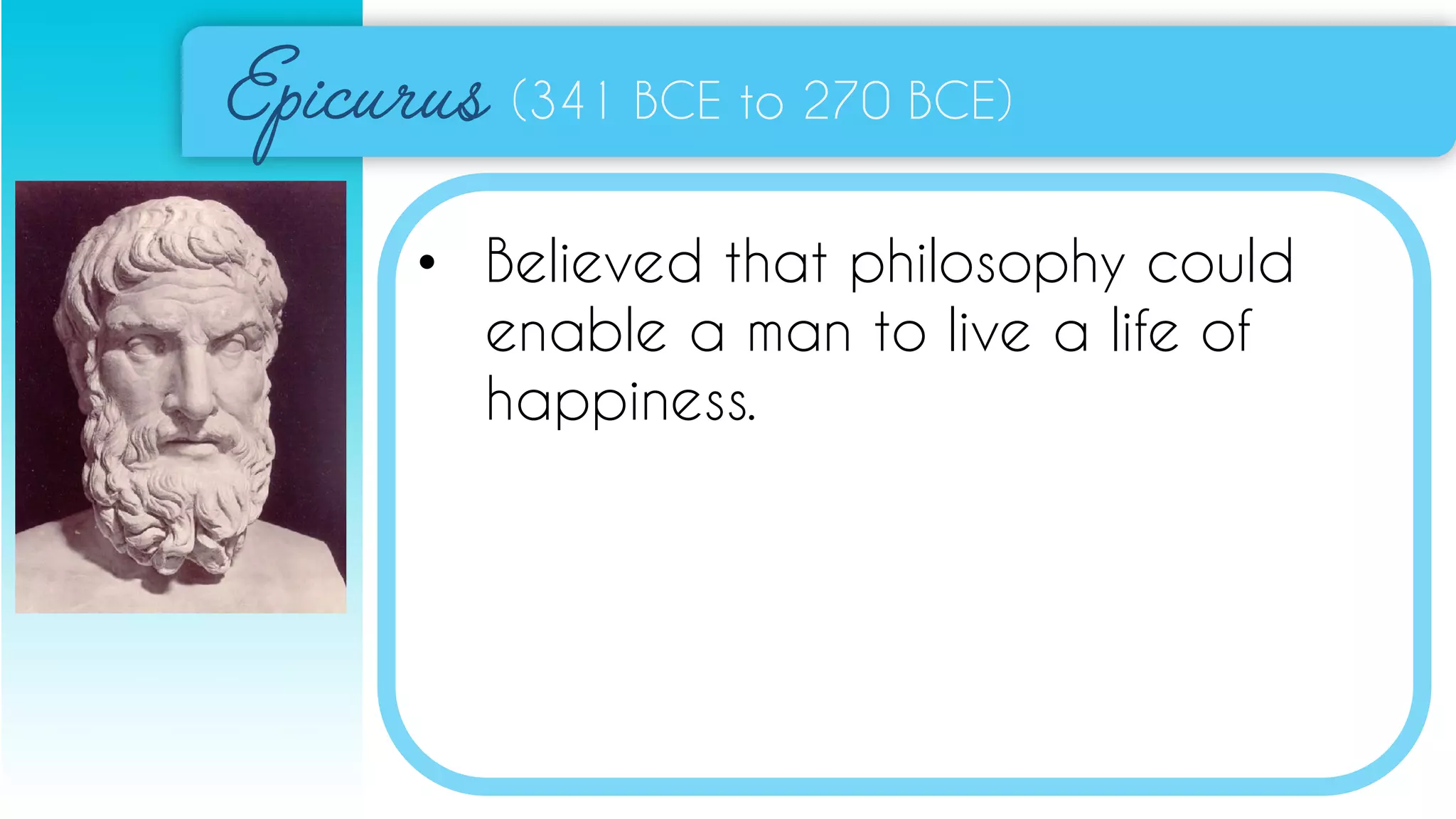
(341 BCE to 270 BCE)
• Believed that philosophy could
enable a man to live a life of
happiness.
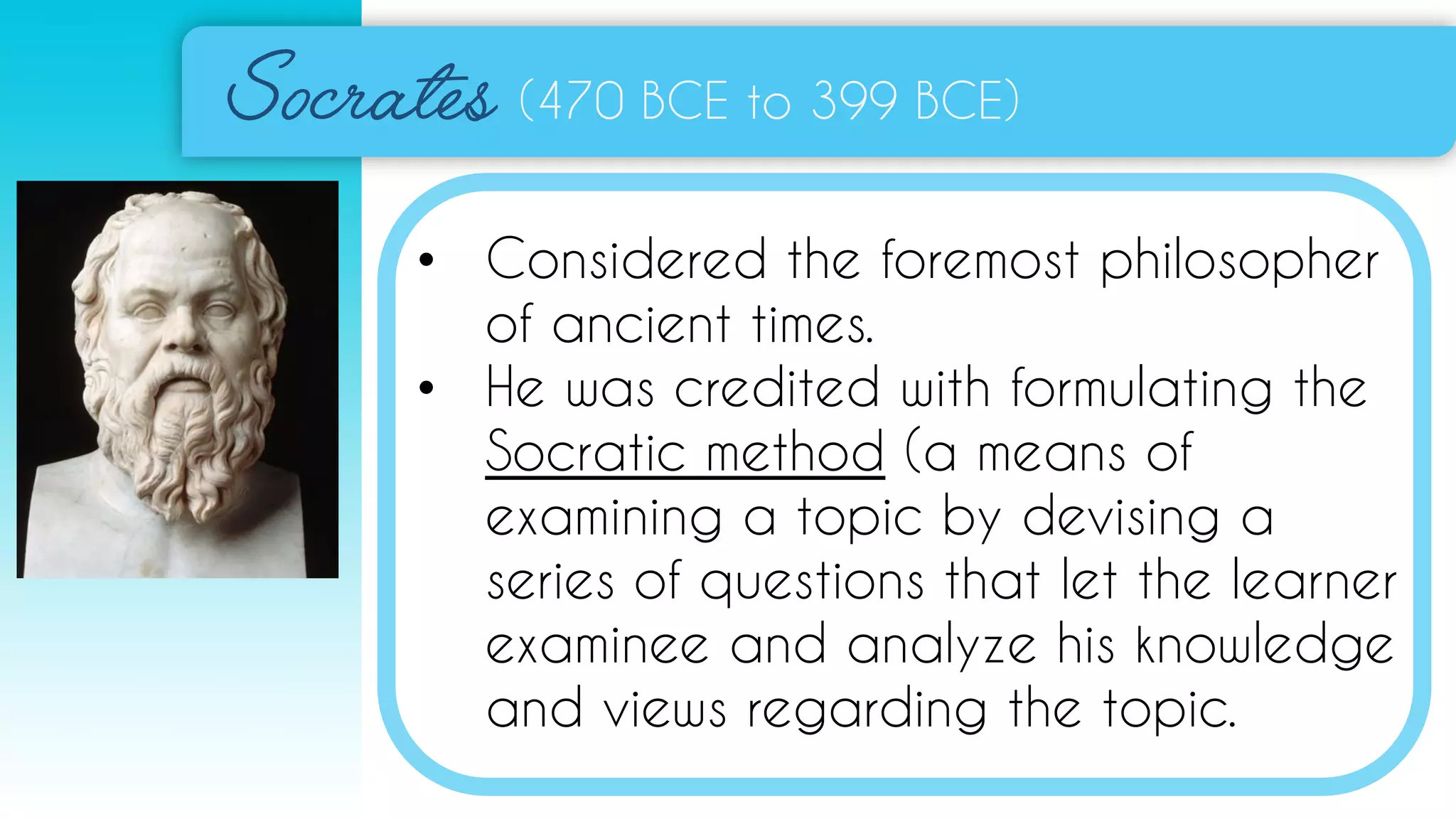
(470 BCE to 399 BCE)
• Considered the foremost philosopher
of ancient times.
• He was credited with formulating the
Socratic method (a means of
examining a topic by devising a
series of questions that let the learner
examinee and analyze his knowledge
and views regarding the topic.
(427 BCE to 347 BCE)
• A student of Socrates;
• Known for his dialectic – a method of
inquiry where two opposing ideas as
discussed in an attempt to arrive at
new knowledge.
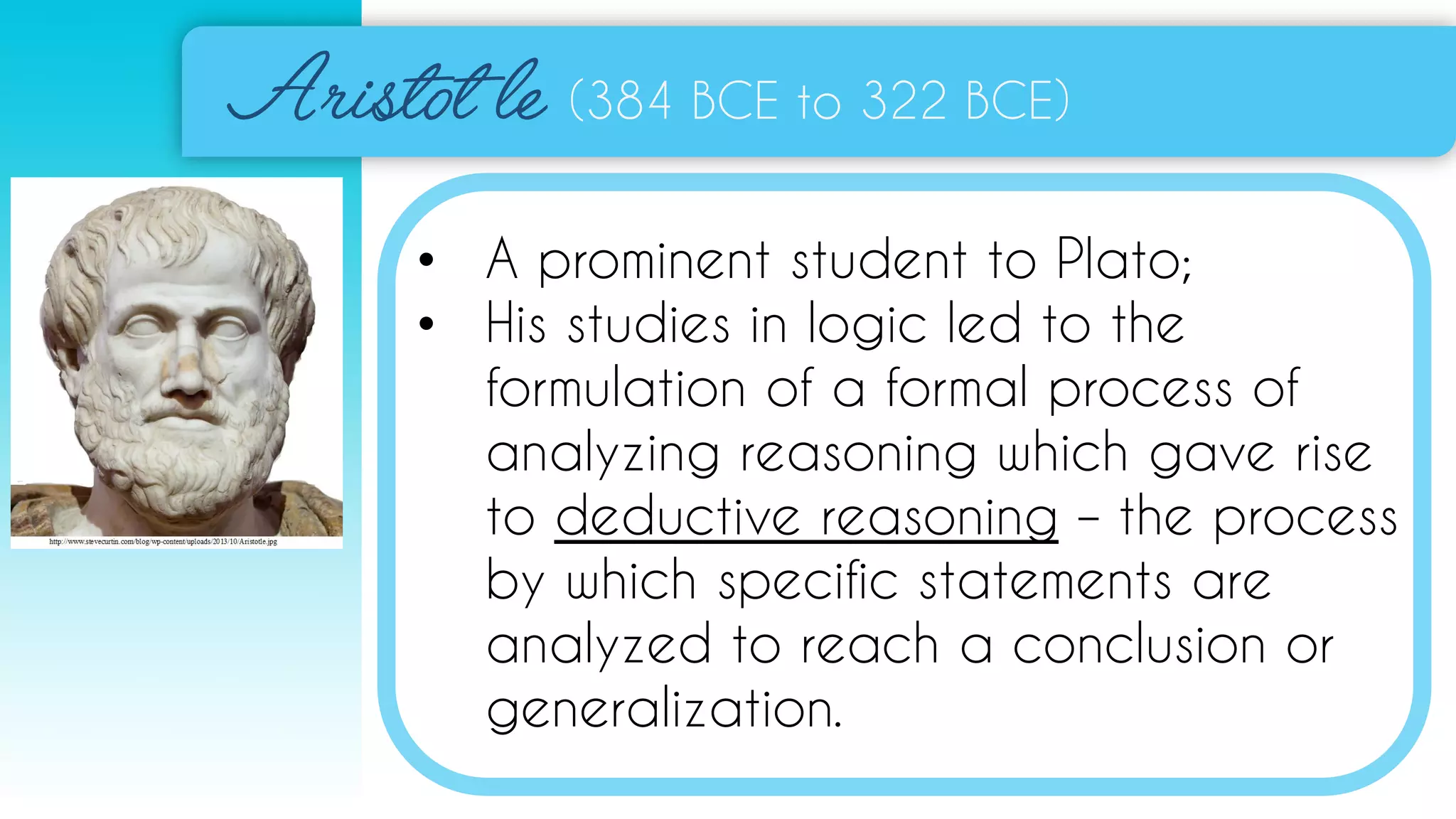
(384 BCE to 322 BCE)
• A prominent student to Plato;
• His studies in logic led to the
formulation of a formal process of
analyzing reasoning which gave rise
to deductive reasoning – the process
by which specific statements are
analyzed to reach a conclusion or
generalization.
Why is there a need to philosophize?
(PLATO)
• Whenever we are confronted with an
experience, we always wonder how it
came about.
• “Where did we come from?” “Why do
we exist?” “For what purpose are we
created?”
(RENE DESCARTES)
• Descartes was famous for rejecting or
questioning established ideas, and
he even went as far as doubting his
own ideas.
• A critical and questioning
perspective is necessary to
determine if indeed these ideas or
views are correct or true.
(KARL JASPERS)
• A man is often confronted by
experiences which challenge his
ideas and frameworks.
• These challenges are called limit
situations, which are often
accompanied by feelings of
hopelessness, anxiety, or dread.
(SOCRATES)
• To love wisdom is to have an
insatiable desire for truth.
• A philosopher seeks to continue to
question, to probe, and to discuss in
order to get to the bottom of things.
• “An unexamined life is not worth
living.”
What are some situations that compel a
person to engage in philosophical
thinking?
How can a person benefit from
philosophizing?
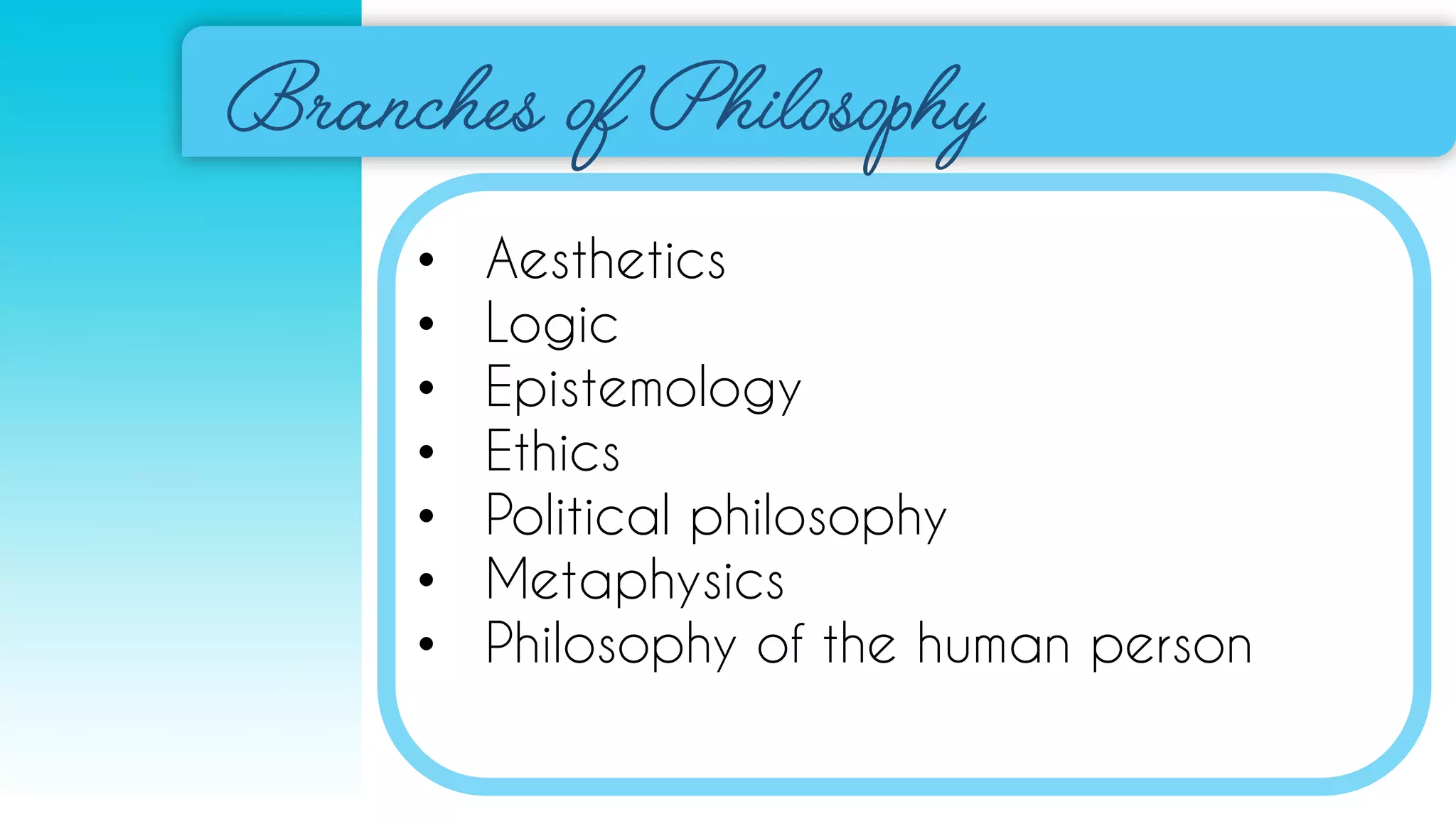
What are the branches of Philosophy?
• Aesthetics
• Logic
• Epistemology
• Ethics
• Political philosophy
• Metaphysics
• Philosophy of the human person
• The philosophy which deals with
beauty and what makes things
“beautiful.”
• The branch of philosophy which
deals with correct reasoning.
• Discusses the nature of knowledge
and knowing.
• The area in philosophy which
understands the human person from
a philosophical perspective –
integrating and synthesizing the
different branches of philosophy and
other fields of study to know the truth
about the human person
• What is philosophy?
• Why is there a need to philosophize?
• What are the branches of
philosophy?
• What is ‘Philosophy of the Human
Person’?
Is it possible for a any person to
engage in philosophical discussion?
Why?
Make a list of 5 “Why?” Questions
Example:
“Why do we cry when we are sad, and
smile when we are happy?”

PHILOSOPHY - INTRODUCTION

  • 1.
    Introduction to the Philosophy ofthe Human Person June 6, 2018
  • 2.
    The word philosophycame from two Greek words: 1) philos (love) 2) sophia (wisdom) philosophy = “love of wisdom”
  • 3.
    People who engagein philosophy are called philosophers or “lovers of wisdom.”
  • 4.
    Among the ancientGreeks, the philosophers became the pioneers in various fields of knowledge such as history, biology, medicine, mathematics, astronomy, and even physics.
  • 5.
    What does itmean to be a lover of wisdom? What characteristics should a philosopher posses?
  • 6.
    • What isreal? Are we able to perceive and understand reality and everything in it? • How do we know what we know? Are the things that we know true?
  • 7.
    • What isthe ultimate cause of all things? What is our purpose in this world? • To what extent are our choices and actions considered “free”?
  • 8.
    What are somephilosophical questions have you asked yourself? What led you to ponder those questions?
  • 9.
    Do you thinkthat you will be able to figure out the answers to these philosophical questions? Explain.
  • 10.
    The most notableancient Greek philosophers:
  • 11.
    (570 BCE to459 BCE) • A mathematician and scientist. • Credited with formulating the Pythagorean Theorem. • His work earned him many followers, and he established a community of learners who were devoted to the study of religion and philosophy.
  • 12.
    (535 BCE to475 BCE) • Proposed that everything that exists is based on a higher order or plan which he called logos. • For him, change is a permanent aspect of the human condition as he was credited with the saying, “No man ever steps in the same river twice.”
  • 13.
    (460 BCE to370 BCE) • Devoted himself to the study of the causes of natural phenomena; • Among the first to propose that matter is composed of tiny particles called atoms.
  • 14.
    (412 BCE to323 BCE) • A known advocate of living a simple and virtuous life. • For him, one should not talk of virtue, but should show it in words and actions.
  • 15.
    (341 BCE to270 BCE) • Believed that philosophy could enable a man to live a life of happiness.
  • 16.
    (470 BCE to399 BCE) • Considered the foremost philosopher of ancient times. • He was credited with formulating the Socratic method (a means of examining a topic by devising a series of questions that let the learner examinee and analyze his knowledge and views regarding the topic.
  • 17.
    (427 BCE to347 BCE) • A student of Socrates; • Known for his dialectic – a method of inquiry where two opposing ideas as discussed in an attempt to arrive at new knowledge.
  • 18.
    (384 BCE to322 BCE) • A prominent student to Plato; • His studies in logic led to the formulation of a formal process of analyzing reasoning which gave rise to deductive reasoning – the process by which specific statements are analyzed to reach a conclusion or generalization.
  • 19.
    Why is therea need to philosophize?
  • 20.
    (PLATO) • Whenever weare confronted with an experience, we always wonder how it came about. • “Where did we come from?” “Why do we exist?” “For what purpose are we created?”
  • 21.
    (RENE DESCARTES) • Descarteswas famous for rejecting or questioning established ideas, and he even went as far as doubting his own ideas. • A critical and questioning perspective is necessary to determine if indeed these ideas or views are correct or true.
  • 22.
    (KARL JASPERS) • Aman is often confronted by experiences which challenge his ideas and frameworks. • These challenges are called limit situations, which are often accompanied by feelings of hopelessness, anxiety, or dread.
  • 23.
    (SOCRATES) • To lovewisdom is to have an insatiable desire for truth. • A philosopher seeks to continue to question, to probe, and to discuss in order to get to the bottom of things. • “An unexamined life is not worth living.”
  • 24.
    What are somesituations that compel a person to engage in philosophical thinking? How can a person benefit from philosophizing?
  • 25.
    What are thebranches of Philosophy?
  • 26.
    • Aesthetics • Logic •Epistemology • Ethics • Political philosophy • Metaphysics • Philosophy of the human person
  • 27.
    • The philosophywhich deals with beauty and what makes things “beautiful.”
  • 28.
    • The branchof philosophy which deals with correct reasoning.
  • 29.
    • Discusses thenature of knowledge and knowing.
  • 30.
    • The areain philosophy which understands the human person from a philosophical perspective – integrating and synthesizing the different branches of philosophy and other fields of study to know the truth about the human person
  • 31.
    • What isphilosophy? • Why is there a need to philosophize? • What are the branches of philosophy? • What is ‘Philosophy of the Human Person’?
  • 32.
    Is it possiblefor a any person to engage in philosophical discussion? Why?
  • 33.
    Make a listof 5 “Why?” Questions Example: “Why do we cry when we are sad, and smile when we are happy?”