- love of wisdom
love of wisdom
- comes from the Greek words,
philos and sophia
comes from the Greek words,
philos and sophia
- the study that uses human reason
to investigate the ultimate causes,
reasons, and principles which
govern all things
applied it to the study that uses
human reason to investigate the
ultimate causes, reasons, and
principles which govern all things
is an activity people
undertake when they seek
to understand fundamental
truths about themselves,
the world in which they live,
and their relationships to
the world and to each other.
- is an activity people
undertake when they seek
to understand fundamental
truths about themselves,
the world in which they live,
and their relationships to
the world and to each other.
Most Notable Ancient
Greek Philosophers
1. Pythagoras – mathematician and scientist
- formulating the Pythagorean theorem
- established a community of learners who were devoted to the study of
religion and philosophy
2. Heraclitus – proposed that everything that exists is based on a higher
order or plan which he called logos. He was credited with the saying “No
man ever steps in the same river twice.”
3. Democritus – first to propose that matter is composed of tiny particles
called atoms
Most Notable Ancient
Greek Philosophers
4. Diogenes of Sinope – was a known advocate of living a simple and
virtuous life. His teaching and views were developed by his followers and
influenced the development of schools of philosophy such as Cynicism
and Stoicism.
5. Epicurus– believed that philosophy enable a man to live life happiness.
His views gave rise to Epicureanism, a school philosophy that believes
that wisdom and simple living will result in a life free of fear and pain.
6. Socrates – the foremost philosopher in ancient times.
- he contributed much in ethics
- developed Socratic Method – means examining a topic by devising a
series of questions
Most Notable Ancient
Greek Philosophers
7. Plato – student of Socrates, he wrote some of his mentor’s teaching and
incorporated some of his own ideas
a. Theory of forms – proposes that everything that exist is based on the
ideas that can only be perceived in mind.
b. Famous for his dialect – method of inquiry where two opposing ideas
are discussed in an attempt to arrive in a new knowledge
8. Aristotle – a prominent student of Plato.
- against the idea of Plato’s theory of forms
- for him, all ideas and views are based on perception, and our reality is
based on what we can sense and perceive.
- deductive reasoning – the process by which specific statements are
analyzed to reach a conclusion or generalization
Is there a need to philosophize? Why?
• Plato – traced man’s need to philosophize to his sense
of wonder. Overbounding curiosity drives a man to ask
question.
• Rene Descartes – traced the need to philosophize to
doubt
• Karl Jaspers – need to philosophize because of
experience
Is there a need to philosophize? Why?
► The need to philosophize is driven by the
love of wisdom. To love wisdom is to have an
insatiable desire for truth.
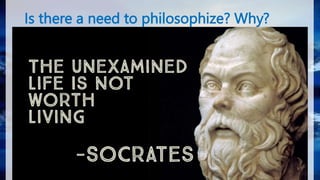
Is there a need to philosophize? Why?
► the need to philosophize is driven by the
love of wisdom.
Branches of Philosophy
 Aesthetics – deals with beauty and what makes things
beautiful.
 Epistemology – discusses the nature of knowledge and
knowing.
 Ethics – deals with moral questions and dilemmas
 Political Philosophy – studies governments and deals with
questions of justice, power and the rights and obligations of
citizens.
 Metaphysics – deals with questions regarding reality and
existence.
 Logic – deals with correct reasoning
Partial Thinking
► focuses on specific aspects of a situation
► Partial view is an important component of
analytical thinking, as an individual focuses on
certain areas or aspects of a problem in order to
understand it.
Holistic Thinking
► refers to a perspective that considers large-scale patterns
in systems.
► often described as looking as at the “big picture” when
describing and analyzing a situation or problem.
► it also means that one does not confine one’s
understanding of the world to one’s own perspective, but
also includes the perspective of others.
Reflection
► examining one’s thoughts, feelings, and actions and to
learn more about one’s life and experiences
Note: Reflecting on situations, activities, actions, and decisions
enables a person to gain insights that will help in
effective decision-making.

INTRODUCTION TO PHILOSOPHY FOR HUMAN NATURE

  • 2.
    - love ofwisdom love of wisdom - comes from the Greek words, philos and sophia comes from the Greek words, philos and sophia - the study that uses human reason to investigate the ultimate causes, reasons, and principles which govern all things applied it to the study that uses human reason to investigate the ultimate causes, reasons, and principles which govern all things
  • 3.
    is an activitypeople undertake when they seek to understand fundamental truths about themselves, the world in which they live, and their relationships to the world and to each other. - is an activity people undertake when they seek to understand fundamental truths about themselves, the world in which they live, and their relationships to the world and to each other.
  • 4.
    Most Notable Ancient GreekPhilosophers 1. Pythagoras – mathematician and scientist - formulating the Pythagorean theorem - established a community of learners who were devoted to the study of religion and philosophy 2. Heraclitus – proposed that everything that exists is based on a higher order or plan which he called logos. He was credited with the saying “No man ever steps in the same river twice.” 3. Democritus – first to propose that matter is composed of tiny particles called atoms
  • 5.
    Most Notable Ancient GreekPhilosophers 4. Diogenes of Sinope – was a known advocate of living a simple and virtuous life. His teaching and views were developed by his followers and influenced the development of schools of philosophy such as Cynicism and Stoicism. 5. Epicurus– believed that philosophy enable a man to live life happiness. His views gave rise to Epicureanism, a school philosophy that believes that wisdom and simple living will result in a life free of fear and pain. 6. Socrates – the foremost philosopher in ancient times. - he contributed much in ethics - developed Socratic Method – means examining a topic by devising a series of questions
  • 6.
    Most Notable Ancient GreekPhilosophers 7. Plato – student of Socrates, he wrote some of his mentor’s teaching and incorporated some of his own ideas a. Theory of forms – proposes that everything that exist is based on the ideas that can only be perceived in mind. b. Famous for his dialect – method of inquiry where two opposing ideas are discussed in an attempt to arrive in a new knowledge 8. Aristotle – a prominent student of Plato. - against the idea of Plato’s theory of forms - for him, all ideas and views are based on perception, and our reality is based on what we can sense and perceive. - deductive reasoning – the process by which specific statements are analyzed to reach a conclusion or generalization
  • 7.
    Is there aneed to philosophize? Why? • Plato – traced man’s need to philosophize to his sense of wonder. Overbounding curiosity drives a man to ask question. • Rene Descartes – traced the need to philosophize to doubt • Karl Jaspers – need to philosophize because of experience
  • 8.
    Is there aneed to philosophize? Why? ► The need to philosophize is driven by the love of wisdom. To love wisdom is to have an insatiable desire for truth.
  • 9.
    Is there aneed to philosophize? Why? ► the need to philosophize is driven by the love of wisdom.
  • 10.
    Branches of Philosophy Aesthetics – deals with beauty and what makes things beautiful.  Epistemology – discusses the nature of knowledge and knowing.  Ethics – deals with moral questions and dilemmas  Political Philosophy – studies governments and deals with questions of justice, power and the rights and obligations of citizens.  Metaphysics – deals with questions regarding reality and existence.  Logic – deals with correct reasoning
  • 11.
    Partial Thinking ► focuseson specific aspects of a situation ► Partial view is an important component of analytical thinking, as an individual focuses on certain areas or aspects of a problem in order to understand it.
  • 12.
    Holistic Thinking ► refersto a perspective that considers large-scale patterns in systems. ► often described as looking as at the “big picture” when describing and analyzing a situation or problem. ► it also means that one does not confine one’s understanding of the world to one’s own perspective, but also includes the perspective of others.
  • 15.
    Reflection ► examining one’sthoughts, feelings, and actions and to learn more about one’s life and experiences Note: Reflecting on situations, activities, actions, and decisions enables a person to gain insights that will help in effective decision-making.

Editor's Notes

  • #3 If knowledge is power, wisdom is your choice to use or apply that power to pursue good life
  • #4 Human Nature – the characteristics that separate from the other existing creatures Science is concrete, Philosophy is an abstract
  • #5 Logos – reason, plan, - the water in the river is constantly flowing, which means that even within a few minutes, water at a particular spot won't be the same as it was earlier.
  • #7 Aristotle – his studies in logic lead to the formulation of the formal process of analyzing reasoning. Which give rise to deductive reasoning