HUMAN PERSON
IN THE
ENVIRONMENT
What is a Human Person?
A human person is a living being that contains a
real and existing to direct its own development
toward fulfillment through perfect, unconditional,
and infinite Truth, Love, Goodness, Beauty, and
Unity, and will do so if all the proper conditions are
met.
Environment
The sum total of all surroundings of a
living organism, including natural
forces and other living things, which
provide conditions for development
and
growth as well as of danger and
damage.
• WHAT IS THE WORLD MADE OF?
• HOW DID THE WORLD COME INTO BEING?
• HOW CAN WE EXPLAIN THE PROCESS OF CHANGE?
Those are philosophical questions brought up
approximately 600 B.C.E in the Western Ionian
seaport town of Miletus across the Aegean sea from
Athens, Greece.
The speculation of the pre-Socratic
philosophers represent a paradigm shift–
a change from mythical explanation of the
origins of the cosmos to a more rational
explanation.
Eastern sages probed nature’s depths intuitively through
the eyes of spiritual sages which Greek thinkers viewed
nature trough cognitive and scientific eyes (Price 2000).
This thinkers were looking for the underlying laws of
nature. They wanted to understand the processes of
nature by studying nature itself, not by listening to the
stories about the gods.
According to Payne (2010) there are two frameworks where
humans can be related.
1. Anthropocentric Model
Based on the Anthropocentric model, humans are superior
and central to the universe, thus it is human centered.
 Human
 Culture
 Individualism
 Mind
 Calculative
 Human over/against Environments
 Global/Technological
Anthropocentric Model
Sometimes, humans adopt an exploitive
attitude whenever nature is merely
considered as an instrument for one’s
profit or gain.
The domination of humanity is linked to the
domination of nature based on the
anthropocentric model. An unfair or unjust
utilization of the environment result to
ecological crisis. From this view, it follows
that human arrogance toward nature is
justifiable in order to satisfy human interest.
SOME EFFECTS OF ANTROPOCENTRIC MODEL
EARTH
POLLUTION
STONGER
TYPHOONS
SOIL EROSION FAMINE
GLOBAL
WARMING
2. Ecocentric Model
Ecocentric model, the ecological or relational integrity of the
humans provides meaning of our morals and values and it is nature
centered.
Devoted to preserving the totality of Earth’s biodiversity and the
functioning of it’s life-supporting system.
 Nature
 Wild
 Holism
 Body
 Relational
 Earth/Wisdom
 Ecology over/against humans
Ecocentric Model
There are three theories about the
Ecocentric Model such as
Deep Ecology, Social Ecology and
Ecofeminism.
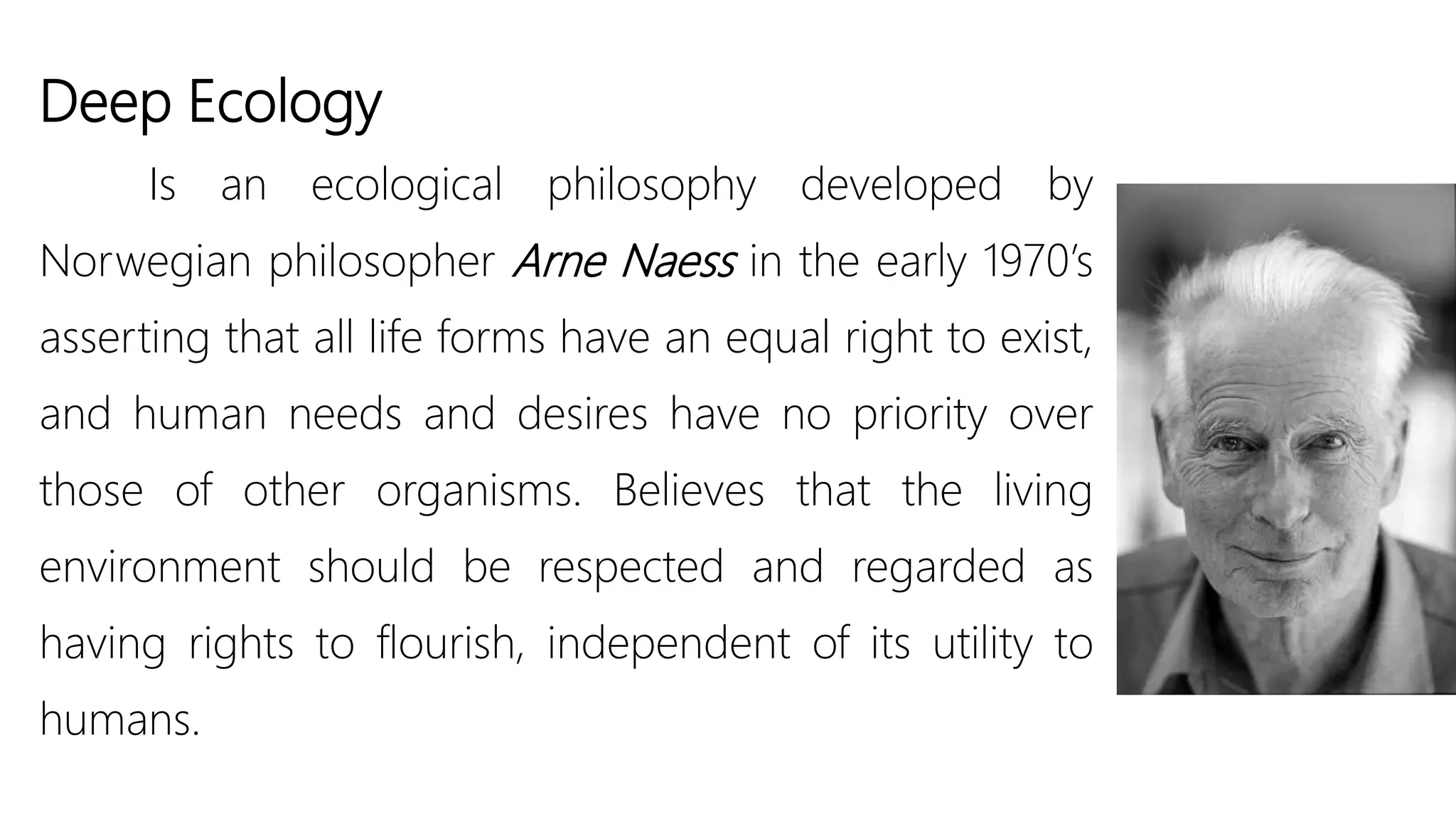
Deep Ecology
Is an ecological philosophy developed by
Norwegian philosopher Arne Naess in the early 1970’s
asserting that all life forms have an equal right to exist,
and human needs and desires have no priority over
those of other organisms. Believes that the living
environment should be respected and regarded as
having rights to flourish, independent of its utility to
humans.
Social Ecology
It is a critical social theory founded by
American anarchist and libertarian socialist
author Murray Bookchin. Conceptualized as
a critique of current social, political, and anti-
ecological trends, it espouses a
reconstructive, ecological, communitarian,
and ethical approach to society.
Ecofeminism
It is also called ecological feminism, branch of feminism
that examines the connections between women and nature. Its
name was coined by French feminist Francoise d’Eaubonne in
1974.
A philosophical idea that combines feminism and ecology
concerns, emphasizing that both suffer from their treatment by a
male dominated society.
Comes from the idea that women and nature have
significant connection, since women most often have a close
association with nature in many societies due to the nature of
their traditional roles.
Anaximander a pre-Socratic philosopher and
scientist said about the Creation-Destruction.
According to him, the sketch of the genesis of the
world (cosmology), the evolution of the world begins
with the generation of opposites in a certain region
Nature. Nature is indeterminate-boundless in the
sense that no boundaries between the warm and
or the moist and dry regions are originally present
within.
While, according to Pythagoras, ‘universe is a
living embodiment of nature’s order, harmony
and beauty.’
He sees our relationship with the universe
involving biophilia (love of other living things)
And cosmophilia (love of other living beings).
For Modern Thinker, Immanuel Kant,
‘beauty is ultimately a symbol of
morality (goodness). He believes that
the orderliness of nature and the
harmony of nature with our faculties
guide us toward a deeper religious
perspective.’
Herbert Marcuse said about the power of
humans over nature, while George
Herbert Mead tackled about our duties
and responsibilities in nature.
Our environment is created for every
humans, so you as good as one being
must take Good care of nature!
Remember LIFE is all about BALANCE.

Human Person in the Environment

  • 1.
  • 2.
    What is aHuman Person? A human person is a living being that contains a real and existing to direct its own development toward fulfillment through perfect, unconditional, and infinite Truth, Love, Goodness, Beauty, and Unity, and will do so if all the proper conditions are met.
  • 3.
    Environment The sum totalof all surroundings of a living organism, including natural forces and other living things, which provide conditions for development and growth as well as of danger and damage.
  • 4.
    • WHAT ISTHE WORLD MADE OF? • HOW DID THE WORLD COME INTO BEING? • HOW CAN WE EXPLAIN THE PROCESS OF CHANGE? Those are philosophical questions brought up approximately 600 B.C.E in the Western Ionian seaport town of Miletus across the Aegean sea from Athens, Greece.
  • 5.
    The speculation ofthe pre-Socratic philosophers represent a paradigm shift– a change from mythical explanation of the origins of the cosmos to a more rational explanation.
  • 6.
    Eastern sages probednature’s depths intuitively through the eyes of spiritual sages which Greek thinkers viewed nature trough cognitive and scientific eyes (Price 2000). This thinkers were looking for the underlying laws of nature. They wanted to understand the processes of nature by studying nature itself, not by listening to the stories about the gods.
  • 7.
    According to Payne(2010) there are two frameworks where humans can be related. 1. Anthropocentric Model Based on the Anthropocentric model, humans are superior and central to the universe, thus it is human centered.  Human  Culture  Individualism  Mind  Calculative  Human over/against Environments  Global/Technological
  • 8.
  • 9.
    Sometimes, humans adoptan exploitive attitude whenever nature is merely considered as an instrument for one’s profit or gain. The domination of humanity is linked to the domination of nature based on the anthropocentric model. An unfair or unjust utilization of the environment result to ecological crisis. From this view, it follows that human arrogance toward nature is justifiable in order to satisfy human interest.
  • 10.
    SOME EFFECTS OFANTROPOCENTRIC MODEL EARTH POLLUTION STONGER TYPHOONS SOIL EROSION FAMINE GLOBAL WARMING
  • 11.
    2. Ecocentric Model Ecocentricmodel, the ecological or relational integrity of the humans provides meaning of our morals and values and it is nature centered. Devoted to preserving the totality of Earth’s biodiversity and the functioning of it’s life-supporting system.  Nature  Wild  Holism  Body  Relational  Earth/Wisdom  Ecology over/against humans
  • 12.
  • 13.
    There are threetheories about the Ecocentric Model such as Deep Ecology, Social Ecology and Ecofeminism.
  • 14.
    Deep Ecology Is anecological philosophy developed by Norwegian philosopher Arne Naess in the early 1970’s asserting that all life forms have an equal right to exist, and human needs and desires have no priority over those of other organisms. Believes that the living environment should be respected and regarded as having rights to flourish, independent of its utility to humans.
  • 16.
    Social Ecology It isa critical social theory founded by American anarchist and libertarian socialist author Murray Bookchin. Conceptualized as a critique of current social, political, and anti- ecological trends, it espouses a reconstructive, ecological, communitarian, and ethical approach to society.
  • 18.
    Ecofeminism It is alsocalled ecological feminism, branch of feminism that examines the connections between women and nature. Its name was coined by French feminist Francoise d’Eaubonne in 1974. A philosophical idea that combines feminism and ecology concerns, emphasizing that both suffer from their treatment by a male dominated society. Comes from the idea that women and nature have significant connection, since women most often have a close association with nature in many societies due to the nature of their traditional roles.
  • 20.
    Anaximander a pre-Socraticphilosopher and scientist said about the Creation-Destruction. According to him, the sketch of the genesis of the world (cosmology), the evolution of the world begins with the generation of opposites in a certain region Nature. Nature is indeterminate-boundless in the sense that no boundaries between the warm and or the moist and dry regions are originally present within.
  • 21.
    While, according toPythagoras, ‘universe is a living embodiment of nature’s order, harmony and beauty.’ He sees our relationship with the universe involving biophilia (love of other living things) And cosmophilia (love of other living beings).
  • 22.
    For Modern Thinker,Immanuel Kant, ‘beauty is ultimately a symbol of morality (goodness). He believes that the orderliness of nature and the harmony of nature with our faculties guide us toward a deeper religious perspective.’
  • 23.
    Herbert Marcuse saidabout the power of humans over nature, while George Herbert Mead tackled about our duties and responsibilities in nature.
  • 24.
    Our environment iscreated for every humans, so you as good as one being must take Good care of nature! Remember LIFE is all about BALANCE.