DOING
PHILOSOPHY
OBJECTIVES
The students are expected to:
1. discuss philosophy and its importance as a
discipline and a means for understanding life;
2. appreciate the value of philosophy in daily
life;
3. become philosophical in dealing with life
situations; and
4. discuss the practical uses of philosophy in life.
MOTIVATION
A murderer is sentenced into
death. He has to choose
between three rooms. The first
room is full of furious flame. The
second is full of murderers with
loaded guns. And there are lions
in the third room who had not
been fed for years. Which room
is the safest?
Answer: The room of the lions because they’re dead if they haven’t
been fed for years!
PRESENTING THE NEW LESSON
What questions
about your life are
you struggling to
find answers to?
Share some of
them in class.
PRESENTING EXAMPLE OR INSTANCE
OF THE NEW LESSON
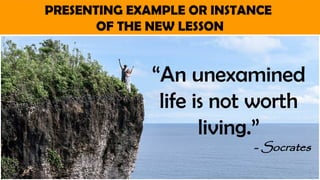
“An unexamined
life is not worth
living.”
- Socrates
ACTIVITY
Read and analyse the following conversation between a high school
teacher and her student in class.
Teacher: Juan, what would you
like to be when you grow up?
Juan: Ma’am, I want to be
happy!
Teacher: Juan, you did not
understand my question.
Juan: Ma’am, you do not
understand what life is all
about!
ACTIVITY
Processing Questions:
1. Do you think that Juan’s answer was appropriate for
his teacher’s question?
2. What do you think was Juan’s interpretation of his
teacher’s question?
3. Based on his responses, what kind of student do you
imagine Juan to be?
4. If you were Juan’s teacher, how would you respond to
him?
5. How is philosophy related to this situation?
ANALYSIS
1. What is philosophy?
2. Why is there a need to philosophize?
3. How do we characterize the study
of philosophy?
4. What are the practical uses of
philosophy in life?
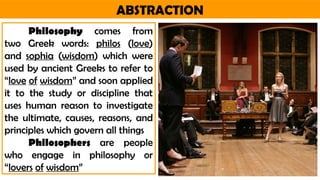
ABSTRACTION
Philosophy comes from
two Greek words: philos (love)
and sophia (wisdom) which were
used by ancient Greeks to refer to
“love of wisdom” and soon applied
it to the study or discipline that
uses human reason to investigate
the ultimate, causes, reasons, and
principles which govern all things
Philosophers are people
who engage in philosophy or
“lovers of wisdom”
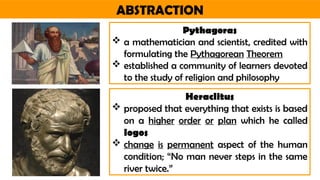
ABSTRACTION
Pythagoras
 a mathematician and scientist, credited with
formulating the Pythagorean Theorem
 established a community of learners devoted
to the study of religion and philosophy
Heraclitus
 proposed that everything that exists is based
on a higher order or plan which he called
logos
 change is permanent aspect of the human
condition; “No man never steps in the same
river twice.”
ABSTRACTION
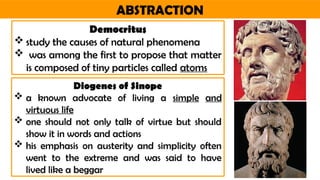
Democritus
 study the causes of natural phenomena
 was among the first to propose that matter
is composed of tiny particles called atoms
Diogenes of Sinope
 a known advocate of living a simple and
virtuous life
 one should not only talk of virtue but should
show it in words and actions
 his emphasis on austerity and simplicity often
went to the extreme and was said to have
lived like a beggar
ABSTRACTION
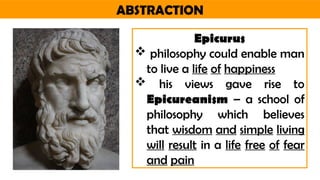
Epicurus
 philosophy could enable man
to live a life of happiness
 his views gave rise to
Epicureanism – a school of
philosophy which believes
that wisdom and simple living
will result in a life free of fear
and pain
ABSTRACTION
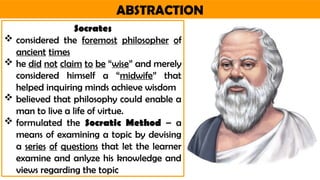
Socrates
 considered the foremost philosopher of
ancient times
 he did not claim to be “wise” and merely
considered himself a “midwife” that
helped inquiring minds achieve wisdom
 believed that philosophy could enable a
man to live a life of virtue.
 formulated the Socratic Method – a
means of examining a topic by devising
a series of questions that let the learner
examine and anlyze his knowledge and
views regarding the topic
ABSTRACTION
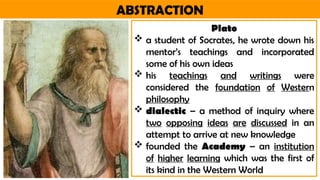
Plato
 a student of Socrates, he wrote down his
mentor’s teachings and incorporated
some of his own ideas
 his teachings and writings were
considered the foundation of Western
philosophy
 dialectic – a method of inquiry where
two opposing ideas are discussed in an
attempt to arrive at new knowledge
 founded the Academy – an institution
of higher learning which was the first of
its kind in the Western World
ABSTRACTION
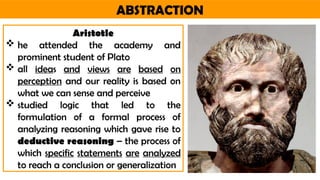
Aristotle
 he attended the academy and
prominent student of Plato
 all ideas and views are based on
perception and our reality is based on
what we can sense and perceive
 studied logic that led to the
formulation of a formal process of
analyzing reasoning which gave rise to
deductive reasoning – the process of
which specific statements are analyzed
to reach a conclusion or generalization
ABSTRACTION
We all have the potential to
philosophize since we have the
tendency to wonder and doubt. We
possess the capacity to reflect on our
experiences, and we have a never-
ending need to learn and discover.
The need to philosophize is traced to a
person’s sense of wonder (Plato) and
doubt (Rene Descartes), the need to
make sense of challenging experiences
(Karl Jaspers), and the love for wisdom.
ABSTRACTION
The study of philosophy can be
considered as a way of analyzing ideas
and frameworks. It is also considered
as a way of examining a particular
area of knowledge. Philosophy itself is
a discipline with its own goals, concerns,
and ways of doing things. It also
makes use of information gathered
from other fields of knowledge and not
just its own conclusions. Finally,
philosophy can be considered a
reflective and meditative activity.
ABSTRACTION
Aesthetics
deals with beauty and what makes
things “beautiful”
Logic
the branch of philosophy which
deals with correct reasoning
Epistemology
discusses the nature of knowledge
and knowing
Ethics
the branch which deals with moral
questions and dilemmas
ABSTRACTION
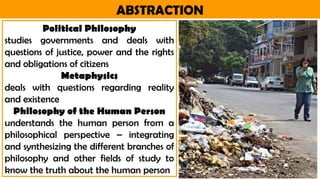
Political Philosophy
studies governments and deals with
questions of justice, power and the rights
and obligations of citizens
Metaphysics
deals with questions regarding reality
and existence
Philosophy of the Human Person
understands the human person from a
philosophical perspective – integrating
and synthesizing the different branches of
philosophy and other fields of study to
know the truth about the human person
ABSTRACTION
Practical Uses of Philosophy in Our Lives:
1. Philosophy enables a person to engage in critical analysis and
interpretation of concepts, definitions, arguments, and problems.
2. Philosophy also improves problem-solving and decision making.
3. A philosopher is a good communicator who can clearly and
adequately present his or her ideas.
4. Wisdom is one intended product of philosophizing that refers to a
person’s ability to apply knowledge to daily life particularly in
making sound choices and judgment.
5. Knowledge of Philosophy can contribute to self-development.
APPLICATION
Describe (through poster, slogan, essay,
song, poem, drawing, etc.) a situation in
your life when you were able to engage
in philosophy. What circumstances or
dilemma brought about your need to
philosophize? How did philosophy help
you address your situation?
GENERALIZATION
1. What are the reasons that compel a person
to engage in philosophical thinking?
2. How can you as a person benefit from
philosophizing?
3. Based on the characteristics of Philosophy,
would it be possible for any person to
engage in philosophical discussion? Why or
why not?
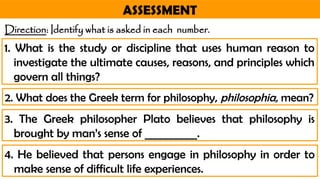
ASSESSMENT
Direction: Identify what is asked in each number.
2. What does the Greek term for philosophy, philosophia, mean?
1. What is the study or discipline that uses human reason to
investigate the ultimate causes, reasons, and principles which
govern all things?
3. The Greek philosopher Plato believes that philosophy is
brought by man’s sense of __________.
4. He believed that persons engage in philosophy in order to
make sense of difficult life experiences.
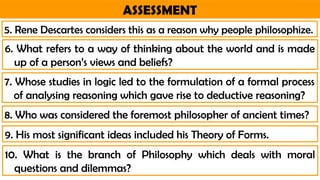
ASSESSMENT
6. What refers to a way of thinking about the world and is made
up of a person’s views and beliefs?
5. Rene Descartes considers this as a reason why people philosophize.
7. Whose studies in logic led to the formulation of a formal process
of analysing reasoning which gave rise to deductive reasoning?
8. Who was considered the foremost philosopher of ancient times?
9. His most significant ideas included his Theory of Forms.
10. What is the branch of Philosophy which deals with moral
questions and dilemmas?
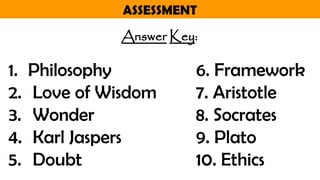
ASSESSMENT
Answer Key:
1. Philosophy 6. Framework
2. Love of Wisdom 7. Aristotle
3. Wonder 8. Socrates
4. Karl Jaspers 9. Plato
5. Doubt 10. Ethics
AGREEMENT
What philosophical questions
do you wish to be answered as
you study this course? List
down five.
OBJECTIVES
The students are expected to:
1. distinguish a holistic perspective from a
partial point of view (PPT11/12-Ia-1.1);
2. recognize the value of having a holistic
view to become better individuals; and
3. understand situations from different
vantage points to see them more fully.
MOTIVATION
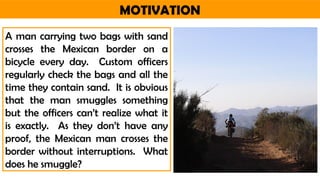
A man carrying two bags with sand
crosses the Mexican border on a
bicycle every day. Custom officers
regularly check the bags and all the
time they contain sand. It is obvious
that the man smuggles something
but the officers can’t realize what it
is exactly. As they don’t have any
proof, the Mexican man crosses the
border without interruptions. What
does he smuggle?
MOTIVATION
Answer: This creative individual
distracts the customs officers’
attention with the bags of sand.
But in fact, he smuggles bicycles!
PRESENTING THE NEW LESSON
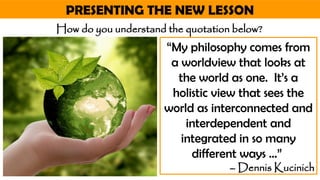
“My philosophy comes from
a worldview that looks at
the world as one. It’s a
holistic view that sees the
world as interconnected and
interdependent and
integrated in so many
different ways …”
– Dennis Kucinich
How do you understand the quotation below?
PRESENTING EXAMPLE OR INSTANCE
OF THE NEW LESSON
Building Vocabularies:
1. Holistic Thinking
2. Partial Thinking
ACTIVITY
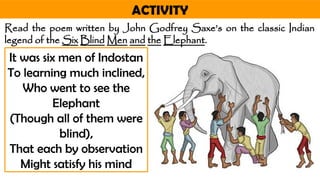
Read the poem written by John Godfrey Saxe’s on the classic Indian
legend of the Six Blind Men and the Elephant.
It was six men of Indostan
To learning much inclined,
Who went to see the
Elephant
(Though all of them were
blind),
That each by observation
Might satisfy his mind
ACTIVITY
The First approach’d the
Elephant,
And happening to fall
Against his broad and
sturdy side,
At once began to bawl:
“God bless me! But the
Elephant
Is very like a WALL!”
ACTIVITY
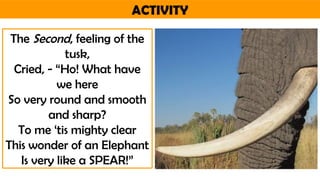
The Second, feeling of the
tusk,
Cried, - “Ho! What have
we here
So very round and smooth
and sharp?
To me ‘tis mighty clear
This wonder of an Elephant
Is very like a SPEAR!”
ACTIVITY
The Third approached the
animal,
And happening to take
The squirming trunk within
his hands,
Thus boldly up and spoke:
“I see,” quoth he, “the
Elephant
Is very like a SNAKE!”
ACTIVITY
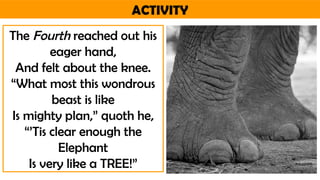
The Fourth reached out his
eager hand,
And felt about the knee.
“What most this wondrous
beast is like
Is mighty plan,” quoth he,
“’Tis clear enough the
Elephant
Is very like a TREE!”
ACTIVITY
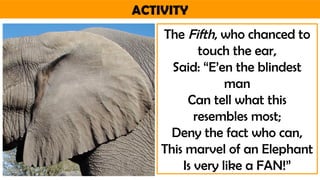
The Fifth, who chanced to
touch the ear,
Said: “E’en the blindest
man
Can tell what this
resembles most;
Deny the fact who can,
This marvel of an Elephant
Is very like a FAN!”
ACTIVITY
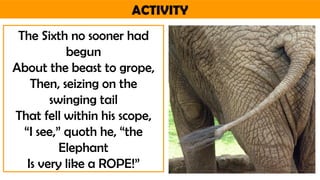
The Sixth no sooner had
begun
About the beast to grope,
Then, seizing on the
swinging tail
That fell within his scope,
“I see,” quoth he, “the
Elephant
Is very like a ROPE!”
ACTIVITY
And so these men of
Indostan
Disputed loud and long,
Each in his own opinion
Exceeding stiff and strong,
Though each was partly
in the right,
And all were in the
wrong!
MORAL
So oft in theologic wars
The disputants, I ween
Rail on in utter ignorance
Of what each other
mean,
And prate about an
Elephant
Not one of them has seen!
ACTIVITY
Processing Questions:
1. Did anyone among the blind men give the correct answer?
Why or why not?
2. In the context of the elephant story, what do you think is a
holistic perspective? What is a partial point of view?
3. What is the importance of a holistic perspective as pointed
out by the poet John Godfrey Saxe?
4. In the last stanza, John Godfrey Saxe related the legend to
the religious wars during his time. What do you think is
John Godfrey Saxe trying to say in this poem?
ANALYSIS
What is the difference
between holistic thinking
and partial thinking?
ABSTRACTION
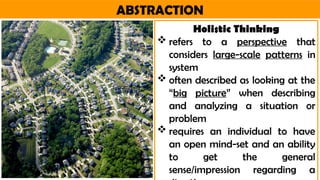
Holistic Thinking
 refers to a perspective that
considers large-scale patterns in
system
 often described as looking at the
“big picture” when describing
and analyzing a situation or
problem
 requires an individual to have
an open mind-set and an ability
to get the general
sense/impression regarding a
ABSTRACTION
Partial Thinking
 focuses on specific aspects of a
situation
 important component of analytical
thinking, as an individual focuses
on certain areas or aspects of a
problem in order to understand it
 though partial thinking is useful,
philosophy utilizes holistic thinking
in making sense of problems and
issues related to the human
experience.
ABSTRACTION
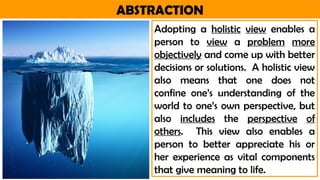
Adopting a holistic view enables a
person to view a problem more
objectively and come up with better
decisions or solutions. A holistic view
also means that one does not
confine one’s understanding of the
world to one’s own perspective, but
also includes the perspective of
others. This view also enables a
person to better appreciate his or
her experience as vital components
that give meaning to life.
APPLICATION
The story of the elephant and the
blind men can be an analogy of
everyday experiences. Recall an
experience where you had
disagreements with friends or family
over something. Was the
disagreement resolved? If yes, how?
If not, how can a more holistic
perspective help in the resolution?
Share your story to your groupmates,
then choose the best story that you
will share to others in class.
GENERALIZATION
Have you adopted a holistic
view in looking at a problem or
situation? How did adopting a
holistic view help you make sense
of the situation?

Intro to Philosophy - Lessons 1 & 2.pptx

  • 1.
  • 2.
    OBJECTIVES The students areexpected to: 1. discuss philosophy and its importance as a discipline and a means for understanding life; 2. appreciate the value of philosophy in daily life; 3. become philosophical in dealing with life situations; and 4. discuss the practical uses of philosophy in life.
  • 3.
    MOTIVATION A murderer issentenced into death. He has to choose between three rooms. The first room is full of furious flame. The second is full of murderers with loaded guns. And there are lions in the third room who had not been fed for years. Which room is the safest? Answer: The room of the lions because they’re dead if they haven’t been fed for years!
  • 4.
    PRESENTING THE NEWLESSON What questions about your life are you struggling to find answers to? Share some of them in class.
  • 5.
    PRESENTING EXAMPLE ORINSTANCE OF THE NEW LESSON “An unexamined life is not worth living.” - Socrates
  • 6.
    ACTIVITY Read and analysethe following conversation between a high school teacher and her student in class. Teacher: Juan, what would you like to be when you grow up? Juan: Ma’am, I want to be happy! Teacher: Juan, you did not understand my question. Juan: Ma’am, you do not understand what life is all about!
  • 7.
    ACTIVITY Processing Questions: 1. Doyou think that Juan’s answer was appropriate for his teacher’s question? 2. What do you think was Juan’s interpretation of his teacher’s question? 3. Based on his responses, what kind of student do you imagine Juan to be? 4. If you were Juan’s teacher, how would you respond to him? 5. How is philosophy related to this situation?
  • 8.
    ANALYSIS 1. What isphilosophy? 2. Why is there a need to philosophize? 3. How do we characterize the study of philosophy? 4. What are the practical uses of philosophy in life?
  • 9.
    ABSTRACTION Philosophy comes from twoGreek words: philos (love) and sophia (wisdom) which were used by ancient Greeks to refer to “love of wisdom” and soon applied it to the study or discipline that uses human reason to investigate the ultimate, causes, reasons, and principles which govern all things Philosophers are people who engage in philosophy or “lovers of wisdom”
  • 10.
    ABSTRACTION Pythagoras  a mathematicianand scientist, credited with formulating the Pythagorean Theorem  established a community of learners devoted to the study of religion and philosophy Heraclitus  proposed that everything that exists is based on a higher order or plan which he called logos  change is permanent aspect of the human condition; “No man never steps in the same river twice.”
  • 11.
    ABSTRACTION Democritus  study thecauses of natural phenomena  was among the first to propose that matter is composed of tiny particles called atoms Diogenes of Sinope  a known advocate of living a simple and virtuous life  one should not only talk of virtue but should show it in words and actions  his emphasis on austerity and simplicity often went to the extreme and was said to have lived like a beggar
  • 12.
    ABSTRACTION Epicurus  philosophy couldenable man to live a life of happiness  his views gave rise to Epicureanism – a school of philosophy which believes that wisdom and simple living will result in a life free of fear and pain
  • 13.
    ABSTRACTION Socrates  considered theforemost philosopher of ancient times  he did not claim to be “wise” and merely considered himself a “midwife” that helped inquiring minds achieve wisdom  believed that philosophy could enable a man to live a life of virtue.  formulated the Socratic Method – a means of examining a topic by devising a series of questions that let the learner examine and anlyze his knowledge and views regarding the topic
  • 14.
    ABSTRACTION Plato  a studentof Socrates, he wrote down his mentor’s teachings and incorporated some of his own ideas  his teachings and writings were considered the foundation of Western philosophy  dialectic – a method of inquiry where two opposing ideas are discussed in an attempt to arrive at new knowledge  founded the Academy – an institution of higher learning which was the first of its kind in the Western World
  • 15.
    ABSTRACTION Aristotle  he attendedthe academy and prominent student of Plato  all ideas and views are based on perception and our reality is based on what we can sense and perceive  studied logic that led to the formulation of a formal process of analyzing reasoning which gave rise to deductive reasoning – the process of which specific statements are analyzed to reach a conclusion or generalization
  • 16.
    ABSTRACTION We all havethe potential to philosophize since we have the tendency to wonder and doubt. We possess the capacity to reflect on our experiences, and we have a never- ending need to learn and discover. The need to philosophize is traced to a person’s sense of wonder (Plato) and doubt (Rene Descartes), the need to make sense of challenging experiences (Karl Jaspers), and the love for wisdom.
  • 17.
    ABSTRACTION The study ofphilosophy can be considered as a way of analyzing ideas and frameworks. It is also considered as a way of examining a particular area of knowledge. Philosophy itself is a discipline with its own goals, concerns, and ways of doing things. It also makes use of information gathered from other fields of knowledge and not just its own conclusions. Finally, philosophy can be considered a reflective and meditative activity.
  • 18.
    ABSTRACTION Aesthetics deals with beautyand what makes things “beautiful” Logic the branch of philosophy which deals with correct reasoning Epistemology discusses the nature of knowledge and knowing Ethics the branch which deals with moral questions and dilemmas
  • 19.
    ABSTRACTION Political Philosophy studies governmentsand deals with questions of justice, power and the rights and obligations of citizens Metaphysics deals with questions regarding reality and existence Philosophy of the Human Person understands the human person from a philosophical perspective – integrating and synthesizing the different branches of philosophy and other fields of study to know the truth about the human person
  • 20.
    ABSTRACTION Practical Uses ofPhilosophy in Our Lives: 1. Philosophy enables a person to engage in critical analysis and interpretation of concepts, definitions, arguments, and problems. 2. Philosophy also improves problem-solving and decision making. 3. A philosopher is a good communicator who can clearly and adequately present his or her ideas. 4. Wisdom is one intended product of philosophizing that refers to a person’s ability to apply knowledge to daily life particularly in making sound choices and judgment. 5. Knowledge of Philosophy can contribute to self-development.
  • 21.
    APPLICATION Describe (through poster,slogan, essay, song, poem, drawing, etc.) a situation in your life when you were able to engage in philosophy. What circumstances or dilemma brought about your need to philosophize? How did philosophy help you address your situation?
  • 22.
    GENERALIZATION 1. What arethe reasons that compel a person to engage in philosophical thinking? 2. How can you as a person benefit from philosophizing? 3. Based on the characteristics of Philosophy, would it be possible for any person to engage in philosophical discussion? Why or why not?
  • 23.
    ASSESSMENT Direction: Identify whatis asked in each number. 2. What does the Greek term for philosophy, philosophia, mean? 1. What is the study or discipline that uses human reason to investigate the ultimate causes, reasons, and principles which govern all things? 3. The Greek philosopher Plato believes that philosophy is brought by man’s sense of __________. 4. He believed that persons engage in philosophy in order to make sense of difficult life experiences.
  • 24.
    ASSESSMENT 6. What refersto a way of thinking about the world and is made up of a person’s views and beliefs? 5. Rene Descartes considers this as a reason why people philosophize. 7. Whose studies in logic led to the formulation of a formal process of analysing reasoning which gave rise to deductive reasoning? 8. Who was considered the foremost philosopher of ancient times? 9. His most significant ideas included his Theory of Forms. 10. What is the branch of Philosophy which deals with moral questions and dilemmas?
  • 25.
    ASSESSMENT Answer Key: 1. Philosophy6. Framework 2. Love of Wisdom 7. Aristotle 3. Wonder 8. Socrates 4. Karl Jaspers 9. Plato 5. Doubt 10. Ethics
  • 26.
    AGREEMENT What philosophical questions doyou wish to be answered as you study this course? List down five.
  • 27.
    OBJECTIVES The students areexpected to: 1. distinguish a holistic perspective from a partial point of view (PPT11/12-Ia-1.1); 2. recognize the value of having a holistic view to become better individuals; and 3. understand situations from different vantage points to see them more fully.
  • 28.
    MOTIVATION A man carryingtwo bags with sand crosses the Mexican border on a bicycle every day. Custom officers regularly check the bags and all the time they contain sand. It is obvious that the man smuggles something but the officers can’t realize what it is exactly. As they don’t have any proof, the Mexican man crosses the border without interruptions. What does he smuggle?
  • 29.
    MOTIVATION Answer: This creativeindividual distracts the customs officers’ attention with the bags of sand. But in fact, he smuggles bicycles!
  • 30.
    PRESENTING THE NEWLESSON “My philosophy comes from a worldview that looks at the world as one. It’s a holistic view that sees the world as interconnected and interdependent and integrated in so many different ways …” – Dennis Kucinich How do you understand the quotation below?
  • 31.
    PRESENTING EXAMPLE ORINSTANCE OF THE NEW LESSON Building Vocabularies: 1. Holistic Thinking 2. Partial Thinking
  • 32.
    ACTIVITY Read the poemwritten by John Godfrey Saxe’s on the classic Indian legend of the Six Blind Men and the Elephant. It was six men of Indostan To learning much inclined, Who went to see the Elephant (Though all of them were blind), That each by observation Might satisfy his mind
  • 33.
    ACTIVITY The First approach’dthe Elephant, And happening to fall Against his broad and sturdy side, At once began to bawl: “God bless me! But the Elephant Is very like a WALL!”
  • 34.
    ACTIVITY The Second, feelingof the tusk, Cried, - “Ho! What have we here So very round and smooth and sharp? To me ‘tis mighty clear This wonder of an Elephant Is very like a SPEAR!”
  • 35.
    ACTIVITY The Third approachedthe animal, And happening to take The squirming trunk within his hands, Thus boldly up and spoke: “I see,” quoth he, “the Elephant Is very like a SNAKE!”
  • 36.
    ACTIVITY The Fourth reachedout his eager hand, And felt about the knee. “What most this wondrous beast is like Is mighty plan,” quoth he, “’Tis clear enough the Elephant Is very like a TREE!”
  • 37.
    ACTIVITY The Fifth, whochanced to touch the ear, Said: “E’en the blindest man Can tell what this resembles most; Deny the fact who can, This marvel of an Elephant Is very like a FAN!”
  • 38.
    ACTIVITY The Sixth nosooner had begun About the beast to grope, Then, seizing on the swinging tail That fell within his scope, “I see,” quoth he, “the Elephant Is very like a ROPE!”
  • 39.
    ACTIVITY And so thesemen of Indostan Disputed loud and long, Each in his own opinion Exceeding stiff and strong, Though each was partly in the right, And all were in the wrong! MORAL So oft in theologic wars The disputants, I ween Rail on in utter ignorance Of what each other mean, And prate about an Elephant Not one of them has seen!
  • 40.
    ACTIVITY Processing Questions: 1. Didanyone among the blind men give the correct answer? Why or why not? 2. In the context of the elephant story, what do you think is a holistic perspective? What is a partial point of view? 3. What is the importance of a holistic perspective as pointed out by the poet John Godfrey Saxe? 4. In the last stanza, John Godfrey Saxe related the legend to the religious wars during his time. What do you think is John Godfrey Saxe trying to say in this poem?
  • 41.
    ANALYSIS What is thedifference between holistic thinking and partial thinking?
  • 42.
    ABSTRACTION Holistic Thinking  refersto a perspective that considers large-scale patterns in system  often described as looking at the “big picture” when describing and analyzing a situation or problem  requires an individual to have an open mind-set and an ability to get the general sense/impression regarding a
  • 43.
    ABSTRACTION Partial Thinking  focuseson specific aspects of a situation  important component of analytical thinking, as an individual focuses on certain areas or aspects of a problem in order to understand it  though partial thinking is useful, philosophy utilizes holistic thinking in making sense of problems and issues related to the human experience.
  • 44.
    ABSTRACTION Adopting a holisticview enables a person to view a problem more objectively and come up with better decisions or solutions. A holistic view also means that one does not confine one’s understanding of the world to one’s own perspective, but also includes the perspective of others. This view also enables a person to better appreciate his or her experience as vital components that give meaning to life.
  • 45.
    APPLICATION The story ofthe elephant and the blind men can be an analogy of everyday experiences. Recall an experience where you had disagreements with friends or family over something. Was the disagreement resolved? If yes, how? If not, how can a more holistic perspective help in the resolution? Share your story to your groupmates, then choose the best story that you will share to others in class.
  • 46.
    GENERALIZATION Have you adopteda holistic view in looking at a problem or situation? How did adopting a holistic view help you make sense of the situation?