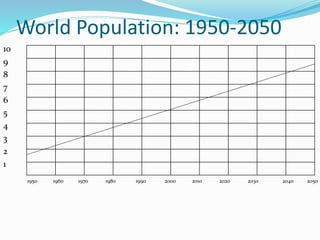
World Population: 1950-2050
10
9
8
7
6
5
4
3
2
1
1950 1960 1970 1980 1990 2000 2010 2020 2030 2040 2050
 The world’s population is increasing rapidly, especially
in developing countries like the Philippines. This
brings about enormous problems relating to adequate
food supply, availability of land and water, energy and
acceptable standards of living for the majority of the
population.
 In 1994, representatives from 179 countries convened to form an
international agreement to put population concerns at the center
of all economic, political and environmental activities. The goal
was to address the critical challenges and interrelationships
between population and development. Collectively, the
International Conference on Population and
Development (ICPD) has agreed on the following programs of
action:
 Universal access to primary education
 Reduction of infant and child mortality
 Reduction of maternal mortality
 Access to reproductive and sexual health services including
family planning
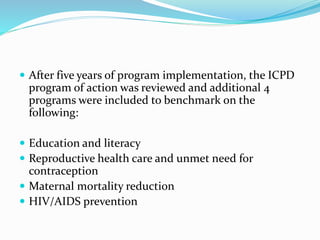
 After five years of program implementation, the ICPD
program of action was reviewed and additional 4
programs were included to benchmark on the
following:
 Education and literacy
 Reproductive health care and unmet need for
contraception
 Maternal mortality reduction
 HIV/AIDS prevention
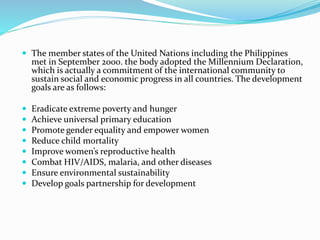
 The member states of the United Nations including the Philippines
met in September 2000. the body adopted the Millennium Declaration,
which is actually a commitment of the international community to
sustain social and economic progress in all countries. The development
goals are as follows:
 Eradicate extreme poverty and hunger
 Achieve universal primary education
 Promote gender equality and empower women
 Reduce child mortality
 Improve women’s reproductive health
 Combat HIV/AIDS, malaria, and other diseases
 Ensure environmental sustainability
 Develop goals partnership for development

Addressing Problems Related to Rapid Population Growth

  • 2.
    World Population: 1950-2050 10 9 8 7 6 5 4 3 2 1 19501960 1970 1980 1990 2000 2010 2020 2030 2040 2050
  • 3.
     The world’spopulation is increasing rapidly, especially in developing countries like the Philippines. This brings about enormous problems relating to adequate food supply, availability of land and water, energy and acceptable standards of living for the majority of the population.
  • 4.
     In 1994,representatives from 179 countries convened to form an international agreement to put population concerns at the center of all economic, political and environmental activities. The goal was to address the critical challenges and interrelationships between population and development. Collectively, the International Conference on Population and Development (ICPD) has agreed on the following programs of action:  Universal access to primary education  Reduction of infant and child mortality  Reduction of maternal mortality  Access to reproductive and sexual health services including family planning
  • 5.
     After fiveyears of program implementation, the ICPD program of action was reviewed and additional 4 programs were included to benchmark on the following:  Education and literacy  Reproductive health care and unmet need for contraception  Maternal mortality reduction  HIV/AIDS prevention
  • 6.
     The memberstates of the United Nations including the Philippines met in September 2000. the body adopted the Millennium Declaration, which is actually a commitment of the international community to sustain social and economic progress in all countries. The development goals are as follows:  Eradicate extreme poverty and hunger  Achieve universal primary education  Promote gender equality and empower women  Reduce child mortality  Improve women’s reproductive health  Combat HIV/AIDS, malaria, and other diseases  Ensure environmental sustainability  Develop goals partnership for development