REPROGRAMMING
THE GENOME
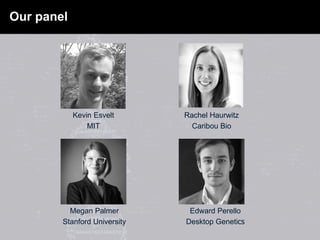
Edward Perello
Desktop Genetics
Our panel
Megan Palmer
Stanford University
Rachel Haurwitz
Caribou Bio
Kevin Esvelt
MIT
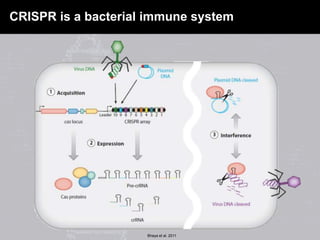
CRISPR is a bacterial immune system
Bhaya et al. 2011
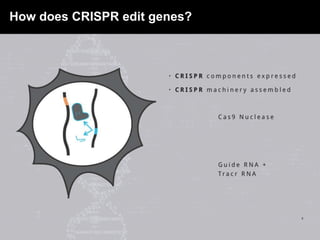
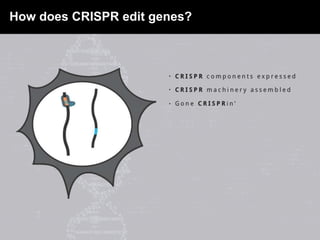
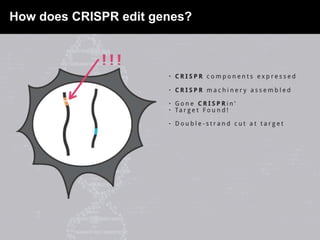
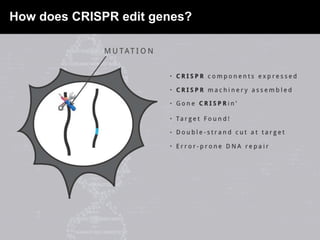
How does CRISPR edit genes?
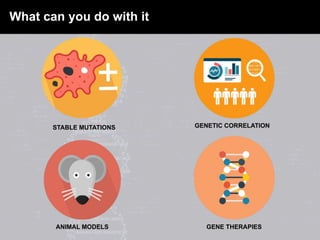
What can you do with it
STABLE MUTATIONS GENETIC CORRELATION
ANIMAL MODELS GENE THERAPIES
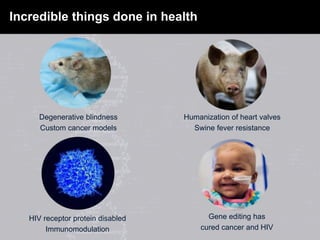
Incredible things done in health
Degenerative blindness
Custom cancer models
Humanization of heart valves
Swine fever resistance
HIV receptor protein disabled
Immunomodulation
Gene editing has
cured cancer and HIV
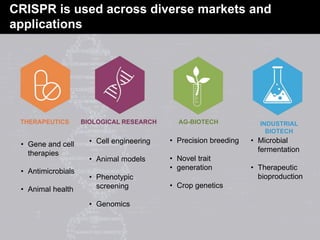
CRISPR is used across diverse markets and
applications
THERAPEUTICS AG-BIOTECHBIOLOGICAL RESEARCH INDUSTRIAL
BIOTECH
• Gene and cell
therapies
• Antimicrobials
• Animal health
• Precision breeding
• Novel trait
• generation
• Crop genetics
• Cell engineering
• Animal models
• Phenotypic
screening
• Genomics
• Microbial
fermentation
• Therapeutic
bioproduction
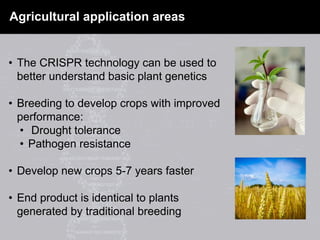
Agricultural application areas
• The CRISPR technology can be used to
better understand basic plant genetics
• Breeding to develop crops with improved
performance:
• Drought tolerance
• Pathogen resistance
• Develop new crops 5-7 years faster
• End product is identical to plants
generated by traditional breeding
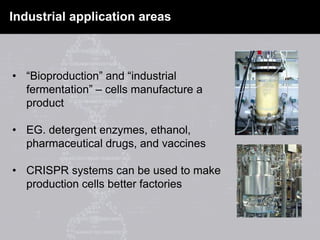
Industrial application areas
• “Bioproduction” and “industrial
fermentation” – cells manufacture a
product
• EG. detergent enzymes, ethanol,
pharmaceutical drugs, and vaccines
• CRISPR systems can be used to make
production cells better factories
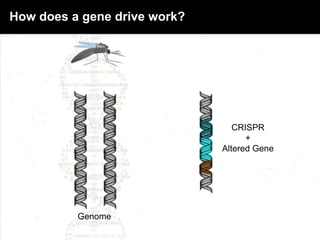
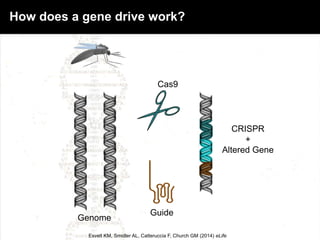
Genome
Esvelt KM, Smidler AL, Catteruccia F, Church GM (2014) eLife
CRISPR
+
Altered Gene
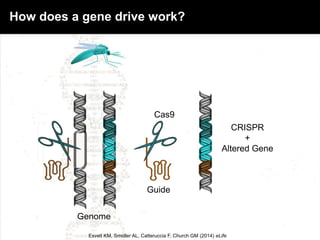
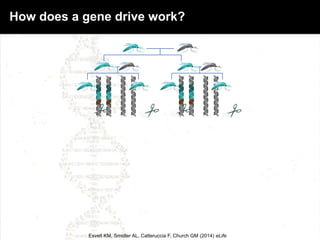
How does a gene drive work?
Guide
Cas9
Genome
Esvelt KM, Smidler AL, Catteruccia F, Church GM (2014) eLife
CRISPR
+
Altered Gene
How does a gene drive work?
Genome
Guide
Cas9
CRISPR
+
Altered Gene
How does a gene drive work?
Esvelt KM, Smidler AL, Catteruccia F, Church GM (2014) eLife
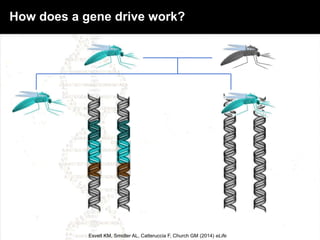
How does a gene drive work?
Esvelt KM, Smidler AL, Catteruccia F, Church GM (2014) eLife
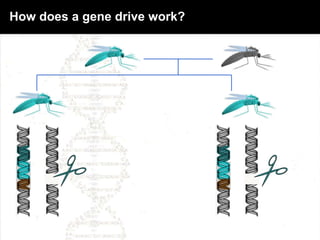
How does a gene drive work?
Esvelt KM, Smidler AL, Catteruccia F, Church GM (2014) eLife
How does a gene drive work?
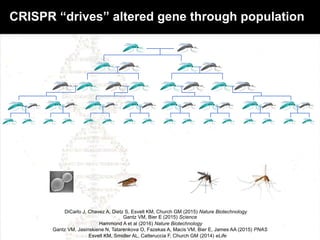
Gantz VM, Bier E (2015) Science
DiCarlo J, Chavez A, Dietz S, Esvelt KM, Church GM (2015) Nature Biotechnology
Gantz VM, Jasinskiene N, Tatarenkova O, Fazekas A, Macis VM, Bier E, James AA (2015) PNAS
Hammond A et al (2016) Nature Biotechnology
Esvelt KM, Smidler AL, Catteruccia F, Church GM (2014) eLife
CRISPR “drives” altered gene through population
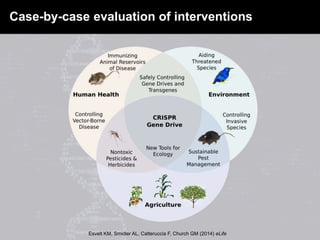
Esvelt KM, Smidler AL, Catteruccia F, Church GM (2014) eLife
Case-by-case evaluation of interventions
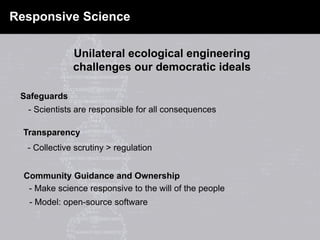
- Scientists are responsible for all consequences
Safeguards
Transparency
- Collective scrutiny > regulation
Community Guidance and Ownership
- Make science responsive to the will of the people
- Model: open-source software
Responsive Science
Unilateral ecological engineering
challenges our democratic ideals
How might we ensure that the development of
biotechnology is (overwhelmingly) constructive…?
…or at the very least, not destructive?
Going forward
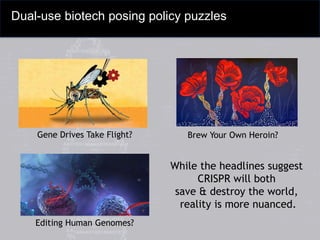
Dual-use biotech posing policy puzzles
While the headlines suggest
CRISPR will both
save & destroy the world,
reality is more nuanced.
Gene Drives Take Flight? Brew Your Own Heroin?
Editing Human Genomes?
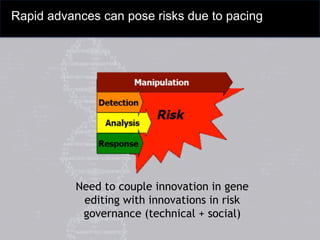
Rapid advances can pose risks due to pacing
Need to couple innovation in gene
editing with innovations in risk
governance (technical + social)
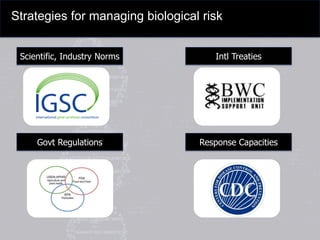
Strategies for managing biological risk
Scientific, Industry Norms
Govt Regulations
Intl Treaties
Response Capacities
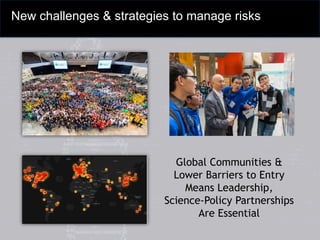
New challenges & strategies to manage risks
Global Communities &
Lower Barriers to Entry
Means Leadership,
Science-Policy Partnerships
Are Essential
Thank you!
edwardp@deskgen.com
haurwitz@cariboubio.co
m
esvelt@mit.edu
mjpalmer@stanford.edu

Reprogramming the genome with CRISPR

  • 1.
  • 2.
    Edward Perello Desktop Genetics Ourpanel Megan Palmer Stanford University Rachel Haurwitz Caribou Bio Kevin Esvelt MIT
  • 3.
    CRISPR is abacterial immune system Bhaya et al. 2011
  • 4.
    How does CRISPRedit genes?
  • 5.
    How does CRISPRedit genes?
  • 6.
    How does CRISPRedit genes?
  • 7.
    How does CRISPRedit genes?
  • 8.
    What can youdo with it STABLE MUTATIONS GENETIC CORRELATION ANIMAL MODELS GENE THERAPIES
  • 9.
    Incredible things donein health Degenerative blindness Custom cancer models Humanization of heart valves Swine fever resistance HIV receptor protein disabled Immunomodulation Gene editing has cured cancer and HIV
  • 10.
    CRISPR is usedacross diverse markets and applications THERAPEUTICS AG-BIOTECHBIOLOGICAL RESEARCH INDUSTRIAL BIOTECH • Gene and cell therapies • Antimicrobials • Animal health • Precision breeding • Novel trait • generation • Crop genetics • Cell engineering • Animal models • Phenotypic screening • Genomics • Microbial fermentation • Therapeutic bioproduction
  • 11.
    Agricultural application areas •The CRISPR technology can be used to better understand basic plant genetics • Breeding to develop crops with improved performance: • Drought tolerance • Pathogen resistance • Develop new crops 5-7 years faster • End product is identical to plants generated by traditional breeding
  • 12.
    Industrial application areas •“Bioproduction” and “industrial fermentation” – cells manufacture a product • EG. detergent enzymes, ethanol, pharmaceutical drugs, and vaccines • CRISPR systems can be used to make production cells better factories
  • 13.
    Genome Esvelt KM, SmidlerAL, Catteruccia F, Church GM (2014) eLife CRISPR + Altered Gene How does a gene drive work?
  • 14.
    Guide Cas9 Genome Esvelt KM, SmidlerAL, Catteruccia F, Church GM (2014) eLife CRISPR + Altered Gene How does a gene drive work?
  • 15.
    Genome Guide Cas9 CRISPR + Altered Gene How doesa gene drive work? Esvelt KM, Smidler AL, Catteruccia F, Church GM (2014) eLife
  • 16.
    How does agene drive work? Esvelt KM, Smidler AL, Catteruccia F, Church GM (2014) eLife
  • 17.
    How does agene drive work?
  • 18.
    Esvelt KM, SmidlerAL, Catteruccia F, Church GM (2014) eLife How does a gene drive work?
  • 19.
    Gantz VM, BierE (2015) Science DiCarlo J, Chavez A, Dietz S, Esvelt KM, Church GM (2015) Nature Biotechnology Gantz VM, Jasinskiene N, Tatarenkova O, Fazekas A, Macis VM, Bier E, James AA (2015) PNAS Hammond A et al (2016) Nature Biotechnology Esvelt KM, Smidler AL, Catteruccia F, Church GM (2014) eLife CRISPR “drives” altered gene through population
  • 20.
    Esvelt KM, SmidlerAL, Catteruccia F, Church GM (2014) eLife Case-by-case evaluation of interventions
  • 21.
    - Scientists areresponsible for all consequences Safeguards Transparency - Collective scrutiny > regulation Community Guidance and Ownership - Make science responsive to the will of the people - Model: open-source software Responsive Science Unilateral ecological engineering challenges our democratic ideals
  • 22.
    How might weensure that the development of biotechnology is (overwhelmingly) constructive…? …or at the very least, not destructive? Going forward
  • 23.
    Dual-use biotech posingpolicy puzzles While the headlines suggest CRISPR will both save & destroy the world, reality is more nuanced. Gene Drives Take Flight? Brew Your Own Heroin? Editing Human Genomes?
  • 24.
    Rapid advances canpose risks due to pacing Need to couple innovation in gene editing with innovations in risk governance (technical + social)
  • 25.
    Strategies for managingbiological risk Scientific, Industry Norms Govt Regulations Intl Treaties Response Capacities
  • 26.
    New challenges &strategies to manage risks Global Communities & Lower Barriers to Entry Means Leadership, Science-Policy Partnerships Are Essential
  • 27.