Fragment Based Drug
Design (FBDD)
Presented by: Ekta P. Tembhare
Smt. Kishoritai Bhoyar College of Pharmacy, Kamptee,
Nagpur.
Introduction:
Fragment-based lead discovery is now firmly established as a
mature collection of methods and approaches for the discovery
of small molecules that bind to protein or nucleic acid targets.
The approach has also had a number of other impacts such as
providing starting points for lead discovery for challenging,
unconventional targets such as protein–protein interactions,
increasing the use of biophysics to characterize compound
binding and properties,
and providing small groups, particularly in academia, with
access to the tools to identify chemical probes of biological
systems
What are Fragments?
Fragments are defined as low molecular weight, moderately lipophilic, highly
soluble organic molecules.
• Fragments typically bind to their target protein with low affinity, generally
in the μM to mM range, and can be grown, merged or linked with another
fragment to improve the potency.
• The “Rule of Three” states that fragments should have,
- a molecular weight < 300 Da,
- cLogP≤3,
- number of hydrogen bond donors ≤ 3 and
- number of hydrogen bond acceptors ≤3.
- the number of rotatable bonds ≤ 3 and
- the polar surface area (PSA) ≤ 60 Å2,
would give
more desirable
fragment like
compounds
For conventional targets:
• Fragments can sample the chemical space of what will bind to a binding site.
• Fragments can show selectivity even for closely related proteins and even when a
fragment binds to many similar targets, it can adopt different binding modes
• Where crystal structures are available, the important first step in assimilating the set
of fragment hits is to categorize the fragments on binding mode.
• Often, there will be regions of a fragment that are not optimal or required for
binding. For this reason, it is important to explore the SAR of the initial fragment(s)
before optimization, identifying which binding modes and potential vectors offer the
opportunity to gain selectivity and affinity.
For unconventional targets:
• Fragments provide the opportunity to assess challenging targets for chemical
matter that binds; the hit rate can be an indication of how difficult it is going to be
to progress compounds against a target
• It is usually not an issue in identifying fragments that bind to such targets.
• The major challenge is establishing robust, validated assays – both for establishing
binding and for activity.
High-throughput screening (HTS) of pre-existing compounds in a variety of
pharmacological assays is still the most widely used approach to hit
discovery.
Half of all HTS screens fail to deliver appropriate chemical starting points for
new discovery programs.
Reasons:
The non drug-like compounds present in many chemical archives assembled
by random combinatorial chemistry approaches.
These compounds cannot be optimized into development candidates.
It is usually more efficient to start discovery from creating new target focused
libraries of ‘lead-like’ compounds which can be more readily optimized.
Why FBDD?
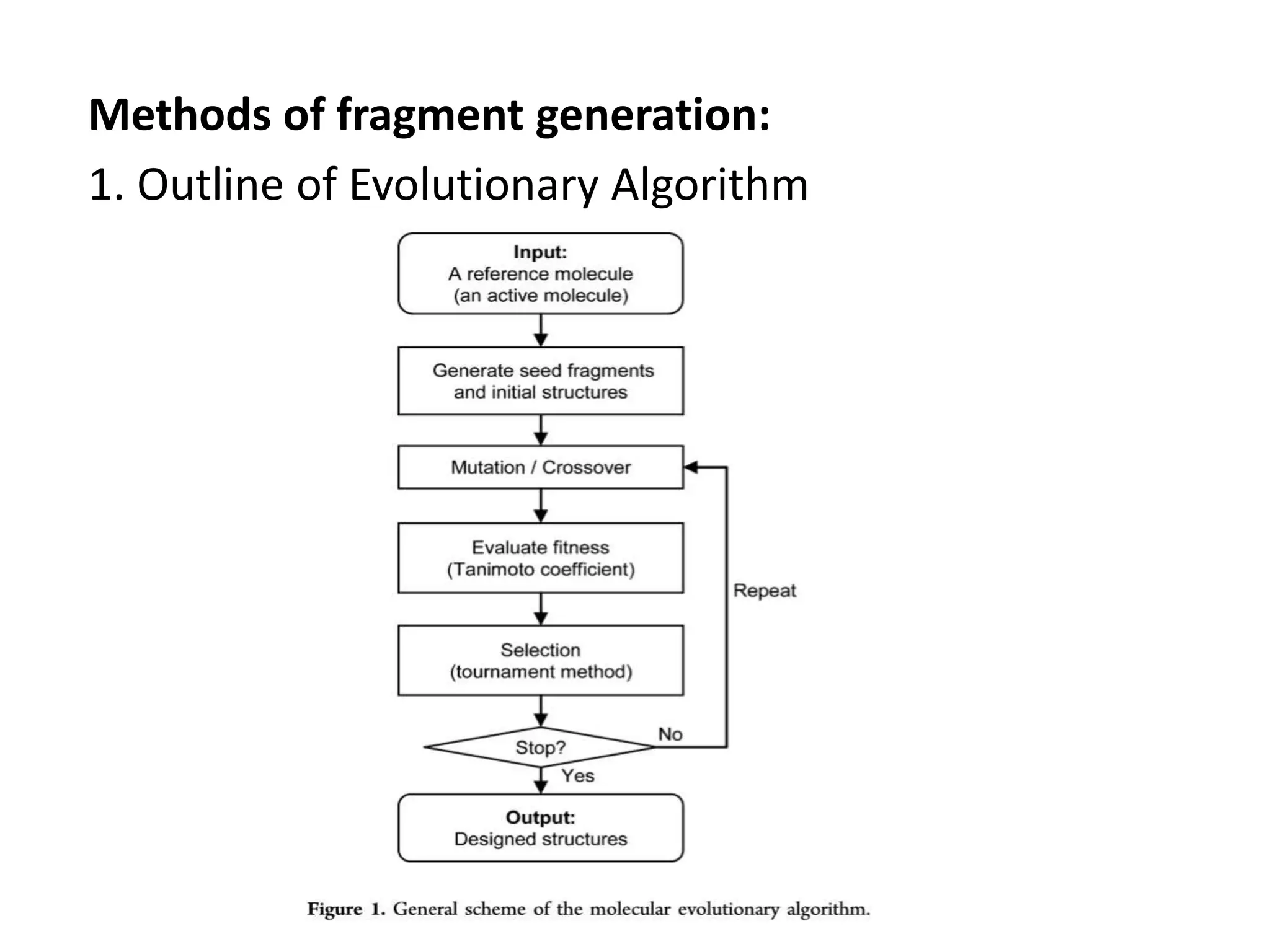
Methods of fragment generation:
1. Outline of Evolutionary Algorithm
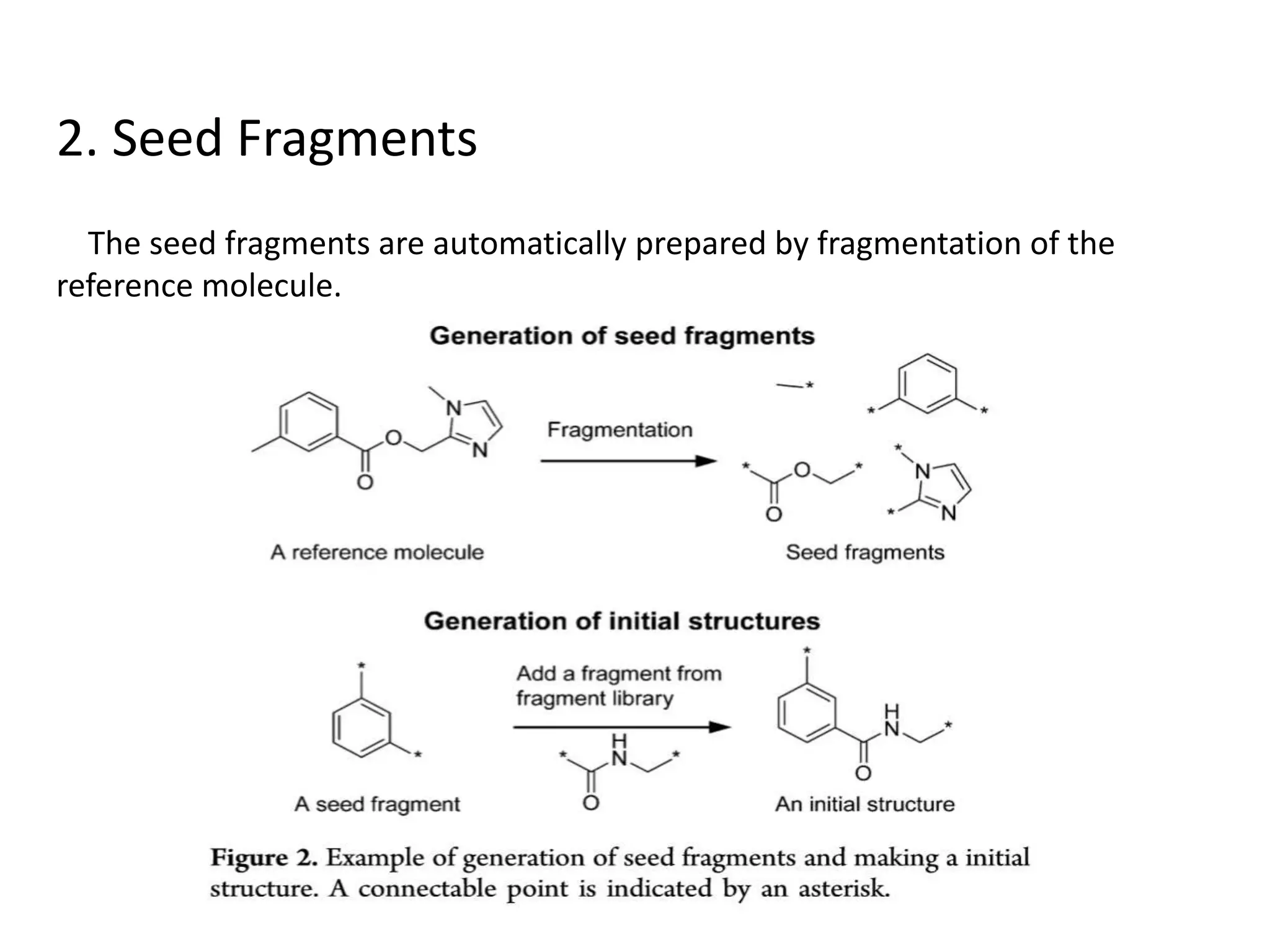
2. Seed Fragments
The seed fragments are automatically prepared by fragmentation of the
reference molecule.
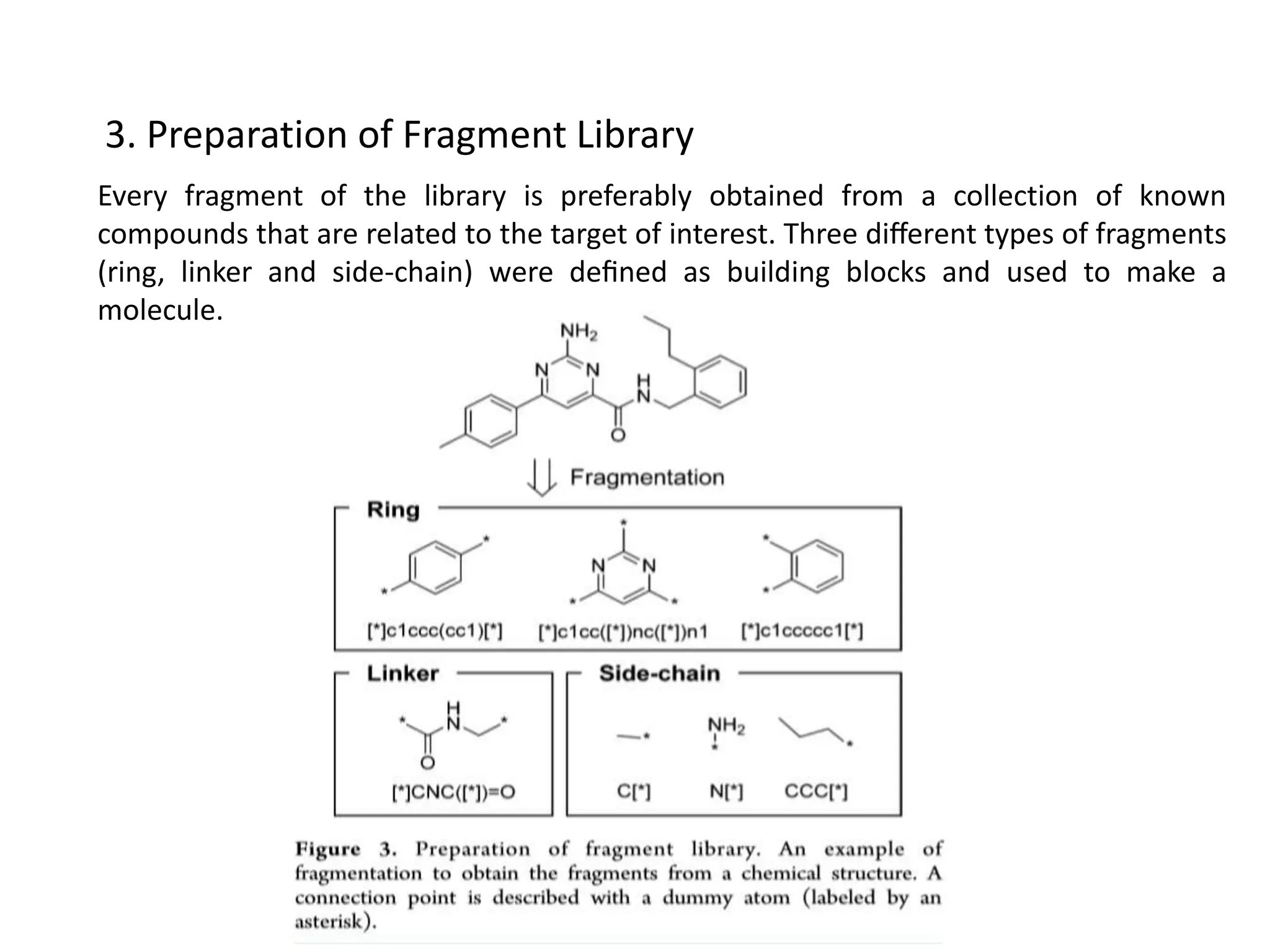
3. Preparation of Fragment Library
Every fragment of the library is preferably obtained from a collection of known
compounds that are related to the target of interest. Three different types of fragments
(ring, linker and side-chain) were defined as building blocks and used to make a
molecule.
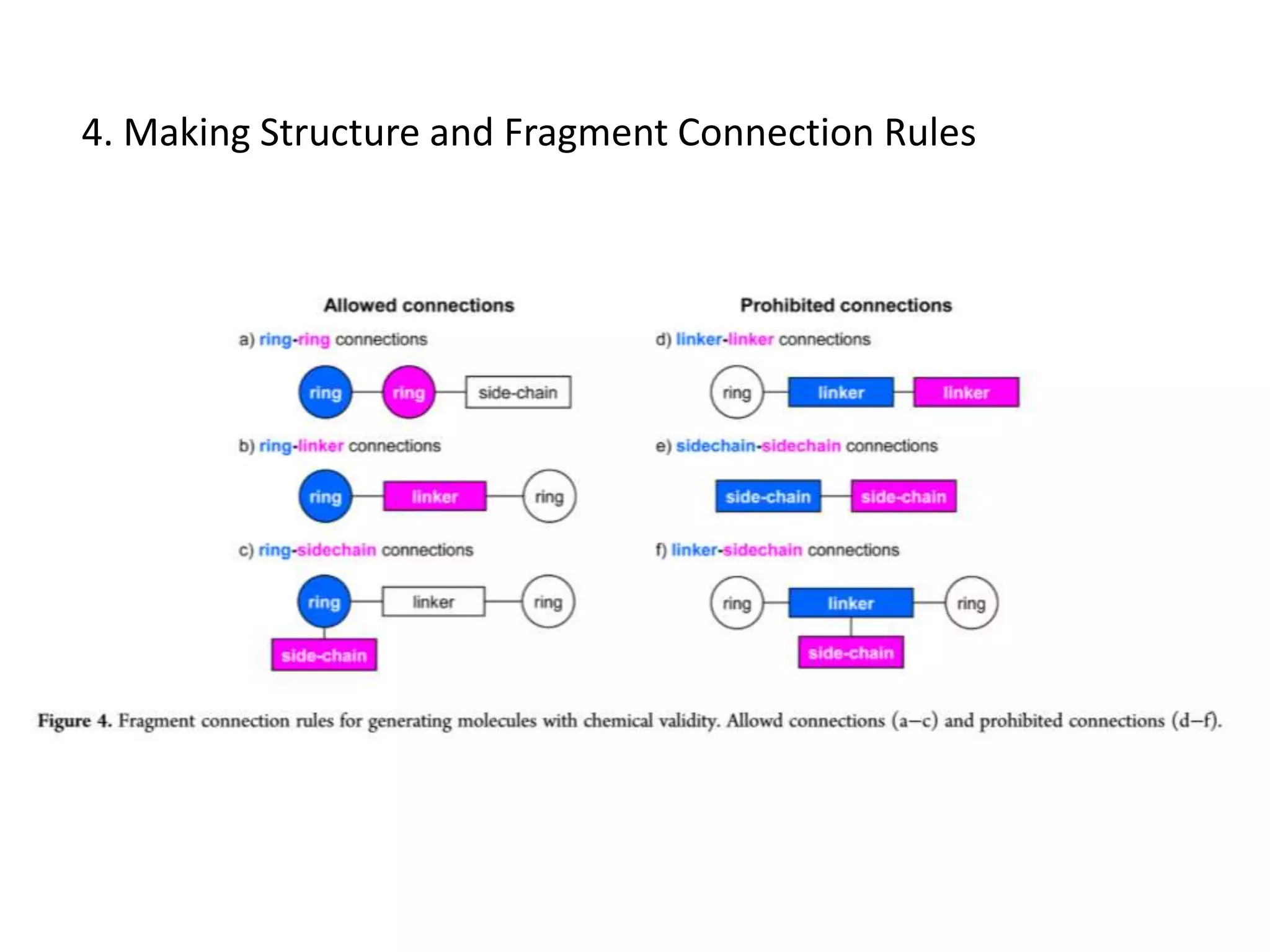
4. Making Structure and Fragment Connection Rules
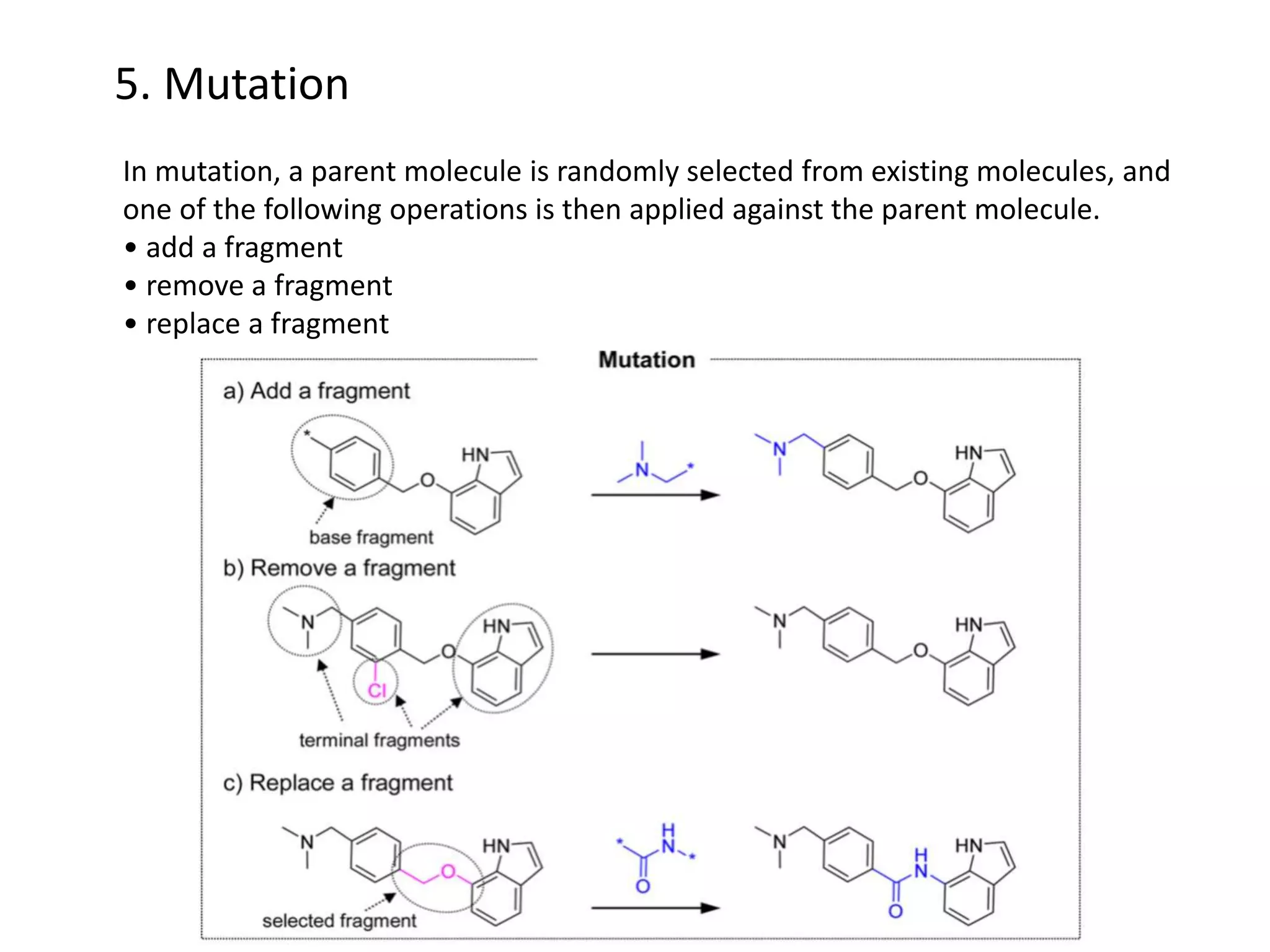
5. Mutation
In mutation, a parent molecule is randomly selected from existing molecules, and
one of the following operations is then applied against the parent molecule.
• add a fragment
• remove a fragment
• replace a fragment
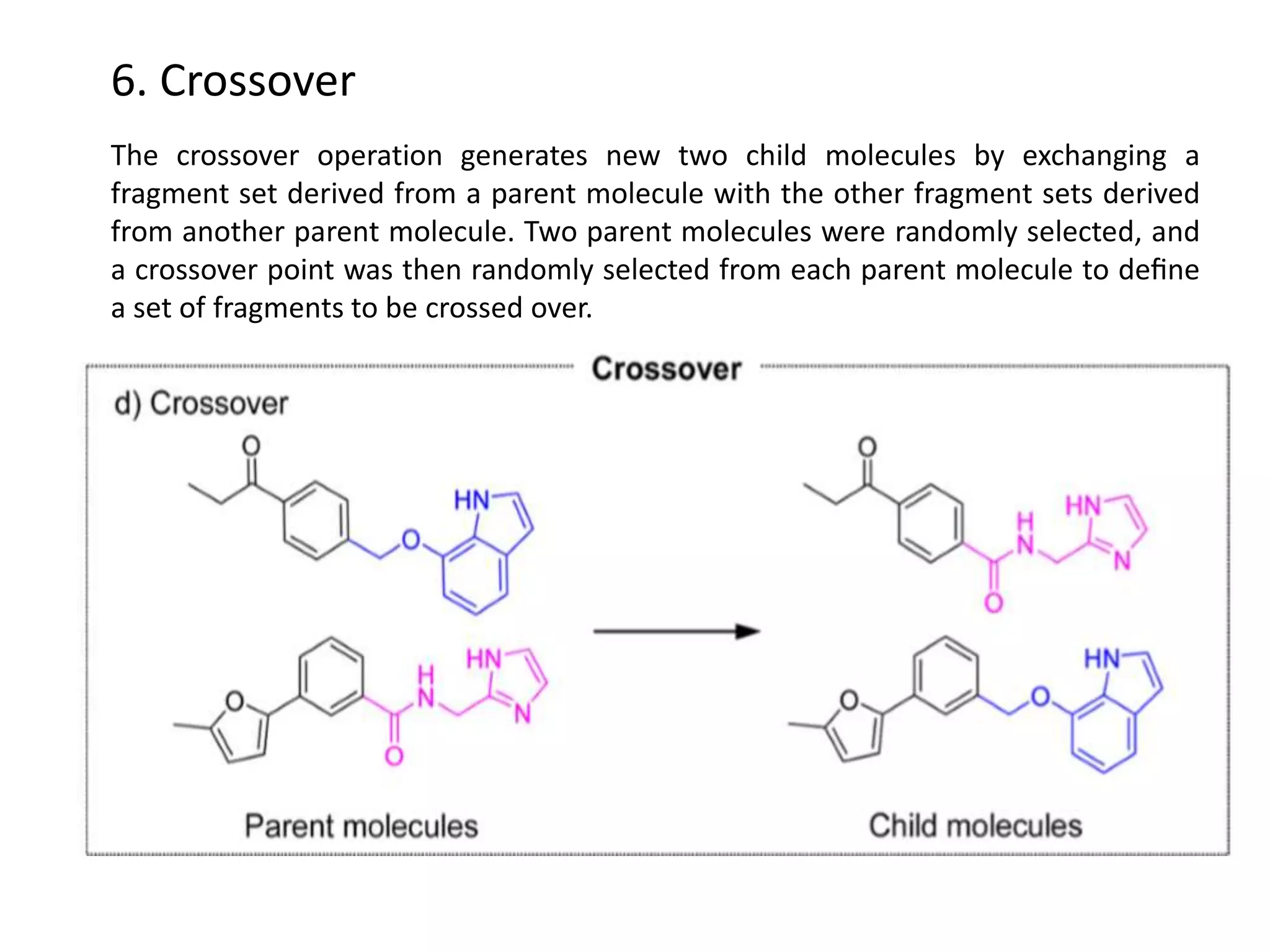
6. Crossover
The crossover operation generates new two child molecules by exchanging a
fragment set derived from a parent molecule with the other fragment sets derived
from another parent molecule. Two parent molecules were randomly selected, and
a crossover point was then randomly selected from each parent molecule to define
a set of fragments to be crossed over.
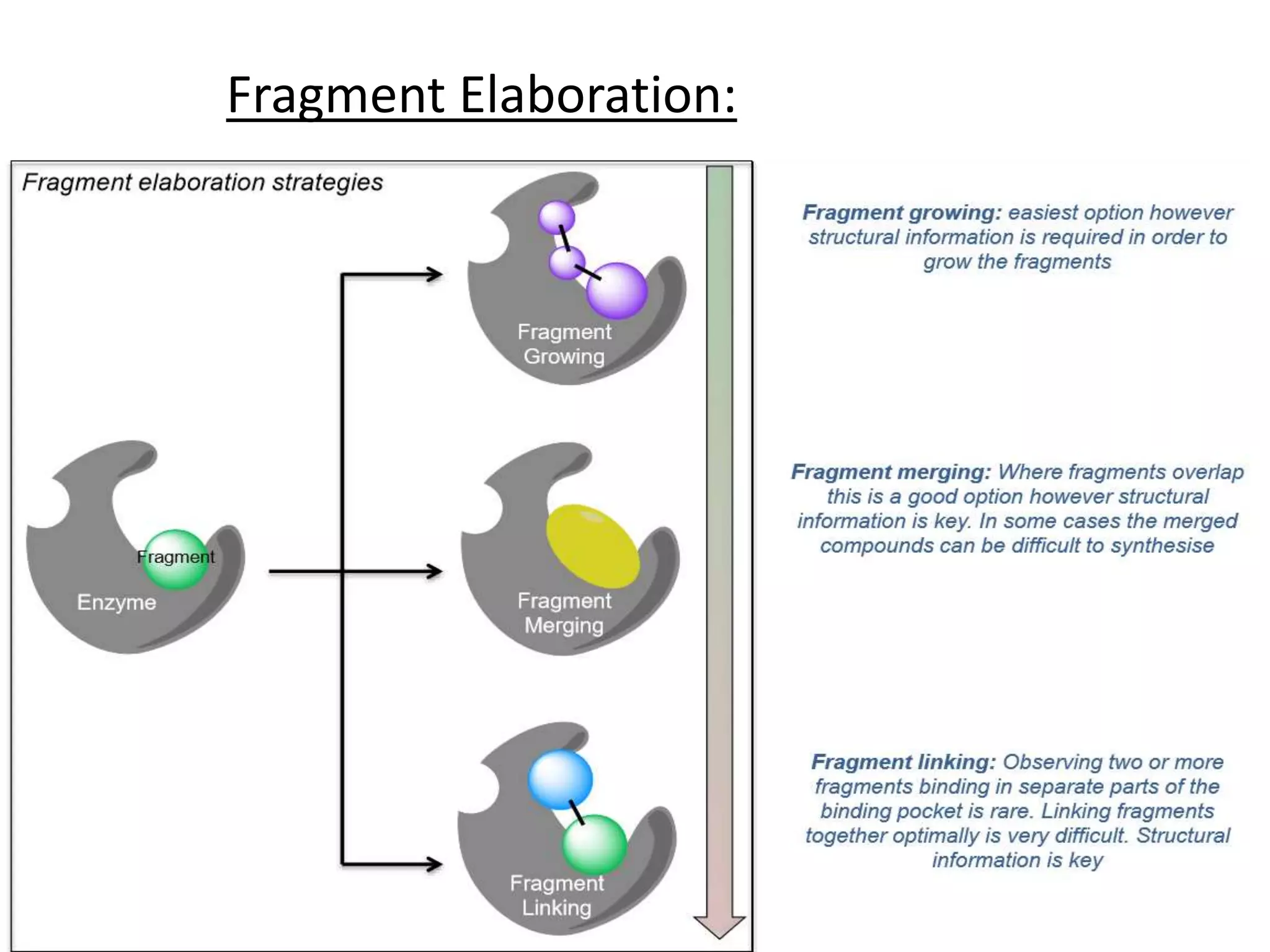
Fragment Elaboration:
1. Fragment growing
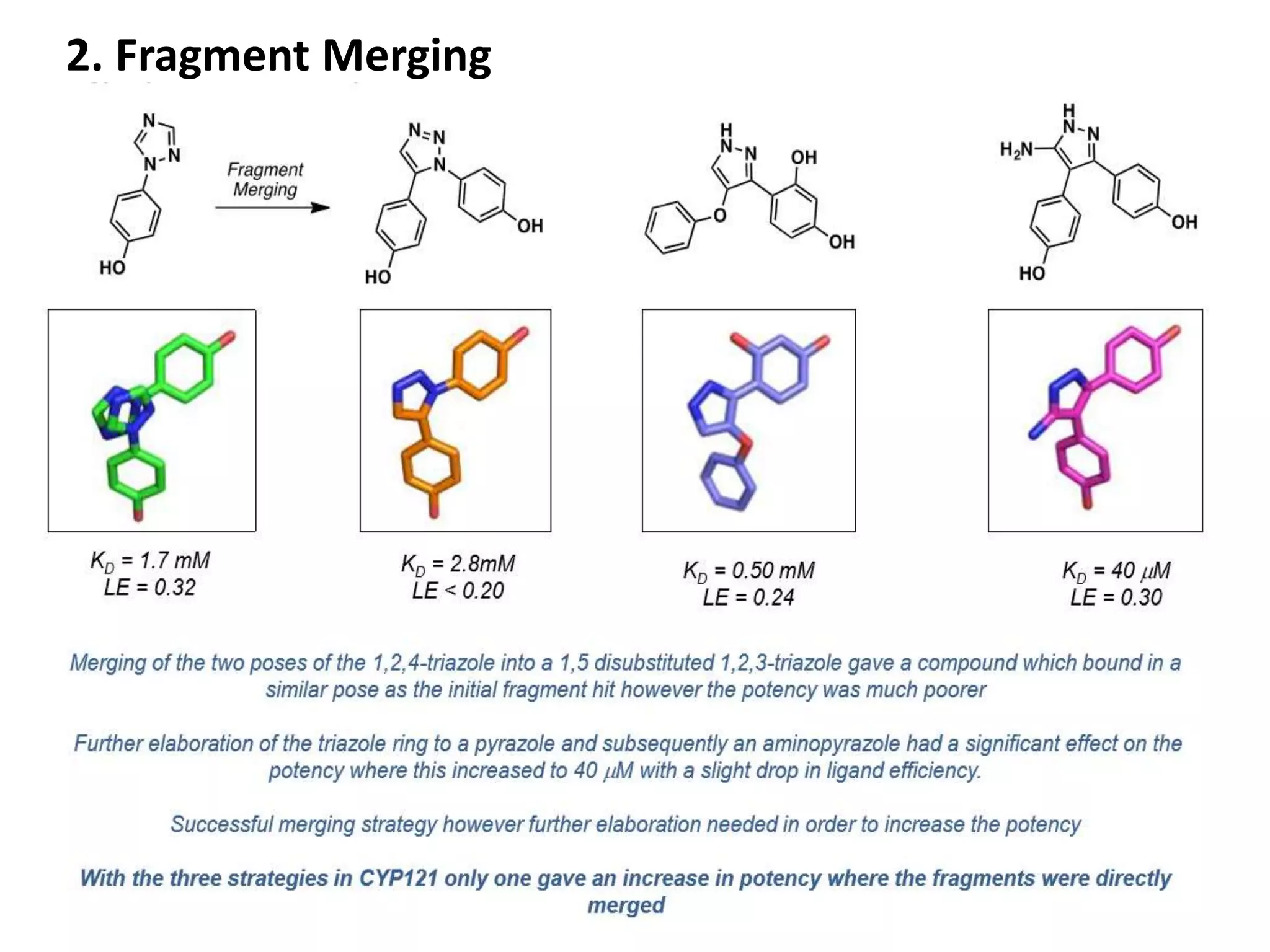
2. Fragment Merging
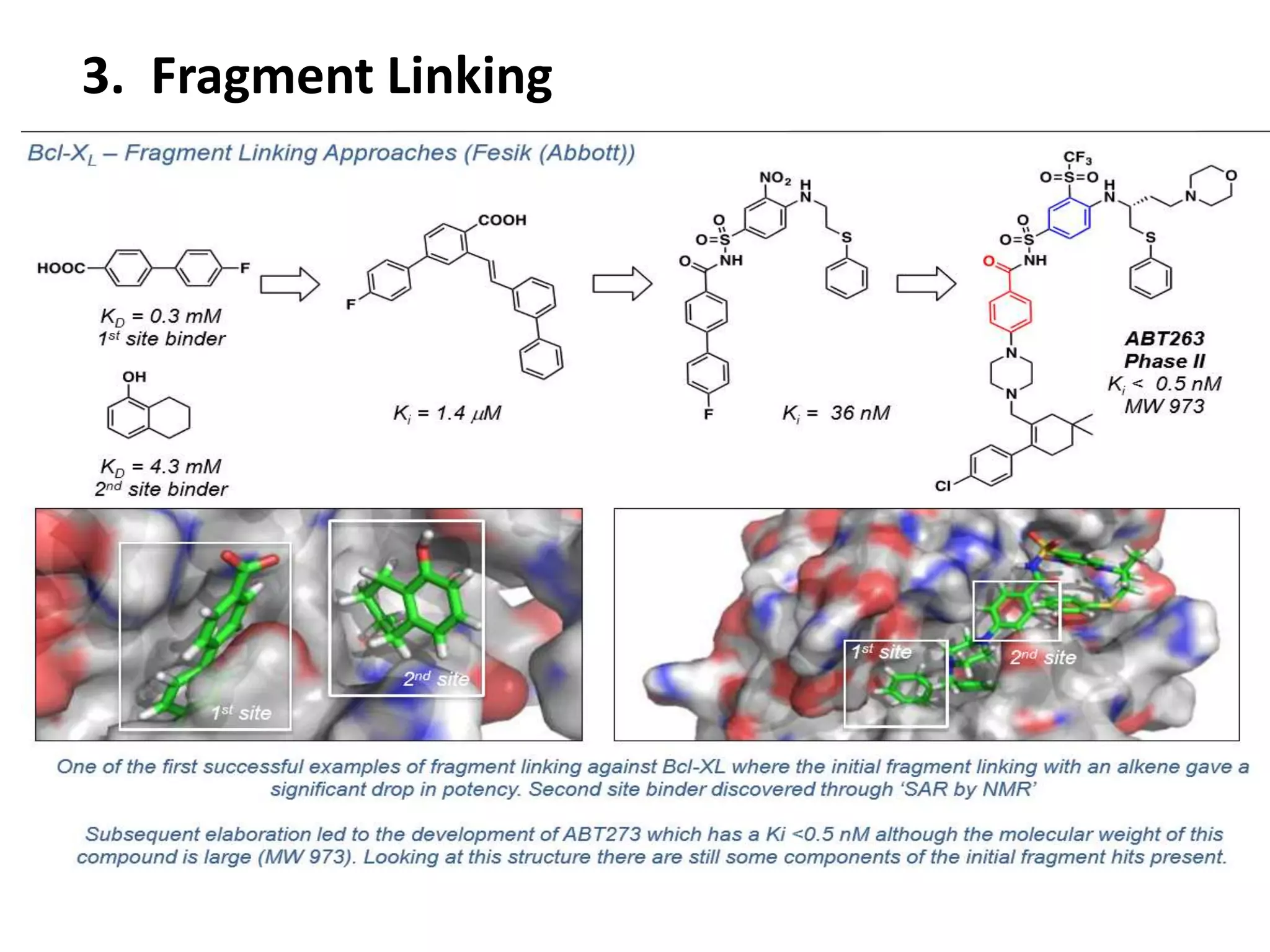
3. Fragment Linking
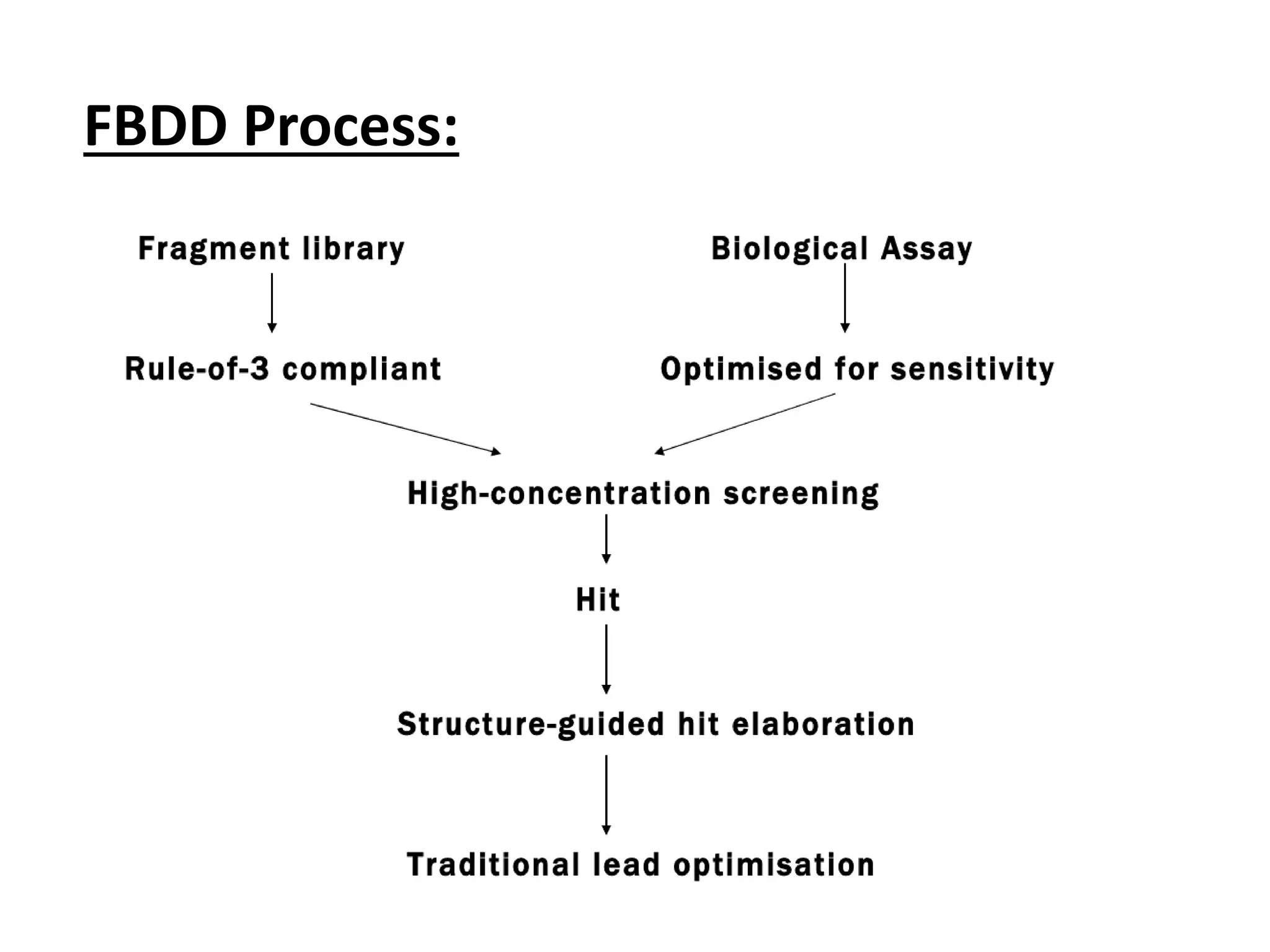
FBDD Process:
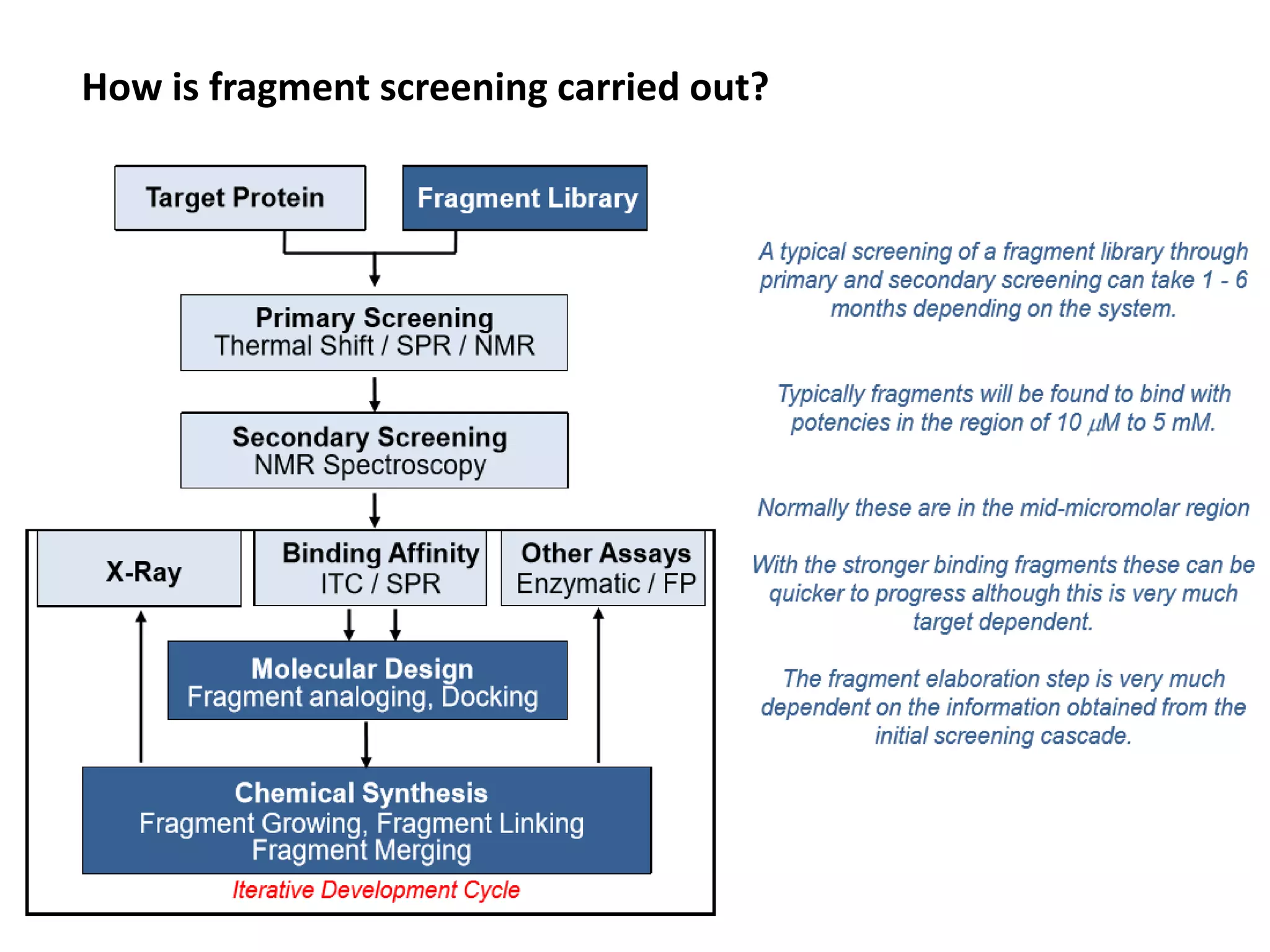
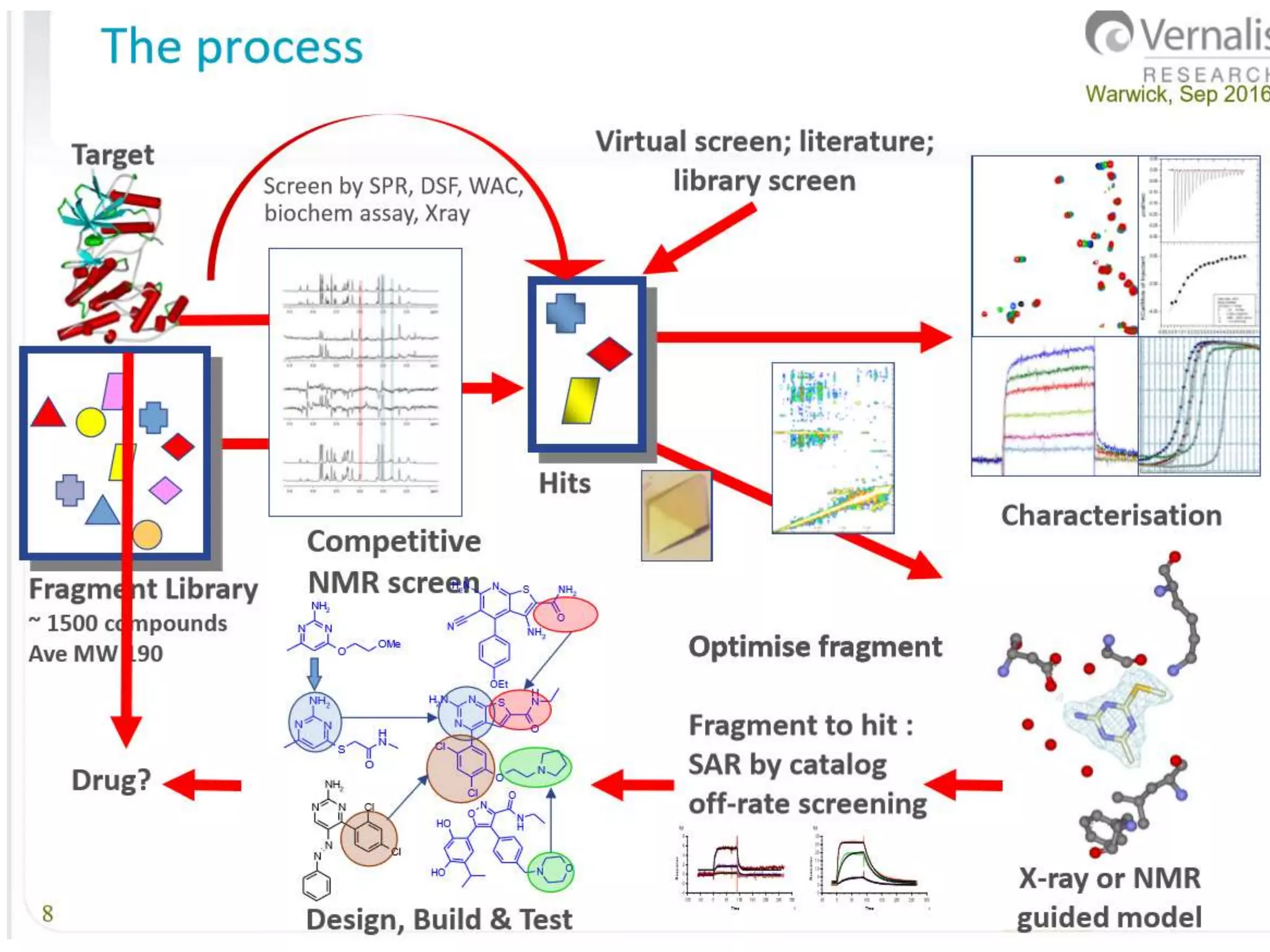
How is fragment screening carried out?
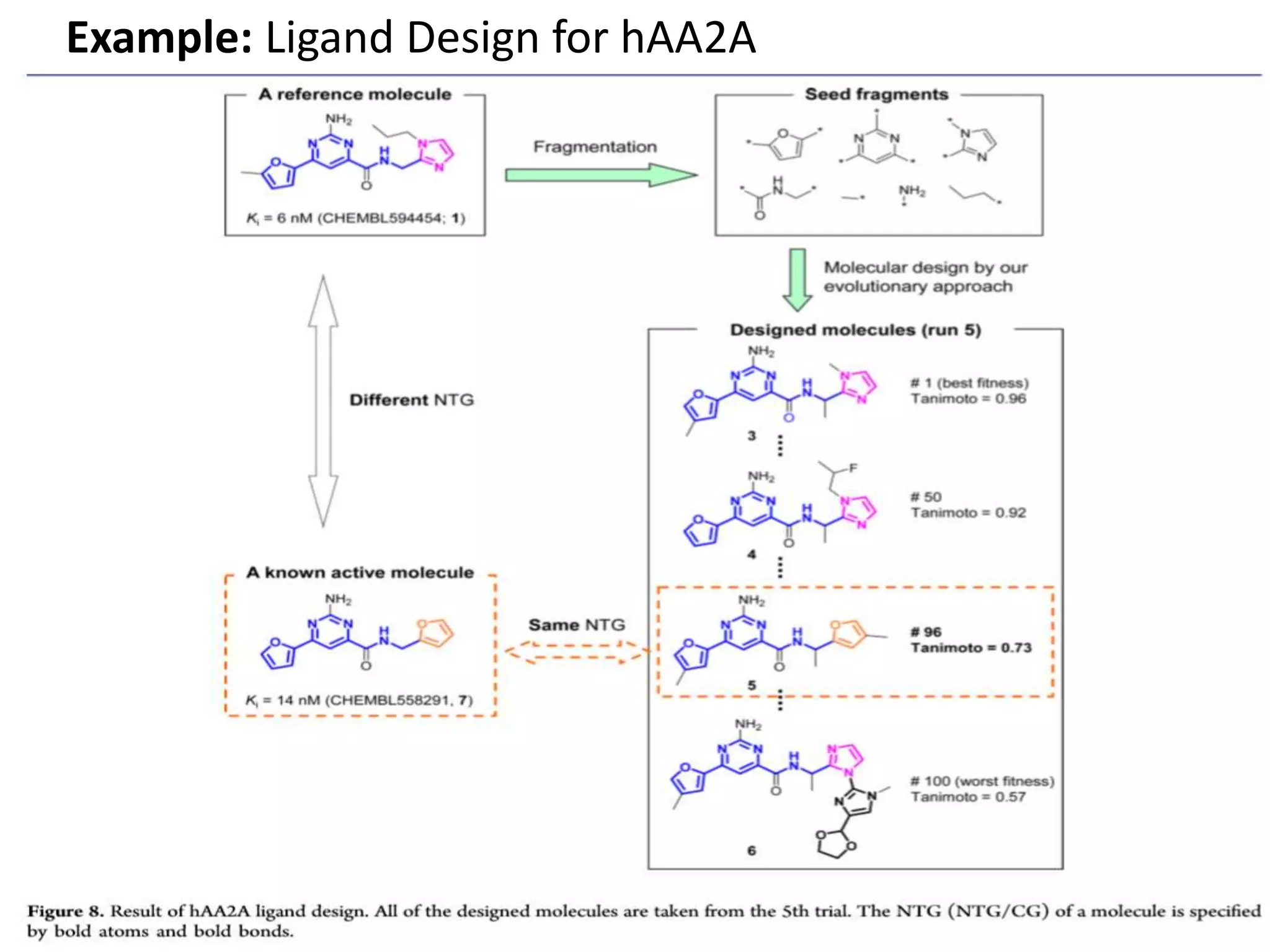
Example:
Example: Ligand Design for hAA2A
Thank You!

Fragment based drug design

  • 1.
    Fragment Based Drug Design(FBDD) Presented by: Ekta P. Tembhare Smt. Kishoritai Bhoyar College of Pharmacy, Kamptee, Nagpur.
  • 2.
    Introduction: Fragment-based lead discoveryis now firmly established as a mature collection of methods and approaches for the discovery of small molecules that bind to protein or nucleic acid targets. The approach has also had a number of other impacts such as providing starting points for lead discovery for challenging, unconventional targets such as protein–protein interactions, increasing the use of biophysics to characterize compound binding and properties, and providing small groups, particularly in academia, with access to the tools to identify chemical probes of biological systems
  • 3.
    What are Fragments? Fragmentsare defined as low molecular weight, moderately lipophilic, highly soluble organic molecules. • Fragments typically bind to their target protein with low affinity, generally in the μM to mM range, and can be grown, merged or linked with another fragment to improve the potency. • The “Rule of Three” states that fragments should have, - a molecular weight < 300 Da, - cLogP≤3, - number of hydrogen bond donors ≤ 3 and - number of hydrogen bond acceptors ≤3. - the number of rotatable bonds ≤ 3 and - the polar surface area (PSA) ≤ 60 Å2, would give more desirable fragment like compounds
  • 4.
    For conventional targets: •Fragments can sample the chemical space of what will bind to a binding site. • Fragments can show selectivity even for closely related proteins and even when a fragment binds to many similar targets, it can adopt different binding modes • Where crystal structures are available, the important first step in assimilating the set of fragment hits is to categorize the fragments on binding mode. • Often, there will be regions of a fragment that are not optimal or required for binding. For this reason, it is important to explore the SAR of the initial fragment(s) before optimization, identifying which binding modes and potential vectors offer the opportunity to gain selectivity and affinity. For unconventional targets: • Fragments provide the opportunity to assess challenging targets for chemical matter that binds; the hit rate can be an indication of how difficult it is going to be to progress compounds against a target • It is usually not an issue in identifying fragments that bind to such targets. • The major challenge is establishing robust, validated assays – both for establishing binding and for activity.
  • 5.
    High-throughput screening (HTS)of pre-existing compounds in a variety of pharmacological assays is still the most widely used approach to hit discovery. Half of all HTS screens fail to deliver appropriate chemical starting points for new discovery programs. Reasons: The non drug-like compounds present in many chemical archives assembled by random combinatorial chemistry approaches. These compounds cannot be optimized into development candidates. It is usually more efficient to start discovery from creating new target focused libraries of ‘lead-like’ compounds which can be more readily optimized. Why FBDD?
  • 6.
    Methods of fragmentgeneration: 1. Outline of Evolutionary Algorithm
  • 7.
    2. Seed Fragments Theseed fragments are automatically prepared by fragmentation of the reference molecule.
  • 8.
    3. Preparation ofFragment Library Every fragment of the library is preferably obtained from a collection of known compounds that are related to the target of interest. Three different types of fragments (ring, linker and side-chain) were defined as building blocks and used to make a molecule.
  • 9.
    4. Making Structureand Fragment Connection Rules
  • 10.
    5. Mutation In mutation,a parent molecule is randomly selected from existing molecules, and one of the following operations is then applied against the parent molecule. • add a fragment • remove a fragment • replace a fragment
  • 11.
    6. Crossover The crossoveroperation generates new two child molecules by exchanging a fragment set derived from a parent molecule with the other fragment sets derived from another parent molecule. Two parent molecules were randomly selected, and a crossover point was then randomly selected from each parent molecule to define a set of fragments to be crossed over.
  • 12.
  • 13.
  • 14.
  • 15.
  • 16.
  • 17.
    How is fragmentscreening carried out?
  • 18.
  • 21.
  • 22.