Dr Padmesh
Dept of Neonatology, Institute of Child
Health, Chennai
• TOPICS FOR DISCUSSION:
• 1. BRIEF HISTORY
• 2. TERMINOLOGIES
• 3. PATHOPHYSIOLOGY OF SHOCK IN NEWBORNS &
UNIQUE FEATURES IN PRETERMS
• 4. RECEPTOR PHYSIOLOGY
• 5. PHARMACOLOGY OF INDIVIDUAL DRUGS AND
CLINICAL SCENARIOS
• BRIEF HISTORY:
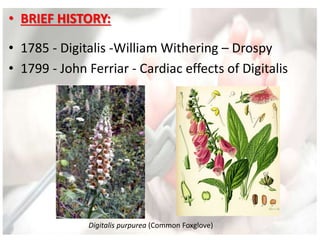
• 1785 - Digitalis -William Withering – Drospy
• 1799 - John Ferriar - Cardiac effects of Digitalis
Digitalis purpurea (Common Foxglove)
• BRIEF HISTORY:
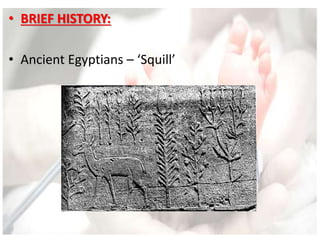
• Ancient Egyptians – ‘Squill’
• BRIEF HISTORY:
SANJIVANI: ‘LIFE RESTORING HERB’
• DEFINITIONS & TERMINOLOGIES:
• INOTROPY: myocardial contractility
• CHRONOTROPY: heart rate (firing of sinu atrial node)
• LUSITROPY: relaxation of myocardium
• DROMOTROPY: conduction velocity of atrioventricular
node
• BATHMOTROPY: increases degree of excitability
• VASOPRESSOR: increases vascular tone
• Shock is
“a state of cellular energy failure resulting from an
inability of tissue oxygen delivery
to satisfy tissue oxygen demand”
(Singer, 2008)
• PRINCIPLES OF OXYGEN DELIVERY:
• Oxygen delivery
DO2 = Cardiac Output (CO) × arterial O2 content (CaO2)
where
CO = HR × stroke volume (SV)
&
CaO2 = [1.34 × Hb × SaO2] + [0.003 × PaO2]
• PRINCIPLES OF OXYGEN DELIVERY:
• Oxygen delivery
DO2 = Cardiac Output (CO) × arterial O2 content (CaO2)
where
CO = HR × stroke volume (SV)
&
CaO2 = [1.34 × Hb × SaO2] + [0.003 × PaO2]
1.Preload
2.Afterload
3.Contractility
• PRINCIPLES OF OXYGEN DELIVERY:
• Oxygen consumption
VO2 = Cardiac Output (CO) × (CaO2 −CvO2)
where
CvO2 is the mixed venous oxygen content.
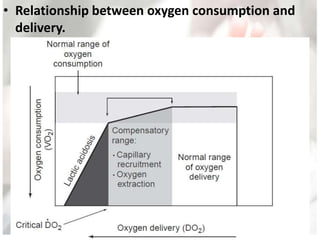
• Relationship between oxygen consumption and
delivery.
• PER MOL GLUCOSE
• Aerobic metabolism: 38 mol ATP produced.
• Anaerobic metabolism: 2 mol ATP and 2 mol
lactate produced.
Pathogenesis of neonatal shock
• ETIOLOGICAL FACTORS:
– Hypovolemia
– Myocardial Dysfunction
– Abnormal Peripheral Vasoregulation
• Hypovolemia
• Hypovolemia may be
– absolute (loss of intravascular volume),
– relative (increased venous capacitance), or
– combined (septic shock).
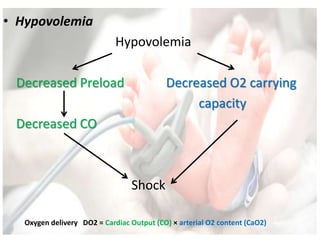
• Hypovolemia
Hypovolemia
Decreased Preload Decreased O2 carrying
capacity
Decreased CO
Shock
Oxygen delivery DO2 = Cardiac Output (CO) × arterial O2 content (CaO2)
Pathogenesis of neonatal shock
• ETIOLOGICAL FACTORS:
– Hypovolemia
– Myocardial Dysfunction
– Abnormal Peripheral Vasoregulation
• Myocardial Dysfunction:
• Post-asphyxia
• Extreme preterm
• Septic shock
• Viral myocarditis Myocardial dysfunction
Decreased Cardiac Output
Decreased Oxygen delivery
to tissues
• Physiological considerations in preterm infants :
Myocardium contains only
30% contractile tissue
• Preterm heart Under-developed Sarcoplasmic
reticulum & T-tubules
Less contractile & functioning
near its physiological capacity
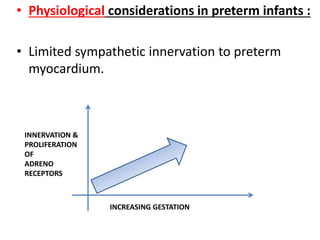
• Physiological considerations in preterm infants :
• Limited sympathetic innervation to preterm
myocardium.
INCREASING GESTATION
INNERVATION &
PROLIFERATION
OF
ADRENO
RECEPTORS
Pathogenesis of neonatal shock
• ETIOLOGICAL FACTORS:
– Hypovolemia
– Myocardial Dysfunction
– Abnormal Peripheral Vasoregulation
• Physiological considerations in preterm infants :
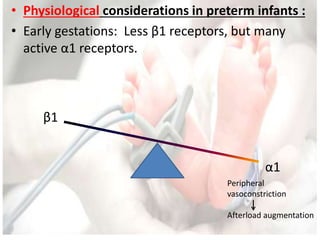
• Early gestations: Less β1 receptors, but many
active α1 receptors.
β1
α1
Peripheral
vasoconstriction
Afterload augmentation
• CO2-CBF reactivity > pressure flow reactivity.
• 1 mm Hg change in PaCO2  4% change in CBF,
• 1 mm Hg change in blood pressure  1% change in
CBF only
• Hypocapnia  PVL
• Hypercapnia IVH
(Greisen, 2005; Müller et al, 2002).
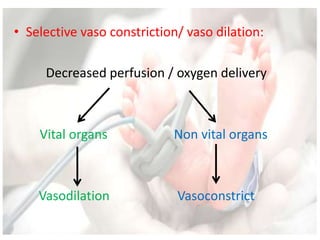
• Selective vaso constriction/ vaso dilation:
Decreased perfusion / oxygen delivery
Vital organs Non vital organs
Vasodilation Vasoconstrict
• Vital organ assignment in preterms:
• Vessels of forebrain of dog pups vasoconstrict
(nonvital organ) whereas vessels of hindbrain
vasodilate in response to hypoxic exposure
(Hernandez et al, 1982).
• CBF autoregulation appears in brainstem first
and in only later in forebrain. (Ashwal et al,
1984)
• DOWN REGULATION OF ADRENERGIC RECEPTORS:
• Downregulation is the process by which a cell
decreases the quantity of a cellular component.
• Adrenergic receptors: capable of desensitising or
downregulating.
• May require higher doses of drug
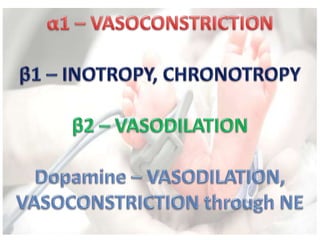
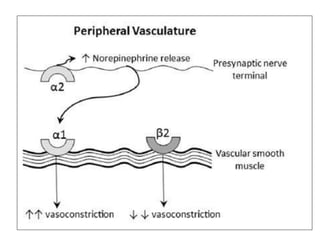
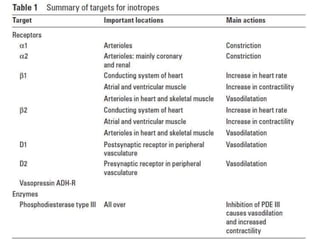
• Adrenergic receptors relevant to vasopressor
activity:
–alpha-1
–beta-1
–beta-2
–dopamine receptors
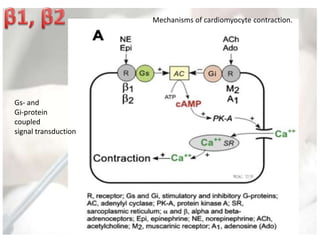
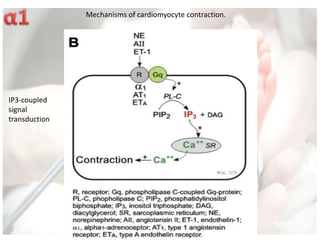
Mechanisms of cardiomyocyte contraction.
Gs- and
Gi-protein
coupled
signal transduction
IP3-coupled
signal
transduction
Mechanisms of cardiomyocyte contraction.
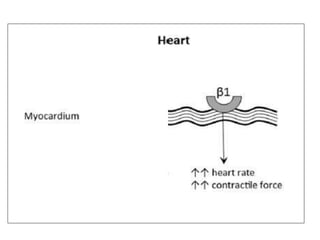
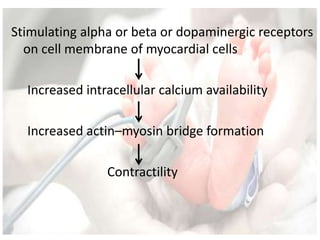
Stimulating alpha or beta or dopaminergic receptors
on cell membrane of myocardial cells
Increased intracellular calcium availability
Increased actin–myosin bridge formation
Contractility
• UNIQUE FEATURES OF INOTROPES:
–One drug, many receptors
–Dose-response curve
–Direct versus reflex actions
–Tachyphylaxis
• DOPAMINE
• Endogenous sympathomimetic amine.
• Direct action on α-, β-, and dopaminergic
receptors.
• Also potentiates release of norepinephrine.
(50% of action)
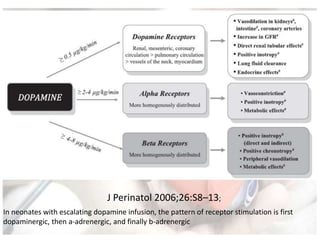
In neonates with escalating dopamine infusion, the pattern of receptor stimulation is first
dopaminergic, then a-adrenergic, and finally b-adrenergic
J Perinatol 2006;26:S8–13;
• Effective dose varies among neonates:
• Decreased metabolism of drug
Lower doses may have increased action
• Immature sympathetic innervation
Blunted norepinephrine release
Relative resistance to dopamine
• Lack of response to conventional doses (2–20
mg/kg/min) in critically ill neonates:
– Receptor downregulation
– Relative adrenal insufficiency
– Blunted NE release
• Case series in neonates not responding to
conventional doses suggest that dopamine at
doses of 30 to 50 mg/kg/ min increased blood
pressure and urine output.
• USES OF DOPAMINE: IN TRANSITION PERIOD:
• BENEFITS: Increased
– Myocardial contractility
– Mean arterial pressure (high dose)
– Systemic vascular resistance (high dose)
– Cerebral blood flow
– Tissue oxygenation
• LIMITATIONS:
– Increased systemic vascular resistance may impair
cardiac contractility (high dose)
• USES OF DOPAMINE: IN PPHN:
• BENEFITS: Increased
– Myocardial contractility
– Mean arterial pressure (high dose)
– Systemic vascular resistance (high dose)
• LIMITATIONS:
– Increased Pulmonary arterial pressure (all doses)
• USES OF DOPAMINE: IN SEPTIC SHOCK:
• BENEFITS: Increased
– Myocardial contractility
– Mean arterial pressure (high dose)
– Systemic vascular resistance (high dose)
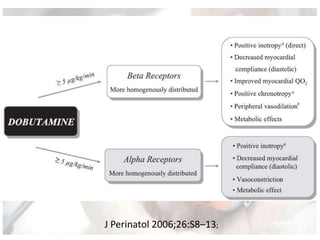
• DOBUTAMINE:
• Synthetic sympathomimetic amine.
• Acts directly on α- and β-receptors without the
release of norepinephrine.
• Relative affinity for:
– β1-cardioreceptors  myocardial contractility,
– β2-receptors  vasodilation of peripheral vasculature
• Dobutamine has asymmetric carbon atom, with
the two enantiomers having different affinity for
adrenergic receptors.
• Negative isomer  a1-agonist  Increases
myocardial contractility and SVR.
• Positive isomer  β1 and β2 agonist  increase
myocardial contractility, heart rate, conduction
velocity and decreases SVR.
J Perinatol 2006;26:S8–13;
• Dobutamine is used primarily for treatment of
decreased myocardial contractility and low
cardiac output.
• Dobutamine may be the drug of choice during
the transition period in premature neonates due
to its ability to improve contractility of the
immature myocardium and decrease afterload.
• In general, dobutamine is more effective than
dopamine in increasing cardiac output in
neonates with myocardial dysfunction.
• USES OF DOBUTAMINE: IN TRANSITION PERIOD:
• BENEFITS:
Increased
– Myocardial contractility (Cardiac output)
– Oxygenation
Decreased
– Pulmonary vascular resistance
• LIMITATIONS:
– Decreased Peripheral vascular tone
– No increase in MAP
• USES OF DOBUTAMINE: IN PPHN:
• BENEFITS: Increased
– Myocardial contractility (Cardiac output)
– Renal perfusion
– Cerebral blood flow
• LIMITATIONS:
– Decreased Peripheral vascular tone
– No change in MAP
• USES OF DOBUTAMINE: IN SEPTIC SHOCK:
• (only use in conjunction with another inotrope
in warm shock)
• BENEFITS: Increased
– Myocardial contractility (Cardiac output)
• LIMITATIONS:
– Decreased Systemic vascular resistance
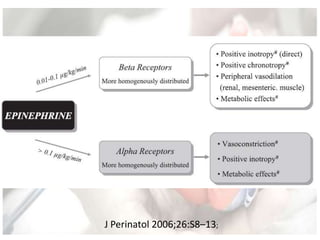
• EPINEPHRINE:
• Endogenous catecholamine
• Stimulates α1,2- and β1,2-receptors.
• Low doses (0.01–0.1 mcg/kg/min)  β1,2 effect
 increase in myocardial contractility with
associated peripheral vasodilation.
• High-dose (>0.1 mcg/kg/min)  α receptor
effect  increased systemic vascular resistance
J Perinatol 2006;26:S8–13;
• EPINEPHRINE:
• Net hemodynamic effects:
– Increase in blood pressure
– Increase in cardiac output & systemic blood flow
– Increase in CBF in hypotensive preterm neonates.
• EPINEPHRINE:
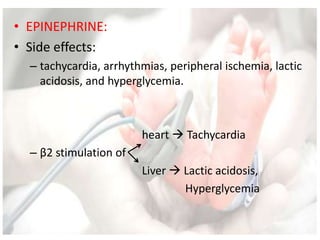
• Side effects:
– tachycardia, arrhythmias, peripheral ischemia, lactic
acidosis, and hyperglycemia.
heart  Tachycardia
– β2 stimulation of
Liver  Lactic acidosis,
Hyperglycemia
• USES OF EPINEPHRINE: IN TRANSITION PERIOD:
• BENEFITS: Increased
– Myocardial contractility
– Mean arterial pressure (high dose)
– Systemic vascular resistance (high dose)
– Cerebral blood flow
• LIMITATIONS:
Increased
– Heart rate
– Plasma lactate
– Blood glucose
• USES OF EPINEPHRINE: IN SEPTIC SHOCK:
• BENEFITS: Increased
– Myocardial contractility (Cardiac output)
– MAP (in high dose)
– Systemic vascular resistance (in high dose)
• LIMITATIONS:
– Lactic acidosis
– Peripheral ischemia (in high dose)
– Mesenteric ischemia (in high dose)
• USES OF EPINEPHRINE: IN PPHN:
• BENEFITS: Increased
– Myocardial contractility (Cardiac output)
– MAP (in high dose)
– Systemic vascular resistance (in high dose)
• LIMITATIONS:
No change in
- Pulmonary vascular resistance
- Pulmonary artery pressure
• Norepinephrine:
• Endogenous catecholamine.
• Activation of α1,2- and β1-receptors
• Increases systemic vascular resistance & cardiac
output.
• Increases cardiac output by increasing
contractility via β1-receptors, although this
effect is less pronounced due to potent α -
mediated vasoconstriction.
• Norepinephrine:
• Standard of care for treatment of vasodilatory
septic shock in adults and children.
• USES OF NOR EPINEPHRINE: IN SEPTIC SHOCK:
• BENEFITS: Increased
– Myocardial contractility (Cardiac output)
– MAP (in high dose)
– Systemic vascular resistance (in high dose)
– Tissue perfusion
• LIMITATIONS:
-Increased myocardial oxygen consumption
-Increase in systemic vascular resistance may impair
cardiac contractility (high dose)
• USES OF NOR EPINEPHRINE: IN PPHN:
• BENEFITS:
Increased
-MAP (in high dose)
-Systemic vascular resistance (in high dose)
-Left ventricular output
Decreased
-FiO2 requirement
-Pulmonary to systemic pressure ratio
• LIMITATIONS:
-Peripheral ischemia (>3.3 mg/kg/min)
-Acidosis (>3.3 mg/kg/min)
• Selective Phosphodiesterase type 3 inhibitor.
• Inotropic, inodilator, and lusitropic.
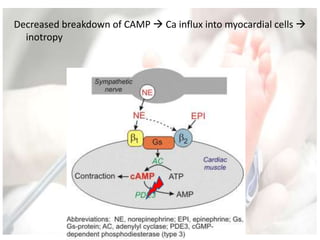
Decreased breakdown of CAMP  Ca influx into myocardial cells 
inotropy
• Milrinone increases cardiac output without an
increase in myocardial oxygen demand.
• Decreases afterload by decreasing systemic
vascular resistance.
Large vol of distribution
• Unique Pharmacology
Long t1/2 (1.5 to 3.5 hr)
• Milrinone augments the pulmonary vasodilation
induced by nitric oxide.
• In observational clinical trials, milrinone
decreases pulmonary artery pressures and
oxygenation index without a significant effect on
blood pressure.
• Use with caution in PPHN with associated
hypotension.
• USES OF MILRINONE: IN PPHN:
• BENEFITS:
Increased
-Myocardial contractility
-Oxygenation
Decreased
-Ductal shunting
-iNO requirement
-Lactic acid
• LIMITATIONS:
-Decreased MAP
• Endogenous arginine-vasopressin (AVP):
Neuropeptide
• Posterior Pituitary
• V1 receptors: vascular tone, platelet function,
release of aldosterone and cortisol.
• V2 receptors: Fluid balance and vascular tone.
• Primary physiologic role: extracellular osmolality.
• Vascular effects of vasopressin: stimulation of G
protein–coupled V1a and V2 receptors.
• V1a receptor (IP3)  Vasoconstriction
• V2 receptors (cAMP) Vasodilation
• Vasoconstrictive effects of vasopressin dominate
when used as an infusion.
• AVP increases vascular tone and produces
coronary and pulmonary vasodilation.
Increases blood pressure and cardiac output with
a decreased catecholamine requirement.
• USES OF VASOPRESSIN: IN PPHN:
• BENEFITS:
Increased
-Mean arterial pressure
-Systemic vascular resistance
Decreased
-Pulmonary vascular resistance
-Oxygenation index
-iNO requirement
• USES OF VASOPRESSIN: IN SEPTIC SHOCK:
• BENEFITS:
Increased
-Mean arterial pressure
-Systemic vascular resistance
Decreased
-Catecholamine requirement
• LIMITATIONS:
Increase in systemic vascular resistance may
impair cardiac contractility (high dose)
• Relative or absolute adrenal insufficiency +/-
• Secondary to
– decreased cortisol stores
– decreased ability to produce cortisol in response to
stress.
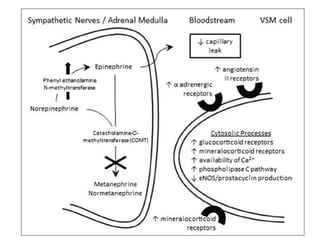
• Corticosteroids :
• Decrease breakdown of catecholamines,
• Modifies cAMP  Increases Ca levels in
myocardial cells
• Upregulate adrenergic receptors.
• Decreases capillary leak
INCREASES BLOOD PRESSURE
• Corticosteroids :
• Adverse effects:
– hyperglycemia,
– gastric irritation, and
– fluid retention.
• Long-term exposure:
– Osteopenia
– Inhibits immune function
– Inhibits somatic growth.
PDA with low SAP or DAP
• First line: Shunt limitation strategies, ductal closure
• Second line: Positive inotropic agent:
e.g.,dobutamine
SEPSIS/ NNEC
• Warm shock: Low DAP, tachycardia:
– First line: Volume(crystalloid,blood products)
Vasopressor agents: e.g.,dopamine
– Second line: Vasopressoragents :e.g.,vasopressin,
norepinephrine
• Cold shock: Low SAP or severe/ combined
hypotension:
– First line: Volume expansion (crystalloid or blood
products), Positive inotropic agent: e.g:epinephrine
– Second line: Hydrocortisone
HIE
• First line: Positive inotropic agent:e.g.,dobutamine
• Second line: Positive inotropic agent:
eg:epinephrine
• Hydrocortisone if refractory
PPHN
• Normal LV and RV systolic function:
– First line: Sedation,muscle relaxation,optimum
ventilation, pulmonary vasodilators e.g.,iNO
– Second line: If normal MAP and DAP: Milrinone
If low MAP and DAP: Vasopressin
If restrictive or no DA: Prostaglandin
• LV and/or RV systolic dysfunction:
– Sedation & muscle relaxation
– Pulmonary vasodilator(iNO)
– If normal or high MAP/DAP: Milrinone
– If low MAP/DAP: Dobutamine
– Second line: If low MAP/DAP: Vasopressin
Shock & Inotropes in Neonates  - Dr Padmesh - Neonatology

Shock & Inotropes in Neonates - Dr Padmesh - Neonatology

  • 1.
    Dr Padmesh Dept ofNeonatology, Institute of Child Health, Chennai
  • 2.
    • TOPICS FORDISCUSSION: • 1. BRIEF HISTORY • 2. TERMINOLOGIES • 3. PATHOPHYSIOLOGY OF SHOCK IN NEWBORNS & UNIQUE FEATURES IN PRETERMS • 4. RECEPTOR PHYSIOLOGY • 5. PHARMACOLOGY OF INDIVIDUAL DRUGS AND CLINICAL SCENARIOS
  • 4.
    • BRIEF HISTORY: •1785 - Digitalis -William Withering – Drospy • 1799 - John Ferriar - Cardiac effects of Digitalis Digitalis purpurea (Common Foxglove)
  • 5.
    • BRIEF HISTORY: •Ancient Egyptians – ‘Squill’
  • 6.
    • BRIEF HISTORY: SANJIVANI:‘LIFE RESTORING HERB’
  • 8.
    • DEFINITIONS &TERMINOLOGIES: • INOTROPY: myocardial contractility • CHRONOTROPY: heart rate (firing of sinu atrial node) • LUSITROPY: relaxation of myocardium • DROMOTROPY: conduction velocity of atrioventricular node • BATHMOTROPY: increases degree of excitability • VASOPRESSOR: increases vascular tone
  • 10.
    • Shock is “astate of cellular energy failure resulting from an inability of tissue oxygen delivery to satisfy tissue oxygen demand” (Singer, 2008)
  • 11.
    • PRINCIPLES OFOXYGEN DELIVERY: • Oxygen delivery DO2 = Cardiac Output (CO) × arterial O2 content (CaO2) where CO = HR × stroke volume (SV) & CaO2 = [1.34 × Hb × SaO2] + [0.003 × PaO2]
  • 12.
    • PRINCIPLES OFOXYGEN DELIVERY: • Oxygen delivery DO2 = Cardiac Output (CO) × arterial O2 content (CaO2) where CO = HR × stroke volume (SV) & CaO2 = [1.34 × Hb × SaO2] + [0.003 × PaO2] 1.Preload 2.Afterload 3.Contractility
  • 13.
    • PRINCIPLES OFOXYGEN DELIVERY: • Oxygen consumption VO2 = Cardiac Output (CO) × (CaO2 −CvO2) where CvO2 is the mixed venous oxygen content.
  • 14.
    • Relationship betweenoxygen consumption and delivery.
  • 15.
    • PER MOLGLUCOSE • Aerobic metabolism: 38 mol ATP produced. • Anaerobic metabolism: 2 mol ATP and 2 mol lactate produced.
  • 16.
    Pathogenesis of neonatalshock • ETIOLOGICAL FACTORS: – Hypovolemia – Myocardial Dysfunction – Abnormal Peripheral Vasoregulation
  • 17.
    • Hypovolemia • Hypovolemiamay be – absolute (loss of intravascular volume), – relative (increased venous capacitance), or – combined (septic shock).
  • 18.
    • Hypovolemia Hypovolemia Decreased PreloadDecreased O2 carrying capacity Decreased CO Shock Oxygen delivery DO2 = Cardiac Output (CO) × arterial O2 content (CaO2)
  • 19.
    Pathogenesis of neonatalshock • ETIOLOGICAL FACTORS: – Hypovolemia – Myocardial Dysfunction – Abnormal Peripheral Vasoregulation
  • 20.
    • Myocardial Dysfunction: •Post-asphyxia • Extreme preterm • Septic shock • Viral myocarditis Myocardial dysfunction Decreased Cardiac Output Decreased Oxygen delivery to tissues
  • 21.
    • Physiological considerationsin preterm infants : Myocardium contains only 30% contractile tissue • Preterm heart Under-developed Sarcoplasmic reticulum & T-tubules Less contractile & functioning near its physiological capacity
  • 22.
    • Physiological considerationsin preterm infants : • Limited sympathetic innervation to preterm myocardium. INCREASING GESTATION INNERVATION & PROLIFERATION OF ADRENO RECEPTORS
  • 23.
    Pathogenesis of neonatalshock • ETIOLOGICAL FACTORS: – Hypovolemia – Myocardial Dysfunction – Abnormal Peripheral Vasoregulation
  • 24.
    • Physiological considerationsin preterm infants : • Early gestations: Less β1 receptors, but many active α1 receptors. β1 α1 Peripheral vasoconstriction Afterload augmentation
  • 26.
    • CO2-CBF reactivity> pressure flow reactivity. • 1 mm Hg change in PaCO2  4% change in CBF, • 1 mm Hg change in blood pressure  1% change in CBF only • Hypocapnia  PVL • Hypercapnia IVH (Greisen, 2005; Müller et al, 2002).
  • 27.
    • Selective vasoconstriction/ vaso dilation: Decreased perfusion / oxygen delivery Vital organs Non vital organs Vasodilation Vasoconstrict
  • 28.
    • Vital organassignment in preterms: • Vessels of forebrain of dog pups vasoconstrict (nonvital organ) whereas vessels of hindbrain vasodilate in response to hypoxic exposure (Hernandez et al, 1982). • CBF autoregulation appears in brainstem first and in only later in forebrain. (Ashwal et al, 1984)
  • 29.
    • DOWN REGULATIONOF ADRENERGIC RECEPTORS: • Downregulation is the process by which a cell decreases the quantity of a cellular component. • Adrenergic receptors: capable of desensitising or downregulating. • May require higher doses of drug
  • 31.
    • Adrenergic receptorsrelevant to vasopressor activity: –alpha-1 –beta-1 –beta-2 –dopamine receptors
  • 35.
    Mechanisms of cardiomyocytecontraction. Gs- and Gi-protein coupled signal transduction
  • 36.
  • 37.
    Stimulating alpha orbeta or dopaminergic receptors on cell membrane of myocardial cells Increased intracellular calcium availability Increased actin–myosin bridge formation Contractility
  • 39.
    • UNIQUE FEATURESOF INOTROPES: –One drug, many receptors –Dose-response curve –Direct versus reflex actions –Tachyphylaxis
  • 42.
    • DOPAMINE • Endogenoussympathomimetic amine. • Direct action on α-, β-, and dopaminergic receptors. • Also potentiates release of norepinephrine. (50% of action)
  • 43.
    In neonates withescalating dopamine infusion, the pattern of receptor stimulation is first dopaminergic, then a-adrenergic, and finally b-adrenergic J Perinatol 2006;26:S8–13;
  • 44.
    • Effective dosevaries among neonates: • Decreased metabolism of drug Lower doses may have increased action • Immature sympathetic innervation Blunted norepinephrine release Relative resistance to dopamine
  • 45.
    • Lack ofresponse to conventional doses (2–20 mg/kg/min) in critically ill neonates: – Receptor downregulation – Relative adrenal insufficiency – Blunted NE release • Case series in neonates not responding to conventional doses suggest that dopamine at doses of 30 to 50 mg/kg/ min increased blood pressure and urine output.
  • 46.
    • USES OFDOPAMINE: IN TRANSITION PERIOD: • BENEFITS: Increased – Myocardial contractility – Mean arterial pressure (high dose) – Systemic vascular resistance (high dose) – Cerebral blood flow – Tissue oxygenation • LIMITATIONS: – Increased systemic vascular resistance may impair cardiac contractility (high dose)
  • 47.
    • USES OFDOPAMINE: IN PPHN: • BENEFITS: Increased – Myocardial contractility – Mean arterial pressure (high dose) – Systemic vascular resistance (high dose) • LIMITATIONS: – Increased Pulmonary arterial pressure (all doses)
  • 48.
    • USES OFDOPAMINE: IN SEPTIC SHOCK: • BENEFITS: Increased – Myocardial contractility – Mean arterial pressure (high dose) – Systemic vascular resistance (high dose)
  • 50.
    • DOBUTAMINE: • Syntheticsympathomimetic amine. • Acts directly on α- and β-receptors without the release of norepinephrine. • Relative affinity for: – β1-cardioreceptors  myocardial contractility, – β2-receptors  vasodilation of peripheral vasculature
  • 51.
    • Dobutamine hasasymmetric carbon atom, with the two enantiomers having different affinity for adrenergic receptors. • Negative isomer  a1-agonist  Increases myocardial contractility and SVR. • Positive isomer  β1 and β2 agonist  increase myocardial contractility, heart rate, conduction velocity and decreases SVR.
  • 52.
  • 53.
    • Dobutamine isused primarily for treatment of decreased myocardial contractility and low cardiac output. • Dobutamine may be the drug of choice during the transition period in premature neonates due to its ability to improve contractility of the immature myocardium and decrease afterload. • In general, dobutamine is more effective than dopamine in increasing cardiac output in neonates with myocardial dysfunction.
  • 54.
    • USES OFDOBUTAMINE: IN TRANSITION PERIOD: • BENEFITS: Increased – Myocardial contractility (Cardiac output) – Oxygenation Decreased – Pulmonary vascular resistance • LIMITATIONS: – Decreased Peripheral vascular tone – No increase in MAP
  • 55.
    • USES OFDOBUTAMINE: IN PPHN: • BENEFITS: Increased – Myocardial contractility (Cardiac output) – Renal perfusion – Cerebral blood flow • LIMITATIONS: – Decreased Peripheral vascular tone – No change in MAP
  • 56.
    • USES OFDOBUTAMINE: IN SEPTIC SHOCK: • (only use in conjunction with another inotrope in warm shock) • BENEFITS: Increased – Myocardial contractility (Cardiac output) • LIMITATIONS: – Decreased Systemic vascular resistance
  • 58.
    • EPINEPHRINE: • Endogenouscatecholamine • Stimulates α1,2- and β1,2-receptors. • Low doses (0.01–0.1 mcg/kg/min)  β1,2 effect  increase in myocardial contractility with associated peripheral vasodilation. • High-dose (>0.1 mcg/kg/min)  α receptor effect  increased systemic vascular resistance
  • 59.
  • 60.
    • EPINEPHRINE: • Nethemodynamic effects: – Increase in blood pressure – Increase in cardiac output & systemic blood flow – Increase in CBF in hypotensive preterm neonates.
  • 61.
    • EPINEPHRINE: • Sideeffects: – tachycardia, arrhythmias, peripheral ischemia, lactic acidosis, and hyperglycemia. heart  Tachycardia – β2 stimulation of Liver  Lactic acidosis, Hyperglycemia
  • 62.
    • USES OFEPINEPHRINE: IN TRANSITION PERIOD: • BENEFITS: Increased – Myocardial contractility – Mean arterial pressure (high dose) – Systemic vascular resistance (high dose) – Cerebral blood flow • LIMITATIONS: Increased – Heart rate – Plasma lactate – Blood glucose
  • 63.
    • USES OFEPINEPHRINE: IN SEPTIC SHOCK: • BENEFITS: Increased – Myocardial contractility (Cardiac output) – MAP (in high dose) – Systemic vascular resistance (in high dose) • LIMITATIONS: – Lactic acidosis – Peripheral ischemia (in high dose) – Mesenteric ischemia (in high dose)
  • 64.
    • USES OFEPINEPHRINE: IN PPHN: • BENEFITS: Increased – Myocardial contractility (Cardiac output) – MAP (in high dose) – Systemic vascular resistance (in high dose) • LIMITATIONS: No change in - Pulmonary vascular resistance - Pulmonary artery pressure
  • 66.
    • Norepinephrine: • Endogenouscatecholamine. • Activation of α1,2- and β1-receptors • Increases systemic vascular resistance & cardiac output. • Increases cardiac output by increasing contractility via β1-receptors, although this effect is less pronounced due to potent α - mediated vasoconstriction.
  • 67.
    • Norepinephrine: • Standardof care for treatment of vasodilatory septic shock in adults and children.
  • 68.
    • USES OFNOR EPINEPHRINE: IN SEPTIC SHOCK: • BENEFITS: Increased – Myocardial contractility (Cardiac output) – MAP (in high dose) – Systemic vascular resistance (in high dose) – Tissue perfusion • LIMITATIONS: -Increased myocardial oxygen consumption -Increase in systemic vascular resistance may impair cardiac contractility (high dose)
  • 69.
    • USES OFNOR EPINEPHRINE: IN PPHN: • BENEFITS: Increased -MAP (in high dose) -Systemic vascular resistance (in high dose) -Left ventricular output Decreased -FiO2 requirement -Pulmonary to systemic pressure ratio • LIMITATIONS: -Peripheral ischemia (>3.3 mg/kg/min) -Acidosis (>3.3 mg/kg/min)
  • 71.
    • Selective Phosphodiesterasetype 3 inhibitor. • Inotropic, inodilator, and lusitropic.
  • 72.
    Decreased breakdown ofCAMP  Ca influx into myocardial cells  inotropy
  • 73.
    • Milrinone increasescardiac output without an increase in myocardial oxygen demand. • Decreases afterload by decreasing systemic vascular resistance. Large vol of distribution • Unique Pharmacology Long t1/2 (1.5 to 3.5 hr)
  • 74.
    • Milrinone augmentsthe pulmonary vasodilation induced by nitric oxide. • In observational clinical trials, milrinone decreases pulmonary artery pressures and oxygenation index without a significant effect on blood pressure. • Use with caution in PPHN with associated hypotension.
  • 75.
    • USES OFMILRINONE: IN PPHN: • BENEFITS: Increased -Myocardial contractility -Oxygenation Decreased -Ductal shunting -iNO requirement -Lactic acid • LIMITATIONS: -Decreased MAP
  • 77.
    • Endogenous arginine-vasopressin(AVP): Neuropeptide • Posterior Pituitary • V1 receptors: vascular tone, platelet function, release of aldosterone and cortisol. • V2 receptors: Fluid balance and vascular tone.
  • 78.
    • Primary physiologicrole: extracellular osmolality. • Vascular effects of vasopressin: stimulation of G protein–coupled V1a and V2 receptors. • V1a receptor (IP3)  Vasoconstriction • V2 receptors (cAMP) Vasodilation • Vasoconstrictive effects of vasopressin dominate when used as an infusion.
  • 79.
    • AVP increasesvascular tone and produces coronary and pulmonary vasodilation. Increases blood pressure and cardiac output with a decreased catecholamine requirement.
  • 80.
    • USES OFVASOPRESSIN: IN PPHN: • BENEFITS: Increased -Mean arterial pressure -Systemic vascular resistance Decreased -Pulmonary vascular resistance -Oxygenation index -iNO requirement
  • 81.
    • USES OFVASOPRESSIN: IN SEPTIC SHOCK: • BENEFITS: Increased -Mean arterial pressure -Systemic vascular resistance Decreased -Catecholamine requirement • LIMITATIONS: Increase in systemic vascular resistance may impair cardiac contractility (high dose)
  • 83.
    • Relative orabsolute adrenal insufficiency +/- • Secondary to – decreased cortisol stores – decreased ability to produce cortisol in response to stress.
  • 84.
    • Corticosteroids : •Decrease breakdown of catecholamines, • Modifies cAMP  Increases Ca levels in myocardial cells • Upregulate adrenergic receptors. • Decreases capillary leak INCREASES BLOOD PRESSURE
  • 86.
    • Corticosteroids : •Adverse effects: – hyperglycemia, – gastric irritation, and – fluid retention. • Long-term exposure: – Osteopenia – Inhibits immune function – Inhibits somatic growth.
  • 88.
    PDA with lowSAP or DAP • First line: Shunt limitation strategies, ductal closure • Second line: Positive inotropic agent: e.g.,dobutamine
  • 89.
    SEPSIS/ NNEC • Warmshock: Low DAP, tachycardia: – First line: Volume(crystalloid,blood products) Vasopressor agents: e.g.,dopamine – Second line: Vasopressoragents :e.g.,vasopressin, norepinephrine • Cold shock: Low SAP or severe/ combined hypotension: – First line: Volume expansion (crystalloid or blood products), Positive inotropic agent: e.g:epinephrine – Second line: Hydrocortisone
  • 90.
    HIE • First line:Positive inotropic agent:e.g.,dobutamine • Second line: Positive inotropic agent: eg:epinephrine • Hydrocortisone if refractory
  • 91.
    PPHN • Normal LVand RV systolic function: – First line: Sedation,muscle relaxation,optimum ventilation, pulmonary vasodilators e.g.,iNO – Second line: If normal MAP and DAP: Milrinone If low MAP and DAP: Vasopressin If restrictive or no DA: Prostaglandin • LV and/or RV systolic dysfunction: – Sedation & muscle relaxation – Pulmonary vasodilator(iNO) – If normal or high MAP/DAP: Milrinone – If low MAP/DAP: Dobutamine – Second line: If low MAP/DAP: Vasopressin

Editor's Notes

  • #12 1 g% of Hb is capable of carrying about 1.34 ml of O2. 0.003 is the solubility coefficient of oxygen in human plasma. SaO2 = saturation of hemoglobin with oxygen
  • #13 Preload = End-diastolic volume of the ventricle, and, up to a point, the greater the preload, the larger the stroke volume (the Frank-Starling relationship). Afterload is the force the ventricle must generate against the systemic or pulmonary vascular resistance. As long as appropriate perfusion pressure is ensured, the lower the afterload, the better the cardiac output. Contractility (the intrinsic ability to generate force per unit time) Typically, cardiac output in neonates is considered heart rate–dependent, because the neonate’s ability to augment stroke volume is somewhat limited compared to children or adults.
  • #14 CaO2 =arterial O2 content . If cardiac output falls, VO2 may be maintained constant by capillary bed vasodilation and increased O2 extraction by the tissues. Increased O2 extraction is manifested as a lower CvO2 and therefore greater CaO2 – CvO2 difference
  • #15 Normally, DO2 and VO2 are well matched. O2 extraction approximately 25%. If the SaO2 is 100%, SvO2 would be expected to be 75%. If cardiac output falls, VO2 may be maintained constant by capillary bed vasodilation and recruitment and/or by increased O2 extraction by the tissues. Increased O2 extraction is manifested as a lower CvO2 and therefore greater CaO2 – CvO2 difference. FICK PRINCIPLE: uptake or release of a substance by any organ is the product of the arteriovenous (A-V) concentration difference of the substance and the blood flow to that organ.
  • #18 1. 75% of circulating blood volume is on venous side of circulation at any given point in time, therefore increase in venous capacitance caused by venodilation  relative hypovolemia. 2. Preload is augmented by the negative intrathoracic pressure generated at each spontaneous inspiration. Therefore positive intrathoracic pressure associated with positive pressure mechanical ventilation reduces venous return and hence preload and cardiac output.
  • #22 1. Adult heart 60% of myocardium is muscular; early pretermsmyocardium contains only 30% contractile tissue. 2. Mechanisms of control of myocyte activity such as sarcoplasmic reticulum and t-tubule system are underdeveloped and there is an over representation of mitochondria which are relatively disorganized. 3. Neonatal myocardium is less contractile and is functioning near its physiological capacity.Therefore,ability to respond to additional stress placed by metabolic demands (e.g., infection,changing loading conditions) or inotropes may be limited. Because the preterm myocardium is adapted to a low-resistance intrauterine environment, characterized by reduced contractile elements, and has a limited ability to respond to increased afterload .
  • #23 The adrenergic system also differs in the immature neonate.
  • #25 Balance of response to catecholamine stimulating agents is skewed towards peripheral vasoconstriction and afterload augmentation at the expense of cardiac output,which may not be desirable in some patients.These effects are most pronounced at the earliest gestation and diminish with maturation .
  • #36 guanine nucleotide-binding proteins adenylyl cyclase cAMP stimulated protein kinase
  • #37 Phosphatidyl inositol biphosphate Inositol trisphosphate Diacylglycerol
  • #62 glycolysis  lactic acidosis increases glucogon levels  hyperglycemia