RIPE 2012
PEDIATRICS OSCE
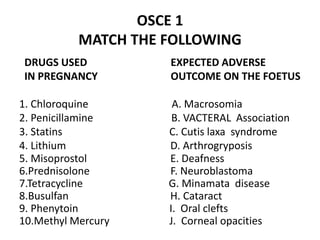
OSCE 1
MATCH THE FOLLOWING
DRUGS USED EXPECTED ADVERSE
IN PREGNANCY OUTCOME ON THE FOETUS
1. Chloroquine A. Macrosomia
2. Penicillamine B. VACTERAL Association
3. Statins C. Cutis laxa syndrome
4. Lithium D. Arthrogryposis
5. Misoprostol E. Deafness
6.Prednisolone F. Neuroblastoma
7.Tetracycline G. Minamata disease
8.Busulfan H. Cataract
9. Phenytoin I. Oral clefts
10.Methyl Mercury J. Corneal opacities
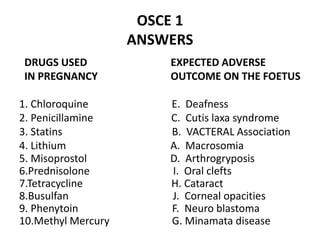
OSCE 1
ANSWERS
DRUGS USED EXPECTED ADVERSE
IN PREGNANCY OUTCOME ON THE FOETUS
1. Chloroquine E. Deafness
2. Penicillamine C. Cutis laxa syndrome
3. Statins B. VACTERAL Association
4. Lithium A. Macrosomia
5. Misoprostol D. Arthrogryposis
6.Prednisolone I. Oral clefts
7.Tetracycline H. Cataract
8.Busulfan J. Corneal opacities
9. Phenytoin F. Neuro blastoma
10.Methyl Mercury G. Minamata disease
OSCE -2
• A 12 year old adolescent boy, known Nephrotic
syndrome presented in Emergency Room with the
history of acute onset of breathlessness. In the ER, his
vitals: HR-100/mt, BP- 120/80 mm Hg, RR- 40/mt,Spo2
98% in Room air. His ABG , PH- 7.55,Pco2-20 mm/Hg,
Pao2- 110 mm/Hg, Hco3-26meq/L.
1. What is the interpretation of ABG?
2. What is the formula for compensation?
3. Name two electrolyte disturbances associated with this
ABG finding?
4. Name two drug overdose causing similar ABG finding?
5. What is the probable diagnosis?
OSCE – 2
ANSWERS
1. Acute uncompensated Respiratory Alkalosis
2. Acute compensation-Plasma Hco3 falls by 2 for each
10mm/Hg decrease in Pco2. .
Chronic compensation-Plasma Hco3 falls by 4 for
each 10mm/Hg decrease in Pco2
3. Hypocalcemia, Hypokalemia
4. Salicylates,caffeine,Theophylline.
5. Pulmonary Embolism.
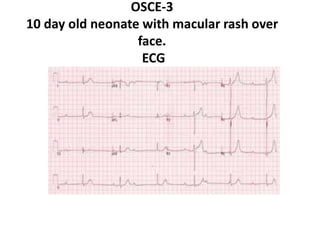
OSCE-3
10 day old neonate with macular rash over
face.
ECG
OSCE - 3
A 10 day old neonate with macular rash over the face.
1. Interpretation of ECG and probable diagnosis?
2. How will you confirm the diagnosis?
3. How will you prevent this condition?
4. What is the treatment?
5. What is the risk of recurrence in future pregnancies?
OSCE – 3
ANSWERS
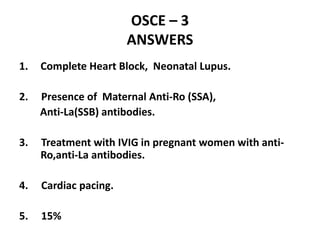
1. Complete Heart Block, Neonatal Lupus.
2. Presence of Maternal Anti-Ro (SSA),
Anti-La(SSB) antibodies.
3. Treatment with IVIG in pregnant women with anti-
Ro,anti-La antibodies.
4. Cardiac pacing.
5. 15%
OSCE-4
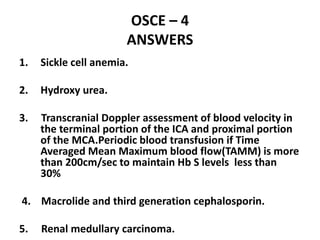
• PERIPHERAL SMEAR
OSCE - 4
1. What is the diagnosis?
2. What is the drug of choice for the prevention of
painful episodes?
3. What are measures for the primary prevention of
stroke in these children?
4. What are the antibiotics of choice in acute chest
syndrome?
5. What type of renal malignancy is common in this
condition?
OSCE – 4
ANSWERS
1. Sickle cell anemia.
2. Hydroxy urea.
3. Transcranial Doppler assessment of blood velocity in
the terminal portion of the ICA and proximal portion
of the MCA.Periodic blood transfusion if Time
Averaged Mean Maximum blood flow(TAMM) is more
than 200cm/sec to maintain Hb S levels less than
30%
4. Macrolide and third generation cephalosporin.
5. Renal medullary carcinoma.
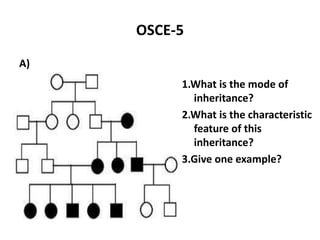
OSCE-5
A)
1.What is the mode of
inheritance?
2.What is the characteristic
feature of this
inheritance?
3.Give one example?
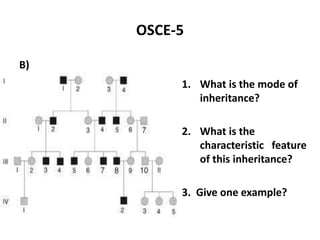
OSCE-5
B)
1. What is the mode of
inheritance?
2. What is the
characteristic feature
of this inheritance?
3. Give one example?
OSCE – 5
ANSWERS
A)
1. Mitochondrial Inheritance.
2. Since Mitochondrial genome is entirely derived from the
mother awomen with this disorder can have affected
offspring of either sex but an affected father cannot pass on
the disease to his offspring.
3. 3. Leber hereditary optic neuropathy,Leigh disease,MELAS,
MERRF.
B)
1. Y-Linked inheritance.
2. Only male to male transmission,only males are affected.
3. Leri-weil dyschondrosteosis,Langer mesomelic dwarfism.
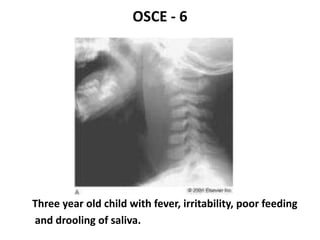
OSCE - 6
Three year old child with fever, irritability, poor feeding
and drooling of saliva.
OSCE - 6
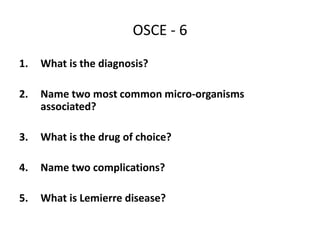
1. What is the diagnosis?
2. Name two most common micro-organisms
associated?
3. What is the drug of choice?
4. Name two complications?
5. What is Lemierre disease?
OSCE – 6
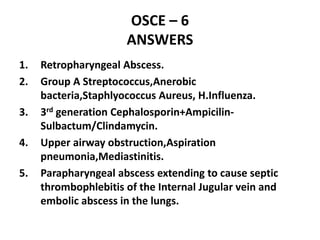
ANSWERS
1. Retropharyngeal Abscess.
2. Group A Streptococcus,Anerobic
bacteria,Staphlyococcus Aureus, H.Influenza.
3. 3rd generation Cephalosporin+Ampicilin-
Sulbactum/Clindamycin.
4. Upper airway obstruction,Aspiration
pneumonia,Mediastinitis.
5. Parapharyngeal abscess extending to cause septic
thrombophlebitis of the Internal Jugular vein and
embolic abscess in the lungs.
OSCE – 7
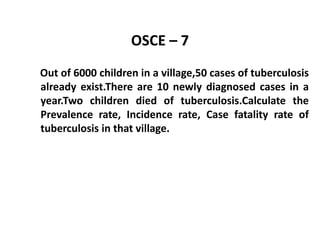
Out of 6000 children in a village,50 cases of tuberculosis
already exist.There are 10 newly diagnosed cases in a
year.Two children died of tuberculosis.Calculate the
Prevalence rate, Incidence rate, Case fatality rate of
tuberculosis in that village.
OSCE – 7
ANSWER
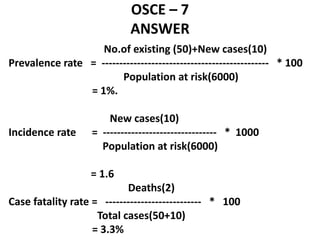
No.of existing (50)+New cases(10)
Prevalence rate = ----------------------------------------------- * 100
Population at risk(6000)
= 1%.
New cases(10)
Incidence rate = -------------------------------- * 1000
Population at risk(6000)
= 1.6
Deaths(2)
Case fatality rate = --------------------------- * 100
Total cases(50+10)
= 3.3%
OSCE – 8
HISTORY TAKING
• A 3 year old male child has bruising over his shins and
knees. Elicit a Targeted History (10 Points) :-
OSCE – 8
ANSWERS
1. Greetings, Introduction & Establishing Rapport
2. History regarding walking activity and frequency of
falls (Normal toddler bruising)
3. History of preceding fever (ITP)
4. History of bleeding elsewhere including hematuria
(ITP,HSP)
5. History of Abdominal and joint pain (HSP)
6. History of painful swollen joints with family history of
bleeding disorder (Hemophilia)
OSCE – 8
ANSWERS
7. History of intake of NSAIDS like aspirin (Drug induced)
8. Social history and enquiry about care takers and family
dynamics (Non Accidental Injury)
9. History of prolonged fever (leukemia,aplastic anemia)
10. History of progressive pallor requiring transfusions
(leukemia,aplastic anemia)
OSCE - 9
You have performed Incision &drainage of Gluteal
abscess in a child.How will u dispose the used items
given below?
1) Cotton and gauze contaminated with pus.
2) Scalpels and needles.
3) Intravenous set and tubings.
4) Remaining contaminated Lignocaine used for Local
anasthesia.
OSCE - 9
ANSWERS
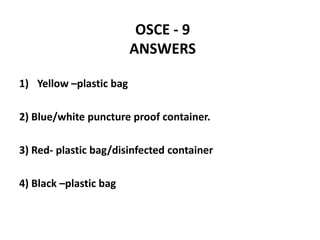
1) Yellow –plastic bag
2) Blue/white puncture proof container.
3) Red- plastic bag/disinfected container
4) Black –plastic bag
OSCE - 10
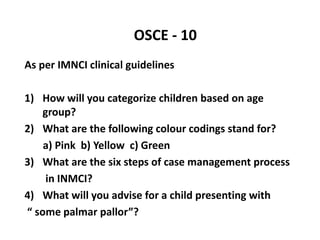
As per IMNCI clinical guidelines
1) How will you categorize children based on age
group?
2) What are the following colour codings stand for?
a) Pink b) Yellow c) Green
3) What are the six steps of case management process
in INMCI?
4) What will you advise for a child presenting with
“ some palmar pallor”?
OSCE - 10
ANSWERS
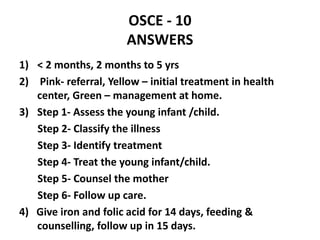
1) < 2 months, 2 months to 5 yrs
2) Pink- referral, Yellow – initial treatment in health
center, Green – management at home.
3) Step 1- Assess the young infant /child.
Step 2- Classify the illness
Step 3- Identify treatment
Step 4- Treat the young infant/child.
Step 5- Counsel the mother
Step 6- Follow up care.
4) Give iron and folic acid for 14 days, feeding &
counselling, follow up in 15 days.
OSCE -11
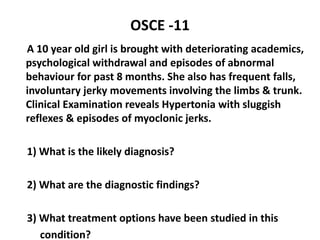
A 10 year old girl is brought with deteriorating academics,
psychological withdrawal and episodes of abnormal
behaviour for past 8 months. She also has frequent falls,
involuntary jerky movements involving the limbs & trunk.
Clinical Examination reveals Hypertonia with sluggish
reflexes & episodes of myoclonic jerks.
1) What is the likely diagnosis?
2) What are the diagnostic findings?
3) What treatment options have been studied in this
condition?
OSCE - 11
ANSWERS
1) Subacute Sclerosing Panencephalitis.
2) The diagnostic Findings are:
• CSF Measles Antibody titer > 1:8
• EEG: Burst Suppression pattern.
• Isolation of virus or viral Antigen on Brain Biopsy.
3) Isoprinosine, Interferon α2β
OSCE - 12
A 14 year old boy has sustained injury to the neck due
to a Road Traffic Accident. He is breathing but cannot
move or feel his arms or legs.
1. What is the recommended maneuver for opening the
airway in neck injuries?
2. X ray of the Cervical spine shows no bony injury. Is it
still possible for the boy to have a spinal cord injury?
Name the condition, its incidence and mode of
diagnosis?
3. What is the Emergency drug treatment that can be
offered to this boy?
OSCE - 12
ANSWERS
1. Jaw Thrust without Head tilt.
2. YES. SCIWORA (Spinal Cord Injury Without
Radiographic bone Abnormalities)Incidence 20%. MRI
Spine.
3. High dose Methyl Prednisolone (30 mg/kg) within 8
hrs of injury.
OSCE - 13
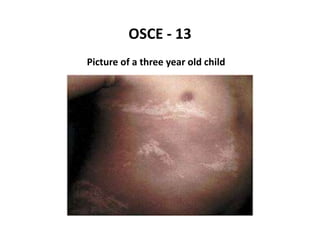
Picture of a three year old child
OSCE - 13
1. What is the diagnosis?
2. Name 4 associated abnormalities:
3. What are the differential diagnoses?
4. When does the skin lesion disappear?
5. What will be the finding in CT brain?
OSCE - 13
ANSWERS
1. Hypomelanosis of Ito
2. Mental retardation, Seizures, microcephaly and
Muscular Hypotonia
3. Differential Diagnoses:
• Systematized Nevus Depigmentosus
• Incontinentia pigmenti
4. Fades during Adulthood
5. Cerebral Atrophy
OSCE - 14
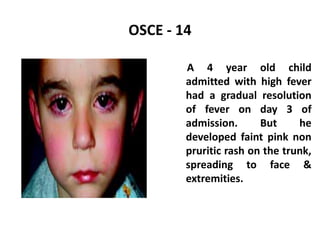
A 4 year old child
admitted with high fever
had a gradual resolution
of fever on day 3 of
admission. But he
developed faint pink non
pruritic rash on the trunk,
spreading to face &
extremities.
OSCE - 14
1. What is the condition?
1. What is the causative organism?
2. What is the typical finding seen in oral cavity?
3. Name 3 complications?
4. Can Breast milk transmit the disease to the baby?
OSCE - 14
ANSWERS
1. Roseola Infantum or Exanthem Subitum or Sixth Disease.
2. HHV Type 6, belonging to Roseola Virus Genus.
3. Nagayama Spots, Ulcers at the Uvulo-palato-glossal junction.
4. Seizures, Encephalitis, Cerebellitis, Hepatitis and Myocarditis.
5. No
OSCE - 15
OSELTAMIVIR
1. Indications for this drug?
2. Mechanism of Action?
3. Dose & Duration of therapy in pediatric H1N1 A Infection?
4. Which drug when co-administered improves the half life of
Oseltamivir?
5. Which Vaccine is contra indicated within 48 hours of
cessation of Oseltamivir therapy?
OSCE - 15
ANSWERS
1. Treatment of Influenza A & B in patients > 1 year of age,
who have been symptomatic for no more than 2 days. Also
used for prophylaxis.
2. Neuraminidase inhibitor, prevents new viral particles from
being released by infected cells.
3. By Weight:
< 15 kg: 30 mg BD for 5 days
15-23 Kg: 45 mg BD for 5 days
24- 40 Kg: 60 mg BD for 5 days
>40 Kg: 75 mg BD for 5 days
OSCE - 15
ANSWERS
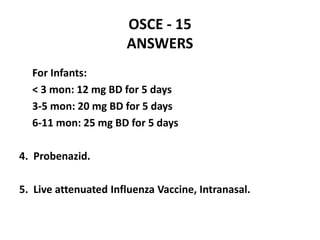
For Infants:
< 3 mon: 12 mg BD for 5 days
3-5 mon: 20 mg BD for 5 days
6-11 mon: 25 mg BD for 5 days
4. Probenazid.
5. Live attenuated Influenza Vaccine, Intranasal.
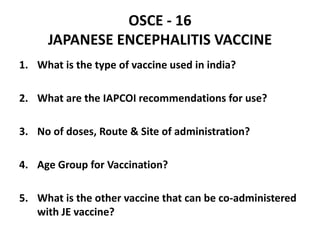
OSCE - 16
JAPANESE ENCEPHALITIS VACCINE
1. What is the type of vaccine used in india?
2. What are the IAPCOI recommendations for use?
3. No of doses, Route & Site of administration?
4. Age Group for Vaccination?
5. What is the other vaccine that can be co-administered
with JE vaccine?
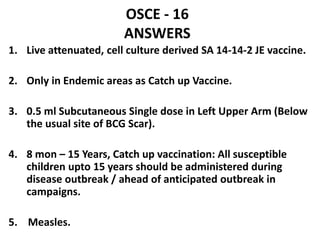
OSCE - 16
ANSWERS
1. Live attenuated, cell culture derived SA 14-14-2 JE vaccine.
2. Only in Endemic areas as Catch up Vaccine.
3. 0.5 ml Subcutaneous Single dose in Left Upper Arm (Below
the usual site of BCG Scar).
4. 8 mon – 15 Years, Catch up vaccination: All susceptible
children upto 15 years should be administered during
disease outbreak / ahead of anticipated outbreak in
campaigns.
5. Measles.
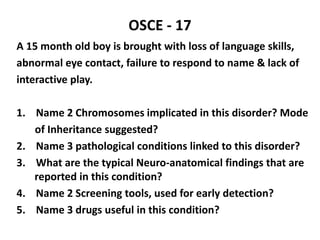
OSCE - 17
A 15 month old boy is brought with loss of language skills,
abnormal eye contact, failure to respond to name & lack of
interactive play.
1. Name 2 Chromosomes implicated in this disorder? Mode
of Inheritance suggested?
2. Name 3 pathological conditions linked to this disorder?
3. What are the typical Neuro-anatomical findings that are
reported in this condition?
4. Name 2 Screening tools, used for early detection?
5. Name 3 drugs useful in this condition?
OSCE - 17
ANSWERS
1. Chromosome 2q,7q,15q11-13; X-linked Inheritance.
2. Tuberous Sclerosis, Fragile X Syndrome, Angelman
Syndrome.
3. Macrocephaly, with abnormal growth in frontal,
temporal, cerebellar and limbic regions of brain.
4. M-CHAT: Modified Checklist for Autism in Toddlers
PDDST: Pervasive Developmental Disorders Screening
test.
5. Clomipramine, Fluoxetine, Clonidene, Risperidone,
Olanzapine.
OSCE - 18
TRUE OR FALSE
Regarding Tricyclic Anti depressant Poisoning:
1. Emesis is contra indicated because of the danger of
aspiration from vomiting.
2. Hypertension is a poor prognostic sign.
3. Lidocaine is used to treat dysrrhythmias unresponsive to
serum alkalinization.
4. Physostigmine, if given within 6 hours after exposure
prevents dysrhythmias.
5. Multiple doses of activated charcoal are recommended
to prevent intestinal absorption.
OSCE - 18
ANSWERS
1. True
2. False
3. True
4. False
5. True
OSCE – 19
A 6 year old boy is evaluated for recurrent pneumonia &
Osteomyelitis of multiple sites. On examination, He had
Anemia, malnutrition & Cervical Lymphadenitis. He also
had Folliculitis & multiple cutaneous granulomas.
1. What is the possible Diagnosis?
2. What is the closest differential diagnosis?
3. What are the Gastro-Intestinal complications of this
condition?
4. What is the recent diagnostic test for this condition?
5. Name 3 drugs used in the management?
OSCE - 19
ANSWERS
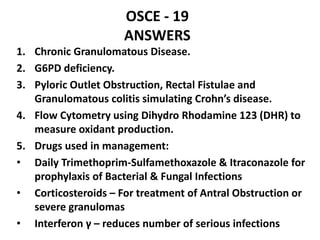
1. Chronic Granulomatous Disease.
2. G6PD deficiency.
3. Pyloric Outlet Obstruction, Rectal Fistulae and
Granulomatous colitis simulating Crohn’s disease.
4. Flow Cytometry using Dihydro Rhodamine 123 (DHR) to
measure oxidant production.
5. Drugs used in management:
• Daily Trimethoprim-Sulfamethoxazole & Itraconazole for
prophylaxis of Bacterial & Fungal Infections
• Corticosteroids – For treatment of Antral Obstruction or
severe granulomas
• Interferon γ – reduces number of serious infections
OSCE - 20
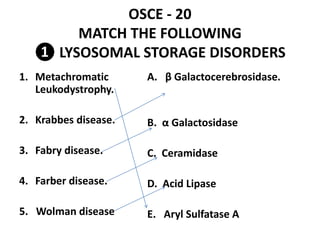
MATCH THE FOLLOWING
❶ LYSOSOMAL STORAGE DISORDERS
1. Metachromatic
Leukodystrophy.
2. Krabbes disease.
3. Fabry disease.
4. Farber disease.
5. Wolman disease
A. β Galactocerebrosidase.
B. α Galactosidase
C. Ceramidase
D. Acid Lipase
E. Aryl Sulfatase A
OSCE - 20
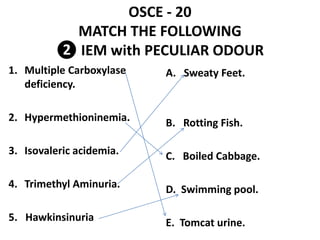
MATCH THE FOLLOWING
❷ IEM with PECULIAR ODOUR
1. Multiple Carboxylase
deficiency.
2. Hypermethioninemia.
3. Isovaleric acidemia.
4. Trimethyl Aminuria.
5. Hawkinsinuria
A. Sweaty Feet.
B. Rotting Fish.
C. Boiled Cabbage.
D. Swimming pool.
E. Tomcat urine.
OSCE - 20
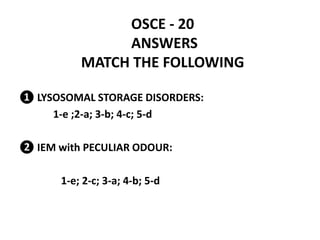
ANSWERS
MATCH THE FOLLOWING
❶ LYSOSOMAL STORAGE DISORDERS:
1-e ;2-a; 3-b; 4-c; 5-d
❷ IEM with PECULIAR ODOUR:
1-e; 2-c; 3-a; 4-b; 5-d
http://oscepediatrics.blogspot.in/

RIPE 2012 Pediatrics OSCE

  • 1.
  • 2.
    OSCE 1 MATCH THEFOLLOWING DRUGS USED EXPECTED ADVERSE IN PREGNANCY OUTCOME ON THE FOETUS 1. Chloroquine A. Macrosomia 2. Penicillamine B. VACTERAL Association 3. Statins C. Cutis laxa syndrome 4. Lithium D. Arthrogryposis 5. Misoprostol E. Deafness 6.Prednisolone F. Neuroblastoma 7.Tetracycline G. Minamata disease 8.Busulfan H. Cataract 9. Phenytoin I. Oral clefts 10.Methyl Mercury J. Corneal opacities
  • 3.
    OSCE 1 ANSWERS DRUGS USEDEXPECTED ADVERSE IN PREGNANCY OUTCOME ON THE FOETUS 1. Chloroquine E. Deafness 2. Penicillamine C. Cutis laxa syndrome 3. Statins B. VACTERAL Association 4. Lithium A. Macrosomia 5. Misoprostol D. Arthrogryposis 6.Prednisolone I. Oral clefts 7.Tetracycline H. Cataract 8.Busulfan J. Corneal opacities 9. Phenytoin F. Neuro blastoma 10.Methyl Mercury G. Minamata disease
  • 4.
    OSCE -2 • A12 year old adolescent boy, known Nephrotic syndrome presented in Emergency Room with the history of acute onset of breathlessness. In the ER, his vitals: HR-100/mt, BP- 120/80 mm Hg, RR- 40/mt,Spo2 98% in Room air. His ABG , PH- 7.55,Pco2-20 mm/Hg, Pao2- 110 mm/Hg, Hco3-26meq/L. 1. What is the interpretation of ABG? 2. What is the formula for compensation? 3. Name two electrolyte disturbances associated with this ABG finding? 4. Name two drug overdose causing similar ABG finding? 5. What is the probable diagnosis?
  • 5.
    OSCE – 2 ANSWERS 1.Acute uncompensated Respiratory Alkalosis 2. Acute compensation-Plasma Hco3 falls by 2 for each 10mm/Hg decrease in Pco2. . Chronic compensation-Plasma Hco3 falls by 4 for each 10mm/Hg decrease in Pco2 3. Hypocalcemia, Hypokalemia 4. Salicylates,caffeine,Theophylline. 5. Pulmonary Embolism.
  • 6.
    OSCE-3 10 day oldneonate with macular rash over face. ECG
  • 7.
    OSCE - 3 A10 day old neonate with macular rash over the face. 1. Interpretation of ECG and probable diagnosis? 2. How will you confirm the diagnosis? 3. How will you prevent this condition? 4. What is the treatment? 5. What is the risk of recurrence in future pregnancies?
  • 8.
    OSCE – 3 ANSWERS 1.Complete Heart Block, Neonatal Lupus. 2. Presence of Maternal Anti-Ro (SSA), Anti-La(SSB) antibodies. 3. Treatment with IVIG in pregnant women with anti- Ro,anti-La antibodies. 4. Cardiac pacing. 5. 15%
  • 9.
  • 10.
    OSCE - 4 1.What is the diagnosis? 2. What is the drug of choice for the prevention of painful episodes? 3. What are measures for the primary prevention of stroke in these children? 4. What are the antibiotics of choice in acute chest syndrome? 5. What type of renal malignancy is common in this condition?
  • 11.
    OSCE – 4 ANSWERS 1.Sickle cell anemia. 2. Hydroxy urea. 3. Transcranial Doppler assessment of blood velocity in the terminal portion of the ICA and proximal portion of the MCA.Periodic blood transfusion if Time Averaged Mean Maximum blood flow(TAMM) is more than 200cm/sec to maintain Hb S levels less than 30% 4. Macrolide and third generation cephalosporin. 5. Renal medullary carcinoma.
  • 12.
    OSCE-5 A) 1.What is themode of inheritance? 2.What is the characteristic feature of this inheritance? 3.Give one example?
  • 13.
    OSCE-5 B) 1. What isthe mode of inheritance? 2. What is the characteristic feature of this inheritance? 3. Give one example?
  • 14.
    OSCE – 5 ANSWERS A) 1.Mitochondrial Inheritance. 2. Since Mitochondrial genome is entirely derived from the mother awomen with this disorder can have affected offspring of either sex but an affected father cannot pass on the disease to his offspring. 3. 3. Leber hereditary optic neuropathy,Leigh disease,MELAS, MERRF. B) 1. Y-Linked inheritance. 2. Only male to male transmission,only males are affected. 3. Leri-weil dyschondrosteosis,Langer mesomelic dwarfism.
  • 15.
    OSCE - 6 Threeyear old child with fever, irritability, poor feeding and drooling of saliva.
  • 16.
    OSCE - 6 1.What is the diagnosis? 2. Name two most common micro-organisms associated? 3. What is the drug of choice? 4. Name two complications? 5. What is Lemierre disease?
  • 17.
    OSCE – 6 ANSWERS 1.Retropharyngeal Abscess. 2. Group A Streptococcus,Anerobic bacteria,Staphlyococcus Aureus, H.Influenza. 3. 3rd generation Cephalosporin+Ampicilin- Sulbactum/Clindamycin. 4. Upper airway obstruction,Aspiration pneumonia,Mediastinitis. 5. Parapharyngeal abscess extending to cause septic thrombophlebitis of the Internal Jugular vein and embolic abscess in the lungs.
  • 18.
    OSCE – 7 Outof 6000 children in a village,50 cases of tuberculosis already exist.There are 10 newly diagnosed cases in a year.Two children died of tuberculosis.Calculate the Prevalence rate, Incidence rate, Case fatality rate of tuberculosis in that village.
  • 19.
    OSCE – 7 ANSWER No.ofexisting (50)+New cases(10) Prevalence rate = ----------------------------------------------- * 100 Population at risk(6000) = 1%. New cases(10) Incidence rate = -------------------------------- * 1000 Population at risk(6000) = 1.6 Deaths(2) Case fatality rate = --------------------------- * 100 Total cases(50+10) = 3.3%
  • 20.
    OSCE – 8 HISTORYTAKING • A 3 year old male child has bruising over his shins and knees. Elicit a Targeted History (10 Points) :-
  • 21.
    OSCE – 8 ANSWERS 1.Greetings, Introduction & Establishing Rapport 2. History regarding walking activity and frequency of falls (Normal toddler bruising) 3. History of preceding fever (ITP) 4. History of bleeding elsewhere including hematuria (ITP,HSP) 5. History of Abdominal and joint pain (HSP) 6. History of painful swollen joints with family history of bleeding disorder (Hemophilia)
  • 22.
    OSCE – 8 ANSWERS 7.History of intake of NSAIDS like aspirin (Drug induced) 8. Social history and enquiry about care takers and family dynamics (Non Accidental Injury) 9. History of prolonged fever (leukemia,aplastic anemia) 10. History of progressive pallor requiring transfusions (leukemia,aplastic anemia)
  • 23.
    OSCE - 9 Youhave performed Incision &drainage of Gluteal abscess in a child.How will u dispose the used items given below? 1) Cotton and gauze contaminated with pus. 2) Scalpels and needles. 3) Intravenous set and tubings. 4) Remaining contaminated Lignocaine used for Local anasthesia.
  • 24.
    OSCE - 9 ANSWERS 1)Yellow –plastic bag 2) Blue/white puncture proof container. 3) Red- plastic bag/disinfected container 4) Black –plastic bag
  • 25.
    OSCE - 10 Asper IMNCI clinical guidelines 1) How will you categorize children based on age group? 2) What are the following colour codings stand for? a) Pink b) Yellow c) Green 3) What are the six steps of case management process in INMCI? 4) What will you advise for a child presenting with “ some palmar pallor”?
  • 26.
    OSCE - 10 ANSWERS 1)< 2 months, 2 months to 5 yrs 2) Pink- referral, Yellow – initial treatment in health center, Green – management at home. 3) Step 1- Assess the young infant /child. Step 2- Classify the illness Step 3- Identify treatment Step 4- Treat the young infant/child. Step 5- Counsel the mother Step 6- Follow up care. 4) Give iron and folic acid for 14 days, feeding & counselling, follow up in 15 days.
  • 27.
    OSCE -11 A 10year old girl is brought with deteriorating academics, psychological withdrawal and episodes of abnormal behaviour for past 8 months. She also has frequent falls, involuntary jerky movements involving the limbs & trunk. Clinical Examination reveals Hypertonia with sluggish reflexes & episodes of myoclonic jerks. 1) What is the likely diagnosis? 2) What are the diagnostic findings? 3) What treatment options have been studied in this condition?
  • 28.
    OSCE - 11 ANSWERS 1)Subacute Sclerosing Panencephalitis. 2) The diagnostic Findings are: • CSF Measles Antibody titer > 1:8 • EEG: Burst Suppression pattern. • Isolation of virus or viral Antigen on Brain Biopsy. 3) Isoprinosine, Interferon α2β
  • 29.
    OSCE - 12 A14 year old boy has sustained injury to the neck due to a Road Traffic Accident. He is breathing but cannot move or feel his arms or legs. 1. What is the recommended maneuver for opening the airway in neck injuries? 2. X ray of the Cervical spine shows no bony injury. Is it still possible for the boy to have a spinal cord injury? Name the condition, its incidence and mode of diagnosis? 3. What is the Emergency drug treatment that can be offered to this boy?
  • 30.
    OSCE - 12 ANSWERS 1.Jaw Thrust without Head tilt. 2. YES. SCIWORA (Spinal Cord Injury Without Radiographic bone Abnormalities)Incidence 20%. MRI Spine. 3. High dose Methyl Prednisolone (30 mg/kg) within 8 hrs of injury.
  • 31.
    OSCE - 13 Pictureof a three year old child
  • 32.
    OSCE - 13 1.What is the diagnosis? 2. Name 4 associated abnormalities: 3. What are the differential diagnoses? 4. When does the skin lesion disappear? 5. What will be the finding in CT brain?
  • 33.
    OSCE - 13 ANSWERS 1.Hypomelanosis of Ito 2. Mental retardation, Seizures, microcephaly and Muscular Hypotonia 3. Differential Diagnoses: • Systematized Nevus Depigmentosus • Incontinentia pigmenti 4. Fades during Adulthood 5. Cerebral Atrophy
  • 34.
    OSCE - 14 A4 year old child admitted with high fever had a gradual resolution of fever on day 3 of admission. But he developed faint pink non pruritic rash on the trunk, spreading to face & extremities.
  • 35.
    OSCE - 14 1.What is the condition? 1. What is the causative organism? 2. What is the typical finding seen in oral cavity? 3. Name 3 complications? 4. Can Breast milk transmit the disease to the baby?
  • 36.
    OSCE - 14 ANSWERS 1.Roseola Infantum or Exanthem Subitum or Sixth Disease. 2. HHV Type 6, belonging to Roseola Virus Genus. 3. Nagayama Spots, Ulcers at the Uvulo-palato-glossal junction. 4. Seizures, Encephalitis, Cerebellitis, Hepatitis and Myocarditis. 5. No
  • 37.
    OSCE - 15 OSELTAMIVIR 1.Indications for this drug? 2. Mechanism of Action? 3. Dose & Duration of therapy in pediatric H1N1 A Infection? 4. Which drug when co-administered improves the half life of Oseltamivir? 5. Which Vaccine is contra indicated within 48 hours of cessation of Oseltamivir therapy?
  • 38.
    OSCE - 15 ANSWERS 1.Treatment of Influenza A & B in patients > 1 year of age, who have been symptomatic for no more than 2 days. Also used for prophylaxis. 2. Neuraminidase inhibitor, prevents new viral particles from being released by infected cells. 3. By Weight: < 15 kg: 30 mg BD for 5 days 15-23 Kg: 45 mg BD for 5 days 24- 40 Kg: 60 mg BD for 5 days >40 Kg: 75 mg BD for 5 days
  • 39.
    OSCE - 15 ANSWERS ForInfants: < 3 mon: 12 mg BD for 5 days 3-5 mon: 20 mg BD for 5 days 6-11 mon: 25 mg BD for 5 days 4. Probenazid. 5. Live attenuated Influenza Vaccine, Intranasal.
  • 40.
    OSCE - 16 JAPANESEENCEPHALITIS VACCINE 1. What is the type of vaccine used in india? 2. What are the IAPCOI recommendations for use? 3. No of doses, Route & Site of administration? 4. Age Group for Vaccination? 5. What is the other vaccine that can be co-administered with JE vaccine?
  • 41.
    OSCE - 16 ANSWERS 1.Live attenuated, cell culture derived SA 14-14-2 JE vaccine. 2. Only in Endemic areas as Catch up Vaccine. 3. 0.5 ml Subcutaneous Single dose in Left Upper Arm (Below the usual site of BCG Scar). 4. 8 mon – 15 Years, Catch up vaccination: All susceptible children upto 15 years should be administered during disease outbreak / ahead of anticipated outbreak in campaigns. 5. Measles.
  • 42.
    OSCE - 17 A15 month old boy is brought with loss of language skills, abnormal eye contact, failure to respond to name & lack of interactive play. 1. Name 2 Chromosomes implicated in this disorder? Mode of Inheritance suggested? 2. Name 3 pathological conditions linked to this disorder? 3. What are the typical Neuro-anatomical findings that are reported in this condition? 4. Name 2 Screening tools, used for early detection? 5. Name 3 drugs useful in this condition?
  • 43.
    OSCE - 17 ANSWERS 1.Chromosome 2q,7q,15q11-13; X-linked Inheritance. 2. Tuberous Sclerosis, Fragile X Syndrome, Angelman Syndrome. 3. Macrocephaly, with abnormal growth in frontal, temporal, cerebellar and limbic regions of brain. 4. M-CHAT: Modified Checklist for Autism in Toddlers PDDST: Pervasive Developmental Disorders Screening test. 5. Clomipramine, Fluoxetine, Clonidene, Risperidone, Olanzapine.
  • 44.
    OSCE - 18 TRUEOR FALSE Regarding Tricyclic Anti depressant Poisoning: 1. Emesis is contra indicated because of the danger of aspiration from vomiting. 2. Hypertension is a poor prognostic sign. 3. Lidocaine is used to treat dysrrhythmias unresponsive to serum alkalinization. 4. Physostigmine, if given within 6 hours after exposure prevents dysrhythmias. 5. Multiple doses of activated charcoal are recommended to prevent intestinal absorption.
  • 45.
    OSCE - 18 ANSWERS 1.True 2. False 3. True 4. False 5. True
  • 46.
    OSCE – 19 A6 year old boy is evaluated for recurrent pneumonia & Osteomyelitis of multiple sites. On examination, He had Anemia, malnutrition & Cervical Lymphadenitis. He also had Folliculitis & multiple cutaneous granulomas. 1. What is the possible Diagnosis? 2. What is the closest differential diagnosis? 3. What are the Gastro-Intestinal complications of this condition? 4. What is the recent diagnostic test for this condition? 5. Name 3 drugs used in the management?
  • 47.
    OSCE - 19 ANSWERS 1.Chronic Granulomatous Disease. 2. G6PD deficiency. 3. Pyloric Outlet Obstruction, Rectal Fistulae and Granulomatous colitis simulating Crohn’s disease. 4. Flow Cytometry using Dihydro Rhodamine 123 (DHR) to measure oxidant production. 5. Drugs used in management: • Daily Trimethoprim-Sulfamethoxazole & Itraconazole for prophylaxis of Bacterial & Fungal Infections • Corticosteroids – For treatment of Antral Obstruction or severe granulomas • Interferon γ – reduces number of serious infections
  • 48.
    OSCE - 20 MATCHTHE FOLLOWING ❶ LYSOSOMAL STORAGE DISORDERS 1. Metachromatic Leukodystrophy. 2. Krabbes disease. 3. Fabry disease. 4. Farber disease. 5. Wolman disease A. β Galactocerebrosidase. B. α Galactosidase C. Ceramidase D. Acid Lipase E. Aryl Sulfatase A
  • 49.
    OSCE - 20 MATCHTHE FOLLOWING ❷ IEM with PECULIAR ODOUR 1. Multiple Carboxylase deficiency. 2. Hypermethioninemia. 3. Isovaleric acidemia. 4. Trimethyl Aminuria. 5. Hawkinsinuria A. Sweaty Feet. B. Rotting Fish. C. Boiled Cabbage. D. Swimming pool. E. Tomcat urine.
  • 50.
    OSCE - 20 ANSWERS MATCHTHE FOLLOWING ❶ LYSOSOMAL STORAGE DISORDERS: 1-e ;2-a; 3-b; 4-c; 5-d ❷ IEM with PECULIAR ODOUR: 1-e; 2-c; 3-a; 4-b; 5-d
  • 51.