FORCEP DELIVERY
Dr. Niranjan Chavan
HISTORY
• The Chamberlens were innovators, opportunists and entrepreneurs of
forceps.
• Dr Peter, in 1634, proposed a Sisterhood of Midwives of London,
antedating the formation of the Central Midwives Board by over 250 years.
HISTORY
• The Chamberlens were French ,William Chamberlen, the patriarch of the
family, was most likely a surgeon; he had two sons, both named Pierre, who
became maverick surgeons that specialized in midwifery.
• He was succeeded by his nephew, Dr. Peter Chamberlen, as royal
obstetrician. The success of this dynasty of obstetricians with the Royal
family and high nobles was related in part to the use of this "secret"
instrument allowing release of live child in difficult cases.
• In fact, the instrument was kept secret for 150 years by the Chamberlen
family, although there is evidence for its presence as far back as 1634.
• Models derived from the Chamberlen instrument finally appeared gradually
in England and Scotland in 1735. About 100 years after the invention of the
forceps by Peter Chamberlen Sr. a surgeon by the name of Jean Palfyn
presented his obstetric forceps to the Paris Academy of Sciences in 1723.
• They contained parallel blades and were called the Hands of Palfyn.
• Tarnier's idea was to "split" mechanically the grabbing of the fetal head
(between the forceps blades) on which the operator does not intervene after
their correct positioning, from a mechanical accessory set on the forceps
itself, the "tractor" on which the operator exercises traction needed to pull
down the fetal head in the correct axis of the pelvic excavation.
• Tarnier forceps (and its multiple derivatives under other names) remained the
most widely used system in the world until the development of the cesarean
section
PARTS OF FORCEPS
• Branches
• Blades- solid, fenestrated, Pseudo fenestrated
• Shanks
• Handle
• Lock – English, German, Sliding, Pivot, Hiesters
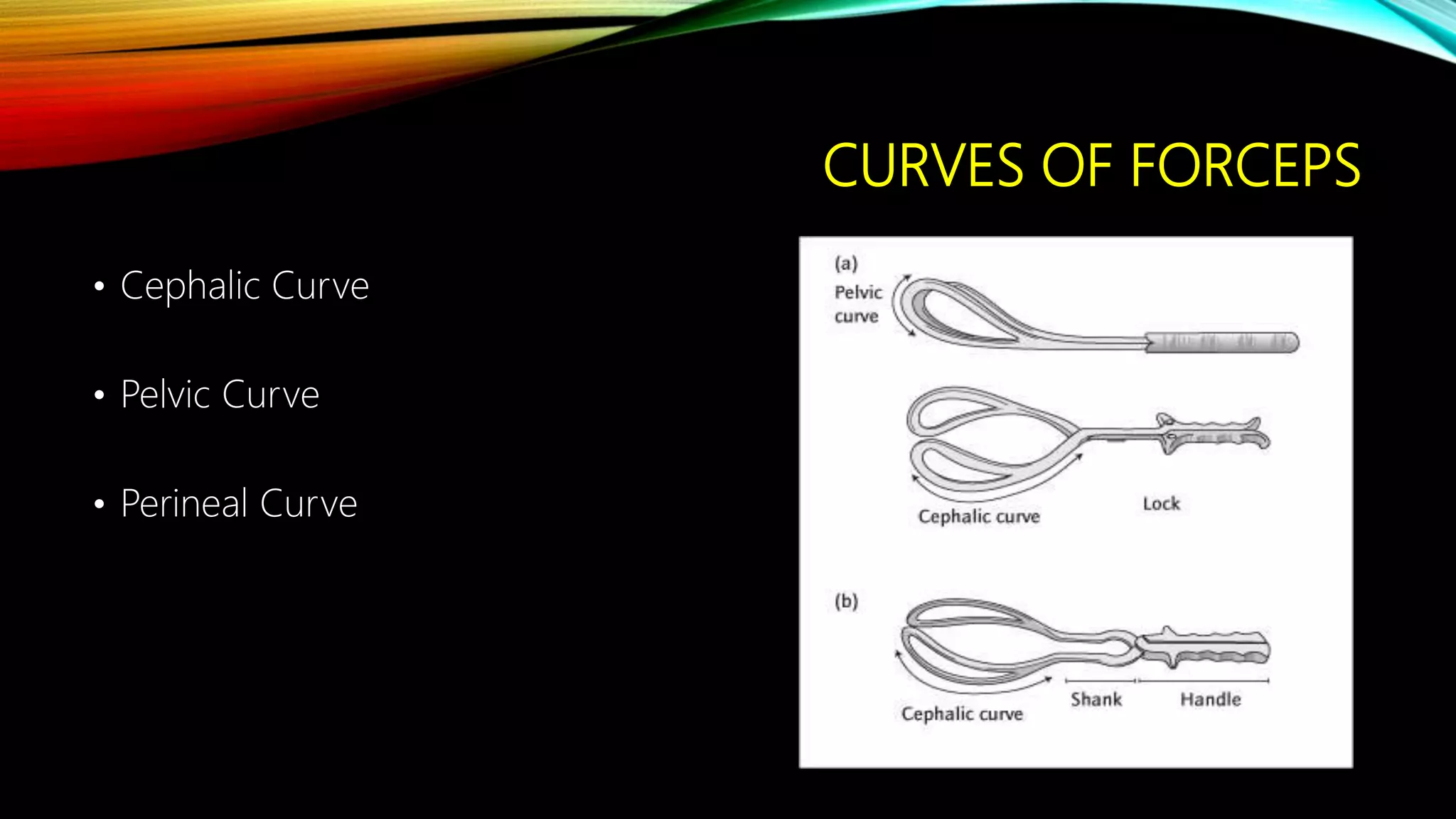
CURVES OF FORCEPS
• Cephalic Curve
• Pelvic Curve
• Perineal Curve
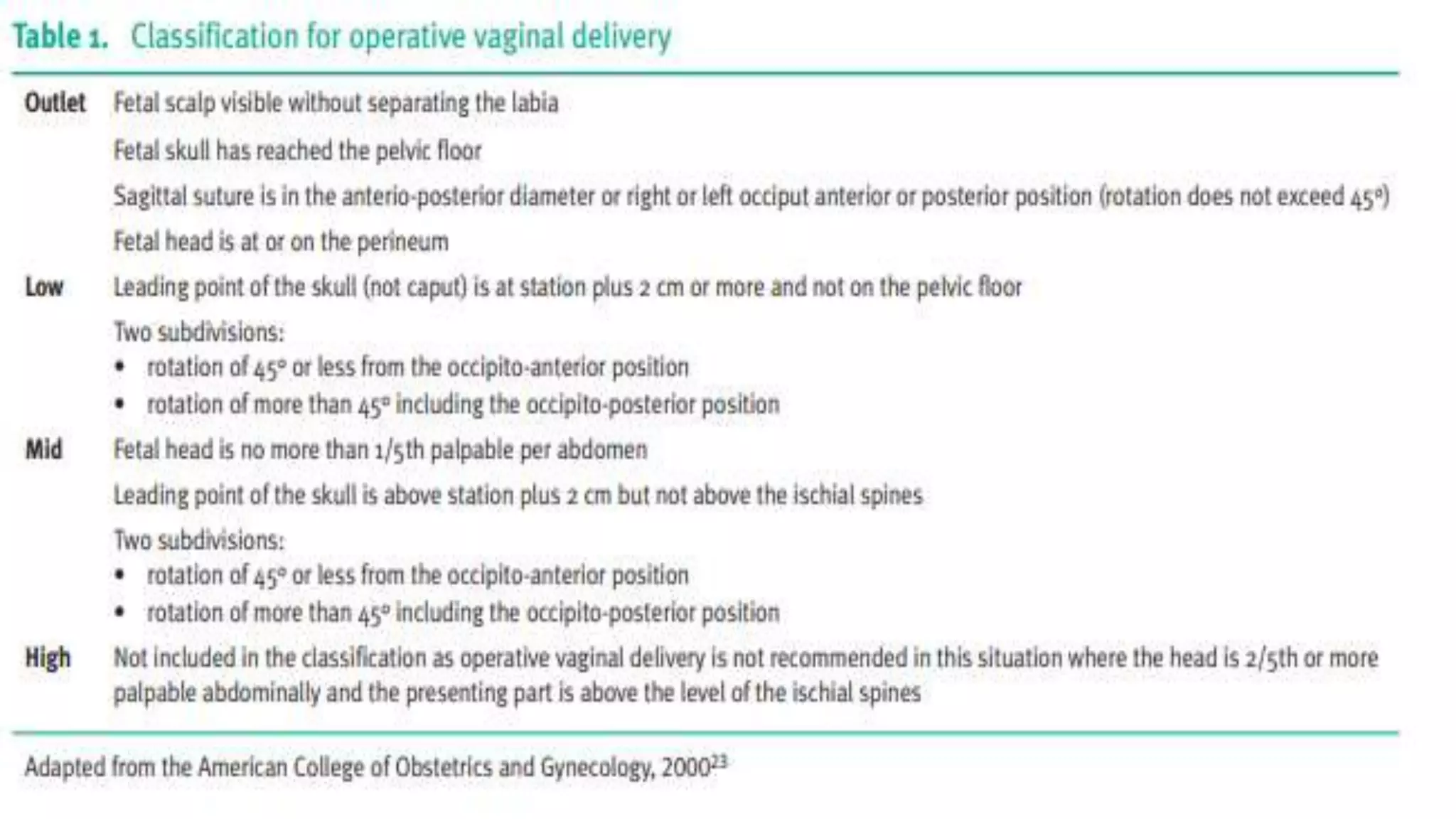
It has been classified by the The American College of Obstetricians and Gynecologists
(ACOG) in 1994 conference at Washington.
PREREQUISITES
• Vertex presentation
• Cervix is fully dilated and the membranes ruptured
• Head is fully engaged
• Exact position of the head can be determined so proper placement of the
instrument can be achieved
• Pelvis is deemed adequate
• Informed consent must be obtained
• Appropriate analgesia is in place
• Maternal bladder has been emptied
• Adequate facilities and backup personnel are available
• Operator must have the knowledge, experience, and skill necessary to use
the instruments and manage complications that may arise
• Backup plan
Types
700+ varieties
3 categories
(1) Classical
• (a)Parallel shanks: Simpson, DeLee, Irving, Hawks-Dennen
• (b)Overlapping shanks: Elliott, Tucker-McLane
(2)Rotational : Kielland, Leff forceps
(3)Special : Piper forceps
CONTRAINDICATIONS
Absolute
• non-vertex or brow
• unengaged head
• incomplete cervix dilation
• clinical evidence of cephalopelvic disproportion
• fetal coagulopathy
CONTRAINDICATIONS
Relative
• unfavourable attitude of fetal head
• rotation >45° from occiput anterior or occiput posterior (vacuum)
• mid-pelvic station
• fetal prematurity. There is a small retrospective study reviewing the
outcome of deliveries of infants 1500 g to 2500 g. No difference was found
in Apgar scores, umbilical pH, or intraventricular hemorrhage when
comparing vacuum extraction with controls who delivered spontaneously.17
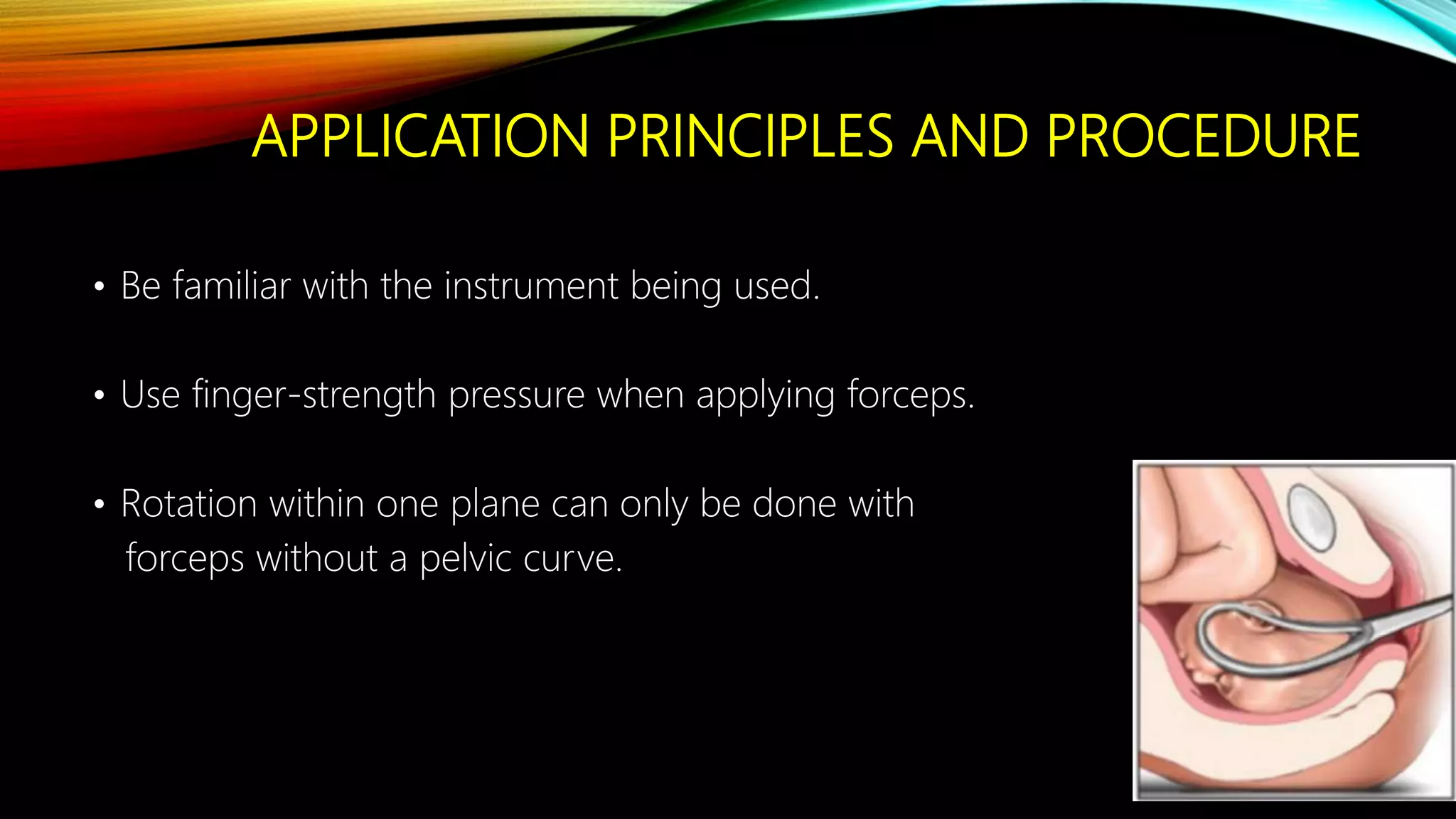
APPLICATION PRINCIPLES AND PROCEDURE
• Be familiar with the instrument being used.
• Use finger-strength pressure when applying forceps.
• Rotation within one plane can only be done with
forceps without a pelvic curve.
When checking the application:
• (a) the posterior fontanelle should be located midway between the sides of
the blades, with the lambdoid sutures equidistant from the forceps blades
and
• (b) the sagittal suture must be perpendicular to the plane of the shanks
throughout its length.
• (c) the fenestration of the blades should be barely felt and the amount of
fenestration felt on each side should be equal. With a solid blade, no more
than a fingertip should be able to be inserted between the blade and the
fetal head one finger-breadth above the plane of the shanks.
• VIDEO
FORCEP FOR AFTER COMING HEAD OF BREECH
Indications –
• Prophylactic i.e. to prevent sudden compression and decompression of
after coming head
• Arrest of after coming head
Different forceps which can be used
• Long Pipers forceps
• Simpsons long forceps
• Kielland’s forceps
Cardinal Principles –
• Forcep to be inserted and applied from ventral aspect of the body
• Pelvic application rather than purely Cephalic application
• Mechanism of extraction is flexion of head accompanished by elevating the
handles of forceps
Prerequisites
• Nape of the neck should be seen
METHOD
• Vaginal examination is done to ensure full dilatation of cervix
• Deep episiotomy to be given
• The operator should kneel for the Pipers forcep insertion
• Assemble forceps
• Assistant holds body of fetus upwards
• Left branch is always introduced first, direct pelvic application from ventral
aspect of the body
• Right branch applied similarly. Blades are locked
• Infants body is allowed to straddle he shanks and operators forearms
• Extract with assistant giving suprapubic pressure, operators other hand
straddle and splint the neck
MATERNAL
COMPLICATIONS
• maternal lacerations
• minor external ocular trauma
• retinal hemorrhage
FETAL
COMPLICATIONS
• fetal skull fractures
• facial nerve palsies
• cephalohematomas
• subaponeurotic hemorrhages
• intracranial hemorrhages
• scalp lacerations
FAILED OPERATIVE DELIVERY
Causes
• Cannot apply the branchs
• Branches do not lock
• Branches slip after application
• While effecting rotation only blades rotate
• Extraction is not possible
• There is morbidity to motality to fetus and mother
FAILED OPERATIVE DELIVERY
• Application before full dilatation of cervix
• Gross Cephalopelvic Disproportion
• DTA
• Undiagnosed hydrocephalus
• Contraction ring grasping the fetus
• Laufe’s principle of failed forcep
Forceps fail not only when vaginal extraction is not possible but also if after
undue pulling there is considerable damage to maternal soft parts and the
baby, which has been delivered, has suffered considerable injury with low
APGAR score and meager chances of survival
FAILED OPERATIVE DELIVERY
• It is well known that a failed operative delivery resulting in a cesarean
delivery is worse than an outright cesarean delivery.
• In the study performed in California by Towner et al, the rates of subdural
hemorrhage, facial-nerve palsy, convulsions, and mechanical ventilation
were significantly higher in infants delivered by caesarean section after a
failed attempt at vacuum extraction, forceps delivery, or both.
• As such, a physician must often think about appropriate patient selection and
the chances of success before attempting an operative vaginal delivery.
• However, fewer than 3% of women in whom an operative vaginal delivery
has been attempted go on to deliver by cesarean. Rotational and midpelvic
(0 to +1 station) forceps, however, are more difficult, with higher rates of
failure, and require more skill.
Forceps delivery- Operative Vaginal Delivery

Forceps delivery- Operative Vaginal Delivery

  • 1.
  • 3.
    HISTORY • The Chamberlenswere innovators, opportunists and entrepreneurs of forceps. • Dr Peter, in 1634, proposed a Sisterhood of Midwives of London, antedating the formation of the Central Midwives Board by over 250 years.
  • 4.
    HISTORY • The Chamberlenswere French ,William Chamberlen, the patriarch of the family, was most likely a surgeon; he had two sons, both named Pierre, who became maverick surgeons that specialized in midwifery. • He was succeeded by his nephew, Dr. Peter Chamberlen, as royal obstetrician. The success of this dynasty of obstetricians with the Royal family and high nobles was related in part to the use of this "secret" instrument allowing release of live child in difficult cases.
  • 5.
    • In fact,the instrument was kept secret for 150 years by the Chamberlen family, although there is evidence for its presence as far back as 1634. • Models derived from the Chamberlen instrument finally appeared gradually in England and Scotland in 1735. About 100 years after the invention of the forceps by Peter Chamberlen Sr. a surgeon by the name of Jean Palfyn presented his obstetric forceps to the Paris Academy of Sciences in 1723. • They contained parallel blades and were called the Hands of Palfyn.
  • 6.
    • Tarnier's ideawas to "split" mechanically the grabbing of the fetal head (between the forceps blades) on which the operator does not intervene after their correct positioning, from a mechanical accessory set on the forceps itself, the "tractor" on which the operator exercises traction needed to pull down the fetal head in the correct axis of the pelvic excavation. • Tarnier forceps (and its multiple derivatives under other names) remained the most widely used system in the world until the development of the cesarean section
  • 7.
    PARTS OF FORCEPS •Branches • Blades- solid, fenestrated, Pseudo fenestrated • Shanks • Handle • Lock – English, German, Sliding, Pivot, Hiesters
  • 8.
    CURVES OF FORCEPS •Cephalic Curve • Pelvic Curve • Perineal Curve
  • 9.
    It has beenclassified by the The American College of Obstetricians and Gynecologists (ACOG) in 1994 conference at Washington.
  • 10.
    PREREQUISITES • Vertex presentation •Cervix is fully dilated and the membranes ruptured • Head is fully engaged • Exact position of the head can be determined so proper placement of the instrument can be achieved • Pelvis is deemed adequate • Informed consent must be obtained • Appropriate analgesia is in place
  • 11.
    • Maternal bladderhas been emptied • Adequate facilities and backup personnel are available • Operator must have the knowledge, experience, and skill necessary to use the instruments and manage complications that may arise • Backup plan
  • 13.
    Types 700+ varieties 3 categories (1)Classical • (a)Parallel shanks: Simpson, DeLee, Irving, Hawks-Dennen • (b)Overlapping shanks: Elliott, Tucker-McLane (2)Rotational : Kielland, Leff forceps (3)Special : Piper forceps
  • 17.
    CONTRAINDICATIONS Absolute • non-vertex orbrow • unengaged head • incomplete cervix dilation • clinical evidence of cephalopelvic disproportion • fetal coagulopathy
  • 18.
    CONTRAINDICATIONS Relative • unfavourable attitudeof fetal head • rotation >45° from occiput anterior or occiput posterior (vacuum) • mid-pelvic station • fetal prematurity. There is a small retrospective study reviewing the outcome of deliveries of infants 1500 g to 2500 g. No difference was found in Apgar scores, umbilical pH, or intraventricular hemorrhage when comparing vacuum extraction with controls who delivered spontaneously.17
  • 19.
    APPLICATION PRINCIPLES ANDPROCEDURE • Be familiar with the instrument being used. • Use finger-strength pressure when applying forceps. • Rotation within one plane can only be done with forceps without a pelvic curve.
  • 20.
    When checking theapplication: • (a) the posterior fontanelle should be located midway between the sides of the blades, with the lambdoid sutures equidistant from the forceps blades and • (b) the sagittal suture must be perpendicular to the plane of the shanks throughout its length. • (c) the fenestration of the blades should be barely felt and the amount of fenestration felt on each side should be equal. With a solid blade, no more than a fingertip should be able to be inserted between the blade and the fetal head one finger-breadth above the plane of the shanks.
  • 22.
  • 23.
    FORCEP FOR AFTERCOMING HEAD OF BREECH Indications – • Prophylactic i.e. to prevent sudden compression and decompression of after coming head • Arrest of after coming head Different forceps which can be used • Long Pipers forceps • Simpsons long forceps • Kielland’s forceps
  • 24.
    Cardinal Principles – •Forcep to be inserted and applied from ventral aspect of the body • Pelvic application rather than purely Cephalic application • Mechanism of extraction is flexion of head accompanished by elevating the handles of forceps Prerequisites • Nape of the neck should be seen
  • 25.
    METHOD • Vaginal examinationis done to ensure full dilatation of cervix • Deep episiotomy to be given • The operator should kneel for the Pipers forcep insertion • Assemble forceps • Assistant holds body of fetus upwards • Left branch is always introduced first, direct pelvic application from ventral aspect of the body
  • 26.
    • Right branchapplied similarly. Blades are locked • Infants body is allowed to straddle he shanks and operators forearms • Extract with assistant giving suprapubic pressure, operators other hand straddle and splint the neck
  • 28.
    MATERNAL COMPLICATIONS • maternal lacerations •minor external ocular trauma • retinal hemorrhage
  • 29.
    FETAL COMPLICATIONS • fetal skullfractures • facial nerve palsies • cephalohematomas • subaponeurotic hemorrhages • intracranial hemorrhages • scalp lacerations
  • 30.
    FAILED OPERATIVE DELIVERY Causes •Cannot apply the branchs • Branches do not lock • Branches slip after application • While effecting rotation only blades rotate • Extraction is not possible • There is morbidity to motality to fetus and mother
  • 31.
    FAILED OPERATIVE DELIVERY •Application before full dilatation of cervix • Gross Cephalopelvic Disproportion • DTA • Undiagnosed hydrocephalus • Contraction ring grasping the fetus
  • 32.
    • Laufe’s principleof failed forcep Forceps fail not only when vaginal extraction is not possible but also if after undue pulling there is considerable damage to maternal soft parts and the baby, which has been delivered, has suffered considerable injury with low APGAR score and meager chances of survival
  • 33.
    FAILED OPERATIVE DELIVERY •It is well known that a failed operative delivery resulting in a cesarean delivery is worse than an outright cesarean delivery. • In the study performed in California by Towner et al, the rates of subdural hemorrhage, facial-nerve palsy, convulsions, and mechanical ventilation were significantly higher in infants delivered by caesarean section after a failed attempt at vacuum extraction, forceps delivery, or both.
  • 34.
    • As such,a physician must often think about appropriate patient selection and the chances of success before attempting an operative vaginal delivery. • However, fewer than 3% of women in whom an operative vaginal delivery has been attempted go on to deliver by cesarean. Rotational and midpelvic (0 to +1 station) forceps, however, are more difficult, with higher rates of failure, and require more skill.