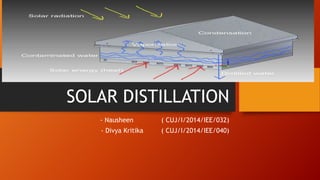
SOLAR DISTILLATION
- Nausheen ( CUJ/I/2014/IEE/032)
- Divya Kritika ( CUJ/I/2014/IEE/040)
INTRODUCTION
• 97% of the water in the world is in the ocean, approximately 2% of the water in
the world is at present stored as ice in polar region, and 1% is fresh water
available in earth for the need of the plants, animals and human life
• Process available for water purification
• Practiced in tropical and sub- tropical region
• System can be large or small
HISTORY
• Father of solar distillation, Carlos Wilson, the creator of the first known
application of solar distillation, built in Las Salinas (The Salts), Chile in 1872
• First documented account of solar distillation use for desalination was by
Giovani Batista Della Porta in 1958
BASIC CONCEPT:
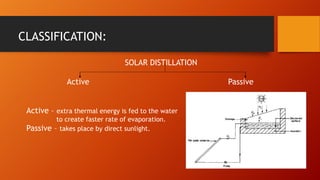
CLASSIFICATION:
SOLAR DISTILLATION
Active Passive
Active – extra thermal energy is fed to the water
to create faster rate of evaporation.
Passive – takes place by direct sunlight.
BASIN – TYPE SOLAR STILL
• Side by side bays , glass cover
• Air supported plastic films
• Shallow basins – 10 to 20 mm deep
• Deep basins – 100 mm or more
• Width are of the order 1 to 2 m, with lengths
variable upto 50 to 100 m
Major energy transport mechanism in basin type still
• Energy transfer from basin to
cover occurs by evaporation-
condensation in addition to
convection and radiation.
• output is measured by the
evaporation-condensation
transfer
Basic Thermal Network For a Basin Type Still
ENERGY BALANCE EQUATION:
Energy balance on the Water in the basin, per unit area of basin, can be written
as:
where the subscripts, e, r, c, and k represent evaporation- condensation, radiation,
convection , and conduction, respectively. The subscripts b and g refer to basin and glazing
(cover), and τc is the transmittance of the cover and the water film or droplets on its
underside.
Neglecting solar energy absorbed by it, energy balance equation can be written as:
Dunkle (1961) provides convenient ways of estimating the terms for internal heat
transfer in the still for use in these equations. He recommends:
For estimating the convection energy transfer from basin to cover, qc,b−g, he suggests
that the normal Rayleigh number must be modified. In a horizontal enclosed air gap, a
relationship between Nusselt and Rayleigh numbers is:
For air and water,
T`, is an equivalent temperature difference accounting for density differences due to water
vapor concentration differences. pwb and pwg are the vapor pressures of water in millimeters
of mercury of the solution in the basin at Tb and of water at the cover temperature Tg.
Temperatures are in degree kelvin.
By last two equations , the convection coefficient in a still is:
the heat transfer between the basin and cover is
the heat transfer by evaporation - condensation is
If the still has insulation under the basin, heat loss to the ground can
be written as:
where UG is an overall loss coefficient to ground assuming the ground to be at a
temperature equal to ambient. This term should be small in a large, well-designed still.
DESIGN OBJECTIVE OF AN EFFICIENT SOLAR
STILL:
• For high efficiency the solar still should maintain:
 a high feed (undistilled) water temperature
 a large temperature difference between feed water and condensing surface
 low vapour leakage
• A high feed water temperature can be achieved if:
 a high proportion of incoming radiation is absorbed by the feed water as heat. Hence low absorption
glazing and a good radiation absorbing surface are required
 heat losses from the floor and walls are kept low
 the water is shallow so there is not so much to heat
• A large temperature difference can be achieved if:
 the condensing surface absorbs little or none of the incoming radiation
 condensing water dissipates heat which must be removed rapidly from the condensing surface by, for
example, a second flow of water or air, or by condensing at night
INSTANTANEOUS EFFICIENCY:
Efficiency from experimental measurements is:
where mp is the rate at which distillate is produced from the still and hfg is the latent heat of
vaporization.
ADVANTAGES AND DISADVANTAGES:
• ADVANTAGES:
 Can be used with salt water
 Simple to maintain
• DISADVANTAGES:
 Impractical as a primary drinking water source
 Very slow treatment rate
 May be difficult to acquire glass or plexiglass
SOME OF THE LARGE SIZE SOLAR STILL
INTALLATIONS :
CONCLUSIONS:
Solar energy technologies and its usage are very important and useful for the developing
and under developed countries to sustain their energy needs. Following are the important
conclusions drawn from the above:
• The condensing glass cover inclination is equal to the latitude of the place for maximum
distillation.
• The simple conventional solar still is more economical than active solar distillation
system to provide drinking for the domestic applications.
• A single sloped solar still receives more radiation than a double sloped solar still at low
and high altitude stations.
• Solar still productivity mainly depends on temperature difference between water and
glass.
• The hourly yield is only possible in the active mode of operation and hence commercially
viable.
REFRENCES:
• Duffie J. A. and W. A. Beckman, (2006); Solar Engineering of Thermal Processes, Johnn Wiley
• Tiwari, G.N (2002); Solar Energy, Fundamentals design, modeling and Apllications, Narosa New Delhi
• www.cefns.nau.edu
• www.powershow.com
• www.solucionespracticas.pe
• www.need.org
• Prem Shankar and Shiv Kumar, ―Solar Distillation – A Parametric Review‖ VSRD-MAP, Vol. 2 (1), 2012, 17-
33
• www.google.co.in
• www.wikipedia.org
• Dunkle RV. ―Solar water distillation, the roof type solar still and a multi effect diffusion still‖,
International Developments in heat transfer, ASME Proceedings of International Heat Transfer,
University of Colorado. 1961; 5:895–902
• Malik MAS, Tiwari GN, Kumar A, Sodha M S. ―Solar distillation‖. Oxford, UK: Pergamon Press; 1982. p. 8–17.
Solar distillation presentation

Solar distillation presentation

  • 1.
    SOLAR DISTILLATION - Nausheen( CUJ/I/2014/IEE/032) - Divya Kritika ( CUJ/I/2014/IEE/040)
  • 2.
    INTRODUCTION • 97% ofthe water in the world is in the ocean, approximately 2% of the water in the world is at present stored as ice in polar region, and 1% is fresh water available in earth for the need of the plants, animals and human life • Process available for water purification • Practiced in tropical and sub- tropical region • System can be large or small
  • 3.
    HISTORY • Father ofsolar distillation, Carlos Wilson, the creator of the first known application of solar distillation, built in Las Salinas (The Salts), Chile in 1872 • First documented account of solar distillation use for desalination was by Giovani Batista Della Porta in 1958
  • 4.
  • 5.
    CLASSIFICATION: SOLAR DISTILLATION Active Passive Active– extra thermal energy is fed to the water to create faster rate of evaporation. Passive – takes place by direct sunlight.
  • 6.
    BASIN – TYPESOLAR STILL • Side by side bays , glass cover • Air supported plastic films • Shallow basins – 10 to 20 mm deep • Deep basins – 100 mm or more • Width are of the order 1 to 2 m, with lengths variable upto 50 to 100 m
  • 7.
    Major energy transportmechanism in basin type still
  • 8.
    • Energy transferfrom basin to cover occurs by evaporation- condensation in addition to convection and radiation. • output is measured by the evaporation-condensation transfer Basic Thermal Network For a Basin Type Still
  • 9.
    ENERGY BALANCE EQUATION: Energybalance on the Water in the basin, per unit area of basin, can be written as: where the subscripts, e, r, c, and k represent evaporation- condensation, radiation, convection , and conduction, respectively. The subscripts b and g refer to basin and glazing (cover), and τc is the transmittance of the cover and the water film or droplets on its underside. Neglecting solar energy absorbed by it, energy balance equation can be written as:
  • 10.
    Dunkle (1961) providesconvenient ways of estimating the terms for internal heat transfer in the still for use in these equations. He recommends: For estimating the convection energy transfer from basin to cover, qc,b−g, he suggests that the normal Rayleigh number must be modified. In a horizontal enclosed air gap, a relationship between Nusselt and Rayleigh numbers is: For air and water,
  • 11.
    T`, is anequivalent temperature difference accounting for density differences due to water vapor concentration differences. pwb and pwg are the vapor pressures of water in millimeters of mercury of the solution in the basin at Tb and of water at the cover temperature Tg. Temperatures are in degree kelvin. By last two equations , the convection coefficient in a still is: the heat transfer between the basin and cover is the heat transfer by evaporation - condensation is
  • 12.
    If the stillhas insulation under the basin, heat loss to the ground can be written as: where UG is an overall loss coefficient to ground assuming the ground to be at a temperature equal to ambient. This term should be small in a large, well-designed still.
  • 13.
    DESIGN OBJECTIVE OFAN EFFICIENT SOLAR STILL: • For high efficiency the solar still should maintain:  a high feed (undistilled) water temperature  a large temperature difference between feed water and condensing surface  low vapour leakage • A high feed water temperature can be achieved if:  a high proportion of incoming radiation is absorbed by the feed water as heat. Hence low absorption glazing and a good radiation absorbing surface are required  heat losses from the floor and walls are kept low  the water is shallow so there is not so much to heat • A large temperature difference can be achieved if:  the condensing surface absorbs little or none of the incoming radiation  condensing water dissipates heat which must be removed rapidly from the condensing surface by, for example, a second flow of water or air, or by condensing at night
  • 14.
    INSTANTANEOUS EFFICIENCY: Efficiency fromexperimental measurements is: where mp is the rate at which distillate is produced from the still and hfg is the latent heat of vaporization.
  • 15.
    ADVANTAGES AND DISADVANTAGES: •ADVANTAGES:  Can be used with salt water  Simple to maintain • DISADVANTAGES:  Impractical as a primary drinking water source  Very slow treatment rate  May be difficult to acquire glass or plexiglass
  • 16.
    SOME OF THELARGE SIZE SOLAR STILL INTALLATIONS :
  • 17.
    CONCLUSIONS: Solar energy technologiesand its usage are very important and useful for the developing and under developed countries to sustain their energy needs. Following are the important conclusions drawn from the above: • The condensing glass cover inclination is equal to the latitude of the place for maximum distillation. • The simple conventional solar still is more economical than active solar distillation system to provide drinking for the domestic applications. • A single sloped solar still receives more radiation than a double sloped solar still at low and high altitude stations. • Solar still productivity mainly depends on temperature difference between water and glass. • The hourly yield is only possible in the active mode of operation and hence commercially viable.
  • 18.
    REFRENCES: • Duffie J.A. and W. A. Beckman, (2006); Solar Engineering of Thermal Processes, Johnn Wiley • Tiwari, G.N (2002); Solar Energy, Fundamentals design, modeling and Apllications, Narosa New Delhi • www.cefns.nau.edu • www.powershow.com • www.solucionespracticas.pe • www.need.org • Prem Shankar and Shiv Kumar, ―Solar Distillation – A Parametric Review‖ VSRD-MAP, Vol. 2 (1), 2012, 17- 33 • www.google.co.in • www.wikipedia.org • Dunkle RV. ―Solar water distillation, the roof type solar still and a multi effect diffusion still‖, International Developments in heat transfer, ASME Proceedings of International Heat Transfer, University of Colorado. 1961; 5:895–902 • Malik MAS, Tiwari GN, Kumar A, Sodha M S. ―Solar distillation‖. Oxford, UK: Pergamon Press; 1982. p. 8–17.