http://www.iaeme.com/IJMET/index.asp 16 editor@iaeme.com
International Journal of Mechanical Engineering and Technology (IJMET)
Volume 6, Issue 7, Jul 2015, pp. 16-20, Article ID: IJMET_06_07_003
Available online at
http://www.iaeme.com/IJMET/issues.asp?JTypeIJMET&VType=6&IType=7
ISSN Print: 0976-6340 and ISSN Online: 0976-6359
© IAEME Publication
___________________________________________________________________________
EXPERIMENTAL STUDY ON A FINNED
BASIN SOLAR STILL
Sadhana, Ajeet Kumar Rai and Vivek Sachan
Department of Mechanical Engineering, SSET, SHIATS
Allahabad, U. P. India
Maheep Kumar
Department of Mechanical Engineering,
NIU, Greater Noida
ABSTRACT
In the present work an attempt has been made to investigate the
performance of a finned basin solar shell. For this purpose, two similar
double slope solar stills are fabricated. The absorbing plate of one of the solar
still is integrated with fins to enhance the rate of heat transfer for basin liner
to water, while another still base is flat. It is observed that daily distillate
output from the finned basin solar still is 18% more than the conventional
double slope solar still.
Key words: Solar still, Heat transfer and Finned and unfinned base.
Cite this Article: Sadhana, Ajeet Kumar Rai and Vivek Sachan, Maheep
Kumar. Experimental Study on a Finned Basin Solar Still. International
Journal of Mechanical Engineering and Technology, 6(7), 2015, pp. 16-20.
http://www.iaeme.com/IJMET/issues.asp?JTypeIJMET&VType=6&IType=7
_____________________________________________________________________
1. INTRODUCTION
Solar still is a simple, easy to construct, low cost device that can be used to produce
potable water from brackish water. It has many features, but the daily productivity
from the still is not sufficient to meet the end users need. Over the years, different
solar stills has been designed and developed by many researchers. Numerous
experiments and theoretical investigation has been carried out to increase the daily
productivity of the still. reviewed large variety of systems, both conventional and
renewable energy systems, used to convert sea water into potable water. Rai et al [3,
4] have done experimental work on different design of solar still. Shukla et al [9, 10]
have used energy storage medium to enhance the productivity of the still.
In the present work two similar DSSS has been fabricated to find the effect of
adding fins on basin liner.
Experimental Study on a Finned Basin Solar Still
http://www.iaeme.com/IJMET/index.asp 17 editor@iaeme.com
2. EXPERIMENTAL SETUP AND PROCEDURE
In this work two solar stills were designed and fabricated to study and compare the
performance of the solar desalination systems with and without fins on the base plate.
Figure 1 shows the photographs of two similar double slope solar stills kept on a
single platform. The first one is a finned still and the second is a conventional still.
The height of the fins are 1 cm, and the pitch between two successive fin is taken 0.09
m and kept constant. Fins are made of galvanized iron sheet for its good thermal
conductivity and cheeper cost. The basin is covered with 0.05 m thick glass sheet
inclined at nearly 26° from horizontal which is the latitude of Allahabad city of Uttar
Pradesh in India to maximize the amount of incident solar radiation The tilted glass
cover (0.05 m thick) served as solar energy transmitter as well as a condensing
surface for the vapor generated in the basin [1, 2]. The stills are made of galvanized
iron sheets, with basin area of 0.72 m2
. The whole basin surface are coated with black
paint from inside to increase the absorptivity. Also the still is insulated from bottom to
side walls with heat armor insulation sheet to reduce the heat loss from the still to
ambient [5−8]. The insulation is paste by the Fevicol-909 adhesive. A distillate
channel was provided at each end of the basin. Experimental setup is kept in the North
South direction to receive maximum solar radiation throughout the year. For the
collection of distillate output, a hole was drilled in each of the channels and plastic
pipes were fixed through them with an adhesive (Araldite).
Figure 1 Photograph of experimental set up
3. PROCEDURE
The experiments were conducted in the premises of SHIATS Allahabad, UP, India.
All experiments were started at 8:30 AM at local time. Copper-Constantan
thermocouples with 1° least count were used to measure the temperature of basin
liner, water, glass covers and atmosphere. After a prolong use thermocouples were
deviating from their original values. So thermocouples were caliberated using ZEAL
thermometer. The distillate output was recorded with the help of a measuring bar with
least count 1 ml. The solar intensity was measured with the help of caliberated
solarimeter of least count 2 mW/m2
. The effect of use of fin is also studied by
comparative analysis.
Sadhana, Ajeet Kumar Rai, Vivek Sachan and Maheep Kumar
http://www.iaeme.com/IJMET/index.asp 18 editor@iaeme.com
4. PRODUCTIVITY OF SOLAR STILL
Energy balance equations are given for the different components of a solar still by
Shukla et al [8]. The hourly and daily productivity of solar still is given by the
expressions
Mewh=hewh(Tw-Tgin)/L (1)
Mewd=Σ24hMewh (2)
5. RESULTS AND DISCUSSION
Figure 2 shows the variation of solar intensity falling on a particular day on double
slope solar still. Since the both the solar stills are kept on the same plateform and their
orientations are also the same, solar intensity are also found same. Maximum value of
solar intensity is received at 12:30 PM. Variation of wind velocity is also shown in
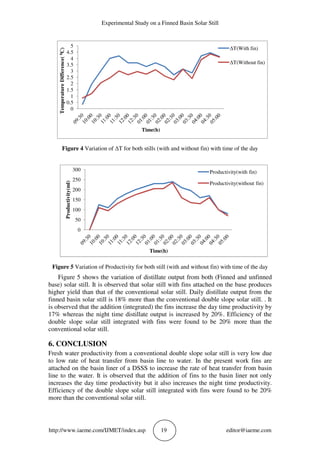
Figure 3. Figure 4 shows the variation of (ΔT) temperature difference between the
water temperature and the glass cover temperature for both stills (with and without
fin). It is observed that the (ΔT) increases with time of the day. (ΔT) is higher for the
finned basin solar still.
Figure 2 Variation of solar intensity with time of the day
Figure 3 Variation of wind velocity with time of the day
0
200
400
600
800
1000
1200
SolarIntensity(w/m2)
Time(h)
0
0.5
1
1.5
2
2.5
WindSpeed(m/s)
Time(h)
Experimental Study on a Finned Basin Solar Still
http://www.iaeme.com/IJMET/index.asp 19 editor@iaeme.com
Figure 4 Variation of ΔT for both stills (with and without fin) with time of the day
Figure 5 Variation of Productivity for both still (with and without fin) with time of the day
Figure 5 shows the variation of distillate output from both (Finned and unfinned
base) solar still. It is observed that solar still with fins attached on the base produces
higher yield than that of the conventional solar still. Daily distillate output from the
finned basin solar still is 18% more than the conventional double slope solar still. . It
is observed that the addition (integrated) the fins increase the day time productivity by
17% whereas the night time distillate output is increased by 20%. Efficiency of the
double slope solar still integrated with fins were found to be 20% more than the
conventional solar still.
6. CONCLUSION
Fresh water productivity from a conventional double slope solar still is very low due
to low rate of heat transfer from basin line to water. In the present work fins are
attached on the basin liner of a DSSS to increase the rate of heat transfer from basin
line to the water. It is observed that the addition of fins to the basin liner not only
increases the day time productivity but it also increases the night time productivity.
Efficiency of the double slope solar still integrated with fins were found to be 20%
more than the conventional solar still.
0
0.5
1
1.5
2
2.5
3
3.5
4
4.5
5
TemperatureDifference(0C)
Time(h)
ΔT(With fin)
ΔT(Without fin)
0
50
100
150
200
250
300
Productivity(ml)
Time(h)
Productivity(with fin)
Productivity(without fin)
Sadhana, Ajeet Kumar Rai, Vivek Sachan and Maheep Kumar
http://www.iaeme.com/IJMET/index.asp 20 editor@iaeme.com
REFERENCES
[1] Duffie, J. A. and Beckman, W. A. Solar Engineering of Thermal Processes, 3rd
ed. New York: Wiley Inderscience, 2006, pp. 5–41, 85–103.
[2] Dunkle, R. V. Solar water distillation: the roof type still and a multiple effect
diffusion still. International Development in Heat Transfer: International Heat
Transfer Conference. University of Colorado, 1961, pp. 895–902 (part 5).
[3] Rai, A. K., Sachan, V. and Kumar, M. Experimental Investigation of a double
slope solar still with a latent heat storage medium. International Journal of
Mechanical Engineering and Technology, 4(1), 2013, pp. 22–29.
[4] Rai, A. K., Singh, N. and Sachan, V. Experimental study of a single basin solar
still with water cooling of the glass cover. International Journal of Mechanical
Engineering and Technology, 4(6), 2013, pp. 1–7.
[5] Malik, M. A. S., Tiwari, G. N., Kumar, A. and Sodha, M. S. Solar Distillation: A
Practical Study of a Wide Range of Stills And Their Optimum Design,
Construction and Performance. Oxford, England: Pergamon Press, 1982.
[6] Singh, A. K., Dr. Rai, A. K. and Sachan, V. Energy and Exergy Analysis of a
Double Slope Solar Still. International Journal of Mechanical Engineering and
Technology, 5(6), 2014, pp. 47–54.
[7] Murugavel, K. K., Chockalingam, Kn. K. S. K. and Srithar, K. Progresses in
improving the effectiveness of the single basin passive solar still Desalination,
220, 2008, pp. 677–686
[8] Singh, P., Dr. Rai, A. K. and Sachan, V. Study of Effect of Condensing Cover
Materials on the Performance of a Solar, Still. International Journal of
Mechanical Engineering and Technology, 5(5), pp. 98–107
[9] Shukla, S. K. and Rai, A. K. Analytical Thermal Modelling of Double Slope
Solar still by Using Inner Glass Cover temperature. Thermal Science, 12(3),
2008, pp. 139–152.
[10] Shukla, S. K. and Rai, A. K. Estimation of Solar Still output Under Indoor
Environment. International Journal of Applied Engineering Research, 5(2), 2010,
pp. 343–350.

Ijmet 06 07_003

  • 1.
    http://www.iaeme.com/IJMET/index.asp 16 editor@iaeme.com InternationalJournal of Mechanical Engineering and Technology (IJMET) Volume 6, Issue 7, Jul 2015, pp. 16-20, Article ID: IJMET_06_07_003 Available online at http://www.iaeme.com/IJMET/issues.asp?JTypeIJMET&VType=6&IType=7 ISSN Print: 0976-6340 and ISSN Online: 0976-6359 © IAEME Publication ___________________________________________________________________________ EXPERIMENTAL STUDY ON A FINNED BASIN SOLAR STILL Sadhana, Ajeet Kumar Rai and Vivek Sachan Department of Mechanical Engineering, SSET, SHIATS Allahabad, U. P. India Maheep Kumar Department of Mechanical Engineering, NIU, Greater Noida ABSTRACT In the present work an attempt has been made to investigate the performance of a finned basin solar shell. For this purpose, two similar double slope solar stills are fabricated. The absorbing plate of one of the solar still is integrated with fins to enhance the rate of heat transfer for basin liner to water, while another still base is flat. It is observed that daily distillate output from the finned basin solar still is 18% more than the conventional double slope solar still. Key words: Solar still, Heat transfer and Finned and unfinned base. Cite this Article: Sadhana, Ajeet Kumar Rai and Vivek Sachan, Maheep Kumar. Experimental Study on a Finned Basin Solar Still. International Journal of Mechanical Engineering and Technology, 6(7), 2015, pp. 16-20. http://www.iaeme.com/IJMET/issues.asp?JTypeIJMET&VType=6&IType=7 _____________________________________________________________________ 1. INTRODUCTION Solar still is a simple, easy to construct, low cost device that can be used to produce potable water from brackish water. It has many features, but the daily productivity from the still is not sufficient to meet the end users need. Over the years, different solar stills has been designed and developed by many researchers. Numerous experiments and theoretical investigation has been carried out to increase the daily productivity of the still. reviewed large variety of systems, both conventional and renewable energy systems, used to convert sea water into potable water. Rai et al [3, 4] have done experimental work on different design of solar still. Shukla et al [9, 10] have used energy storage medium to enhance the productivity of the still. In the present work two similar DSSS has been fabricated to find the effect of adding fins on basin liner.
  • 2.
    Experimental Study ona Finned Basin Solar Still http://www.iaeme.com/IJMET/index.asp 17 editor@iaeme.com 2. EXPERIMENTAL SETUP AND PROCEDURE In this work two solar stills were designed and fabricated to study and compare the performance of the solar desalination systems with and without fins on the base plate. Figure 1 shows the photographs of two similar double slope solar stills kept on a single platform. The first one is a finned still and the second is a conventional still. The height of the fins are 1 cm, and the pitch between two successive fin is taken 0.09 m and kept constant. Fins are made of galvanized iron sheet for its good thermal conductivity and cheeper cost. The basin is covered with 0.05 m thick glass sheet inclined at nearly 26° from horizontal which is the latitude of Allahabad city of Uttar Pradesh in India to maximize the amount of incident solar radiation The tilted glass cover (0.05 m thick) served as solar energy transmitter as well as a condensing surface for the vapor generated in the basin [1, 2]. The stills are made of galvanized iron sheets, with basin area of 0.72 m2 . The whole basin surface are coated with black paint from inside to increase the absorptivity. Also the still is insulated from bottom to side walls with heat armor insulation sheet to reduce the heat loss from the still to ambient [5−8]. The insulation is paste by the Fevicol-909 adhesive. A distillate channel was provided at each end of the basin. Experimental setup is kept in the North South direction to receive maximum solar radiation throughout the year. For the collection of distillate output, a hole was drilled in each of the channels and plastic pipes were fixed through them with an adhesive (Araldite). Figure 1 Photograph of experimental set up 3. PROCEDURE The experiments were conducted in the premises of SHIATS Allahabad, UP, India. All experiments were started at 8:30 AM at local time. Copper-Constantan thermocouples with 1° least count were used to measure the temperature of basin liner, water, glass covers and atmosphere. After a prolong use thermocouples were deviating from their original values. So thermocouples were caliberated using ZEAL thermometer. The distillate output was recorded with the help of a measuring bar with least count 1 ml. The solar intensity was measured with the help of caliberated solarimeter of least count 2 mW/m2 . The effect of use of fin is also studied by comparative analysis.
  • 3.
    Sadhana, Ajeet KumarRai, Vivek Sachan and Maheep Kumar http://www.iaeme.com/IJMET/index.asp 18 editor@iaeme.com 4. PRODUCTIVITY OF SOLAR STILL Energy balance equations are given for the different components of a solar still by Shukla et al [8]. The hourly and daily productivity of solar still is given by the expressions Mewh=hewh(Tw-Tgin)/L (1) Mewd=Σ24hMewh (2) 5. RESULTS AND DISCUSSION Figure 2 shows the variation of solar intensity falling on a particular day on double slope solar still. Since the both the solar stills are kept on the same plateform and their orientations are also the same, solar intensity are also found same. Maximum value of solar intensity is received at 12:30 PM. Variation of wind velocity is also shown in Figure 3. Figure 4 shows the variation of (ΔT) temperature difference between the water temperature and the glass cover temperature for both stills (with and without fin). It is observed that the (ΔT) increases with time of the day. (ΔT) is higher for the finned basin solar still. Figure 2 Variation of solar intensity with time of the day Figure 3 Variation of wind velocity with time of the day 0 200 400 600 800 1000 1200 SolarIntensity(w/m2) Time(h) 0 0.5 1 1.5 2 2.5 WindSpeed(m/s) Time(h)
  • 4.
    Experimental Study ona Finned Basin Solar Still http://www.iaeme.com/IJMET/index.asp 19 editor@iaeme.com Figure 4 Variation of ΔT for both stills (with and without fin) with time of the day Figure 5 Variation of Productivity for both still (with and without fin) with time of the day Figure 5 shows the variation of distillate output from both (Finned and unfinned base) solar still. It is observed that solar still with fins attached on the base produces higher yield than that of the conventional solar still. Daily distillate output from the finned basin solar still is 18% more than the conventional double slope solar still. . It is observed that the addition (integrated) the fins increase the day time productivity by 17% whereas the night time distillate output is increased by 20%. Efficiency of the double slope solar still integrated with fins were found to be 20% more than the conventional solar still. 6. CONCLUSION Fresh water productivity from a conventional double slope solar still is very low due to low rate of heat transfer from basin line to water. In the present work fins are attached on the basin liner of a DSSS to increase the rate of heat transfer from basin line to the water. It is observed that the addition of fins to the basin liner not only increases the day time productivity but it also increases the night time productivity. Efficiency of the double slope solar still integrated with fins were found to be 20% more than the conventional solar still. 0 0.5 1 1.5 2 2.5 3 3.5 4 4.5 5 TemperatureDifference(0C) Time(h) ΔT(With fin) ΔT(Without fin) 0 50 100 150 200 250 300 Productivity(ml) Time(h) Productivity(with fin) Productivity(without fin)
  • 5.
    Sadhana, Ajeet KumarRai, Vivek Sachan and Maheep Kumar http://www.iaeme.com/IJMET/index.asp 20 editor@iaeme.com REFERENCES [1] Duffie, J. A. and Beckman, W. A. Solar Engineering of Thermal Processes, 3rd ed. New York: Wiley Inderscience, 2006, pp. 5–41, 85–103. [2] Dunkle, R. V. Solar water distillation: the roof type still and a multiple effect diffusion still. International Development in Heat Transfer: International Heat Transfer Conference. University of Colorado, 1961, pp. 895–902 (part 5). [3] Rai, A. K., Sachan, V. and Kumar, M. Experimental Investigation of a double slope solar still with a latent heat storage medium. International Journal of Mechanical Engineering and Technology, 4(1), 2013, pp. 22–29. [4] Rai, A. K., Singh, N. and Sachan, V. Experimental study of a single basin solar still with water cooling of the glass cover. International Journal of Mechanical Engineering and Technology, 4(6), 2013, pp. 1–7. [5] Malik, M. A. S., Tiwari, G. N., Kumar, A. and Sodha, M. S. Solar Distillation: A Practical Study of a Wide Range of Stills And Their Optimum Design, Construction and Performance. Oxford, England: Pergamon Press, 1982. [6] Singh, A. K., Dr. Rai, A. K. and Sachan, V. Energy and Exergy Analysis of a Double Slope Solar Still. International Journal of Mechanical Engineering and Technology, 5(6), 2014, pp. 47–54. [7] Murugavel, K. K., Chockalingam, Kn. K. S. K. and Srithar, K. Progresses in improving the effectiveness of the single basin passive solar still Desalination, 220, 2008, pp. 677–686 [8] Singh, P., Dr. Rai, A. K. and Sachan, V. Study of Effect of Condensing Cover Materials on the Performance of a Solar, Still. International Journal of Mechanical Engineering and Technology, 5(5), pp. 98–107 [9] Shukla, S. K. and Rai, A. K. Analytical Thermal Modelling of Double Slope Solar still by Using Inner Glass Cover temperature. Thermal Science, 12(3), 2008, pp. 139–152. [10] Shukla, S. K. and Rai, A. K. Estimation of Solar Still output Under Indoor Environment. International Journal of Applied Engineering Research, 5(2), 2010, pp. 343–350.