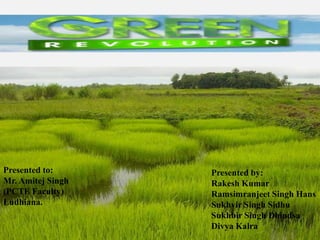


Presented to:      Presented by:
Mr. Amitej Singh   Rakesh Kumar
(PCTE Faculty)     Ramsimranjeet Singh Hans
Ludhiana.          Sukhvir Singh Sidhu
                   Sukhbir Singh Dhindsa
                   Divya Kalra
Contents:
1)    Introduction
2)    Definition of Green Revolution
3)    History of Green Revolution
4)    Methods used in Green Revolution
5)    Basic Elements in Method of Green Revolution
6)    Causes of Green Revolution
7)    Effects of Green Revolution
8)    Result/ Evaluation of Green Revolution
9)    Advantages of Green Revolution
10)   Limitations of Green Revolution
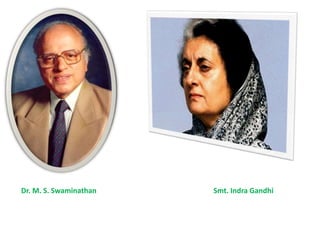
Dr. M. S. Swaminathan   Smt. Indra Gandhi
Green Revolution is also known as
    Seed-Water-Fertilizers-Pesticides-Technology.


• In 1965 the government of Mrs. Indra Gandhi decided to take
  a major step on Agriculture condition.
• Thus "Green Revolution" was applied to the period from 1967
  to 1978 basically in parts of Punjab and Haryana.
• At this stage the Green Revolution was concern only with
  Wheat & Rice.
• Dr. M S Swaminathan from India led the Green Revolution as
  the Project.
Definition:
• J. G. Harrar, “The green revolution is the phrase generally
  used to describe the Spectacular increase that took place
  during 19687-68 and is continuing in the production of food
  grains in India”.
History of Green Revolution:

• The beginnings of the Green Revolution are often attributed to
  Norman Borlaug, an American scientist interested in
  agriculture. In the 1940s, he began conducting research in
  Mexico and developed new disease resistance high-yield
  varieties of wheat.
• Due to the success of the Green Revolution in Mexico, its
  technologies spread worldwide in the 1950s and 1960s.
• The introduction of high-yielding varieties of seeds after 1965
  and the increased use of fertilizers and irrigation provided the
  increase in production which improved agriculture in India.
Methods Used in Green Revolution:

   Double/ Multiple Cropping system
   Seeds with superior genetics
   Proper irrigation system
   High Yielding Variety (HYV) of seeds
   Use of pesticides and fertilizers
   Use of modern machinery (Tractor, Harvester, Thrasher)
   Expansion of farming areas
Basic Elements in Green Revolution:

• Continued expansion of farming areas:
  Green Revolution continued with quantitative expansion of
  farmlands.
• Double-cropping existing farmland:
  Instead of one crop season per year, the decision was made to
  have two crop seasons per year.
  There had to be two "monsoons" per year. One would be the
  natural „monsoon‟ and the other an artificial „monsoon‟.
• Using seeds with superior genetics:
  This was the scientific aspect of the Green Revolution to use
  High Yielding Variety (HVY) of seeds.
Causes of Green Revolution:

   High Yielding Varieties of Seed
   Chemical Fertilizers
   Irrigation
   Multiple Cropping
   Modern Agricultural Machinery
   Credit Facilities
   Agricultural Research
   Plant Protection
   Rural Electrification
   Soil Testing and Soil Conservation
Effects of Green Revolution:

 Increase in Production
 Capitalistic Farming
 Effect on Rural Employment
 Reduction in Imports of food grains
 Development of Industries
 Effect on Prices
 Base for Economic Growth
 Effect on consumers
 Effect on Planning
 Increase in Trade
 Change in Thinking of Farmers
Result/Evaluation of Green Revolution:

1. Statistical Result:
2. Economic Result:
• The increase in irrigation created need of new dams to harness
   monsoon water.
• It boosted industrial growth, created jobs and improved the
   quality of life of the people.
• India paid back all loans taken from the World Bank for the
   purpose of the Green Revolution.

3. Sociological Results:
• The Green Revolution created plenty of jobs not only for
   agricultural workers but also industrial workers by the creation
   of lateral facilities such as factories and hydro-electric power
   stations help to uplift the social as well as the economic
   condition.
4. Other Results:
• India transformed itself from a starving nation to an exporter
  of food. Green Revolution was one factor that made Mrs. Indra
  Gandhi (1917-84) and her party, a very powerful political
  force in India.
• Poorer farmers cannot achieve yields as high as those with
  better access to water, fertilizer and land.
• More people own land, but it is being divided into smaller and
  smaller plots. This is because of population growth and land
  redistribution schemes.
Advantages of Green Revolution:

1. Yields increased three times.
2. Multiple cropping.
3. Other crops grown which varied the diet.
4. Surplus to sell in cities creating a profit improving the
   standard of living.
5. Allows purchase of fertilizers, machinery etc.
6. India becomes self sufficient in food grains.
Limitations of Green Revolution:

1. The Green Revolution, howsoever impressive, but NOT a
   100% success.
2. Only Punjab and Haryana states showed best results of Green
   Revolution.
3. The new farming techniques, has given birth to the serious
   pollution of drinking water causing cancer and other diseases.
4. A recent Punjabi University study found a high rate of
   genetic damage among farmers, which was attributed to
   pesticide use.
5. The new organic fertilizer, pesticides and chemicals are
   ruining the soil.
6. Lead to unemployment and Rural-Urban Immigration.
Need for Second Green Revolution:


 The time is now ripe for Second Green Revolution.
 India has tremendous export potential in agriculture in present
   era of globalization.
 In Second Green Revolution emphasis should be laid on:
1. Non food grains
2. Improving global market opportunities
3. Improving rural infrastructure
4. Improving irrigation, rural roads and rural electrification.
Conclusion:

• As a technological innovation, the Green Revolution replaced
  “one way of life in another in short span of two decades”.
• The lesson learned from this green revolution should enable
  policy makers to reduce the adverse effects of the coming
  Biorevolution based on genetic engineering.
Green revolution India

Green revolution India

  • 1.
    Presented to: Presented by: Mr. Amitej Singh Rakesh Kumar (PCTE Faculty) Ramsimranjeet Singh Hans Ludhiana. Sukhvir Singh Sidhu Sukhbir Singh Dhindsa Divya Kalra
  • 2.
    Contents: 1) Introduction 2) Definition of Green Revolution 3) History of Green Revolution 4) Methods used in Green Revolution 5) Basic Elements in Method of Green Revolution 6) Causes of Green Revolution 7) Effects of Green Revolution 8) Result/ Evaluation of Green Revolution 9) Advantages of Green Revolution 10) Limitations of Green Revolution
  • 3.
    Dr. M. S.Swaminathan Smt. Indra Gandhi
  • 4.
    Green Revolution isalso known as Seed-Water-Fertilizers-Pesticides-Technology. • In 1965 the government of Mrs. Indra Gandhi decided to take a major step on Agriculture condition. • Thus "Green Revolution" was applied to the period from 1967 to 1978 basically in parts of Punjab and Haryana. • At this stage the Green Revolution was concern only with Wheat & Rice. • Dr. M S Swaminathan from India led the Green Revolution as the Project.
  • 5.
    Definition: • J. G.Harrar, “The green revolution is the phrase generally used to describe the Spectacular increase that took place during 19687-68 and is continuing in the production of food grains in India”.
  • 7.
    History of GreenRevolution: • The beginnings of the Green Revolution are often attributed to Norman Borlaug, an American scientist interested in agriculture. In the 1940s, he began conducting research in Mexico and developed new disease resistance high-yield varieties of wheat. • Due to the success of the Green Revolution in Mexico, its technologies spread worldwide in the 1950s and 1960s. • The introduction of high-yielding varieties of seeds after 1965 and the increased use of fertilizers and irrigation provided the increase in production which improved agriculture in India.
  • 8.
    Methods Used inGreen Revolution:  Double/ Multiple Cropping system  Seeds with superior genetics  Proper irrigation system  High Yielding Variety (HYV) of seeds  Use of pesticides and fertilizers  Use of modern machinery (Tractor, Harvester, Thrasher)  Expansion of farming areas
  • 9.
    Basic Elements inGreen Revolution: • Continued expansion of farming areas: Green Revolution continued with quantitative expansion of farmlands. • Double-cropping existing farmland: Instead of one crop season per year, the decision was made to have two crop seasons per year. There had to be two "monsoons" per year. One would be the natural „monsoon‟ and the other an artificial „monsoon‟. • Using seeds with superior genetics: This was the scientific aspect of the Green Revolution to use High Yielding Variety (HVY) of seeds.
  • 10.
    Causes of GreenRevolution:  High Yielding Varieties of Seed  Chemical Fertilizers  Irrigation  Multiple Cropping  Modern Agricultural Machinery  Credit Facilities  Agricultural Research  Plant Protection  Rural Electrification  Soil Testing and Soil Conservation
  • 11.
    Effects of GreenRevolution:  Increase in Production  Capitalistic Farming  Effect on Rural Employment  Reduction in Imports of food grains  Development of Industries  Effect on Prices  Base for Economic Growth  Effect on consumers  Effect on Planning  Increase in Trade  Change in Thinking of Farmers
  • 12.
    Result/Evaluation of GreenRevolution: 1. Statistical Result:
  • 13.
    2. Economic Result: •The increase in irrigation created need of new dams to harness monsoon water. • It boosted industrial growth, created jobs and improved the quality of life of the people. • India paid back all loans taken from the World Bank for the purpose of the Green Revolution. 3. Sociological Results: • The Green Revolution created plenty of jobs not only for agricultural workers but also industrial workers by the creation of lateral facilities such as factories and hydro-electric power stations help to uplift the social as well as the economic condition.
  • 14.
    4. Other Results: •India transformed itself from a starving nation to an exporter of food. Green Revolution was one factor that made Mrs. Indra Gandhi (1917-84) and her party, a very powerful political force in India. • Poorer farmers cannot achieve yields as high as those with better access to water, fertilizer and land. • More people own land, but it is being divided into smaller and smaller plots. This is because of population growth and land redistribution schemes.
  • 15.
    Advantages of GreenRevolution: 1. Yields increased three times. 2. Multiple cropping. 3. Other crops grown which varied the diet. 4. Surplus to sell in cities creating a profit improving the standard of living. 5. Allows purchase of fertilizers, machinery etc. 6. India becomes self sufficient in food grains.
  • 16.
    Limitations of GreenRevolution: 1. The Green Revolution, howsoever impressive, but NOT a 100% success. 2. Only Punjab and Haryana states showed best results of Green Revolution. 3. The new farming techniques, has given birth to the serious pollution of drinking water causing cancer and other diseases. 4. A recent Punjabi University study found a high rate of genetic damage among farmers, which was attributed to pesticide use. 5. The new organic fertilizer, pesticides and chemicals are ruining the soil. 6. Lead to unemployment and Rural-Urban Immigration.
  • 18.
    Need for SecondGreen Revolution:  The time is now ripe for Second Green Revolution.  India has tremendous export potential in agriculture in present era of globalization.  In Second Green Revolution emphasis should be laid on: 1. Non food grains 2. Improving global market opportunities 3. Improving rural infrastructure 4. Improving irrigation, rural roads and rural electrification.
  • 19.
    Conclusion: • As atechnological innovation, the Green Revolution replaced “one way of life in another in short span of two decades”. • The lesson learned from this green revolution should enable policy makers to reduce the adverse effects of the coming Biorevolution based on genetic engineering.