PAILLIER CRYPTOSYSTEM
Dejan Radić
HOMOMORPHIC ENCRYPTION
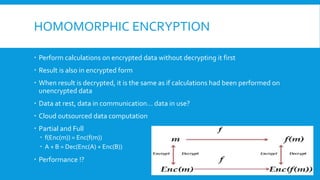
 Perform calculations on encrypted data without decrypting it first
 Result is also in encrypted form
 When result is decrypted, it is the same as if calculations had been performed on
unencrypted data
 Data at rest, data in communication… data in use?
 Cloud outsourced data computation
 Partial and Full
 f(Enc(m)) = Enc(f(m))
 A + B = Dec(Enc(A) + Enc(B))
 Performance !?
BACKGROUND INFO
 Pascal Paillier
 1999
 Public-Key Cryptosystems Based on Composite Degree Residuosity Classes
 Public-Key !?
 Comparable to RSA
 A
 Ciphertext addition
 Multiplication of ciphertext by plaintext
GREATEST COMMON DIVISOR - GCD
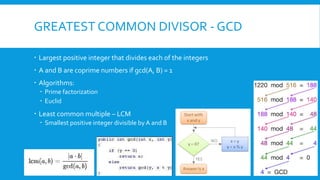
 Largest positive integer that divides each of the integers
 A and B are coprime numbers if gcd(A, B) = 1
 Algorithms:
 Prime factorization
 Euclid
 Least common multiple – LCM
 Smallest positive integer divisible by A and B
BIG MOD ALGORITHM
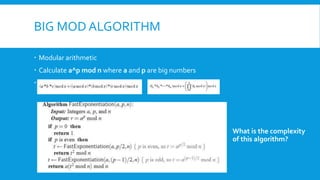
 Modular arithmetic
 Calculate a^p mod n where a and p are big numbers
 Overflow !?
What is the complexity
of this algorithm?
MODULAR MULTIPLICATIVE INVERSE
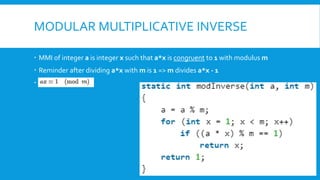
 MMI of integer a is integer x such that a*x is congruent to 1 with modulus m
 Reminder after dividing a*x with m is 1 => m divides a*x - 1
 A
BIG INTEGER
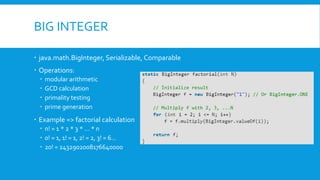
 java.math.BigInteger, Serializable, Comparable
 Operations:
 modular arithmetic
 GCD calculation
 primality testing
 prime generation
 Example => factorial calculation
 n! = 1 * 2 * 3 * … * n
 0! = 1, 1! = 1, 2! = 2, 3! = 6…
 20! = 2432902008176640000
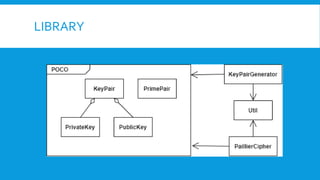
LIBRARY
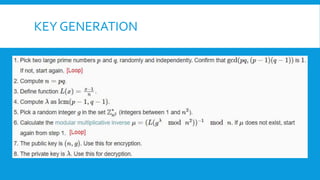
KEY GENERATION
ENCRYPTION
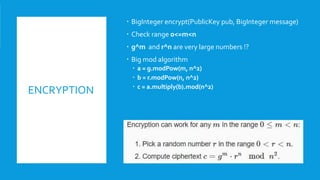
 BigInteger encrypt(PublicKey pub, BigInteger message)
 Check range 0<=m<n
 g^m and r^n are very large numbers !?
 Big mod algorithm
 a = g.modPow(m, n^2)
 b = r.modPow(n, n^2)
 c = a.multiply(b).mod(n^2)
DECRYPTION
 BigInteger decrypt(KeyPair kp, BigInteger c)
 Both private and public key needed => KeyPair
 Check range 0<c<n^2
 Recalculation => reason why Util class exists
 Lambda is part of private key
HOMOMORPHIC PROPERTIES
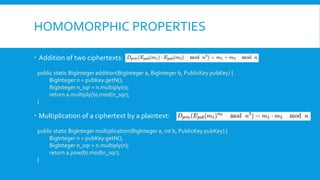
 Addition of two ciphertexts:
public static BigInteger addition(BigInteger a, BigInteger b, PublicKey pubKey) {
BigInteger n = pubKey.getN();
BigInteger n_sqr = n.multiply(n);
return a.multiply(b).mod(n_sqr);
}
 Multiplication of a ciphertext by a plaintext:
public static BigInteger multiplication(BigInteger a, int b, PublicKey pubKey) {
BigInteger n = pubKey.getN();
BigInteger n_sqr = n.multiply(n);
return a.pow(b).mod(n_sqr);
}
OBLIVIOUS AGGREGATE QUERY USE CASE
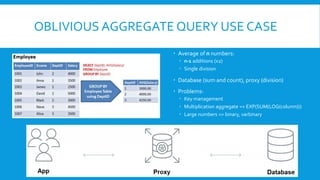
 Average of n numbers:
 n-1 additions (x2)
 Single division
 Database (sum and count), proxy (division)
 Problems:
 Key management
 Multiplication aggregate => EXP(SUM(LOG(column)))
 Large numbers => binary, varbinary
HOW TO CODE DECIMALS
INSTEAD OF INTEGERS?
QUESTIONS ?
Thank you for your attention!

Paillier Cryptosystem

  • 1.
  • 2.
    HOMOMORPHIC ENCRYPTION  Performcalculations on encrypted data without decrypting it first  Result is also in encrypted form  When result is decrypted, it is the same as if calculations had been performed on unencrypted data  Data at rest, data in communication… data in use?  Cloud outsourced data computation  Partial and Full  f(Enc(m)) = Enc(f(m))  A + B = Dec(Enc(A) + Enc(B))  Performance !?
  • 4.
    BACKGROUND INFO  PascalPaillier  1999  Public-Key Cryptosystems Based on Composite Degree Residuosity Classes  Public-Key !?  Comparable to RSA  A  Ciphertext addition  Multiplication of ciphertext by plaintext
  • 5.
    GREATEST COMMON DIVISOR- GCD  Largest positive integer that divides each of the integers  A and B are coprime numbers if gcd(A, B) = 1  Algorithms:  Prime factorization  Euclid  Least common multiple – LCM  Smallest positive integer divisible by A and B
  • 6.
    BIG MOD ALGORITHM Modular arithmetic  Calculate a^p mod n where a and p are big numbers  Overflow !? What is the complexity of this algorithm?
  • 7.
    MODULAR MULTIPLICATIVE INVERSE MMI of integer a is integer x such that a*x is congruent to 1 with modulus m  Reminder after dividing a*x with m is 1 => m divides a*x - 1  A
  • 8.
    BIG INTEGER  java.math.BigInteger,Serializable, Comparable  Operations:  modular arithmetic  GCD calculation  primality testing  prime generation  Example => factorial calculation  n! = 1 * 2 * 3 * … * n  0! = 1, 1! = 1, 2! = 2, 3! = 6…  20! = 2432902008176640000
  • 9.
  • 10.
  • 11.
    ENCRYPTION  BigInteger encrypt(PublicKeypub, BigInteger message)  Check range 0<=m<n  g^m and r^n are very large numbers !?  Big mod algorithm  a = g.modPow(m, n^2)  b = r.modPow(n, n^2)  c = a.multiply(b).mod(n^2)
  • 12.
    DECRYPTION  BigInteger decrypt(KeyPairkp, BigInteger c)  Both private and public key needed => KeyPair  Check range 0<c<n^2  Recalculation => reason why Util class exists  Lambda is part of private key
  • 13.
    HOMOMORPHIC PROPERTIES  Additionof two ciphertexts: public static BigInteger addition(BigInteger a, BigInteger b, PublicKey pubKey) { BigInteger n = pubKey.getN(); BigInteger n_sqr = n.multiply(n); return a.multiply(b).mod(n_sqr); }  Multiplication of a ciphertext by a plaintext: public static BigInteger multiplication(BigInteger a, int b, PublicKey pubKey) { BigInteger n = pubKey.getN(); BigInteger n_sqr = n.multiply(n); return a.pow(b).mod(n_sqr); }
  • 14.
    OBLIVIOUS AGGREGATE QUERYUSE CASE  Average of n numbers:  n-1 additions (x2)  Single division  Database (sum and count), proxy (division)  Problems:  Key management  Multiplication aggregate => EXP(SUM(LOG(column)))  Large numbers => binary, varbinary
  • 15.
    HOW TO CODEDECIMALS INSTEAD OF INTEGERS?
  • 16.
    QUESTIONS ? Thank youfor your attention!