NTCP-DiamondApproach
Presented by,
Rakshit Sood – RP17010
Deependra Kumar-RP17027
Shubham Chaudhari-RP17028
Ganapathi V Sabhahit-RP17030
Hitesh Valecha-RP17038
Introduction
• Modern project managers are aware that different types of
projects need different styles of project management.
• Despite modern technological advances, many projects
today are destined to fail.
• “Project Success” is an elusive concept.
• The realization that different projects need different types
of project management in order to succeed has started to
sink in.
• In 2007, Novelty, Technology, Complexity, and
Pace(NTCP) “diamond” framework presented by Shenhar
and Dvir emerged as one of the most eloquent theories.
What is NTCP-Diamond Model?
• It is a model to analyse the success of projects in multiple
dimensions.
• It takes into account the degree of project performance and
the contribution made to the business strategy.
• This approach is also useful to evaluate a project on the way,
identify possible gaps in troubled project and select the
corrective measures to put the project back on track.
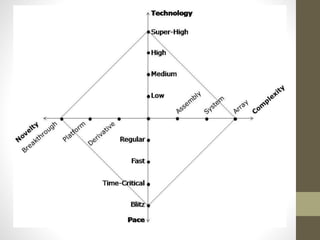
Dimensions of a “Diamond”:-
The categorization of projects is established on initial
characteristics of project, based on the four independent
dimensions comprised in the NTCP acronym.
The four diamond dimensions are defined as follows:
• Novelty: How new the product is to the customers and to the
market?
• Technology: The extent of use of new or even non-existing
technology at the time of project initiation.
• Complexity: Determines the degree of system’s complexity
for achieving the project outcomes.
• Pace: How urgent the project is at the time of initiation; the
criticality of the project’s completion time.
How to use the “Diamond”?
• The NTCP model allows the correct management approach
projects selection still in the planning phase.
• It allows the comparison between the current model of
management and what is actually required for the project.
• Such gaps are easily visualized through graphs.
• The use of NCTP allows more precise sources’ analysis of
risk by dividing the risk of separable and measurable
components.
• One can see that as larger is the diamond, greater is the risks
involved.
• Thus, a numerical scale associated with each dimension can
be created in order to define which projects have a higher
level of risk and which dimensions should be the treatment
of prioritized risks.
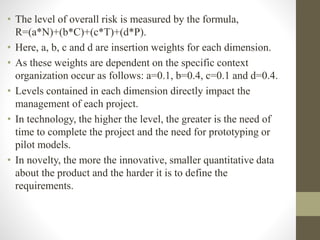
• The level of overall risk is measured by the formula,
R=(a*N)+(b*C)+(c*T)+(d*P).
• Here, a, b, c and d are insertion weights for each dimension.
• As these weights are dependent on the specific context
organization occur as follows: a=0.1, b=0.4, c=0.1 and d=0.4.
• Levels contained in each dimension directly impact the
management of each project.
• In technology, the higher the level, the greater is the need of
time to complete the project and the need for prototyping or
pilot models.
• In novelty, the more the innovative, smaller quantitative data
about the product and the harder it is to define the
requirements.
• Regarding the complexity, increasing it requires a better
formalization of the processes and activities of the
organization for the smooth project progress.
• Finally, the more rapid the rate, the greater the need for
autonomy of the team.
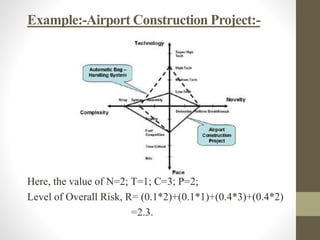
Example:-Airport Construction Project:-
Here, the value of N=2; T=1; C=3; P=2;
Level of Overall Risk, R= (0.1*2)+(0.1*1)+(0.4*3)+(0.4*2)
=2.3.
Example Continuation:-
Area= 0.5(TN+TC+NP+PC)
= 0.5(1*2+1*3+2*2+2*3)
= 7.5
Hence, the project scope can be rated as Complex.
The project scope can be rated according to area under curve
analogy which classifies project scopes as:
Critical: Area is above 12.
Complex: Area is between 7 & 12.
Simple: Area is below 7.
Discussions:-
In resource management:
• Simple means the resources deployed may be relatively
inexperienced and need not require functional expertise.
• Complex means the resources deployed should be relatively
experienced in similar projects and external functional expert
should be consulted whenever required.
• Critical means the resources deployed should be highly
experienced in a similar project execution and a highly
functional expert should be present in the core team.
Similarly the scope definition varies based on different
classifications such as performance management, Process
management and so on and with the help of this a clear idea
about how to manage a project can be known.
Conclusion:-
• NTCP diamond concept of project classification seems to be
a very effective tool for evaluation and classification of
R&D based projects.
• If all the factors of the NTCP diamond assume equal
weightage, Area under the curve is the best mathematical
model for the classification.
• The main demerit of this model is that the pace rating
method needs to be a bit more subjective to effectively
assign the levels of classification.
THANK YOU!!!

Diamond approach

  • 1.
    NTCP-DiamondApproach Presented by, Rakshit Sood– RP17010 Deependra Kumar-RP17027 Shubham Chaudhari-RP17028 Ganapathi V Sabhahit-RP17030 Hitesh Valecha-RP17038
  • 2.
    Introduction • Modern projectmanagers are aware that different types of projects need different styles of project management. • Despite modern technological advances, many projects today are destined to fail. • “Project Success” is an elusive concept. • The realization that different projects need different types of project management in order to succeed has started to sink in. • In 2007, Novelty, Technology, Complexity, and Pace(NTCP) “diamond” framework presented by Shenhar and Dvir emerged as one of the most eloquent theories.
  • 3.
    What is NTCP-DiamondModel? • It is a model to analyse the success of projects in multiple dimensions. • It takes into account the degree of project performance and the contribution made to the business strategy. • This approach is also useful to evaluate a project on the way, identify possible gaps in troubled project and select the corrective measures to put the project back on track.
  • 4.
    Dimensions of a“Diamond”:- The categorization of projects is established on initial characteristics of project, based on the four independent dimensions comprised in the NTCP acronym. The four diamond dimensions are defined as follows: • Novelty: How new the product is to the customers and to the market? • Technology: The extent of use of new or even non-existing technology at the time of project initiation. • Complexity: Determines the degree of system’s complexity for achieving the project outcomes. • Pace: How urgent the project is at the time of initiation; the criticality of the project’s completion time.
  • 6.
    How to usethe “Diamond”? • The NTCP model allows the correct management approach projects selection still in the planning phase. • It allows the comparison between the current model of management and what is actually required for the project. • Such gaps are easily visualized through graphs. • The use of NCTP allows more precise sources’ analysis of risk by dividing the risk of separable and measurable components. • One can see that as larger is the diamond, greater is the risks involved. • Thus, a numerical scale associated with each dimension can be created in order to define which projects have a higher level of risk and which dimensions should be the treatment of prioritized risks.
  • 7.
    • The levelof overall risk is measured by the formula, R=(a*N)+(b*C)+(c*T)+(d*P). • Here, a, b, c and d are insertion weights for each dimension. • As these weights are dependent on the specific context organization occur as follows: a=0.1, b=0.4, c=0.1 and d=0.4. • Levels contained in each dimension directly impact the management of each project. • In technology, the higher the level, the greater is the need of time to complete the project and the need for prototyping or pilot models. • In novelty, the more the innovative, smaller quantitative data about the product and the harder it is to define the requirements.
  • 8.
    • Regarding thecomplexity, increasing it requires a better formalization of the processes and activities of the organization for the smooth project progress. • Finally, the more rapid the rate, the greater the need for autonomy of the team.
  • 9.
    Example:-Airport Construction Project:- Here,the value of N=2; T=1; C=3; P=2; Level of Overall Risk, R= (0.1*2)+(0.1*1)+(0.4*3)+(0.4*2) =2.3.
  • 10.
    Example Continuation:- Area= 0.5(TN+TC+NP+PC) =0.5(1*2+1*3+2*2+2*3) = 7.5 Hence, the project scope can be rated as Complex. The project scope can be rated according to area under curve analogy which classifies project scopes as: Critical: Area is above 12. Complex: Area is between 7 & 12. Simple: Area is below 7.
  • 11.
    Discussions:- In resource management: •Simple means the resources deployed may be relatively inexperienced and need not require functional expertise. • Complex means the resources deployed should be relatively experienced in similar projects and external functional expert should be consulted whenever required. • Critical means the resources deployed should be highly experienced in a similar project execution and a highly functional expert should be present in the core team. Similarly the scope definition varies based on different classifications such as performance management, Process management and so on and with the help of this a clear idea about how to manage a project can be known.
  • 12.
    Conclusion:- • NTCP diamondconcept of project classification seems to be a very effective tool for evaluation and classification of R&D based projects. • If all the factors of the NTCP diamond assume equal weightage, Area under the curve is the best mathematical model for the classification. • The main demerit of this model is that the pace rating method needs to be a bit more subjective to effectively assign the levels of classification.
  • 13.