Traditional Project management
VS
Agile Project Management
Presented by :-
Khairnar Akshay 8830437088
Course Name :Software Project Management
Agenda
• Traditional Methodologies
• Agile Methodologies
• Compare and contrast
• Which one to choose ?
• Traditional Methodologies
Traditional project management is a step-by-step predictive approach.
Traditional project management (Waterfall Methodology) is a linear approach where processes
occur in a predictable sequence. In this approach, the project follows a preplanned set of stages and
assumes that the requirements remain fixed while the budget and project timeline can be changed.
traditional project management heavily relies on proper planning and analysis in the development
phase, the resulting development process is quite streamlined
In traditional project management, projects are clearly defined beforehand and it focuses on having
formal processes and extensive documentation, with minimum customer involvement.
• Agile Methodologies
Agile project management is an iterative approach to project management that primarily
focuses on customer feedback, flexibility and effective collaboration between team members.
Agile allows project teams to be more flexible and ensure that the final product is according to
the customer’s standards.
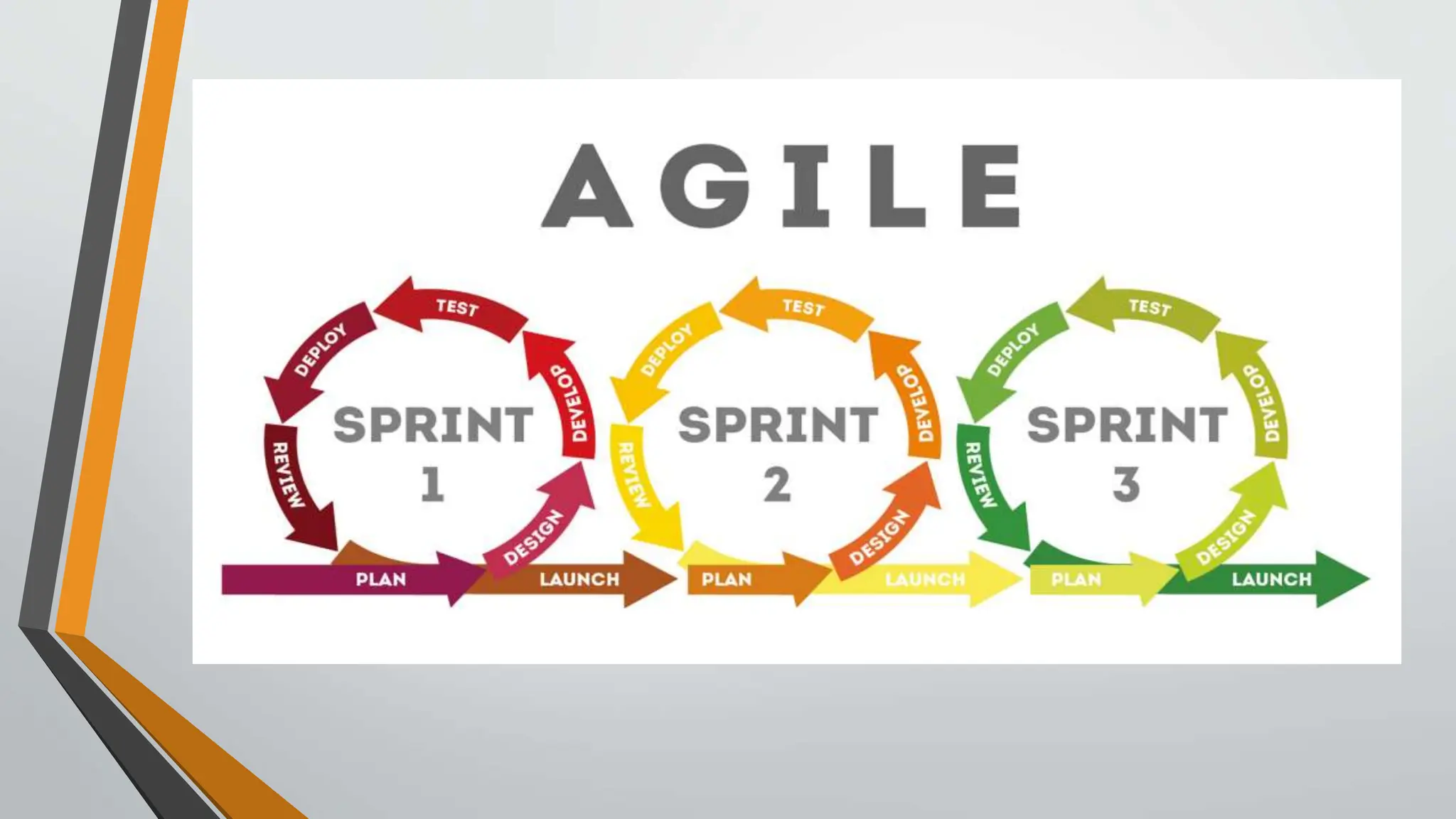
The agile framework divides the project into smaller time-boxed sprints that commonly last for
2 weeks.
There is no predefine plan. All work starts at the same time when projects starts.
customers are also involved throughout the project and their feedback is taken into account for
an acceptable final product.
• Compare and contrast
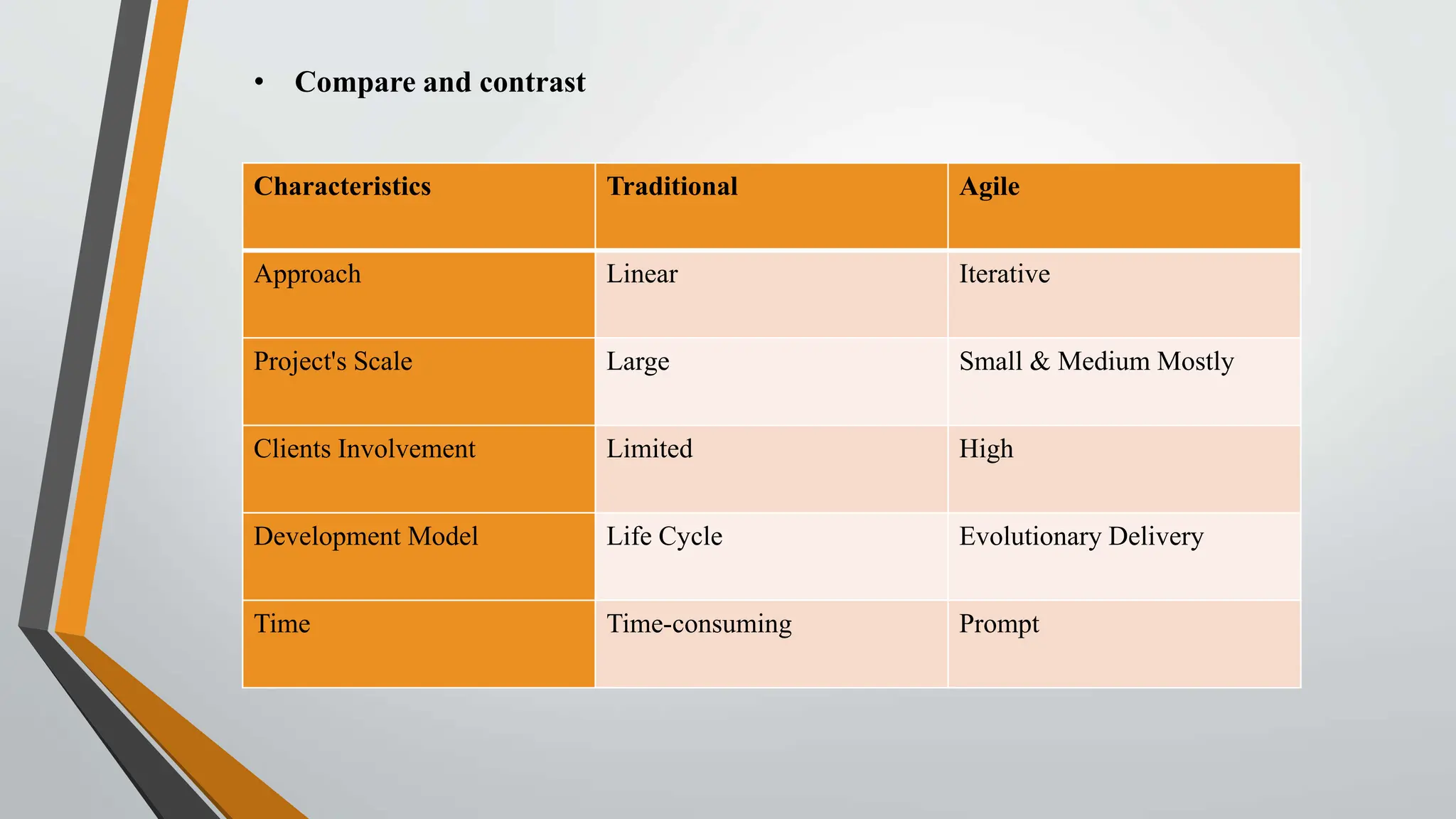
Characteristics Traditional Agile
Approach Linear Iterative
Project's Scale Large Small & Medium Mostly
Clients Involvement Limited High
Development Model Life Cycle Evolutionary Delivery
Time Time-consuming Prompt
• Compare and contrast
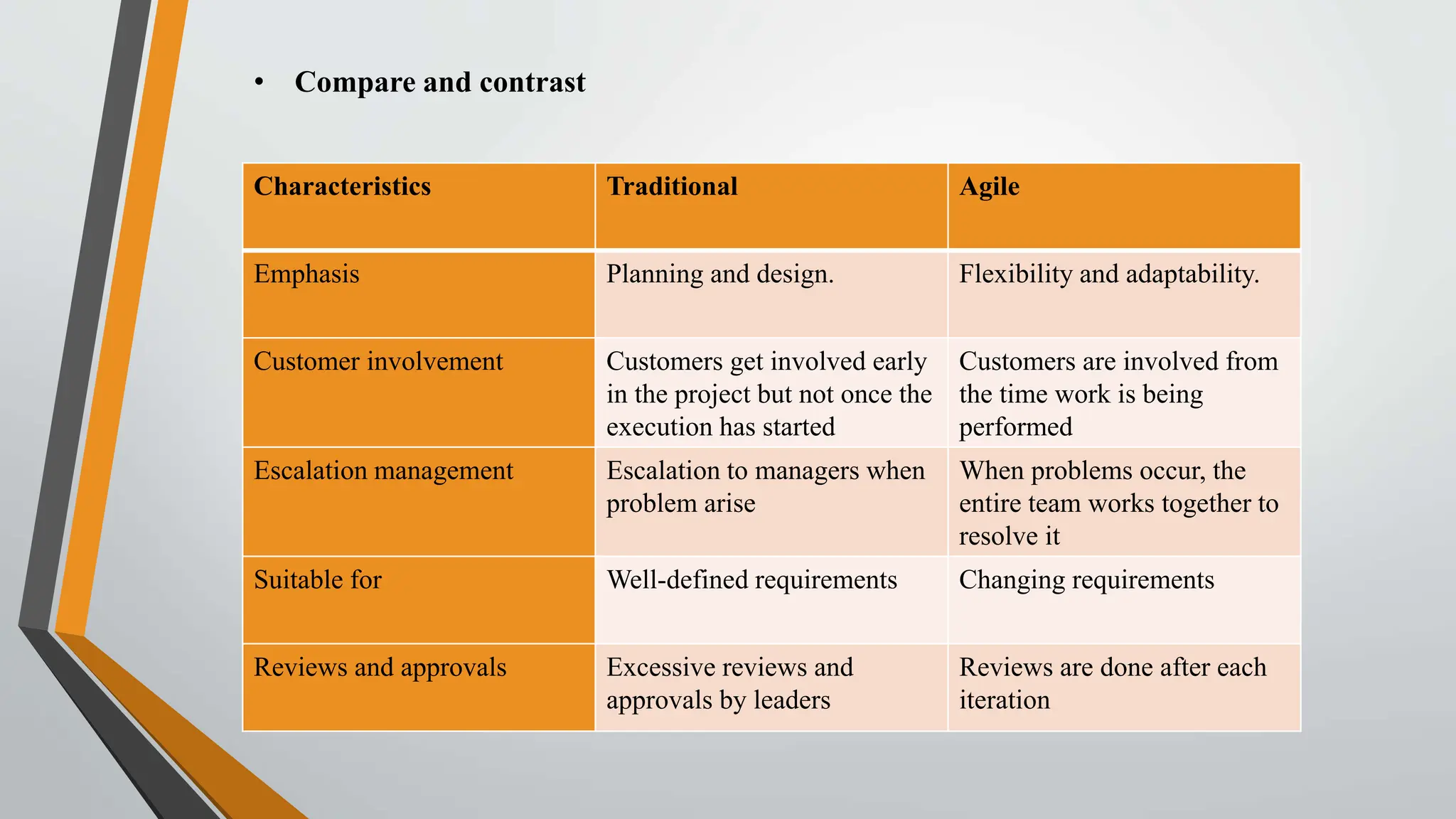
Characteristics Traditional Agile
Emphasis Planning and design. Flexibility and adaptability.
Customer involvement Customers get involved early
in the project but not once the
execution has started
Customers are involved from
the time work is being
performed
Escalation management Escalation to managers when
problem arise
When problems occur, the
entire team works together to
resolve it
Suitable for Well-defined requirements Changing requirements
Reviews and approvals Excessive reviews and
approvals by leaders
Reviews are done after each
iteration
• Compare and contrast
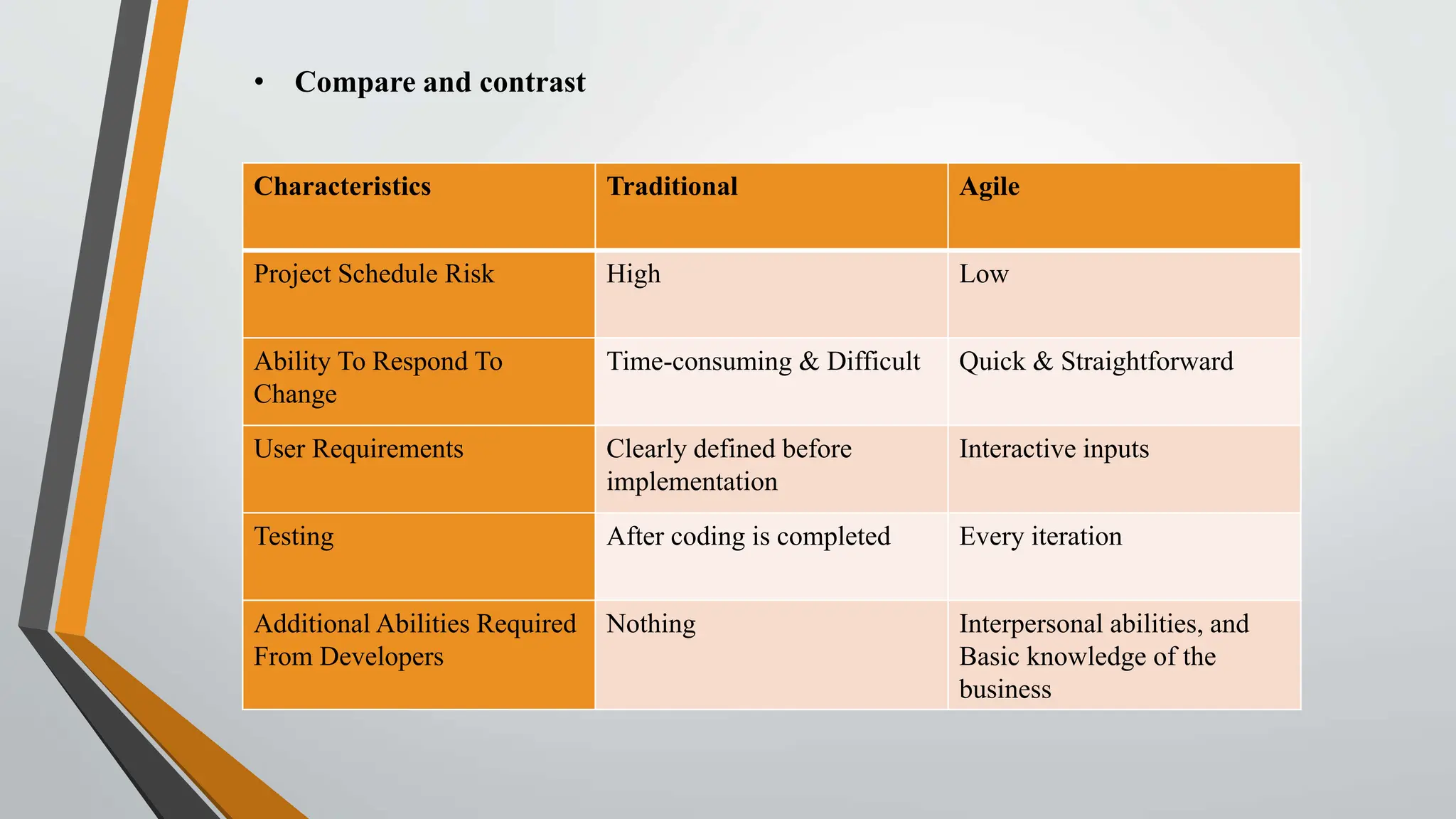
Characteristics Traditional Agile
Project Schedule Risk High Low
Ability To Respond To
Change
Time-consuming & Difficult Quick & Straightforward
User Requirements Clearly defined before
implementation
Interactive inputs
Testing After coding is completed Every iteration
Additional Abilities Required
From Developers
Nothing Interpersonal abilities, and
Basic knowledge of the
business
• Compare and contrast
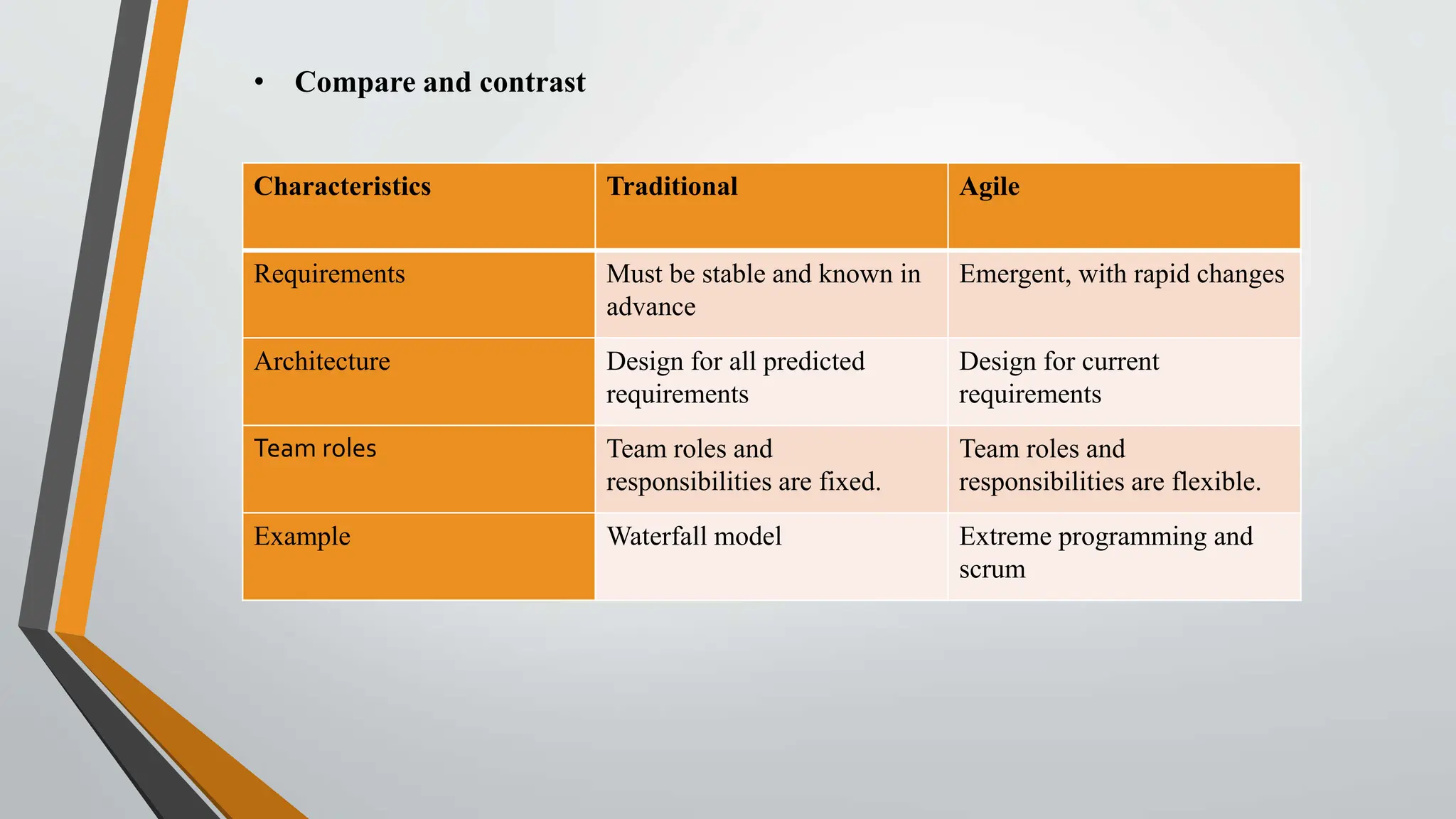
Characteristics Traditional Agile
Requirements Must be stable and known in
advance
Emergent, with rapid changes
Architecture Design for all predicted
requirements
Design for current
requirements
Team roles Team roles and
responsibilities are fixed.
Team roles and
responsibilities are flexible.
Example Waterfall model Extreme programming and
scrum
29%
14%
57%
Traditional
Succesfull
Faild
Challanged
9%
42%
49%
AGILE
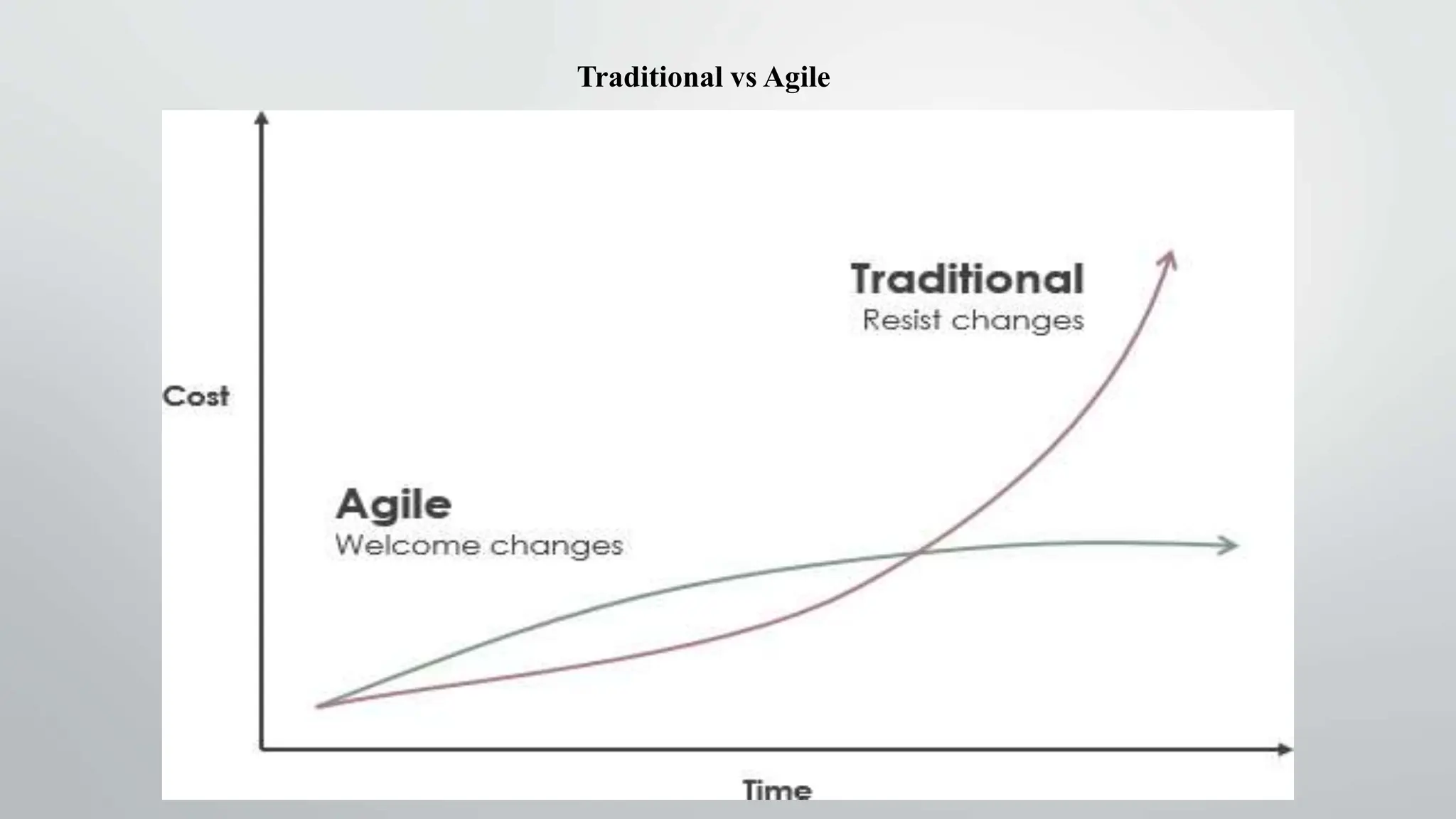
Traditional vs Agile
Productivity
Agile methods productivity is 20X more than traditional
Rico, D. F., Sayani, H. H., & Sone, S. (2009). The business value of agile methods. Ft. Lauderdale, FL: J. Ross Publishir
• Quality of Agile methods
Agile method quality 5X better than Traditional
Rico, D. F., Sayani, H. H., & Sone, S. (2009). The business value of agile methods. Ft. Lauderdale, FL: J. Ross Publishir
• Cost of Agile methods
Agile cost is 2X less than Traditional cost.
Rico, D. F., Sayani, H. H., & Sone, S. (2009). The business value of agile methods. Ft. Lauderdale, FL: J. Ross Publishir
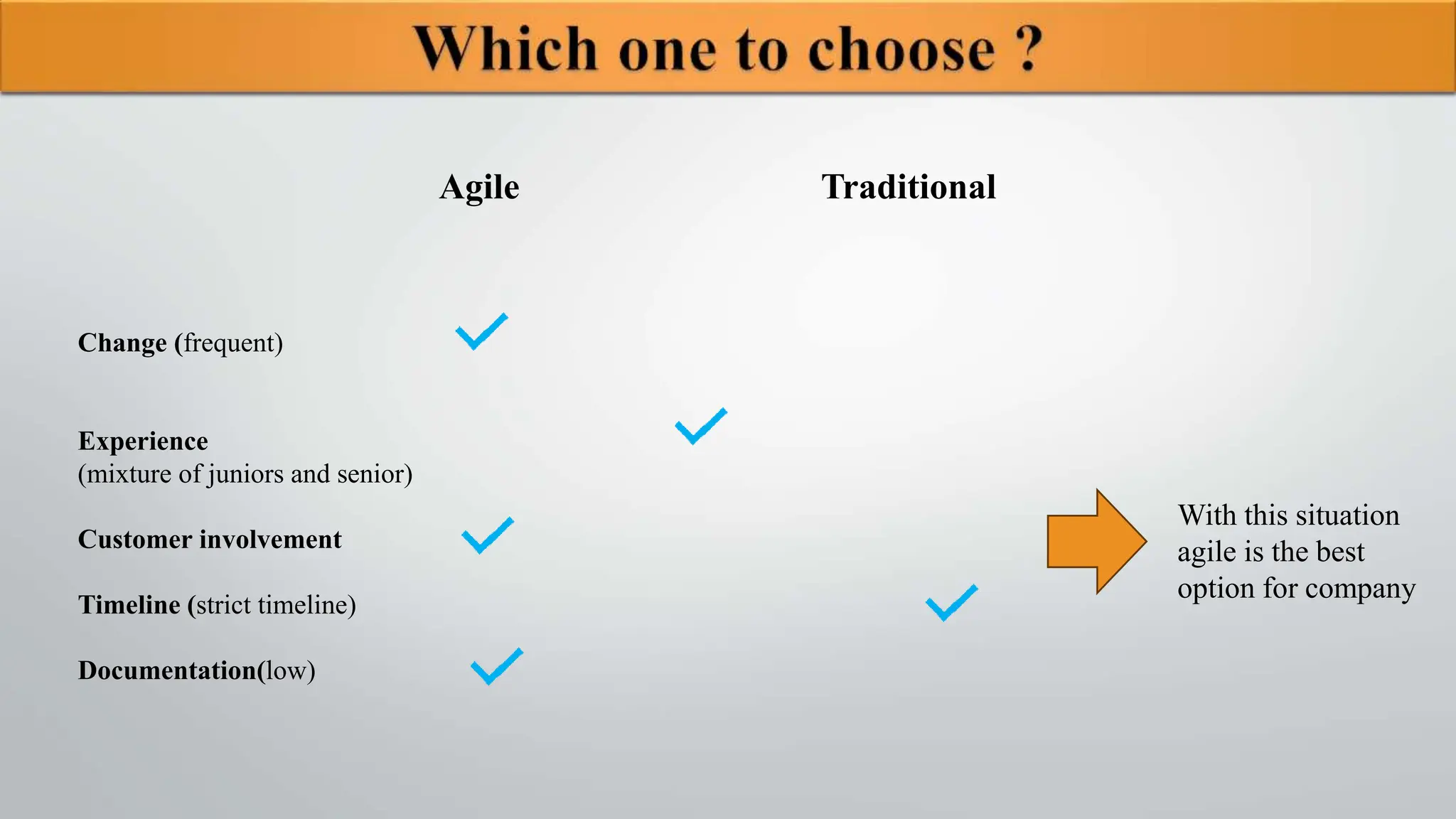
Agile Traditional
Change (frequent)
Experience
(mixture of juniors and senior)
Customer involvement
Timeline (strict timeline)
Documentation(low)
With this situation
agile is the best
option for company
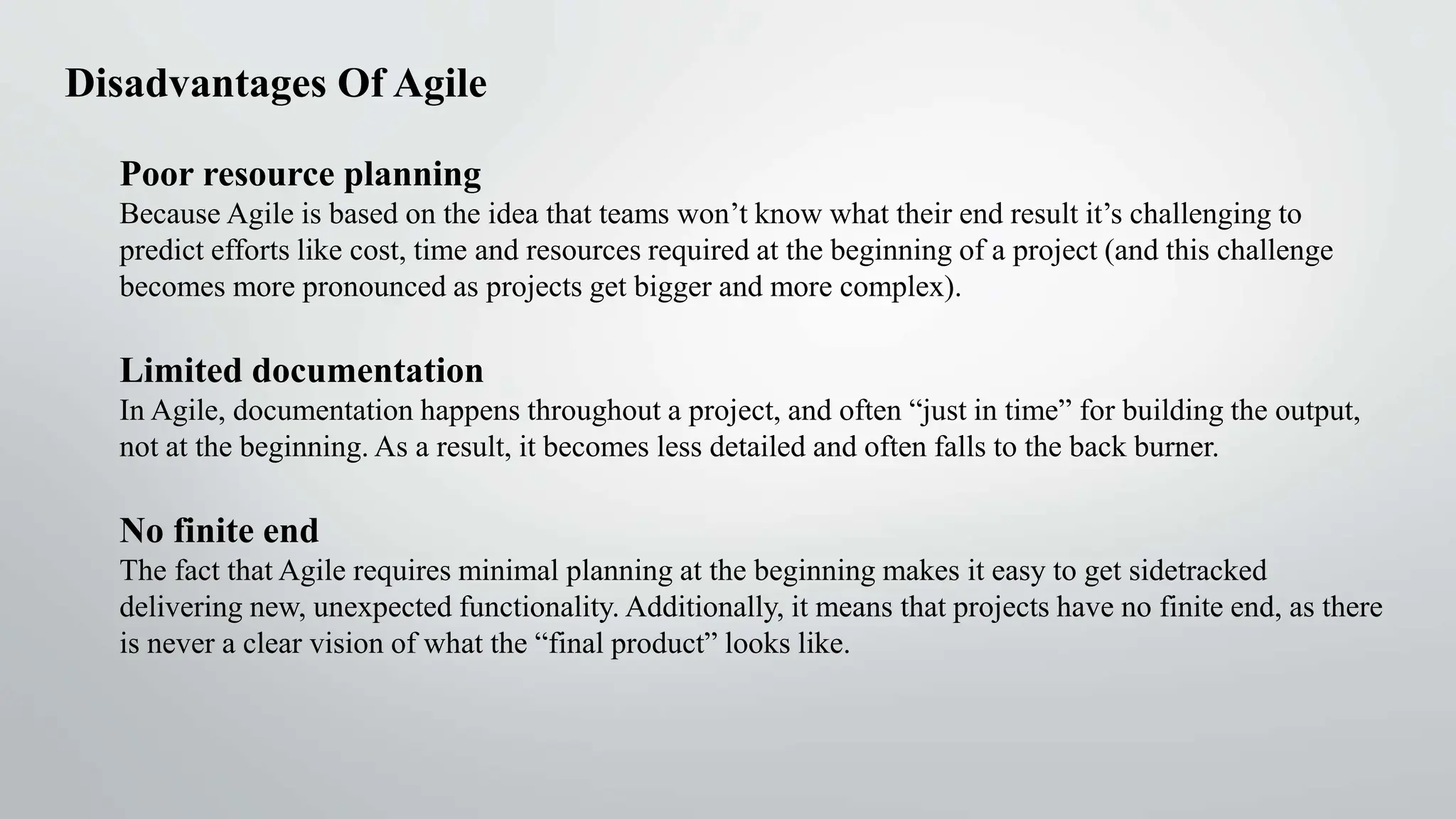
Disadvantages Of Agile
Poor resource planning
Because Agile is based on the idea that teams won’t know what their end result it’s challenging to
predict efforts like cost, time and resources required at the beginning of a project (and this challenge
becomes more pronounced as projects get bigger and more complex).
Limited documentation
In Agile, documentation happens throughout a project, and often “just in time” for building the output,
not at the beginning. As a result, it becomes less detailed and often falls to the back burner.
No finite end
The fact that Agile requires minimal planning at the beginning makes it easy to get sidetracked
delivering new, unexpected functionality. Additionally, it means that projects have no finite end, as there
is never a clear vision of what the “final product” looks like.
Traditional Project management vs Agile project management.pptx

Traditional Project management vs Agile project management.pptx

  • 1.
    Traditional Project management VS AgileProject Management Presented by :- Khairnar Akshay 8830437088 Course Name :Software Project Management
  • 2.
    Agenda • Traditional Methodologies •Agile Methodologies • Compare and contrast • Which one to choose ?
  • 3.
    • Traditional Methodologies Traditionalproject management is a step-by-step predictive approach. Traditional project management (Waterfall Methodology) is a linear approach where processes occur in a predictable sequence. In this approach, the project follows a preplanned set of stages and assumes that the requirements remain fixed while the budget and project timeline can be changed. traditional project management heavily relies on proper planning and analysis in the development phase, the resulting development process is quite streamlined In traditional project management, projects are clearly defined beforehand and it focuses on having formal processes and extensive documentation, with minimum customer involvement.
  • 5.
    • Agile Methodologies Agileproject management is an iterative approach to project management that primarily focuses on customer feedback, flexibility and effective collaboration between team members. Agile allows project teams to be more flexible and ensure that the final product is according to the customer’s standards. The agile framework divides the project into smaller time-boxed sprints that commonly last for 2 weeks. There is no predefine plan. All work starts at the same time when projects starts. customers are also involved throughout the project and their feedback is taken into account for an acceptable final product.
  • 7.
    • Compare andcontrast Characteristics Traditional Agile Approach Linear Iterative Project's Scale Large Small & Medium Mostly Clients Involvement Limited High Development Model Life Cycle Evolutionary Delivery Time Time-consuming Prompt
  • 8.
    • Compare andcontrast Characteristics Traditional Agile Emphasis Planning and design. Flexibility and adaptability. Customer involvement Customers get involved early in the project but not once the execution has started Customers are involved from the time work is being performed Escalation management Escalation to managers when problem arise When problems occur, the entire team works together to resolve it Suitable for Well-defined requirements Changing requirements Reviews and approvals Excessive reviews and approvals by leaders Reviews are done after each iteration
  • 9.
    • Compare andcontrast Characteristics Traditional Agile Project Schedule Risk High Low Ability To Respond To Change Time-consuming & Difficult Quick & Straightforward User Requirements Clearly defined before implementation Interactive inputs Testing After coding is completed Every iteration Additional Abilities Required From Developers Nothing Interpersonal abilities, and Basic knowledge of the business
  • 10.
    • Compare andcontrast Characteristics Traditional Agile Requirements Must be stable and known in advance Emergent, with rapid changes Architecture Design for all predicted requirements Design for current requirements Team roles Team roles and responsibilities are fixed. Team roles and responsibilities are flexible. Example Waterfall model Extreme programming and scrum
  • 11.
  • 12.
  • 13.
    Productivity Agile methods productivityis 20X more than traditional Rico, D. F., Sayani, H. H., & Sone, S. (2009). The business value of agile methods. Ft. Lauderdale, FL: J. Ross Publishir
  • 14.
    • Quality ofAgile methods Agile method quality 5X better than Traditional Rico, D. F., Sayani, H. H., & Sone, S. (2009). The business value of agile methods. Ft. Lauderdale, FL: J. Ross Publishir
  • 15.
    • Cost ofAgile methods Agile cost is 2X less than Traditional cost. Rico, D. F., Sayani, H. H., & Sone, S. (2009). The business value of agile methods. Ft. Lauderdale, FL: J. Ross Publishir
  • 16.
    Agile Traditional Change (frequent) Experience (mixtureof juniors and senior) Customer involvement Timeline (strict timeline) Documentation(low) With this situation agile is the best option for company
  • 17.
    Disadvantages Of Agile Poorresource planning Because Agile is based on the idea that teams won’t know what their end result it’s challenging to predict efforts like cost, time and resources required at the beginning of a project (and this challenge becomes more pronounced as projects get bigger and more complex). Limited documentation In Agile, documentation happens throughout a project, and often “just in time” for building the output, not at the beginning. As a result, it becomes less detailed and often falls to the back burner. No finite end The fact that Agile requires minimal planning at the beginning makes it easy to get sidetracked delivering new, unexpected functionality. Additionally, it means that projects have no finite end, as there is never a clear vision of what the “final product” looks like.