Nadia Pisanti
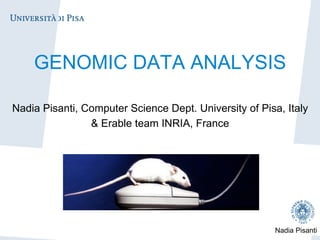
GENOMIC DATA ANALYSIS
Nadia Pisanti, Computer Science Dept. University of Pisa, Italy
& Erable team INRIA, France
Nadia Pisanti
OUTLINE OF THE TALK
- A BIT OF HISTORY: the Human Genome Project
- OPPORTUNITIES:
-  Analysing and Comparing Genomes
-  Understanding Regulation mechanisms and much more..
-  A… Data Driven Innovation in Medicine!
- COMPUTATIONAL CHALLENGES:
-  Assembly.
-  Alignments.
-  Analysis: Efficient Algorithms and Tools.
-  Storage and Browsing of Genomic Data.
Nadia Pisanti
From double helix to sequencing
1953: F.Crick and J.Watson discover the double helix
structure of DNA.
70's: The first sequencing techniques are developed
(F.Sanger).
1990: The Human Genome Project begins. The goal is to
identify the sequences of all the genes of the human
genome (expected to be >100,000).
Nobel Prize 1962


Nobel Prize 1980


Still one of the biggest research projects of
modern science.
Nadia Pisanti
The Human Genome Project
Started in 1990.
Expected ending time: 2003.
Actual ending time: 2000-2003.
Expected result: Locate and sequence and understand the function of
the at least 100,000 human genes (the remaining is just junk DNA).
Actual result: “only” 20,000-25,000 genes were found,
and “junk DNA” plays a fundamental role in gene regulation.
Nadia Pisanti
The Human Genome Project
1998: Craig Venter announces the creation of his
company Celera Genomics, and poses a challenge
to the public consortium...
1999: Celera completes the sequencing of Drosophila,
exhibiting a new techniques to sequence a
complex genome.
[during 1999, Celera's stock auctions grew of a 500%
factor in 4 months....]
The speed of Celera, together with ethical issues*

caused a general (public) panic... and a boost!


*Celera declared its intention to patent human genomic data
Nadia Pisanti
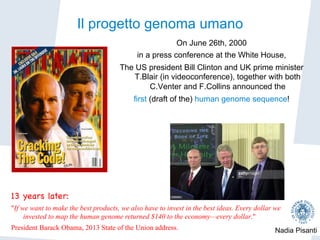
Il progetto genoma umano
On June 26th, 2000
in a press conference at the White House,
The US president Bill Clinton and UK prime minister
T.Blair (in videoconference), together with both
C.Venter and F.Collins announced the
first (draft of the) human genome sequence!
13 years later:

"If we want to make the best products, we also have to invest in the best ideas. Every dollar we
invested to map the human genome returned $140 to the economy—every dollar."
President Barack Obama, 2013 State of the Union address.
Nadia Pisanti
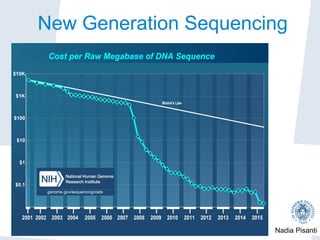
New Generation Sequencing
Nadia Pisanti
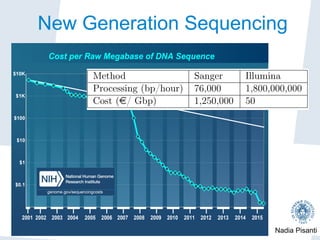
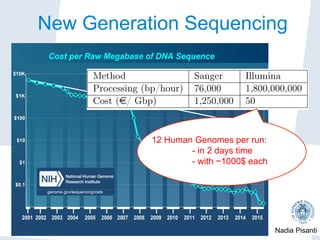
New Generation SequencingThe (first) sequencing revolution: 2005-2
Platform ABI 3730 HiSeq200
Method Sanger Illumina
Processing (bp/hour) 76,000 1,800,000,000
Cost (e/ Gbp) 1,250,000 50
23.648	ABI3730 	vs 							1	HiSeq200
Nadia Pisanti
New Generation SequencingThe (first) sequencing revolution: 2005-2
Platform ABI 3730 HiSeq200
Method Sanger Illumina
Processing (bp/hour) 76,000 1,800,000,000
Cost (e/ Gbp) 1,250,000 50
23.648	ABI3730 	vs 							1	HiSeq200
12 Human Genomes per run:
- in 2 days time
- with ~1000$ each
Nadia Pisanti
New Generation Sequencing
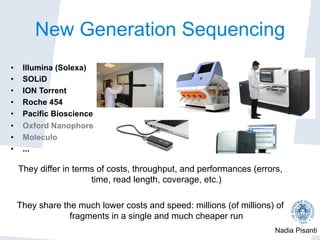
•  Illumina (Solexa)
•  SOLiD
•  ION Torrent
•  Roche 454
•  Pacific Bioscience
•  Oxford Nanophore
•  Moleculo
•  ...
They differ in terms of costs, throughput, and performances (errors,
time, read length, coverage, etc.)
They share the much lower costs and speed: millions (of millions) of
fragments in a single and much cheaper run
Nadia Pisanti
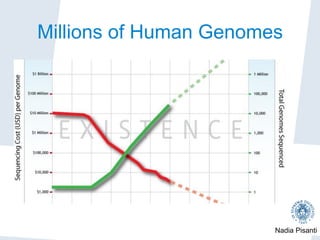
Millions of Human Genomes
Nadia Pisanti
Millions of Genomes
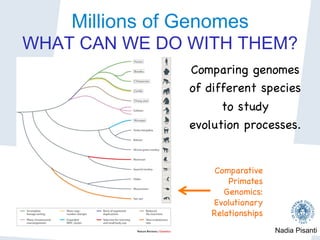
WHAT CAN WE DO WITH THEM?
Comparing genomes 

of different species 

to study 

evolution processes.


Comparative
Primates
Genomics:
Evolutionary
Relationships
Nadia Pisanti
Millions of Genomes
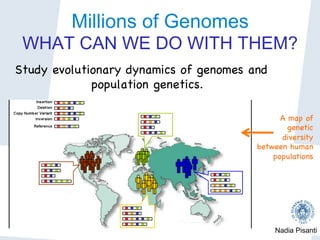
WHAT CAN WE DO WITH THEM?
Study evolutionary dynamics of genomes and
population genetics.

A map of

genetic
diversity
between human
populations
Nadia Pisanti
Millions of Genomes
WHAT CAN WE DO WITH THEM?
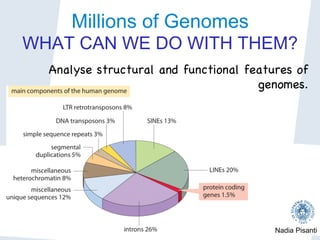
Analyse structural and functional features of
genomes.
Nadia Pisanti
Millions of Genomes
WHAT CAN WE DO WITH THEM?
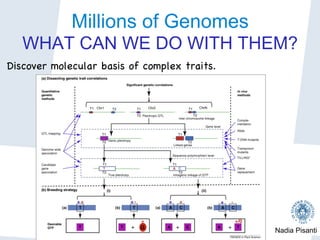
Discover molecular basis of complex traits.
Nadia Pisanti
Millions of Genomes
WHAT CAN WE DO WITH THEM?
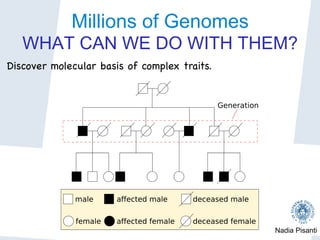
Discover molecular basis of complex traits.
Nadia Pisanti
Millions of Genomes
WHAT CAN WE DO WITH THEM?
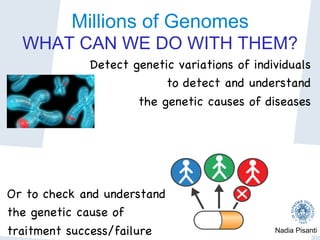
Detect genetic variations of individuals

to detect and understand 

the genetic causes of diseases


Or to check and understand

the genetic cause of 

traitment success/failure
Nadia Pisanti
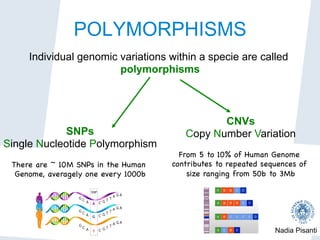
POLYMORPHISMS
Individual genomic variations within a specie are called
polymorphisms
SNPs
Single Nucleotide Polymorphism
There are ~ 10M SNPs in the Human
Genome, averagely one every 1000b

CNVs
Copy Number Variation
From 5 to 10% of Human Genome
contributes to repeated sequences of
size ranging from 50b to 3Mb
Nadia Pisanti
VARIATIONS ANALYSIS
Polymorphisms are common and physiological variations
(some variations characterize a population)
Mutations are more rare and can be associated to (a
predisposition to) a disease
or be caused by a disease
or can be associated to drug response
Nadia Pisanti
Genome and TranscriptomeRNA content depends on tissue, environment, and ce
life stage.;
it is transcribed from DNA in correspondence of gene
DNA
RNA
50
30
50
30
50
30
Biological analysis of the transcriptome
Collect the complete set of genes (annotation);
capture all expressed RNA molecules (quantification)
and compare expression levels among samples
(differential expression).
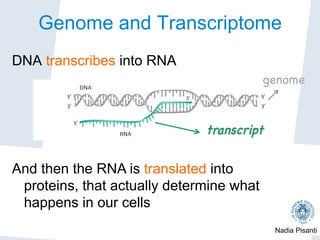
DNA transcribes into RNA
And then the RNA is translated into
proteins, that actually determine what
happens in our cells
transcript

genome
Nadia Pisanti
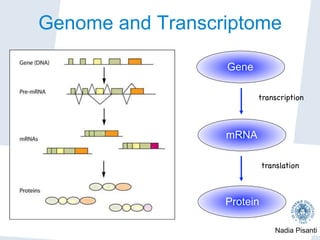
Gene
mRNA
Protein
translation

transcription

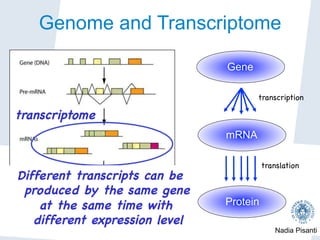
Genome and Transcriptome
Nadia Pisanti
Gene
mRNA
Protein
transcription

translation

transcriptome

Genome and Transcriptome
Different transcripts can be
produced by the same gene
at the same time with
different expression level
Nadia Pisanti
Transcriptome Sequencing
•  Genes express differently even in the same individual:
•  In different conditions
•  In different times
•  In different tissues
•  Why and How does the transcriptome change?
(much more than the genome!)
Nadia Pisanti
Transcriptome Sequencing
•  Genes express differently even in the same individual:
•  In different conditions
•  In different times
•  In different tissues
•  Why and How does the transcriptome change?
(much more than the genome!)
? regulation mechanisms ?
Nadia Pisanti
Transcriptome Sequencing
•  Genes express differently even in the same individual:
•  In different conditions
•  In different times
•  In different tissues
•  Why and How does the transcriptome change?
(much more than the genome!)
? regulation mechanisms ?
with New Generation Sequencing it is possible
to sequence the transcriptome: RNA-Seq
Nadia Pisanti
Transcriptome Sequencing
with New Generation Sequencing it is possible
to sequence the transcriptome: RNA-Seq

Detect all expressed RNA in a cell at a given time:
- with their genomic location, and
- with estimation of expressed transcript abundance
Nadia Pisanti
Genome Assembly
High-throughput sequencing (NGS)
DNA sample Sequencer Reads
DNA sample extract
fragmentation and ad
ligation;
amplification and seq
The sequencing process
DNA is physically broken into millions of random fragments (inse
are replicated several times.
DNA sequencing machines “read” (usually from both ends) the se
the inserts and provide the so called (paired) reads.
Different libraries available:
DNA is broken into
million of pieces before
sequencing…
“Imagine a book cut by scissors into 10 million small pieces. Assuming
that 1 million pieces are lost and the remaining 9 million are splashed
with ink… try to recover the original text!” [P.Pevzner, UCSD]
Nadia Pisanti
Genome Assembly
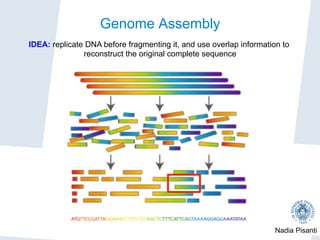
IDEA: replicate DNA before fragmenting it, and use overlap information to
reconstruct the original complete sequence
Nadia Pisanti
COMPUTATIONAL PROBLEMS ON
BIOLOGICAL SEQUENCES ANALYSIS
sequence (assembly);
map reads from an unknown
genome to a reference one
(alignment);
provide specialized tools for
genomic analyses (i.e., structural
variants detection).
reference-guided assembly);
map RNA-Seq reads to a
reference genome (spliced
alignment);
compute transcripts
abundances (e.g., expression
levels estimation).
assembly alignment coverage profiling
Bioinformatics 19/73
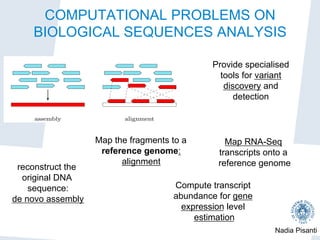
reconstruct the
original DNA
sequence:
de novo assembly
Map the fragments to a
reference genome:
alignment
Provide specialised
tools for variant
discovery and
detection
Map RNA-Seq
transcripts onto a
reference genome
Compute transcript
abundance for gene
expression level
estimation
Nadia Pisanti
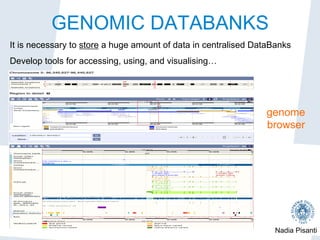
It is necessary to store a huge amount of data in centralised DataBanks
Develop tools for accessing, using, and visualising…

GENOMIC DATABANKS
genome
browser
Nadia Pisanti
THANK YOU!

Genomic Data Analysis

  • 1.
    Nadia Pisanti GENOMIC DATAANALYSIS Nadia Pisanti, Computer Science Dept. University of Pisa, Italy & Erable team INRIA, France
  • 2.
    Nadia Pisanti OUTLINE OFTHE TALK - A BIT OF HISTORY: the Human Genome Project - OPPORTUNITIES: -  Analysing and Comparing Genomes -  Understanding Regulation mechanisms and much more.. -  A… Data Driven Innovation in Medicine! - COMPUTATIONAL CHALLENGES: -  Assembly. -  Alignments. -  Analysis: Efficient Algorithms and Tools. -  Storage and Browsing of Genomic Data.
  • 3.
    Nadia Pisanti From doublehelix to sequencing 1953: F.Crick and J.Watson discover the double helix structure of DNA. 70's: The first sequencing techniques are developed (F.Sanger). 1990: The Human Genome Project begins. The goal is to identify the sequences of all the genes of the human genome (expected to be >100,000). Nobel Prize 1962 Nobel Prize 1980 Still one of the biggest research projects of modern science.
  • 4.
    Nadia Pisanti The HumanGenome Project Started in 1990. Expected ending time: 2003. Actual ending time: 2000-2003. Expected result: Locate and sequence and understand the function of the at least 100,000 human genes (the remaining is just junk DNA). Actual result: “only” 20,000-25,000 genes were found, and “junk DNA” plays a fundamental role in gene regulation.
  • 5.
    Nadia Pisanti The HumanGenome Project 1998: Craig Venter announces the creation of his company Celera Genomics, and poses a challenge to the public consortium... 1999: Celera completes the sequencing of Drosophila, exhibiting a new techniques to sequence a complex genome. [during 1999, Celera's stock auctions grew of a 500% factor in 4 months....] The speed of Celera, together with ethical issues* caused a general (public) panic... and a boost! *Celera declared its intention to patent human genomic data
  • 6.
    Nadia Pisanti Il progettogenoma umano On June 26th, 2000 in a press conference at the White House, The US president Bill Clinton and UK prime minister T.Blair (in videoconference), together with both C.Venter and F.Collins announced the first (draft of the) human genome sequence! 13 years later: "If we want to make the best products, we also have to invest in the best ideas. Every dollar we invested to map the human genome returned $140 to the economy—every dollar." President Barack Obama, 2013 State of the Union address.
  • 7.
  • 8.
    Nadia Pisanti New GenerationSequencingThe (first) sequencing revolution: 2005-2 Platform ABI 3730 HiSeq200 Method Sanger Illumina Processing (bp/hour) 76,000 1,800,000,000 Cost (e/ Gbp) 1,250,000 50 23.648 ABI3730 vs 1 HiSeq200
  • 9.
    Nadia Pisanti New GenerationSequencingThe (first) sequencing revolution: 2005-2 Platform ABI 3730 HiSeq200 Method Sanger Illumina Processing (bp/hour) 76,000 1,800,000,000 Cost (e/ Gbp) 1,250,000 50 23.648 ABI3730 vs 1 HiSeq200 12 Human Genomes per run: - in 2 days time - with ~1000$ each
  • 10.
    Nadia Pisanti New GenerationSequencing •  Illumina (Solexa) •  SOLiD •  ION Torrent •  Roche 454 •  Pacific Bioscience •  Oxford Nanophore •  Moleculo •  ... They differ in terms of costs, throughput, and performances (errors, time, read length, coverage, etc.) They share the much lower costs and speed: millions (of millions) of fragments in a single and much cheaper run
  • 11.
  • 12.
    Nadia Pisanti Millions ofGenomes WHAT CAN WE DO WITH THEM? Comparing genomes of different species to study evolution processes. Comparative Primates Genomics: Evolutionary Relationships
  • 13.
    Nadia Pisanti Millions ofGenomes WHAT CAN WE DO WITH THEM? Study evolutionary dynamics of genomes and population genetics. A map of genetic diversity between human populations
  • 14.
    Nadia Pisanti Millions ofGenomes WHAT CAN WE DO WITH THEM? Analyse structural and functional features of genomes.
  • 15.
    Nadia Pisanti Millions ofGenomes WHAT CAN WE DO WITH THEM? Discover molecular basis of complex traits.
  • 16.
    Nadia Pisanti Millions ofGenomes WHAT CAN WE DO WITH THEM? Discover molecular basis of complex traits.
  • 17.
    Nadia Pisanti Millions ofGenomes WHAT CAN WE DO WITH THEM? Detect genetic variations of individuals to detect and understand the genetic causes of diseases Or to check and understand the genetic cause of traitment success/failure
  • 18.
    Nadia Pisanti POLYMORPHISMS Individual genomicvariations within a specie are called polymorphisms SNPs Single Nucleotide Polymorphism There are ~ 10M SNPs in the Human Genome, averagely one every 1000b CNVs Copy Number Variation From 5 to 10% of Human Genome contributes to repeated sequences of size ranging from 50b to 3Mb
  • 19.
    Nadia Pisanti VARIATIONS ANALYSIS Polymorphismsare common and physiological variations (some variations characterize a population) Mutations are more rare and can be associated to (a predisposition to) a disease or be caused by a disease or can be associated to drug response
  • 20.
    Nadia Pisanti Genome andTranscriptomeRNA content depends on tissue, environment, and ce life stage.; it is transcribed from DNA in correspondence of gene DNA RNA 50 30 50 30 50 30 Biological analysis of the transcriptome Collect the complete set of genes (annotation); capture all expressed RNA molecules (quantification) and compare expression levels among samples (differential expression). DNA transcribes into RNA And then the RNA is translated into proteins, that actually determine what happens in our cells transcript genome
  • 21.
  • 22.
    Nadia Pisanti Gene mRNA Protein transcription translation transcriptome Genome andTranscriptome Different transcripts can be produced by the same gene at the same time with different expression level
  • 23.
    Nadia Pisanti Transcriptome Sequencing • Genes express differently even in the same individual: •  In different conditions •  In different times •  In different tissues •  Why and How does the transcriptome change? (much more than the genome!)
  • 24.
    Nadia Pisanti Transcriptome Sequencing • Genes express differently even in the same individual: •  In different conditions •  In different times •  In different tissues •  Why and How does the transcriptome change? (much more than the genome!) ? regulation mechanisms ?
  • 25.
    Nadia Pisanti Transcriptome Sequencing • Genes express differently even in the same individual: •  In different conditions •  In different times •  In different tissues •  Why and How does the transcriptome change? (much more than the genome!) ? regulation mechanisms ? with New Generation Sequencing it is possible to sequence the transcriptome: RNA-Seq
  • 26.
    Nadia Pisanti Transcriptome Sequencing withNew Generation Sequencing it is possible to sequence the transcriptome: RNA-Seq Detect all expressed RNA in a cell at a given time: - with their genomic location, and - with estimation of expressed transcript abundance
  • 27.
    Nadia Pisanti Genome Assembly High-throughputsequencing (NGS) DNA sample Sequencer Reads DNA sample extract fragmentation and ad ligation; amplification and seq The sequencing process DNA is physically broken into millions of random fragments (inse are replicated several times. DNA sequencing machines “read” (usually from both ends) the se the inserts and provide the so called (paired) reads. Different libraries available: DNA is broken into million of pieces before sequencing… “Imagine a book cut by scissors into 10 million small pieces. Assuming that 1 million pieces are lost and the remaining 9 million are splashed with ink… try to recover the original text!” [P.Pevzner, UCSD]
  • 28.
    Nadia Pisanti Genome Assembly IDEA:replicate DNA before fragmenting it, and use overlap information to reconstruct the original complete sequence
  • 29.
    Nadia Pisanti COMPUTATIONAL PROBLEMSON BIOLOGICAL SEQUENCES ANALYSIS sequence (assembly); map reads from an unknown genome to a reference one (alignment); provide specialized tools for genomic analyses (i.e., structural variants detection). reference-guided assembly); map RNA-Seq reads to a reference genome (spliced alignment); compute transcripts abundances (e.g., expression levels estimation). assembly alignment coverage profiling Bioinformatics 19/73 reconstruct the original DNA sequence: de novo assembly Map the fragments to a reference genome: alignment Provide specialised tools for variant discovery and detection Map RNA-Seq transcripts onto a reference genome Compute transcript abundance for gene expression level estimation
  • 30.
    Nadia Pisanti It isnecessary to store a huge amount of data in centralised DataBanks Develop tools for accessing, using, and visualising… GENOMIC DATABANKS genome browser
  • 31.