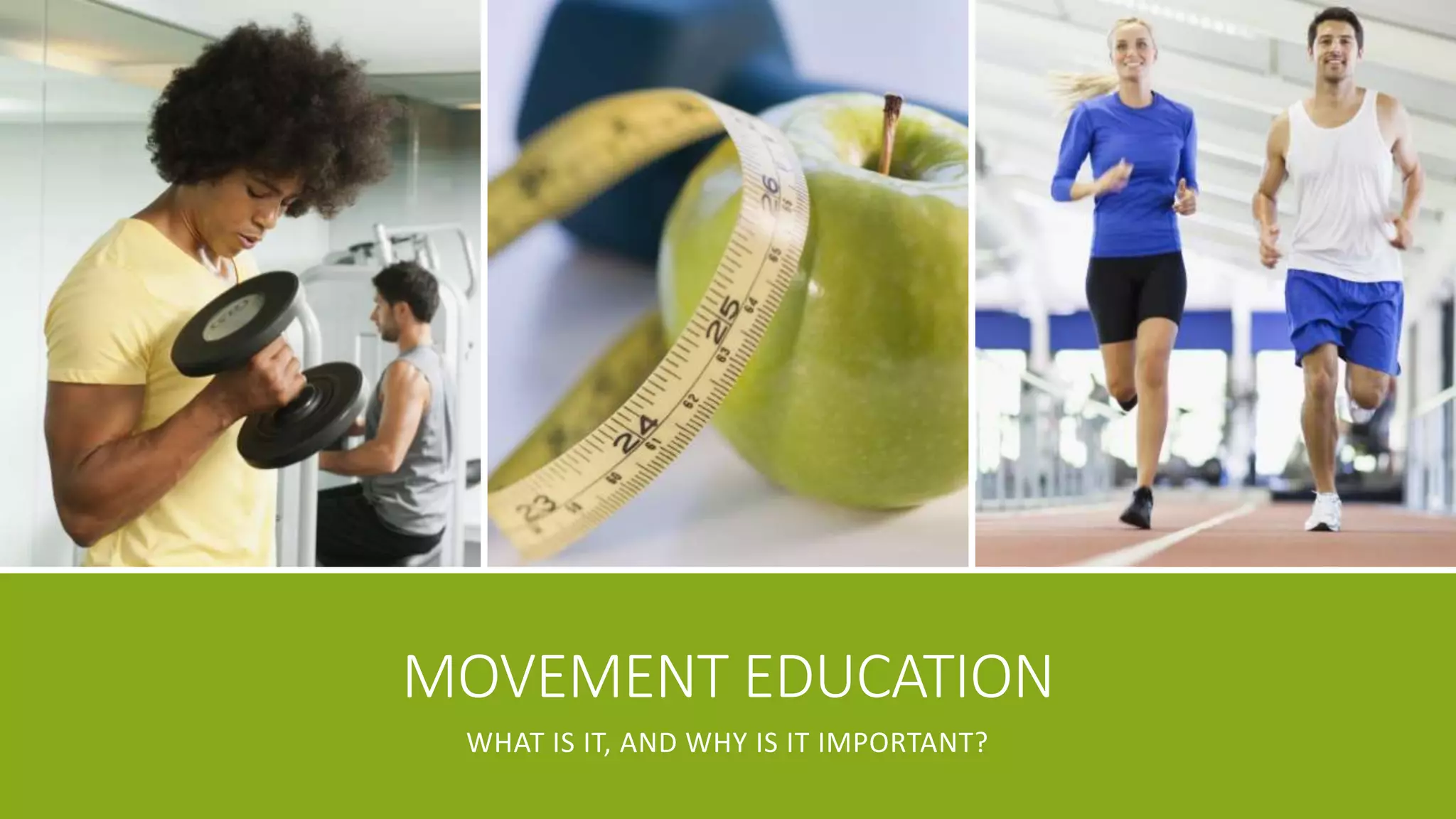
MOVEMENT EDUCATION
WHAT IS IT, AND WHY IS IT IMPORTANT?
INTRODUCTION TO MOVEMENT EDUCATION
▪ Outdoors play time has been traditionally seen as a way for students to ‘have a break’
from the classroom and their teachers.
▪ However, it is increasingly agreed the potential of the outdoors as a classroom
extension can promote children’s development.
▪ Outdoor learning is not simply restricted to the enhancement of physical skills, but also
for the development of social, emotional, creative and cognitive abilities.
▪ Teachers can simply continue indoor activities outdoors, especially ones that involve
movement activities.
▪ This provides an opportunity for teachers to interact with students in a more informal
manner and offer guidance and suggestions that extend children’s play.
(Pica, 2011)
© 2016 Danny Quach (17016298)
INTRODUCTION TO MOVEMENT EDUCATION
▪ Integration has always focused on literature and theory-based subjects.
▪ Experts however, have recommended teachers integrate literature with physical
education.
▪ For example, researchers suggest using sports fiction and children’s picture books
to introduce physical education skills and concepts to stimulate movement.
▪ In addition, it can also promote cooperation amongst children.
▪ This is considered a desirable outcome for early childhood and primary school
settings.
(Molenda & Bhavnagri, 2009)
© 2016 Danny Quach (17016298)
STRENGTHS AS A TEACHING APPROACH
▪ In movement education, the teacher can take on the role as play leader.
▪ This is someone who interacts with the children by asking leading questions and
providing guidance for certain skills such as hopping, cooperating and taking turns.
▪ Experts say a play leader helps children plan and discuss their own activities, without
the teacher (play leader) taking charge.
▪ This can also help them with their imagination – for example, a basketball along and
their typical use do not always stimulate children’s physical, cognitive or creative
development.
▪ A play leader can teach children to view the equipment as having other uses, such as a
swing being a clothes line.
(Pica, 2011)
© 2016 Danny Quach (17016298)
WHY DO WE USE IT IN THE CLASSROOM?
(C) 2016 Danny Quach (17016298)
▪ Movement plays a significant role in children’s development.
▪ Travelling, balancing and object control skills help them to engage actively with
experiences, to construct their own views of the world, to interact with other
children and explore their own environment.
(Griggs, 2012)
RATIONALE
▪ Education is more than literacy and numeracy – movement education and physical
activity is often overlooked (Griggs, 2012)
▪ The NSW PDHPE Syllabus’ Rationale has the following:
▪ It promotes physical activity
▪ Emphasises informed decision making leading to effective responsible action
▪ Physical, social and emotional growth and development patterns
(Board of Studies NSW, 2007)
(C) 2016 Danny Quach (17016298)
RATIONALE
▪ Promotes physical activity
▪ Obesity is a growing issue amongst young children
▪ Children today prefer to stay indoors and play games
▪ Emphasises informed decision making leading to effective responsible action
▪ Being outdoors and being engaged in movement education can broaden students’
experiences – they are in a different setting with different scenarios
▪ Physical, social and emotional growth and development patterns
▪ Movement education can aid in children’s development as individuals – from the
activities, they are engaged in communicating and socialising with one another
(C) 2016 Danny Quach (17016298)
REFERENCES
(C) 2016 Danny Quach (17016298)
Board of Studies, NSW. (2007). Personal Development, Health and Physical Education
K‐6 Syllabus. Sydney: Board of Studies.
Griggs, G. (2012). An introduction to primary physical education. Oxon: Routledge.
Molenda, C .F., & Bhavnagri, N. P. (2009). Cooperation through movement education
and children’s literature. Early Childhood Education Journal, 37(1), 153-159.
doi: 10.1007/s10643-009-0333-0
Pica, R. (2011). Taking movement education outdoors. YC Young Children, 66(4), 58-
59.

Movement Education

  • 1.
    MOVEMENT EDUCATION WHAT ISIT, AND WHY IS IT IMPORTANT?
  • 2.
    INTRODUCTION TO MOVEMENTEDUCATION ▪ Outdoors play time has been traditionally seen as a way for students to ‘have a break’ from the classroom and their teachers. ▪ However, it is increasingly agreed the potential of the outdoors as a classroom extension can promote children’s development. ▪ Outdoor learning is not simply restricted to the enhancement of physical skills, but also for the development of social, emotional, creative and cognitive abilities. ▪ Teachers can simply continue indoor activities outdoors, especially ones that involve movement activities. ▪ This provides an opportunity for teachers to interact with students in a more informal manner and offer guidance and suggestions that extend children’s play. (Pica, 2011) © 2016 Danny Quach (17016298)
  • 3.
    INTRODUCTION TO MOVEMENTEDUCATION ▪ Integration has always focused on literature and theory-based subjects. ▪ Experts however, have recommended teachers integrate literature with physical education. ▪ For example, researchers suggest using sports fiction and children’s picture books to introduce physical education skills and concepts to stimulate movement. ▪ In addition, it can also promote cooperation amongst children. ▪ This is considered a desirable outcome for early childhood and primary school settings. (Molenda & Bhavnagri, 2009) © 2016 Danny Quach (17016298)
  • 4.
    STRENGTHS AS ATEACHING APPROACH ▪ In movement education, the teacher can take on the role as play leader. ▪ This is someone who interacts with the children by asking leading questions and providing guidance for certain skills such as hopping, cooperating and taking turns. ▪ Experts say a play leader helps children plan and discuss their own activities, without the teacher (play leader) taking charge. ▪ This can also help them with their imagination – for example, a basketball along and their typical use do not always stimulate children’s physical, cognitive or creative development. ▪ A play leader can teach children to view the equipment as having other uses, such as a swing being a clothes line. (Pica, 2011) © 2016 Danny Quach (17016298)
  • 5.
    WHY DO WEUSE IT IN THE CLASSROOM? (C) 2016 Danny Quach (17016298) ▪ Movement plays a significant role in children’s development. ▪ Travelling, balancing and object control skills help them to engage actively with experiences, to construct their own views of the world, to interact with other children and explore their own environment. (Griggs, 2012)
  • 6.
    RATIONALE ▪ Education ismore than literacy and numeracy – movement education and physical activity is often overlooked (Griggs, 2012) ▪ The NSW PDHPE Syllabus’ Rationale has the following: ▪ It promotes physical activity ▪ Emphasises informed decision making leading to effective responsible action ▪ Physical, social and emotional growth and development patterns (Board of Studies NSW, 2007) (C) 2016 Danny Quach (17016298)
  • 7.
    RATIONALE ▪ Promotes physicalactivity ▪ Obesity is a growing issue amongst young children ▪ Children today prefer to stay indoors and play games ▪ Emphasises informed decision making leading to effective responsible action ▪ Being outdoors and being engaged in movement education can broaden students’ experiences – they are in a different setting with different scenarios ▪ Physical, social and emotional growth and development patterns ▪ Movement education can aid in children’s development as individuals – from the activities, they are engaged in communicating and socialising with one another (C) 2016 Danny Quach (17016298)
  • 8.
    REFERENCES (C) 2016 DannyQuach (17016298) Board of Studies, NSW. (2007). Personal Development, Health and Physical Education K‐6 Syllabus. Sydney: Board of Studies. Griggs, G. (2012). An introduction to primary physical education. Oxon: Routledge. Molenda, C .F., & Bhavnagri, N. P. (2009). Cooperation through movement education and children’s literature. Early Childhood Education Journal, 37(1), 153-159. doi: 10.1007/s10643-009-0333-0 Pica, R. (2011). Taking movement education outdoors. YC Young Children, 66(4), 58- 59.