ADAPTED
PHYSICAL
EDUCATION
John Albert M. Zafra
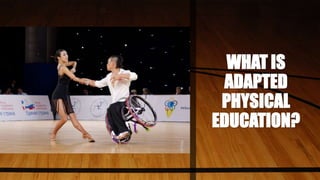
WHAT IS
ADAPTED
PHYSICAL
EDUCATION?
WHAT IS ADAPTED PHYSICAL EDUCATION?
•Adapted Physical Education is an
instructional program provided by
teachers certified in Adapted
Physical Education.
WHAT IS ADAPTED PHYSICAL EDUCATION?
•It is a specifically designed
physical education program for
students with disabilities who are
unable to participate and benefit
fully in regular physical education.
WHAT IS ADAPTED PHYSICAL EDUCATION?
•It is individualized to meet the
identified motor/physical
education needs of students in
special education.
WHAT IS ADAPTED PHYSICAL EDUCATION?
•The student’s program may include
consultation, support, modifications
or inclusion in regular PE, OR self-
contained Adapted PE instruction,
OR a combination of regular and
adapted physical education.
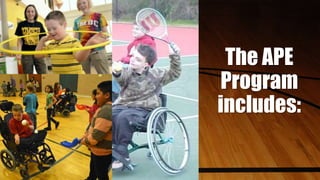
The APE
Program
includes:
•Instruction by teachers certified
in Adapted PE
•Peer-tutoring
•Buddy Program in regular P.E.
•Orientation and Mobility Skills
•Health Education
•Creole Curriculum/Wheelchair
Sports and Mobility Curriculum
•Special Olympics
•Sports for individuals with
physical disabilities
WHY IS ADAPTED
PE IMPORTANT?
Movement is a pre-requisite for most of
our educational activities. Individuals
with inefficient movement patterns
may encounter added difficulties in
vocational, social, emotional and
educational areas.
It is essential to provide success-
oriented activities to students who
have interests, capabilities and
limitations that are not met
through the regular PE program.
Adapted PE emphasizes:
• Physical and motor fitness
• Motor skills and patterns
• Body mechanics
• Individual games and sports for
lifetime enjoyment and fitness
• Leisure/recreation activities
• Healthy Lifestyles
Students are also taught to apply
motor and recreational skills to
various home and community
settings, to facilitate socialization,
self and peer group acceptance,
and normalization in the
community.
HOW STUDENTS
RECEIVE ADAPTED PE
Students must qualify for Adapted
physical education according to
criteria established by the Louisiana
Department of Education. When a
student is having difficulty
performing in regular physical
education, a motor screening is
initially conducted by the regular
physical education teacher PRIOR to
referral.
The Academic/ Behavioral
Intervention Team at the school will
be contacted. If warranted,
evaluation will then be conducted by
Adapted PE personnel. When a
student qualifies for APE services,
the type and frequency of services
will be determined by the IEP team.
Students who have the following
characteristics will be considered for
screening and referral:
• Developmental delays in chronologically
age-appropriate motor skills;
• Difficulty with equilibrium responses and
balance activities;
• Lack of strength, endurance, flexibility;
• Poor body or spatial awareness;
• Chronic medical conditions;
• Lack of appropriate play and socialization
behavior;
• Poor auditory processing.
WHERE AND WHEN
STUDENTS RECEIVE
ADAPTED PE
Students receive APE during their school
day. The class is scheduled according to the
needs of the student as indicated on the IEP.
Typically, students participate in some
regular physical education with support
from a para-educator or inclusion support
from the adapted physical education
teacher.
However, many students require instruction
in a self-contained class with other
students with disabilities. Instruction may
occur outdoors on school grounds, in the
gym, or in another defined space.
Reference:
http://jpschools.org/department/special-education/adapted-physical-
education/

Adapted Physical Education

  • 1.
  • 2.
  • 3.
    WHAT IS ADAPTEDPHYSICAL EDUCATION? •Adapted Physical Education is an instructional program provided by teachers certified in Adapted Physical Education.
  • 4.
    WHAT IS ADAPTEDPHYSICAL EDUCATION? •It is a specifically designed physical education program for students with disabilities who are unable to participate and benefit fully in regular physical education.
  • 5.
    WHAT IS ADAPTEDPHYSICAL EDUCATION? •It is individualized to meet the identified motor/physical education needs of students in special education.
  • 6.
    WHAT IS ADAPTEDPHYSICAL EDUCATION? •The student’s program may include consultation, support, modifications or inclusion in regular PE, OR self- contained Adapted PE instruction, OR a combination of regular and adapted physical education.
  • 7.
  • 8.
    •Instruction by teacherscertified in Adapted PE •Peer-tutoring •Buddy Program in regular P.E. •Orientation and Mobility Skills
  • 9.
    •Health Education •Creole Curriculum/Wheelchair Sportsand Mobility Curriculum •Special Olympics •Sports for individuals with physical disabilities
  • 10.
  • 11.
    Movement is apre-requisite for most of our educational activities. Individuals with inefficient movement patterns may encounter added difficulties in vocational, social, emotional and educational areas.
  • 12.
    It is essentialto provide success- oriented activities to students who have interests, capabilities and limitations that are not met through the regular PE program. Adapted PE emphasizes:
  • 13.
    • Physical andmotor fitness • Motor skills and patterns • Body mechanics • Individual games and sports for lifetime enjoyment and fitness • Leisure/recreation activities • Healthy Lifestyles
  • 14.
    Students are alsotaught to apply motor and recreational skills to various home and community settings, to facilitate socialization, self and peer group acceptance, and normalization in the community.
  • 15.
  • 16.
    Students must qualifyfor Adapted physical education according to criteria established by the Louisiana Department of Education. When a student is having difficulty performing in regular physical education, a motor screening is initially conducted by the regular physical education teacher PRIOR to referral.
  • 17.
    The Academic/ Behavioral InterventionTeam at the school will be contacted. If warranted, evaluation will then be conducted by Adapted PE personnel. When a student qualifies for APE services, the type and frequency of services will be determined by the IEP team.
  • 18.
    Students who havethe following characteristics will be considered for screening and referral:
  • 19.
    • Developmental delaysin chronologically age-appropriate motor skills; • Difficulty with equilibrium responses and balance activities; • Lack of strength, endurance, flexibility; • Poor body or spatial awareness; • Chronic medical conditions; • Lack of appropriate play and socialization behavior; • Poor auditory processing.
  • 20.
    WHERE AND WHEN STUDENTSRECEIVE ADAPTED PE
  • 21.
    Students receive APEduring their school day. The class is scheduled according to the needs of the student as indicated on the IEP. Typically, students participate in some regular physical education with support from a para-educator or inclusion support from the adapted physical education teacher.
  • 22.
    However, many studentsrequire instruction in a self-contained class with other students with disabilities. Instruction may occur outdoors on school grounds, in the gym, or in another defined space.
  • 23.