Movement Education Approach
A friendly online guide for Parents
What is Movement Education?
 Physical Education (PE) in general provides opportunities for growing children to
be active, contributing to their awareness of how to lead balanced lifestyles and
execute healthy choices (Fairclough & Stratton, 2005).
 Movement education (ME) is at the heart of PE and aims to help individuals
develop their basic motor skills through physical movement (Lynch, 2015).
ME approach incorperates various PDHPE Syllabus objectives:
 MOS1.4 Demonstares maturing performance of basic movement and
compositional skills in a variety of predictable situations.
 PSS1.5 Draws on past experiences to solve familiar problems.
 ALS1.6: Particpates in physical activity, recognises that it can be both enjoyable
and important for health.
The Philosophy of our Movement
Education Approach
 Besides motor success, ME fosters the development of cognitive
(higher order thinking) knowledge about movement.
 ME establishes a wide foundation of movements that children can use
as a baseline to develop and execute further skill movement.
 It is adaptable and inclusive of all ages and developmental stages.
 ME is the essential thread that runs through any movement required
and we as teachers, can incorporate important terminology into the
theoretical component (Morgan & Hasen, 2007; Pringle, 2010).
Movement Education Gains
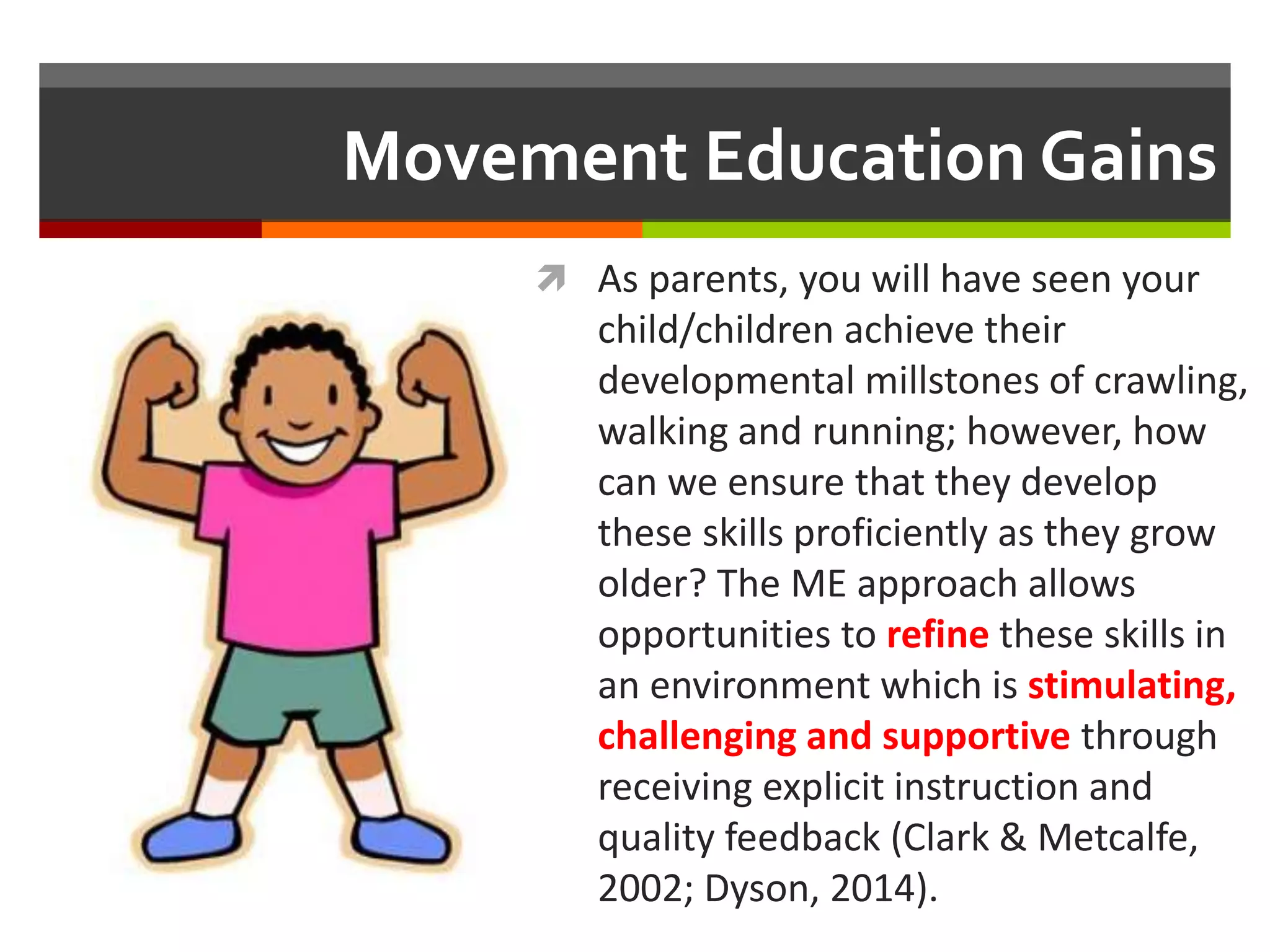
 As parents, you will have seen your
child/children achieve their
developmental millstones of crawling,
walking and running; however, how
can we ensure that they develop
these skills proficiently as they grow
older? The ME approach allows
opportunities to refine these skills in
an environment which is stimulating,
challenging and supportive through
receiving explicit instruction and
quality feedback (Clark & Metcalfe,
2002; Dyson, 2014).
Movement Education Gains
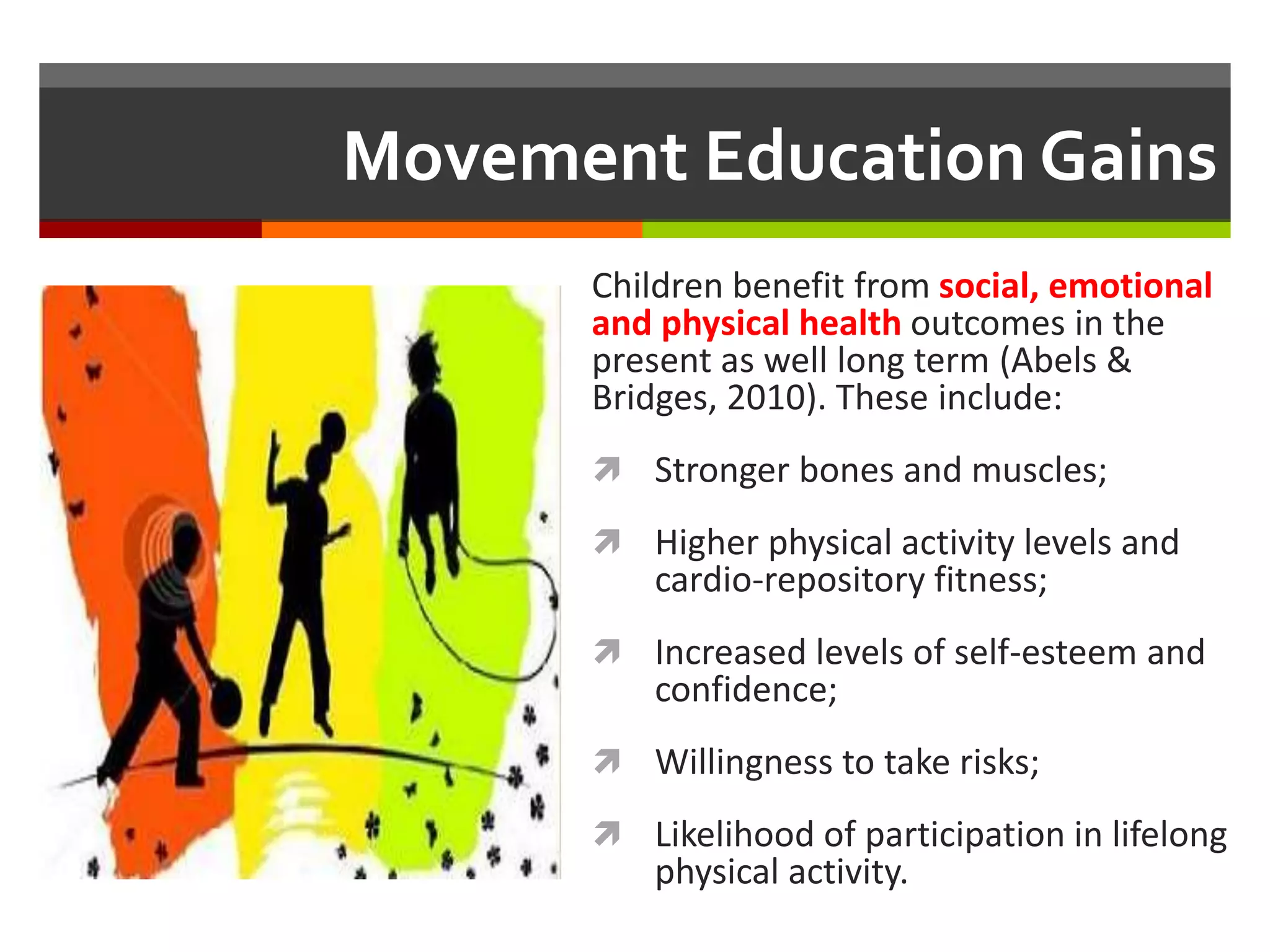
Children benefit from social, emotional
and physical health outcomes in the
present as well long term (Abels &
Bridges, 2010). These include:
 Stronger bones and muscles;
 Higher physical activity levels and
cardio-repository fitness;
 Increased levels of self-esteem and
confidence;
 Willingness to take risks;
 Likelihood of participation in lifelong
physical activity.
The Building Blocks for Children
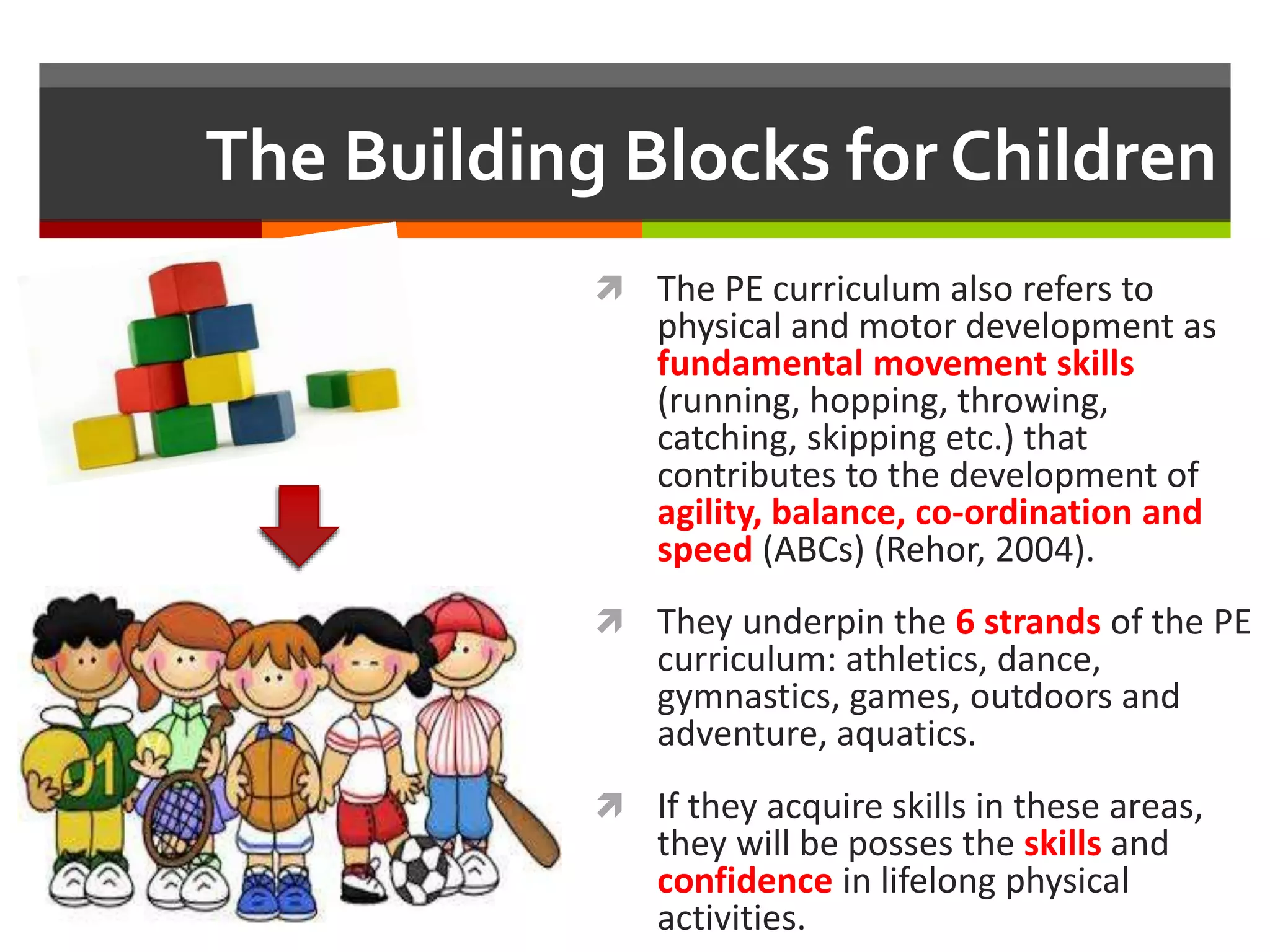
 The PE curriculum also refers to
physical and motor development as
fundamental movement skills
(running, hopping, throwing,
catching, skipping etc.) that
contributes to the development of
agility, balance, co-ordination and
speed (ABCs) (Rehor, 2004).
 They underpin the 6 strands of the PE
curriculum: athletics, dance,
gymnastics, games, outdoors and
adventure, aquatics.
 If they acquire skills in these areas,
they will be posses the skills and
confidence in lifelong physical
activities.
Where do we come in?
Teachers role:
 Teaching in developmental sequential order
(initial - informative - mature stages);
 Providing choices enhances learning: inform
children what to do, refine and simplify
activities, extend by making the movement
more challenging and be engaging to
maintain motivation by relating to children’s
interests;
 Child-centered Approach: use stories and
imagination (circus tight rope walking,
superhero jumping), adding music/songs,
immediate feedback, opportunity to explore,
and different grouping strategies (Fairclough
& Stratton, 2005; Fishburne & Berg, 2005).
What can parents take home from this?
 Concurrent with the PDHPE syllabus rationale, ME provides lifelong tools
that promote the development of motor skills, informed health choices
and actions (Board of Studies, 2014).
 ME helps maintain a positive physical, emotional and spiritual wellbeing=
healthy and happy growing children.
 Students establish interpersonal skills and individual accountability.
 MOST IMPORTANTLY: ME equals fun; after all, they are children and play is
fundamental to their social and cognitive growth.
Reference List
 Abels, A., & Bridges, J. (2010). Teaching Movement Education Foundations for Active Lifestyles. Retrieved from
http://www.humankinetics.com/excerpts/excerpts/what-are-the-origins-of-movement-education
 Board of Studies, NSW (2014). NSW Personal Development, Health and Physical Education (PDHPE) K-6 Syllabus.
 Clark, J. E., & Metcalfe, J. S. (2002). The mountain of motor development: A metaphor. Motor development: Research and reviews, 2,
163-190.
 Dyson, B. (2014). Quality physical education: A commentary on effective physical education teaching. Research Quarterly for Exercise and
Sport, 85(2), 144-152
 Fairclough, S., & Stratton, G. (2005). ‘Physical education makes you fit and healthy’. Physical education's contribution to young
people's physical activity levels. Health education research, 20(1), 14-23.
 Fishburne, G. J., & Berg, S. P. (2005). Building Strong Bones & Muscles. Human Kinetics.
 Lynch, T. (2015). Health and physical education (HPE): Implementation in primary schools. International Journal of Educational Research,
70, 88-100
 Morgan, P., & Hansen, V. (2007). Recommendations to improve primary school physical education: Classroom teachers'
perspective. The journal of educational research, 101(2), 99-108.
 Pringle, R. (2010). Finding pleasure in physical education: A critical examination of the educative value of positive movement affects.
Quest, 62(2), 119-134.
 Rehor, P. R. (2004). Does the present teacher preparation curriculum in health and physical education meet the present needs of
Australian youth?

PDHPE

  • 1.
    Movement Education Approach Afriendly online guide for Parents
  • 2.
    What is MovementEducation?  Physical Education (PE) in general provides opportunities for growing children to be active, contributing to their awareness of how to lead balanced lifestyles and execute healthy choices (Fairclough & Stratton, 2005).  Movement education (ME) is at the heart of PE and aims to help individuals develop their basic motor skills through physical movement (Lynch, 2015). ME approach incorperates various PDHPE Syllabus objectives:  MOS1.4 Demonstares maturing performance of basic movement and compositional skills in a variety of predictable situations.  PSS1.5 Draws on past experiences to solve familiar problems.  ALS1.6: Particpates in physical activity, recognises that it can be both enjoyable and important for health.
  • 3.
    The Philosophy ofour Movement Education Approach  Besides motor success, ME fosters the development of cognitive (higher order thinking) knowledge about movement.  ME establishes a wide foundation of movements that children can use as a baseline to develop and execute further skill movement.  It is adaptable and inclusive of all ages and developmental stages.  ME is the essential thread that runs through any movement required and we as teachers, can incorporate important terminology into the theoretical component (Morgan & Hasen, 2007; Pringle, 2010).
  • 4.
    Movement Education Gains As parents, you will have seen your child/children achieve their developmental millstones of crawling, walking and running; however, how can we ensure that they develop these skills proficiently as they grow older? The ME approach allows opportunities to refine these skills in an environment which is stimulating, challenging and supportive through receiving explicit instruction and quality feedback (Clark & Metcalfe, 2002; Dyson, 2014).
  • 5.
    Movement Education Gains Childrenbenefit from social, emotional and physical health outcomes in the present as well long term (Abels & Bridges, 2010). These include:  Stronger bones and muscles;  Higher physical activity levels and cardio-repository fitness;  Increased levels of self-esteem and confidence;  Willingness to take risks;  Likelihood of participation in lifelong physical activity.
  • 6.
    The Building Blocksfor Children  The PE curriculum also refers to physical and motor development as fundamental movement skills (running, hopping, throwing, catching, skipping etc.) that contributes to the development of agility, balance, co-ordination and speed (ABCs) (Rehor, 2004).  They underpin the 6 strands of the PE curriculum: athletics, dance, gymnastics, games, outdoors and adventure, aquatics.  If they acquire skills in these areas, they will be posses the skills and confidence in lifelong physical activities.
  • 7.
    Where do wecome in? Teachers role:  Teaching in developmental sequential order (initial - informative - mature stages);  Providing choices enhances learning: inform children what to do, refine and simplify activities, extend by making the movement more challenging and be engaging to maintain motivation by relating to children’s interests;  Child-centered Approach: use stories and imagination (circus tight rope walking, superhero jumping), adding music/songs, immediate feedback, opportunity to explore, and different grouping strategies (Fairclough & Stratton, 2005; Fishburne & Berg, 2005).
  • 8.
    What can parentstake home from this?  Concurrent with the PDHPE syllabus rationale, ME provides lifelong tools that promote the development of motor skills, informed health choices and actions (Board of Studies, 2014).  ME helps maintain a positive physical, emotional and spiritual wellbeing= healthy and happy growing children.  Students establish interpersonal skills and individual accountability.  MOST IMPORTANTLY: ME equals fun; after all, they are children and play is fundamental to their social and cognitive growth.
  • 9.
    Reference List  Abels,A., & Bridges, J. (2010). Teaching Movement Education Foundations for Active Lifestyles. Retrieved from http://www.humankinetics.com/excerpts/excerpts/what-are-the-origins-of-movement-education  Board of Studies, NSW (2014). NSW Personal Development, Health and Physical Education (PDHPE) K-6 Syllabus.  Clark, J. E., & Metcalfe, J. S. (2002). The mountain of motor development: A metaphor. Motor development: Research and reviews, 2, 163-190.  Dyson, B. (2014). Quality physical education: A commentary on effective physical education teaching. Research Quarterly for Exercise and Sport, 85(2), 144-152  Fairclough, S., & Stratton, G. (2005). ‘Physical education makes you fit and healthy’. Physical education's contribution to young people's physical activity levels. Health education research, 20(1), 14-23.  Fishburne, G. J., & Berg, S. P. (2005). Building Strong Bones & Muscles. Human Kinetics.  Lynch, T. (2015). Health and physical education (HPE): Implementation in primary schools. International Journal of Educational Research, 70, 88-100  Morgan, P., & Hansen, V. (2007). Recommendations to improve primary school physical education: Classroom teachers' perspective. The journal of educational research, 101(2), 99-108.  Pringle, R. (2010). Finding pleasure in physical education: A critical examination of the educative value of positive movement affects. Quest, 62(2), 119-134.  Rehor, P. R. (2004). Does the present teacher preparation curriculum in health and physical education meet the present needs of Australian youth?