Waterfalls
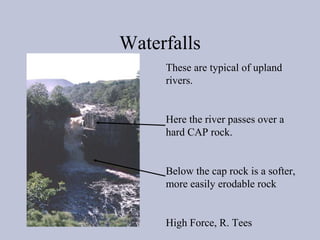
These are typical of upland
rivers.
Here the river passes over a
hard CAP rock.
Below the cap rock is a softer,
more easily erodable rock
High Force, R. Tees
High Force – R. Tees
Waterfalls
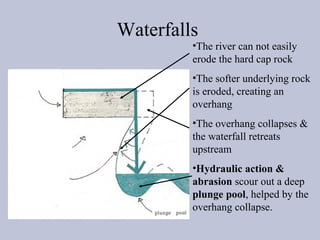
•The river can not easily
erode the hard cap rock
•The softer underlying rock
is eroded, creating an
overhang
•The overhang collapses &
the waterfall retreats
upstream
•Hydraulic action &
abrasion scour out a deep
plunge pool, helped by the
overhang collapse.
Waterfalls
•As the waterfall
retreats upstream it
leaves behind a
narrow, steep sided
valley or GORGE
•Vertical &
headward erosion
Waterfall formation WAGOLL
Water flows over hard rock then soft rock. As the water
flows over the soft rock, it erodes faster than the hard rock
through the processes of hydraulic action which is the sheer
force of the water wearing away the bed of the river making it
steeper. Eventually this causes a vertical drop in the river
with a deep pool called a plunge pool at the base. As the
water flows over into the plunge pool it undercuts the hard
rock by eroding the soft rock.
The undercut, now forms an overhang of hard rock which
will eventually collapse into the plunge pool. This process
repeats itself faster due to abrasion, which is where rocks in
the river erode the bed, causing the waterfall to retreat
upstream forming a steep sided gorge.
Waterfall formation WAGOLL
Water flows over hard rock then soft rock. As the water
flows over the soft rock, it erodes faster than the hard rock
through the processes of hydraulic action which is the sheer
force of the water wearing away the bed of the river making it
steeper. Eventually this causes a vertical drop in the river
with a deep pool called a plunge pool at the base. As the
water flows over into the plunge pool it undercuts the hard
rock by eroding the soft rock.
The undercut, now forms an overhang of hard rock which
will eventually collapse into the plunge pool. This process
repeats itself faster due to abrasion, which is where rocks in
the river erode the bed, causing the waterfall to retreat
upstream forming a steep sided gorge.

Waterfalls 2nd ppt

  • 1.
    Waterfalls These are typicalof upland rivers. Here the river passes over a hard CAP rock. Below the cap rock is a softer, more easily erodable rock High Force, R. Tees
  • 2.
  • 3.
    Waterfalls •The river cannot easily erode the hard cap rock •The softer underlying rock is eroded, creating an overhang •The overhang collapses & the waterfall retreats upstream •Hydraulic action & abrasion scour out a deep plunge pool, helped by the overhang collapse.
  • 4.
    Waterfalls •As the waterfall retreatsupstream it leaves behind a narrow, steep sided valley or GORGE •Vertical & headward erosion
  • 6.
    Waterfall formation WAGOLL Waterflows over hard rock then soft rock. As the water flows over the soft rock, it erodes faster than the hard rock through the processes of hydraulic action which is the sheer force of the water wearing away the bed of the river making it steeper. Eventually this causes a vertical drop in the river with a deep pool called a plunge pool at the base. As the water flows over into the plunge pool it undercuts the hard rock by eroding the soft rock. The undercut, now forms an overhang of hard rock which will eventually collapse into the plunge pool. This process repeats itself faster due to abrasion, which is where rocks in the river erode the bed, causing the waterfall to retreat upstream forming a steep sided gorge.
  • 7.
    Waterfall formation WAGOLL Waterflows over hard rock then soft rock. As the water flows over the soft rock, it erodes faster than the hard rock through the processes of hydraulic action which is the sheer force of the water wearing away the bed of the river making it steeper. Eventually this causes a vertical drop in the river with a deep pool called a plunge pool at the base. As the water flows over into the plunge pool it undercuts the hard rock by eroding the soft rock. The undercut, now forms an overhang of hard rock which will eventually collapse into the plunge pool. This process repeats itself faster due to abrasion, which is where rocks in the river erode the bed, causing the waterfall to retreat upstream forming a steep sided gorge.