GEOMETRICAL
TOLERANCES
• PREPARED BY:-CHETAN
HIWASE
• ROLL NO:-173510
10/24/2017
1
GEOMETRICAL TOLERARANCES
• Geometrical tolerances is a system for defined and
communicating engineering tolerances . It uses a symbolic
language on engineering drawings and computer-generated
three-dimensional solid models that explicitly describes
nominal tolerances and its allowable variation.
• It tells the manufacturing staff and machines what degree
of accuracy and precision is needed on each controlled feature
of the part.
• Geometrical tolerances can add quality and reduce cost at the
same time through producibility.
• Geometric tolerance reading helps to understand to specify and
control the form, location and orientation of the features of
components and manufactured parts.
10/24/2017 2
HISTORY
• The origin of Geometrical tolerances has been credited to a
man named Stanley Parker, who developed the concept of
"true position" in 1938.] While very little is known about the
life of Stanley Parker, it is recorded that he worked at the
Royal Torpedo Factory in Alexandria, Scotland. Parker's work
was used to increase production of naval weapons .
10/24/2017 3
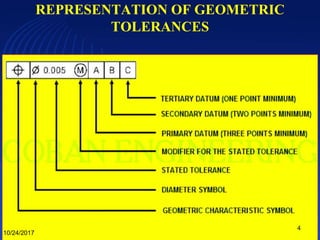
REPRESENTATION OF GEOMETRIC
TOLERANCES
10/24/2017
4
DATUM PLANES
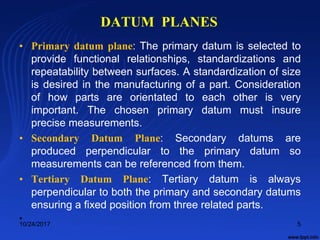
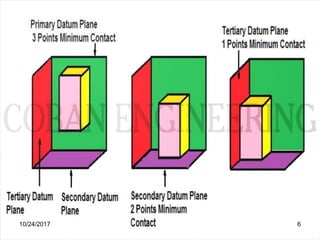
• Primary datum plane: The primary datum is selected to
provide functional relationships, standardizations and
repeatability between surfaces. A standardization of size
is desired in the manufacturing of a part. Consideration
of how parts are orientated to each other is very
important. The chosen primary datum must insure
precise measurements.
• Secondary Datum Plane: Secondary datums are
produced perpendicular to the primary datum so
measurements can be referenced from them.
• Tertiary Datum Plane: Tertiary datum is always
perpendicular to both the primary and secondary datums
ensuring a fixed position from three related parts.
•
10/24/2017 5
10/24/2017 6
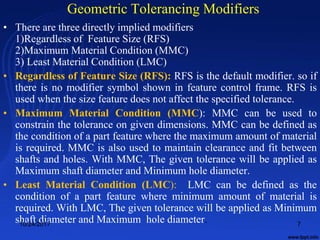
Geometric Tolerancing Modifiers
• There are three directly implied modifiers
1)Regardless of Feature Size (RFS)
2)Maximum Material Condition (MMC)
3) Least Material Condition (LMC)
• Regardless of Feature Size (RFS): RFS is the default modifier. so if
there is no modifier symbol shown in feature control frame. RFS is
used when the size feature does not affect the specified tolerance.
• Maximum Material Condition (MMC): MMC can be used to
constrain the tolerance on given dimensions. MMC can be defined as
the condition of a part feature where the maximum amount of material
is required. MMC is also used to maintain clearance and fit between
shafts and holes. With MMC, The given tolerance will be applied as
Maximum shaft diameter and Minimum hole diameter.
• Least Material Condition (LMC): LMC can be defined as the
condition of a part feature where minimum amount of material is
required. With LMC, The given tolerance will be applied as Minimum
shaft diameter and Maximum hole diameter.10/24/2017 7
TOLERANCE OF
ORIENTATION
10/24/2017 8
1.Perpendicularity
•The normal form or Surface Perpendicularity is a tolerance that controls
Perpendicularity between two 90° surfaces.
•Axis Perpendicularity is a tolerance that controls how perpendicular a
specific axis needs to be to a datum.
10/24/2017 9
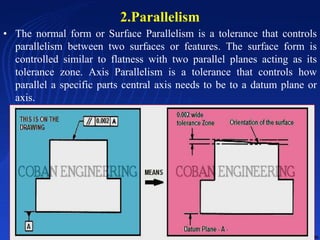
2.Parallelism
• The normal form or Surface Parallelism is a tolerance that controls
parallelism between two surfaces or features. The surface form is
controlled similar to flatness with two parallel planes acting as its
tolerance zone. Axis Parallelism is a tolerance that controls how
parallel a specific parts central axis needs to be to a datum plane or
axis.
10/24/2017 10
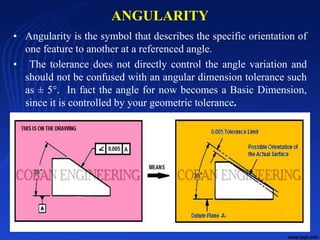
ANGULARITY
• Angularity is the symbol that describes the specific orientation of
one feature to another at a referenced angle.
• The tolerance does not directly control the angle variation and
should not be confused with an angular dimension tolerance such
as ± 5°. In fact the angle for now becomes a Basic Dimension,
since it is controlled by your geometric tolerance.
10/24/2017 11
TOLERANCE OF
FORM
10/24/2017 12
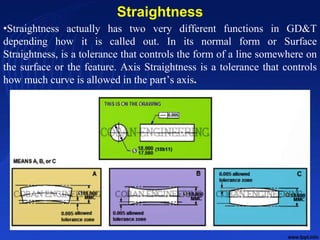
Straightness
•Straightness actually has two very different functions in GD&T
depending how it is called out. In its normal form or Surface
Straightness, is a tolerance that controls the form of a line somewhere on
the surface or the feature. Axis Straightness is a tolerance that controls
how much curve is allowed in the part’s axis.
10/24/2017 13
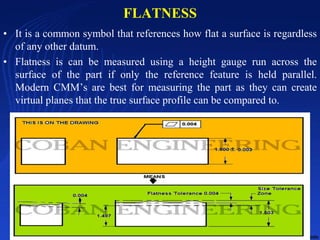
FLATNESS
• It is a common symbol that references how flat a surface is regardless
of any other datum.
• Flatness is can be measured using a height gauge run across the
surface of the part if only the reference feature is held parallel.
Modern CMM’s are best for measuring the part as they can create
virtual planes that the true surface profile can be compared to.
10/24/2017 14
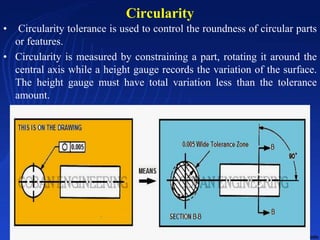
Circularity
• Circularity tolerance is used to control the roundness of circular parts
or features.
• Circularity is measured by constraining a part, rotating it around the
central axis while a height gauge records the variation of the surface.
The height gauge must have total variation less than the tolerance
amount.
10/24/2017 15
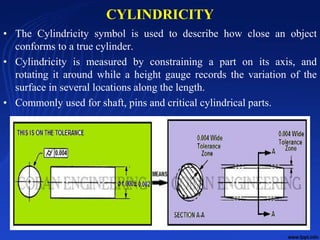
CYLINDRICITY
• The Cylindricity symbol is used to describe how close an object
conforms to a true cylinder.
• Cylindricity is measured by constraining a part on its axis, and
rotating it around while a height gauge records the variation of the
surface in several locations along the length.
• Commonly used for shaft, pins and critical cylindrical parts.
10/24/2017 16
TOLERANCE OF
LOCATION
10/24/2017 17
SYMMETRY
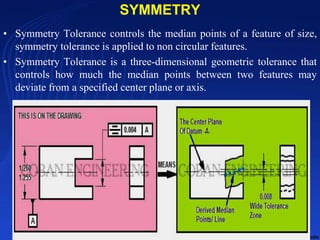
• Symmetry Tolerance controls the median points of a feature of size,
symmetry tolerance is applied to non circular features.
• Symmetry Tolerance is a three-dimensional geometric tolerance that
controls how much the median points between two features may
deviate from a specified center plane or axis.
10/24/2017 18
CONCENTRICITY
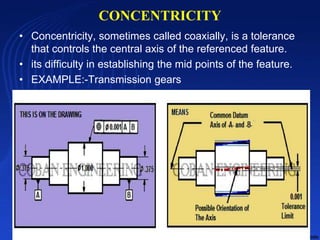
• Concentricity, sometimes called coaxially, is a tolerance
that controls the central axis of the referenced feature.
• its difficulty in establishing the mid points of the feature.
• EXAMPLE:-Transmission gears
10/24/2017 19
POSITION
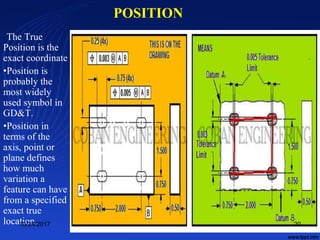
• The True
Position is the
exact coordinate
•Position is
probably the
most widely
used symbol in
GD&T.
•Position in
terms of the
axis, point or
plane defines
how much
variation a
feature can have
from a specified
exact true
location.10/24/2017 20
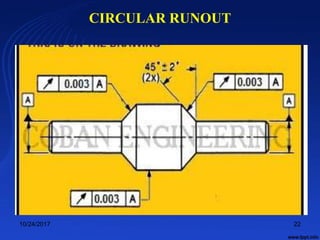
RUNOUT
• In GD&T, total runout is a
complex tolerance that controls
features straightness, profile,
angularity, and other geometric
variation.
•Circular Runout zone
is limited in the
measuring plane
perpendicular to the
axis by two concentric
circles, the common
centre of which lies on
the datum axis
10/24/2017 21
CIRCULAR RUNOUT
10/24/2017 22
TOTAL RUNOUT
10/24/2017 23
PROFILE TOLERANCES
10/24/2017 24
LINE PROFILE
10/24/2017 25
SURFACE PROFILE
10/24/2017 26
REFERANCES
• Geometrical dimensioning and tolerances by james d.
Meadoes
• Geometrical dimensioning and tolerances for design,
manufacturing and inspection by g.henzold.
• Geometrical dimensioning and tolerances paul green
10/24/2017 27
THANK YOU
10/24/2017 28

Geometrical tolerance

  • 1.
  • 2.
    GEOMETRICAL TOLERARANCES • Geometricaltolerances is a system for defined and communicating engineering tolerances . It uses a symbolic language on engineering drawings and computer-generated three-dimensional solid models that explicitly describes nominal tolerances and its allowable variation. • It tells the manufacturing staff and machines what degree of accuracy and precision is needed on each controlled feature of the part. • Geometrical tolerances can add quality and reduce cost at the same time through producibility. • Geometric tolerance reading helps to understand to specify and control the form, location and orientation of the features of components and manufactured parts. 10/24/2017 2
  • 3.
    HISTORY • The originof Geometrical tolerances has been credited to a man named Stanley Parker, who developed the concept of "true position" in 1938.] While very little is known about the life of Stanley Parker, it is recorded that he worked at the Royal Torpedo Factory in Alexandria, Scotland. Parker's work was used to increase production of naval weapons . 10/24/2017 3
  • 4.
  • 5.
    DATUM PLANES • Primarydatum plane: The primary datum is selected to provide functional relationships, standardizations and repeatability between surfaces. A standardization of size is desired in the manufacturing of a part. Consideration of how parts are orientated to each other is very important. The chosen primary datum must insure precise measurements. • Secondary Datum Plane: Secondary datums are produced perpendicular to the primary datum so measurements can be referenced from them. • Tertiary Datum Plane: Tertiary datum is always perpendicular to both the primary and secondary datums ensuring a fixed position from three related parts. • 10/24/2017 5
  • 6.
  • 7.
    Geometric Tolerancing Modifiers •There are three directly implied modifiers 1)Regardless of Feature Size (RFS) 2)Maximum Material Condition (MMC) 3) Least Material Condition (LMC) • Regardless of Feature Size (RFS): RFS is the default modifier. so if there is no modifier symbol shown in feature control frame. RFS is used when the size feature does not affect the specified tolerance. • Maximum Material Condition (MMC): MMC can be used to constrain the tolerance on given dimensions. MMC can be defined as the condition of a part feature where the maximum amount of material is required. MMC is also used to maintain clearance and fit between shafts and holes. With MMC, The given tolerance will be applied as Maximum shaft diameter and Minimum hole diameter. • Least Material Condition (LMC): LMC can be defined as the condition of a part feature where minimum amount of material is required. With LMC, The given tolerance will be applied as Minimum shaft diameter and Maximum hole diameter.10/24/2017 7
  • 8.
  • 9.
    1.Perpendicularity •The normal formor Surface Perpendicularity is a tolerance that controls Perpendicularity between two 90° surfaces. •Axis Perpendicularity is a tolerance that controls how perpendicular a specific axis needs to be to a datum. 10/24/2017 9
  • 10.
    2.Parallelism • The normalform or Surface Parallelism is a tolerance that controls parallelism between two surfaces or features. The surface form is controlled similar to flatness with two parallel planes acting as its tolerance zone. Axis Parallelism is a tolerance that controls how parallel a specific parts central axis needs to be to a datum plane or axis. 10/24/2017 10
  • 11.
    ANGULARITY • Angularity isthe symbol that describes the specific orientation of one feature to another at a referenced angle. • The tolerance does not directly control the angle variation and should not be confused with an angular dimension tolerance such as ± 5°. In fact the angle for now becomes a Basic Dimension, since it is controlled by your geometric tolerance. 10/24/2017 11
  • 12.
  • 13.
    Straightness •Straightness actually hastwo very different functions in GD&T depending how it is called out. In its normal form or Surface Straightness, is a tolerance that controls the form of a line somewhere on the surface or the feature. Axis Straightness is a tolerance that controls how much curve is allowed in the part’s axis. 10/24/2017 13
  • 14.
    FLATNESS • It isa common symbol that references how flat a surface is regardless of any other datum. • Flatness is can be measured using a height gauge run across the surface of the part if only the reference feature is held parallel. Modern CMM’s are best for measuring the part as they can create virtual planes that the true surface profile can be compared to. 10/24/2017 14
  • 15.
    Circularity • Circularity toleranceis used to control the roundness of circular parts or features. • Circularity is measured by constraining a part, rotating it around the central axis while a height gauge records the variation of the surface. The height gauge must have total variation less than the tolerance amount. 10/24/2017 15
  • 16.
    CYLINDRICITY • The Cylindricitysymbol is used to describe how close an object conforms to a true cylinder. • Cylindricity is measured by constraining a part on its axis, and rotating it around while a height gauge records the variation of the surface in several locations along the length. • Commonly used for shaft, pins and critical cylindrical parts. 10/24/2017 16
  • 17.
  • 18.
    SYMMETRY • Symmetry Tolerancecontrols the median points of a feature of size, symmetry tolerance is applied to non circular features. • Symmetry Tolerance is a three-dimensional geometric tolerance that controls how much the median points between two features may deviate from a specified center plane or axis. 10/24/2017 18
  • 19.
    CONCENTRICITY • Concentricity, sometimescalled coaxially, is a tolerance that controls the central axis of the referenced feature. • its difficulty in establishing the mid points of the feature. • EXAMPLE:-Transmission gears 10/24/2017 19
  • 20.
    POSITION • The True Positionis the exact coordinate •Position is probably the most widely used symbol in GD&T. •Position in terms of the axis, point or plane defines how much variation a feature can have from a specified exact true location.10/24/2017 20
  • 21.
    RUNOUT • In GD&T,total runout is a complex tolerance that controls features straightness, profile, angularity, and other geometric variation. •Circular Runout zone is limited in the measuring plane perpendicular to the axis by two concentric circles, the common centre of which lies on the datum axis 10/24/2017 21
  • 22.
  • 23.
  • 24.
  • 25.
  • 26.
  • 27.
    REFERANCES • Geometrical dimensioningand tolerances by james d. Meadoes • Geometrical dimensioning and tolerances for design, manufacturing and inspection by g.henzold. • Geometrical dimensioning and tolerances paul green 10/24/2017 27
  • 28.