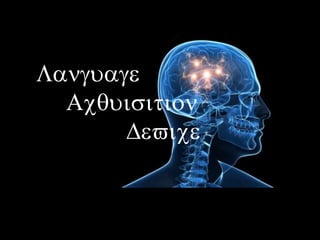
Language
Acquisition
Device
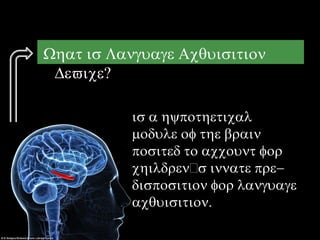
What is Language Acquisition
Device?
is a hypothetical
module of the brain
posited to account for
childrens innate pre-
disposition for language
acquisition.
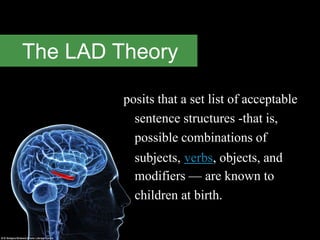
The LAD Theory
posits that a set list of acceptable
sentence structures -that is,
possible combinations of
subjects, verbs, objects, and
modifiers — are known to
children at birth.
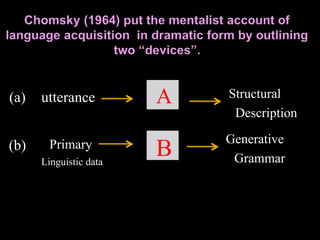
(a)
Generative
Grammar
Structural
Description
Primary
Linguistic data
utterance A
B(b)
What is Universal Grammar?
Universal Grammar (UG) is a
theory in linguistic.
• Ability to learn grammar is
hard-wired into the brain.
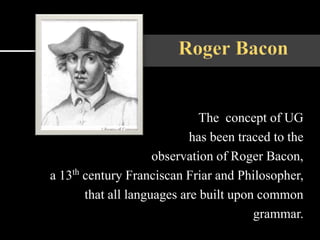
The concept of UG
has been traced to the
observation of Roger Bacon,
a 13th century Franciscan Friar and Philosopher,
that all languages are built upon common
grammar.
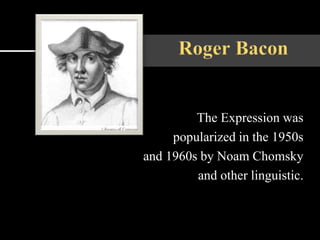
The Expression was
popularized in the 1950s
and 1960s by Noam Chomsky
and other linguistic.
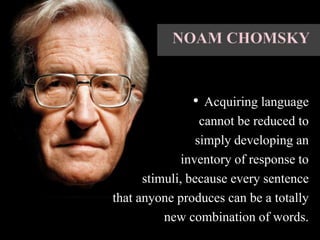
• Acquiring language
cannot be reduced to
simply developing an
inventory of response to
stimuli, because every sentence
that anyone produces can be a totally
new combination of words.
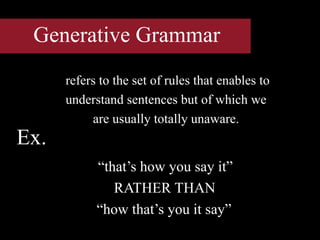
Generative Grammar
refers to the set of rules that enables to
understand sentences but of which we
are usually totally unaware.
“that’s how you say it”
RATHER THAN
“how that’s you it say”
Ex.
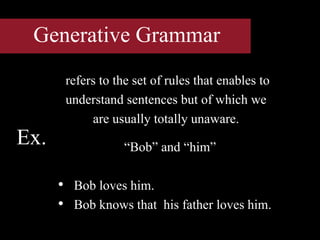
Generative Grammar
refers to the set of rules that enables to
understand sentences but of which we
are usually totally unaware.
“Bob” and “him”
• Bob loves him.
• Bob knows that his father loves him.
Ex.
Generative Grammar
NOTE:
Generative grammar has
nothing to do with grammar
textbooks, whose purpose is
simply to explain what
grammatically correct and
incorrect in given language.
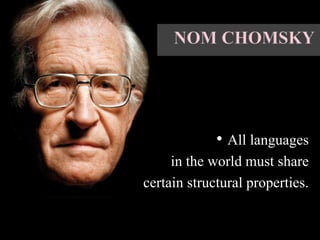
• All languages
in the world must share
certain structural properties.
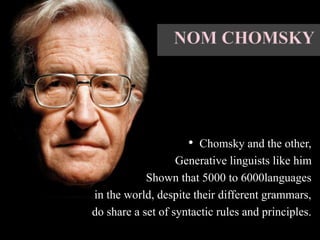
• Chomsky and the other,
Generative linguists like him
Shown that 5000 to 6000languages
in the world, despite their different grammars,
do share a set of syntactic rules and principles.
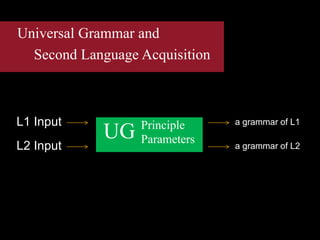
Universal Grammar and
Second Language Acquisition
L1 Input
UG Principle
ParametersL2 Input
a grammar of L1
a grammar of L2
Language Acquisition Device; Noam Chomsky

Language Acquisition Device; Noam Chomsky

  • 1.
  • 2.
    What is LanguageAcquisition Device? is a hypothetical module of the brain posited to account for childrens innate pre- disposition for language acquisition.
  • 3.
    The LAD Theory positsthat a set list of acceptable sentence structures -that is, possible combinations of subjects, verbs, objects, and modifiers — are known to children at birth.
  • 4.
  • 6.
    What is UniversalGrammar? Universal Grammar (UG) is a theory in linguistic. • Ability to learn grammar is hard-wired into the brain.
  • 7.
    The concept ofUG has been traced to the observation of Roger Bacon, a 13th century Franciscan Friar and Philosopher, that all languages are built upon common grammar.
  • 8.
    The Expression was popularizedin the 1950s and 1960s by Noam Chomsky and other linguistic.
  • 9.
    • Acquiring language cannotbe reduced to simply developing an inventory of response to stimuli, because every sentence that anyone produces can be a totally new combination of words.
  • 10.
    Generative Grammar refers tothe set of rules that enables to understand sentences but of which we are usually totally unaware. “that’s how you say it” RATHER THAN “how that’s you it say” Ex.
  • 11.
    Generative Grammar refers tothe set of rules that enables to understand sentences but of which we are usually totally unaware. “Bob” and “him” • Bob loves him. • Bob knows that his father loves him. Ex.
  • 12.
    Generative Grammar NOTE: Generative grammarhas nothing to do with grammar textbooks, whose purpose is simply to explain what grammatically correct and incorrect in given language.
  • 13.
    • All languages inthe world must share certain structural properties.
  • 14.
    • Chomsky andthe other, Generative linguists like him Shown that 5000 to 6000languages in the world, despite their different grammars, do share a set of syntactic rules and principles.
  • 15.
    Universal Grammar and SecondLanguage Acquisition L1 Input UG Principle ParametersL2 Input a grammar of L1 a grammar of L2