COCOMO MODEL
(Cost Constructive MOdel)
Most widely used software estimation
model.
COCOMO predicts the efforts and
schedule of a software product.
SEG3300 A&B W2004 R.L. Probert 2
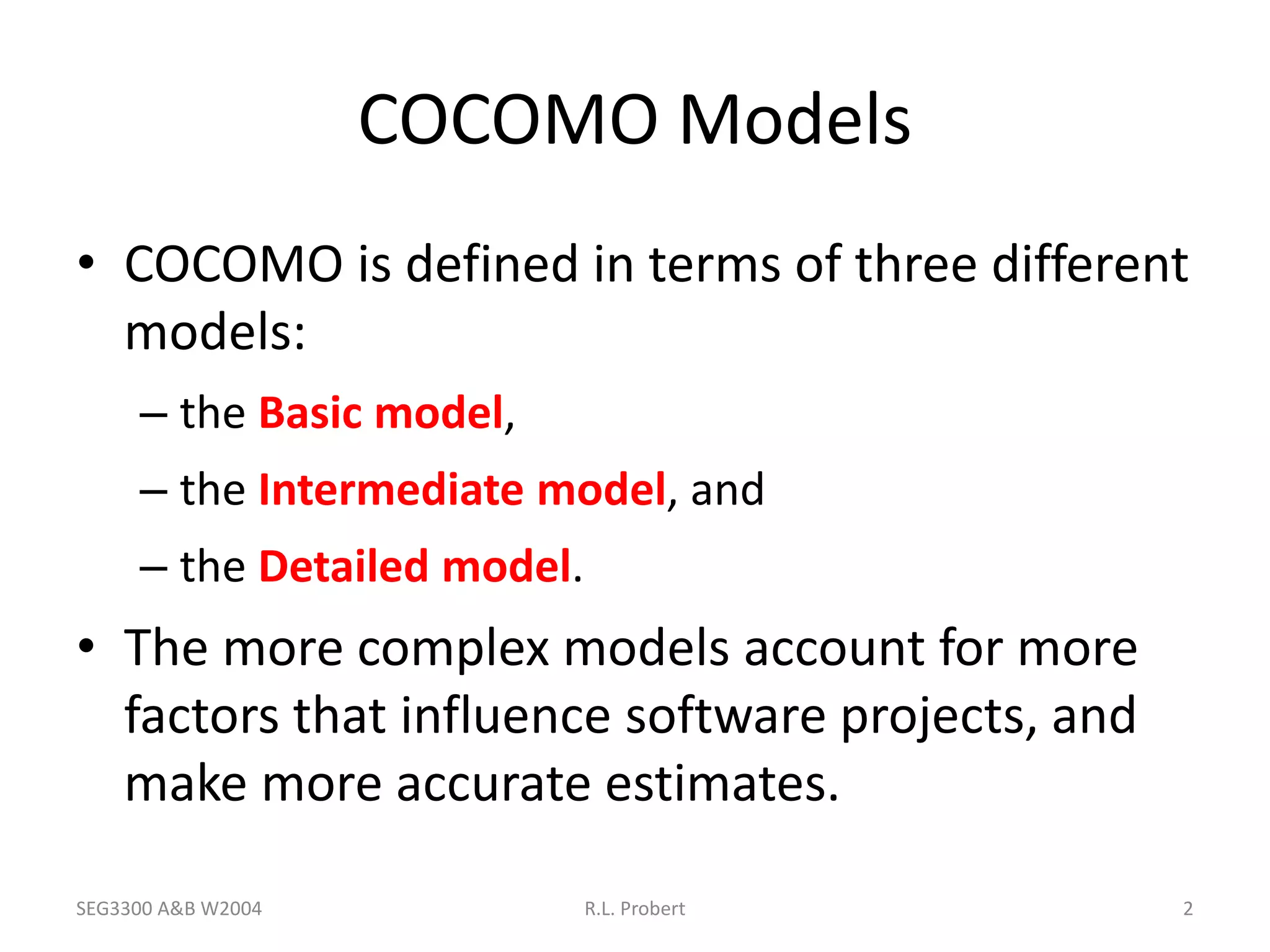
COCOMO Models
• COCOMO is defined in terms of three different
models:
– the Basic model,
– the Intermediate model, and
– the Detailed model.
• The more complex models account for more
factors that influence software projects, and
make more accurate estimates.
SEG3300 A&B W2004 R.L. Probert 3
The Development mode
• the most important factors contributing to a
project's duration and cost is the
Development Mode
• Organic Mode: The project is developed in a familiar,
stable environment, and the product is similar to
previously developed products. The product is
relatively small, and requires little innovation.
• Semidetached Mode: The project's characteristics are
intermediate between Organic and Embedded.
SEG3300 A&B W2004 R.L. Probert 4
The Development mode
• the most important factors contributing to a
project's duration and cost is the
Development Mode:
• Embedded Mode: The project is characterized by tight,
inflexible constraints and interface requirements. An
embedded mode project will require a great deal of
innovation.
TCS2411 Software Engineering 5
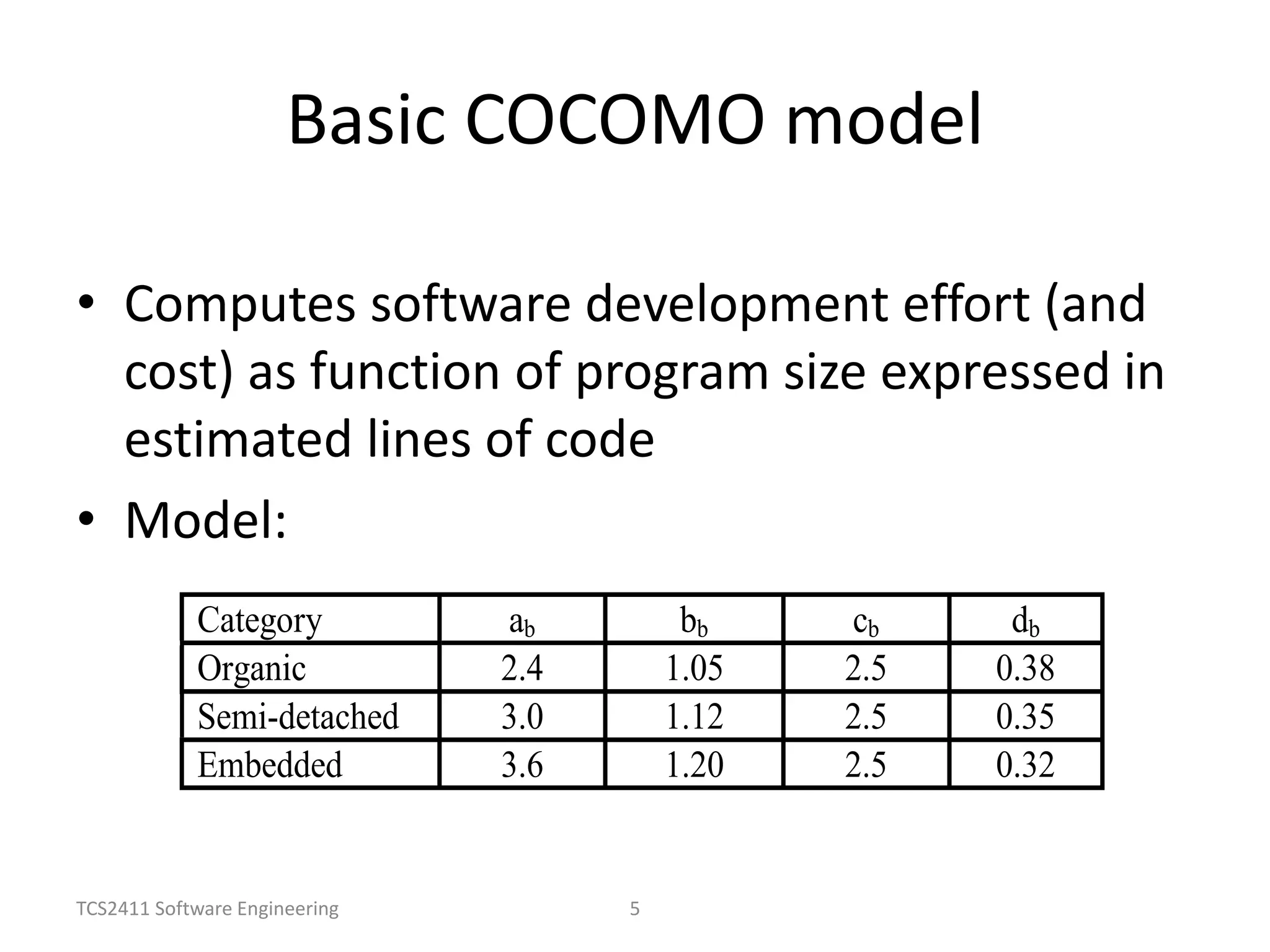
Basic COCOMO model
• Computes software development effort (and
cost) as function of program size expressed in
estimated lines of code
• Model:
Category ab bb cb db
Organic 2.4 1.05 2.5 0.38
Semi-detached 3.0 1.12 2.5 0.35
Embedded 3.6 1.20 2.5 0.32
TCS2411 Software Engineering 6
Basic COCOMO Equations
where
• E is effort in person-months
• D is development time in months
• kLOC is estimated number of lines of code
b
b
d
b
b
b
EcD
kLOCaE


P=E/D
P- Total number of persons
required to accomplish the
project
Merits
• Good for quick,early,rough order of estimates
Limitations:
• Accuracy is limited
• Does not consider certain factors(H/W
constraints,personal quality,experience,tools)
Example
• Consider a software project using semi-
detached mode with 30000 lines of code.We
will obtain estimation for this project as
follows:
• E=3.0(30)1.12
=135 person-month
• Duration estimation
D=2.5(135)0.35
=14 months
• Person estimation
P=E/D
=135/14
=10 persons approximately
TCS2411 Software Engineering 12
Intermediate COCOMO
• computes software development effort as a
function of program size and a set of “cost
drivers” that include subjective assessments of
product, hardware, personnel, and project
attributes
• Give rating to 15 attributes, from “very low” to
“extra high”, find effort multipllier (from table)
and product of all effort multipliers gives an
effort adjustment factor (EAF)
TCS2411 Software Engineering 13
Cost Driver Attributes
• Product attributes
– Required reliability
– Database size
– Product complexity
• Computer attributes
– Execution time constraint
– Main storage constraint
– Virtual machine volatility
– Computer turnaround time
TCS2411 Software Engineering 14
Cost Driver Attributes (Continued)
• Personnel attributes
– Analyst capability, Programmer capability
– Applications experience
– Virtual machine experience
– Programming language experience
• Project attributes
– Use of modern programming practices
– Use of software tools
– Required development schedule
TCS2411 Software Engineering 15
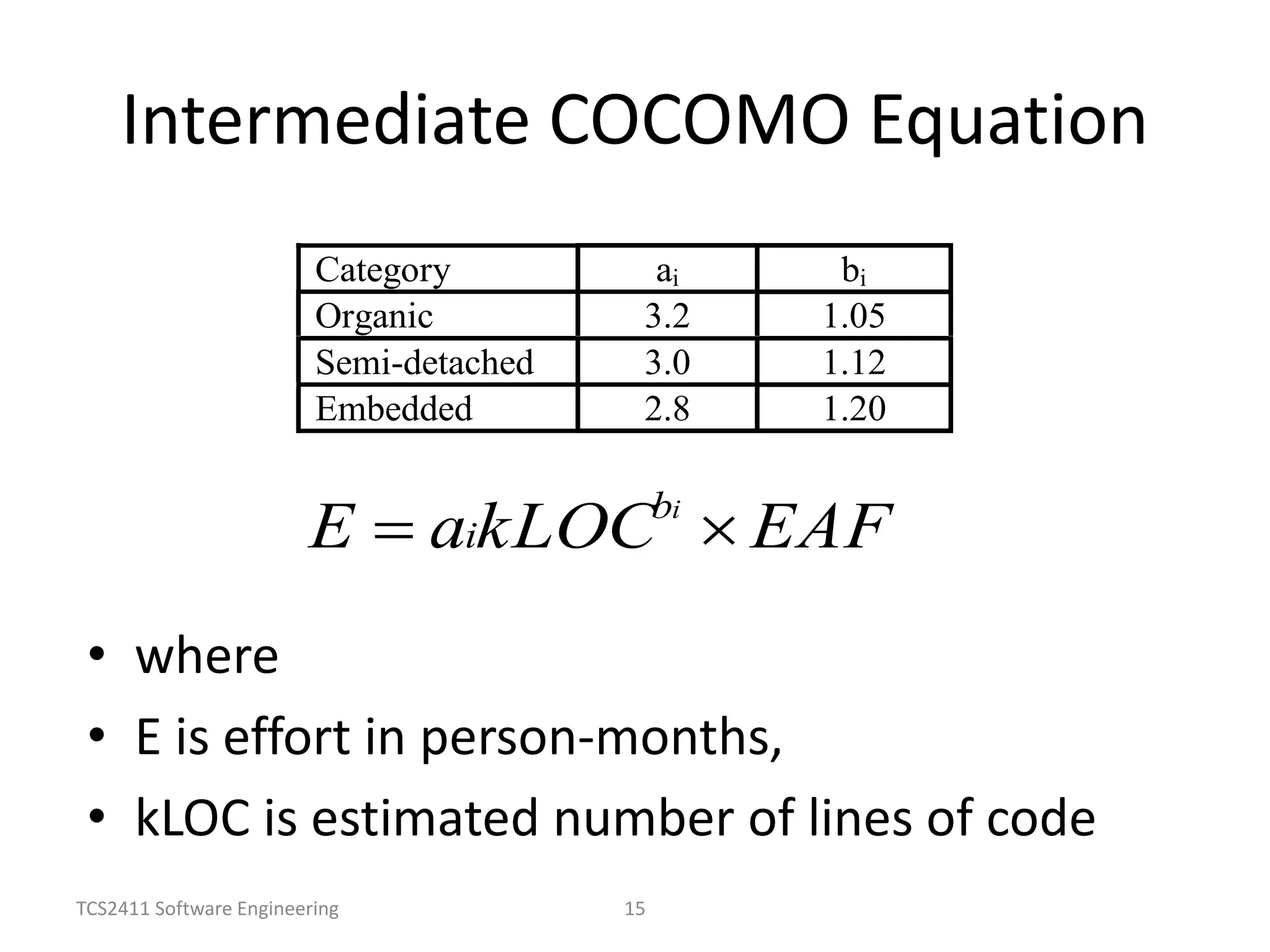
Intermediate COCOMO Equation
• where
• E is effort in person-months,
• kLOC is estimated number of lines of code
Category ai bi
Organic 3.2 1.05
Semi-detached 3.0 1.12
Embedded 2.8 1.20
EAFkLOCaE ib
i 
Merits
• Can be applied to almost entire software for
easy and rough cost estimation
• Can be applied at the s/w product component
level
Limitations:
Many components difficult to estimate
TCS2411 Software Engineering 17
Advanced COCOMO
• Incorporates all characteristics of intermediate
COCOMOwith an assessment of the cost
driver’s impact on each step of software
engineering process
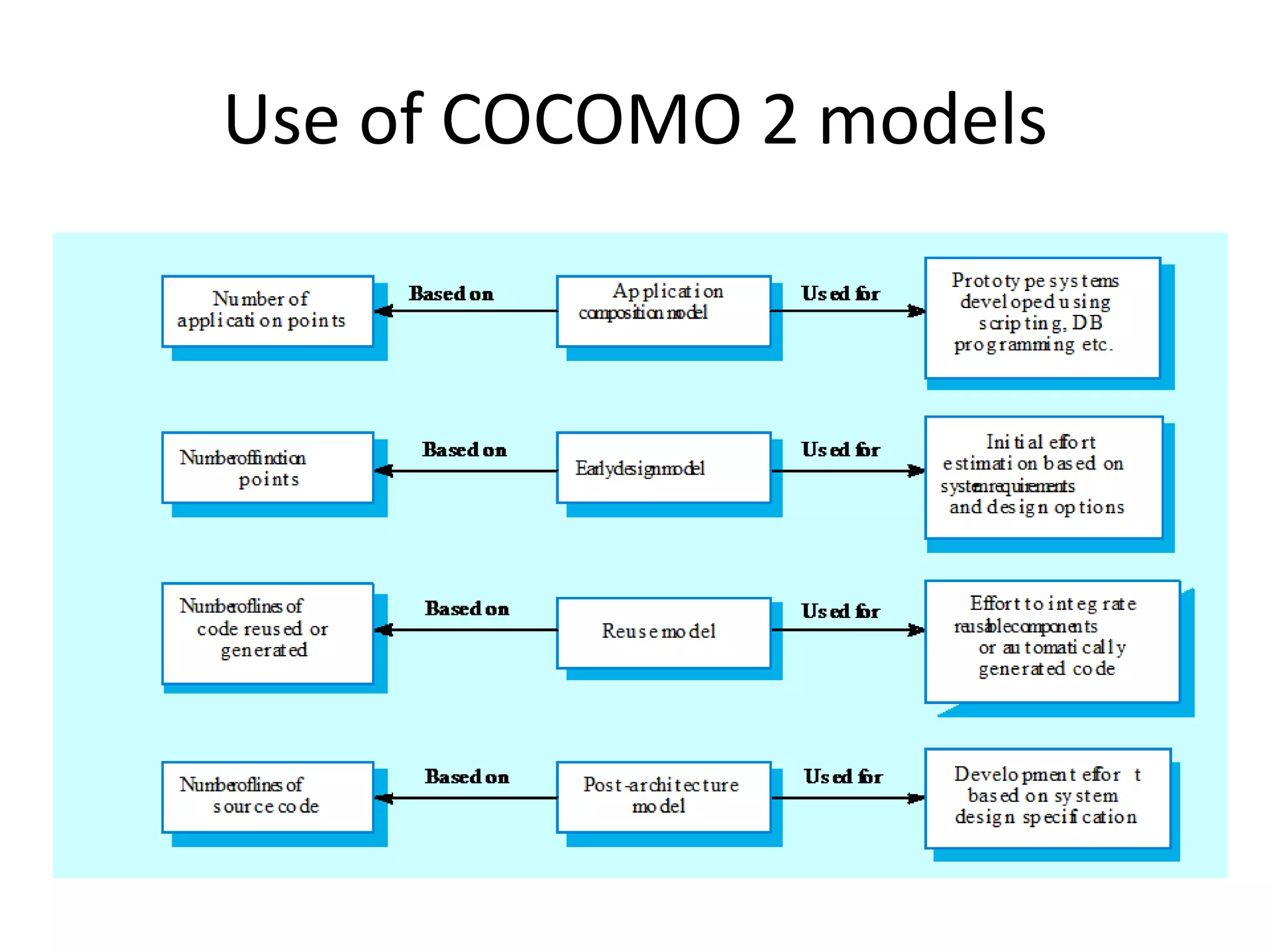
COCOMO 2 models
• COCOMO 2 incorporates a range of sub-models that produce
increasingly detailed software estimates.
• The sub-models in COCOMO 2 are:
– Application composition model. Used when software is composed
from existing parts.
– Early design model. Used when requirements are available but design
has not yet started.
– Reuse model. Used to compute the effort of integrating reusable
components.
– Post-architecture model. Used once the system architecture has been
designed and more information about the system is available.
Use of COCOMO 2 models
Application composition model
• Supports prototyping projects and projects where there is
extensive reuse.
• Based on standard estimates of developer productivity in
application (object) points/month.
• Takes CASE tool use into account.
• Formula is
– PM = ( NAP  (1 - %reuse/100 ) ) / PROD
– PM is the effort in person-months, NAP is the number of application
points and PROD is the productivity.
Object point productivity
DeveloperÕs experience
and capability
Very low Low Nominal High Very high
ICASE maturity and
capability
Very low Low Nominal High Very high
PROD (NOP/month) 4 7 13 25 50
Early design model
• Estimates can be made after the requirements
have been agreed.
• Based on a standard formula for algorithmic
models
– PM = A  SizeB  M where
– M = PERS  RCPX  RUSE  PDIF  PREX  FCIL 
SCED;
– A = 2.94 in initial calibration, Size in KLOC, B varies
from 1.1 to 1.24 depending on novelty of the
project, development flexibility, risk management
approaches and the process maturity.
Multipliers
• Multipliers reflect the capability of the
developers, the non-functional requirements,
the familiarity with the development platform,
etc.
– RCPX - product reliability and complexity;
– RUSE - the reuse required;
– PDIF - platform difficulty;
– PREX - personnel experience;
– PERS - personnel capability;
– SCED - required schedule;
– FCIL - the team support facilities.
The reuse model
• Takes into account black-box code that is
reused without change and code that has to
be adapted to integrate it with new code.
• There are two versions:
– Black-box reuse where code is not modified. An
effort estimate (PM) is computed.
– White-box reuse where code is modified. A size
estimate equivalent to the number of lines of new
source code is computed. This then adjusts the
size estimate for new code.
Reuse model estimates 1
• For generated code:
– PM = (ASLOC * AT/100)/ATPROD
– ASLOC is the number of lines of generated code
– AT is the percentage of code automatically
generated.
– ATPROD is the productivity of engineers in
integrating this code.
Reuse model estimates 2
• When code has to be understood and
integrated:
– ESLOC = ASLOC * (1-AT/100) * AAM.
– ASLOC and AT as before.
– AAM is the adaptation adjustment multiplier
computed from the costs of changing the reused
code, the costs of understanding how to integrate
the code and the costs of reuse decision making.
Post-architecture level
• Uses the same formula as the early design model
but with 17 rather than 7 associated multipliers.
• The code size is estimated as:
– Number of lines of new code to be developed;
– Estimate of equivalent number of lines of new code
computed using the reuse model;
– An estimate of the number of lines of code that have
to be modified according to requirements changes.
• This depends on 5 scale factors (see next slide). Their
sum/100 is added to 1.01
• A company takes on a project in a new domain. The client has
not defined the process to be used and has not allowed time
for risk analysis. The company has a CMM level 2 rating.
– Precedenteness - new project (4)
– Development flexibility - no client involvement - Very high (1)
– Architecture/risk resolution - No risk analysis - V. Low .(5)
– Team cohesion - new team - nominal (3)
– Process maturity - some control - nominal (3)
• Scale factor is therefore 1.17.
The exponent term
Exponent scale factors
Precedentedness Reflects the previous experience of the organisation with this type of
project. Very low means no previous experience, Extra high means
that the organisation is completely familiar with this application
domain.
Development
flexibility
Reflects the degree of flexibility in the development process. Very
low means a prescribed process is used; Extra high means that the
client only sets general goals.
Architecture/risk
resolution
Reflects the extent of risk analysis carried out. Very low means little
analysis, Extra high means a complete a thorough risk analysis.
Team cohesion Reflects how well the development team know each other and work
together. Very low means very difficult interactions, Extra high
means an integrated and effective team with no communication
problems.
Process maturity Reflects the process maturity of the organisation. The computation
of this value depends on the CMM Maturity Questionnaire but an
estimate can be achieved by subtracting the CMM process maturity
level from 5.
TCS2411 Software Engineering 30
Estimation Issues
• Historical Data
• Accuracy
• Estimation Technique
• Automation
• Improving the Estimate
TCS2411 Software Engineering 31
References
• “Software Engineering: A Practitioner’s
Approach” 5th Ed. by Roger S. Pressman, Mc-
Graw-Hill, 2001
• “Software Engineering” by Ian Sommerville,
Addison-Wesley, 2001

Cocomo model

  • 1.
    COCOMO MODEL (Cost ConstructiveMOdel) Most widely used software estimation model. COCOMO predicts the efforts and schedule of a software product.
  • 2.
    SEG3300 A&B W2004R.L. Probert 2 COCOMO Models • COCOMO is defined in terms of three different models: – the Basic model, – the Intermediate model, and – the Detailed model. • The more complex models account for more factors that influence software projects, and make more accurate estimates.
  • 3.
    SEG3300 A&B W2004R.L. Probert 3 The Development mode • the most important factors contributing to a project's duration and cost is the Development Mode • Organic Mode: The project is developed in a familiar, stable environment, and the product is similar to previously developed products. The product is relatively small, and requires little innovation. • Semidetached Mode: The project's characteristics are intermediate between Organic and Embedded.
  • 4.
    SEG3300 A&B W2004R.L. Probert 4 The Development mode • the most important factors contributing to a project's duration and cost is the Development Mode: • Embedded Mode: The project is characterized by tight, inflexible constraints and interface requirements. An embedded mode project will require a great deal of innovation.
  • 5.
    TCS2411 Software Engineering5 Basic COCOMO model • Computes software development effort (and cost) as function of program size expressed in estimated lines of code • Model: Category ab bb cb db Organic 2.4 1.05 2.5 0.38 Semi-detached 3.0 1.12 2.5 0.35 Embedded 3.6 1.20 2.5 0.32
  • 6.
    TCS2411 Software Engineering6 Basic COCOMO Equations where • E is effort in person-months • D is development time in months • kLOC is estimated number of lines of code b b d b b b EcD kLOCaE  
  • 7.
    P=E/D P- Total numberof persons required to accomplish the project
  • 8.
    Merits • Good forquick,early,rough order of estimates Limitations: • Accuracy is limited • Does not consider certain factors(H/W constraints,personal quality,experience,tools)
  • 9.
    Example • Consider asoftware project using semi- detached mode with 30000 lines of code.We will obtain estimation for this project as follows: • E=3.0(30)1.12 =135 person-month
  • 10.
  • 11.
  • 12.
    TCS2411 Software Engineering12 Intermediate COCOMO • computes software development effort as a function of program size and a set of “cost drivers” that include subjective assessments of product, hardware, personnel, and project attributes • Give rating to 15 attributes, from “very low” to “extra high”, find effort multipllier (from table) and product of all effort multipliers gives an effort adjustment factor (EAF)
  • 13.
    TCS2411 Software Engineering13 Cost Driver Attributes • Product attributes – Required reliability – Database size – Product complexity • Computer attributes – Execution time constraint – Main storage constraint – Virtual machine volatility – Computer turnaround time
  • 14.
    TCS2411 Software Engineering14 Cost Driver Attributes (Continued) • Personnel attributes – Analyst capability, Programmer capability – Applications experience – Virtual machine experience – Programming language experience • Project attributes – Use of modern programming practices – Use of software tools – Required development schedule
  • 15.
    TCS2411 Software Engineering15 Intermediate COCOMO Equation • where • E is effort in person-months, • kLOC is estimated number of lines of code Category ai bi Organic 3.2 1.05 Semi-detached 3.0 1.12 Embedded 2.8 1.20 EAFkLOCaE ib i 
  • 16.
    Merits • Can beapplied to almost entire software for easy and rough cost estimation • Can be applied at the s/w product component level Limitations: Many components difficult to estimate
  • 17.
    TCS2411 Software Engineering17 Advanced COCOMO • Incorporates all characteristics of intermediate COCOMOwith an assessment of the cost driver’s impact on each step of software engineering process
  • 18.
    COCOMO 2 models •COCOMO 2 incorporates a range of sub-models that produce increasingly detailed software estimates. • The sub-models in COCOMO 2 are: – Application composition model. Used when software is composed from existing parts. – Early design model. Used when requirements are available but design has not yet started. – Reuse model. Used to compute the effort of integrating reusable components. – Post-architecture model. Used once the system architecture has been designed and more information about the system is available.
  • 19.
    Use of COCOMO2 models
  • 20.
    Application composition model •Supports prototyping projects and projects where there is extensive reuse. • Based on standard estimates of developer productivity in application (object) points/month. • Takes CASE tool use into account. • Formula is – PM = ( NAP  (1 - %reuse/100 ) ) / PROD – PM is the effort in person-months, NAP is the number of application points and PROD is the productivity.
  • 21.
    Object point productivity DeveloperÕsexperience and capability Very low Low Nominal High Very high ICASE maturity and capability Very low Low Nominal High Very high PROD (NOP/month) 4 7 13 25 50
  • 22.
    Early design model •Estimates can be made after the requirements have been agreed. • Based on a standard formula for algorithmic models – PM = A  SizeB  M where – M = PERS  RCPX  RUSE  PDIF  PREX  FCIL  SCED; – A = 2.94 in initial calibration, Size in KLOC, B varies from 1.1 to 1.24 depending on novelty of the project, development flexibility, risk management approaches and the process maturity.
  • 23.
    Multipliers • Multipliers reflectthe capability of the developers, the non-functional requirements, the familiarity with the development platform, etc. – RCPX - product reliability and complexity; – RUSE - the reuse required; – PDIF - platform difficulty; – PREX - personnel experience; – PERS - personnel capability; – SCED - required schedule; – FCIL - the team support facilities.
  • 24.
    The reuse model •Takes into account black-box code that is reused without change and code that has to be adapted to integrate it with new code. • There are two versions: – Black-box reuse where code is not modified. An effort estimate (PM) is computed. – White-box reuse where code is modified. A size estimate equivalent to the number of lines of new source code is computed. This then adjusts the size estimate for new code.
  • 25.
    Reuse model estimates1 • For generated code: – PM = (ASLOC * AT/100)/ATPROD – ASLOC is the number of lines of generated code – AT is the percentage of code automatically generated. – ATPROD is the productivity of engineers in integrating this code.
  • 26.
    Reuse model estimates2 • When code has to be understood and integrated: – ESLOC = ASLOC * (1-AT/100) * AAM. – ASLOC and AT as before. – AAM is the adaptation adjustment multiplier computed from the costs of changing the reused code, the costs of understanding how to integrate the code and the costs of reuse decision making.
  • 27.
    Post-architecture level • Usesthe same formula as the early design model but with 17 rather than 7 associated multipliers. • The code size is estimated as: – Number of lines of new code to be developed; – Estimate of equivalent number of lines of new code computed using the reuse model; – An estimate of the number of lines of code that have to be modified according to requirements changes.
  • 28.
    • This dependson 5 scale factors (see next slide). Their sum/100 is added to 1.01 • A company takes on a project in a new domain. The client has not defined the process to be used and has not allowed time for risk analysis. The company has a CMM level 2 rating. – Precedenteness - new project (4) – Development flexibility - no client involvement - Very high (1) – Architecture/risk resolution - No risk analysis - V. Low .(5) – Team cohesion - new team - nominal (3) – Process maturity - some control - nominal (3) • Scale factor is therefore 1.17. The exponent term
  • 29.
    Exponent scale factors PrecedentednessReflects the previous experience of the organisation with this type of project. Very low means no previous experience, Extra high means that the organisation is completely familiar with this application domain. Development flexibility Reflects the degree of flexibility in the development process. Very low means a prescribed process is used; Extra high means that the client only sets general goals. Architecture/risk resolution Reflects the extent of risk analysis carried out. Very low means little analysis, Extra high means a complete a thorough risk analysis. Team cohesion Reflects how well the development team know each other and work together. Very low means very difficult interactions, Extra high means an integrated and effective team with no communication problems. Process maturity Reflects the process maturity of the organisation. The computation of this value depends on the CMM Maturity Questionnaire but an estimate can be achieved by subtracting the CMM process maturity level from 5.
  • 30.
    TCS2411 Software Engineering30 Estimation Issues • Historical Data • Accuracy • Estimation Technique • Automation • Improving the Estimate
  • 31.
    TCS2411 Software Engineering31 References • “Software Engineering: A Practitioner’s Approach” 5th Ed. by Roger S. Pressman, Mc- Graw-Hill, 2001 • “Software Engineering” by Ian Sommerville, Addison-Wesley, 2001