SOFTWARE
   COST
ESTIMATION
 PROJECT
PRESENTED BY -

          AHETSHAM
            ASHISH
           GAJANAN
            PALASH
         SUKHNANDAN
          SHASHANK
!! OBJECTIVES !!
  To introduce the fundamentals of
software costing and pricing.
  To describe 3 metrics for software
productivity assessment.
  To explain why different techniques
should be used for software estimation.
  To describe the principles of the
COCOMO 2 algorithmic cost estimation
model.
@ TOPICS @
    Software productivity.

    Estimation techniques.

    Algorithmic cost modelling.

    Project duration and
    staf fing.
$ SOFTWARE COST
            COMPONENTS $

Hardware and software costs.
Travel and training costs.
Effort costs (the dominant factor in most projects).
   The salaries of engineers involved in the project.
   Social and insurance costs.
Effort costs must take overheads into account.
   Costs of building, heating, lighting.
   Costs of networking and communications.
   Costs of shared facilities (e.g: library, staff restaurant, etc.)
SOFTWARE                 PRODUCTIVITY
   A measure of the rate at which individual engineers
involved in software development
   produce software and associated
   although quality assurance is a factor in productivi
assessment.

   Essentially, we was documentation.

   Not quality-oriented not to measure useful
  functionality produced per time unit.
!!! PRODUCTIVITY MEASURES !!!

  Size related meaSureS :
   Based on some output from the
software process. This may be lines of
delivered source code, object code
instructions, etc.

  Function-related meaSureS :
    Based on an estimate of the functionality
of the delivered software. Function-points
are the best known of this type of measure.
FACTORS EFFECTING
                PRODUCTIVITY
APPLICATION DOMAIN EXPERINACE :
    Knowledge of the application domain is essential for effective
software development. Engineers who already understand a domain are
likely to be the most productive.

 PROCESS qUALITY :
  The development proces use can have a significant efect on productiv
 PROjECT SIzE
      The larger a project, the more time required for team
 communications. Less time is available for development so individual
 productivity is reduced
 .
TEChNOLOGY SUPPORT
    Good support technology such as CASE tools, configuration
management systems, etc. can improve productivity.

WORkING ENVIRONMENT
   A quiet working environment with private work areas contributes to
improved productivity.
!! ESTIMATION
      TECHNIQUE !!

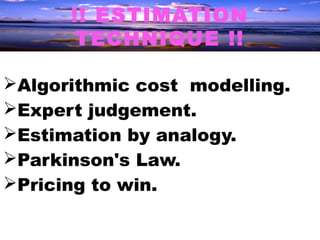
Algorithmic cost modelling.
Expert judgement.
Estimation by analogy.
Parkinson's Law.
Pricing to win.
FACTORS EFFECTING
       PRODUCTIVITY
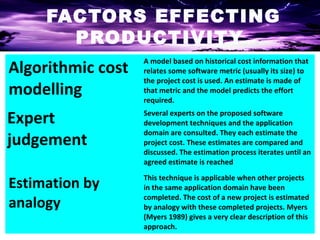
Algorithmic cost
                   A model based on historical cost information that
                   relates some software metric (usually its size) to
                   the project cost is used. An estimate is made of
modelling          that metric and the model predicts the effort
                   required.

Expert             Several experts on the proposed software
                   development techniques and the application
                   domain are consulted. They each estimate the
judgement          project cost. These estimates are compared and
                   discussed. The estimation process iterates until an
                   agreed estimate is reached

Estimation by      This technique is applicable when other projects
                   in the same application domain have been
                   completed. The cost of a new project is estimated
analogy            by analogy with these completed projects. Myers
                   (Myers 1989) gives a very clear description of this
                   approach.
FACTORS EFFECTING
        PRODUCTIVITY

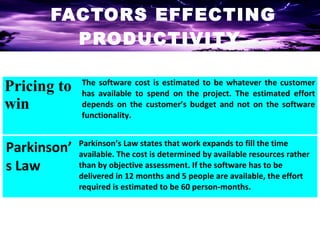
Pricing to   The software cost is estimated to be whatever the customer
             has available to spend on the project. The estimated effort
win          depends on the customer’s budget and not on the software
             functionality.


Parkinson’   Parkinson’s Law states that work expands to fill the time
             available. The cost is determined by available resources rather
s Law        than by objective assessment. If the software has to be
             delivered in 12 months and 5 people are available, the effort
             required is estimated to be 60 person-months.
TOP DOWN & BOTTOM UP
        ESTIMATION

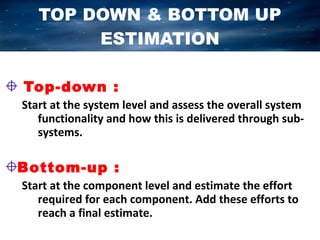
Top-down :
Start at the system level and assess the overall system
   functionality and how this is delivered through sub-
   systems.

Bottom-up :
Start at the component level and estimate the effort
   required for each component. Add these efforts to
   reach a final estimate.
COCOMO MODEL
 An empirical model based on project
experience.
  Well-documented, ‘independent’ model which
is not tied to a specific software vendor.
  Long history from initial version published in
1981 (COCOMO-81) through various
instantiations to COCOMO 2.
 COCOMO 2 takes into account different
approaches to software development, reuse,
etc.
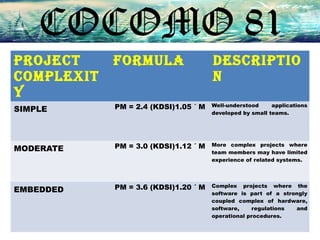
COCOMO 81
PROJECT     FORMULA                   DESCRIPTIO
COMPLEXIT                             N
Y
SIMPLE      PM = 2.4 (KDSI)1.05 ´ M   Well-understood     applications
                                      developed by small teams.


MODERATE    PM = 3.0 (KDSI)1.12 ´ M   More complex projects where
                                      team members may have limited
                                      experience of related systems.


EMBEDDED    PM = 3.6 (KDSI)1.20 ´ M   Complex projects where the
                                      software is part of a strongly
                                      coupled complex of hardware,
                                      software,     regulations and
                                      operational procedures.
COCOMO 2
  COCOMO 81 was developed with the assumption that
a waterfall process would be used and that all software
would be developed from scratch.


   Since its formulation, there have been many changes
in software engineering practice and COCOMO 2 is
designed to accommodate different approaches to
software development.
ROJECT DURATION & STAFFING
    As well as effort estimation, managers must
   estimate the calendar time required to
complete a project and when staff will be
required.
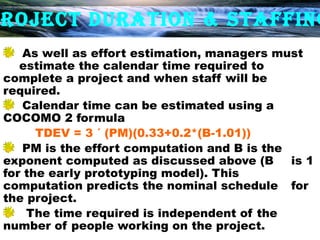
    Calendar time can be estimated using a
COCOMO 2 formula
      TDEV = 3 ´ (PM)(0.33+0.2*(B-1.01))
    PM is the effort computation and B is the
exponent computed as discussed above (B       is 1
for the early prototyping model). This
computation predicts the nominal schedule for
the project.
    The time required is independent of the
number of people working on the project.
STAFFING REQUIRMENT
 Staff required can’t be computed by diving
 the development time by the required
 schedule.

 The number of people working on a project
 varies depending on the phase of the
 project.

 The more people who work on the project,
 the more total effort is usually required.

 A very rapid build-up of people often
 correlates with schedule slippage.
KEYPOINTS
  There is not a simple relationship between
  the price charged for a system and its
development costs.

   Factors affecting productivity include
individual aptitude, domain experience,   the
development project, the project size, tool
support and the working environment.

  Software may be priced to gain a contract
  and the functionality adjusted to the price.
KEYPOINTS
  Different techniques of cost estimation should be
  used when estimating costs.

  The COCOMO model takes project, product,
personnel and hardware attributes into account
when predicting effort required.

  Algorithmic cost models support quantitative
option analysis as they allow the costs of different
options to be compared.

  The time to complete project is not proportional to
  the number of people working on the project.
Software  cost estimation project

Software cost estimation project

  • 1.
    SOFTWARE COST ESTIMATION PROJECT
  • 2.
    PRESENTED BY - AHETSHAM ASHISH GAJANAN PALASH SUKHNANDAN SHASHANK
  • 3.
    !! OBJECTIVES !! To introduce the fundamentals of software costing and pricing. To describe 3 metrics for software productivity assessment. To explain why different techniques should be used for software estimation. To describe the principles of the COCOMO 2 algorithmic cost estimation model.
  • 4.
    @ TOPICS @  Software productivity.  Estimation techniques.  Algorithmic cost modelling.  Project duration and staf fing.
  • 5.
    $ SOFTWARE COST COMPONENTS $ Hardware and software costs. Travel and training costs. Effort costs (the dominant factor in most projects). The salaries of engineers involved in the project. Social and insurance costs. Effort costs must take overheads into account. Costs of building, heating, lighting. Costs of networking and communications. Costs of shared facilities (e.g: library, staff restaurant, etc.)
  • 6.
    SOFTWARE PRODUCTIVITY A measure of the rate at which individual engineers involved in software development produce software and associated although quality assurance is a factor in productivi assessment. Essentially, we was documentation. Not quality-oriented not to measure useful functionality produced per time unit.
  • 7.
    !!! PRODUCTIVITY MEASURES!!! Size related meaSureS : Based on some output from the software process. This may be lines of delivered source code, object code instructions, etc. Function-related meaSureS : Based on an estimate of the functionality of the delivered software. Function-points are the best known of this type of measure.
  • 8.
    FACTORS EFFECTING PRODUCTIVITY APPLICATION DOMAIN EXPERINACE : Knowledge of the application domain is essential for effective software development. Engineers who already understand a domain are likely to be the most productive. PROCESS qUALITY : The development proces use can have a significant efect on productiv PROjECT SIzE The larger a project, the more time required for team communications. Less time is available for development so individual productivity is reduced . TEChNOLOGY SUPPORT Good support technology such as CASE tools, configuration management systems, etc. can improve productivity. WORkING ENVIRONMENT A quiet working environment with private work areas contributes to improved productivity.
  • 9.
    !! ESTIMATION TECHNIQUE !! Algorithmic cost modelling. Expert judgement. Estimation by analogy. Parkinson's Law. Pricing to win.
  • 10.
    FACTORS EFFECTING PRODUCTIVITY Algorithmic cost A model based on historical cost information that relates some software metric (usually its size) to the project cost is used. An estimate is made of modelling that metric and the model predicts the effort required. Expert Several experts on the proposed software development techniques and the application domain are consulted. They each estimate the judgement project cost. These estimates are compared and discussed. The estimation process iterates until an agreed estimate is reached Estimation by This technique is applicable when other projects in the same application domain have been completed. The cost of a new project is estimated analogy by analogy with these completed projects. Myers (Myers 1989) gives a very clear description of this approach.
  • 11.
    FACTORS EFFECTING PRODUCTIVITY Pricing to The software cost is estimated to be whatever the customer has available to spend on the project. The estimated effort win depends on the customer’s budget and not on the software functionality. Parkinson’ Parkinson’s Law states that work expands to fill the time available. The cost is determined by available resources rather s Law than by objective assessment. If the software has to be delivered in 12 months and 5 people are available, the effort required is estimated to be 60 person-months.
  • 12.
    TOP DOWN &BOTTOM UP ESTIMATION Top-down : Start at the system level and assess the overall system functionality and how this is delivered through sub- systems. Bottom-up : Start at the component level and estimate the effort required for each component. Add these efforts to reach a final estimate.
  • 13.
    COCOMO MODEL Anempirical model based on project experience. Well-documented, ‘independent’ model which is not tied to a specific software vendor. Long history from initial version published in 1981 (COCOMO-81) through various instantiations to COCOMO 2. COCOMO 2 takes into account different approaches to software development, reuse, etc.
  • 14.
    COCOMO 81 PROJECT FORMULA DESCRIPTIO COMPLEXIT N Y SIMPLE PM = 2.4 (KDSI)1.05 ´ M Well-understood applications developed by small teams. MODERATE PM = 3.0 (KDSI)1.12 ´ M More complex projects where team members may have limited experience of related systems. EMBEDDED PM = 3.6 (KDSI)1.20 ´ M Complex projects where the software is part of a strongly coupled complex of hardware, software, regulations and operational procedures.
  • 15.
    COCOMO 2 COCOMO 81 was developed with the assumption that a waterfall process would be used and that all software would be developed from scratch. Since its formulation, there have been many changes in software engineering practice and COCOMO 2 is designed to accommodate different approaches to software development.
  • 16.
    ROJECT DURATION &STAFFING As well as effort estimation, managers must estimate the calendar time required to complete a project and when staff will be required. Calendar time can be estimated using a COCOMO 2 formula TDEV = 3 ´ (PM)(0.33+0.2*(B-1.01)) PM is the effort computation and B is the exponent computed as discussed above (B is 1 for the early prototyping model). This computation predicts the nominal schedule for the project. The time required is independent of the number of people working on the project.
  • 17.
    STAFFING REQUIRMENT Staffrequired can’t be computed by diving the development time by the required schedule. The number of people working on a project varies depending on the phase of the project. The more people who work on the project, the more total effort is usually required. A very rapid build-up of people often correlates with schedule slippage.
  • 18.
    KEYPOINTS Thereis not a simple relationship between the price charged for a system and its development costs. Factors affecting productivity include individual aptitude, domain experience, the development project, the project size, tool support and the working environment. Software may be priced to gain a contract and the functionality adjusted to the price.
  • 19.
    KEYPOINTS Differenttechniques of cost estimation should be used when estimating costs. The COCOMO model takes project, product, personnel and hardware attributes into account when predicting effort required. Algorithmic cost models support quantitative option analysis as they allow the costs of different options to be compared. The time to complete project is not proportional to the number of people working on the project.