Baraka Gitari
Masters Thesis Proposal
Part 1 of 3
BACTERIAL CELLULOSE:
THE PERFECT MEDIUM
1
-Goal
-History (Literature)
- Subcellular processes
- Hestrin Schramm Medium with modifications
- Extracting cellulose
-Plan
-Synthesizing
-Processing (Extracting, electrospinning)
-Characterizing (DSC, SEM, XRD, TGA, OM)
-Hurdles
-Aseptic procedure
OUTLINE
2
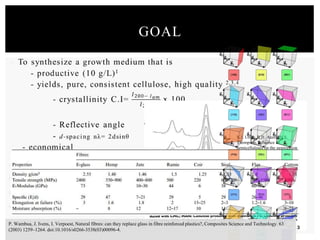
GOAL
K.I. Uhlin, R.H. Atalla, N.S.
Thompson, Influence of
hemicelluloses on the aggregation
patterns of bacterial cellulose,
Cellulose. 2 (1995) 129–144.
doi:10.1007/bf00816385.
3
P. Wambua, J. Ivens, I. Verpoest, Natural fibres: can they replace glass in fibre reinforced plastics?, Composites Science and Technology. 63
(2003) 1259–1264. doi:10.1016/s0266-3538(03)00096-4.
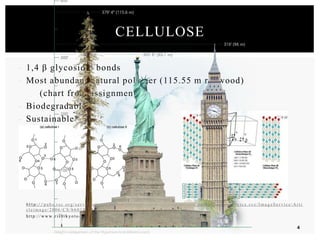
- 1,4 β glycosidic bonds
- Most abundant natural polymer (115.55 m redwood)
(chart from assignment 2)
- Biodegradable
- Sustainable*
- http:// pubs.r s c .or g/ s er vi c e s/ i ma ge s/ RS Cp ub s. eP l a t fo r m. S er vi c e. Fr e e Co nt e nt .I ma g eS er vi c e. s vc /I ma g eS e r vi c e / Ar ti
cleima ge/ 2006 /C S/b6 01872 f/b 601872 f - f2 . gi f
- http:// ww w. r is h. kyo to - u. a c.j p/ W / LB M I/ r e s e ar c h/I a ib_ S.j p g
CELLULOSE
4
-Intracellular polymerization, extracellular crystallization
- Gluconacetobacter xylinus
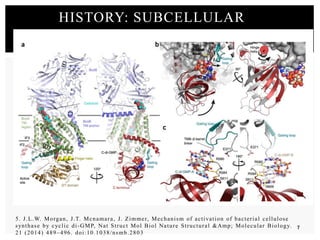
- Bacterial Cellulose Synthase5
- activated by ci-di-GMP
- Substrate UDP-Glucose
- BcsA/B/C/D subunits from BcsI and BcsII opersons
- Mutations6
- G. xylinus NBRC 3288,(frameshift bcsBI and transposon insertion bcsCII)
- K. hansenii ATCC 23769 (IS cellulose synthase)
- Acetobacter tropicalis SKU1100 (R to S via single C deletion or insertion
polE)
- complete genome sequencing
- Basics of protein function and mechanisms
5. J .L.W. Morgan, J .T. Mcnamara, J . Zimmer, Mechanism of activation of bacterial cellulose synthase by cyclic di -
GMP, Nat Struct Mol Biol Nature Structural &Amp; Molecular Biology. 21 (2014) 489 –496.
doi:10.1038/nsmb.2803 .
6. M. Matsutani, K. Ito, Y. Azuma, H. Ogino, M. Shirai, T. Yakushi, et al., Adaptive mutation related to cellulose
producibility in Komagataeibacter medellinensis (Gluconacetobacter xylinus) NBRC 3288, Appl Microbiol
Biotechnol Applied Microbiology and Biotechnology. 99 (2015) 7229 –7240. doi:10.1007/s00253 -015-6598-x.
HISTORY: SUBCELLULAR
ci-di-GMP UDP-Glucose
5
7. K. J i, W . W ang, B .
Zeng, S. Chen, Q. Zhao,
Y. Chen, et al.,
Bacteria l cellulos e
synt hes i s mecha ni s m of
facul t ati v e anaerob e
Enteroba ct e r sp. FY -07,
Sci. Rep. Scienti fi c
Reports. 6 (2016)
21863.
doi:10.1038/srep 21863 .
HISTORY: SUBCELLULAR
6
5. J.L.W. Morgan, J.T. Mcnamara, J. Zimmer, Mechanism of activation of bacterial cellulose
synthase by cyclic di-GMP, Nat Struct Mol Biol Nature Structural &Amp; Molecular Biology.
21 (2014) 489–496. doi:10.1038/nsmb.2803
HISTORY: SUBCELLULAR
7
- Hestrin Schramm Medium8 (1954) (% w/v)
- glucose 2.0
- bactopeptone 0.5
- yeast extract 0.5
- di-sodium hydrogen phosphate* Na2HPO4 0.27
- citric acid* 0.12
- starting pH 6.0
- Modifications
-sugars (sucrose, fructose)
- Alcohols
-micronutrients (P, S, K, Mg, Ca , Fe)
- antioxidants (lignosulfonate)
- pH
8 . M. Schramm, S. Hestrin , Factors affecting Production of Cellulose at the Air/ Liquid Interface of a Culture of
Acetobacter xylinum, Journal of General Microbio lo gy. 11 (1954) 123 –129. doi:10.109 9/0 02 212 87 -1 1-1 -1 23.
https://ndb.nal .usda .go v/ ndb/ foo ds/sho w/ 87 34? fo r ma t= F u l l& re por t f m t=p df&p df Qvs= % 7 B % 7D
HISTORY: GROWTH MEDIUM
8
A. Kurosumi, C. Sasaki, Y. Yamashita, Y. Nakamura, Utilization of various fruit juices as carbon source for production of bacterial cellulose by Acetobacter
xylinum NBRC 13693, Carbohydrate Polymers. 76 (2009) 333–335. doi:10.1016/j.carbpol.2008.11.009.
9
Micronutrient Orange Juice Pineapple Juice
Calcium 10.89 mg 13 mg
Iron 0.20 mg 0.29 mg
Magnesium 10.89 mg 12 mg
Potassium 200 mg 109 mg
10
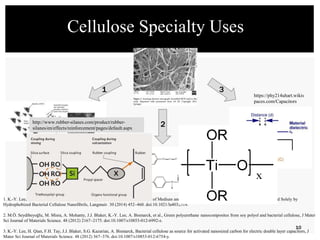
Cellulose Specialty Uses
https://phy214uhart.wikis
paces.com/Capacitors
1. K.-Y. Lee, J.J. Blaker, R. Murakami, J.Y.Y. Heng, A. Bismarck, Phase Behavior of Medium and High Internal Phase Water-in-Oil Emulsions Stabilized Solely by
Hydrophobized Bacterial Cellulose Nanofibrils, Langmuir. 30 (2014) 452–460. doi:10.1021/la4032514.
2. M.Ö. Seydibeyoğlu, M. Misra, A. Mohanty, J.J. Blaker, K.-Y. Lee, A. Bismarck, et al., Green polyurethane nanocomposites from soy polyol and bacterial cellulose, J Mater
Sci Journal of Materials Science. 48 (2012) 2167–2175. doi:10.1007/s10853-012-6992-z.
3. K.-Y. Lee, H. Qian, F.H. Tay, J.J. Blaker, S.G. Kazarian, A. Bismarck, Bacterial cellulose as source for activated nanosized carbon for electric double layer capacitors, J
Mater Sci Journal of Materials Science. 48 (2012) 367–376. doi:10.1007/s10853-012-6754-y.
1
2
3
http://www.rubber-silanes.com/product/rubber-
silanes/en/effects/reinforcement/pages/default.aspx
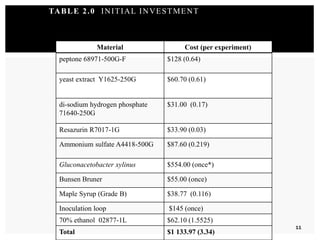
TABLE 2.0 INITIAL INVESTMENT
Material Cost (per experiment)
peptone 68971-500G-F $128 (0.64)
yeast extract Y1625-250G $60.70 (0.61)
di-sodium hydrogen phosphate
71640-250G
$31.00 (0.17)
Resazurin R7017-1G $33.90 (0.03)
Ammonium sulfate A4418-500G $87.60 (0.219)
Gluconacetobacter xylinus $554.00 (once*)
Bunsen Bruner $55.00 (once)
Maple Syrup (Grade B) $38.77 (0.116)
Inoculation loop $145 (once)
70% ethanol 02877-1L $62.10 (1.5525)
Total $1 133.97 (3.34)
11
TABLE 1.0 GROWTH MEDIUM SOURCE AND BACTERIAL FUNCTION
Element Medium Source Function
Carbon -Grade B Maple Syrup
-peptone, yeast extract
- Backbone of organic molecules
Oxygen -Oxygen in air
- organic compounds
- Last acceptor in ETC
- Organic molecules
Nitrogen - Peptone,
- Yeast extract
- Ammonium sulfate
- Proteins
- Nucleic acids
- Coenzymes
Hydrogen -organic compounds
- H2 in air
-Organic molecules
Phosphorous - Na2HPO4 (di-sodium hydrogen
phosphate)
-Nucleic acids
-Phospholipids
- Lipopolysaccharides (LPS)
Sulfur NH4SO4 - Amino Acids with Sulfur
- Coenzyme
Potassium -Grade B Maple Syrup -intracellular cation
-cytoplasmic signaling
-incorporation of sulfur into protein
- Cofactor (pyruvate kinase)
Magnesium -Grade B Maple Syrup - Cofactor (pyruvate kinase)
- Stabilizes (ATP, nucleic acids, RNA, membrane)
Calcium -Grade B Maple Syrup - Intracellular signaling hypothesized
Iron -Grade B Maple Syrup - Cytochrome ETC
12
PLAN: EXPERIMENTAL PROCEDURE
autoclave Bunsen burner
ShakerΔT
53524
centrifuge
13
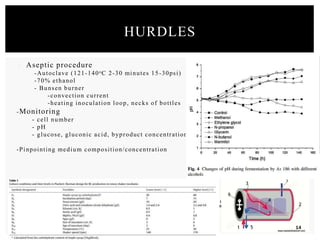
- Aseptic procedure - clean bench
-Autoclave (121-140oC 2-30 minutes 15-30psi)
-70% ethanol
- Bunsen burner
-convection current
-heating inoculation loop, necks of bottles
-Monitoring
- cell number
- pH
- glucose, gluconic acid, byproduct concentration, cellulose production
-Pinpointing medium composition/concentration
http:// ww w. e xpl a i nt ha t st uf f. co m/ a uto c l a ve s. ht ml
http:// ww w. s t er il i z er s. c o m/ a u to cl a v e-t i me -t e mp e r at ur e -pr e s s ur e -c h ar t. h t ml
Table 1.0 X. Zeng, D.P. Smal l, W. Wan, Statist ica l optimiza t i on of culture conditions for bacterial cellulose
production by Acetobacter xylinum BPR 2001 from maple syrup, Carbohydrate Polymers. 85 (2011) 506 –513.
doi:10.1016/ j .ca rbp o l. 20 11. 02 .0 34.
HURDLES
14

Bacterial Cellulose A Perfect Medium

  • 1.
    Baraka Gitari Masters ThesisProposal Part 1 of 3 BACTERIAL CELLULOSE: THE PERFECT MEDIUM 1
  • 2.
    -Goal -History (Literature) - Subcellularprocesses - Hestrin Schramm Medium with modifications - Extracting cellulose -Plan -Synthesizing -Processing (Extracting, electrospinning) -Characterizing (DSC, SEM, XRD, TGA, OM) -Hurdles -Aseptic procedure OUTLINE 2
  • 3.
    GOAL K.I. Uhlin, R.H.Atalla, N.S. Thompson, Influence of hemicelluloses on the aggregation patterns of bacterial cellulose, Cellulose. 2 (1995) 129–144. doi:10.1007/bf00816385. 3 P. Wambua, J. Ivens, I. Verpoest, Natural fibres: can they replace glass in fibre reinforced plastics?, Composites Science and Technology. 63 (2003) 1259–1264. doi:10.1016/s0266-3538(03)00096-4.
  • 4.
    - 1,4 βglycosidic bonds - Most abundant natural polymer (115.55 m redwood) (chart from assignment 2) - Biodegradable - Sustainable* - http:// pubs.r s c .or g/ s er vi c e s/ i ma ge s/ RS Cp ub s. eP l a t fo r m. S er vi c e. Fr e e Co nt e nt .I ma g eS er vi c e. s vc /I ma g eS e r vi c e / Ar ti cleima ge/ 2006 /C S/b6 01872 f/b 601872 f - f2 . gi f - http:// ww w. r is h. kyo to - u. a c.j p/ W / LB M I/ r e s e ar c h/I a ib_ S.j p g CELLULOSE 4
  • 5.
    -Intracellular polymerization, extracellularcrystallization - Gluconacetobacter xylinus - Bacterial Cellulose Synthase5 - activated by ci-di-GMP - Substrate UDP-Glucose - BcsA/B/C/D subunits from BcsI and BcsII opersons - Mutations6 - G. xylinus NBRC 3288,(frameshift bcsBI and transposon insertion bcsCII) - K. hansenii ATCC 23769 (IS cellulose synthase) - Acetobacter tropicalis SKU1100 (R to S via single C deletion or insertion polE) - complete genome sequencing - Basics of protein function and mechanisms 5. J .L.W. Morgan, J .T. Mcnamara, J . Zimmer, Mechanism of activation of bacterial cellulose synthase by cyclic di - GMP, Nat Struct Mol Biol Nature Structural &Amp; Molecular Biology. 21 (2014) 489 –496. doi:10.1038/nsmb.2803 . 6. M. Matsutani, K. Ito, Y. Azuma, H. Ogino, M. Shirai, T. Yakushi, et al., Adaptive mutation related to cellulose producibility in Komagataeibacter medellinensis (Gluconacetobacter xylinus) NBRC 3288, Appl Microbiol Biotechnol Applied Microbiology and Biotechnology. 99 (2015) 7229 –7240. doi:10.1007/s00253 -015-6598-x. HISTORY: SUBCELLULAR ci-di-GMP UDP-Glucose 5
  • 6.
    7. K. Ji, W . W ang, B . Zeng, S. Chen, Q. Zhao, Y. Chen, et al., Bacteria l cellulos e synt hes i s mecha ni s m of facul t ati v e anaerob e Enteroba ct e r sp. FY -07, Sci. Rep. Scienti fi c Reports. 6 (2016) 21863. doi:10.1038/srep 21863 . HISTORY: SUBCELLULAR 6
  • 7.
    5. J.L.W. Morgan,J.T. Mcnamara, J. Zimmer, Mechanism of activation of bacterial cellulose synthase by cyclic di-GMP, Nat Struct Mol Biol Nature Structural &Amp; Molecular Biology. 21 (2014) 489–496. doi:10.1038/nsmb.2803 HISTORY: SUBCELLULAR 7
  • 8.
    - Hestrin SchrammMedium8 (1954) (% w/v) - glucose 2.0 - bactopeptone 0.5 - yeast extract 0.5 - di-sodium hydrogen phosphate* Na2HPO4 0.27 - citric acid* 0.12 - starting pH 6.0 - Modifications -sugars (sucrose, fructose) - Alcohols -micronutrients (P, S, K, Mg, Ca , Fe) - antioxidants (lignosulfonate) - pH 8 . M. Schramm, S. Hestrin , Factors affecting Production of Cellulose at the Air/ Liquid Interface of a Culture of Acetobacter xylinum, Journal of General Microbio lo gy. 11 (1954) 123 –129. doi:10.109 9/0 02 212 87 -1 1-1 -1 23. https://ndb.nal .usda .go v/ ndb/ foo ds/sho w/ 87 34? fo r ma t= F u l l& re por t f m t=p df&p df Qvs= % 7 B % 7D HISTORY: GROWTH MEDIUM 8
  • 9.
    A. Kurosumi, C.Sasaki, Y. Yamashita, Y. Nakamura, Utilization of various fruit juices as carbon source for production of bacterial cellulose by Acetobacter xylinum NBRC 13693, Carbohydrate Polymers. 76 (2009) 333–335. doi:10.1016/j.carbpol.2008.11.009. 9 Micronutrient Orange Juice Pineapple Juice Calcium 10.89 mg 13 mg Iron 0.20 mg 0.29 mg Magnesium 10.89 mg 12 mg Potassium 200 mg 109 mg
  • 10.
    10 Cellulose Specialty Uses https://phy214uhart.wikis paces.com/Capacitors 1.K.-Y. Lee, J.J. Blaker, R. Murakami, J.Y.Y. Heng, A. Bismarck, Phase Behavior of Medium and High Internal Phase Water-in-Oil Emulsions Stabilized Solely by Hydrophobized Bacterial Cellulose Nanofibrils, Langmuir. 30 (2014) 452–460. doi:10.1021/la4032514. 2. M.Ö. Seydibeyoğlu, M. Misra, A. Mohanty, J.J. Blaker, K.-Y. Lee, A. Bismarck, et al., Green polyurethane nanocomposites from soy polyol and bacterial cellulose, J Mater Sci Journal of Materials Science. 48 (2012) 2167–2175. doi:10.1007/s10853-012-6992-z. 3. K.-Y. Lee, H. Qian, F.H. Tay, J.J. Blaker, S.G. Kazarian, A. Bismarck, Bacterial cellulose as source for activated nanosized carbon for electric double layer capacitors, J Mater Sci Journal of Materials Science. 48 (2012) 367–376. doi:10.1007/s10853-012-6754-y. 1 2 3 http://www.rubber-silanes.com/product/rubber- silanes/en/effects/reinforcement/pages/default.aspx
  • 11.
    TABLE 2.0 INITIALINVESTMENT Material Cost (per experiment) peptone 68971-500G-F $128 (0.64) yeast extract Y1625-250G $60.70 (0.61) di-sodium hydrogen phosphate 71640-250G $31.00 (0.17) Resazurin R7017-1G $33.90 (0.03) Ammonium sulfate A4418-500G $87.60 (0.219) Gluconacetobacter xylinus $554.00 (once*) Bunsen Bruner $55.00 (once) Maple Syrup (Grade B) $38.77 (0.116) Inoculation loop $145 (once) 70% ethanol 02877-1L $62.10 (1.5525) Total $1 133.97 (3.34) 11
  • 12.
    TABLE 1.0 GROWTHMEDIUM SOURCE AND BACTERIAL FUNCTION Element Medium Source Function Carbon -Grade B Maple Syrup -peptone, yeast extract - Backbone of organic molecules Oxygen -Oxygen in air - organic compounds - Last acceptor in ETC - Organic molecules Nitrogen - Peptone, - Yeast extract - Ammonium sulfate - Proteins - Nucleic acids - Coenzymes Hydrogen -organic compounds - H2 in air -Organic molecules Phosphorous - Na2HPO4 (di-sodium hydrogen phosphate) -Nucleic acids -Phospholipids - Lipopolysaccharides (LPS) Sulfur NH4SO4 - Amino Acids with Sulfur - Coenzyme Potassium -Grade B Maple Syrup -intracellular cation -cytoplasmic signaling -incorporation of sulfur into protein - Cofactor (pyruvate kinase) Magnesium -Grade B Maple Syrup - Cofactor (pyruvate kinase) - Stabilizes (ATP, nucleic acids, RNA, membrane) Calcium -Grade B Maple Syrup - Intracellular signaling hypothesized Iron -Grade B Maple Syrup - Cytochrome ETC 12
  • 13.
    PLAN: EXPERIMENTAL PROCEDURE autoclaveBunsen burner ShakerΔT 53524 centrifuge 13
  • 14.
    - Aseptic procedure- clean bench -Autoclave (121-140oC 2-30 minutes 15-30psi) -70% ethanol - Bunsen burner -convection current -heating inoculation loop, necks of bottles -Monitoring - cell number - pH - glucose, gluconic acid, byproduct concentration, cellulose production -Pinpointing medium composition/concentration http:// ww w. e xpl a i nt ha t st uf f. co m/ a uto c l a ve s. ht ml http:// ww w. s t er il i z er s. c o m/ a u to cl a v e-t i me -t e mp e r at ur e -pr e s s ur e -c h ar t. h t ml Table 1.0 X. Zeng, D.P. Smal l, W. Wan, Statist ica l optimiza t i on of culture conditions for bacterial cellulose production by Acetobacter xylinum BPR 2001 from maple syrup, Carbohydrate Polymers. 85 (2011) 506 –513. doi:10.1016/ j .ca rbp o l. 20 11. 02 .0 34. HURDLES 14

Editor's Notes

  • #4 Based on the 10 year review of BNC cellulose 10 g/L seems like a reasonable initial goal (the highest being 16.32 g/L) (mean was 7.35125 g/L) Well defined peaks at 22.5o (002), 15o (101) and 16.8o (1,0,-1) that were also found by other papers with different carbon sources, temperatures, and bacterial strains Crystallinity is measured using the crystallinity index which treats the peaks as diffraction from crystal lattice and minimums as scattering by amorphous structures. Generates a ratio which corresponds to the degree of crystallinity Generally want . high crystallinity (papers get 80-95% crystallinity) . Ib dominant for higher order plants, Ia more common for bacteria and fungi (S. Keshk found Ia content of 0.43 and 0.44 based on FTIR Ia 750cm-1 and Ib 710 cm-1) . S. Keshk also used X-ray diffraction (λ = 1.54 Å) with a max at I020 and a min at 2θ = 18° similar to that of the first paper . The three numbers after the I refer to the millers index, essentially the view/slice of the lattice that the electromagnetic rays are interacting with . d- spacing is proportional to reflective angle at a fixed wavelength What I want is a medium that yield a large amount of cellulose that is comparable in these quantitative markers as previous papers Economical meaning using a waste medium the as little additives as possible Productivity . Sucrose consumed 80% and consumption of glucose 93.5% . Efficiency of sucrose 70% (11.98 g/L) and glucose 34% G. Pourrameza, A. Roayaei, Q. Qezelbash, Optimization of Culture Conditions for Bacterial Cellulose Production by Acetobacter sp. 4B-2, Biotechnology(Faisalabad) Biotechnology. 8 (2009) 150–154. doi:10.3923/biotech.2009.150.154. 20 grams of carbon source per litre. Numbers in g/L4 Glucose 3.10 Mannitol 3.37 Glycerol 3.75 Fructose 2.81 Sucrose 3.83 Galactose 0.09 51.5% glucose consumption at 96h with 0.30g cellulose produced per gram consumed (down from 13.5% and 0.66%)
  • #5 -Cellulose is a polymer of glucose BNC fibril width reported to be 5.3-5.5 nm in literature 4 (Boylston and Hebert, 1980) A bit of confusion about what product I am actually getting .Cellulose nanofibers (CNF) width 3-50 nm, length 0.5-5.0 µm . Bacterial nanocellulose (BNC) width 20-100 nm length 1.0-5.0 µm (width does not match up with literature) .Cellulose nanocrystals (CNC) width 3-20 nm, length 50-1000 nm The length of 1-5 nm is a consensus Cellulose (35-50% wood), hemicellulose, lignin is what allow trees to stand tall same strength can be used for our purposes Cellulose natively made by biomass and degraded by that same biomass unlike bio-based materials like PE which can not be degraded despite their source Sustainability hinges on the effectiveness of the synthesis and processing of this cellulose http://polysac3db.cermav.cnrs.fr/discover_cellulose.html Cotton fibre 95% cellulose http://puu.aalto.fi/en/midcom-serveattachmentguid-1e44f95a778f77c4f9511e4a12b01d1437b57775777/nanocelluloses.pdf
  • #6 - Several genera that an synthesize cellulose, one genera goes by several names Gluconacetobacter xylinus And Acetobacter and Komagataeibacter BcsA polymerizes cellulose from UDP-Glucose. 8-TM helices, part of GT-2 glycosyltransferase family. C terminus has the salt bridge gating loop which covers the active site and undergoes a conformational change when bonded to (ci-di-GMP) A and B are anchored in the periderm and synthesize the cellulose C and D and thought to transport the cellulose out of the cell in pores A.J Brown 1886 identified ability to product cellulose 3136kb circular chromosome 3265 genes https://microbewiki.kenyon.edu/index.php/Acetobacter_xylinum
  • #7 -There are several pathways glucose can go down . Can make other organic compounds such as amino acids, gluconic acid and pentose sugars, . Can make energy . Or can make cellulose - What to get away from this is; pathways I want are energy (ETC) and cellulose
  • #8 Take home message is that basics of mechanism known but not specifics Activator to work but exactly how and where not known. But active site, salt bridge known (enough to apply)
  • #9 -its all there alerady
  • #11 1. K.-Y. Lee, J.J. Blaker, R. Murakami, J.Y.Y. Heng, A. Bismarck, Phase Behavior of Medium and High Internal Phase Water-in-Oil Emulsions Stabilized Solely by Hydrophobized Bacterial Cellulose Nanofibrils, Langmuir. 30 (2014) 452–460. doi:10.1021/la4032514. 2. M.Ö. Seydibeyoğlu, M. Misra, A. Mohanty, J.J. Blaker, K.-Y. Lee, A. Bismarck, et al., Green polyurethane nanocomposites from soy polyol and bacterial cellulose, J Mater Sci Journal of Materials Science. 48 (2012) 2167–2175. doi:10.1007/s10853-012-6992-z. 3. K.-Y. Lee, H. Qian, F.H. Tay, J.J. Blaker, S.G. Kazarian, A. Bismarck, Bacterial cellulose as source for activated nanosized carbon for electric double layer capacitors, J Mater Sci Journal of Materials Science. 48 (2012) 367–376. doi:10.1007/s10853-012-6754-y.
  • #12 - Prices based on sigma Aldridge as well as amazon and Fischer
  • #15 Seems to be standard of most papers depending on the goal Papers used different carbon sources and addative and were trying to pinpoint the affect Bacteria die at 145oF or 62C -autoclave